PLANT LOCATION
ITM Malad SMBA-18
     Group No. 04 - Members
 ANKITA BHALERAO
 FAIZA DARBAR
 SHRADDHA KADAM
 JAY SANGHRAJKA
 PRIYANKA BHAYANI
 HIREN SAGAR
 SUJIT SURENDRAN
PLANT LOCATION
Meaning-the establishment of an industry at a
    particular place.
It types-
 Localization /centralization-

means concentration of similar type of
    industries at some particular place. E.g.
    textile in Mumbai.
 Delocalization /Decentralization-

means spreading of similar type of industries
    at different places. E.g. banking industries.
PLANT LOCATION
   Site selection is an important activity as it decides
    the fate of the business.
    A good location will reduce the cost of production
    &distribution to a large extent. The reduction of
    cost of distribution helps in elevating either the
    competitive strength or the profit margin of
    business.
   Locating of business involves large & relatively
    permanent investment.
PLANT LOCATION
   If the site selection is not done properly, all the
    money spent on factory building, machinery &
    their installation will go in waste & the owner
    has to suffer great loss.
   Therefore the site for factory should be selected
    very carefully. While selecting a site it is
    necessary to consider technical, commercial, &
    financial aspects & then select a site that may
    provide maximum profit.
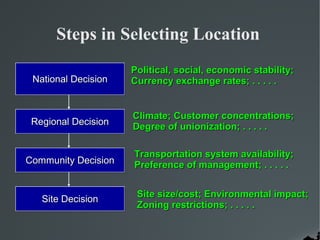
Steps in Selecting Location
                     Political, social, economic stability;
 National Decision   Currency exchange rates; . . . . .


                     Climate; Customer concentrations;
 Regional Decision
                     Degree of unionization; . . . . .

                     Transportation system availability;
Community Decision   Preference of management; . . . . .


                      Site size/cost; Environmental impact;
   Site Decision
                      Zoning restrictions; . . . . .
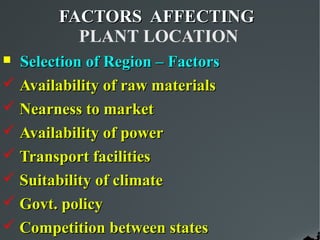
FACTORS AFFECTING
         PLANT LOCATION
 Selection of Region – Factors
 Availability of raw materials
 Nearness to market
 Availability of power
 Transport facilities
 Suitability of climate
 Govt. policy
 Competition between states
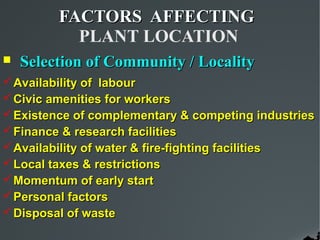
FACTORS AFFECTING
           PLANT LOCATION
   Selection of Community / Locality
 Availability of labour
 Civic amenities for workers
 Existence of complementary & competing industries
 Finance & research facilities
 Availability of water & fire-fighting facilities
 Local taxes & restrictions
 Momentum of early start
 Personal factors
 Disposal of waste
Analyzing Location Decisions
Quantitative Approaches- Break-even analysis


Qualitative Approaches-factor rating & point
 rating methods
Quantitative Approaches
            Break Even Analysis.
 The measures of evaluating & making competing sites
 are team appraisal system. Multidisciplinary teams
 comprises of operations manager, town planners,
 project managers, lawyers, marketing managers,
 financial experts, etc. they visit sites & carry out their
 assessment of factors chosen to form the basis of
 evaluation.
 All the competing sites are evaluated & their overall
 weighted average is arrived at
Quantitative Approaches
            Break Even Analysis.
It is easy to understand that decision in site selection is
  an economic one. The site that offers least cost of
  operations should be the one selected for
  implementation Total operation cost can be classified
  in two broad categories.
           - Fixed Costs
           - Variable Costs.
BEP are drawn for different locations to compare the
  sites. Fixed Costs, Variable Costs & Revenue / Output
  are taken into account to do so. Mathematically,
BE Volume:        FC / Contribution.
Subjective Approaches
Precedence: Assumption is that if a particular
 location was suitable to similar firms in the past,
 it would be a preferable site too. The decision is
 guided by the principal of precedence.
Preference: The decision is based on personal
 preferences. It is entirely dependent on owners
 whims & preferences. These are not based on
 cost or profits.
Dominant factor: Site selection can sometimes
 be reduced to an exercise based on a single but
 most dominant factor.
RECENT TRENDS IN THE
       LOCATION OF INDUSTRY
 Priority for sub-urban areas
 Industrial development in notified backward
 areas
 Establishment of Industrial estate
 Decentralization of industries
 Increased role of government in the decision of
 location of industries
 Competition between Government &
 Industries
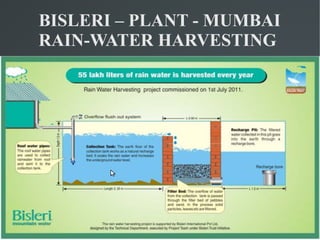
BISLERI – PLANT - MUMBAI
RAIN-WATER HARVESTING
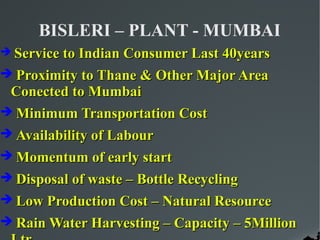
BISLERI – PLANT - MUMBAI
 Service to Indian Consumer Last 40years

 Proximity to Thane & Other Major Area
 Conected to Mumbai
 Minimum Transportation Cost
 Availability of Labour
 Momentum of early start
 Disposal of waste – Bottle Recycling
 Low Production Cost – Natural Resource
 Rain Water Harvesting – Capacity – 5Million
REFERENCE
 Bisleri.com/
 Livemint.com
 Wikipedia.org
 Wall Street Journal
 Hindustan Times
 Authorstream.com
Plant Location Decission

Plant Location Decission

  • 1.
  • 2.
    ITM Malad SMBA-18 Group No. 04 - Members  ANKITA BHALERAO  FAIZA DARBAR  SHRADDHA KADAM  JAY SANGHRAJKA  PRIYANKA BHAYANI  HIREN SAGAR  SUJIT SURENDRAN
  • 3.
    PLANT LOCATION Meaning-the establishmentof an industry at a particular place. It types-  Localization /centralization- means concentration of similar type of industries at some particular place. E.g. textile in Mumbai.  Delocalization /Decentralization- means spreading of similar type of industries at different places. E.g. banking industries.
  • 4.
    PLANT LOCATION  Site selection is an important activity as it decides the fate of the business.  A good location will reduce the cost of production &distribution to a large extent. The reduction of cost of distribution helps in elevating either the competitive strength or the profit margin of business.  Locating of business involves large & relatively permanent investment.
  • 5.
    PLANT LOCATION  If the site selection is not done properly, all the money spent on factory building, machinery & their installation will go in waste & the owner has to suffer great loss.  Therefore the site for factory should be selected very carefully. While selecting a site it is necessary to consider technical, commercial, & financial aspects & then select a site that may provide maximum profit.
  • 6.
    Steps in SelectingLocation Political, social, economic stability; National Decision Currency exchange rates; . . . . . Climate; Customer concentrations; Regional Decision Degree of unionization; . . . . . Transportation system availability; Community Decision Preference of management; . . . . . Site size/cost; Environmental impact; Site Decision Zoning restrictions; . . . . .
  • 7.
    FACTORS AFFECTING PLANT LOCATION  Selection of Region – Factors  Availability of raw materials  Nearness to market  Availability of power  Transport facilities  Suitability of climate  Govt. policy  Competition between states
  • 8.
    FACTORS AFFECTING PLANT LOCATION  Selection of Community / Locality  Availability of labour  Civic amenities for workers  Existence of complementary & competing industries  Finance & research facilities  Availability of water & fire-fighting facilities  Local taxes & restrictions  Momentum of early start  Personal factors  Disposal of waste
  • 9.
    Analyzing Location Decisions QuantitativeApproaches- Break-even analysis Qualitative Approaches-factor rating & point rating methods
  • 10.
    Quantitative Approaches Break Even Analysis.  The measures of evaluating & making competing sites are team appraisal system. Multidisciplinary teams comprises of operations manager, town planners, project managers, lawyers, marketing managers, financial experts, etc. they visit sites & carry out their assessment of factors chosen to form the basis of evaluation.  All the competing sites are evaluated & their overall weighted average is arrived at
  • 11.
    Quantitative Approaches Break Even Analysis. It is easy to understand that decision in site selection is an economic one. The site that offers least cost of operations should be the one selected for implementation Total operation cost can be classified in two broad categories. - Fixed Costs - Variable Costs. BEP are drawn for different locations to compare the sites. Fixed Costs, Variable Costs & Revenue / Output are taken into account to do so. Mathematically, BE Volume: FC / Contribution.
  • 12.
    Subjective Approaches Precedence: Assumptionis that if a particular location was suitable to similar firms in the past, it would be a preferable site too. The decision is guided by the principal of precedence. Preference: The decision is based on personal preferences. It is entirely dependent on owners whims & preferences. These are not based on cost or profits. Dominant factor: Site selection can sometimes be reduced to an exercise based on a single but most dominant factor.
  • 13.
    RECENT TRENDS INTHE LOCATION OF INDUSTRY  Priority for sub-urban areas  Industrial development in notified backward areas  Establishment of Industrial estate  Decentralization of industries  Increased role of government in the decision of location of industries  Competition between Government & Industries
  • 15.
    BISLERI – PLANT- MUMBAI RAIN-WATER HARVESTING
  • 16.
    BISLERI – PLANT- MUMBAI  Service to Indian Consumer Last 40years  Proximity to Thane & Other Major Area Conected to Mumbai  Minimum Transportation Cost  Availability of Labour  Momentum of early start  Disposal of waste – Bottle Recycling  Low Production Cost – Natural Resource  Rain Water Harvesting – Capacity – 5Million
  • 18.
    REFERENCE  Bisleri.com/  Livemint.com Wikipedia.org  Wall Street Journal  Hindustan Times  Authorstream.com