CORNEAL DYSTROPHIES
1. Anterior
• Cogan microcystic
• Reis-Bucklers
• Meesmann
• Schnyder
2. Stromal
• Lattice I, II, III
• Granular I, II, III (Avellino)
• Macular
3. Posterior
• Fuchs endothelial
• Posterior polymorphous
..
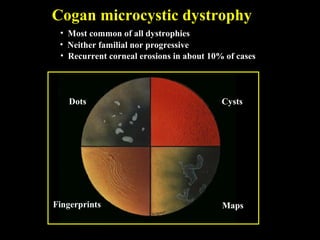
Cogan microcystic dystrophy
• Most common of all dystrophies
• Neither familial nor progressive
• Recurrent corneal erosions in about 10% of cases
Dots
Fingerprints
Cysts
Maps
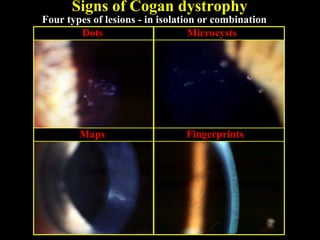
Four types of lesions - in isolation or combination
MicrocystsDots
Maps Fingerprints
Signs of Cogan dystrophy
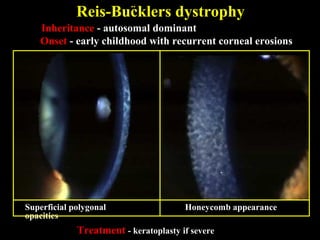
Inheritance - autosomal dominant
Onset - early childhood with recurrent corneal erosions
Superficial polygonal
opacities
Honeycomb appearance
Treatment - keratoplasty if severe
Reis-Bucklers dystrophy
..
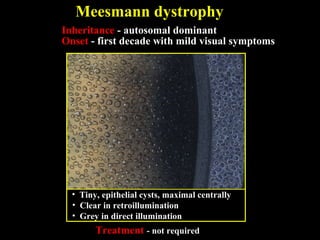
Meesmann dystrophy
Inheritance - autosomal dominant
Onset - first decade with mild visual symptoms
Treatment - not required
• Clear in retroillumination
• Grey in direct illumination
• Tiny, epithelial cysts, maximal centrally
Inheritance - autosomal dominant
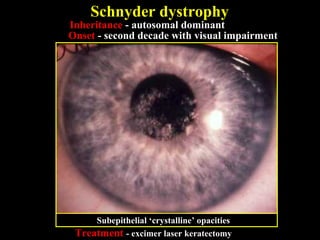
Onset - second decade with visual impairment
Treatment - excimer laser keratectomy
Schnyder dystrophy
Subepithelial ‘crystalline’ opacities
Inheritance - autosomal dominant
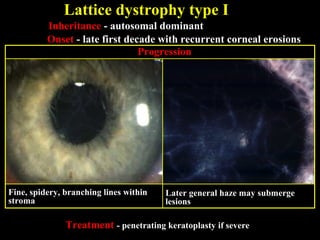
Onset - late first decade with recurrent corneal erosions
Treatment - penetrating keratoplasty if severe
Lattice dystrophy type I
Fine, spidery, branching lines within
stroma
Later general haze may submerge
lesions
Progression
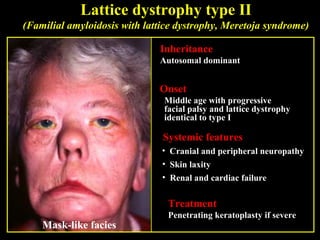
Inheritance
Autosomal dominant
Onset
Middle age with progressive
facial palsy and lattice dystrophy
identical to type I
Systemic features
• Cranial and peripheral neuropathy
• Skin laxity
• Renal and cardiac failure
Treatment
Penetrating keratoplasty if severe
Lattice dystrophy type II
(Familial amyloidosis with lattice dystrophy, Meretoja syndrome)
Mask-like facies
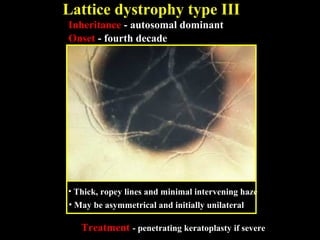
Inheritance - autosomal dominant
Onset - fourth decade
• Thick, ropey lines and minimal intervening haze
• May be asymmetrical and initially unilateral
Treatment - penetrating keratoplasty if severe
Lattice dystrophy type III
Inheritance - autosomal dominant
Onset - first decade with recurrent corneal erosions
Treatment - penetrating keratoplasty if severe
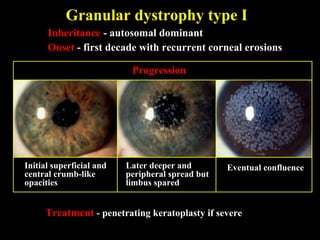
Granular dystrophy type I
Eventual confluenceInitial superficial and
central crumb-like
opacities
Later deeper and
peripheral spread but
limbus spared
Progression
Inheritance - autosomal dominant
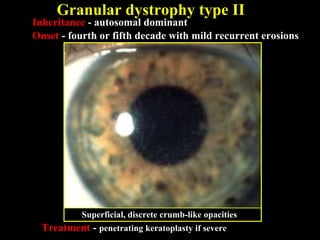
Onset - fourth or fifth decade with mild recurrent erosions
Superficial, discrete crumb-like opacities
Treatment - penetrating keratoplasty if severe
Granular dystrophy type II
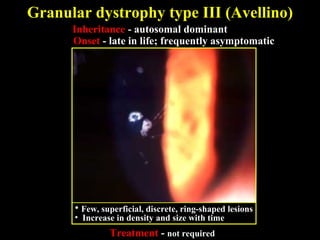
Inheritance - autosomal dominant
Onset - late in life; frequently asymptomatic
• Few, superficial, discrete, ring-shaped lesions
• Increase in density and size with time
Treatment - not required
Granular dystrophy type III (Avellino)
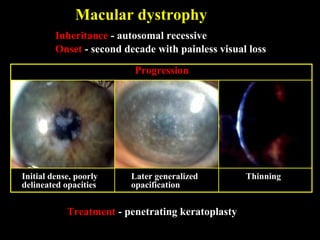
Inheritance - autosomal recessive
Onset - second decade with painless visual loss
Macular dystrophy
Treatment - penetrating keratoplasty
Initial dense, poorly
delineated opacities
Later generalized
opacification
Thinning
Progression
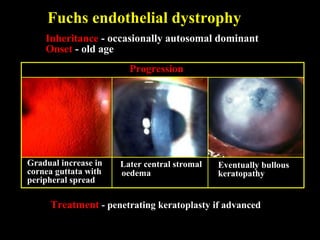
Inheritance - occasionally autosomal dominant
Onset - old age
Treatment - penetrating keratoplasty if advanced
Fuchs endothelial dystrophy
Eventually bullous
keratopathy
Later central stromal
oedema
Gradual increase in
cornea guttata with
peripheral spread
Progression
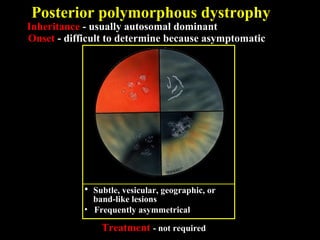
Inheritance - usually autosomal dominant
Onset - difficult to determine because asymptomatic
• Subtle, vesicular, geographic, or
band-like lesions
• Frequently asymmetrical
Treatment - not required
Posterior polymorphous dystrophy

17 corneal dystrophies

  • 1.
    CORNEAL DYSTROPHIES 1. Anterior •Cogan microcystic • Reis-Bucklers • Meesmann • Schnyder 2. Stromal • Lattice I, II, III • Granular I, II, III (Avellino) • Macular 3. Posterior • Fuchs endothelial • Posterior polymorphous ..
  • 2.
    Cogan microcystic dystrophy •Most common of all dystrophies • Neither familial nor progressive • Recurrent corneal erosions in about 10% of cases Dots Fingerprints Cysts Maps
  • 3.
    Four types oflesions - in isolation or combination MicrocystsDots Maps Fingerprints Signs of Cogan dystrophy
  • 4.
    Inheritance - autosomaldominant Onset - early childhood with recurrent corneal erosions Superficial polygonal opacities Honeycomb appearance Treatment - keratoplasty if severe Reis-Bucklers dystrophy ..
  • 5.
    Meesmann dystrophy Inheritance -autosomal dominant Onset - first decade with mild visual symptoms Treatment - not required • Clear in retroillumination • Grey in direct illumination • Tiny, epithelial cysts, maximal centrally
  • 6.
    Inheritance - autosomaldominant Onset - second decade with visual impairment Treatment - excimer laser keratectomy Schnyder dystrophy Subepithelial ‘crystalline’ opacities
  • 7.
    Inheritance - autosomaldominant Onset - late first decade with recurrent corneal erosions Treatment - penetrating keratoplasty if severe Lattice dystrophy type I Fine, spidery, branching lines within stroma Later general haze may submerge lesions Progression
  • 8.
    Inheritance Autosomal dominant Onset Middle agewith progressive facial palsy and lattice dystrophy identical to type I Systemic features • Cranial and peripheral neuropathy • Skin laxity • Renal and cardiac failure Treatment Penetrating keratoplasty if severe Lattice dystrophy type II (Familial amyloidosis with lattice dystrophy, Meretoja syndrome) Mask-like facies
  • 9.
    Inheritance - autosomaldominant Onset - fourth decade • Thick, ropey lines and minimal intervening haze • May be asymmetrical and initially unilateral Treatment - penetrating keratoplasty if severe Lattice dystrophy type III
  • 10.
    Inheritance - autosomaldominant Onset - first decade with recurrent corneal erosions Treatment - penetrating keratoplasty if severe Granular dystrophy type I Eventual confluenceInitial superficial and central crumb-like opacities Later deeper and peripheral spread but limbus spared Progression
  • 11.
    Inheritance - autosomaldominant Onset - fourth or fifth decade with mild recurrent erosions Superficial, discrete crumb-like opacities Treatment - penetrating keratoplasty if severe Granular dystrophy type II
  • 12.
    Inheritance - autosomaldominant Onset - late in life; frequently asymptomatic • Few, superficial, discrete, ring-shaped lesions • Increase in density and size with time Treatment - not required Granular dystrophy type III (Avellino)
  • 13.
    Inheritance - autosomalrecessive Onset - second decade with painless visual loss Macular dystrophy Treatment - penetrating keratoplasty Initial dense, poorly delineated opacities Later generalized opacification Thinning Progression
  • 14.
    Inheritance - occasionallyautosomal dominant Onset - old age Treatment - penetrating keratoplasty if advanced Fuchs endothelial dystrophy Eventually bullous keratopathy Later central stromal oedema Gradual increase in cornea guttata with peripheral spread Progression
  • 15.
    Inheritance - usuallyautosomal dominant Onset - difficult to determine because asymptomatic • Subtle, vesicular, geographic, or band-like lesions • Frequently asymmetrical Treatment - not required Posterior polymorphous dystrophy