CORNEAL
DYSTROPHY
DR ANJU
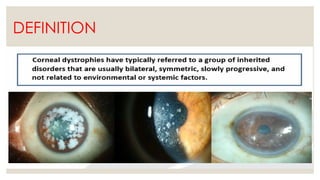
DEFINITION
• 1890, Corneal dystrophy was first introduced by
Groenouw and then Biber.
• Dystrophy comes from the Greek word “ wrong
nourishment”
• The IC3D Classification was initially anatomically based
• Level of involvement of the corneal layers was
considered.
• It considered clinical, pathological and genetic features
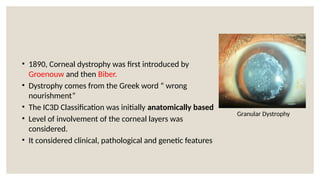
Granular Dystrophy
International Committee for Classification of Corneal
Dystrophies (2008)
◦ Historically, corneal dystrophies
were classified on their
phenotypic appearance.
◦ The IC3D Classification was
anatomically based
◦ Level of involvement of the
corneal layers was considered.
◦ Dystrophies were solely
assigned to single layer most
affected.
◦ It considered clinical,
pathological and genetic
features
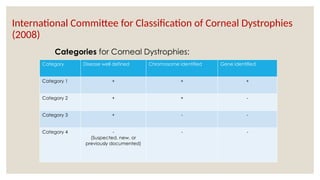
Category Disease well defined Chromosome identified Gene identified
Category 1 + + +
Category 2 + + -
Category 3 + - -
Category 4 -
(Suspected, new, or
previously documented)
- -
Categories for Corneal Dystrophies:
International Committee for Classification of Corneal Dystrophies
(2008)
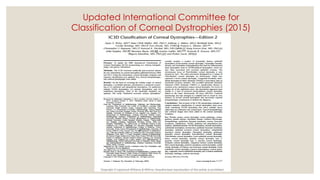
Updated International Committee for
Classification of Corneal Dystrophies (2015)
Revised IC3D- 2015
Need for Revision
◦ Dystrophies were classified based upon the layer most affected.
◦ To have a more accurate anatomical classification considering cellular origin
◦ Need to add histopathological and Confocal picture for better understanding
◦ Better classification of TGFβ1 dystrophies
Revised IC3D- 2015
Changes Made - Removed
◦ Information on genetic mutation
removed – as it is rapidly changing
◦ Removed CHED Autosomal
Dominant inheritance
◦ 10q23-24 dystrophy not considered
as a variant of TBCD
◦ Removed Grayson-Willebrandt
Dystrophy
Changes Made - Added
◦ Included histopathological,
electron microscopy and confocal
microscopy
◦ Added Anterior segment-OCT
where available
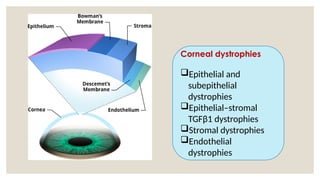
Corneal dystrophies
Epithelial and
subepithelial
dystrophies
Epithelial–stromal
TGFβ1 dystrophies
Stromal dystrophies
Endothelial
dystrophies
Revised IC3D- 2015
Classification system
◦ Epithelial and Sub-epithelial dystrophies
1. Epithelial basement membrane dystrophy (EBMD)
majority degenerative, rarely C1
2. Epithelial recurrent erosion dystrophies (EREDs)—
Franceschetti corneal dystrophy (FRCD) C3,
Dystrophia Smolandiensis (DS) C3, and Dystrophia
Helsinglandica (DH) C3
3. Subepithelial mucinous corneal dystrophy (SMCD)
C4
4. Meesmann corneal dystrophy (MECD) C1
5. Lisch epithelial corneal dystrophy (LECD) C2
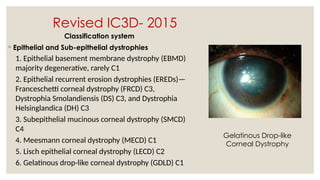
6. Gelatinous drop-like corneal dystrophy (GDLD) C1
Gelatinous Drop-like
Corneal Dystrophy
Revised IC3D- 2015
Classification system
◦ Epithelial–stromal TGFBI dystrophies
◦ Reis–Bücklers corneal dystrophy
(RBCD) C1
◦ Thiel-Behnke corneal dystrophy (TBCD)
C1
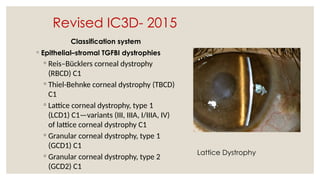
◦ Lattice corneal dystrophy, type 1
(LCD1) C1—variants (III, IIIA, I/IIIA, IV)
of lattice corneal dystrophy C1
◦ Granular corneal dystrophy, type 1
(GCD1) C1
◦ Granular corneal dystrophy, type 2
(GCD2) C1
Lattice Dystrophy
Revised IC3D- 2015
Classification system
◦ Stromal dystrophies
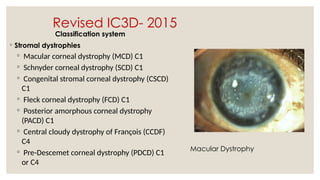
◦ Macular corneal dystrophy (MCD) C1
◦ Schnyder corneal dystrophy (SCD) C1
◦ Congenital stromal corneal dystrophy (CSCD)
C1
◦ Fleck corneal dystrophy (FCD) C1
◦ Posterior amorphous corneal dystrophy
(PACD) C1
◦ Central cloudy dystrophy of François (CCDF)
C4
◦ Pre-Descemet corneal dystrophy (PDCD) C1
or C4
Macular Dystrophy
Revised IC3D- 2015
Classification system
◦ Endothelial dystrophies
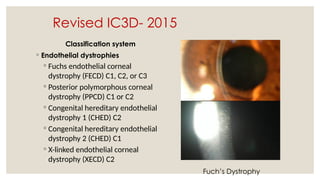
◦ Fuchs endothelial corneal
dystrophy (FECD) C1, C2, or C3
◦ Posterior polymorphous corneal
dystrophy (PPCD) C1 or C2
◦ Congenital hereditary endothelial
dystrophy 1 (CHED) C2
◦ Congenital hereditary endothelial
dystrophy 2 (CHED) C1
◦ X-linked endothelial corneal
dystrophy (XECD) C2
Fuch’s Dystrophy
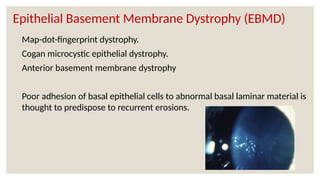
Epithelial Basement Membrane Dystrophy (EBMD)
Map-dot-fingerprint dystrophy.
Cogan microcystic epithelial dystrophy.
Anterior basement membrane dystrophy
Poor adhesion of basal epithelial cells to abnormal basal laminar material is
thought to predispose to recurrent erosions.
◦ Epithelial basement membrane dystrophy (EBMD) is a disease that affects the
anterior cornea, result in decreased vision and/or recurrent corneal erosions.
◦ INHERITANCE – UNCERTAIN
◦ GENETIC LOCUS – 5q31
◦ GENE – TGFBI
◦ Risk Factors
◦ Known family history and age are probably the most important risk factors.
◦ Others include trauma such as corneal abrasion, LASIK, or other intraocular
surgery.
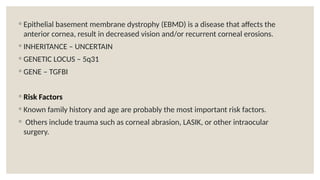
◦ Symptoms – Asymptomatic, pain, lacrimation, blurred vision
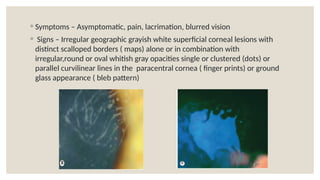
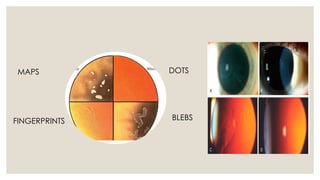
◦ Signs – Irregular geographic grayish white superficial corneal lesions with
distinct scalloped borders ( maps) alone or in combination with
irregular,round or oval whitish gray opacities single or clustered (dots) or
parallel curvilinear lines in the paracentral cornea ( finger prints) or ground
glass appearance ( bleb pattern)
MAPS DOTS
FINGERPRINTS BLEBS
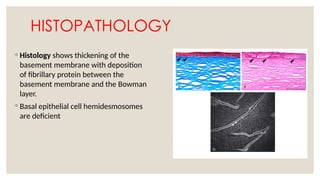
HISTOPATHOLOGY
◦ Histology shows thickening of the
basement membrane with deposition
of fibrillary protein between the
basement membrane and the Bowman
layer.
◦ Basal epithelial cell hemidesmosomes
are deficient
treatment
◦ First line treatment options usually involve the use of night time lubricating
ointments or hypertonic saline ointments.
◦ Symptomatic erosions may be treated with bandage contact lenses, antibiotic
ointments, or patching.
◦ Various procedures in case of recurrent corneal erosions include such as
anterior stromal puncture (outside the visual axis), YAG laser micropuncture,
cautery, epithelial debridement and/or diamond burr polishing,
phototherapeutic keratectomy (PTK), and extended bandage contact lens wear
Meesmann corneal dystrophy
◦ Inheritance autosomal dominant
◦ Genetic locus
12 q13 (KRT3) , 17q12 (KRT12) Stocker–Holt
variant
◦ Gene keratin K3 and keratin K12
◦ Onset early childhood stationary or
slowly progressive
◦ Symptoms : asymptomatic
mild blurring of vision
glare , photophobia
foreign body sensation
Signs include multiple tiny
intraepithelial vesicles
extend to the limbus and
are more numerous in the
interpalpebral area with
clear surrounding
epithelium. whorled
wedged shaped opacities ,
cyst like lesions or
refractile linear opacities.
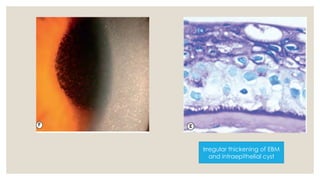
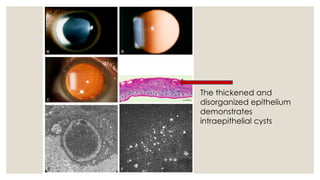
Irregular thickening of EBM
and intraepithelial cyst
The thickened and
disorganized epithelium
demonstrates
intraepithelial cysts
TREATMENT
◦ No treatment for asymptomatic patients
◦ Preservative free lubricating eye drops
◦ For acute corneal erosions – broad spectrum topical antibiotics , lubricating
eyedrops, hypertonic saline solution eyedrops (5%) during day and ointment
(6%) at night, BCL
◦ For recurrent corneal erosions– epithelial debridement of the involved area
with topical broad spectrum antibiotics and lubricating eyedrops, excimer
laser PTK
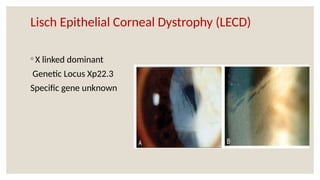
Lisch Epithelial Corneal Dystrophy (LECD)
◦ X linked dominant
Genetic Locus Xp22.3
Specific gene unknown
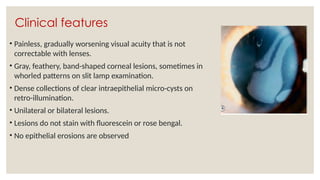
Clinical features
• Painless, gradually worsening visual acuity that is not
correctable with lenses.
• Gray, feathery, band-shaped corneal lesions, sometimes in
whorled patterns on slit lamp examination.
• Dense collections of clear intraepithelial micro-cysts on
retro-illumination.
• Unilateral or bilateral lesions.
• Lesions do not stain with fluorescein or rose bengal.
• No epithelial erosions are observed
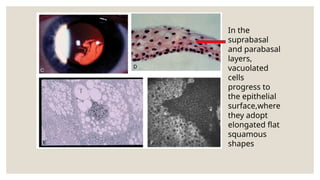
In the
suprabasal
and parabasal
layers,
vacuolated
cells
progress to
the epithelial
surface,where
they adopt
elongated flat
squamous
shapes
Gelatinous Drop-like Corneal Dystrophy (GDLD)
◦ Subepithelial amyloidosis.
◦ Primary familial amyloidosis (Grayson).
◦ Autosomal recessive inheritance
Genetic Locus 1p32.
Gene-- Tumor-associated calcium signal transducer 2 (TACSTD2,previously
M1S1).
Onset 1st
- 2nd
decade
progressive
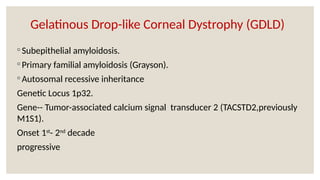
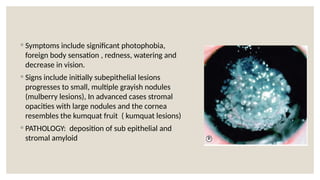
◦ Symptoms include significant photophobia,
foreign body sensation , redness, watering and
decrease in vision.
◦ Signs include initially subepithelial lesions
progresses to small, multiple grayish nodules
(mulberry lesions), In advanced cases stromal
opacities with large nodules and the cornea
resembles the kumquat fruit ( kumquat lesions)
◦ PATHOLOGY: deposition of sub epithelial and
stromal amyloid
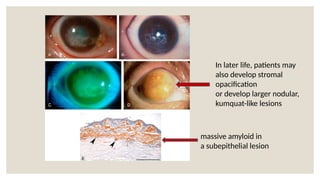
In later life, patients may
also develop stromal
opacification
or develop larger nodular,
kumquat-like lesions
massive amyloid in
a subepithelial lesion
Management
◦ Preservative free lubricating eyedrops
◦ If nodules are large, superficial keratectomy with or without AMG or EXCIMER
laser PTK
◦ In advanced cases keratoplasty– DALK or PK
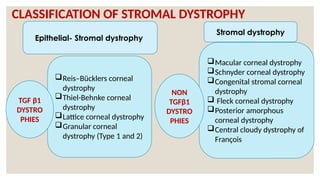
CLASSIFICATION OF STROMAL DYSTROPHY
Reis–Bücklers corneal
dystrophy
Thiel-Behnke corneal
dystrophy
Lattice corneal dystrophy
Granular corneal
dystrophy (Type 1 and 2)
Macular corneal dystrophy
Schnyder corneal dystrophy
Congenital stromal corneal
dystrophy
 Fleck corneal dystrophy
Posterior amorphous
corneal dystrophy
Central cloudy dystrophy of
François
TGF β1
DYSTRO
PHIES
NON
TGFβ1
DYSTRO
PHIES
Epithelial- Stromal dystrophy
Stromal dystrophy
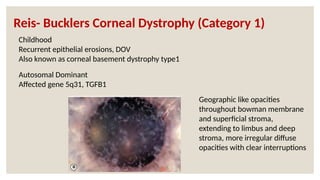
Autosomal Dominant
Affected gene 5q31, TGFB1
Childhood
Recurrent epithelial erosions, DOV
Also known as corneal basement dystrophy type1
Geographic like opacities
throughout bowman membrane
and superficial stroma,
extending to limbus and deep
stroma, more irregular diffuse
opacities with clear interruptions
Reis- Bucklers Corneal Dystrophy (Category 1)
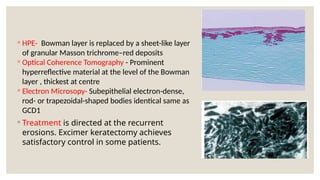
◦ HPE- Bowman layer is replaced by a sheet-like layer
of granular Masson trichrome–red deposits
◦ Optical Coherence Tomography - Prominent
hyperreflective material at the level of the Bowman
layer , thickest at centre
◦ Electron Microsopy- Subepithelial electron-dense,
rod- or trapezoidal-shaped bodies identical same as
GCD1
◦ Treatment is directed at the recurrent
erosions. Excimer keratectomy achieves
satisfactory control in some patients.
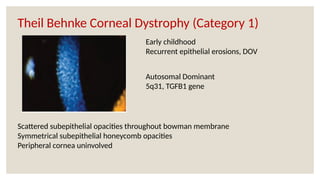
Autosomal Dominant
5q31, TGFB1 gene
Early childhood
Recurrent epithelial erosions, DOV
Scattered subepithelial opacities throughout bowman membrane
Symmetrical subepithelial honeycomb opacities
Peripheral cornea uninvolved
Theil Behnke Corneal Dystrophy (Category 1)
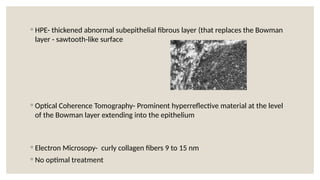
◦ HPE- thickened abnormal subepithelial fibrous layer (that replaces the Bowman
layer - sawtooth-like surface
◦ Optical Coherence Tomography- Prominent hyperreflective material at the level
of the Bowman layer extending into the epithelium
◦ Electron Microsopy- curly collagen fibers 9 to 15 nm
◦ No optimal treatment
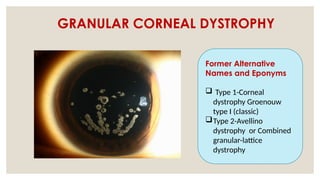
GRANULAR CORNEAL DYSTROPHY
Former Alternative
Names and Eponyms
 Type 1-Corneal
dystrophy Groenouw
type I (classic)
Type 2-Avellino
dystrophy or Combined
granular-lattice
dystrophy
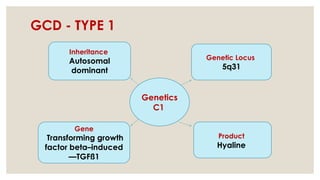
GCD - TYPE 1
*IC3D Classification of Co
Genetics
C1
Inheritance
Autosomal
dominant
Genetic Locus
5q31
Gene
Transforming growth
factor beta–induced
—TGFß1
Product
Hyaline
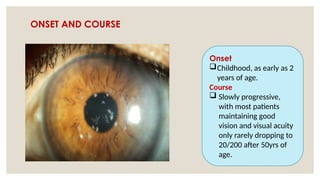
ONSET AND COURSE
Onset
Childhood, as early as 2
years of age.
Course
 Slowly progressive,
with most patients
maintaining good
vision and visual acuity
only rarely dropping to
20/200 after 50yrs of
age.
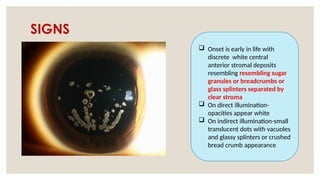
SIGNS
 Onset is early in life with
discrete white central
anterior stromal deposits
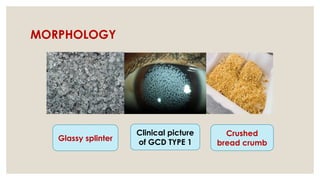
resembling resembling sugar
granules or breadcrumbs or
glass splinters separated by
clear stroma
 On direct illumination-
opacities appear white
 On indirect illumination-small
translucent dots with vacuoles
and glassy splinters or crushed
bread crumb appearance
MORPHOLOGY
Glassy splinter
Clinical picture
of GCD TYPE 1
Crushed
bread crumb
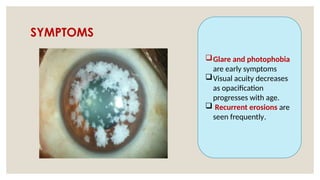
SYMPTOMS
Glare and photophobia
are early symptoms
Visual acuity decreases
as opacification
progresses with age.
 Recurrent erosions are
seen frequently.
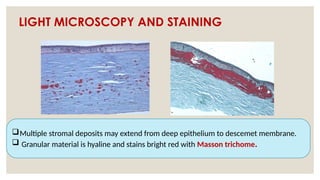
LIGHT MICROSCOPY AND STAINING
Multiple stromal deposits may extend from deep epithelium to descemet membrane.
 Granular material is hyaline and stains bright red with Masson trichome.
Treatment
◦ Medical treatment include artificial lubricants, Bandage soft contact lenses with
antibiotic drops and ointments
◦ Surgical management include excimer laser phototherapeutic keratectomy
(remove superficial opacities) and others include penetrating or deep lamellar
keratoplasty
GRANULAR CORNEAL DYSTROPHY TYPE 2
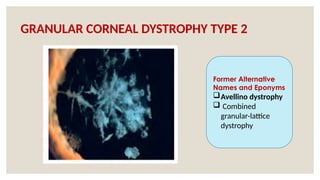
Former Alternative
Names and Eponyms
Avellino dystrophy
 Combined
granular-lattice
dystrophy
GRANULAR CORNEAL DYSTROPHY TYPE 2
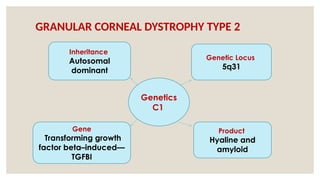
Genetics
C1
Inheritance
Autosomal
dominant
Genetic Locus
5q31
Gene
Transforming growth
factor beta–induced—
TGFBI
Product
Hyaline and
amyloid
ONSET AND COURSE
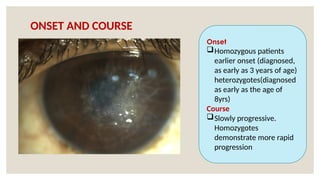
Onset
Homozygous patients
earlier onset (diagnosed,
as early as 3 years of age)
heterozygotes(diagnosed
as early as the age of
8yrs)
Course
Slowly progressive.
Homozygotes
demonstrate more rapid
progression
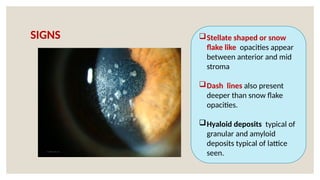
SIGNS Stellate shaped or snow
flake like opacities appear
between anterior and mid
stroma
Dash lines also present
deeper than snow flake
opacities.
Hyaloid deposits typical of
granular and amyloid
deposits typical of lattice
seen.
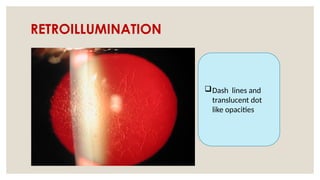
RETROILLUMINATION
Dash lines and
translucent dot
like opacities
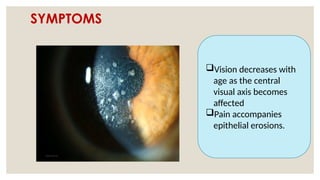
SYMPTOMS
Vision decreases with
age as the central
visual axis becomes
affected
Pain accompanies
epithelial erosions.
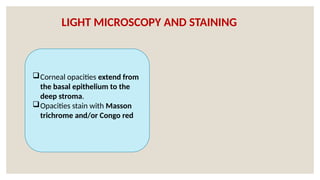
LIGHT MICROSCOPY AND STAINING
Corneal opacities extend from
the basal epithelium to the
deep stroma.
Opacities stain with Masson
trichrome and/or Congo red
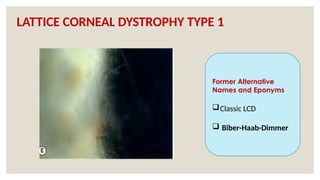
LATTICE CORNEAL DYSTROPHY TYPE 1
Former Alternative
Names and Eponyms
Classic LCD
 Biber-Haab-Dimmer
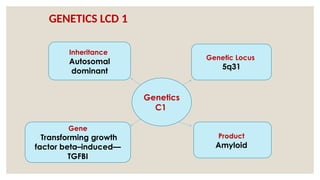
GENETICS LCD 1
Genetics
C1
Inheritance
Autosomal
dominant
Genetic Locus
5q31
Gene
Transforming growth
factor beta–induced—
TGFBI
Product
Amyloid
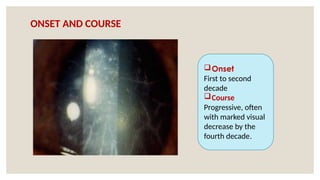
ONSET AND COURSE
Onset
First to second
decade
Course
Progressive, often
with marked visual
decrease by the
fourth decade.
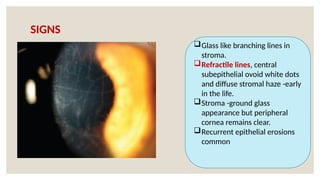
SIGNS
Glass like branching lines in
stroma.
Refractile lines, central
subepithelial ovoid white dots
and diffuse stromal haze -early
in the life.
Stroma -ground glass
appearance but peripheral
cornea remains clear.
Recurrent epithelial erosions
common
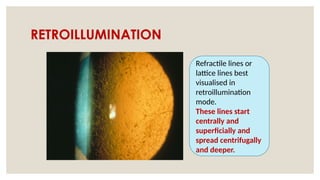
RETROILLUMINATION
Refractile lines or
lattice lines best
visualised in
retroillumination
mode.
These lines start
centrally and
superficially and
spread centrifugally
and deeper.
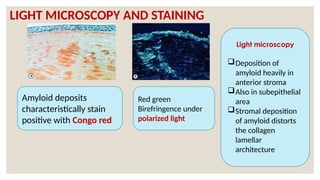
LIGHT MICROSCOPY AND STAINING
Amyloid deposits
characteristically stain
positive with Congo red.
Red green
Birefringence under
polarized light
Light microscopy
Deposition of
amyloid heavily in
anterior stroma
Also in subepithelial
area
Stromal deposition
of amyloid distorts
the collagen
lamellar
architecture
LATTICE CORNEAL DYSTROPHY TYPE 2
Alternative names
Gelsolin type
Or
Finnish Familial amyloidosis
Or
Meretoja syndrome
Or
Amyloidosis (type V)
Or
Familial amyloidotic polyneuropathy type
IV
Inheritence- Autosomal dominant
Gene locus- 9q3
Gene – Gelsolin/GSN
Due to systemic involvement, not
a true dystrophy
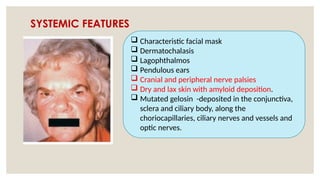
SYSTEMIC FEATURES
 Characteristic facial mask
 Dermatochalasis
 Lagophthalmos
 Pendulous ears
 Cranial and peripheral nerve palsies
 Dry and lax skin with amyloid deposition.
 Mutated gelosin -deposited in the conjunctiva,
sclera and ciliary body, along the
choriocapillaries, ciliary nerves and vessels and
optic nerves.
Treatment for LCD
◦ Antibiotics and BCL can treat the epithelial erosions in LCD 1 and 2
◦ Dry eye syndromes in LCD 2 can treat with topical lubricants,hydrophilic
contact lens and lacrimal duct plugs
◦ Surgical options like keratoplasty in later life
◦ Penetraing keratoplasty and DALK are the options
◦ PTK useful in epithelial erosions,opacifications and in recurrence of changes
after KP
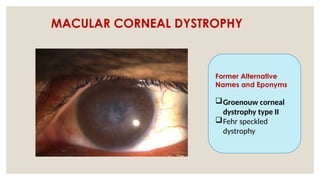
MACULAR CORNEAL DYSTROPHY
Former Alternative
Names and Eponyms
Groenouw corneal
dystrophy type II
Fehr speckled
dystrophy
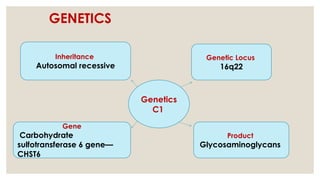
GENETICS
Genetics
C1
Inheritance
Autosomal recessive
Genetic Locus
16q22
Gene
Carbohydrate
sulfotransferase 6 gene—
CHST6
Product
Glycosaminoglycans
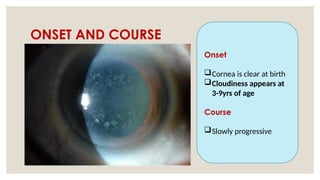
ONSET AND COURSE
Onset
Cornea is clear at birth
Cloudiness appears at
3-9yrs of age
Course
Slowly progressive
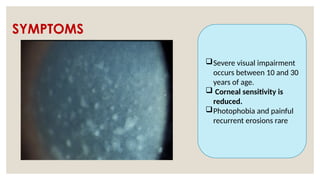
SYMPTOMS
Severe visual impairment
occurs between 10 and 30
years of age.
 Corneal sensitivity is
reduced.
Photophobia and painful
recurrent erosions rare
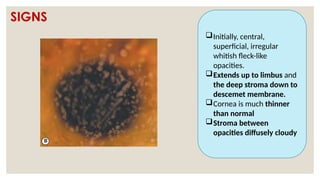
SIGNS
Initially, central,
superficial, irregular
whitish fleck-like
opacities.
Extends up to limbus and
the deep stroma down to
descemet membrane.
Cornea is much thinner
than normal
Stroma between
opacities diffusely cloudy
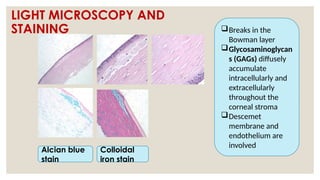
LIGHT MICROSCOPY AND
STAINING Breaks in the
Bowman layer
Glycosaminoglycan
s (GAGs) diffusely
accumulate
intracellularly and
extracellularly
throughout the
corneal stroma
Descemet
membrane and
endothelium are
involved
Alcian blue
stain
Colloidal
iron stain
Treatment
◦ Initial medical management include artificial tears, lubricants, NSAISDs for pain
◦ Corneal transplantation is the gold standard once MCD visually significant
◦ Penetrating KP is the most common surgical treatment
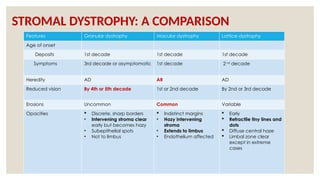
STROMAL DYSTROPHY: A COMPARISON
Features Granular dystrophy Macular dystrophy Lattice dystrophy
Age of onset
Deposits 1st decade 1st decade 1st decade
Symptoms 3rd decade or asymptomatic 1st decade 2 nd
decade
Heredity AD AR AD
Reduced vision By 4th or 5th decade 1st or 2nd decade By 2nd or 3rd decade
Erosions Uncommon Common Variable
Opacities  Discrete, sharp borders
• Intervening stroma clear
early but becomes hazy
• Subepithelial spots
• Not to limbus
 Indistinct margins
• Hazy intervening
stroma
• Extends to limbus
• Endothelium affected
 Early
 Refractile tiny lines and
dots
 Diffuse central haze
 Limbal zone clear
except in extreme
cases
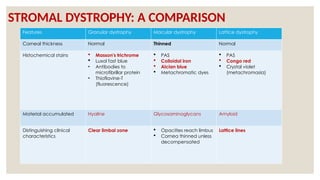
STROMAL DYSTROPHY: A COMPARISON
Features Granular dystrophy Macular dystrophy Lattice dystrophy
Corneal thickness Normal Thinned Normal
Histochemical stains  Masson's trichrome
 Luxol fast blue
• Antibodies to
microfibrillar protein
• Thioflavine-T
(fluorescence)
 PAS
 Colloidal iron
 Alcian blue
 Metachromatic dyes
 PAS
 Congo red
 Crystal violet
(metachromasia)
Material accumulated Hyaline Glycosaminoglycans Amyloid
Distinguishing clinical
characteristics
Clear limbal zone  Opacities reach limbus
 Cornea thinned unless
decompensated
Lattice lines
Corneal Stromal Dystrophies
(Non TGFBI)
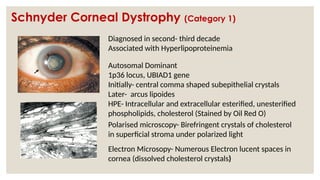
Diagnosed in second- third decade
Associated with Hyperlipoproteinemia
Autosomal Dominant
1p36 locus, UBIAD1 gene
Initially- central comma shaped subepithelial crystals
Later- arcus lipoides
HPE- Intracellular and extracellular esterified, unesterified
phospholipids, cholesterol (Stained by Oil Red O)
Schnyder Corneal Dystrophy (Category 1)
Polarised microscopy- Birefringent crystals of cholesterol
in superficial stroma under polarized light
Electron Microsopy- Numerous Electron lucent spaces in
cornea (dissolved cholesterol crystals)
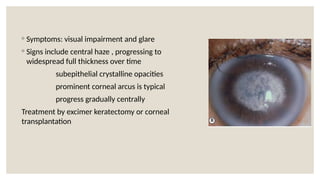
◦ Symptoms: visual impairment and glare
◦ Signs include central haze , progressing to
widespread full thickness over time
subepithelial crystalline opacities
prominent corneal arcus is typical
progress gradually centrally
Treatment by excimer keratectomy or corneal
transplantation
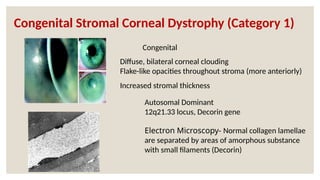
Autosomal Dominant
12q21.33 locus, Decorin gene
Congenital
Diffuse, bilateral corneal clouding
Flake-like opacities throughout stroma (more anteriorly)
Increased stromal thickness
Electron Microscopy- Normal collagen lamellae
are separated by areas of amorphous substance
with small filaments (Decorin)
Congenital Stromal Corneal Dystrophy (Category 1)
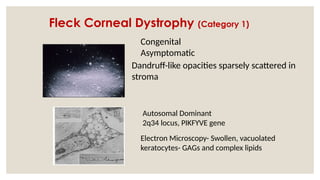
Autosomal Dominant
2q34 locus, PIKFYVE gene
Congenital
Asymptomatic
Dandruff-like opacities sparsely scattered in
stroma
Electron Microscopy- Swollen, vacuolated
keratocytes- GAGs and complex lipids
Fleck Corneal Dystrophy (Category 1)
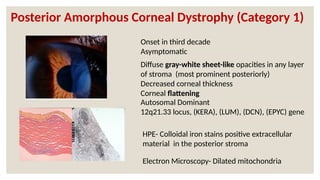
Autosomal Dominant
12q21.33 locus, (KERA), (LUM), (DCN), (EPYC) gene
Onset in third decade
Asymptomatic
Diffuse gray-white sheet-like opacities in any layer
of stroma (most prominent posteriorly)
Decreased corneal thickness
Corneal flattening
HPE- Colloidal iron stains positive extracellular
material in the posterior stroma
Posterior Amorphous Corneal Dystrophy (Category 1)
Electron Microscopy- Dilated mitochondria
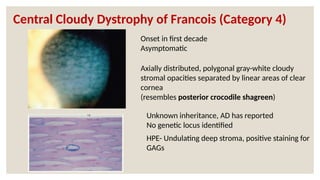
Central Cloudy Dystrophy of Francois (Category 4)
Unknown inheritance, AD has reported
No genetic locus identified
Onset in first decade
Asymptomatic
Axially distributed, polygonal gray-white cloudy
stromal opacities separated by linear areas of clear
cornea
(resembles posterior crocodile shagreen)
HPE- Undulating deep stroma, positive staining for
GAGs
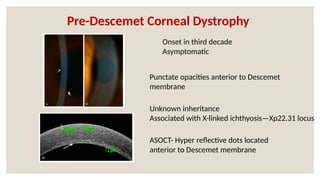
Unknown inheritance
Associated with X-linked ichthyosis—Xp22.31 locus
Onset in third decade
Asymptomatic
Punctate opacities anterior to Descemet
membrane
ASOCT- Hyper reflective dots located
anterior to Descemet membrane
Pre-Descemet Corneal Dystrophy
Endothelial
dystrophy
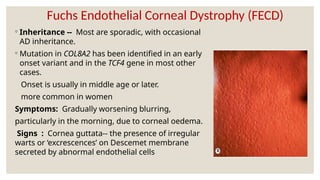
Fuchs Endothelial Corneal Dystrophy (FECD)
◦ Inheritance -- Most are sporadic, with occasional
AD inheritance.
◦ Mutation in COL8A2 has been identified in an early
onset variant and in the TCF4 gene in most other
cases.
Onset is usually in middle age or later.
more common in women
Symptoms: Gradually worsening blurring,
particularly in the morning, due to corneal oedema.
Signs : Cornea guttata-- the presence of irregular
warts or ‘excrescences’ on Descemet membrane
secreted by abnormal endothelial cells
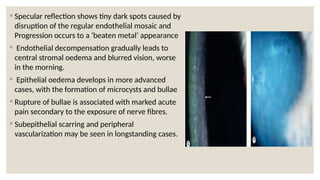
◦ Specular reflection shows tiny dark spots caused by
disruption of the regular endothelial mosaic and
Progression occurs to a ‘beaten metal’ appearance
◦ Endothelial decompensation gradually leads to
central stromal oedema and blurred vision, worse
in the morning.
◦ Epithelial oedema develops in more advanced
cases, with the formation of microcysts and bullae
◦ Rupture of bullae is associated with marked acute
pain secondary to the exposure of nerve fibres.
◦ Subepithelial scarring and peripheral
vascularization may be seen in longstanding cases.
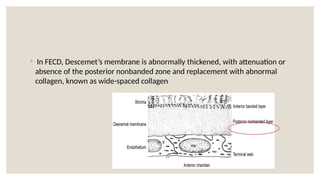
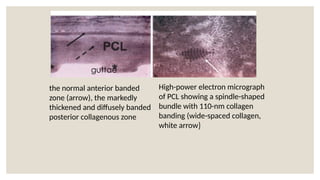
◦ In FECD, Descemet’s membrane is abnormally thickened, with attenuation or
absence of the posterior nonbanded zone and replacement with abnormal
collagen, known as wide-spaced collagen
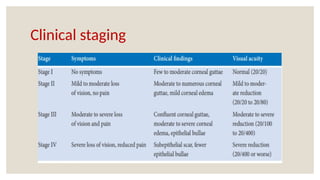
Clinical staging
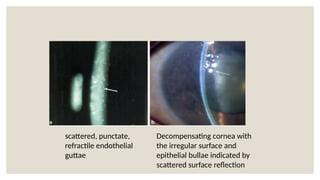
scattered, punctate,
refractile endothelial
guttae
Decompensating cornea with
the irregular surface and
epithelial bullae indicated by
scattered surface reflection
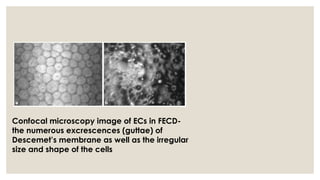
Confocal microscopy image of ECs in FECD-
the numerous excrescences (guttae) of
Descemet’s membrane as well as the irregular
size and shape of the cells
the normal anterior banded
zone (arrow), the markedly
thickened and diffusely banded
posterior collagenous zone
guttae
High-power electron micrograph
of PCL showing a spindle-shaped
bundle with 110-nm collagen
banding (wide-spaced collagen,
white arrow)
treatment
◦ Conservative options include topical sodium chloride 5% drops or ointment,
reduction of IOP and use of a hair dryer for corneal dehydration.
◦ In Ruptured bullae, the use of bandage contact lenses, cycloplegia, antibiotic
ointment and lubricants.
◦ Anterior stromal puncture may be helpful.
◦ Posterior lamellar ( DSAEK or DMEK) and penetrating keratoplasty
Options in eyes with poor visual potential include
◦ conjunctival flaps and amniotic membrane transplantation.
◦ topical Rho-kinase inhibitor to stimulate endothelial cell proliferation and improve
function
Posterior Polymorphous Corneal Dystrophy (PPCD)
◦ Autosomal dominant.
Genetic Locus
PPCD 1: 20p11.2-q11.2.
PPCD 2: 1p34.3-p32.3.
PPCD 3: 10p11.22.
Gene
PPCD1: unknown.
PPCD2: mutation in COL8A2.
PPCD 3: mutation of zinc finger E box–binding homeobox 1 (ZEB1).
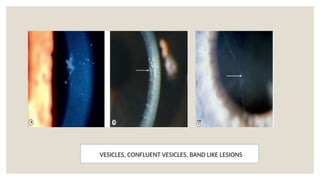
VESICLES, CONFLUENT VESICLES, BAND LIKE LESIONS
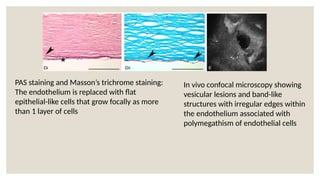
PAS staining and Masson’s trichrome staining:
The endothelium is replaced with flat
epithelial-like cells that grow focally as more
than 1 layer of cells
In vivo confocal microscopy showing
vesicular lesions and band-like
structures with irregular edges within
the endothelium associated with
polymegathism of endothelial cells
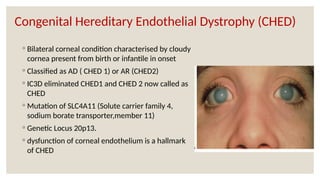
Congenital Hereditary Endothelial Dystrophy (CHED)
◦ Bilateral corneal condition characterised by cloudy
cornea present from birth or infantile in onset
◦ Classified as AD ( CHED 1) or AR (CHED2)
◦ IC3D eliminated CHED1 and CHED 2 now called as
CHED
◦ Mutation of SLC4A11 (Solute carrier family 4,
sodium borate transporter,member 11)
◦ Genetic Locus 20p13.
◦ dysfunction of corneal endothelium is a hallmark
of CHED
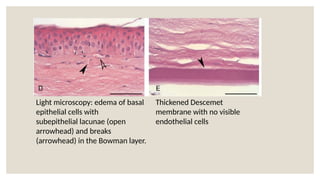
Light microscopy: edema of basal
epithelial cells with
subepithelial lacunae (open
arrowhead) and breaks
(arrowhead) in the Bowman layer.
Thickened Descemet
membrane with no visible
endothelial cells
Signs
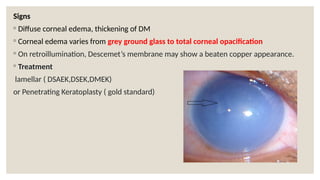
◦ Diffuse corneal edema, thickening of DM
◦ Corneal edema varies from grey ground glass to total corneal opacification
◦ On retroillumination, Descemet’s membrane may show a beaten copper appearance.
◦ Treatment
lamellar ( DSAEK,DSEK,DMEK)
or Penetrating Keratoplasty ( gold standard)
THANK YOU
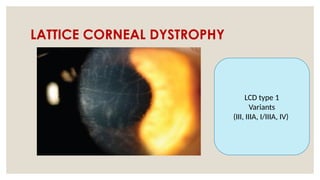
LATTICE CORNEAL DYSTROPHY
LCD type 1
Variants
(III, IIIA, I/IIIA, IV)
Epithelial Recurrent Erosion Dystrophies (EREDs)
◦ VARIANTS
◦ Franceschetti corneal dystrophy (FRCD).
◦ Dystrophia Smolandiensis (DS).
◦ Dystrophia Helsinglandica (DH).

Corneal dystrophy ANJU.power point presentation

  • 1.
  • 2.
  • 3.
    • 1890, Cornealdystrophy was first introduced by Groenouw and then Biber. • Dystrophy comes from the Greek word “ wrong nourishment” • The IC3D Classification was initially anatomically based • Level of involvement of the corneal layers was considered. • It considered clinical, pathological and genetic features Granular Dystrophy
  • 4.
    International Committee forClassification of Corneal Dystrophies (2008) ◦ Historically, corneal dystrophies were classified on their phenotypic appearance. ◦ The IC3D Classification was anatomically based ◦ Level of involvement of the corneal layers was considered. ◦ Dystrophies were solely assigned to single layer most affected. ◦ It considered clinical, pathological and genetic features
  • 5.
    Category Disease welldefined Chromosome identified Gene identified Category 1 + + + Category 2 + + - Category 3 + - - Category 4 - (Suspected, new, or previously documented) - - Categories for Corneal Dystrophies: International Committee for Classification of Corneal Dystrophies (2008)
  • 6.
    Updated International Committeefor Classification of Corneal Dystrophies (2015)
  • 7.
    Revised IC3D- 2015 Needfor Revision ◦ Dystrophies were classified based upon the layer most affected. ◦ To have a more accurate anatomical classification considering cellular origin ◦ Need to add histopathological and Confocal picture for better understanding ◦ Better classification of TGFβ1 dystrophies
  • 8.
    Revised IC3D- 2015 ChangesMade - Removed ◦ Information on genetic mutation removed – as it is rapidly changing ◦ Removed CHED Autosomal Dominant inheritance ◦ 10q23-24 dystrophy not considered as a variant of TBCD ◦ Removed Grayson-Willebrandt Dystrophy Changes Made - Added ◦ Included histopathological, electron microscopy and confocal microscopy ◦ Added Anterior segment-OCT where available
  • 9.
  • 10.
    Revised IC3D- 2015 Classificationsystem ◦ Epithelial and Sub-epithelial dystrophies 1. Epithelial basement membrane dystrophy (EBMD) majority degenerative, rarely C1 2. Epithelial recurrent erosion dystrophies (EREDs)— Franceschetti corneal dystrophy (FRCD) C3, Dystrophia Smolandiensis (DS) C3, and Dystrophia Helsinglandica (DH) C3 3. Subepithelial mucinous corneal dystrophy (SMCD) C4 4. Meesmann corneal dystrophy (MECD) C1 5. Lisch epithelial corneal dystrophy (LECD) C2 6. Gelatinous drop-like corneal dystrophy (GDLD) C1 Gelatinous Drop-like Corneal Dystrophy
  • 11.
    Revised IC3D- 2015 Classificationsystem ◦ Epithelial–stromal TGFBI dystrophies ◦ Reis–Bücklers corneal dystrophy (RBCD) C1 ◦ Thiel-Behnke corneal dystrophy (TBCD) C1 ◦ Lattice corneal dystrophy, type 1 (LCD1) C1—variants (III, IIIA, I/IIIA, IV) of lattice corneal dystrophy C1 ◦ Granular corneal dystrophy, type 1 (GCD1) C1 ◦ Granular corneal dystrophy, type 2 (GCD2) C1 Lattice Dystrophy
  • 12.
    Revised IC3D- 2015 Classificationsystem ◦ Stromal dystrophies ◦ Macular corneal dystrophy (MCD) C1 ◦ Schnyder corneal dystrophy (SCD) C1 ◦ Congenital stromal corneal dystrophy (CSCD) C1 ◦ Fleck corneal dystrophy (FCD) C1 ◦ Posterior amorphous corneal dystrophy (PACD) C1 ◦ Central cloudy dystrophy of François (CCDF) C4 ◦ Pre-Descemet corneal dystrophy (PDCD) C1 or C4 Macular Dystrophy
  • 13.
    Revised IC3D- 2015 Classificationsystem ◦ Endothelial dystrophies ◦ Fuchs endothelial corneal dystrophy (FECD) C1, C2, or C3 ◦ Posterior polymorphous corneal dystrophy (PPCD) C1 or C2 ◦ Congenital hereditary endothelial dystrophy 1 (CHED) C2 ◦ Congenital hereditary endothelial dystrophy 2 (CHED) C1 ◦ X-linked endothelial corneal dystrophy (XECD) C2 Fuch’s Dystrophy
  • 14.
    Epithelial Basement MembraneDystrophy (EBMD) Map-dot-fingerprint dystrophy. Cogan microcystic epithelial dystrophy. Anterior basement membrane dystrophy Poor adhesion of basal epithelial cells to abnormal basal laminar material is thought to predispose to recurrent erosions.
  • 15.
    ◦ Epithelial basementmembrane dystrophy (EBMD) is a disease that affects the anterior cornea, result in decreased vision and/or recurrent corneal erosions. ◦ INHERITANCE – UNCERTAIN ◦ GENETIC LOCUS – 5q31 ◦ GENE – TGFBI ◦ Risk Factors ◦ Known family history and age are probably the most important risk factors. ◦ Others include trauma such as corneal abrasion, LASIK, or other intraocular surgery.
  • 16.
    ◦ Symptoms –Asymptomatic, pain, lacrimation, blurred vision ◦ Signs – Irregular geographic grayish white superficial corneal lesions with distinct scalloped borders ( maps) alone or in combination with irregular,round or oval whitish gray opacities single or clustered (dots) or parallel curvilinear lines in the paracentral cornea ( finger prints) or ground glass appearance ( bleb pattern)
  • 17.
  • 18.
    HISTOPATHOLOGY ◦ Histology showsthickening of the basement membrane with deposition of fibrillary protein between the basement membrane and the Bowman layer. ◦ Basal epithelial cell hemidesmosomes are deficient
  • 19.
    treatment ◦ First linetreatment options usually involve the use of night time lubricating ointments or hypertonic saline ointments. ◦ Symptomatic erosions may be treated with bandage contact lenses, antibiotic ointments, or patching. ◦ Various procedures in case of recurrent corneal erosions include such as anterior stromal puncture (outside the visual axis), YAG laser micropuncture, cautery, epithelial debridement and/or diamond burr polishing, phototherapeutic keratectomy (PTK), and extended bandage contact lens wear
  • 20.
    Meesmann corneal dystrophy ◦Inheritance autosomal dominant ◦ Genetic locus 12 q13 (KRT3) , 17q12 (KRT12) Stocker–Holt variant ◦ Gene keratin K3 and keratin K12 ◦ Onset early childhood stationary or slowly progressive ◦ Symptoms : asymptomatic mild blurring of vision glare , photophobia foreign body sensation Signs include multiple tiny intraepithelial vesicles extend to the limbus and are more numerous in the interpalpebral area with clear surrounding epithelium. whorled wedged shaped opacities , cyst like lesions or refractile linear opacities.
  • 21.
    Irregular thickening ofEBM and intraepithelial cyst
  • 22.
    The thickened and disorganizedepithelium demonstrates intraepithelial cysts
  • 23.
    TREATMENT ◦ No treatmentfor asymptomatic patients ◦ Preservative free lubricating eye drops ◦ For acute corneal erosions – broad spectrum topical antibiotics , lubricating eyedrops, hypertonic saline solution eyedrops (5%) during day and ointment (6%) at night, BCL ◦ For recurrent corneal erosions– epithelial debridement of the involved area with topical broad spectrum antibiotics and lubricating eyedrops, excimer laser PTK
  • 24.
    Lisch Epithelial CornealDystrophy (LECD) ◦ X linked dominant Genetic Locus Xp22.3 Specific gene unknown
  • 25.
    Clinical features • Painless,gradually worsening visual acuity that is not correctable with lenses. • Gray, feathery, band-shaped corneal lesions, sometimes in whorled patterns on slit lamp examination. • Dense collections of clear intraepithelial micro-cysts on retro-illumination. • Unilateral or bilateral lesions. • Lesions do not stain with fluorescein or rose bengal. • No epithelial erosions are observed
  • 26.
    In the suprabasal and parabasal layers, vacuolated cells progressto the epithelial surface,where they adopt elongated flat squamous shapes
  • 27.
    Gelatinous Drop-like CornealDystrophy (GDLD) ◦ Subepithelial amyloidosis. ◦ Primary familial amyloidosis (Grayson). ◦ Autosomal recessive inheritance Genetic Locus 1p32. Gene-- Tumor-associated calcium signal transducer 2 (TACSTD2,previously M1S1). Onset 1st - 2nd decade progressive
  • 28.
    ◦ Symptoms includesignificant photophobia, foreign body sensation , redness, watering and decrease in vision. ◦ Signs include initially subepithelial lesions progresses to small, multiple grayish nodules (mulberry lesions), In advanced cases stromal opacities with large nodules and the cornea resembles the kumquat fruit ( kumquat lesions) ◦ PATHOLOGY: deposition of sub epithelial and stromal amyloid
  • 29.
    In later life,patients may also develop stromal opacification or develop larger nodular, kumquat-like lesions massive amyloid in a subepithelial lesion
  • 30.
    Management ◦ Preservative freelubricating eyedrops ◦ If nodules are large, superficial keratectomy with or without AMG or EXCIMER laser PTK ◦ In advanced cases keratoplasty– DALK or PK
  • 31.
    CLASSIFICATION OF STROMALDYSTROPHY Reis–Bücklers corneal dystrophy Thiel-Behnke corneal dystrophy Lattice corneal dystrophy Granular corneal dystrophy (Type 1 and 2) Macular corneal dystrophy Schnyder corneal dystrophy Congenital stromal corneal dystrophy  Fleck corneal dystrophy Posterior amorphous corneal dystrophy Central cloudy dystrophy of François TGF β1 DYSTRO PHIES NON TGFβ1 DYSTRO PHIES Epithelial- Stromal dystrophy Stromal dystrophy
  • 32.
    Autosomal Dominant Affected gene5q31, TGFB1 Childhood Recurrent epithelial erosions, DOV Also known as corneal basement dystrophy type1 Geographic like opacities throughout bowman membrane and superficial stroma, extending to limbus and deep stroma, more irregular diffuse opacities with clear interruptions Reis- Bucklers Corneal Dystrophy (Category 1)
  • 33.
    ◦ HPE- Bowmanlayer is replaced by a sheet-like layer of granular Masson trichrome–red deposits ◦ Optical Coherence Tomography - Prominent hyperreflective material at the level of the Bowman layer , thickest at centre ◦ Electron Microsopy- Subepithelial electron-dense, rod- or trapezoidal-shaped bodies identical same as GCD1 ◦ Treatment is directed at the recurrent erosions. Excimer keratectomy achieves satisfactory control in some patients.
  • 34.
    Autosomal Dominant 5q31, TGFB1gene Early childhood Recurrent epithelial erosions, DOV Scattered subepithelial opacities throughout bowman membrane Symmetrical subepithelial honeycomb opacities Peripheral cornea uninvolved Theil Behnke Corneal Dystrophy (Category 1)
  • 35.
    ◦ HPE- thickenedabnormal subepithelial fibrous layer (that replaces the Bowman layer - sawtooth-like surface ◦ Optical Coherence Tomography- Prominent hyperreflective material at the level of the Bowman layer extending into the epithelium ◦ Electron Microsopy- curly collagen fibers 9 to 15 nm ◦ No optimal treatment
  • 36.
    GRANULAR CORNEAL DYSTROPHY FormerAlternative Names and Eponyms  Type 1-Corneal dystrophy Groenouw type I (classic) Type 2-Avellino dystrophy or Combined granular-lattice dystrophy
  • 37.
    GCD - TYPE1 *IC3D Classification of Co Genetics C1 Inheritance Autosomal dominant Genetic Locus 5q31 Gene Transforming growth factor beta–induced —TGFß1 Product Hyaline
  • 38.
    ONSET AND COURSE Onset Childhood,as early as 2 years of age. Course  Slowly progressive, with most patients maintaining good vision and visual acuity only rarely dropping to 20/200 after 50yrs of age.
  • 39.
    SIGNS  Onset isearly in life with discrete white central anterior stromal deposits resembling resembling sugar granules or breadcrumbs or glass splinters separated by clear stroma  On direct illumination- opacities appear white  On indirect illumination-small translucent dots with vacuoles and glassy splinters or crushed bread crumb appearance
  • 40.
    MORPHOLOGY Glassy splinter Clinical picture ofGCD TYPE 1 Crushed bread crumb
  • 41.
    SYMPTOMS Glare and photophobia areearly symptoms Visual acuity decreases as opacification progresses with age.  Recurrent erosions are seen frequently.
  • 42.
    LIGHT MICROSCOPY ANDSTAINING Multiple stromal deposits may extend from deep epithelium to descemet membrane.  Granular material is hyaline and stains bright red with Masson trichome.
  • 43.
    Treatment ◦ Medical treatmentinclude artificial lubricants, Bandage soft contact lenses with antibiotic drops and ointments ◦ Surgical management include excimer laser phototherapeutic keratectomy (remove superficial opacities) and others include penetrating or deep lamellar keratoplasty
  • 44.
    GRANULAR CORNEAL DYSTROPHYTYPE 2 Former Alternative Names and Eponyms Avellino dystrophy  Combined granular-lattice dystrophy
  • 45.
    GRANULAR CORNEAL DYSTROPHYTYPE 2 Genetics C1 Inheritance Autosomal dominant Genetic Locus 5q31 Gene Transforming growth factor beta–induced— TGFBI Product Hyaline and amyloid
  • 46.
    ONSET AND COURSE Onset Homozygouspatients earlier onset (diagnosed, as early as 3 years of age) heterozygotes(diagnosed as early as the age of 8yrs) Course Slowly progressive. Homozygotes demonstrate more rapid progression
  • 47.
    SIGNS Stellate shapedor snow flake like opacities appear between anterior and mid stroma Dash lines also present deeper than snow flake opacities. Hyaloid deposits typical of granular and amyloid deposits typical of lattice seen.
  • 48.
  • 49.
    SYMPTOMS Vision decreases with ageas the central visual axis becomes affected Pain accompanies epithelial erosions.
  • 50.
    LIGHT MICROSCOPY ANDSTAINING Corneal opacities extend from the basal epithelium to the deep stroma. Opacities stain with Masson trichrome and/or Congo red
  • 51.
    LATTICE CORNEAL DYSTROPHYTYPE 1 Former Alternative Names and Eponyms Classic LCD  Biber-Haab-Dimmer
  • 52.
    GENETICS LCD 1 Genetics C1 Inheritance Autosomal dominant GeneticLocus 5q31 Gene Transforming growth factor beta–induced— TGFBI Product Amyloid
  • 53.
    ONSET AND COURSE Onset Firstto second decade Course Progressive, often with marked visual decrease by the fourth decade.
  • 54.
    SIGNS Glass like branchinglines in stroma. Refractile lines, central subepithelial ovoid white dots and diffuse stromal haze -early in the life. Stroma -ground glass appearance but peripheral cornea remains clear. Recurrent epithelial erosions common
  • 55.
    RETROILLUMINATION Refractile lines or latticelines best visualised in retroillumination mode. These lines start centrally and superficially and spread centrifugally and deeper.
  • 56.
    LIGHT MICROSCOPY ANDSTAINING Amyloid deposits characteristically stain positive with Congo red. Red green Birefringence under polarized light Light microscopy Deposition of amyloid heavily in anterior stroma Also in subepithelial area Stromal deposition of amyloid distorts the collagen lamellar architecture
  • 57.
    LATTICE CORNEAL DYSTROPHYTYPE 2 Alternative names Gelsolin type Or Finnish Familial amyloidosis Or Meretoja syndrome Or Amyloidosis (type V) Or Familial amyloidotic polyneuropathy type IV Inheritence- Autosomal dominant Gene locus- 9q3 Gene – Gelsolin/GSN Due to systemic involvement, not a true dystrophy
  • 58.
    SYSTEMIC FEATURES  Characteristicfacial mask  Dermatochalasis  Lagophthalmos  Pendulous ears  Cranial and peripheral nerve palsies  Dry and lax skin with amyloid deposition.  Mutated gelosin -deposited in the conjunctiva, sclera and ciliary body, along the choriocapillaries, ciliary nerves and vessels and optic nerves.
  • 59.
    Treatment for LCD ◦Antibiotics and BCL can treat the epithelial erosions in LCD 1 and 2 ◦ Dry eye syndromes in LCD 2 can treat with topical lubricants,hydrophilic contact lens and lacrimal duct plugs ◦ Surgical options like keratoplasty in later life ◦ Penetraing keratoplasty and DALK are the options ◦ PTK useful in epithelial erosions,opacifications and in recurrence of changes after KP
  • 60.
    MACULAR CORNEAL DYSTROPHY FormerAlternative Names and Eponyms Groenouw corneal dystrophy type II Fehr speckled dystrophy
  • 61.
  • 62.
    ONSET AND COURSE Onset Corneais clear at birth Cloudiness appears at 3-9yrs of age Course Slowly progressive
  • 63.
    SYMPTOMS Severe visual impairment occursbetween 10 and 30 years of age.  Corneal sensitivity is reduced. Photophobia and painful recurrent erosions rare
  • 64.
    SIGNS Initially, central, superficial, irregular whitishfleck-like opacities. Extends up to limbus and the deep stroma down to descemet membrane. Cornea is much thinner than normal Stroma between opacities diffusely cloudy
  • 65.
    LIGHT MICROSCOPY AND STAININGBreaks in the Bowman layer Glycosaminoglycan s (GAGs) diffusely accumulate intracellularly and extracellularly throughout the corneal stroma Descemet membrane and endothelium are involved Alcian blue stain Colloidal iron stain
  • 66.
    Treatment ◦ Initial medicalmanagement include artificial tears, lubricants, NSAISDs for pain ◦ Corneal transplantation is the gold standard once MCD visually significant ◦ Penetrating KP is the most common surgical treatment
  • 67.
    STROMAL DYSTROPHY: ACOMPARISON Features Granular dystrophy Macular dystrophy Lattice dystrophy Age of onset Deposits 1st decade 1st decade 1st decade Symptoms 3rd decade or asymptomatic 1st decade 2 nd decade Heredity AD AR AD Reduced vision By 4th or 5th decade 1st or 2nd decade By 2nd or 3rd decade Erosions Uncommon Common Variable Opacities  Discrete, sharp borders • Intervening stroma clear early but becomes hazy • Subepithelial spots • Not to limbus  Indistinct margins • Hazy intervening stroma • Extends to limbus • Endothelium affected  Early  Refractile tiny lines and dots  Diffuse central haze  Limbal zone clear except in extreme cases
  • 68.
    STROMAL DYSTROPHY: ACOMPARISON Features Granular dystrophy Macular dystrophy Lattice dystrophy Corneal thickness Normal Thinned Normal Histochemical stains  Masson's trichrome  Luxol fast blue • Antibodies to microfibrillar protein • Thioflavine-T (fluorescence)  PAS  Colloidal iron  Alcian blue  Metachromatic dyes  PAS  Congo red  Crystal violet (metachromasia) Material accumulated Hyaline Glycosaminoglycans Amyloid Distinguishing clinical characteristics Clear limbal zone  Opacities reach limbus  Cornea thinned unless decompensated Lattice lines
  • 69.
  • 70.
    Diagnosed in second-third decade Associated with Hyperlipoproteinemia Autosomal Dominant 1p36 locus, UBIAD1 gene Initially- central comma shaped subepithelial crystals Later- arcus lipoides HPE- Intracellular and extracellular esterified, unesterified phospholipids, cholesterol (Stained by Oil Red O) Schnyder Corneal Dystrophy (Category 1) Polarised microscopy- Birefringent crystals of cholesterol in superficial stroma under polarized light Electron Microsopy- Numerous Electron lucent spaces in cornea (dissolved cholesterol crystals)
  • 71.
    ◦ Symptoms: visualimpairment and glare ◦ Signs include central haze , progressing to widespread full thickness over time subepithelial crystalline opacities prominent corneal arcus is typical progress gradually centrally Treatment by excimer keratectomy or corneal transplantation
  • 72.
    Autosomal Dominant 12q21.33 locus,Decorin gene Congenital Diffuse, bilateral corneal clouding Flake-like opacities throughout stroma (more anteriorly) Increased stromal thickness Electron Microscopy- Normal collagen lamellae are separated by areas of amorphous substance with small filaments (Decorin) Congenital Stromal Corneal Dystrophy (Category 1)
  • 73.
    Autosomal Dominant 2q34 locus,PIKFYVE gene Congenital Asymptomatic Dandruff-like opacities sparsely scattered in stroma Electron Microscopy- Swollen, vacuolated keratocytes- GAGs and complex lipids Fleck Corneal Dystrophy (Category 1)
  • 74.
    Autosomal Dominant 12q21.33 locus,(KERA), (LUM), (DCN), (EPYC) gene Onset in third decade Asymptomatic Diffuse gray-white sheet-like opacities in any layer of stroma (most prominent posteriorly) Decreased corneal thickness Corneal flattening HPE- Colloidal iron stains positive extracellular material in the posterior stroma Posterior Amorphous Corneal Dystrophy (Category 1) Electron Microscopy- Dilated mitochondria
  • 75.
    Central Cloudy Dystrophyof Francois (Category 4) Unknown inheritance, AD has reported No genetic locus identified Onset in first decade Asymptomatic Axially distributed, polygonal gray-white cloudy stromal opacities separated by linear areas of clear cornea (resembles posterior crocodile shagreen) HPE- Undulating deep stroma, positive staining for GAGs
  • 76.
    Unknown inheritance Associated withX-linked ichthyosis—Xp22.31 locus Onset in third decade Asymptomatic Punctate opacities anterior to Descemet membrane ASOCT- Hyper reflective dots located anterior to Descemet membrane Pre-Descemet Corneal Dystrophy
  • 77.
  • 78.
    Fuchs Endothelial CornealDystrophy (FECD) ◦ Inheritance -- Most are sporadic, with occasional AD inheritance. ◦ Mutation in COL8A2 has been identified in an early onset variant and in the TCF4 gene in most other cases. Onset is usually in middle age or later. more common in women Symptoms: Gradually worsening blurring, particularly in the morning, due to corneal oedema. Signs : Cornea guttata-- the presence of irregular warts or ‘excrescences’ on Descemet membrane secreted by abnormal endothelial cells
  • 79.
    ◦ Specular reflectionshows tiny dark spots caused by disruption of the regular endothelial mosaic and Progression occurs to a ‘beaten metal’ appearance ◦ Endothelial decompensation gradually leads to central stromal oedema and blurred vision, worse in the morning. ◦ Epithelial oedema develops in more advanced cases, with the formation of microcysts and bullae ◦ Rupture of bullae is associated with marked acute pain secondary to the exposure of nerve fibres. ◦ Subepithelial scarring and peripheral vascularization may be seen in longstanding cases.
  • 80.
    ◦ In FECD,Descemet’s membrane is abnormally thickened, with attenuation or absence of the posterior nonbanded zone and replacement with abnormal collagen, known as wide-spaced collagen
  • 81.
  • 82.
    scattered, punctate, refractile endothelial guttae Decompensatingcornea with the irregular surface and epithelial bullae indicated by scattered surface reflection
  • 83.
    Confocal microscopy imageof ECs in FECD- the numerous excrescences (guttae) of Descemet’s membrane as well as the irregular size and shape of the cells
  • 84.
    the normal anteriorbanded zone (arrow), the markedly thickened and diffusely banded posterior collagenous zone guttae High-power electron micrograph of PCL showing a spindle-shaped bundle with 110-nm collagen banding (wide-spaced collagen, white arrow)
  • 85.
    treatment ◦ Conservative optionsinclude topical sodium chloride 5% drops or ointment, reduction of IOP and use of a hair dryer for corneal dehydration. ◦ In Ruptured bullae, the use of bandage contact lenses, cycloplegia, antibiotic ointment and lubricants. ◦ Anterior stromal puncture may be helpful. ◦ Posterior lamellar ( DSAEK or DMEK) and penetrating keratoplasty Options in eyes with poor visual potential include ◦ conjunctival flaps and amniotic membrane transplantation. ◦ topical Rho-kinase inhibitor to stimulate endothelial cell proliferation and improve function
  • 86.
    Posterior Polymorphous CornealDystrophy (PPCD) ◦ Autosomal dominant. Genetic Locus PPCD 1: 20p11.2-q11.2. PPCD 2: 1p34.3-p32.3. PPCD 3: 10p11.22. Gene PPCD1: unknown. PPCD2: mutation in COL8A2. PPCD 3: mutation of zinc finger E box–binding homeobox 1 (ZEB1).
  • 87.
  • 88.
    PAS staining andMasson’s trichrome staining: The endothelium is replaced with flat epithelial-like cells that grow focally as more than 1 layer of cells In vivo confocal microscopy showing vesicular lesions and band-like structures with irregular edges within the endothelium associated with polymegathism of endothelial cells
  • 89.
    Congenital Hereditary EndothelialDystrophy (CHED) ◦ Bilateral corneal condition characterised by cloudy cornea present from birth or infantile in onset ◦ Classified as AD ( CHED 1) or AR (CHED2) ◦ IC3D eliminated CHED1 and CHED 2 now called as CHED ◦ Mutation of SLC4A11 (Solute carrier family 4, sodium borate transporter,member 11) ◦ Genetic Locus 20p13. ◦ dysfunction of corneal endothelium is a hallmark of CHED
  • 90.
    Light microscopy: edemaof basal epithelial cells with subepithelial lacunae (open arrowhead) and breaks (arrowhead) in the Bowman layer. Thickened Descemet membrane with no visible endothelial cells
  • 91.
    Signs ◦ Diffuse cornealedema, thickening of DM ◦ Corneal edema varies from grey ground glass to total corneal opacification ◦ On retroillumination, Descemet’s membrane may show a beaten copper appearance. ◦ Treatment lamellar ( DSAEK,DSEK,DMEK) or Penetrating Keratoplasty ( gold standard)
  • 92.
  • 93.
    LATTICE CORNEAL DYSTROPHY LCDtype 1 Variants (III, IIIA, I/IIIA, IV)
  • 94.
    Epithelial Recurrent ErosionDystrophies (EREDs) ◦ VARIANTS ◦ Franceschetti corneal dystrophy (FRCD). ◦ Dystrophia Smolandiensis (DS). ◦ Dystrophia Helsinglandica (DH).

Editor's Notes

  • #60 Discovered by oskar fehr
  • #78 Experience morning blurring as evaporation unable to occur overnight with eyelids closed and cornea swells during night