Corneal Dystrophies
BY.DR.GAYATHRI JAGADESH (2nd yr ophthal Pg)
MODERATOR:DR.SWATHI .N(Professor)
Corneal Dystrophies
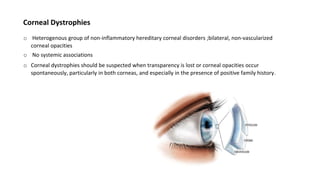
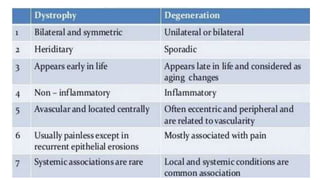
o Heterogenous group of non-inflammatory hereditary corneal disorders ;bilateral, non-vascularized
corneal opacities
o No systemic associations
o Corneal dystrophies should be suspected when transparency is lost or corneal opacities occur
spontaneously, particularly in both corneas, and especially in the presence of positive family history.
:
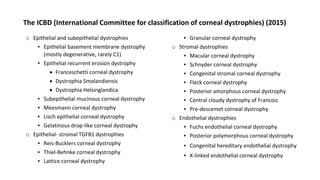
The ICBD (International Committee for classification of corneal dystrophies) (2015)
o Epithelial and subepithelial dystrophies
▪ Epithelial basement membrane dystrophy
(mostly degenerative, rarely C1)
▪ Epithelial recurrent erosion dystrophy
 Franceschetti corneal dystrophy
 Dystrophia Smolandiensis
 Dystrophia Helsinglandica
▪ Subepithelial mucinous corneal dystrophy
▪ Meesmann corneal dystrophy
▪ Lisch epithelial corneal dystrophy
▪ Gelatinous drop-like corneal dystrophy
o Epithelial- stromal TGFB1 dystrophies
▪ Reis-Bucklers corneal dystrophy
▪ Thiel-Behnke corneal dystrophy
▪ Lattice corneal dystrophy
▪ Granular corneal dystrophy
o Stromal dystrophies
▪ Macular corneal dystrophy
▪ Schnyder corneal dystrophy
▪ Congenital stromal corneal dystrophy
▪ Fleck corneal dystrophy
▪ Posterior amorphous corneal dystrophy
▪ Central cloudy dystrophy of Francois
▪ Pre-descemet corneal dystrophy
o Endothelial dystrophies
▪ Fuchs endothelial corneal dystrophy
▪ Posterior polymorphous corneal dystrophy
▪ Congenital hereditary endothelial dystrophy
▪ X-linked endothelial corneal dystrophy
Epithelial and Subepithelial dystrophies
o Involve the anterior most layer of the cornea
o Generally present in adults who may be asymptomatic or suffer from bouts of recurrent
corneal erosions associated with pain, lacrimation and blurring of vision with a varying
extent of corneal haziness
Epithelial Basement membrane dystrophy (Cogan dystrophy) [Map dot fingerprint
dystrophy, anterior basement membrane dystrophy, dystrophic recurrent erosion]
 Most commonly encountered anterior corneal
dystrophy
 Characterised by recurrent corneal erosions
 Onset : usually present in adult life
 Symptoms
o May be asymptomatic
o Recurrent erosions with pain, lacrimation
and blurred vision
o Irregular astigmatism
o Monocular diplopia
 Signs
o Best visualize by retroillumination or scleral
scatter
o Maps: Grey geographical patches
o Dots(Cogan): irregular , round or comma
shaped grey white intraepithelial opacities
o Blebs of Bron and Brown: small clear round
dots in a pebbled glass pattern
o Finger print lines: Parallel, Curvilinear,
refractile, branching lines with club shape
terminations
 Recent erosions occur due to lack of
hemidesmosomal connections between
epithelial cells
 Management:
o Corneal scraping debridement followed by a soft contact lens for 24-48 hours and topical antibiotics and
lubricants
o Conservative therapy with hypertonic sodium chloride
▪ It acts by dehydrating the epithelium allowing it to adhere better
▪ Lubricating eyedrops
o Stromal puncture
▪ 23-25 gauge needle
▪ Anterior stromal puncture by Nd:YAG
o Phototherapeutic Keratectomy
▪ Excimer laser with low pulse energy and low number of pulses
▪ [Shallow ablations with mean ablation depth of 46 microns have been recommended for decreased
complications]
Epithelial recurrent erosion dystrophy (Franceschetti) [Smolandiensis,
Helsinglandica]
o Symptoms :
▪ Onset is usually in the first decade of life
▪ Redness, photophobia, epiphora, ocular pain
▪ Recurrent attacks precipitated by exposure to sunlight, dust, smoke and lack of sleep
▪ Increased sensitivity of eyes
▪ Attacks decline by fourth and fifth decades and cease by 50 years
o Signs
▪ Recurrent corneal erosions spontaneously or after minimal trauma
▪ Diffuse, central, subepithelial opacification with subepithelial fibrosis
▪ Central corneal keloid like opacities seen in Smolandiensis variant
o Management
▪ Keratoplasty
 Recurrence after approximately 15 months
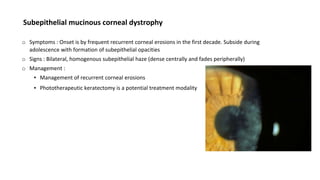
Subepithelial mucinous corneal dystrophy
o Symptoms : Onset is by frequent recurrent corneal erosions in the first decade. Subside during
adolescence with formation of subepithelial opacities
o Signs : Bilateral, homogenous subepithelial haze (dense centrally and fades peripherally)
o Management :
▪ Management of recurrent corneal erosions
▪ Phototherapeutic keratectomy is a potential treatment modality
Meesmann corneal dystrophy [Juvenile Hereditary ED; Stocker-Holt]
o It is a rare non progressive abnormality of
corneal epithelial metabolism.
o Bilateral, diffuse involving accumulation of
intracytoplasmic debris in the corneal
epithelium with the formation of epithelial
cysts
o Symptoms :
▪ Onset : early childhood [12 months of age :
clinical signs]
▪ Usually asymptomatic till 4th or 5th decade
▪ Mild visual reduction, glare, light sensitivity
or painful recurrent epithelial erosions
▪ Blurred vision
o Signs:
▪ Tiny intraepithelial cysts of uniform size but
variable density is maximal centrally and
extend towards limbus
▪ Cornea may be slightly thinned and
sensation reduced
o Treatment
▪ Ocular lubricants
▪ Therapeutic contact lenses
▪ Rx for corneal erosions in severe cases
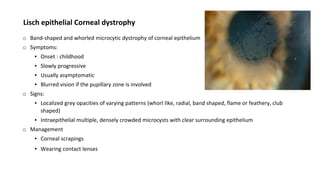
Lisch epithelial Corneal dystrophy
o Band-shaped and whorled microcytic dystrophy of corneal epithelium
o Symptoms:
▪ Onset : childhood
▪ Slowly progressive
▪ Usually asymptomatic
▪ Blurred vision if the pupillary zone is involved
o Signs:
▪ Localized grey opacities of varying patterns (whorl like, radial, band shaped, flame or feathery, club
shaped)
▪ Intraepithelial multiple, densely crowded microcysts with clear surrounding epithelium
o Management
▪ Corneal scrapings
▪ Wearing contact lenses
Gelatinous drop like corneal dystrophy [subepithelial amyloidosis, primary
familial amyloidosis]
o Symptoms
▪ Onset : 1st-2nd decade
▪ Decreased vision, photophobia, irritation,
redness and lacrimation
o Signs
▪ Clusters of small multiple nodules and acquire a
mulberry configuration
▪ Stromal opacification or larger kumquat like
lesions in advanced stages
▪ Hyperpermeability of corneal epithelium [late
staining of Fluorescein]
▪ Superficial vascularization
o Management
▪ Surgical management may be required for visual
rehabilitation
 Superficial Keratectomy
 Corneal transplant procedures like lamellar
keratoplasty or penetrating keratoplasty
▪ Recurrence is common [usually after 5 years]
▪ Phototherapeutic keratectomy is useful for
corneal opacities that recur after lamellar grafts
Epithelial stromal TGFB1 dystrophies
o These dystrophies result from mutations in TGFB1 gene encoding keratoepithelin which
binds to type I, II and IV collagens
o Mutation of the gene acts by inhibiting cell adhesion
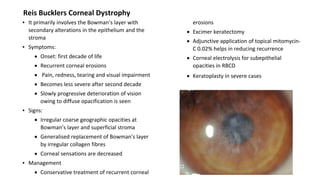
Reis Bucklers Corneal Dystrophy
▪ It primarily involves the Bowman’s layer with
secondary alterations in the epithelium and the
stroma
▪ Symptoms:
 Onset: first decade of life
 Recurrent corneal erosions
 Pain, redness, tearing and visual impairment
 Becomes less severe after second decade
 Slowly progressive deterioration of vision
owing to diffuse opacification is seen
▪ Signs:
 Irregular coarse geographic opacities at
Bowman’s layer and superficial stroma
 Generalised replacement of Bowman’s layer
by irregular collagen fibres
 Corneal sensations are decreased
▪ Management
 Conservative treatment of recurrent corneal
erosions
 Excimer keratectomy
 Adjunctive application of topical mitomycin-
C 0.02% helps in reducing recurrence
 Corneal electrolysis for subepithelial
opacities in RBCD
 Keratoplasty in severe cases
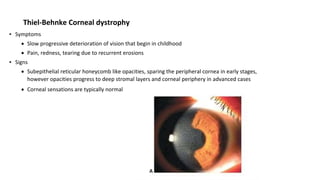
Thiel-Behnke Corneal dystrophy
▪ Symptoms
 Slow progressive deterioration of vision that begin in childhood
 Pain, redness, tearing due to recurrent erosions
▪ Signs
 Subepithelial reticular honeycomb like opacities, sparing the peripheral cornea in early stages,
however opacities progress to deep stromal layers and corneal periphery in advanced cases
 Corneal sensations are typically normal
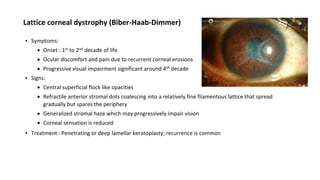
Lattice corneal dystrophy (Biber-Haab-Dimmer)
▪ Symptoms:
 Onset : 1st to 2nd decade of life
 Ocular discomfort and pain due to recurrent corneal erosions
 Progressive visual impairment significant around 4th decade
▪ Signs:
 Central superficial flock like opacities
 Refractile anterior stromal dots coalescing into a relatively fine filamentous lattice that spread
gradually but spares the periphery
 Generalized stromal haze which may progressively impair vision
 Corneal sensation is reduced
▪ Treatment : Penetrating or deep lamellar keratoplasty; recurrence is common
Familial Amyloidosis [Finnish or Meretoja type] [Gelsolin type LCD]
▪ Systemic condition
▪ Symptoms:
 Onset after 20 years
 Ocular irritation, late impairment of vision
(6th decade)
 Erosions are rare
 Bilateral involvement
▪ Signs
 Sparse stromal lattice lines spread centrally
from the periphery
 Corneal sensation is impaired
▪ Systemic features
 Progressive cranial and peripheral
neuropathy
 Mask like facies and autonomic features
 Dysarthria
 Dry and extremely lax itchy skin
 Protruding lips with impaired movement
 Pendulous ears
 Blepharochalasis
▪ Management:
 Treatment of recurrent epithelial erosions
 Amniotic membrane transplantation may
be done for persistent epithelial defects
 Phototherapeutic keratectomy
 Corneal transplant (keratoplasty) in cases
with visually significant epithelial scarring
and corneal haze
 Recurrence common
Granular corneal dystrophy type 1
▪ GCD type 1 [Corneal dystrophy Groenouw type 1]
▪ Symptoms:
 Onset in 1st decade
 Glare and photophobia
 Visual acuity decreases as opacification progresses with age
 Recurrent erosions are unknown
▪ Signs:
 Discrete white central anterior stromal deposits
 Gradual increase in number and size of deposits with deeper and outward spread sparing the limbus
 Corneal sensation is impaired
▪ Management:
 Penetrating or deep lamellar keratoplasty
 Superficial recurrences may require repeated excimer laser keratectomy
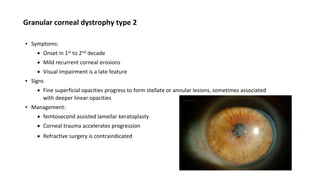
Granular corneal dystrophy type 2
▪ Symptoms:
 Onset in 1st to 2nd decade
 Mild recurrent corneal erosions
 Visual impairment is a late feature
▪ Signs
 Fine superficial opacities progress to form stellate or annular lesions, sometimes associated
with deeper linear opacities
▪ Management:
 femtosecond assisted lamellar keratoplasty
 Corneal trauma accelerates progression
 Refractive surgery is contraindicated
Stromal dystrophies
Macular corneal dystrophy [Groenouw corneal dystrophy type II, Fehr speckled
dystrophy]
 Symptoms
o Onset: childhood
o Slowly progressive course
o Recurrent corneal erosions are common
o Reduced corneal sensitivity
o Visual impairment occur early
 Signs:
o Dense but poorly delineated greyish-white
spots centrally in the anterior stroma and
peripherally in the posterior stroma
o Opacities are elevated
o Progression of lesions occur in conjunction
with anterior stromal haze initially
involving the central cornea.Eventual
involvement of full thickness stroma,
extending to the limbus with no clear
zone.
o Thinning of cornea in early stage, with late
thickening due to stromal imbibition of
water from endothelial decompensation
o In advanced stage, Descemet membrane
develop guttate excrescences
o Corneal sensations are reduced
 Management : Penetrating keratoplasty;
Recurrence is common
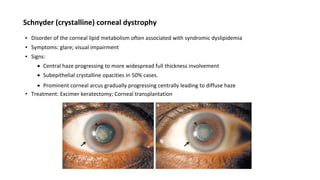
Schnyder (crystalline) corneal dystrophy
▪ Disorder of the corneal lipid metabolism often associated with syndromic dyslipidemia
▪ Symptoms: glare; visual impairment
▪ Signs:
 Central haze progressing to more widespread full thickness involvement
 Subepithelial crystalline opacities in 50% cases.
 Prominent corneal arcus gradually progressing centrally leading to diffuse haze
• Treatment: Excimer keratectomy; Corneal transplantation
Central cloudy dystrophy of francois:
• Polygonal grey opacities
• Resemble crocodile shagreen.
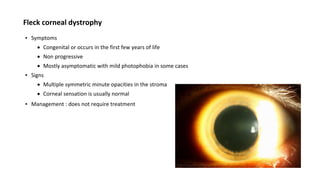
Fleck corneal dystrophy
▪ Symptoms
 Congenital or occurs in the first few years of life
 Non progressive
 Mostly asymptomatic with mild photophobia in some cases
▪ Signs
 Multiple symmetric minute opacities in the stroma
 Corneal sensation is usually normal
▪ Management : does not require treatment
Congenital stromal corneal dystrophy
▪ Symptoms
 Rare, congenital, non-progressive or slowly progressive
 Moderate to severe visual loss
 Strabismus and glaucoma association seen in some patients
 Corneal erosions, photophobia and corneal vascularization are absent
▪ Signs
 Bilateral opaque flaky or feathery areas of clouding in the stroma [multiply with age and
eventually preclude visibility of the endothelium]
 Corneal stromal thickness increased
▪ Management
 Keratoplasty in cases of visually disabling opacities
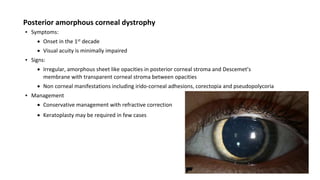
Posterior amorphous corneal dystrophy
▪ Symptoms:
 Onset in the 1st decade
 Visual acuity is minimally impaired
▪ Signs:
 Irregular, amorphous sheet like opacities in posterior corneal stroma and Descemet’s
membrane with transparent corneal stroma between opacities
 Non corneal manifestations including irido-corneal adhesions, corectopia and pseudopolycoria
▪ Management
 Conservative management with refractive correction
 Keratoplasty may be required in few cases
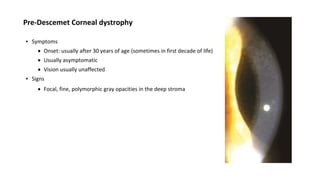
Pre-Descemet Corneal dystrophy
▪ Symptoms
 Onset: usually after 30 years of age (sometimes in first decade of life)
 Usually asymptomatic
 Vision usually unaffected
▪ Signs
 Focal, fine, polymorphic gray opacities in the deep stroma
Endothelial dystrophies
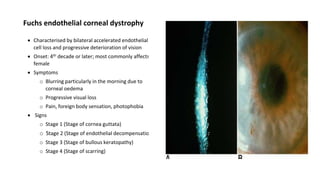
Fuchs endothelial corneal dystrophy
 Characterised by bilateral accelerated endothelial
cell loss and progressive deterioration of vision
 Onset: 4th decade or later; most commonly affects
female
 Symptoms
o Blurring particularly in the morning due to
corneal oedema
o Progressive visual loss
o Pain, foreign body sensation, photophobia
 Signs
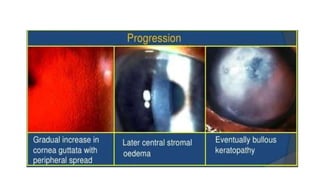
o Stage 1 (Stage of cornea guttata)
o Stage 2 (Stage of endothelial decompensation)
o Stage 3 (Stage of bullous keratopathy)
o Stage 4 (Stage of scarring)
 Management:
o Dehydrating agents for early oedematous stage
o Anti-glaucoma agents in cases with concomitant glaucoma
o Supportive treatment for ruptured bullae
o Topical Rho-kinase inhibitor with prior transcorneal endothelial
o Keratoplasty: corneal transplant is the definitive treatment for advanced cases of FCD
▪ Penetrating keratoplasty
▪ Endothelial keratoplasty (DSAEK) (Descemet’s stripping automated)
o Cataract surgery may
be required in many FCD
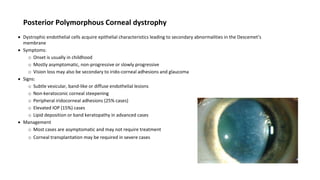
Posterior Polymorphous Corneal dystrophy
 Dystrophic endothelial cells acquire epithelial characteristics leading to secondary abnormalities in the Descemet’s
membrane
 Symptoms:
o Onset is usually in childhood
o Mostly asymptomatic, non-progressive or slowly progressive
o Vision loss may also be secondary to irido-corneal adhesions and glaucoma
 Signs:
o Subtle vesicular, band-like or diffuse endothelial lesions
o Non-keratoconic corneal steepening
o Peripheral iridocorneal adhesions (25% cases)
o Elevated IOP (15%) cases
o Lipid deposition or band keratopathy in advanced cases
 Management
o Most cases are asymptomatic and may not require treatment
o Corneal transplantation may be required in severe cases
Congenital hereditary endothelial dystrophy (Maumenee CD)
 Rare dystrophy with focal or diffuse thickening
of Descemet membrane and endothelial
degeneration
 Symptoms
o Onset at birth
o Bilateral asymmetric involvement
o Stationary to slow progressive course
o Diffuse corneal clouding along with history
suggestive of photophobia (by parents)
o Inability to fixate on objects and involuntary
eye movements
 Signs
o Corneal clouding and thickening are
neonatal in CHED2 and develop during the
first year or two in CHED1
o Visual impairment is variable
o Nystagmus is common in CHED2
o Long standing cases may display band
keratopathy and subepithelial amyloidosis
 Management
o Corneal transplantation
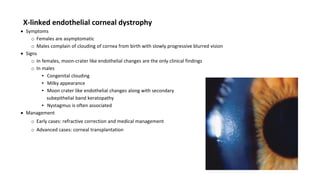
X-linked endothelial corneal dystrophy
 Symptoms
o Females are asymptomatic
o Males complain of clouding of cornea from birth with slowly progressive blurred vision
 Signs
o In females, moon-crater like endothelial changes are the only clinical findings
o In males
▪ Congenital clouding
▪ Milky appearance
▪ Moon crater like endothelial changes along with secondary
subepithelial band keratopathy
▪ Nystagmus is often associated
 Management
o Early cases: refractive correction and medical management
o Advanced cases: corneal transplantation
• THANK YOU

Corneal Dystrophy

  • 1.
    Corneal Dystrophies BY.DR.GAYATHRI JAGADESH(2nd yr ophthal Pg) MODERATOR:DR.SWATHI .N(Professor)
  • 2.
    Corneal Dystrophies o Heterogenousgroup of non-inflammatory hereditary corneal disorders ;bilateral, non-vascularized corneal opacities o No systemic associations o Corneal dystrophies should be suspected when transparency is lost or corneal opacities occur spontaneously, particularly in both corneas, and especially in the presence of positive family history.
  • 3.
  • 4.
    The ICBD (InternationalCommittee for classification of corneal dystrophies) (2015) o Epithelial and subepithelial dystrophies ▪ Epithelial basement membrane dystrophy (mostly degenerative, rarely C1) ▪ Epithelial recurrent erosion dystrophy  Franceschetti corneal dystrophy  Dystrophia Smolandiensis  Dystrophia Helsinglandica ▪ Subepithelial mucinous corneal dystrophy ▪ Meesmann corneal dystrophy ▪ Lisch epithelial corneal dystrophy ▪ Gelatinous drop-like corneal dystrophy o Epithelial- stromal TGFB1 dystrophies ▪ Reis-Bucklers corneal dystrophy ▪ Thiel-Behnke corneal dystrophy ▪ Lattice corneal dystrophy ▪ Granular corneal dystrophy o Stromal dystrophies ▪ Macular corneal dystrophy ▪ Schnyder corneal dystrophy ▪ Congenital stromal corneal dystrophy ▪ Fleck corneal dystrophy ▪ Posterior amorphous corneal dystrophy ▪ Central cloudy dystrophy of Francois ▪ Pre-descemet corneal dystrophy o Endothelial dystrophies ▪ Fuchs endothelial corneal dystrophy ▪ Posterior polymorphous corneal dystrophy ▪ Congenital hereditary endothelial dystrophy ▪ X-linked endothelial corneal dystrophy
  • 5.
    Epithelial and Subepithelialdystrophies o Involve the anterior most layer of the cornea o Generally present in adults who may be asymptomatic or suffer from bouts of recurrent corneal erosions associated with pain, lacrimation and blurring of vision with a varying extent of corneal haziness
  • 6.
    Epithelial Basement membranedystrophy (Cogan dystrophy) [Map dot fingerprint dystrophy, anterior basement membrane dystrophy, dystrophic recurrent erosion]  Most commonly encountered anterior corneal dystrophy  Characterised by recurrent corneal erosions  Onset : usually present in adult life  Symptoms o May be asymptomatic o Recurrent erosions with pain, lacrimation and blurred vision o Irregular astigmatism o Monocular diplopia  Signs o Best visualize by retroillumination or scleral scatter o Maps: Grey geographical patches o Dots(Cogan): irregular , round or comma shaped grey white intraepithelial opacities o Blebs of Bron and Brown: small clear round dots in a pebbled glass pattern o Finger print lines: Parallel, Curvilinear, refractile, branching lines with club shape terminations  Recent erosions occur due to lack of hemidesmosomal connections between epithelial cells
  • 7.
     Management: o Cornealscraping debridement followed by a soft contact lens for 24-48 hours and topical antibiotics and lubricants o Conservative therapy with hypertonic sodium chloride ▪ It acts by dehydrating the epithelium allowing it to adhere better ▪ Lubricating eyedrops o Stromal puncture ▪ 23-25 gauge needle ▪ Anterior stromal puncture by Nd:YAG o Phototherapeutic Keratectomy ▪ Excimer laser with low pulse energy and low number of pulses ▪ [Shallow ablations with mean ablation depth of 46 microns have been recommended for decreased complications]
  • 8.
    Epithelial recurrent erosiondystrophy (Franceschetti) [Smolandiensis, Helsinglandica] o Symptoms : ▪ Onset is usually in the first decade of life ▪ Redness, photophobia, epiphora, ocular pain ▪ Recurrent attacks precipitated by exposure to sunlight, dust, smoke and lack of sleep ▪ Increased sensitivity of eyes ▪ Attacks decline by fourth and fifth decades and cease by 50 years o Signs ▪ Recurrent corneal erosions spontaneously or after minimal trauma ▪ Diffuse, central, subepithelial opacification with subepithelial fibrosis ▪ Central corneal keloid like opacities seen in Smolandiensis variant o Management ▪ Keratoplasty  Recurrence after approximately 15 months
  • 9.
    Subepithelial mucinous cornealdystrophy o Symptoms : Onset is by frequent recurrent corneal erosions in the first decade. Subside during adolescence with formation of subepithelial opacities o Signs : Bilateral, homogenous subepithelial haze (dense centrally and fades peripherally) o Management : ▪ Management of recurrent corneal erosions ▪ Phototherapeutic keratectomy is a potential treatment modality
  • 10.
    Meesmann corneal dystrophy[Juvenile Hereditary ED; Stocker-Holt] o It is a rare non progressive abnormality of corneal epithelial metabolism. o Bilateral, diffuse involving accumulation of intracytoplasmic debris in the corneal epithelium with the formation of epithelial cysts o Symptoms : ▪ Onset : early childhood [12 months of age : clinical signs] ▪ Usually asymptomatic till 4th or 5th decade ▪ Mild visual reduction, glare, light sensitivity or painful recurrent epithelial erosions ▪ Blurred vision o Signs: ▪ Tiny intraepithelial cysts of uniform size but variable density is maximal centrally and extend towards limbus ▪ Cornea may be slightly thinned and sensation reduced o Treatment ▪ Ocular lubricants ▪ Therapeutic contact lenses ▪ Rx for corneal erosions in severe cases
  • 11.
    Lisch epithelial Cornealdystrophy o Band-shaped and whorled microcytic dystrophy of corneal epithelium o Symptoms: ▪ Onset : childhood ▪ Slowly progressive ▪ Usually asymptomatic ▪ Blurred vision if the pupillary zone is involved o Signs: ▪ Localized grey opacities of varying patterns (whorl like, radial, band shaped, flame or feathery, club shaped) ▪ Intraepithelial multiple, densely crowded microcysts with clear surrounding epithelium o Management ▪ Corneal scrapings ▪ Wearing contact lenses
  • 12.
    Gelatinous drop likecorneal dystrophy [subepithelial amyloidosis, primary familial amyloidosis] o Symptoms ▪ Onset : 1st-2nd decade ▪ Decreased vision, photophobia, irritation, redness and lacrimation o Signs ▪ Clusters of small multiple nodules and acquire a mulberry configuration ▪ Stromal opacification or larger kumquat like lesions in advanced stages ▪ Hyperpermeability of corneal epithelium [late staining of Fluorescein] ▪ Superficial vascularization o Management ▪ Surgical management may be required for visual rehabilitation  Superficial Keratectomy  Corneal transplant procedures like lamellar keratoplasty or penetrating keratoplasty ▪ Recurrence is common [usually after 5 years] ▪ Phototherapeutic keratectomy is useful for corneal opacities that recur after lamellar grafts
  • 13.
    Epithelial stromal TGFB1dystrophies o These dystrophies result from mutations in TGFB1 gene encoding keratoepithelin which binds to type I, II and IV collagens o Mutation of the gene acts by inhibiting cell adhesion
  • 14.
    Reis Bucklers CornealDystrophy ▪ It primarily involves the Bowman’s layer with secondary alterations in the epithelium and the stroma ▪ Symptoms:  Onset: first decade of life  Recurrent corneal erosions  Pain, redness, tearing and visual impairment  Becomes less severe after second decade  Slowly progressive deterioration of vision owing to diffuse opacification is seen ▪ Signs:  Irregular coarse geographic opacities at Bowman’s layer and superficial stroma  Generalised replacement of Bowman’s layer by irregular collagen fibres  Corneal sensations are decreased ▪ Management  Conservative treatment of recurrent corneal erosions  Excimer keratectomy  Adjunctive application of topical mitomycin- C 0.02% helps in reducing recurrence  Corneal electrolysis for subepithelial opacities in RBCD  Keratoplasty in severe cases
  • 15.
    Thiel-Behnke Corneal dystrophy ▪Symptoms  Slow progressive deterioration of vision that begin in childhood  Pain, redness, tearing due to recurrent erosions ▪ Signs  Subepithelial reticular honeycomb like opacities, sparing the peripheral cornea in early stages, however opacities progress to deep stromal layers and corneal periphery in advanced cases  Corneal sensations are typically normal
  • 16.
    Lattice corneal dystrophy(Biber-Haab-Dimmer) ▪ Symptoms:  Onset : 1st to 2nd decade of life  Ocular discomfort and pain due to recurrent corneal erosions  Progressive visual impairment significant around 4th decade ▪ Signs:  Central superficial flock like opacities  Refractile anterior stromal dots coalescing into a relatively fine filamentous lattice that spread gradually but spares the periphery  Generalized stromal haze which may progressively impair vision  Corneal sensation is reduced ▪ Treatment : Penetrating or deep lamellar keratoplasty; recurrence is common
  • 17.
    Familial Amyloidosis [Finnishor Meretoja type] [Gelsolin type LCD] ▪ Systemic condition ▪ Symptoms:  Onset after 20 years  Ocular irritation, late impairment of vision (6th decade)  Erosions are rare  Bilateral involvement ▪ Signs  Sparse stromal lattice lines spread centrally from the periphery  Corneal sensation is impaired ▪ Systemic features  Progressive cranial and peripheral neuropathy  Mask like facies and autonomic features  Dysarthria  Dry and extremely lax itchy skin  Protruding lips with impaired movement  Pendulous ears  Blepharochalasis ▪ Management:  Treatment of recurrent epithelial erosions  Amniotic membrane transplantation may be done for persistent epithelial defects  Phototherapeutic keratectomy  Corneal transplant (keratoplasty) in cases with visually significant epithelial scarring and corneal haze  Recurrence common
  • 18.
    Granular corneal dystrophytype 1 ▪ GCD type 1 [Corneal dystrophy Groenouw type 1] ▪ Symptoms:  Onset in 1st decade  Glare and photophobia  Visual acuity decreases as opacification progresses with age  Recurrent erosions are unknown ▪ Signs:  Discrete white central anterior stromal deposits  Gradual increase in number and size of deposits with deeper and outward spread sparing the limbus  Corneal sensation is impaired ▪ Management:  Penetrating or deep lamellar keratoplasty  Superficial recurrences may require repeated excimer laser keratectomy
  • 19.
    Granular corneal dystrophytype 2 ▪ Symptoms:  Onset in 1st to 2nd decade  Mild recurrent corneal erosions  Visual impairment is a late feature ▪ Signs  Fine superficial opacities progress to form stellate or annular lesions, sometimes associated with deeper linear opacities ▪ Management:  femtosecond assisted lamellar keratoplasty  Corneal trauma accelerates progression  Refractive surgery is contraindicated
  • 20.
  • 21.
    Macular corneal dystrophy[Groenouw corneal dystrophy type II, Fehr speckled dystrophy]  Symptoms o Onset: childhood o Slowly progressive course o Recurrent corneal erosions are common o Reduced corneal sensitivity o Visual impairment occur early  Signs: o Dense but poorly delineated greyish-white spots centrally in the anterior stroma and peripherally in the posterior stroma o Opacities are elevated o Progression of lesions occur in conjunction with anterior stromal haze initially involving the central cornea.Eventual involvement of full thickness stroma, extending to the limbus with no clear zone. o Thinning of cornea in early stage, with late thickening due to stromal imbibition of water from endothelial decompensation o In advanced stage, Descemet membrane develop guttate excrescences o Corneal sensations are reduced  Management : Penetrating keratoplasty; Recurrence is common
  • 22.
    Schnyder (crystalline) cornealdystrophy ▪ Disorder of the corneal lipid metabolism often associated with syndromic dyslipidemia ▪ Symptoms: glare; visual impairment ▪ Signs:  Central haze progressing to more widespread full thickness involvement  Subepithelial crystalline opacities in 50% cases.  Prominent corneal arcus gradually progressing centrally leading to diffuse haze • Treatment: Excimer keratectomy; Corneal transplantation
  • 23.
    Central cloudy dystrophyof francois: • Polygonal grey opacities • Resemble crocodile shagreen.
  • 24.
    Fleck corneal dystrophy ▪Symptoms  Congenital or occurs in the first few years of life  Non progressive  Mostly asymptomatic with mild photophobia in some cases ▪ Signs  Multiple symmetric minute opacities in the stroma  Corneal sensation is usually normal ▪ Management : does not require treatment
  • 25.
    Congenital stromal cornealdystrophy ▪ Symptoms  Rare, congenital, non-progressive or slowly progressive  Moderate to severe visual loss  Strabismus and glaucoma association seen in some patients  Corneal erosions, photophobia and corneal vascularization are absent ▪ Signs  Bilateral opaque flaky or feathery areas of clouding in the stroma [multiply with age and eventually preclude visibility of the endothelium]  Corneal stromal thickness increased ▪ Management  Keratoplasty in cases of visually disabling opacities
  • 26.
    Posterior amorphous cornealdystrophy ▪ Symptoms:  Onset in the 1st decade  Visual acuity is minimally impaired ▪ Signs:  Irregular, amorphous sheet like opacities in posterior corneal stroma and Descemet’s membrane with transparent corneal stroma between opacities  Non corneal manifestations including irido-corneal adhesions, corectopia and pseudopolycoria ▪ Management  Conservative management with refractive correction  Keratoplasty may be required in few cases
  • 27.
    Pre-Descemet Corneal dystrophy ▪Symptoms  Onset: usually after 30 years of age (sometimes in first decade of life)  Usually asymptomatic  Vision usually unaffected ▪ Signs  Focal, fine, polymorphic gray opacities in the deep stroma
  • 28.
  • 29.
    Fuchs endothelial cornealdystrophy  Characterised by bilateral accelerated endothelial cell loss and progressive deterioration of vision  Onset: 4th decade or later; most commonly affects female  Symptoms o Blurring particularly in the morning due to corneal oedema o Progressive visual loss o Pain, foreign body sensation, photophobia  Signs o Stage 1 (Stage of cornea guttata) o Stage 2 (Stage of endothelial decompensation) o Stage 3 (Stage of bullous keratopathy) o Stage 4 (Stage of scarring)
  • 31.
     Management: o Dehydratingagents for early oedematous stage o Anti-glaucoma agents in cases with concomitant glaucoma o Supportive treatment for ruptured bullae o Topical Rho-kinase inhibitor with prior transcorneal endothelial o Keratoplasty: corneal transplant is the definitive treatment for advanced cases of FCD ▪ Penetrating keratoplasty ▪ Endothelial keratoplasty (DSAEK) (Descemet’s stripping automated) o Cataract surgery may be required in many FCD
  • 32.
    Posterior Polymorphous Cornealdystrophy  Dystrophic endothelial cells acquire epithelial characteristics leading to secondary abnormalities in the Descemet’s membrane  Symptoms: o Onset is usually in childhood o Mostly asymptomatic, non-progressive or slowly progressive o Vision loss may also be secondary to irido-corneal adhesions and glaucoma  Signs: o Subtle vesicular, band-like or diffuse endothelial lesions o Non-keratoconic corneal steepening o Peripheral iridocorneal adhesions (25% cases) o Elevated IOP (15%) cases o Lipid deposition or band keratopathy in advanced cases  Management o Most cases are asymptomatic and may not require treatment o Corneal transplantation may be required in severe cases
  • 33.
    Congenital hereditary endothelialdystrophy (Maumenee CD)  Rare dystrophy with focal or diffuse thickening of Descemet membrane and endothelial degeneration  Symptoms o Onset at birth o Bilateral asymmetric involvement o Stationary to slow progressive course o Diffuse corneal clouding along with history suggestive of photophobia (by parents) o Inability to fixate on objects and involuntary eye movements  Signs o Corneal clouding and thickening are neonatal in CHED2 and develop during the first year or two in CHED1 o Visual impairment is variable o Nystagmus is common in CHED2 o Long standing cases may display band keratopathy and subepithelial amyloidosis  Management o Corneal transplantation
  • 34.
    X-linked endothelial cornealdystrophy  Symptoms o Females are asymptomatic o Males complain of clouding of cornea from birth with slowly progressive blurred vision  Signs o In females, moon-crater like endothelial changes are the only clinical findings o In males ▪ Congenital clouding ▪ Milky appearance ▪ Moon crater like endothelial changes along with secondary subepithelial band keratopathy ▪ Nystagmus is often associated  Management o Early cases: refractive correction and medical management o Advanced cases: corneal transplantation
  • 35.