CORNEAL DYSTROPHY
EPITHELIAL BASEMENT MEMBRANE
DYSTROPHY
• INHERITANCE- NO Inheritance
• Onset,course,symptom:
• Presents in adult life, rarely seen in children.
• Asymptomatic or recurrent erosion with pain ,lacrimation & blurred vision
• Except for the bleb pattern, on-axis lesions may also cause blurred vision due
to irregular astigmatism
PATHOLOGY: point mutations in the TGFBI gene
• SIGNS-
• MAPS: irregular island of thickened, gray ,hazy epithelium with scalloped
• circumscribed borders, affecting the central or paracentral cornea.
• DOTS: irregular round ,oval or comma shaped, non staining, putty-gray opacities.
• BLEB PATTERN: sub epithelial pattern like pebbled glass best seen by retro
• illumination ..
• FINGERPRINT LINES: parallel ,curvilinear lines, usually paracentral,best seen in retro
• illumination, isolated or combined with maps.
• TREATMENT
• Débridement .
• Superficial keratectomy - DALK
• Lubricants, hypertonic saline
• Bandage soft Contact Lens.
• Anterior stromal reinforcement or puncture.
• Phototherapeutic keratectomy (PTK)
• EPITHELIAL
RECURRENT
EROSION
DYSTROPHY
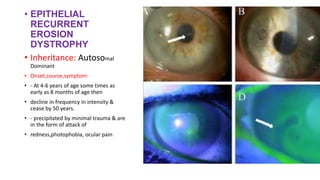
• Inheritance: Autosomal
Dominant
• Onset,course,symptom:
• - At 4-6 years of age some times as
early as 8 months of age then
• decline in frequency in intensity &
cease by 50 years.
• - precipitated by minimal trauma & are
in the form of attack of
• redness,photophobia, ocular pain
• SIGNS :
• CORNEAL EROSIONS are seen during 4-6 years of age sometimes as
• early as 8 months of age & generally decline in frequency &
• intensity & cease by 50 yrs.
• SUBEPITHELIAL HAZE OR BLEB: may be seen between attacks
• CENTARL SUBEPITHELIAL CORNEAL OPACITIES: may appear as early
• as 7 yrs of age.
• TREATMENT
• • Artificial tears
• • Oral tetracycline antibiotics
• • Topical corticosteroid
• • phototherapeutic keratectomy
• SUBEPITHELIAL MUCINOUS
CORNEAL DYSTROPHY
• • Inheritance: Autosomal Dominant
• Onset,course,symptom:
• Onset is in first decade of life & progressive loss of vision occurs in
• adolescence.
• It include painful episodes of recurrent corneal erosion which
decrease
• during adolescence.
• PATHOLOGY:
• Anterior to Bowman layer, deposits of glycosaminoglycan were
detected
• and identified as chondroitin-4-sulfate and dermatan sulfate
• SIGNS :
• It include bilateral sub epithelial opacities & has most dense centrally,
• involving the entire cornea
• MEESMAN CORNEAL DYSTROPHY
• Inheritance: Autosomal dominant
• Onset,course,symptom:
• • occurs in early childhood & is slowly progressive with variant stocker holt dystrophy with
• mild visual reduction
• • Patient complains glare & light sensitivity, recurrent painful epithelial erosions.
• • Rarely blurred vision results from corneal irregularity & scarring.
• • PATHOLOGY: It has been associated with genes KRT3 and KRT12 located on chromosome 12
• and 17 respectively.[4]
• SIGNS :
• Multiple tiny epithelial vesicles which extend to the limbus & are most numerous in the inter
• palpebral area with clear surrounding epithelium.
• Whorled & wedge shaped epithelial patterns have seen.
• Cornea; thickening & reduction in the corneal sensation may be seen.
• The entire cornea demonstrate fine, grayish punctuate epithelial opacities that stain with
• flurorescein & fine linear opacities that may appear in a whorl pattern .
• TREATMENT
• Treatment is usually not needed unless a person is experiencing
symptoms.
• lubricating eye drops.
severe cases, therapeutic contact lenses or cycloplegic eye drops
• Hypertonic saline may be given if symptoms get worse when a
person wakes up.
• Surgical procedures are sometimes tried when these treatments do
not help, and may include epithelial debridement, or keratectomy.
• There is a high risk of recurrence with these procedures.
• Researchers are also evaluating a form of gene therapy called RNA interference (RNAi) which is also called
therapeutic siRNA.
• LISCH EPITHELIAL CORNEAL DYSTROPHY
• • Inheritance: X-linked chromosomal dominant
• Onset,course,symptom:
• Occurs in childhood with slow progression of opacities.
• Asymptomatic blurring of vision occurs if pupillary zone is
• involved.
• SIGNS :
• DIRECT ILLUMINATION: shows localised gray opacities in different
• pattern: whorl like radial, band shaped ,flame.
• INDIRECT ILLUMINATION: demonstrates multiple,densly crowded
• clear cyst with clear surrounding epithelium
• TREATMENT
• Epithelial debridement (superficial
keratectomy)
• •Typically recurs
• Gelatinous Drop-like Dystrophy
• • Inheritance: Autosomal Recessive
• Onset,course,symptom:
• occurs in first decade of life & is progressive.
• Significant decrease in vision ,photophobia, irritation,
redness,
• tearing.
• SIGNS :
• SUBEPITHELIAL LESIONS: appear initially may be
similar to band
• shaped keratopathy or there may be groups of small multiple
• nodules, that is mulberry configuration is frequently
seen.
• Gelatinous Drop-like Dystrophy
• • Inheritance: Autosomal Recessive
• Onset,course,symptom:
• occurs in first decade of life & is progressive.
• Significant decrease in vision ,photophobia, irritation, redness,
• tearing.
• SIGNS :
• SUBEPITHELIAL LESIONS: appear initially may be similar to band
• shaped keratopathy or there may be groups of small multiple
• nodules, that is mulberry configuration is frequently seen
Gelatinous drop–like corneal dystrophy (A) Kumquat–like type (B) Mulberry type (C) Band keratopathy
type (D) Hematoxylin
and eosin staining—amyloid deposition (arrow); (E to G) in vivo confocal microscopy showing bright
reflective material at basal epithelium; (H
and I) Drop-like globular structures in confocal microscopy
BOWMAN LAYER DYSTROPHIES
• REIS-BUCKLERS CORNEAL
• DYTROPHIES
• • INHERITANCE: autosomal dominant
• ONSET,COURSE:
• • also known as dystrophy of bowman layer type 1.
• • occurs in childhood & cause slowly progressive deterioration of vision.
• SYMPTOMS:
• Vision is impaired from childhood.
• Erosions cause ocular discomfort and pain in first decade but may become
• less severe from the end of second decade.
• SIGNS: include confluent irregular and coarse geographic like
opacities
• with varying densities which develop at the level of Bowman layer &
superficial stroma, initially separated from one another opacities may
extend to the limbus and deeper stroma with time.
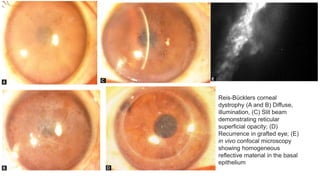
Reis-BĂĽcklers corneal
dystrophy (A and B) Diffuse,
illumination, (C) Slit beam
demonstrating reticular
superficial opacity; (D)
Recurrence in grafted eye; (E)
in vivo confocal microscopy
showing homogeneous
reflective material in the basal
epithelium
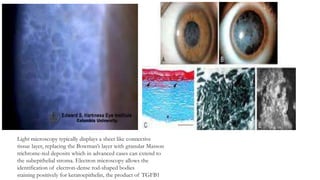
Light microscopy typically displays a sheet like connective
tissue layer, replacing the Bowman’s layer with granular Masson
trichrome-red deposits which in advanced cases can extend to
the subepithelial stroma. Electron microscopy allows the
identification of electron-dense rod-shaped bodies
staining positively for keratoepithelin, the product of TGFB1
• Treatment may include a complete or
• partial corneal transplant, or photorefractive
keratectomy
• THIEL-BEHNKE CORNEAL DYSTROPHY
• INHERITANCE: autosomal dominant
• ONSET,COURSE:
• Is also known as dystrophy of Bowman layer type 2
• Occurs in childhood & slowly progressive deterioration of vision
• from increase corneal opacification.
• SYMPTOMS:
• erosion cause ocular discomfort & pain in the first & second
• decade.
• Gradual visual impairment develops later.
Stromal dystrophy
A) Lattice corneal dystrophy
• 1. Classical lattice corneal dystrophy
• Known as Biber-Haab-Dimmer dystrophy
• Inheritance – autosomal dominant
• PATHOLOGY: Lattice dystrophy gets its name from an accumulation of amyloid deposits, or
• abnormal protein fibers, throughout the middle and anterior stroma. It is caused by
• mutations in TGFBI gene encoding keratoepithelin.
• Onset,course,symptoms:
• Appears at the age of 2 years & progressive, ocular discomfort ,pain occur sometimes as
• early as first decade of life.
• Progressive clouding at central cornea is apparent by age of 20 years, visual acuity is
• impaired.
• Signs :
• • Branching spider-like amyloid deposits forming an irregular lattice work in the corneal
• stroma, sparing the periphery
• • The number of lattice lines may differ between the 2 eyes & dystrophy may be difficult to
• diagnose in some younger patients
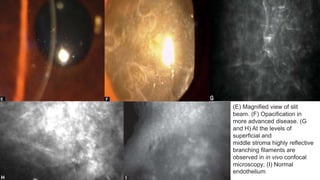
Thin branching lattice lines and dots in retroillumination;
Lattice corneal dystrophy TGFB1 type (classic lattice) - Magnified view of slit beam
(E) Magnified view of slit
beam. (F) Opacification in
more advanced disease. (G
and H) At the levels of
superficial and
middle stroma highly reflective
branching filaments are
observed in in vivo confocal
microscopy; (I) Normal
endothelium
• Lattice corneal dystrophy , Gelsolin Type (LCD2)
• Known as familial amyloidosis of Finnish (FAF)
• Inheritance : autosomal dominant
• PATHOLOGY:
• type II or Finnish type amyloidosis: associated with manifestations of systemic
• amyloidosis due to accumulation of gelsolin.Associated conditions may include cutis
laxa and ataxia.
• Onset & course :
• Occurs in third or forth decade of life, Slowly progressive, majority of patients are good
• health even in seventh decade of life
• Symptoms :
• Dry eye frequently, corneal erosion may occur in late life.
• Visual acuity is normal because of the dystrophy progress peripheral to central cornea.
• Signs : Corneal sensitivity is reduced or absent.
• TREATMENT
• • punctal plugs (both upper and
lower)
• Keretoplasty is required at age of
30-40 years.
• Phototherapeutic
keratectomy (PTK) using
• [Excimer laser] can restore and
preserve useful
• visual function for a significant
period of time in
• patients with anterior corneal
dystrophies.[
b) Granular dystrophy
• 1.Granular corneal dystrophy, type 1 (classic) (GCDI)
• Known as corneal dystrophy groenouw type 1
• Inheritance : autosomal dominant
• Onset & course:
• Occurs in childhood as soon as 2 years of age, Condition
• progressive.
• Symptoms :
• Glare & photophobia, pain,watering,visual acuity decrease with
• increase of age.
• Signs:
• • Milky granular hyaline deposits in anterior stroma, opacification do
• not extend limbus
Granular corneal dystrophy Type 1 (A and B) Discrete stromal opacities (note variation in shape of opacities) axially
distributed with clear intervening stroma (C) Slit beam view; (D) Bread crumb like deposits; (E) Verticillate opacity;
(F) In retroillumination
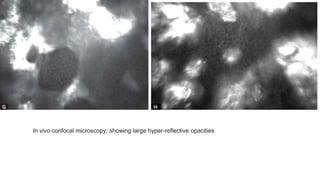
In vivo confocal microscopy; showing large hyper-reflective opacities
• 2. Granular corneal dystrophy , Type 2 (Granular lattice)
(GCD2)
• Known as combined granular–lattice corneal
• Inheritance : autosomal dominant
• Onset & course :
• Occurs in first decade, condition is progressive.
• Symptoms :
• Vision decrease with age, pain, ocular discomfort.
• Signs :
• Superficial stromal tiny whitish dots, rings shaped snowflake
• stromal opacities appearing between superficial stroma & mid
stroma & the next lesion, translucent flattened breadcrumb
opacities are seen in the final stages.
Avellino corneal dystrophy, (A)
Ribbon like and disk shaped
opacities in a genetically
confirmed R124H mutation;
(B) Same
family probands daughter had
crumb like opacities with few
ray like linear deposits in
superficial stroma;
(C) Highly reflective granular
material
seen in the basal epithelial
layer in in vivo confocal
microscopy;
(D) Surrounding stromal
keratocyte nuclei appeared
normal
• Treatment is conservative and includes hypertonic saline and bandage contact lenses
for recurrent erosions.
PTK has been used to treat corneal erosions and to clear the central cornea
of granular and lattice deposits.
Penetrating/deep anterior lamellar keratoplasty is required in late in the course of
disease.
• Recurrences do occur and the granular lesions seem to appear first.
• Injury to the central cornea results in exacerbation of the corneal dystrophy with
increased opacification.
• LASIK is contraindicated in this dystrophy
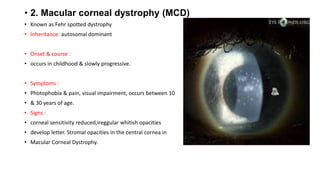
• 2. Macular corneal dystrophy (MCD)
• Known as Fehr spotted dystrophy
• Inheritance: autosomal dominant
• Onset & course :
• occurs in childhood & slowly progressive.
• Symptoms :
• Photophobia & pain, visual impairment, occurs between 10
• & 30 years of age.
• Signs :
• corneal sensitivity reduced,ireggular whitish opacities
• develop letter. Stromal opacities in the central cornea in
• Macular Corneal Dystrophy.
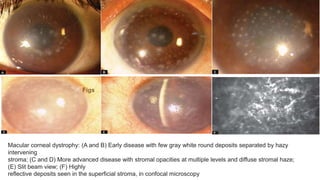
Figs
Macular corneal dystrophy: (A and B) Early disease with few gray white round deposits separated by hazy
intervening
stroma; (C and D) More advanced disease with stromal opacities at multiple levels and diffuse stromal haze;
(E) Slit beam view; (F) Highly
reflective deposits seen in the superficial stroma, in confocal microscopy
• Treatment
• Penetrating keratoplasty is the surgical modality of choice since there is
an involvement of almost all layers of the
cornea. However, recurrences are seen in both lamellar and penetrating
grafts.
• The periphery of the graft is the most affected as the host keratocytes
invade its superficial and deeper layers
• 3. Schnyder corneal dystrophy (SCD)
• Known as hereditary crystalline stromal dystrophy of schnyder.
• Inheritance : autosomal dominant
• Onset & course :
• Appear at birth time or first decade of life, slowly progressive & usually
• asymptomatic.
• PATHOLOGY: Cells in the cornea accumulate cholesterol and phosopholipid
• deposits leading to the opacity
• Symptoms :
• visual acuity decreases with age, scotopic vision is good but photopic vision is
• decreased.
• Signs :
• corneal sensation decrease with age. A. Early opacity. B. Early opacity with crystals.
• C. Central ring shaped opacity
• Treatment
• Penetrating keratoplasty is required as the visual acuity
deteriorates.
Recurrence of cholesterol crystals may occur in either lamellar
or penetrating grafts
• 4.Congenital stromal corneal dystrophy (CSCD)
• Known as congenital hereditary stromal dystrophy
• Inheritance : autosomal dominant
• Onset & Course : occurs congenitally & non progressive or slowly
• progressive.
• Sign & symptoms : lesions are diffused, bilateral, corneal clouding
• with flake-like, whitish stromal opacities throughout the stroma,
• causing moderate to severe visual loss.
• 5. Flack corneal dystrophy (FCD)
• Known as francois-neetens specked corneal dystrophy
• Inheritance : autosomal dominant
• Onset & course : occurs congenitally & is non progressive.
• Signs & symptoms : asymptomatic condition, dandruff like
• opacities or some times ring shaped opacities .
• 6.Posterior amorphous corneal dystrophy (PACD)
• Known as amorphous stromal dystrophy
• Inheritance : autosomal dominant
• Onset & course : occurs in first decade of life, congenital, non or slowly
• progressive.
• Signs & symptoms :
• gray white sheet-like opacities, mild decrease in visual acuity.
• 7. Central cloudy dystrophy of Francois (CCDF)
• Inheritance : unknown
• Onset & course : occurs in first decade, non-progressive.
• Sign & symptoms :
• mostly asymptomatic, rounded stromal opacities that interiorly &
• peripherally & are surrounded by clear tissue.
DESCEMET’S MEMBRANE AND ENDOTHELIUM
• FUCHS ENDOTHELIAL CORNEAL
• DYSTROPHY
• Inheritance: autosomal dominant or sporadic in nature
• Onset & course: Slowly progressive bilateral affecting
• females more than males usually 5th & 6th decade of
• life open angle glaucoma is common association.
• Clinical features:
• Stromal oedema, pain, disc comfortness,blurring of vision, decrease in visual acuity, irritation.
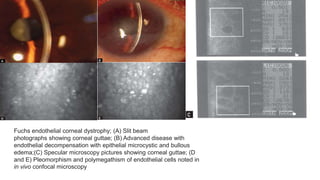
Fuchs endothelial corneal dystrophy; (A) Slit beam
photographs showing corneal guttae; (B) Advanced disease with
endothelial decompensation with epithelial microcystic and bullous
edema;(C) Specular microscopy pictures showing corneal guttae; (D
and E) Pleomorphism and polymegathism of endothelial cells noted in
in vivo confocal microscopy
• TREATMENT
• Topical hypertonic saline,
• Therapeutic soft contact lenses.
• DSAEK (Descemet’s stripping automated endothelial keratoplasty)
• corneal transplantation.
DMEK( descemet membrane endothelial keratoplasty )
Artificial corneas (keratoprosthesis)
• Genetic modification
• Surgery where the central diseased endothelium is stripped off but not replaced
with donor tissue, with subsequent Rho-Associated Kinase (ROCK) inhibition of
endothelial cell division may offer a viable medical treatment.
• POSTERIOR POLYMORPHOU S
CORNEAL DYSTROPHY(PP CD)
• Inheritance: autosomal dominant
• Onset & course: Occurs in early childhood slowly progressive .
• PATHOLOGY :
• Characterised by changes in Descemet's membrane and endothelial
layer.
• PPCD type 2 is linked to the mutations in COL8A2
• Sign & symptoms :
• Deep corneal lesions of various shapes like nodular, vesicular, blister
like lesion.
• Varying gray tissue at the level of descemet membrane.
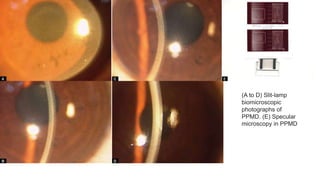
(A to D) Slit-lamp
biomicroscopic
photographs of
PPMD. (E) Specular
microscopy in PPMD
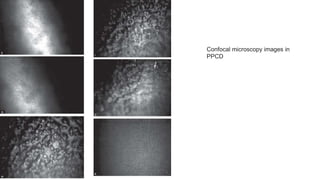
Confocal microscopy images in
PPCD
• CONGENITAL HEREDITARY
ENDOTHELIAL DYTROPHY 1
• Inheritance: autosomal dominant
• Onset & course:
• Occurs in 1st or 2nd yr of life. Occasionally congenital progression of
• corneal clouding occurs over 1 to 10 years.
• Sign & symptoms :
• Endothelial changes in the form of moon crater like changes.
• Corneal clouding ranging from diffuse haze to ground glass, milky appearance with occasional
focal gray sports causing blurred vision, photophobia, watering.
Thickening of cornea (2-3 times thickness).IOP increased rarely.
• CONGENITAL HEREDITARY
ENDOTHELIAL DYSTROPHY 2
• Inheritance: autosomal recessive
• Onset & course:
• Occurs congenitally & is relatively stable
• condition
• Sign & symptoms :
• Condition is more common & severe than
• (CHED 1), Nystagmus present.
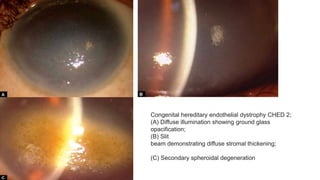
Congenital hereditary endothelial dystrophy CHED 2;
(A) Diffuse illumination showing ground glass
opacification;
(B) Slit
beam demonstrating diffuse stromal thickening;
(C) Secondary spheroidal degeneration
• Treatment
• Penetrating keratoplasty in CHED is moderately successful
and graft survival and visual outcomes are better in cases
with delayed onset.
• X-LINKED ENDOTHELIAL CORNEAL
• DYSTROPHY
• Inheritance: x- chromosomal dominant
• Onset & course:
• Occurs congenitally progressive condition in males & non
• progressive condition in females.
• Sign & symptoms :
• male patients have blurring of vision associated with
• corneal clouding since birth, milky appearance ,nystagmus.
• Female patients are asymptomatic, moon crater like change
• in both.
Thank you

CORNEAL DYSTROPHY.pptx

  • 1.
  • 2.
    EPITHELIAL BASEMENT MEMBRANE DYSTROPHY •INHERITANCE- NO Inheritance • Onset,course,symptom: • Presents in adult life, rarely seen in children. • Asymptomatic or recurrent erosion with pain ,lacrimation & blurred vision • Except for the bleb pattern, on-axis lesions may also cause blurred vision due to irregular astigmatism PATHOLOGY: point mutations in the TGFBI gene
  • 3.
    • SIGNS- • MAPS:irregular island of thickened, gray ,hazy epithelium with scalloped • circumscribed borders, affecting the central or paracentral cornea. • DOTS: irregular round ,oval or comma shaped, non staining, putty-gray opacities. • BLEB PATTERN: sub epithelial pattern like pebbled glass best seen by retro • illumination .. • FINGERPRINT LINES: parallel ,curvilinear lines, usually paracentral,best seen in retro • illumination, isolated or combined with maps.
  • 4.
    • TREATMENT • Débridement. • Superficial keratectomy - DALK • Lubricants, hypertonic saline • Bandage soft Contact Lens. • Anterior stromal reinforcement or puncture. • Phototherapeutic keratectomy (PTK)
  • 5.
    • EPITHELIAL RECURRENT EROSION DYSTROPHY • Inheritance:Autosomal Dominant • Onset,course,symptom: • - At 4-6 years of age some times as early as 8 months of age then • decline in frequency in intensity & cease by 50 years. • - precipitated by minimal trauma & are in the form of attack of • redness,photophobia, ocular pain
  • 6.
    • SIGNS : •CORNEAL EROSIONS are seen during 4-6 years of age sometimes as • early as 8 months of age & generally decline in frequency & • intensity & cease by 50 yrs. • SUBEPITHELIAL HAZE OR BLEB: may be seen between attacks • CENTARL SUBEPITHELIAL CORNEAL OPACITIES: may appear as early • as 7 yrs of age.
  • 7.
    • TREATMENT • •Artificial tears • • Oral tetracycline antibiotics • • Topical corticosteroid • • phototherapeutic keratectomy
  • 8.
    • SUBEPITHELIAL MUCINOUS CORNEALDYSTROPHY • • Inheritance: Autosomal Dominant • Onset,course,symptom: • Onset is in first decade of life & progressive loss of vision occurs in • adolescence. • It include painful episodes of recurrent corneal erosion which decrease • during adolescence. • PATHOLOGY: • Anterior to Bowman layer, deposits of glycosaminoglycan were detected • and identified as chondroitin-4-sulfate and dermatan sulfate
  • 9.
    • SIGNS : •It include bilateral sub epithelial opacities & has most dense centrally, • involving the entire cornea
  • 10.
    • MEESMAN CORNEALDYSTROPHY • Inheritance: Autosomal dominant • Onset,course,symptom: • • occurs in early childhood & is slowly progressive with variant stocker holt dystrophy with • mild visual reduction • • Patient complains glare & light sensitivity, recurrent painful epithelial erosions. • • Rarely blurred vision results from corneal irregularity & scarring. • • PATHOLOGY: It has been associated with genes KRT3 and KRT12 located on chromosome 12 • and 17 respectively.[4]
  • 11.
    • SIGNS : •Multiple tiny epithelial vesicles which extend to the limbus & are most numerous in the inter • palpebral area with clear surrounding epithelium. • Whorled & wedge shaped epithelial patterns have seen. • Cornea; thickening & reduction in the corneal sensation may be seen. • The entire cornea demonstrate fine, grayish punctuate epithelial opacities that stain with • flurorescein & fine linear opacities that may appear in a whorl pattern .
  • 12.
    • TREATMENT • Treatmentis usually not needed unless a person is experiencing symptoms. • lubricating eye drops. severe cases, therapeutic contact lenses or cycloplegic eye drops • Hypertonic saline may be given if symptoms get worse when a person wakes up. • Surgical procedures are sometimes tried when these treatments do not help, and may include epithelial debridement, or keratectomy. • There is a high risk of recurrence with these procedures. • Researchers are also evaluating a form of gene therapy called RNA interference (RNAi) which is also called therapeutic siRNA.
  • 13.
    • LISCH EPITHELIALCORNEAL DYSTROPHY • • Inheritance: X-linked chromosomal dominant • Onset,course,symptom: • Occurs in childhood with slow progression of opacities. • Asymptomatic blurring of vision occurs if pupillary zone is • involved.
  • 14.
    • SIGNS : •DIRECT ILLUMINATION: shows localised gray opacities in different • pattern: whorl like radial, band shaped ,flame. • INDIRECT ILLUMINATION: demonstrates multiple,densly crowded • clear cyst with clear surrounding epithelium • TREATMENT • Epithelial debridement (superficial keratectomy) • •Typically recurs
  • 15.
    • Gelatinous Drop-likeDystrophy • • Inheritance: Autosomal Recessive • Onset,course,symptom: • occurs in first decade of life & is progressive. • Significant decrease in vision ,photophobia, irritation, redness, • tearing.
  • 16.
    • SIGNS : •SUBEPITHELIAL LESIONS: appear initially may be similar to band • shaped keratopathy or there may be groups of small multiple • nodules, that is mulberry configuration is frequently seen.
  • 17.
    • Gelatinous Drop-likeDystrophy • • Inheritance: Autosomal Recessive • Onset,course,symptom: • occurs in first decade of life & is progressive. • Significant decrease in vision ,photophobia, irritation, redness, • tearing. • SIGNS : • SUBEPITHELIAL LESIONS: appear initially may be similar to band • shaped keratopathy or there may be groups of small multiple • nodules, that is mulberry configuration is frequently seen
  • 18.
    Gelatinous drop–like cornealdystrophy (A) Kumquat–like type (B) Mulberry type (C) Band keratopathy type (D) Hematoxylin and eosin staining—amyloid deposition (arrow); (E to G) in vivo confocal microscopy showing bright reflective material at basal epithelium; (H and I) Drop-like globular structures in confocal microscopy
  • 19.
    BOWMAN LAYER DYSTROPHIES •REIS-BUCKLERS CORNEAL • DYTROPHIES • • INHERITANCE: autosomal dominant • ONSET,COURSE: • • also known as dystrophy of bowman layer type 1. • • occurs in childhood & cause slowly progressive deterioration of vision. • SYMPTOMS: • Vision is impaired from childhood. • Erosions cause ocular discomfort and pain in first decade but may become • less severe from the end of second decade.
  • 20.
    • SIGNS: includeconfluent irregular and coarse geographic like opacities • with varying densities which develop at the level of Bowman layer & superficial stroma, initially separated from one another opacities may extend to the limbus and deeper stroma with time.
  • 21.
    Reis-BĂĽcklers corneal dystrophy (Aand B) Diffuse, illumination, (C) Slit beam demonstrating reticular superficial opacity; (D) Recurrence in grafted eye; (E) in vivo confocal microscopy showing homogeneous reflective material in the basal epithelium
  • 22.
    Light microscopy typicallydisplays a sheet like connective tissue layer, replacing the Bowman’s layer with granular Masson trichrome-red deposits which in advanced cases can extend to the subepithelial stroma. Electron microscopy allows the identification of electron-dense rod-shaped bodies staining positively for keratoepithelin, the product of TGFB1
  • 23.
    • Treatment mayinclude a complete or • partial corneal transplant, or photorefractive keratectomy
  • 24.
    • THIEL-BEHNKE CORNEALDYSTROPHY • INHERITANCE: autosomal dominant • ONSET,COURSE: • Is also known as dystrophy of Bowman layer type 2 • Occurs in childhood & slowly progressive deterioration of vision • from increase corneal opacification. • SYMPTOMS: • erosion cause ocular discomfort & pain in the first & second • decade. • Gradual visual impairment develops later.
  • 25.
  • 26.
    A) Lattice cornealdystrophy • 1. Classical lattice corneal dystrophy • Known as Biber-Haab-Dimmer dystrophy • Inheritance – autosomal dominant • PATHOLOGY: Lattice dystrophy gets its name from an accumulation of amyloid deposits, or • abnormal protein fibers, throughout the middle and anterior stroma. It is caused by • mutations in TGFBI gene encoding keratoepithelin. • Onset,course,symptoms: • Appears at the age of 2 years & progressive, ocular discomfort ,pain occur sometimes as • early as first decade of life. • Progressive clouding at central cornea is apparent by age of 20 years, visual acuity is • impaired.
  • 27.
    • Signs : •• Branching spider-like amyloid deposits forming an irregular lattice work in the corneal • stroma, sparing the periphery • • The number of lattice lines may differ between the 2 eyes & dystrophy may be difficult to • diagnose in some younger patients Thin branching lattice lines and dots in retroillumination;
  • 28.
    Lattice corneal dystrophyTGFB1 type (classic lattice) - Magnified view of slit beam
  • 29.
    (E) Magnified viewof slit beam. (F) Opacification in more advanced disease. (G and H) At the levels of superficial and middle stroma highly reflective branching filaments are observed in in vivo confocal microscopy; (I) Normal endothelium
  • 30.
    • Lattice cornealdystrophy , Gelsolin Type (LCD2) • Known as familial amyloidosis of Finnish (FAF) • Inheritance : autosomal dominant • PATHOLOGY: • type II or Finnish type amyloidosis: associated with manifestations of systemic • amyloidosis due to accumulation of gelsolin.Associated conditions may include cutis laxa and ataxia. • Onset & course : • Occurs in third or forth decade of life, Slowly progressive, majority of patients are good • health even in seventh decade of life • Symptoms : • Dry eye frequently, corneal erosion may occur in late life. • Visual acuity is normal because of the dystrophy progress peripheral to central cornea. • Signs : Corneal sensitivity is reduced or absent.
  • 31.
    • TREATMENT • •punctal plugs (both upper and lower) • Keretoplasty is required at age of 30-40 years. • Phototherapeutic keratectomy (PTK) using • [Excimer laser] can restore and preserve useful • visual function for a significant period of time in • patients with anterior corneal dystrophies.[
  • 32.
    b) Granular dystrophy •1.Granular corneal dystrophy, type 1 (classic) (GCDI) • Known as corneal dystrophy groenouw type 1 • Inheritance : autosomal dominant • Onset & course: • Occurs in childhood as soon as 2 years of age, Condition • progressive. • Symptoms : • Glare & photophobia, pain,watering,visual acuity decrease with • increase of age. • Signs: • • Milky granular hyaline deposits in anterior stroma, opacification do • not extend limbus
  • 33.
    Granular corneal dystrophyType 1 (A and B) Discrete stromal opacities (note variation in shape of opacities) axially distributed with clear intervening stroma (C) Slit beam view; (D) Bread crumb like deposits; (E) Verticillate opacity; (F) In retroillumination
  • 34.
    In vivo confocalmicroscopy; showing large hyper-reflective opacities
  • 35.
    • 2. Granularcorneal dystrophy , Type 2 (Granular lattice) (GCD2) • Known as combined granular–lattice corneal • Inheritance : autosomal dominant • Onset & course : • Occurs in first decade, condition is progressive. • Symptoms : • Vision decrease with age, pain, ocular discomfort. • Signs : • Superficial stromal tiny whitish dots, rings shaped snowflake • stromal opacities appearing between superficial stroma & mid stroma & the next lesion, translucent flattened breadcrumb opacities are seen in the final stages.
  • 36.
    Avellino corneal dystrophy,(A) Ribbon like and disk shaped opacities in a genetically confirmed R124H mutation; (B) Same family probands daughter had crumb like opacities with few ray like linear deposits in superficial stroma; (C) Highly reflective granular material seen in the basal epithelial layer in in vivo confocal microscopy; (D) Surrounding stromal keratocyte nuclei appeared normal
  • 37.
    • Treatment isconservative and includes hypertonic saline and bandage contact lenses for recurrent erosions. PTK has been used to treat corneal erosions and to clear the central cornea of granular and lattice deposits. Penetrating/deep anterior lamellar keratoplasty is required in late in the course of disease. • Recurrences do occur and the granular lesions seem to appear first. • Injury to the central cornea results in exacerbation of the corneal dystrophy with increased opacification. • LASIK is contraindicated in this dystrophy
  • 38.
    • 2. Macularcorneal dystrophy (MCD) • Known as Fehr spotted dystrophy • Inheritance: autosomal dominant • Onset & course : • occurs in childhood & slowly progressive. • Symptoms : • Photophobia & pain, visual impairment, occurs between 10 • & 30 years of age. • Signs : • corneal sensitivity reduced,ireggular whitish opacities • develop letter. Stromal opacities in the central cornea in • Macular Corneal Dystrophy.
  • 39.
    Figs Macular corneal dystrophy:(A and B) Early disease with few gray white round deposits separated by hazy intervening stroma; (C and D) More advanced disease with stromal opacities at multiple levels and diffuse stromal haze; (E) Slit beam view; (F) Highly reflective deposits seen in the superficial stroma, in confocal microscopy
  • 40.
    • Treatment • Penetratingkeratoplasty is the surgical modality of choice since there is an involvement of almost all layers of the cornea. However, recurrences are seen in both lamellar and penetrating grafts. • The periphery of the graft is the most affected as the host keratocytes invade its superficial and deeper layers
  • 41.
    • 3. Schnydercorneal dystrophy (SCD) • Known as hereditary crystalline stromal dystrophy of schnyder. • Inheritance : autosomal dominant • Onset & course : • Appear at birth time or first decade of life, slowly progressive & usually • asymptomatic. • PATHOLOGY: Cells in the cornea accumulate cholesterol and phosopholipid • deposits leading to the opacity • Symptoms : • visual acuity decreases with age, scotopic vision is good but photopic vision is • decreased. • Signs : • corneal sensation decrease with age. A. Early opacity. B. Early opacity with crystals. • C. Central ring shaped opacity
  • 42.
    • Treatment • Penetratingkeratoplasty is required as the visual acuity deteriorates. Recurrence of cholesterol crystals may occur in either lamellar or penetrating grafts
  • 43.
    • 4.Congenital stromalcorneal dystrophy (CSCD) • Known as congenital hereditary stromal dystrophy • Inheritance : autosomal dominant • Onset & Course : occurs congenitally & non progressive or slowly • progressive. • Sign & symptoms : lesions are diffused, bilateral, corneal clouding • with flake-like, whitish stromal opacities throughout the stroma, • causing moderate to severe visual loss. • 5. Flack corneal dystrophy (FCD) • Known as francois-neetens specked corneal dystrophy • Inheritance : autosomal dominant • Onset & course : occurs congenitally & is non progressive. • Signs & symptoms : asymptomatic condition, dandruff like • opacities or some times ring shaped opacities .
  • 44.
    • 6.Posterior amorphouscorneal dystrophy (PACD) • Known as amorphous stromal dystrophy • Inheritance : autosomal dominant • Onset & course : occurs in first decade of life, congenital, non or slowly • progressive. • Signs & symptoms : • gray white sheet-like opacities, mild decrease in visual acuity. • 7. Central cloudy dystrophy of Francois (CCDF) • Inheritance : unknown • Onset & course : occurs in first decade, non-progressive. • Sign & symptoms : • mostly asymptomatic, rounded stromal opacities that interiorly & • peripherally & are surrounded by clear tissue.
  • 45.
    DESCEMET’S MEMBRANE ANDENDOTHELIUM • FUCHS ENDOTHELIAL CORNEAL • DYSTROPHY • Inheritance: autosomal dominant or sporadic in nature • Onset & course: Slowly progressive bilateral affecting • females more than males usually 5th & 6th decade of • life open angle glaucoma is common association. • Clinical features: • Stromal oedema, pain, disc comfortness,blurring of vision, decrease in visual acuity, irritation.
  • 46.
    Fuchs endothelial cornealdystrophy; (A) Slit beam photographs showing corneal guttae; (B) Advanced disease with endothelial decompensation with epithelial microcystic and bullous edema;(C) Specular microscopy pictures showing corneal guttae; (D and E) Pleomorphism and polymegathism of endothelial cells noted in in vivo confocal microscopy
  • 47.
    • TREATMENT • Topicalhypertonic saline, • Therapeutic soft contact lenses. • DSAEK (Descemet’s stripping automated endothelial keratoplasty) • corneal transplantation. DMEK( descemet membrane endothelial keratoplasty ) Artificial corneas (keratoprosthesis) • Genetic modification • Surgery where the central diseased endothelium is stripped off but not replaced with donor tissue, with subsequent Rho-Associated Kinase (ROCK) inhibition of endothelial cell division may offer a viable medical treatment.
  • 48.
    • POSTERIOR POLYMORPHOUS CORNEAL DYSTROPHY(PP CD) • Inheritance: autosomal dominant • Onset & course: Occurs in early childhood slowly progressive . • PATHOLOGY : • Characterised by changes in Descemet's membrane and endothelial layer. • PPCD type 2 is linked to the mutations in COL8A2
  • 49.
    • Sign &symptoms : • Deep corneal lesions of various shapes like nodular, vesicular, blister like lesion. • Varying gray tissue at the level of descemet membrane.
  • 50.
    (A to D)Slit-lamp biomicroscopic photographs of PPMD. (E) Specular microscopy in PPMD
  • 51.
  • 52.
    • CONGENITAL HEREDITARY ENDOTHELIALDYTROPHY 1 • Inheritance: autosomal dominant • Onset & course: • Occurs in 1st or 2nd yr of life. Occasionally congenital progression of • corneal clouding occurs over 1 to 10 years. • Sign & symptoms : • Endothelial changes in the form of moon crater like changes. • Corneal clouding ranging from diffuse haze to ground glass, milky appearance with occasional focal gray sports causing blurred vision, photophobia, watering. Thickening of cornea (2-3 times thickness).IOP increased rarely.
  • 53.
    • CONGENITAL HEREDITARY ENDOTHELIALDYSTROPHY 2 • Inheritance: autosomal recessive • Onset & course: • Occurs congenitally & is relatively stable • condition • Sign & symptoms : • Condition is more common & severe than • (CHED 1), Nystagmus present.
  • 54.
    Congenital hereditary endothelialdystrophy CHED 2; (A) Diffuse illumination showing ground glass opacification; (B) Slit beam demonstrating diffuse stromal thickening; (C) Secondary spheroidal degeneration
  • 55.
    • Treatment • Penetratingkeratoplasty in CHED is moderately successful and graft survival and visual outcomes are better in cases with delayed onset.
  • 56.
    • X-LINKED ENDOTHELIALCORNEAL • DYSTROPHY • Inheritance: x- chromosomal dominant • Onset & course: • Occurs congenitally progressive condition in males & non • progressive condition in females. • Sign & symptoms : • male patients have blurring of vision associated with • corneal clouding since birth, milky appearance ,nystagmus. • Female patients are asymptomatic, moon crater like change • in both.
  • 58.