Structural Design of bridge
and Culvert
SDE. Prabhat Kumar Jha
Department of Road
9841360244
Structural design of bridge:
• solid slab bridges, deck girder bridges, B.M. in slab
supported on four edges, distribution of live loads on
longitudinal beams, method of distribution
coefficients, Courbon’s method,
• design of a T- beam bridge, balanced cantilever bridge,
Design of box culvertDesign of box culvert
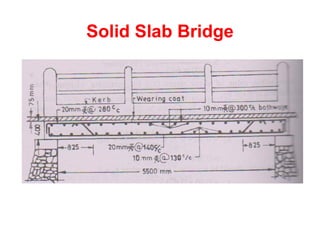
Solid Slab Bridge
Generally for Span <10m
The simplest form of R.C.C. bridges in which the deck
spans between the abutments as a simply supported
one-way slab.
Bending moments and shear force are determined
separately for dead load and live loads.
The design B.M, obtained by adding the B.M due to dead
loads and live load, governs the thickness of slab and
the area of main reinforcement.
• Solid Slab Bridge
The live load to be considered in the design of bridges
consists of concentrated wheel loads due to trains of
different types of heavy vehicles following each other
closely (viz, class AA, class A or class B loading).
The analysis of a slab spanning in one or two directions andThe analysis of a slab spanning in one or two directions and
carrying concentrated load may be carried out by any one of
the rational method like
(i)Pigeaud’s theory
(ii)Westergaurd’s method and
(iii)Effective width method.
• Solid Slab Bridge
7.5m1m W W
Dead Load Bending Moment = w l2 / 8
Live Load Bending Moment by Pigeaud’s theory/Curve
10m
Effective depth required :
d = Sqrt [BM / (R x b)]
Area of Reinforcement required
:
= M / (j x d x σst )
R = Moment of Resistance factor
= 0.5 (σcbc . j . K)
d = effective depth
j = lever arm factor = (1- k/3)
k = neutral axis factor = n/d
= (m. σcbc )/(m. σcbc + σst )
σst = 240 N/mm2 for fy = 500 N/mm2
Solid Slab Bridge
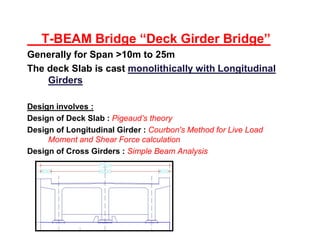
T-BEAM Bridge “Deck Girder Bridge”
Generally for Span >10m to 25m
The deck Slab is cast monolithically with Longitudinalmonolithically with Longitudinal
GirdersGirders
Design involves :
Design of Deck Slab : Pigeaud’s theory
Design of Longitudinal Girder : Courbon's Method for Live Load
Moment and Shear Force calculation
Design of Cross Girders : Simple Beam Analysis
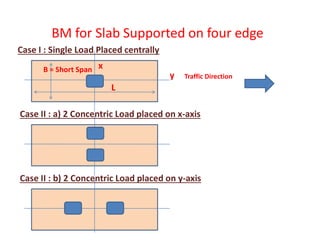
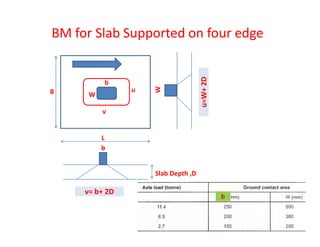
BM for Slab Supported on four edge
Traffic Direction
Case I : Single Load Placed centrally
Case II : a) 2 Concentric Load placed on x-axis
x
y
L
B = Short Span
Case II : b) 2 Concentric Load placed on y-axis
BM for Slab Supported on four edge
B
b
W
u=W+2D
W
u
v
v= b+ 2D
X-X
L
b
Slab Depth ,D
b
BM for Slab Supported on four edge
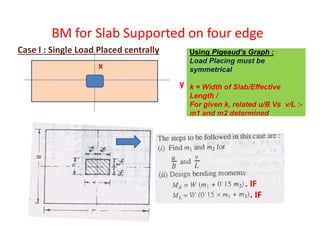
Case I : Single Load Placed centrally
x
y
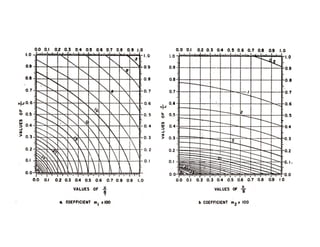
Using Pigeaud’s Graph :
Load Placing must be
symmetrical
k = Width of Slab/Effective
Length /
For given k, related u/B Vs v/L :-
m1 and m2 determined
. IF
. IF
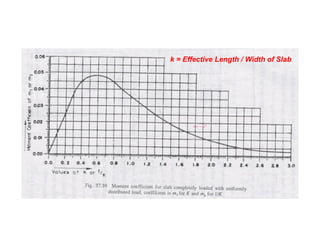
k = Effective Length / Width of Slab
BM for Slab Supported on four edge
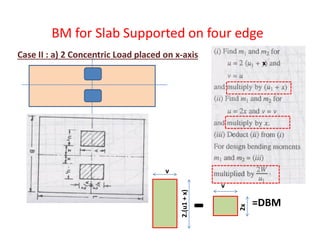
Case II : a) 2 Concentric Load placed on x-axis
x
2.(u1+x) v
=DBM
2x
v
BM for Slab Supported on four edge
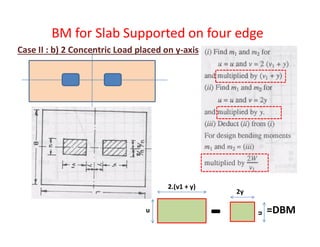
Case II : b) 2 Concentric Load placed on y-axis
u
2.(v1 + y)
u
2y
=DBM
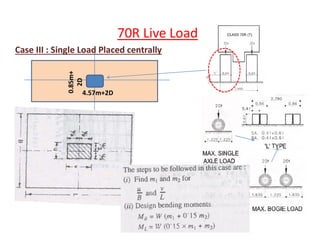
70R Live Load
Case III : Single Load Placed centrally
0.85m+
2D
4.57m+2D
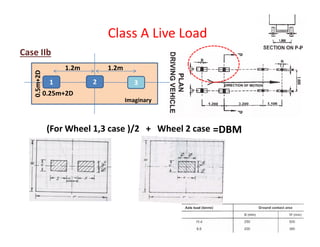
Class A Live Load
Case IIb
1 2
0.5m+2D
1.2m
=DBM
3
Imaginary
(For Wheel 1,3 case )/2 + Wheel 2 case
1.2m
0.25m+2D
=DBM(For Wheel 1,3 case )/2 + Wheel 2 case
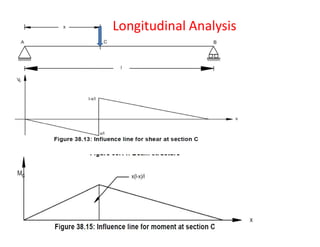
Longitudinal Analysis
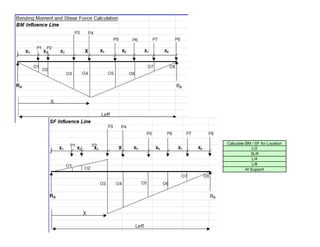
Calculate BM / SF for Location
L/2
3L/8
L/4
L/8
At Support
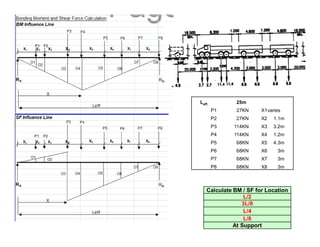
Leff. 25m
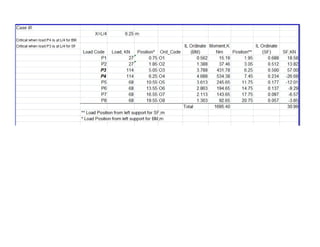
P1 27KN X1varies
P2 27KN X2 1.1m
P3 114KN X3 3.2m
P4 114KN X4 1.2m
P5 68KN X5 4.3m
P6 68KN X6 3m
P7 68KN X7 3m
P8 68KN X8 3m
Calculate BM / SF for Location
L/2
3L/8
L/4
L/8
At Support
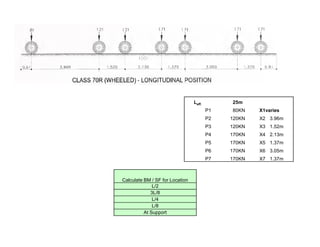
Leff. 25m
P1 80KN X1varies
P2 120KN X2 3.96m
P3 120KN X3 1.52m
P4 170KN X4 2.13m
P5 170KN X5 1.37m
P6 170KN X6 3.05m
P7 170KN X7 1.37m
Calculate BM / SF for Location
L/2
3L/8
L/4
L/8
At Support
COURBON'S METHOD FOR ESTIMATING DISTRIBUTION
COEFFICIENTS
Courbon's method :
According to Courbon's method,
The reaction Ri of the cross beam on any girder I of a typical
bridge consisting of multiple parallel beam is computed
assuming a linear variation of deflection in the transverseassuming a linear variation of deflection in the transverse
direction.
The deflection will be maximum on the exterior girder on the
side of the eccentric load or e.g. of loads if there is a system of
concentrated loads) and minimum of the other exterior girder.
Assumptions or Conditions for Applicability of Courbon's method :
• Simply put, this method for transverse load distribution
among the deck longitudinal is applicable mainly to beam and
slab type decks which are straight in plan (no skew and no
curve).
• The longitudinal beams must be interconnection by
symmetrically spaced, rigid cross beams that are at least five
in number (one above each support, and at least three
intermediate cross beams, equally spaced) ,such that they are
in number (one above each support, and at least three
intermediate cross beams, equally spaced) ,such that they are
not more than about 9 m apart.
• The cross beams should preferably be cast monolithically
with the longitudinal or should be cast at least before any
other gravity loads (besides the self weight of the main
beams) comes on. The stiffness of cross girders is much
greater than that of the longitudinal girders.
Assumptions or Conditions for Applicability of Courbon's
method :
• The ratio of span to width is greater than 2 but less than 4 i.e.
the bridge should be longish.
• spacing between main beams should be between 2 and 4.
• The cross girders extend to a depth of at least 0.75 of the
depth of the longitudinal girders. This is done so as to avoid
• The cross girders extend to a depth of at least 0.75 of the
depth of the longitudinal girders. This is done so as to avoid
anchoring of steel which may interfere with the main steel.
• The bridge structure may have longitudinal girders of same or
different moment of inertia and may have uniform or non -
uniform girder spacing.
• Under the effect of loading, the transverse profile of the
bridge deck maintains a straight geometry.
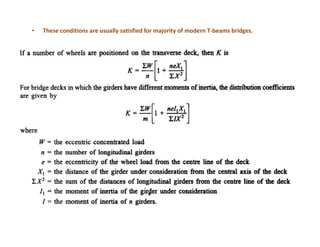
• These conditions are usually satisfied for majority of modern T-beams bridges.
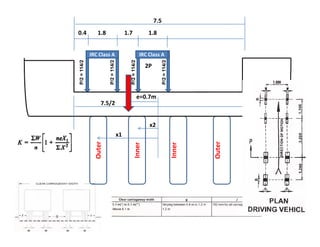
IRC Class A
IRC Class A
P/2=114/2
P/2=114/2
P/2=114/2
P/2=114/2
IRC Class A
0.4 1.8 1.81.7
7.5
7.5/2
2P
e=0.7m
x2
Inner
Inner
Outer
Outer
x1
x2
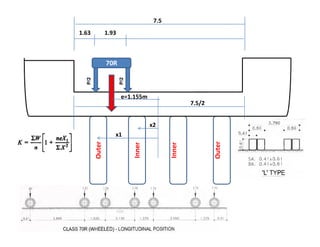
1.63 1.93
7.5
7.5/2
e=1.155m
x2
70R
P/2
P/2
Inner
Inner
Outer
Outer
x1
x2
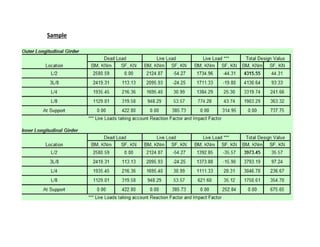
Sample
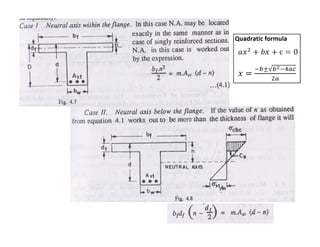
T-Beam Designed as Singly Reinforced Beam
Effective depth required :
d = Sqrt [BM / (R x b)]
Area of Reinforcement required :
= M / (j x d x σst )
R = Moment of Resistance factor
= 0.5 (σcbc . j . K)
d = effective depth
j = lever arm factor = (1- k/3)
k = neutral axis factor = n/d
= (m. σcbc )/(m. σcbc + σst )
σst = 240 N/mm2 for fy = 500 N/mm2
σcbc= fck /3
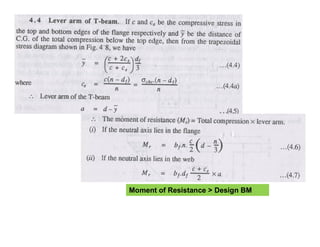
Moment of Resistance > Design BM
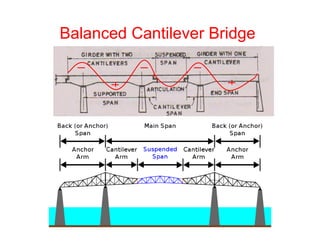
Balanced Cantilever Bridge
•Design of Box Culvert
It is RCC rigid frame box culverts with square or
rectangular opening.
If 4m Span limit and height max. 3m for economy
If Q is low and Bearing Capacity is also low : Box Culvert
is preferred rather than Slab Culvert
The Top of Box Section can be at road level or can be at a
depth below.
Box is structurally very strong, rigid and safe.
Box does not need any elaborate foundation and can
easily be placed over soft foundation by increasing base
slab projection to retain base pressure within safe
bearing capacity of ground soil.
Design of Box Culvert
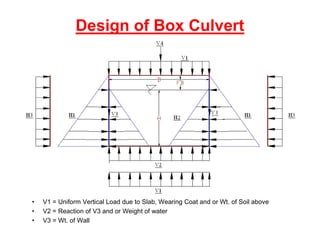
• V1 = Uniform Vertical Load due to Slab, Wearing Coat and or Wt. of Soil above
• V2 = Reaction of V3 and or Weight of water
• V3 = Wt. of Wall
Design of Box Culvert
• V4 = Concentrated vertical Load of Wheel = V x I / e
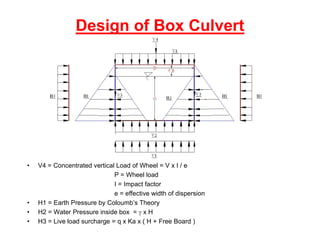
P = Wheel load
I = Impact factor
e = effective width of dispersion
• H1 = Earth Pressure by Coloumb’s Theory
• H2 = Water Pressure inside box =  x H
• H3 = Live load surcharge = q x Ka x ( H + Free Board )
•Design of Box Culvert
Loading Case
Mainly three load cases govern the design. These are
given below :
a) Box empty, live load surcharge on top slab of box
and superimposed surcharge load on earth fill.
b) Box inside full with water, live load surcharge onb) Box inside full with water, live load surcharge on
top slab and superimposed surcharge load on earth
fill.
c) Box inside full with water, live load surcharge on
top slab and no superimposed surcharge on earth
fill.
Design of Box Culvert
The bending moment is obtained by
moment distribution considering all the cell
or cells together for different combination
of loading and design of section
accomplished for final bending momentsaccomplished for final bending moments
for that member.
EffectivedepthrequiredforWallorSlab
d=Sqrt[BM/(Rx1000)]mm
AreaofReinforcementrequiredforWallorSlab
=M/(jxdx
EffectivedepthrequiredforWallorSlab
d=Sqrt[BM/(Rx1000)]mm
AreaofReinforcementrequiredforWallorSlab
=M/(jxdxσst)

1.5 class c,d,e

  • 1.
    Structural Design ofbridge and Culvert SDE. Prabhat Kumar Jha Department of Road 9841360244
  • 2.
    Structural design ofbridge: • solid slab bridges, deck girder bridges, B.M. in slab supported on four edges, distribution of live loads on longitudinal beams, method of distribution coefficients, Courbon’s method, • design of a T- beam bridge, balanced cantilever bridge, Design of box culvertDesign of box culvert
  • 3.
    Solid Slab Bridge Generallyfor Span <10m The simplest form of R.C.C. bridges in which the deck spans between the abutments as a simply supported one-way slab. Bending moments and shear force are determined separately for dead load and live loads. The design B.M, obtained by adding the B.M due to dead loads and live load, governs the thickness of slab and the area of main reinforcement.
  • 4.
    • Solid SlabBridge The live load to be considered in the design of bridges consists of concentrated wheel loads due to trains of different types of heavy vehicles following each other closely (viz, class AA, class A or class B loading). The analysis of a slab spanning in one or two directions andThe analysis of a slab spanning in one or two directions and carrying concentrated load may be carried out by any one of the rational method like (i)Pigeaud’s theory (ii)Westergaurd’s method and (iii)Effective width method.
  • 5.
    • Solid SlabBridge 7.5m1m W W Dead Load Bending Moment = w l2 / 8 Live Load Bending Moment by Pigeaud’s theory/Curve 10m Effective depth required : d = Sqrt [BM / (R x b)] Area of Reinforcement required : = M / (j x d x σst ) R = Moment of Resistance factor = 0.5 (σcbc . j . K) d = effective depth j = lever arm factor = (1- k/3) k = neutral axis factor = n/d = (m. σcbc )/(m. σcbc + σst ) σst = 240 N/mm2 for fy = 500 N/mm2
  • 6.
  • 7.
    T-BEAM Bridge “DeckGirder Bridge” Generally for Span >10m to 25m The deck Slab is cast monolithically with Longitudinalmonolithically with Longitudinal GirdersGirders Design involves : Design of Deck Slab : Pigeaud’s theory Design of Longitudinal Girder : Courbon's Method for Live Load Moment and Shear Force calculation Design of Cross Girders : Simple Beam Analysis
  • 8.
    BM for SlabSupported on four edge Traffic Direction Case I : Single Load Placed centrally Case II : a) 2 Concentric Load placed on x-axis x y L B = Short Span Case II : b) 2 Concentric Load placed on y-axis
  • 9.
    BM for SlabSupported on four edge B b W u=W+2D W u v v= b+ 2D X-X L b Slab Depth ,D b
  • 10.
    BM for SlabSupported on four edge Case I : Single Load Placed centrally x y Using Pigeaud’s Graph : Load Placing must be symmetrical k = Width of Slab/Effective Length / For given k, related u/B Vs v/L :- m1 and m2 determined . IF . IF
  • 12.
    k = EffectiveLength / Width of Slab
  • 13.
    BM for SlabSupported on four edge Case II : a) 2 Concentric Load placed on x-axis x 2.(u1+x) v =DBM 2x v
  • 14.
    BM for SlabSupported on four edge Case II : b) 2 Concentric Load placed on y-axis u 2.(v1 + y) u 2y =DBM
  • 15.
    70R Live Load CaseIII : Single Load Placed centrally 0.85m+ 2D 4.57m+2D
  • 16.
    Class A LiveLoad Case IIb 1 2 0.5m+2D 1.2m =DBM 3 Imaginary (For Wheel 1,3 case )/2 + Wheel 2 case 1.2m 0.25m+2D =DBM(For Wheel 1,3 case )/2 + Wheel 2 case
  • 17.
  • 18.
    Calculate BM /SF for Location L/2 3L/8 L/4 L/8 At Support
  • 19.
    Leff. 25m P1 27KNX1varies P2 27KN X2 1.1m P3 114KN X3 3.2m P4 114KN X4 1.2m P5 68KN X5 4.3m P6 68KN X6 3m P7 68KN X7 3m P8 68KN X8 3m Calculate BM / SF for Location L/2 3L/8 L/4 L/8 At Support
  • 20.
    Leff. 25m P1 80KNX1varies P2 120KN X2 3.96m P3 120KN X3 1.52m P4 170KN X4 2.13m P5 170KN X5 1.37m P6 170KN X6 3.05m P7 170KN X7 1.37m Calculate BM / SF for Location L/2 3L/8 L/4 L/8 At Support
  • 22.
    COURBON'S METHOD FORESTIMATING DISTRIBUTION COEFFICIENTS Courbon's method : According to Courbon's method, The reaction Ri of the cross beam on any girder I of a typical bridge consisting of multiple parallel beam is computed assuming a linear variation of deflection in the transverseassuming a linear variation of deflection in the transverse direction. The deflection will be maximum on the exterior girder on the side of the eccentric load or e.g. of loads if there is a system of concentrated loads) and minimum of the other exterior girder.
  • 23.
    Assumptions or Conditionsfor Applicability of Courbon's method : • Simply put, this method for transverse load distribution among the deck longitudinal is applicable mainly to beam and slab type decks which are straight in plan (no skew and no curve). • The longitudinal beams must be interconnection by symmetrically spaced, rigid cross beams that are at least five in number (one above each support, and at least three intermediate cross beams, equally spaced) ,such that they are in number (one above each support, and at least three intermediate cross beams, equally spaced) ,such that they are not more than about 9 m apart. • The cross beams should preferably be cast monolithically with the longitudinal or should be cast at least before any other gravity loads (besides the self weight of the main beams) comes on. The stiffness of cross girders is much greater than that of the longitudinal girders.
  • 24.
    Assumptions or Conditionsfor Applicability of Courbon's method : • The ratio of span to width is greater than 2 but less than 4 i.e. the bridge should be longish. • spacing between main beams should be between 2 and 4. • The cross girders extend to a depth of at least 0.75 of the depth of the longitudinal girders. This is done so as to avoid • The cross girders extend to a depth of at least 0.75 of the depth of the longitudinal girders. This is done so as to avoid anchoring of steel which may interfere with the main steel. • The bridge structure may have longitudinal girders of same or different moment of inertia and may have uniform or non - uniform girder spacing. • Under the effect of loading, the transverse profile of the bridge deck maintains a straight geometry.
  • 25.
    • These conditionsare usually satisfied for majority of modern T-beams bridges.
  • 26.
    IRC Class A IRCClass A P/2=114/2 P/2=114/2 P/2=114/2 P/2=114/2 IRC Class A 0.4 1.8 1.81.7 7.5 7.5/2 2P e=0.7m x2 Inner Inner Outer Outer x1 x2
  • 27.
  • 28.
  • 29.
    T-Beam Designed asSingly Reinforced Beam Effective depth required : d = Sqrt [BM / (R x b)] Area of Reinforcement required : = M / (j x d x σst ) R = Moment of Resistance factor = 0.5 (σcbc . j . K) d = effective depth j = lever arm factor = (1- k/3) k = neutral axis factor = n/d = (m. σcbc )/(m. σcbc + σst ) σst = 240 N/mm2 for fy = 500 N/mm2 σcbc= fck /3
  • 31.
  • 32.
  • 33.
    •Design of BoxCulvert It is RCC rigid frame box culverts with square or rectangular opening. If 4m Span limit and height max. 3m for economy If Q is low and Bearing Capacity is also low : Box Culvert is preferred rather than Slab Culvert The Top of Box Section can be at road level or can be at a depth below. Box is structurally very strong, rigid and safe. Box does not need any elaborate foundation and can easily be placed over soft foundation by increasing base slab projection to retain base pressure within safe bearing capacity of ground soil.
  • 34.
    Design of BoxCulvert • V1 = Uniform Vertical Load due to Slab, Wearing Coat and or Wt. of Soil above • V2 = Reaction of V3 and or Weight of water • V3 = Wt. of Wall
  • 35.
    Design of BoxCulvert • V4 = Concentrated vertical Load of Wheel = V x I / e P = Wheel load I = Impact factor e = effective width of dispersion • H1 = Earth Pressure by Coloumb’s Theory • H2 = Water Pressure inside box =  x H • H3 = Live load surcharge = q x Ka x ( H + Free Board )
  • 36.
    •Design of BoxCulvert Loading Case Mainly three load cases govern the design. These are given below : a) Box empty, live load surcharge on top slab of box and superimposed surcharge load on earth fill. b) Box inside full with water, live load surcharge onb) Box inside full with water, live load surcharge on top slab and superimposed surcharge load on earth fill. c) Box inside full with water, live load surcharge on top slab and no superimposed surcharge on earth fill.
  • 37.
    Design of BoxCulvert The bending moment is obtained by moment distribution considering all the cell or cells together for different combination of loading and design of section accomplished for final bending momentsaccomplished for final bending moments for that member.
  • 38.