SLOPE DEFLECTION METHOD

NAME:ABDULLAH –AL-MAMUN
ID NO: 10.01.03.079
SECTION:B
YEAR:4th SEMESTER: 2nd
Presentation Overview:
1. INTRODUCTION.(Basic Idea of Slope
Deflection Method )
2. ASSUMPTIONS IN THE SLOPE
DEFLECTION METHOD .
3. APLICATION OF SLOPE DEFLECTION
4.
5.
6.
7.

METHOD.
SIGN CONVENTION.
PROCEDURE.
SLOPE DEFLECTION EQUATION.
EXAMPLE.
INTRODUCTION:
 This method was developed by axel bendexon

in Germany in 1914. This method is applicable
to all types of statically indeterminate beams
& frames and in this method, we solve for
unknown joint rotations, which are expressed
in terms of the applied loads and the bending
moments.Deflections due to shear and axial
stresses are not considered as the effect are
small.
 Indeterminate structure: the structure which
can not be analyzed by the equations of static
equilibriums alone are called indeterminate
structures.
ASSUMPTIONS IN THE SLOPE DEFLECTION METHOD:
This method is based on the following simplified
assumptions:
 All the joints of the frame are rigid,


Distortion, due to axial and shear stresses,
being very small, are neglected.
Applications of slope deflection method:

1. Continuous Beams
2. Frames with out side sway
3. Frames with side sway
SIGN CONVENTION:–
(1) ROTATIONS:– Clockwise joint
rotations are considered as
(-ve).
(2) END MOMENTS:– clockwise
end moments are considered as
(+ve).
PROCEDURE:–

The procedure is as follows:
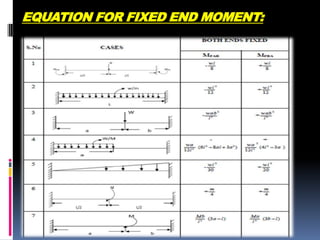
(1) Determine the fixed end moments at the end of
each span due to applied loads acting on span by
considering each span as fixed ended. Assign ±
Signs w.r.t. above sign convention.
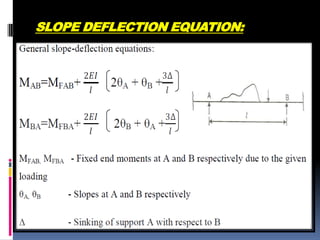
(2) Express all end moments in terms of fixed end
moments and the joint rotations by using slope –
deflection equations.
(3) Establish simultaneous equations with the joint
rotations as the
unknowns by applying the
condition that sum of the end moments acting on
the ends of the two members meeting at a joint
should be equal to zero.
(4) Solve for unknown joint rotations.
(5) Substitute back the end rotations in slope –
deflection equations and compute the end
moments.
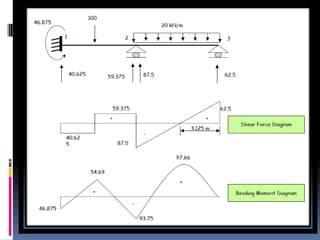
(6) Determine all reactions and draw S.F. and B.M.
diagrams and also sketch the elastic curve
SLOPE DEFLECTION EQUATION:
EQUATION FOR FIXED END MOMENT:
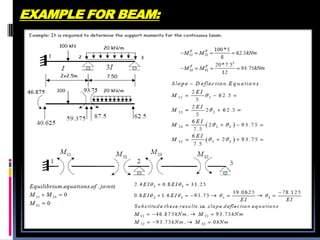
EXAMPLE FOR BEAM:
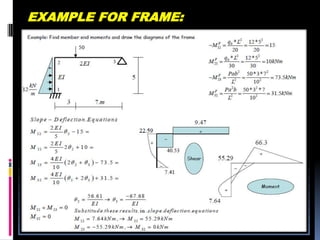
EXAMPLE FOR FRAME:
Slope deflection method

Slope deflection method

  • 1.
    SLOPE DEFLECTION METHOD NAME:ABDULLAH–AL-MAMUN ID NO: 10.01.03.079 SECTION:B YEAR:4th SEMESTER: 2nd
  • 2.
    Presentation Overview: 1. INTRODUCTION.(BasicIdea of Slope Deflection Method ) 2. ASSUMPTIONS IN THE SLOPE DEFLECTION METHOD . 3. APLICATION OF SLOPE DEFLECTION 4. 5. 6. 7. METHOD. SIGN CONVENTION. PROCEDURE. SLOPE DEFLECTION EQUATION. EXAMPLE.
  • 3.
    INTRODUCTION:  This methodwas developed by axel bendexon in Germany in 1914. This method is applicable to all types of statically indeterminate beams & frames and in this method, we solve for unknown joint rotations, which are expressed in terms of the applied loads and the bending moments.Deflections due to shear and axial stresses are not considered as the effect are small.  Indeterminate structure: the structure which can not be analyzed by the equations of static equilibriums alone are called indeterminate structures.
  • 4.
    ASSUMPTIONS IN THESLOPE DEFLECTION METHOD: This method is based on the following simplified assumptions:  All the joints of the frame are rigid,  Distortion, due to axial and shear stresses, being very small, are neglected.
  • 5.
    Applications of slopedeflection method: 1. Continuous Beams 2. Frames with out side sway 3. Frames with side sway
  • 6.
    SIGN CONVENTION:– (1) ROTATIONS:–Clockwise joint rotations are considered as (-ve). (2) END MOMENTS:– clockwise end moments are considered as (+ve).
  • 7.
    PROCEDURE:– The procedure isas follows: (1) Determine the fixed end moments at the end of each span due to applied loads acting on span by considering each span as fixed ended. Assign ± Signs w.r.t. above sign convention. (2) Express all end moments in terms of fixed end moments and the joint rotations by using slope – deflection equations. (3) Establish simultaneous equations with the joint rotations as the unknowns by applying the condition that sum of the end moments acting on the ends of the two members meeting at a joint should be equal to zero. (4) Solve for unknown joint rotations. (5) Substitute back the end rotations in slope – deflection equations and compute the end moments. (6) Determine all reactions and draw S.F. and B.M. diagrams and also sketch the elastic curve
  • 8.
  • 9.
    EQUATION FOR FIXEDEND MOMENT:
  • 10.
  • 12.