
PRESENTATION ON COLUMN
CE-4104 Building Design Sessional| 2024
Suman Jyoti - 191125
• Department of Civil Engineering
• Dhaka University of Engineering & Technology, Gazipur
Prepared by:
Prof.Dr Mozammel Haque
Professor
Mr. Kazi Abu Manjur
Assistant Professor
• Department of Civil Engineering
• Dhaka University of Engineering & Technology, Gazipur
• Definition of column
• Size of the column
• Types of column
• Types of the reinforcement in column
• Minimum longitudinal bars of column
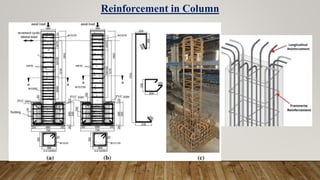
• Reinforcement in column
• Failure modes of column
• Column splices
Contents
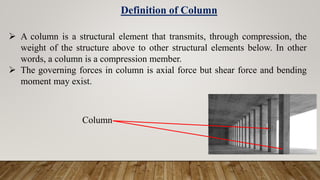
 A column is a structural element that transmits, through compression, the
weight of the structure above to other structural elements below. In other
words, a column is a compression member.
 The governing forces in column is axial force but shear force and bending
moment may exist.
Definition of Column
Column
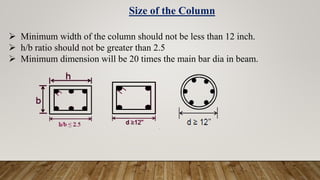
 Minimum width of the column should not be less than 12 inch.
 h/b ratio should not be greater than 2.5
 Minimum dimension will be 20 times the main bar dia in beam.
Size of the Column
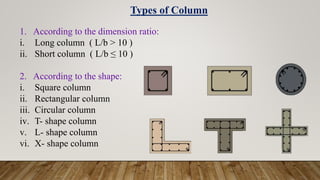
1. According to the dimension ratio:
i. Long column ( L/b > 10 )
ii. Short column ( L/b ≤ 10 )
2. According to the shape:
i. Square column
ii. Rectangular column
iii. Circular column
iv. T- shape column
v. L- shape column
vi. X- shape column
Types of Column
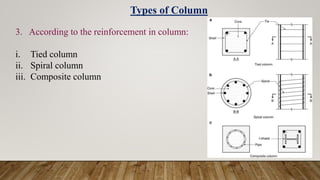
3. According to the reinforcement in column:
i. Tied column
ii. Spiral column
iii. Composite column
Types of Column
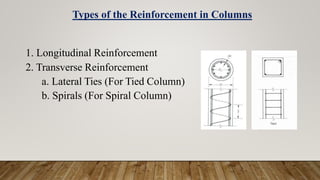
Types of the Reinforcement in Columns
1. Longitudinal Reinforcement
2. Transverse Reinforcement
a. Lateral Ties (For Tied Column)
b. Spirals (For Spiral Column)
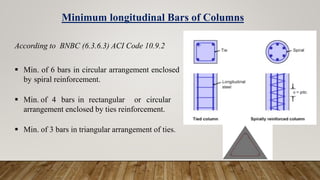
Minimum longitudinal Bars of Columns
According to BNBC (6.3.6.3) ACI Code 10.9.2
 Min. of 6 bars in circular arrangement enclosed
by spiral reinforcement.
 Min. of 4 bars in rectangular or circular
arrangement enclosed by ties reinforcement.
 Min. of 3 bars in triangular arrangement of ties.
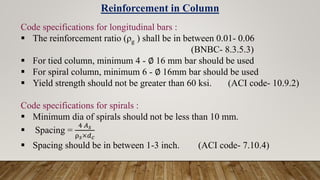
Reinforcement in Column
Code specifications for longitudinal bars :
 The reinforcement ratio (ρg ) shall be in between 0.01- 0.06
(BNBC- 8.3.5.3)
 For tied column, minimum 4 - ∅ 16 mm bar should be used
 For spiral column, minimum 6 - ∅ 16mm bar should be used
 Yield strength should not be greater than 60 ksi. (ACI code- 10.9.2)
Code specifications for spirals :
 Minimum dia of spirals should not be less than 10 mm.
 Spacing =
4 𝐴𝑠
ρ𝑠×𝑑𝑐
 Spacing should be in between 1-3 inch. (ACI code- 7.10.4)
Reinforcement in Column
Code specifications for lateral ties:
 10mm dia bar for main bar ≤ 32 mm dia bar
 12 mm dia bar for main bar ≥ 36mm dia bar and bundle bars
Spacing requirements:
 Minimum of;
i. 16 times of main bar dia.
ii. 48 times of tie bar dia.
iii. Least dimension of column. (ACI code- 7.10.5)
Reinforcement in Column
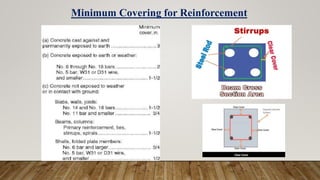
Minimum Covering for Reinforcement
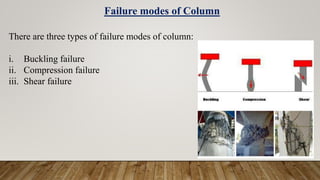
There are three types of failure modes of column:
i. Buckling failure
ii. Compression failure
iii. Shear failure
Failure modes of Column
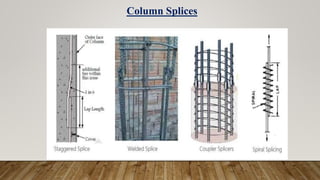
Column Splices
PRESENTATION ON BEAM
CE-4104 Building Design Sessional| 2024
Suman Jyoti - 191125
• Department of Civil Engineering
• Dhaka University of Engineering & Technology, Gazipur
Prepared by:
• Definition of beam
• Types of beam
• Depth of beam for serviceability condition
• Types of the reinforcement in beam
• Cracking system of the beam
• Hook length
• Lapping
• Cross section of beam
• Cantilever Beam Detailing
Contents
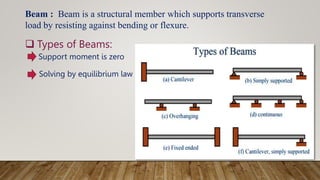
Beam : Beam is a structural member which supports transverse
load by resisting against bending or flexure.
Support moment is zero
Solving by equilibrium law
 Types of Beams:
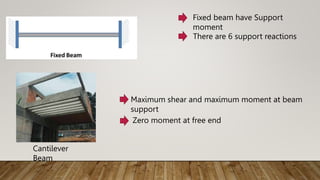
Fixed beam have Support
moment
There are 6 support reactions
Cantilever
Beam
Maximum shear and maximum moment at beam
support
Zero moment at free end
Support
Condition
Simply
Support
One end
Continuous
Both ends
Continuous
Cantilever
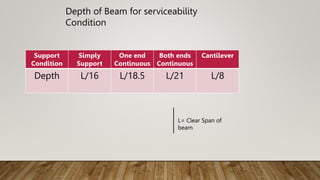
Depth L/16 L/18.5 L/21 L/8
Depth of Beam for serviceability
Condition
L= Clear Span of
beam
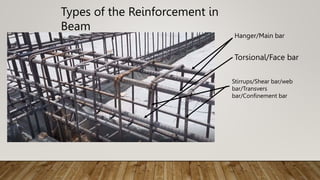
Types of the Reinforcement in
Beam
Hanger/Main bar
Torsional/Face bar
Stirrups/Shear bar/web
bar/Transvers
bar/Confinement bar
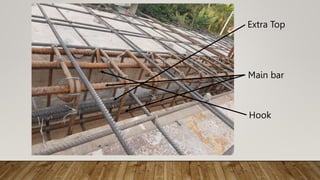
Main bar
Extra Top
Hook
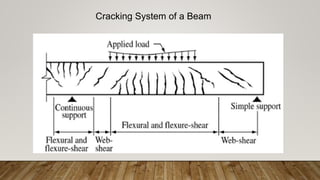
Cracking System of a Beam
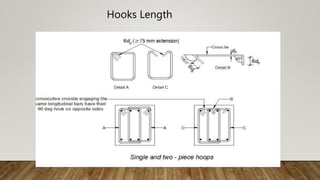
Hooks Length
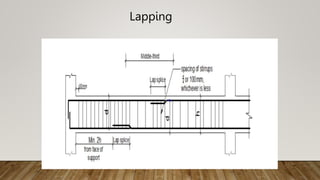
Lapping
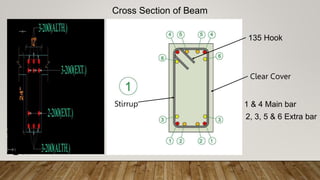
Cross Section of Beam
Clear Cover
1 & 4 Main bar
135 Hook
Stirrup
2, 3, 5 & 6 Extra bar
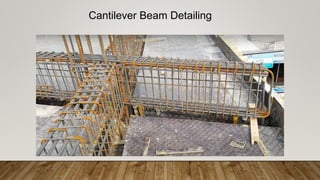
Cantilever Beam Detailing
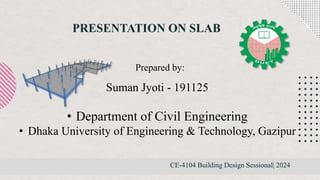
PRESENTATION ON SLAB
CE-4104 Building Design Sessional| 2024
Suman Jyoti - 191125
• Department of Civil Engineering
• Dhaka University of Engineering & Technology, Gazipur
Prepared by:
• Definition of slab
• Types of slab
• Thickness of slab
• Reinforcement of slab
• Deflection of slab
• Corner reinforcement
Contents
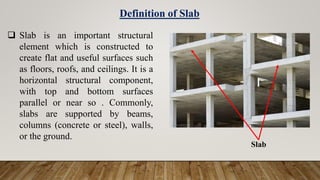
Definition of Slab
 Slab is an important structural
element which is constructed to
create flat and useful surfaces such
as floors, roofs, and ceilings. It is a
horizontal structural component,
with top and bottom surfaces
parallel or near so . Commonly,
slabs are supported by beams,
columns (concrete or steel), walls,
or the ground.
Slab
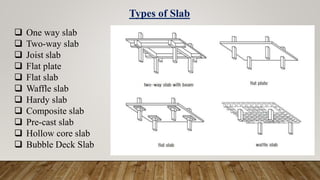
Types of Slab
 One way slab
 Two-way slab
 Joist slab
 Flat plate
 Flat slab
 Waffle slab
 Hardy slab
 Composite slab
 Pre-cast slab
 Hollow core slab
 Bubble Deck Slab
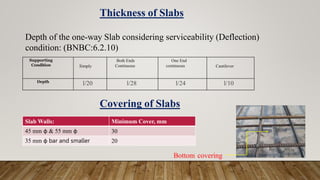
Thickness of Slabs
Depth of the one-way Slab considering serviceability (Deflection)
condition: (BNBC:6.2.10)
Supporting
Condition Simply
Both Ends
Continuous
One End
continuous Cantilever
Depth
l/20 l/28 l/24 l/10
Bottom covering
Covering of Slabs
Slab Walls: Minimum Cover, mm
45 mm φ & 55 mm φ 30
35 mm φ bar and smaller 20
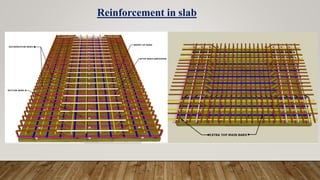
Reinforcement in slab
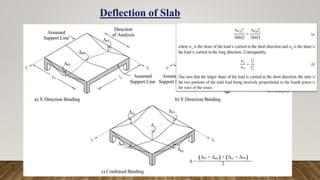
Deflection of Slab
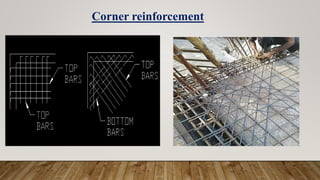
Corner reinforcement
PRESENTATION ON FOUNDATION
CE-4104 Building Design Sessional| 2024
Suman Jyoti - 191125
• Department of Civil Engineering
• Dhaka University of Engineering & Technology, Gazipur
Prepared by:
• Definition of foundation
• Types of foundation/footing
• Tolerable settlement, tilt and rotation
• Area of foundation
• Design of shallow foundation
• Reinforcement in shallow foundation
• Design of pile foundation
Contents
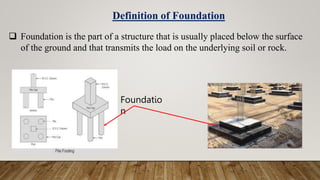
 Foundation is the part of a structure that is usually placed below the surface
of the ground and that transmits the load on the underlying soil or rock.
Definition of Foundation
Foundatio
n
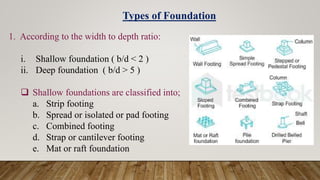
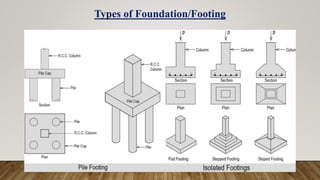
1. According to the width to depth ratio:
i. Shallow foundation ( b/d < 2 )
ii. Deep foundation ( b/d > 5 )
 Shallow foundations are classified into;
a. Strip footing
b. Spread or isolated or pad footing
c. Combined footing
d. Strap or cantilever footing
e. Mat or raft foundation
Types of Foundation
Types of Foundation/Footing
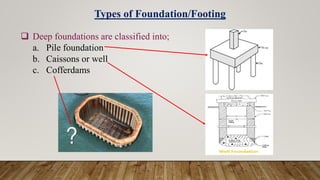
 Deep foundations are classified into;
a. Pile foundation
b. Caissons or well
c. Cofferdams
Types of Foundation/Footing
 For isolated pad footing on sand,
Total settlement ≤ 25 mm
Differential settlement ≤ 20mm
 For isolated pad footing on clay,
Total settlement ≤ 40 mm
Differential settlement ≤ 20 mm
 For mat or raft foundation,
Total settlement ≤ 50 mm
Differential settlement ≤ 19 mm
Tolerable Settlement, Tilt and Rotation
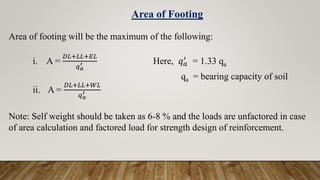
Area of footing will be the maximum of the following:
i. A =
𝐷𝐿+𝐿𝐿+𝐸𝐿
𝑞𝑎
′ Here, 𝑞𝑎
′
= 1.33 qa
qa = bearing capacity of soil
ii. A =
𝐷𝐿+𝐿𝐿+𝑊𝐿
𝑞𝑎
′
Note: Self weight should be taken as 6-8 % and the loads are unfactored in case
of area calculation and factored load for strength design of reinforcement.
Area of Footing
DESIGN OF SHALLOW FOUNDATION
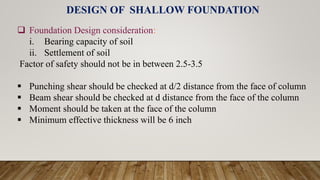
 Foundation Design consideration:
i. Bearing capacity of soil
ii. Settlement of soil
Factor of safety should not be in between 2.5-3.5
 Punching shear should be checked at d/2 distance from the face of column
 Beam shear should be checked at d distance from the face of the column
 Moment should be taken at the face of the column
 Minimum effective thickness will be 6 inch
DESIGN OF SHALLOW FOUNDATION
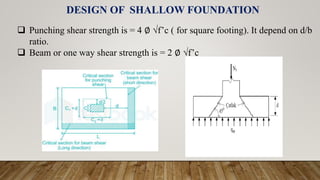
 Punching shear strength is = 4 ∅ √f’c ( for square footing). It depend on d/b
ratio.
 Beam or one way shear strength is = 2 ∅ √f’c
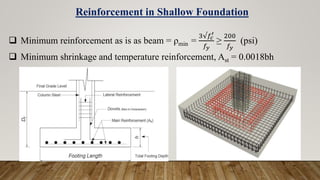
 Minimum reinforcement as is as beam = ρmin =
3√𝑓𝑐
′
𝑓𝑦
≥
200
𝑓𝑦
(psi)
 Minimum shrinkage and temperature reinforcement, Ast = 0.0018bh
Reinforcement in Shallow Foundation
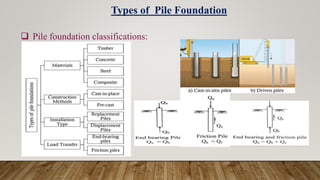
 Pile foundation classifications:
Types of Pile Foundation
Design of Pile Foundation
 Assumptions:
i. Each pile in a group carries equal load
ii. The pile cap is in contact with the ground
iii. The piles are all vertical
iv. Load is applied at the center of the pile group
v. The pile group is symmetric, and the cap is very thick
 Design consideration:
 The length to diameter ration should not be more than 50 for single pile
 Ultimate capacity of driven pile = Qs + Qb –W
 Minimum cylindrical strength of concrete for 28 days is 21 Mpa
 The minimum area at the butt of pile is 650 cm2 and minimum diameter at
the tip is 200mm.
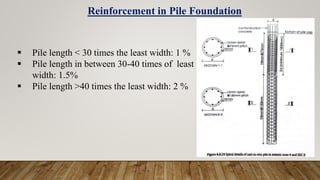
Reinforcement in Pile Foundation
 Pile length < 30 times the least width: 1 %
 Pile length in between 30-40 times of least
width: 1.5%
 Pile length >40 times the least width: 2 %
for
Your Attention!
Any Questions..?

Presentation on Slab, Beam, Column, and Foundation/Footing

  • 1.
    PRESENTATION ON COLUMN CE-4104Building Design Sessional| 2024 Suman Jyoti - 191125 • Department of Civil Engineering • Dhaka University of Engineering & Technology, Gazipur Prepared by:
  • 2.
    Prof.Dr Mozammel Haque Professor Mr.Kazi Abu Manjur Assistant Professor • Department of Civil Engineering • Dhaka University of Engineering & Technology, Gazipur
  • 3.
    • Definition ofcolumn • Size of the column • Types of column • Types of the reinforcement in column • Minimum longitudinal bars of column • Reinforcement in column • Failure modes of column • Column splices Contents
  • 4.
     A columnis a structural element that transmits, through compression, the weight of the structure above to other structural elements below. In other words, a column is a compression member.  The governing forces in column is axial force but shear force and bending moment may exist. Definition of Column Column
  • 5.
     Minimum widthof the column should not be less than 12 inch.  h/b ratio should not be greater than 2.5  Minimum dimension will be 20 times the main bar dia in beam. Size of the Column
  • 6.
    1. According tothe dimension ratio: i. Long column ( L/b > 10 ) ii. Short column ( L/b ≤ 10 ) 2. According to the shape: i. Square column ii. Rectangular column iii. Circular column iv. T- shape column v. L- shape column vi. X- shape column Types of Column
  • 7.
    3. According tothe reinforcement in column: i. Tied column ii. Spiral column iii. Composite column Types of Column
  • 8.
    Types of theReinforcement in Columns 1. Longitudinal Reinforcement 2. Transverse Reinforcement a. Lateral Ties (For Tied Column) b. Spirals (For Spiral Column)
  • 9.
    Minimum longitudinal Barsof Columns According to BNBC (6.3.6.3) ACI Code 10.9.2  Min. of 6 bars in circular arrangement enclosed by spiral reinforcement.  Min. of 4 bars in rectangular or circular arrangement enclosed by ties reinforcement.  Min. of 3 bars in triangular arrangement of ties.
  • 10.
    Reinforcement in Column Codespecifications for longitudinal bars :  The reinforcement ratio (ρg ) shall be in between 0.01- 0.06 (BNBC- 8.3.5.3)  For tied column, minimum 4 - ∅ 16 mm bar should be used  For spiral column, minimum 6 - ∅ 16mm bar should be used  Yield strength should not be greater than 60 ksi. (ACI code- 10.9.2) Code specifications for spirals :  Minimum dia of spirals should not be less than 10 mm.  Spacing = 4 𝐴𝑠 ρ𝑠×𝑑𝑐  Spacing should be in between 1-3 inch. (ACI code- 7.10.4)
  • 11.
    Reinforcement in Column Codespecifications for lateral ties:  10mm dia bar for main bar ≤ 32 mm dia bar  12 mm dia bar for main bar ≥ 36mm dia bar and bundle bars Spacing requirements:  Minimum of; i. 16 times of main bar dia. ii. 48 times of tie bar dia. iii. Least dimension of column. (ACI code- 7.10.5)
  • 12.
  • 13.
    Minimum Covering forReinforcement
  • 14.
    There are threetypes of failure modes of column: i. Buckling failure ii. Compression failure iii. Shear failure Failure modes of Column
  • 15.
  • 16.
    PRESENTATION ON BEAM CE-4104Building Design Sessional| 2024 Suman Jyoti - 191125 • Department of Civil Engineering • Dhaka University of Engineering & Technology, Gazipur Prepared by:
  • 17.
    • Definition ofbeam • Types of beam • Depth of beam for serviceability condition • Types of the reinforcement in beam • Cracking system of the beam • Hook length • Lapping • Cross section of beam • Cantilever Beam Detailing Contents
  • 18.
    Beam : Beamis a structural member which supports transverse load by resisting against bending or flexure. Support moment is zero Solving by equilibrium law  Types of Beams:
  • 19.
    Fixed beam haveSupport moment There are 6 support reactions Cantilever Beam Maximum shear and maximum moment at beam support Zero moment at free end
  • 20.
    Support Condition Simply Support One end Continuous Both ends Continuous Cantilever DepthL/16 L/18.5 L/21 L/8 Depth of Beam for serviceability Condition L= Clear Span of beam
  • 21.
    Types of theReinforcement in Beam Hanger/Main bar Torsional/Face bar Stirrups/Shear bar/web bar/Transvers bar/Confinement bar
  • 22.
  • 23.
  • 24.
  • 25.
  • 26.
    Cross Section ofBeam Clear Cover 1 & 4 Main bar 135 Hook Stirrup 2, 3, 5 & 6 Extra bar
  • 27.
  • 28.
    PRESENTATION ON SLAB CE-4104Building Design Sessional| 2024 Suman Jyoti - 191125 • Department of Civil Engineering • Dhaka University of Engineering & Technology, Gazipur Prepared by:
  • 29.
    • Definition ofslab • Types of slab • Thickness of slab • Reinforcement of slab • Deflection of slab • Corner reinforcement Contents
  • 30.
    Definition of Slab Slab is an important structural element which is constructed to create flat and useful surfaces such as floors, roofs, and ceilings. It is a horizontal structural component, with top and bottom surfaces parallel or near so . Commonly, slabs are supported by beams, columns (concrete or steel), walls, or the ground. Slab
  • 31.
    Types of Slab One way slab  Two-way slab  Joist slab  Flat plate  Flat slab  Waffle slab  Hardy slab  Composite slab  Pre-cast slab  Hollow core slab  Bubble Deck Slab
  • 32.
    Thickness of Slabs Depthof the one-way Slab considering serviceability (Deflection) condition: (BNBC:6.2.10) Supporting Condition Simply Both Ends Continuous One End continuous Cantilever Depth l/20 l/28 l/24 l/10 Bottom covering Covering of Slabs Slab Walls: Minimum Cover, mm 45 mm φ & 55 mm φ 30 35 mm φ bar and smaller 20
  • 33.
  • 34.
  • 35.
  • 36.
    PRESENTATION ON FOUNDATION CE-4104Building Design Sessional| 2024 Suman Jyoti - 191125 • Department of Civil Engineering • Dhaka University of Engineering & Technology, Gazipur Prepared by:
  • 37.
    • Definition offoundation • Types of foundation/footing • Tolerable settlement, tilt and rotation • Area of foundation • Design of shallow foundation • Reinforcement in shallow foundation • Design of pile foundation Contents
  • 38.
     Foundation isthe part of a structure that is usually placed below the surface of the ground and that transmits the load on the underlying soil or rock. Definition of Foundation Foundatio n
  • 39.
    1. According tothe width to depth ratio: i. Shallow foundation ( b/d < 2 ) ii. Deep foundation ( b/d > 5 )  Shallow foundations are classified into; a. Strip footing b. Spread or isolated or pad footing c. Combined footing d. Strap or cantilever footing e. Mat or raft foundation Types of Foundation
  • 40.
  • 41.
     Deep foundationsare classified into; a. Pile foundation b. Caissons or well c. Cofferdams Types of Foundation/Footing
  • 42.
     For isolatedpad footing on sand, Total settlement ≤ 25 mm Differential settlement ≤ 20mm  For isolated pad footing on clay, Total settlement ≤ 40 mm Differential settlement ≤ 20 mm  For mat or raft foundation, Total settlement ≤ 50 mm Differential settlement ≤ 19 mm Tolerable Settlement, Tilt and Rotation
  • 43.
    Area of footingwill be the maximum of the following: i. A = 𝐷𝐿+𝐿𝐿+𝐸𝐿 𝑞𝑎 ′ Here, 𝑞𝑎 ′ = 1.33 qa qa = bearing capacity of soil ii. A = 𝐷𝐿+𝐿𝐿+𝑊𝐿 𝑞𝑎 ′ Note: Self weight should be taken as 6-8 % and the loads are unfactored in case of area calculation and factored load for strength design of reinforcement. Area of Footing
  • 44.
    DESIGN OF SHALLOWFOUNDATION  Foundation Design consideration: i. Bearing capacity of soil ii. Settlement of soil Factor of safety should not be in between 2.5-3.5  Punching shear should be checked at d/2 distance from the face of column  Beam shear should be checked at d distance from the face of the column  Moment should be taken at the face of the column  Minimum effective thickness will be 6 inch
  • 45.
    DESIGN OF SHALLOWFOUNDATION  Punching shear strength is = 4 ∅ √f’c ( for square footing). It depend on d/b ratio.  Beam or one way shear strength is = 2 ∅ √f’c
  • 46.
     Minimum reinforcementas is as beam = ρmin = 3√𝑓𝑐 ′ 𝑓𝑦 ≥ 200 𝑓𝑦 (psi)  Minimum shrinkage and temperature reinforcement, Ast = 0.0018bh Reinforcement in Shallow Foundation
  • 47.
     Pile foundationclassifications: Types of Pile Foundation
  • 48.
    Design of PileFoundation  Assumptions: i. Each pile in a group carries equal load ii. The pile cap is in contact with the ground iii. The piles are all vertical iv. Load is applied at the center of the pile group v. The pile group is symmetric, and the cap is very thick  Design consideration:  The length to diameter ration should not be more than 50 for single pile  Ultimate capacity of driven pile = Qs + Qb –W  Minimum cylindrical strength of concrete for 28 days is 21 Mpa  The minimum area at the butt of pile is 650 cm2 and minimum diameter at the tip is 200mm.
  • 49.
    Reinforcement in PileFoundation  Pile length < 30 times the least width: 1 %  Pile length in between 30-40 times of least width: 1.5%  Pile length >40 times the least width: 2 %
  • 50.