Vectors
1.

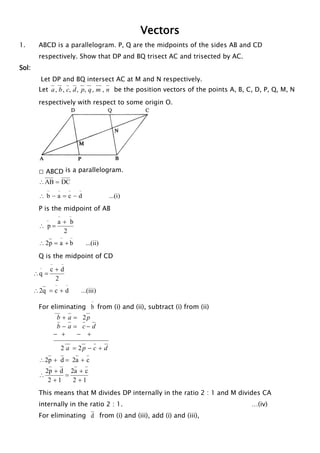
ABCD is a parallelogram. P, Q are the midpoints of the sides AB and CD
respectively. Show that DP and BQ trisect AC and trisected by AC.

Sol:
Let DP and BQ intersect AC at M and N respectively.
Let a , b , c, d , p, q , m , n be the position vectors of the points A, B, C, D, P, Q, M, N
respectively with respect to some origin O.

□ ABCD is a parallelogram.

 AB  DC








bacd

...(i)

P is the midpoint of AB




a b
 p
2






 2p  a  b

...(ii)

Q is the midpoint of CD




cd
q 
2






 2q  c  d

...(iii)


For eliminating b from (i) and (ii), subtract (i) from (ii)

b  a  2p
b  a  c d
 
 
_________________
2 a  2p  c  d

 2p  d  2a  c


2p  d 2a  c

2 1
2 1

This means that M divides DP internally in the ratio 2 : 1 and M divides CA
internally in the ratio 2 : 1.
For eliminating d from (i) and (iii), add (i) and (iii),

…(iv)
c  d  2q
c d b a
____________
2c  2q  b  a
 2q  b  2c  a


2q  b 2c  a

2 1
2 1

This means that N divides BQ internally in the ratio 2: 1 and N divides AC internally
in the ratio 2 : 1.
From (iv) and (v), if follows that DP and BQ trisect AC and are trisected by AC.
2.

If in a tetrahedron, the two pairs of opposite edges are perpendicular, then show
that the edges in the third pair is also perpendicular.

Sol:
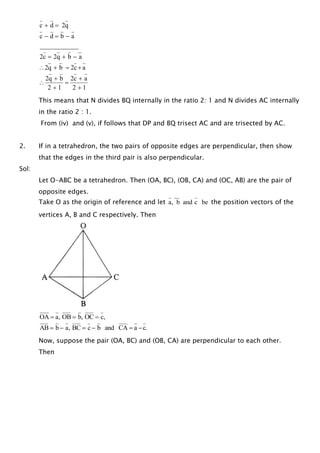
Let O-ABC be a tetrahedron. Then (OA, BC), (OB, CA) and (OC, AB) are the pair of
opposite edges.
Take O as the origin of reference and let a, b and c be the position vectors of the
vertices A, B and C respectively. Then

OA  a, OB  b, OC  c,
AB  b  a, BC  c  b and CA  a  c.
Now, suppose the pair (OA, BC) and (OB, CA) are perpendicular to each other.
Then
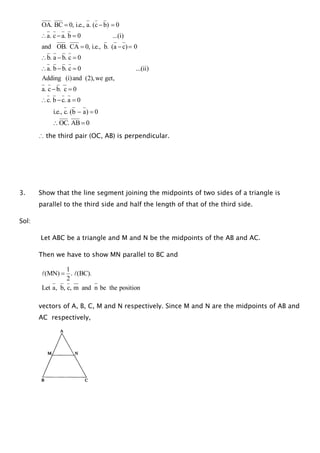
OA. BC  0, i.e., a. (c  b)  0
 a. c  a. b  0

...(i)

and OB. CA  0, i.e., b. (a  c)  0
 b. a  b. c  0
 a. b  b. c  0
Adding (i) and (2), we get,

...(ii)

a. c  b. c  0
 c. b  c. a  0

i.e., c. (b  a)  0
 OC. AB  0
∴ the third pair (OC, AB) is perpendicular.

3.

Show that the line segment joining the midpoints of two sides of a triangle is
parallel to the third side and half the length of that of the third side.

Sol:
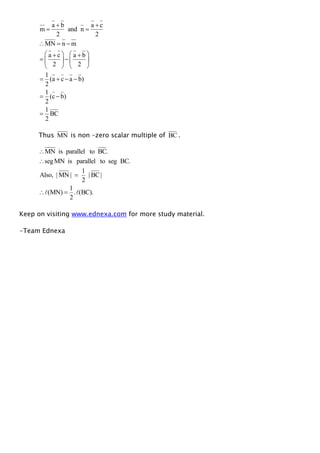
Let ABC be a triangle and M and N be the midpoints of the AB and AC.
Then we have to show MN parallel to BC and

1
(MN)  . (BC).
2
Let a, b, c, m and n be the position
vectors of A, B, C, M and N respectively. Since M and N are the midpoints of AB and
AC respectively,
ab
a c
and n 
2
2
 MN  n  m
m

ac ab



 2   2 
1
 (a  c  a  b)
2
1
 (c  b)
2
1
 BC
2
Thus MN is non –zero scalar multiple of BC .

 MN is parallel to BC.
seg MN is parallel to seg BC.
1
Also, | MN | 
| BC |
2
1
 (MN)  . (BC).
2
Keep on visiting www.ednexa.com for more study material.
-Team Ednexa

Class 12 Maths - Vectors

  • 1.
    Vectors 1. ABCD is aparallelogram. P, Q are the midpoints of the sides AB and CD respectively. Show that DP and BQ trisect AC and trisected by AC. Sol: Let DP and BQ intersect AC at M and N respectively. Let a , b , c, d , p, q , m , n be the position vectors of the points A, B, C, D, P, Q, M, N respectively with respect to some origin O. □ ABCD is a parallelogram.  AB  DC     bacd ...(i) P is the midpoint of AB   a b  p 2     2p  a  b ...(ii) Q is the midpoint of CD   cd q  2     2q  c  d ...(iii)  For eliminating b from (i) and (ii), subtract (i) from (ii) b  a  2p b  a  c d     _________________ 2 a  2p  c  d  2p  d  2a  c  2p  d 2a  c  2 1 2 1 This means that M divides DP internally in the ratio 2 : 1 and M divides CA internally in the ratio 2 : 1. For eliminating d from (i) and (iii), add (i) and (iii), …(iv)
  • 2.
    c  d 2q c d b a ____________ 2c  2q  b  a  2q  b  2c  a  2q  b 2c  a  2 1 2 1 This means that N divides BQ internally in the ratio 2: 1 and N divides AC internally in the ratio 2 : 1. From (iv) and (v), if follows that DP and BQ trisect AC and are trisected by AC. 2. If in a tetrahedron, the two pairs of opposite edges are perpendicular, then show that the edges in the third pair is also perpendicular. Sol: Let O-ABC be a tetrahedron. Then (OA, BC), (OB, CA) and (OC, AB) are the pair of opposite edges. Take O as the origin of reference and let a, b and c be the position vectors of the vertices A, B and C respectively. Then OA  a, OB  b, OC  c, AB  b  a, BC  c  b and CA  a  c. Now, suppose the pair (OA, BC) and (OB, CA) are perpendicular to each other. Then
  • 3.
    OA. BC 0, i.e., a. (c  b)  0  a. c  a. b  0 ...(i) and OB. CA  0, i.e., b. (a  c)  0  b. a  b. c  0  a. b  b. c  0 Adding (i) and (2), we get, ...(ii) a. c  b. c  0  c. b  c. a  0 i.e., c. (b  a)  0  OC. AB  0 ∴ the third pair (OC, AB) is perpendicular. 3. Show that the line segment joining the midpoints of two sides of a triangle is parallel to the third side and half the length of that of the third side. Sol: Let ABC be a triangle and M and N be the midpoints of the AB and AC. Then we have to show MN parallel to BC and 1 (MN)  . (BC). 2 Let a, b, c, m and n be the position vectors of A, B, C, M and N respectively. Since M and N are the midpoints of AB and AC respectively,
  • 4.
    ab a c and n 2 2  MN  n  m m ac ab     2   2  1  (a  c  a  b) 2 1  (c  b) 2 1  BC 2 Thus MN is non –zero scalar multiple of BC .  MN is parallel to BC. seg MN is parallel to seg BC. 1 Also, | MN |  | BC | 2 1  (MN)  . (BC). 2 Keep on visiting www.ednexa.com for more study material. -Team Ednexa