1
Beta & Gamma Functions
By
Dr. Deepa Chauhan
Associate Professor,
Applied Science & Humanities Department,
Axis Institute of Technology, Kanpur
2 Dr. Deepa Chauhan
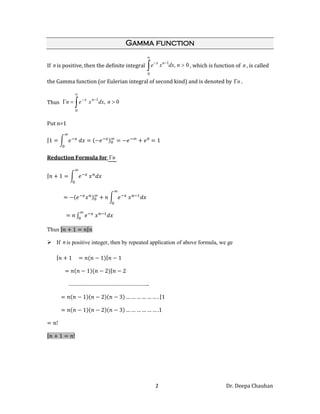
Gamma function
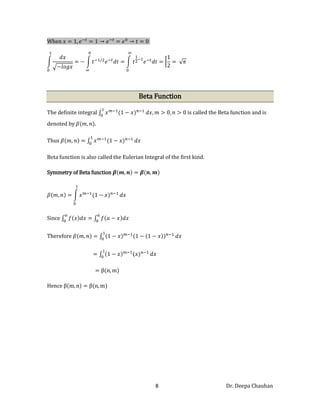
If nis positive, then the definite integral 




0
1
0
, n
dx
x
e n
x
, which is function of n, is called
the Gamma function (or Eulerian integral of second kind) and is denoted by n
 .
Thus 






0
1
0
, n
dx
x
e
n n
x
Put n=1
Reduction Formula for n

Thus
 If nis positive integer, then by repeated application of above formula, we ge
………………………………………………..
3 Dr. Deepa Chauhan
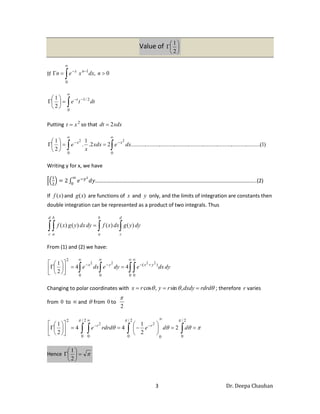
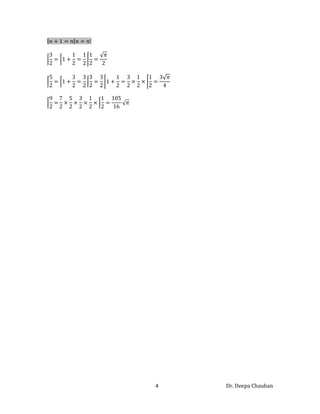
Value of 






2
1
If 






0
1
0
, n
dx
x
e
n n
x
dt
t
e t












0
2
/
1
2
1
Putting 2
x
t  so that xdx
dt 2

)
1
(
..........
..........
..........
..........
..........
..........
..........
..........
..........
2
2
.
1
.
2
1
0
0
2
2
dx
e
xdx
x
e x
x















Writing y for x, we have
…………………………………………………………………………………………………………..(2)
If )
(x
f and )
(x
g are functions of x and y only, and the limits of integration are constants then
double integration can be represented as a product of two integrals. Thus
  

d
c
b
a
b
a
d
c
dy
y
g
dx
x
f
dy
dx
y
g
x
f )
(
)
(
)
(
)
(
From (1) and (2) we have:



 





















0 0
)
(
0
0
2
2
2
2
2
4
4
2
1
dy
dx
e
dy
e
dx
e y
x
y
x
Changing to polar coordinates with 

 rdrd
dxdy
r
y
r
x 

 ,
sin
,
cos ; therefore r varies
from 0 to  and  from 0 to
2


 
 



























2
/
0
0
2
/
0
2
/
0
0
2
2
2
1
4
4
2
1 2
2

 



 d
d
e
rdrd
e r
r
Hence 








2
1
4 Dr. Deepa Chauhan
5 Dr. Deepa Chauhan
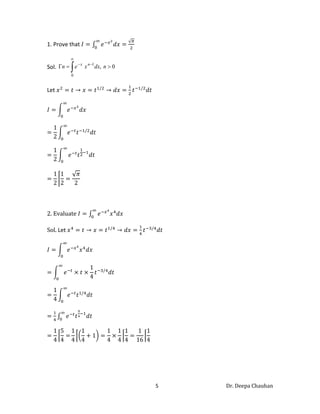
1. Prove that
Sol. 






0
1
0
, n
dx
x
e
n n
x
Let
2. Evaluate
Sol. Let
6 Dr. Deepa Chauhan
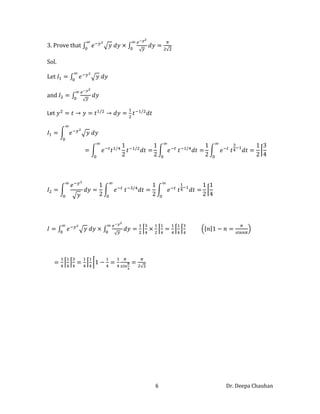
3. Prove that
Sol.
Let
and
Let
7 Dr. Deepa Chauhan
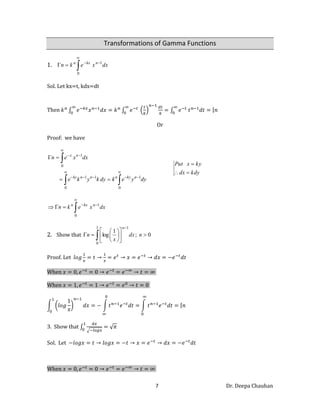
Transformations of Gamma Functions
1. dx
x
e
k
n n
kx
n






0
1
Sol. Let kx=t, kdx=dt
Then
Or
Proof: we have

















0
1
0
1
1
0
1
dy
y
e
k
dy
k
y
k
e
dx
x
e
n
n
ky
n
n
n
ky
n
x
kdy
dx
ky
x
Put



dx
x
e
k
n n
kx
n







0
1
2. Show that 0
;
1
log
1
0
1














 

n
dx
x
n
n
Proof. Let
When
When
3. Show that
Sol. Let
When
8 Dr. Deepa Chauhan
When
Beta Function
The definite integral is called the Beta function and is
denoted by .
Thus
Beta function is also called the Eulerian Integral of the first kind.
Symmetry of Beta function
Since
Therefore
Hence
9 Dr. Deepa Chauhan
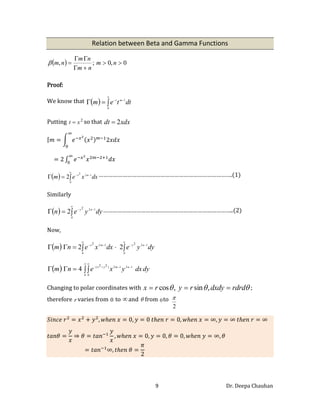
Relation between Beta and Gamma Functions
  0
,
0
;
, 





 n
m
n
m
n
m
n
m

Proof:
We know that   dt
t
e
m m
t






0
1
Putting 2
x
t  so that xdx
dt 2

  dx
x
e
m m
x 1
2
0
2
2 





Similarly
  dy
y
e
n n
y 1
2
0
2
2 





Now,
  dy
y
e
dx
x
e
n
m n
y
m
x 1
2
0
1
2
0
2
2
2
2 






 



  dy
dx
y
x
e
n
m n
m
y
x 1
2
0
1
2
0
)
( 2
2
4 





 



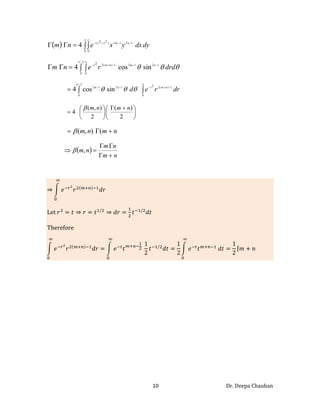
Changing to polar coordinates with 

 rdrd
dxdy
r
y
r
x 

 ,
sin
,
cos ;
therefore r varies from 0 to and  from 0to
2

10 Dr. Deepa Chauhan
  dy
dx
y
x
e
n
m n
m
y
x 1
2
0
1
2
0
)
( 2
2
4 





 



 









2
/
0
1
2
1
2
1
)
(
2
0
sin
cos
4
2



 drd
r
e
n
m n
m
n
m
r
 







2
/
0
1
)
(
2
0
1
2
1
2 2
sin
cos
4



 dr
r
e
d n
m
r
n
m





 








2
)
(
2
)
,
(
4
n
m
n
m

n
m
n
m 

 (
)
,
(

 
n
m
n
m
n
m





 ,

Let
Therefore
11 Dr. Deepa Chauhan
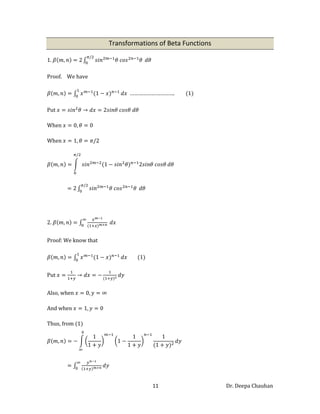
Transformations of Beta Functions
1.
Proof. We have
Put
When
When
2.
Proof: We know that
(1)
Put
Also, when
And when
Thus, from (1)
12 Dr. Deepa Chauhan
Or
Since beta function is symmetrical in m and n, we have
Therefore
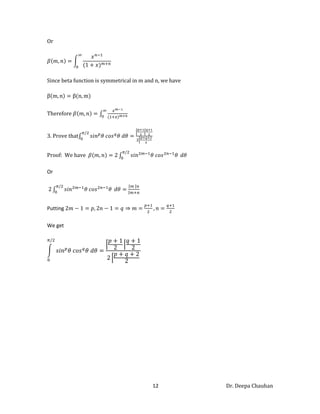
3. Prove that
Proof: We have
Or
Putting
We get
13 Dr. Deepa Chauhan
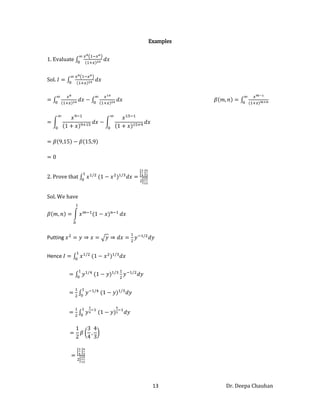
Examples
1. Evaluate
Sol.
2. Prove that
Sol. We have
Putting
Hence
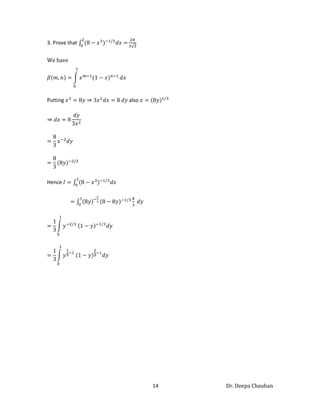
14 Dr. Deepa Chauhan
3. Prove that
We have
Putting also
Hence
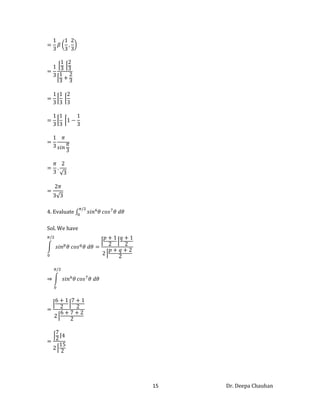
15 Dr. Deepa Chauhan
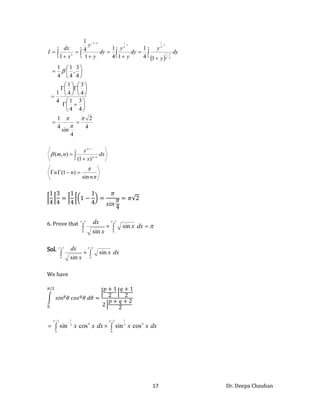
4. Evaluate
Sol. We have
16 Dr. Deepa Chauhan
5. Using beta and gamma functions, evaluate



0
4
1 x
dx
Sol. We have
Putting dy
y
dx
y
x
y
x 4
/
3
4
/
1
4
4
1 





17 Dr. Deepa Chauhan
 
4
2
4
sin
4
1
4
3
4
1
4
3
4
1
4
1
4
3
,
4
1
4
1
1
4
1
1
4
1
1
4
1
1 0 4
3
4
1
1
4
1
0
1
4
1
0
4
/
3
0
4











































 











dy
y
y
dy
y
y
dy
y
y
x
dx
I



n
n
n
dx
x
x
n
m n
m
m
sin
)
1
(
)
1
(
)
,
(
0
1





 



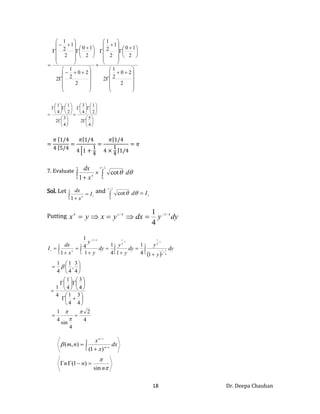
6. Prove that 



 

2
/
0
2
/
0
sin
sin
dx
x
x
dx
Sol.

 
2
/
0
2
/
0
sin
sin


dx
x
x
dx
We have

 

 2
/
0
0
2
1
2
/
0
0
2
1
cos
sin
cos
sin


dx
x
x
dx
x
x
18 Dr. Deepa Chauhan




















 





































 

















2
2
0
2
1
2
2
1
0
2
1
2
1
2
2
0
2
1
2
2
1
0
2
1
2
1












































4
5
2
2
1
4
3
4
3
2
2
1
4
1
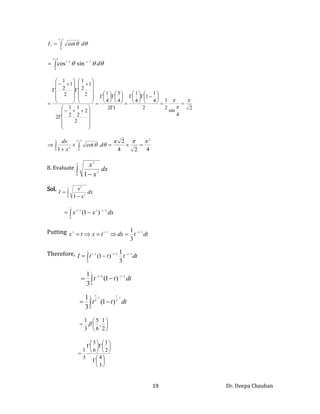
7. Evaluate

 

 2
/
0
0
4
cot
1


 d
x
dx
Sol. Let
1
0
4
1
I
x
dx




and
2
2
/
0
cot I
d 




Putting dy
y
dx
y
x
y
x 4
/
3
4
/
1
4
4
1 





 
4
2
4
sin
4
1
4
3
4
1
4
3
4
1
4
1
4
3
,
4
1
4
1
1
4
1
1
4
1
1
4
1
1 0 4
3
4
1
1
4
1
0
1
4
1
0
4
/
3
0
4
1











































 











dy
y
y
dy
y
y
dy
y
y
x
dx
I



n
n
n
dx
x
x
n
m n
m
m
sin
)
1
(
)
1
(
)
,
(
0
1





 



19 Dr. Deepa Chauhan


2
/
0
2
cot


 d
I



2
/
0
2
/
1
2
/
1
sin
cos



 d
2
4
sin
2
1
2
4
1
1
4
1
1
2
4
3
4
1
2
2
2
1
2
1
2
2
1
2
1
2
1
2
1



















































































4
2
4
2
cot
1
2
2
/
0
0
4











 


d
x
dx
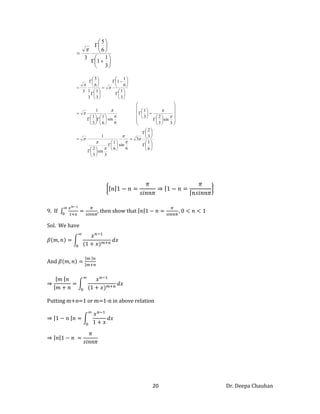
8. Evaluate 

1
0
3
3
1
dx
x
x
Sol.



1
0
3
3
1
dx
x
x
I
dx
x
x 2
/
1
3
1
0
2
/
3
)
1
( 

 
Putting dt
t
dx
t
x
t
x 3
/
2
3
/
1
3
3
1 





Therefore, dt
t
t
t
I 3
/
2
2
/
1
1
0
2
/
1
3
1
)
1
( 


 
dt
t
t 2
/
1
1
0
6
/
1
)
1
(
3
1 


 
dt
t
t
1
2
1
1
0
1
6
5
)
1
(
3
1 


 







2
1
,
6
5
3
1























3
4
2
1
6
5
3
1
20 Dr. Deepa Chauhan
















3
1
1
6
5
3








































































































6
1
3
2
3
6
sin
6
1
3
sin
3
2
1
3
sin
3
2
3
1
6
sin
6
1
3
1
1
3
1
6
1
1
3
1
3
1
6
5
3













9. If , then show that
Sol. We have
And
Putting m+n=1 or m=1-n in above relation
21 Dr. Deepa Chauhan
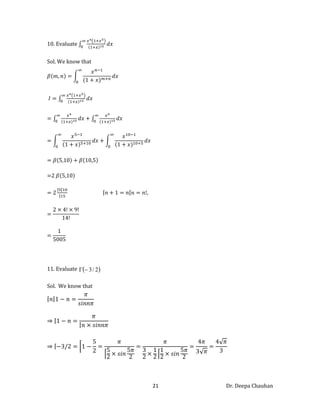
10. Evaluate
Sol. We know that
=2
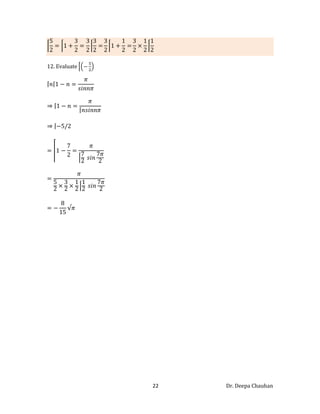
11. Evaluate  
2
/
3


Sol. We know that
22 Dr. Deepa Chauhan
12. Evaluate
23 Dr. Deepa Chauhan
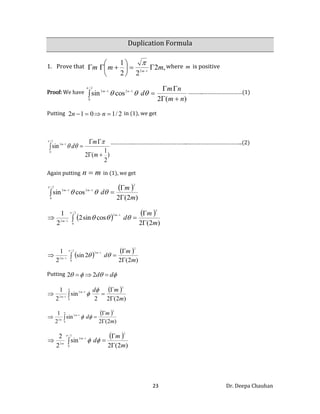
Duplication Formula
1. Prove that ,
2
2
2
1
1
2
m
m
m m










 
 where m is positive
Proof: We have
)
(
2
cos
sin 1
2
2
/
0
1
2
n
m
n
m
d
n
m







 



Putting 2
/
1
0
1
2 


 n
n in (1), we get
)
2
1
(
2
sin
2
/
0
1
2







m
m
d
m 



.(2)
Again putting m
n  in (1), we get
 
)
2
(
2
cos
sin
2
1
2
2
/
0
1
2
m
m
d
m
m





 



 
 
)
2
(
2
cos
sin
2
2
1
2
2
/
0
1
2
1
2
m
m
d
m
m



 






 
 
)
2
(
2
2
sin
2
1
2
2
/
0
1
2
1
2
m
m
d
m
m



 





Putting 


 d
d 

 2
2
 
)
2
(
2
2
sin
2
1
2
0
1
2
1
2
m
m
d
m
m



 





 
)
2
(
2
sin
2
1
2
0
1
2
2
m
m
d
m
m



 




 
)
2
(
2
sin
2
2
2
2
/
0
1
2
2
m
m
d
m
m



 




24 Dr. Deepa Chauhan
Replacing  by  , we obtain,
 
)
2
(
2
sin
2
2
2
2
/
0
1
2
2
m
m
d
m
m








 
)
2
(
2
2
sin
2
1
2
2
/
0
1
2
m
m
d
m
m






 


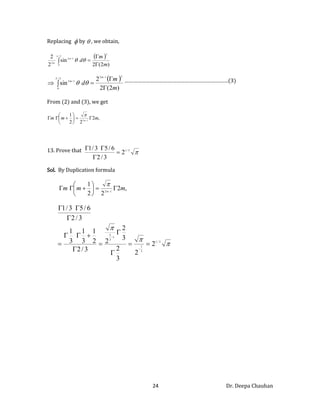
From (2) and (3), we get
,
2
2
2
1
1
2
m
m
m m










 

13. Prove that 
3
/
1
2
3
/
2
6
/
5
3
/
1




Sol. By Duplication formula
,
2
2
2
1
1
2
m
m
m m










 




3
/
1
3
1
1
3
2
2
2
3
2
3
2
2
3
/
2
2
1
3
1
3
1
3
/
2
6
/
5
3
/
1
















Beta & Gamma Functions

  • 1.
    1 Beta & GammaFunctions By Dr. Deepa Chauhan Associate Professor, Applied Science & Humanities Department, Axis Institute of Technology, Kanpur
  • 2.
    2 Dr. DeepaChauhan Gamma function If nis positive, then the definite integral      0 1 0 , n dx x e n x , which is function of n, is called the Gamma function (or Eulerian integral of second kind) and is denoted by n  . Thus        0 1 0 , n dx x e n n x Put n=1 Reduction Formula for n  Thus  If nis positive integer, then by repeated application of above formula, we ge ………………………………………………..
  • 3.
    3 Dr. DeepaChauhan Value of        2 1 If        0 1 0 , n dx x e n n x dt t e t             0 2 / 1 2 1 Putting 2 x t  so that xdx dt 2  ) 1 ( .......... .......... .......... .......... .......... .......... .......... .......... .......... 2 2 . 1 . 2 1 0 0 2 2 dx e xdx x e x x                Writing y for x, we have …………………………………………………………………………………………………………..(2) If ) (x f and ) (x g are functions of x and y only, and the limits of integration are constants then double integration can be represented as a product of two integrals. Thus     d c b a b a d c dy y g dx x f dy dx y g x f ) ( ) ( ) ( ) ( From (1) and (2) we have:                           0 0 ) ( 0 0 2 2 2 2 2 4 4 2 1 dy dx e dy e dx e y x y x Changing to polar coordinates with    rdrd dxdy r y r x    , sin , cos ; therefore r varies from 0 to  and  from 0 to 2                                  2 / 0 0 2 / 0 2 / 0 0 2 2 2 1 4 4 2 1 2 2        d d e rdrd e r r Hence          2 1
  • 4.
    4 Dr. DeepaChauhan
  • 5.
    5 Dr. DeepaChauhan 1. Prove that Sol.        0 1 0 , n dx x e n n x Let 2. Evaluate Sol. Let
  • 6.
    6 Dr. DeepaChauhan 3. Prove that Sol. Let and Let
  • 7.
    7 Dr. DeepaChauhan Transformations of Gamma Functions 1. dx x e k n n kx n       0 1 Sol. Let kx=t, kdx=dt Then Or Proof: we have                  0 1 0 1 1 0 1 dy y e k dy k y k e dx x e n n ky n n n ky n x kdy dx ky x Put    dx x e k n n kx n        0 1 2. Show that 0 ; 1 log 1 0 1                  n dx x n n Proof. Let When When 3. Show that Sol. Let When
  • 8.
    8 Dr. DeepaChauhan When Beta Function The definite integral is called the Beta function and is denoted by . Thus Beta function is also called the Eulerian Integral of the first kind. Symmetry of Beta function Since Therefore Hence
  • 9.
    9 Dr. DeepaChauhan Relation between Beta and Gamma Functions   0 , 0 ; ,        n m n m n m n m  Proof: We know that   dt t e m m t       0 1 Putting 2 x t  so that xdx dt 2    dx x e m m x 1 2 0 2 2       Similarly   dy y e n n y 1 2 0 2 2       Now,   dy y e dx x e n m n y m x 1 2 0 1 2 0 2 2 2 2               dy dx y x e n m n m y x 1 2 0 1 2 0 ) ( 2 2 4            Changing to polar coordinates with    rdrd dxdy r y r x    , sin , cos ; therefore r varies from 0 to and  from 0to 2 
  • 10.
    10 Dr. DeepaChauhan   dy dx y x e n m n m y x 1 2 0 1 2 0 ) ( 2 2 4                       2 / 0 1 2 1 2 1 ) ( 2 0 sin cos 4 2     drd r e n m n m n m r          2 / 0 1 ) ( 2 0 1 2 1 2 2 sin cos 4     dr r e d n m r n m                2 ) ( 2 ) , ( 4 n m n m  n m n m    ( ) , (    n m n m n m       ,  Let Therefore
  • 11.
    11 Dr. DeepaChauhan Transformations of Beta Functions 1. Proof. We have Put When When 2. Proof: We know that (1) Put Also, when And when Thus, from (1)
  • 12.
    12 Dr. DeepaChauhan Or Since beta function is symmetrical in m and n, we have Therefore 3. Prove that Proof: We have Or Putting We get
  • 13.
    13 Dr. DeepaChauhan Examples 1. Evaluate Sol. 2. Prove that Sol. We have Putting Hence
  • 14.
    14 Dr. DeepaChauhan 3. Prove that We have Putting also Hence
  • 15.
    15 Dr. DeepaChauhan 4. Evaluate Sol. We have
  • 16.
    16 Dr. DeepaChauhan 5. Using beta and gamma functions, evaluate    0 4 1 x dx Sol. We have Putting dy y dx y x y x 4 / 3 4 / 1 4 4 1      
  • 17.
    17 Dr. DeepaChauhan   4 2 4 sin 4 1 4 3 4 1 4 3 4 1 4 1 4 3 , 4 1 4 1 1 4 1 1 4 1 1 4 1 1 0 4 3 4 1 1 4 1 0 1 4 1 0 4 / 3 0 4                                                         dy y y dy y y dy y y x dx I    n n n dx x x n m n m m sin ) 1 ( ) 1 ( ) , ( 0 1           6. Prove that        2 / 0 2 / 0 sin sin dx x x dx Sol.    2 / 0 2 / 0 sin sin   dx x x dx We have      2 / 0 0 2 1 2 / 0 0 2 1 cos sin cos sin   dx x x dx x x
  • 18.
    18 Dr. DeepaChauhan                                                                               2 2 0 2 1 2 2 1 0 2 1 2 1 2 2 0 2 1 2 2 1 0 2 1 2 1                                             4 5 2 2 1 4 3 4 3 2 2 1 4 1 7. Evaluate      2 / 0 0 4 cot 1    d x dx Sol. Let 1 0 4 1 I x dx     and 2 2 / 0 cot I d      Putting dy y dx y x y x 4 / 3 4 / 1 4 4 1         4 2 4 sin 4 1 4 3 4 1 4 3 4 1 4 1 4 3 , 4 1 4 1 1 4 1 1 4 1 1 4 1 1 0 4 3 4 1 1 4 1 0 1 4 1 0 4 / 3 0 4 1                                                         dy y y dy y y dy y y x dx I    n n n dx x x n m n m m sin ) 1 ( ) 1 ( ) , ( 0 1          
  • 19.
    19 Dr. DeepaChauhan   2 / 0 2 cot    d I    2 / 0 2 / 1 2 / 1 sin cos     d 2 4 sin 2 1 2 4 1 1 4 1 1 2 4 3 4 1 2 2 2 1 2 1 2 2 1 2 1 2 1 2 1                                                                                    4 2 4 2 cot 1 2 2 / 0 0 4                d x dx 8. Evaluate   1 0 3 3 1 dx x x Sol.    1 0 3 3 1 dx x x I dx x x 2 / 1 3 1 0 2 / 3 ) 1 (     Putting dt t dx t x t x 3 / 2 3 / 1 3 3 1       Therefore, dt t t t I 3 / 2 2 / 1 1 0 2 / 1 3 1 ) 1 (      dt t t 2 / 1 1 0 6 / 1 ) 1 ( 3 1      dt t t 1 2 1 1 0 1 6 5 ) 1 ( 3 1             2 1 , 6 5 3 1                        3 4 2 1 6 5 3 1
  • 20.
    20 Dr. DeepaChauhan                 3 1 1 6 5 3                                                                                                         6 1 3 2 3 6 sin 6 1 3 sin 3 2 1 3 sin 3 2 3 1 6 sin 6 1 3 1 1 3 1 6 1 1 3 1 3 1 6 5 3              9. If , then show that Sol. We have And Putting m+n=1 or m=1-n in above relation
  • 21.
    21 Dr. DeepaChauhan 10. Evaluate Sol. We know that =2 11. Evaluate   2 / 3   Sol. We know that
  • 22.
    22 Dr. DeepaChauhan 12. Evaluate
  • 23.
    23 Dr. DeepaChauhan Duplication Formula 1. Prove that , 2 2 2 1 1 2 m m m m              where m is positive Proof: We have ) ( 2 cos sin 1 2 2 / 0 1 2 n m n m d n m             Putting 2 / 1 0 1 2     n n in (1), we get ) 2 1 ( 2 sin 2 / 0 1 2        m m d m     .(2) Again putting m n  in (1), we get   ) 2 ( 2 cos sin 2 1 2 2 / 0 1 2 m m d m m               ) 2 ( 2 cos sin 2 2 1 2 2 / 0 1 2 1 2 m m d m m                ) 2 ( 2 2 sin 2 1 2 2 / 0 1 2 1 2 m m d m m           Putting     d d    2 2   ) 2 ( 2 2 sin 2 1 2 0 1 2 1 2 m m d m m             ) 2 ( 2 sin 2 1 2 0 1 2 2 m m d m m            ) 2 ( 2 sin 2 2 2 2 / 0 1 2 2 m m d m m         
  • 24.
    24 Dr. DeepaChauhan Replacing  by  , we obtain,   ) 2 ( 2 sin 2 2 2 2 / 0 1 2 2 m m d m m           ) 2 ( 2 2 sin 2 1 2 2 / 0 1 2 m m d m m           From (2) and (3), we get , 2 2 2 1 1 2 m m m m              13. Prove that  3 / 1 2 3 / 2 6 / 5 3 / 1     Sol. By Duplication formula , 2 2 2 1 1 2 m m m m                 3 / 1 3 1 1 3 2 2 2 3 2 3 2 2 3 / 2 2 1 3 1 3 1 3 / 2 6 / 5 3 / 1               