CARTESIAN PRODUCT
Janak singh Saud
saudjanaksingh@gmail.com
https://images.app.goo.gl/CjPHqUg6ZxC3ehER6
6/19/2020 JANAK SINGH SAUD 1
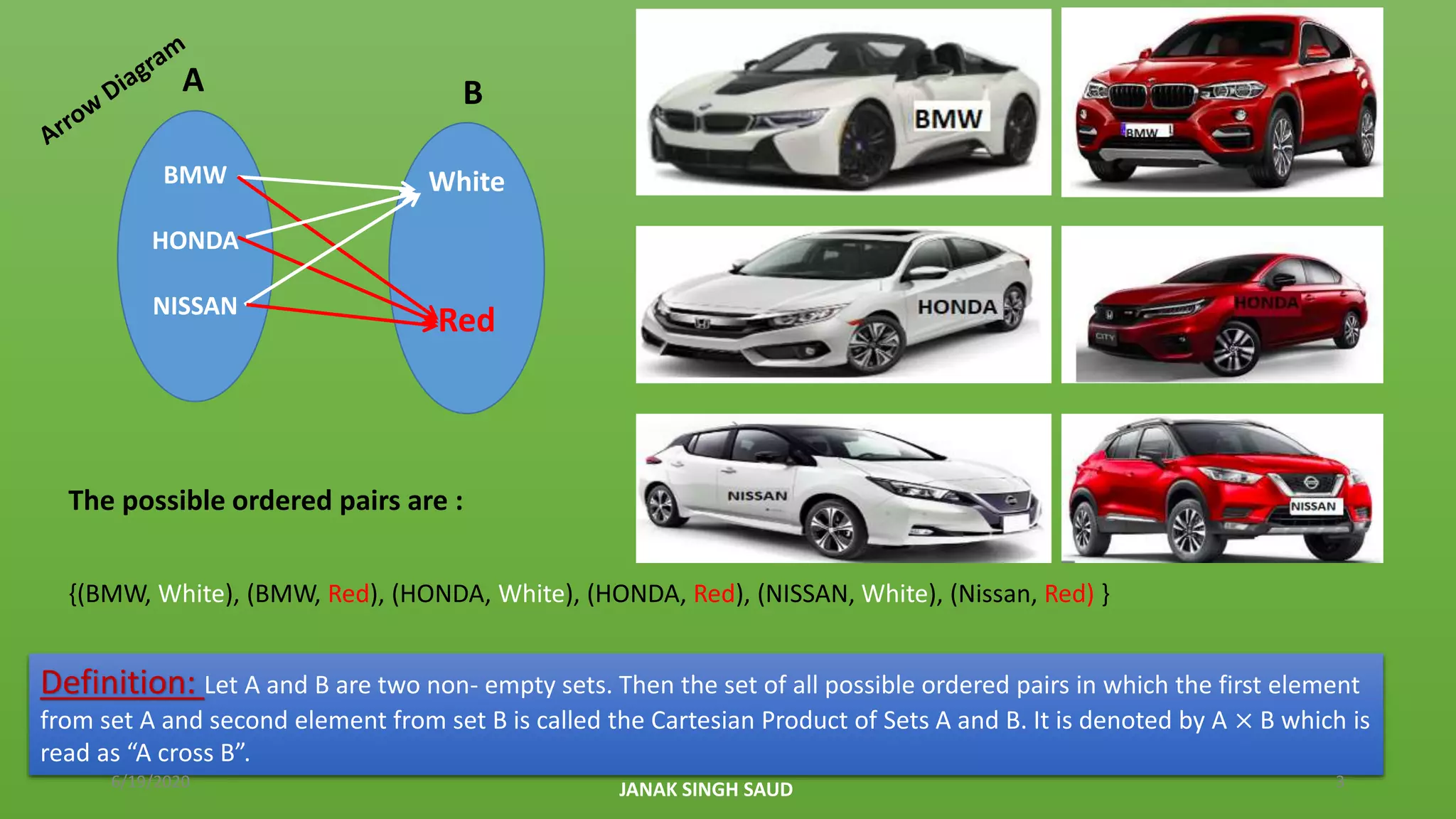
Assume the AASHIFA is only considering Car Company HONDA,
Car Company NISSAN, Car Company BMW and she is only
looking for white or red colour.
• Set A = {BMW, HONDA, NISSAN}
• Set B = {white , red}
The set of for this example as following:
https://images.app.goo.gl/TkXCbhW5RbZmCPvp7
6/19/2020 JANAK SINGH SAUD 2
BMW
HONDA
NISSAN
White
Red
A B
{(BMW, White), (BMW, Red), (HONDA, White), (HONDA, Red), (NISSAN, White), (Nissan, Red) }
The possible ordered pairs are :
Definition: Let A and B are two non- empty sets. Then the set of all possible ordered pairs in which the first element
from set A and second element from set B is called the Cartesian Product of Sets A and B. It is denoted by A × B which is
read as “A cross B”.
6/19/2020 JANAK SINGH SAUD 3
BMW
HONDA
NISSAN
White
Red
White
Red
White
Red
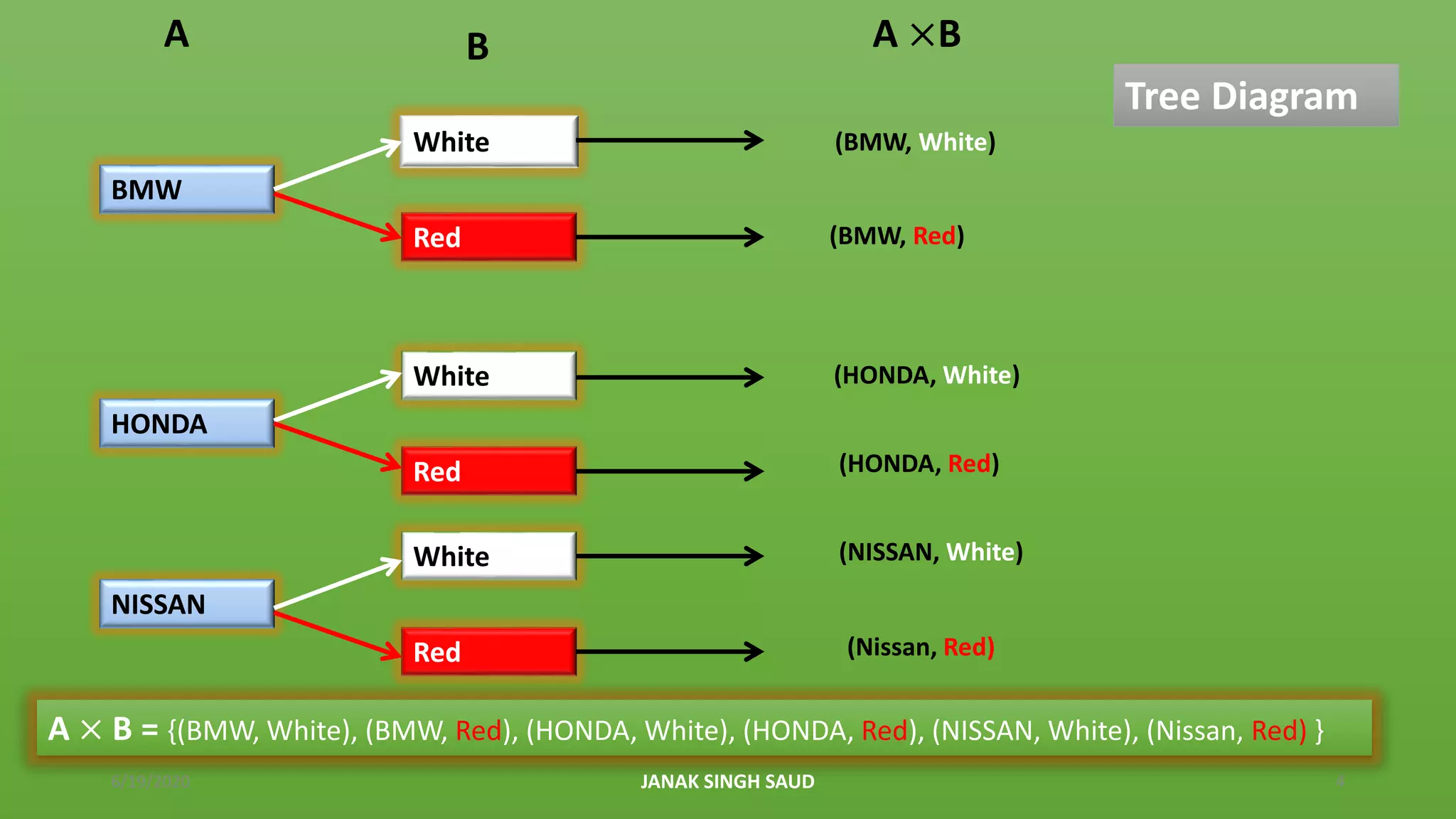
A B A ×B
(BMW, White)
(BMW, Red)
(HONDA, Red)
(HONDA, White)
(NISSAN, White)
(Nissan, Red)
A × B = {(BMW, White), (BMW, Red), (HONDA, White), (HONDA, Red), (NISSAN, White), (Nissan, Red) }
Tree Diagram
6/19/2020 JANAK SINGH SAUD 4
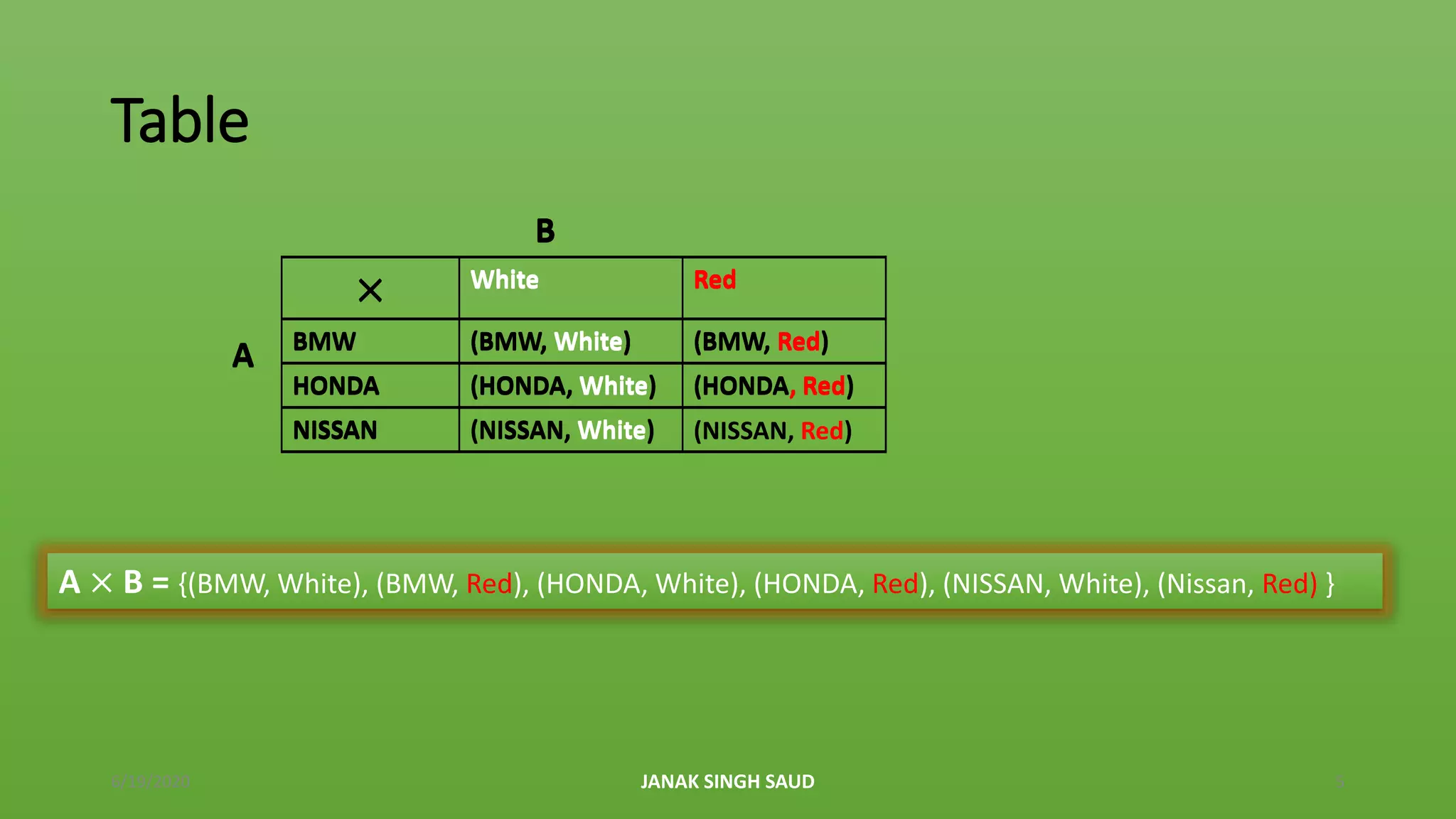
Table
B
A
× White Red
BMW
HONDA
NISSAN
A × B = {(BMW, White), (BMW, Red), (HONDA, White), (HONDA, Red), (NISSAN, White), (Nissan, Red) }
B
A
× White Red
BMW (BMW, White)
HONDA
NISSAN
B
A
× White Red
BMW (BMW, White) (BMW, Red)
HONDA
NISSAN
B
A
× White Red
BMW (BMW, White) (BMW, Red)
HONDA (HONDA, White)
NISSAN
B
A
× White Red
BMW (BMW, White) (BMW, Red)
HONDA (HONDA, White) (HONDA, Red)
NISSAN
B
A
× White Red
BMW (BMW, White) (BMW, Red)
HONDA (HONDA, White) (HONDA, Red)
NISSAN (NISSAN, White)
B
A
× White Red
BMW (BMW, White) (BMW, Red)
HONDA (HONDA, White) (HONDA, Red)
NISSAN (NISSAN, White) (NISSAN, Red)
6/19/2020 JANAK SINGH SAUD 5
6/19/2020 JANAK SINGH SAUD 6
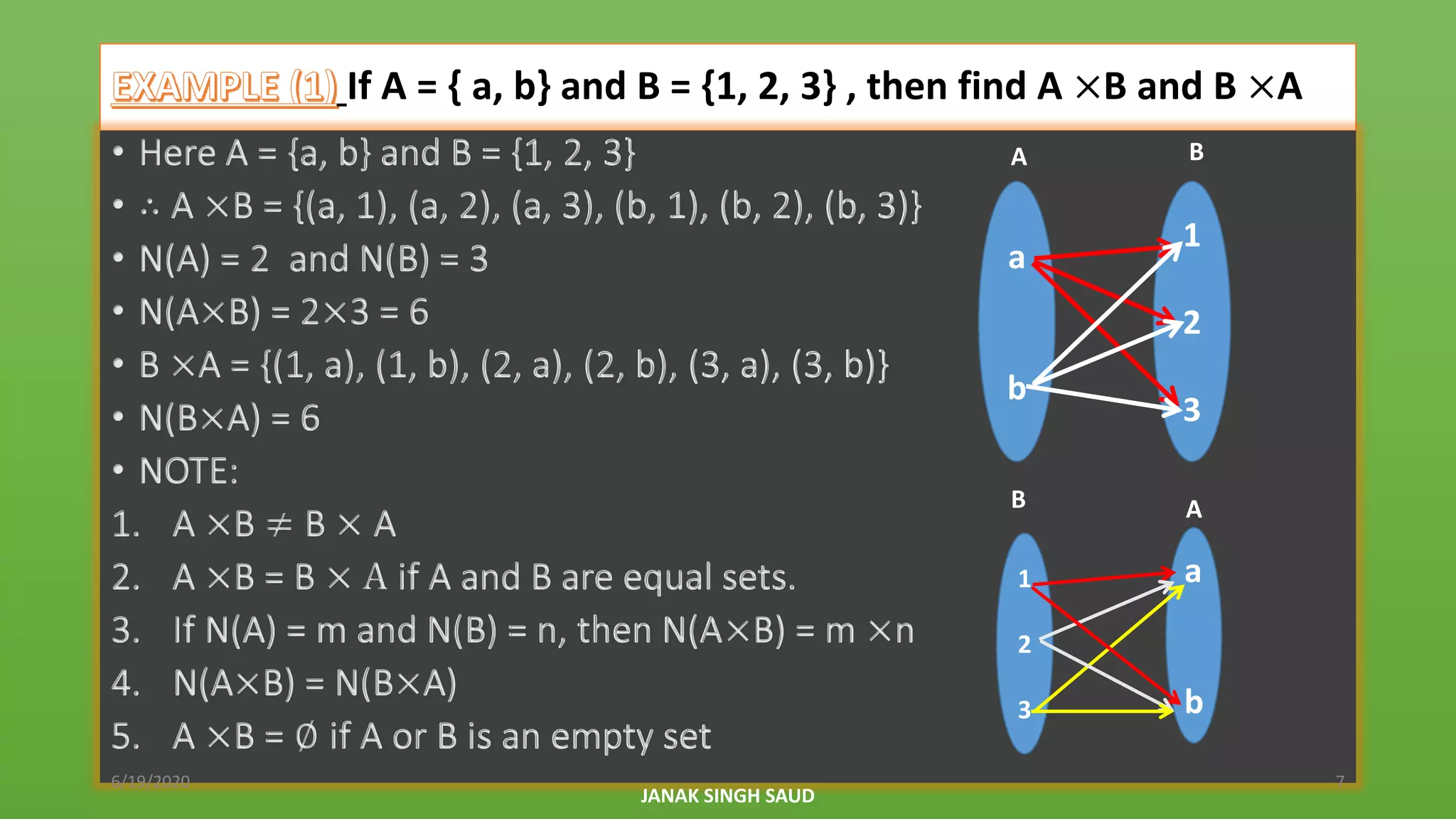
If A = { a, b} and B = {1, 2, 3} , then find A ×B and B ×A
• Here A = {a, b} and B = {1, 2, 3}
• ∴ A ×B = {(a, 1), (a, 2), (a, 3), (b, 1), (b, 2), (b, 3)}
• N(A) = 2 and N(B) = 3
• N(A×B) = 2×3 = 6
• B ×A = {(1, a), (1, b), (2, a), (2, b), (3, a), (3, b)}
• N(B×A) = 6
• NOTE:
1. A ×B ≠ B × A
2. A ×B = B × A if A and B are equal sets.
3. If N(A) = m and N(B) = n, then N(A×B) = m ×n
4. N(A×B) = N(B×A)
5. A ×B = ∅ if A or B is an empty set
a
b
1
2
3
A B
1
2
3
B A
a
b
6/19/2020
JANAK SINGH SAUD
7
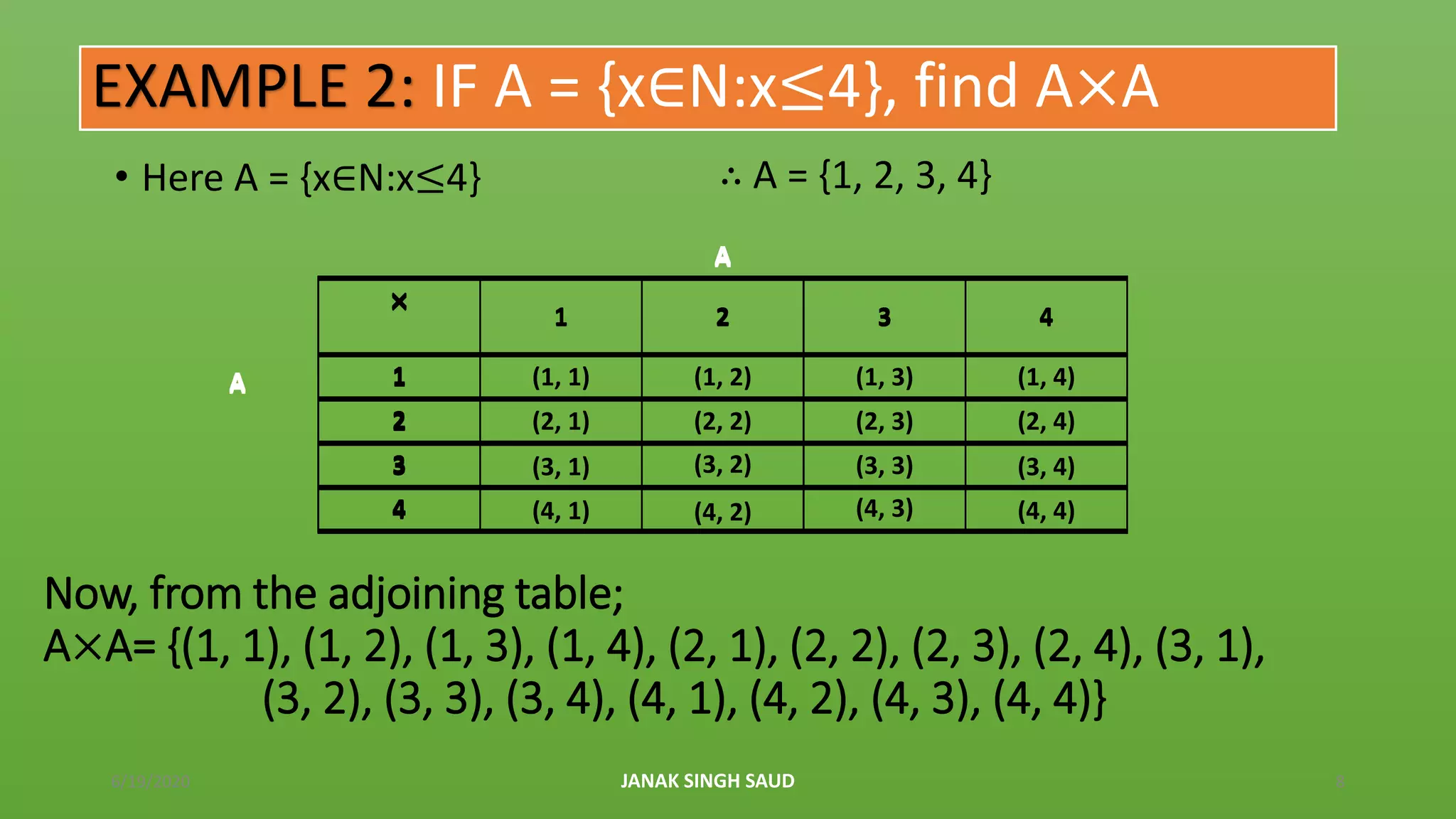
EXAMPLE 2: IF A = {x∈N:x≤4}, find A×A
• Here A = {x∈N:x≤4}
A
A
×
1 2 3 4
1
2
3
4
∴ A = {1, 2, 3, 4}
A
A
×
1 2 3 4
1 (1, 1)
2
3
4
A
A
×
1 2 3 4
1 (1, 2)
2
3
4
A
A
×
1 2 3 4
1 (1, 3)
2
3
4
A
A
×
1 2 3 4
1 (1, 4)
2
3
4
A
A
×
1 2 3 4
1
2 (2, 1)
3
4
A
A
×
1 2 3 4
1
2 (2, 2)
3
4
A
A
×
1 2 3 4
1
2 (2, 3)
3
4
A
A
×
1 2 3 4
1
2 (2, 4)
3
4
A
A
×
1 2 3 4
1
2
3 (3, 1)
4
A
A
×
1
2
3 (3, 2)
4
A
A
×
(3, 3)
A
A
×
(3, 4)
A
A
×
(4, 1)
A
A
×
(4, 2)
A
A
×
(4, 3)
A
A
×
(4, 4)
Now, from the adjoining table;
A×A= {(1, 1), (1, 2), (1, 3), (1, 4), (2, 1), (2, 2), (2, 3), (2, 4), (3, 1),
(3, 2), (3, 3), (3, 4), (4, 1), (4, 2), (4, 3), (4, 4)}
6/19/2020 JANAK SINGH SAUD 8
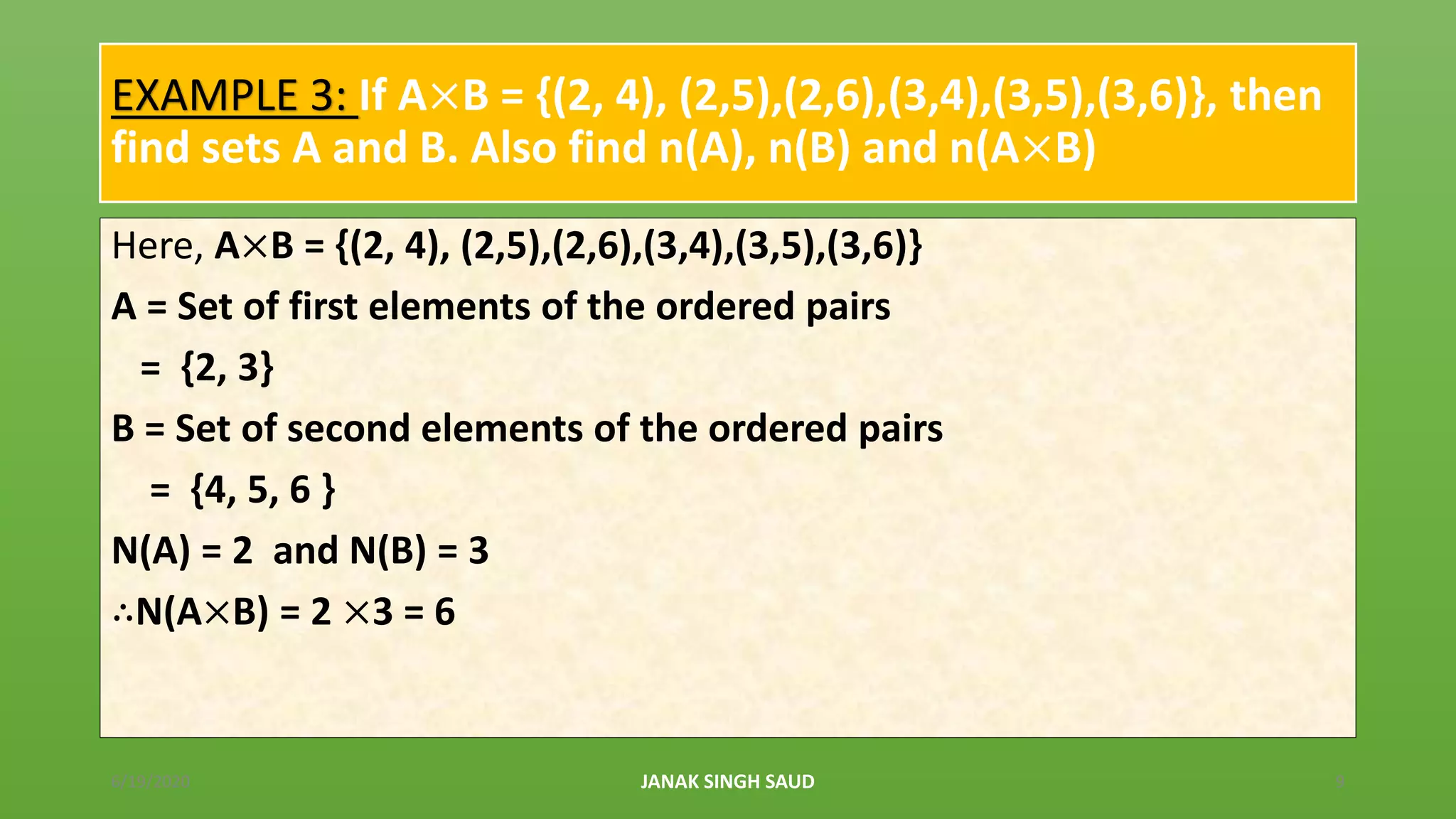
EXAMPLE 3: If A×B = {(2, 4), (2,5),(2,6),(3,4),(3,5),(3,6)}, then
find sets A and B. Also find n(A), n(B) and n(A×B)
Here, A×B = {(2, 4), (2,5),(2,6),(3,4),(3,5),(3,6)}
A = Set of first elements of the ordered pairs
= {2, 3}
B = Set of second elements of the ordered pairs
= {4, 5, 6 }
N(A) = 2 and N(B) = 3
∴N(A×B) = 2 ×3 = 6
6/19/2020 JANAK SINGH SAUD 9
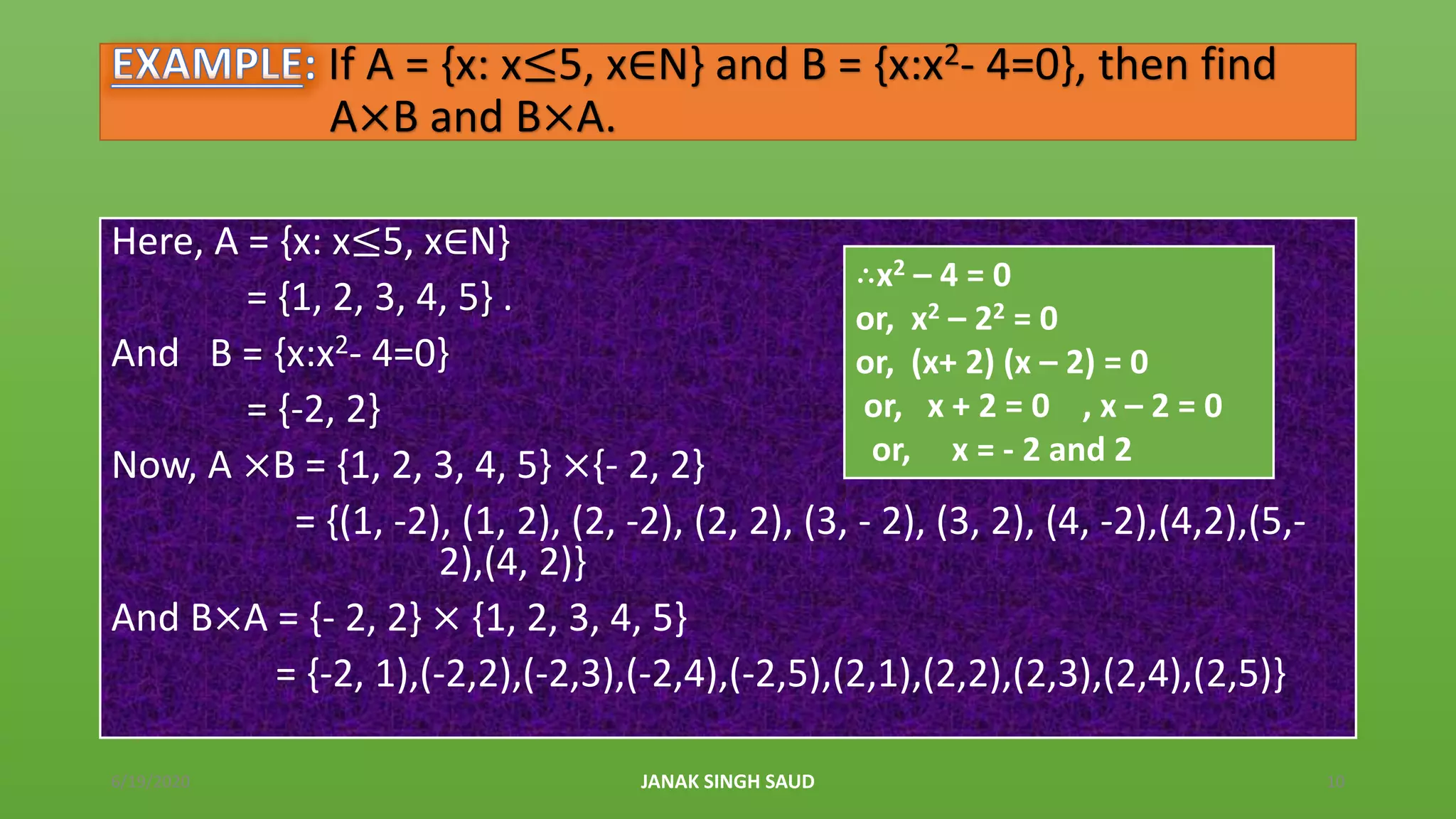
If A = {x: x≤5, x∈N} and B = {x:x2- 4=0}, then find
A×B and B×A.
Here, A = {x: x≤5, x∈N}
= {1, 2, 3, 4, 5} .
And B = {x:x2- 4=0}
= {-2, 2}
Now, A ×B = {1, 2, 3, 4, 5} ×{- 2, 2}
= {(1, -2), (1, 2), (2, -2), (2, 2), (3, - 2), (3, 2), (4, -2),(4,2),(5,-
2),(4, 2)}
And B×A = {- 2, 2} × {1, 2, 3, 4, 5}
= {-2, 1),(-2,2),(-2,3),(-2,4),(-2,5),(2,1),(2,2),(2,3),(2,4),(2,5)}
∴x2 – 4 = 0
or, x2 – 22 = 0
or, (x+ 2) (x – 2) = 0
or, x + 2 = 0 , x – 2 = 0
or, x = - 2 and 2
6/19/2020 JANAK SINGH SAUD 10
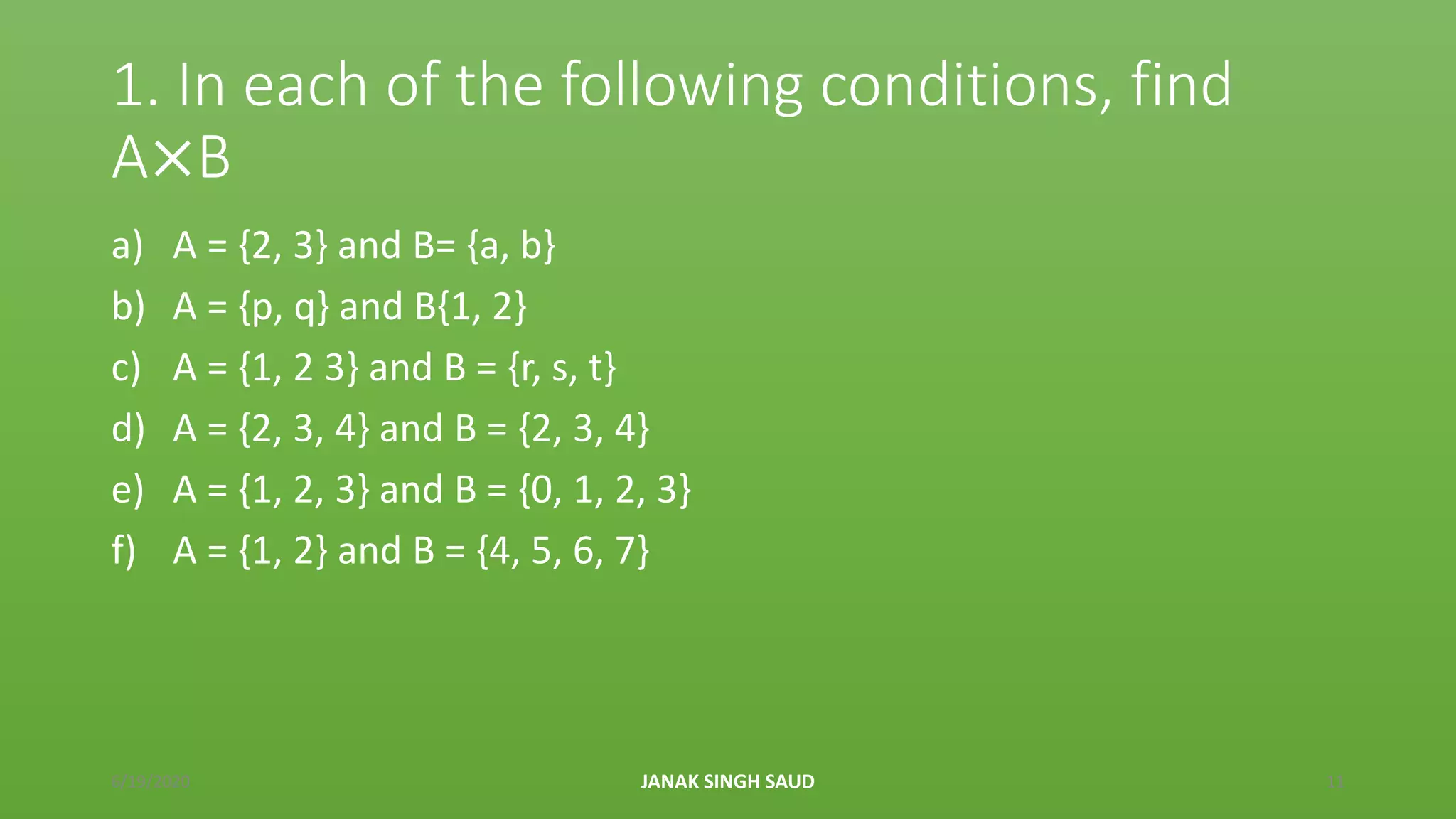
1. In each of the following conditions, find
A×B
a) A = {2, 3} and B= {a, b}
b) A = {p, q} and B{1, 2}
c) A = {1, 2 3} and B = {r, s, t}
d) A = {2, 3, 4} and B = {2, 3, 4}
e) A = {1, 2, 3} and B = {0, 1, 2, 3}
f) A = {1, 2} and B = {4, 5, 6, 7}
6/19/2020 JANAK SINGH SAUD 11
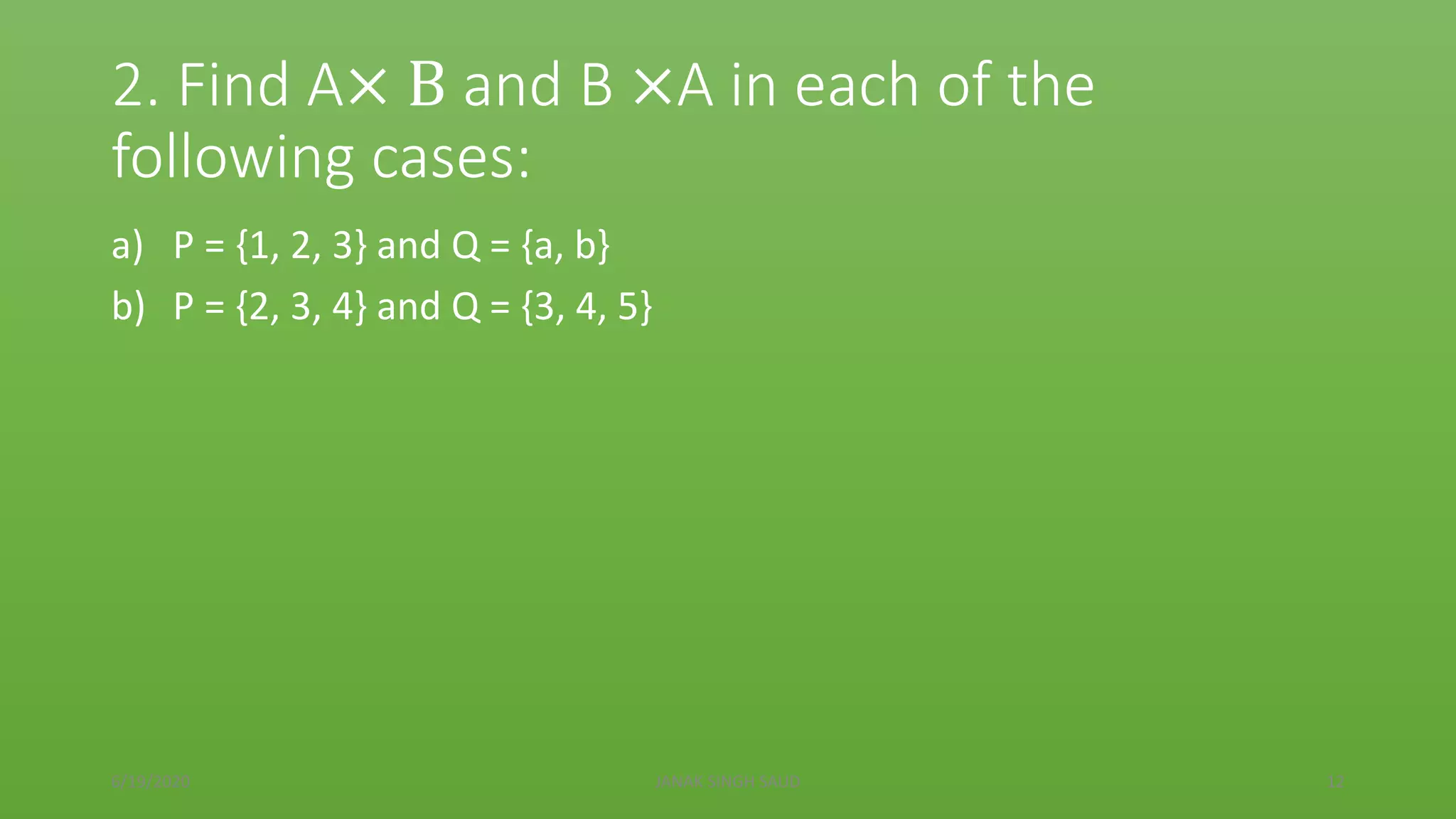
2. Find A× B and B ×A in each of the
following cases:
a) P = {1, 2, 3} and Q = {a, b}
b) P = {2, 3, 4} and Q = {3, 4, 5}
6/19/2020 JANAK SINGH SAUD 12
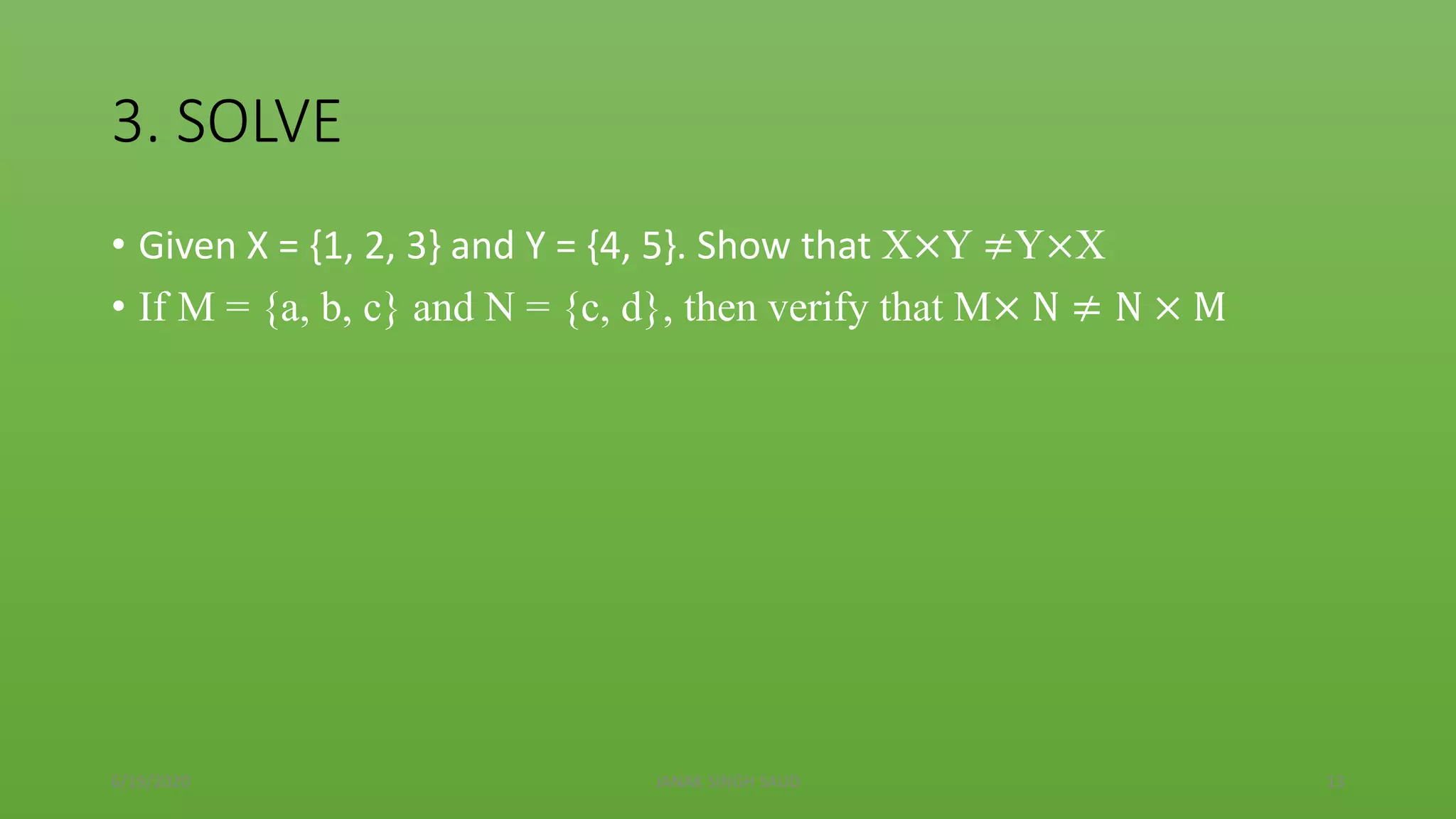
3. SOLVE
• Given X = {1, 2, 3} and Y = {4, 5}. Show that X×Y ≠Y×X
• If M = {a, b, c} and N = {c, d}, then verify that M× N ≠ N × M
6/19/2020 JANAK SINGH SAUD 13
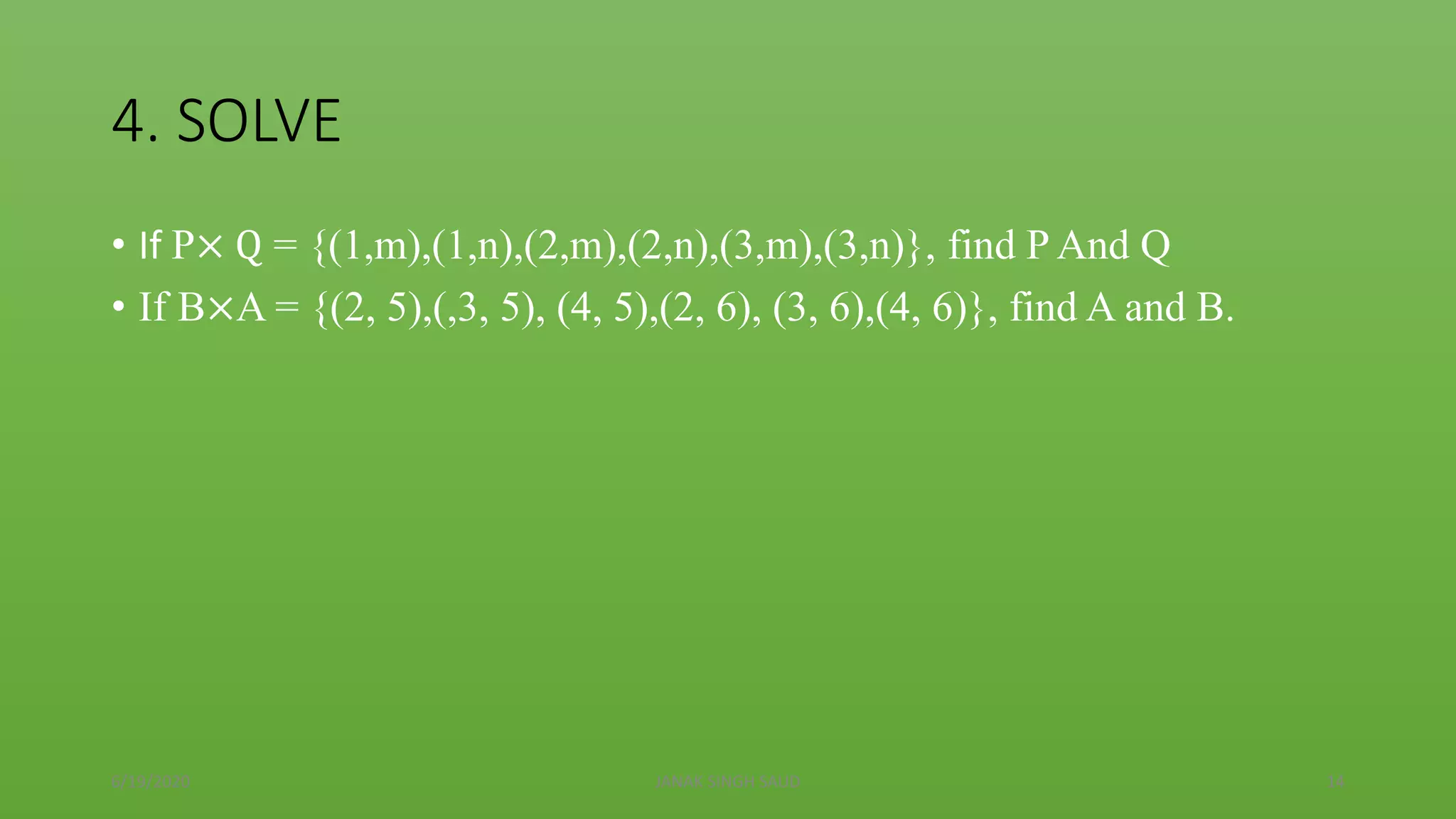
4. SOLVE
• If P× Q = {(1,m),(1,n),(2,m),(2,n),(3,m),(3,n)}, find P And Q
• If B×A = {(2, 5),(,3, 5), (4, 5),(2, 6), (3, 6),(4, 6)}, find A and B.
6/19/2020 JANAK SINGH SAUD 14
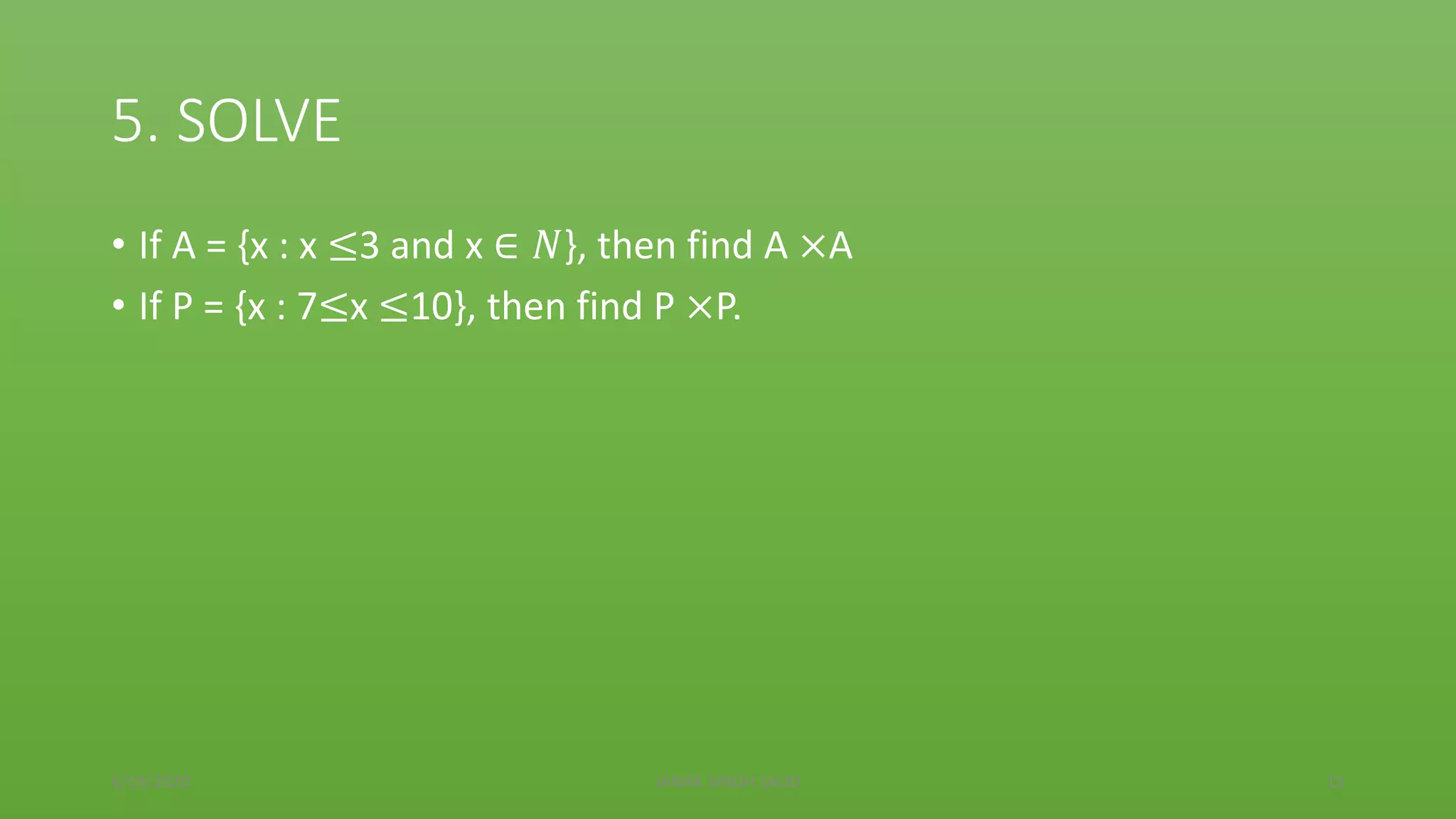
5. SOLVE
• If A = {x : x ≤3 and x ∈ 𝑁}, then find A ×A
• If P = {x : 7≤x ≤10}, then find P ×P.
6/19/2020 JANAK SINGH SAUD 15
6. SOLVE
• If P = {4, 5, 6} and Q = {1, 2}, show that P×Q in mapping diagram and
on graph
• If A = {x:x∈ 𝑁, 6< x <9}, find A ×A and show it in mapping diagram
and in lattice diagram.
6/19/2020 JANAK SINGH SAUD 16
H.W.- Cartesian Product
1. Find A× B and B ×A in each of the following cases if A = {1, 2, 3}
and B = {a, b} by tree diagram
2. If M = {a, b, c} and N = {c, d}, then verify that M× N ≠ N × M
3. If P× Q = {(1,m),(1,n),(2,m),(2,n),(3,m),(3,n)}, find P And Q
4. If P = {x : 7≤x ≤10}, then find P ×P.
5. If P = {4, 5, 6} and Q = {1, 2}, show that P×Q in mapping diagram
6. If A = {x:x∈ 𝑁, 6< x <9}, find A ×A and show it in Table Method and
6/19/2020 JANAK SINGH SAUD 17
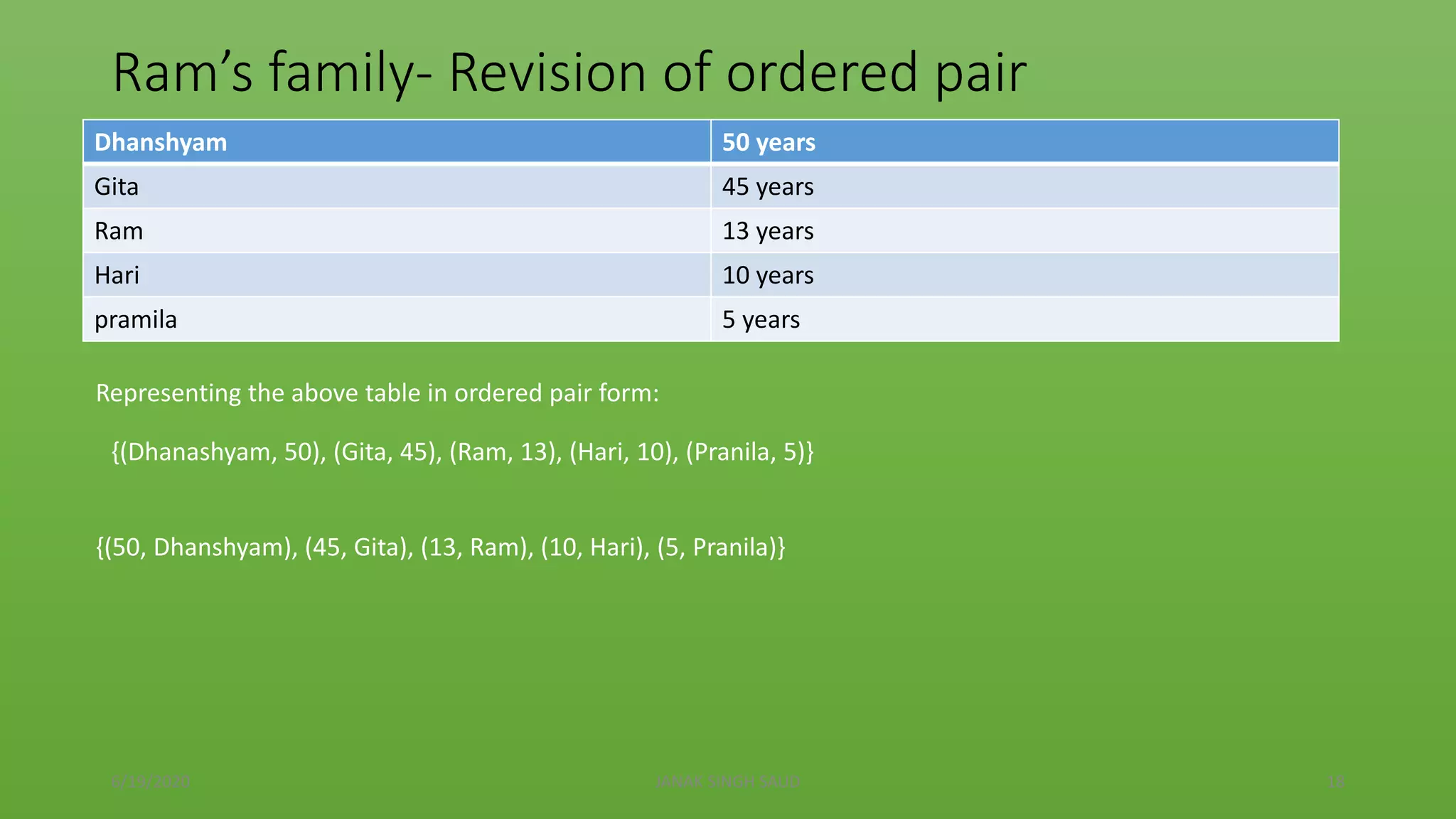
Ram’s family- Revision of ordered pair
Dhanshyam 50 years
Gita 45 years
Ram 13 years
Hari 10 years
pramila 5 years
{(Dhanashyam, 50), (Gita, 45), (Ram, 13), (Hari, 10), (Pranila, 5)}
{(50, Dhanshyam), (45, Gita), (13, Ram), (10, Hari), (5, Pranila)}
Representing the above table in ordered pair form:
6/19/2020 JANAK SINGH SAUD 18
https://www.youtube.com/channel/UCGxSYD_UZLzXfmAzxaRyYhw?vie
w_as=subscriber
https://www.facebook.com/janaksinghsaud
https://www.slideshare.net/janaksinghsaud
saudjanaksingh@gmail.com
6/19/2020 JANAK SINGH SAUD 19

Cartesian product of two sets

  • 1.
    CARTESIAN PRODUCT Janak singhSaud saudjanaksingh@gmail.com https://images.app.goo.gl/CjPHqUg6ZxC3ehER6 6/19/2020 JANAK SINGH SAUD 1
  • 2.
    Assume the AASHIFAis only considering Car Company HONDA, Car Company NISSAN, Car Company BMW and she is only looking for white or red colour. • Set A = {BMW, HONDA, NISSAN} • Set B = {white , red} The set of for this example as following: https://images.app.goo.gl/TkXCbhW5RbZmCPvp7 6/19/2020 JANAK SINGH SAUD 2
  • 3.
    BMW HONDA NISSAN White Red A B {(BMW, White),(BMW, Red), (HONDA, White), (HONDA, Red), (NISSAN, White), (Nissan, Red) } The possible ordered pairs are : Definition: Let A and B are two non- empty sets. Then the set of all possible ordered pairs in which the first element from set A and second element from set B is called the Cartesian Product of Sets A and B. It is denoted by A × B which is read as “A cross B”. 6/19/2020 JANAK SINGH SAUD 3
  • 4.
    BMW HONDA NISSAN White Red White Red White Red A B A×B (BMW, White) (BMW, Red) (HONDA, Red) (HONDA, White) (NISSAN, White) (Nissan, Red) A × B = {(BMW, White), (BMW, Red), (HONDA, White), (HONDA, Red), (NISSAN, White), (Nissan, Red) } Tree Diagram 6/19/2020 JANAK SINGH SAUD 4
  • 5.
    Table B A × White Red BMW HONDA NISSAN A× B = {(BMW, White), (BMW, Red), (HONDA, White), (HONDA, Red), (NISSAN, White), (Nissan, Red) } B A × White Red BMW (BMW, White) HONDA NISSAN B A × White Red BMW (BMW, White) (BMW, Red) HONDA NISSAN B A × White Red BMW (BMW, White) (BMW, Red) HONDA (HONDA, White) NISSAN B A × White Red BMW (BMW, White) (BMW, Red) HONDA (HONDA, White) (HONDA, Red) NISSAN B A × White Red BMW (BMW, White) (BMW, Red) HONDA (HONDA, White) (HONDA, Red) NISSAN (NISSAN, White) B A × White Red BMW (BMW, White) (BMW, Red) HONDA (HONDA, White) (HONDA, Red) NISSAN (NISSAN, White) (NISSAN, Red) 6/19/2020 JANAK SINGH SAUD 5
  • 6.
  • 7.
    If A ={ a, b} and B = {1, 2, 3} , then find A ×B and B ×A • Here A = {a, b} and B = {1, 2, 3} • ∴ A ×B = {(a, 1), (a, 2), (a, 3), (b, 1), (b, 2), (b, 3)} • N(A) = 2 and N(B) = 3 • N(A×B) = 2×3 = 6 • B ×A = {(1, a), (1, b), (2, a), (2, b), (3, a), (3, b)} • N(B×A) = 6 • NOTE: 1. A ×B ≠ B × A 2. A ×B = B × A if A and B are equal sets. 3. If N(A) = m and N(B) = n, then N(A×B) = m ×n 4. N(A×B) = N(B×A) 5. A ×B = ∅ if A or B is an empty set a b 1 2 3 A B 1 2 3 B A a b 6/19/2020 JANAK SINGH SAUD 7
  • 8.
    EXAMPLE 2: IFA = {x∈N:x≤4}, find A×A • Here A = {x∈N:x≤4} A A × 1 2 3 4 1 2 3 4 ∴ A = {1, 2, 3, 4} A A × 1 2 3 4 1 (1, 1) 2 3 4 A A × 1 2 3 4 1 (1, 2) 2 3 4 A A × 1 2 3 4 1 (1, 3) 2 3 4 A A × 1 2 3 4 1 (1, 4) 2 3 4 A A × 1 2 3 4 1 2 (2, 1) 3 4 A A × 1 2 3 4 1 2 (2, 2) 3 4 A A × 1 2 3 4 1 2 (2, 3) 3 4 A A × 1 2 3 4 1 2 (2, 4) 3 4 A A × 1 2 3 4 1 2 3 (3, 1) 4 A A × 1 2 3 (3, 2) 4 A A × (3, 3) A A × (3, 4) A A × (4, 1) A A × (4, 2) A A × (4, 3) A A × (4, 4) Now, from the adjoining table; A×A= {(1, 1), (1, 2), (1, 3), (1, 4), (2, 1), (2, 2), (2, 3), (2, 4), (3, 1), (3, 2), (3, 3), (3, 4), (4, 1), (4, 2), (4, 3), (4, 4)} 6/19/2020 JANAK SINGH SAUD 8
  • 9.
    EXAMPLE 3: IfA×B = {(2, 4), (2,5),(2,6),(3,4),(3,5),(3,6)}, then find sets A and B. Also find n(A), n(B) and n(A×B) Here, A×B = {(2, 4), (2,5),(2,6),(3,4),(3,5),(3,6)} A = Set of first elements of the ordered pairs = {2, 3} B = Set of second elements of the ordered pairs = {4, 5, 6 } N(A) = 2 and N(B) = 3 ∴N(A×B) = 2 ×3 = 6 6/19/2020 JANAK SINGH SAUD 9
  • 10.
    If A ={x: x≤5, x∈N} and B = {x:x2- 4=0}, then find A×B and B×A. Here, A = {x: x≤5, x∈N} = {1, 2, 3, 4, 5} . And B = {x:x2- 4=0} = {-2, 2} Now, A ×B = {1, 2, 3, 4, 5} ×{- 2, 2} = {(1, -2), (1, 2), (2, -2), (2, 2), (3, - 2), (3, 2), (4, -2),(4,2),(5,- 2),(4, 2)} And B×A = {- 2, 2} × {1, 2, 3, 4, 5} = {-2, 1),(-2,2),(-2,3),(-2,4),(-2,5),(2,1),(2,2),(2,3),(2,4),(2,5)} ∴x2 – 4 = 0 or, x2 – 22 = 0 or, (x+ 2) (x – 2) = 0 or, x + 2 = 0 , x – 2 = 0 or, x = - 2 and 2 6/19/2020 JANAK SINGH SAUD 10
  • 11.
    1. In eachof the following conditions, find A×B a) A = {2, 3} and B= {a, b} b) A = {p, q} and B{1, 2} c) A = {1, 2 3} and B = {r, s, t} d) A = {2, 3, 4} and B = {2, 3, 4} e) A = {1, 2, 3} and B = {0, 1, 2, 3} f) A = {1, 2} and B = {4, 5, 6, 7} 6/19/2020 JANAK SINGH SAUD 11
  • 12.
    2. Find A×B and B ×A in each of the following cases: a) P = {1, 2, 3} and Q = {a, b} b) P = {2, 3, 4} and Q = {3, 4, 5} 6/19/2020 JANAK SINGH SAUD 12
  • 13.
    3. SOLVE • GivenX = {1, 2, 3} and Y = {4, 5}. Show that X×Y ≠Y×X • If M = {a, b, c} and N = {c, d}, then verify that M× N ≠ N × M 6/19/2020 JANAK SINGH SAUD 13
  • 14.
    4. SOLVE • IfP× Q = {(1,m),(1,n),(2,m),(2,n),(3,m),(3,n)}, find P And Q • If B×A = {(2, 5),(,3, 5), (4, 5),(2, 6), (3, 6),(4, 6)}, find A and B. 6/19/2020 JANAK SINGH SAUD 14
  • 15.
    5. SOLVE • IfA = {x : x ≤3 and x ∈ 𝑁}, then find A ×A • If P = {x : 7≤x ≤10}, then find P ×P. 6/19/2020 JANAK SINGH SAUD 15
  • 16.
    6. SOLVE • IfP = {4, 5, 6} and Q = {1, 2}, show that P×Q in mapping diagram and on graph • If A = {x:x∈ 𝑁, 6< x <9}, find A ×A and show it in mapping diagram and in lattice diagram. 6/19/2020 JANAK SINGH SAUD 16
  • 17.
    H.W.- Cartesian Product 1.Find A× B and B ×A in each of the following cases if A = {1, 2, 3} and B = {a, b} by tree diagram 2. If M = {a, b, c} and N = {c, d}, then verify that M× N ≠ N × M 3. If P× Q = {(1,m),(1,n),(2,m),(2,n),(3,m),(3,n)}, find P And Q 4. If P = {x : 7≤x ≤10}, then find P ×P. 5. If P = {4, 5, 6} and Q = {1, 2}, show that P×Q in mapping diagram 6. If A = {x:x∈ 𝑁, 6< x <9}, find A ×A and show it in Table Method and 6/19/2020 JANAK SINGH SAUD 17
  • 18.
    Ram’s family- Revisionof ordered pair Dhanshyam 50 years Gita 45 years Ram 13 years Hari 10 years pramila 5 years {(Dhanashyam, 50), (Gita, 45), (Ram, 13), (Hari, 10), (Pranila, 5)} {(50, Dhanshyam), (45, Gita), (13, Ram), (10, Hari), (5, Pranila)} Representing the above table in ordered pair form: 6/19/2020 JANAK SINGH SAUD 18
  • 19.