By
S.R. Seenivasan, MCA., (Ph.D)
Microsoft Certifed, RedHat Linux Certified, Ethical Hacking Certified
Seminar on Computer Hardware
Date: 26.09.2016
• The Three Stages of Computing
• Components of a Computer
• Support Hardware
Overview
The Three Stages of
Computing
Input Devices
Processing
Output Devices
Input / Output
Support Hardware
• Generation in computer terminology is a change in
technology a computer is/was being used.
• Initially, the generation term was used to distinguish between
varying hardware technologies. But nowadays, generation
includes both hardware and software, which together make up
an entire computer system.
• There are totally five computer generations known till date.
Computer Generation
First Generation
The period of first generation: 1946-1959.
Vacuum tube based.
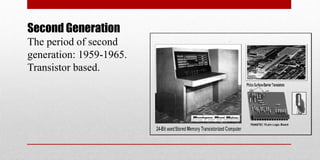
Second Generation
The period of second
generation: 1959-1965.
Transistor based.
Third Generation
The period of third generation was 1965-
1971. The computers of third generation
used integrated circuits (IC's) in place of
transistors.
A single IC has many transistors, resistors
and capacitors along with the associated
circuitry.
• 1971-1980.
• Used Very Large Scale Integrated (VLSI)
circuits. 5000 transistors and other circuit
elements and their associated circuits on a single
chip
• Real time, networks, distributed operating system
were used. All the high-level languages like C,
C++, DBASE etc., were used in this generation.
Fourth Generation
Fifth Generation
1980-till date.
The VLSI technology became ULSI (Ultra Large
Scale Integration) technology
AI method of making computers think like human
beings.
AI includes:
Robotics, Neural Networks, Game Playing,
Expert systems to make decisions in real life
situations.
Computer Parts
There are many parts that work
together to make a computer
work.
Hardware
Physical parts of the computer,
including processor and
memory chips, input/output
devices, tapes, disks, modems,
cable, etc.
CPU
The Central Processing Unit
Processor
The CPU – The chip or chips
that interpret and execute
program instructions and
manage the functions of input,
output, and storage devices.
Computer Case
Contains the major
components of the computer.
It helps protect them.
Front of the Computer
Case
Built in Handle
Floppy Bay
Power Switch
DVD Bay
Front USB Ports
Rear Panel of the
Computer Case
Inside the Computer Case
Monitor
A display screen to provide
“output” to the user. It is
where you view the
information your are working
on.
Video Card
Connects the computer to the
monitor. It is a circuit board
attached to the motherboard
that contains the memory and
other circuitry necessary to
send information to the
monitor for display on screen.
Keyboard
Used to enter information into
the computer and for giving
commands.
Mouse
An input device operated by
rolling its ball across a flat
surface. The mouse is used to
control the on-screen pointer
by pointing and clicking,
double-clicking, or dragging
objects on the screen.
Touchpad
A pressure-sensitive and
motion sensitive device used
in place of a mouse.
CD Rom Drive
The drive that plays CDs and
reads data that has been stored
on the CD.
CD
Compact Disk – A type of
optical storage device.
Floppy Disk Drive
A device that holds a
removable floppy disk when
in use; read/write heads read
and write data to the diskette.
Hard Disk
Magnetic storage device in the
computer.
RAM
Random Access Memory
RAM is a computer’s temporary
memory, which exists as chips on the
motherboard near the CPU. It stores
data or programs while they are being
used and requires power.
Printer
An output device that
produces a hard copy on
paper. It gives information to
the user in printed form.
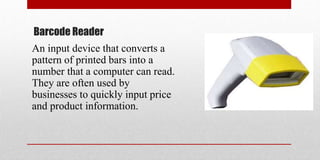
Barcode Reader
An input device that converts a
pattern of printed bars into a
number that a computer can read.
They are often used by
businesses to quickly input price
and product information.
Scanner
A device that allows pictures
to be placed into a computer.
Microphone
Allows the user to record
sounds as input to their
computer.
Speakers
Used to generate or reproduce
voice, music, and other
sounds.
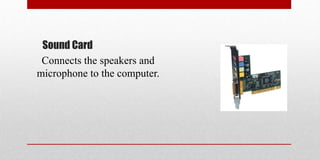
Sound Card
Connects the speakers and
microphone to the computer.
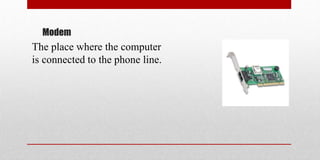
Modem
The place where the computer
is connected to the phone line.
Network Card
A circuit board that connects
the computer to the rest of the
network usually using special
cables.
Software
Programs that tell the
computer what to do. It
provides instructions that the
CPU will need to carry out.
THANK YOU

Computer Hardware Introduction

  • 1.
    By S.R. Seenivasan, MCA.,(Ph.D) Microsoft Certifed, RedHat Linux Certified, Ethical Hacking Certified Seminar on Computer Hardware Date: 26.09.2016
  • 2.
    • The ThreeStages of Computing • Components of a Computer • Support Hardware Overview
  • 3.
    The Three Stagesof Computing
  • 4.
  • 5.
  • 6.
  • 7.
  • 8.
  • 9.
    • Generation incomputer terminology is a change in technology a computer is/was being used. • Initially, the generation term was used to distinguish between varying hardware technologies. But nowadays, generation includes both hardware and software, which together make up an entire computer system. • There are totally five computer generations known till date. Computer Generation
  • 10.
    First Generation The periodof first generation: 1946-1959. Vacuum tube based.
  • 11.
    Second Generation The periodof second generation: 1959-1965. Transistor based.
  • 12.
    Third Generation The periodof third generation was 1965- 1971. The computers of third generation used integrated circuits (IC's) in place of transistors. A single IC has many transistors, resistors and capacitors along with the associated circuitry.
  • 13.
    • 1971-1980. • UsedVery Large Scale Integrated (VLSI) circuits. 5000 transistors and other circuit elements and their associated circuits on a single chip • Real time, networks, distributed operating system were used. All the high-level languages like C, C++, DBASE etc., were used in this generation. Fourth Generation
  • 14.
    Fifth Generation 1980-till date. TheVLSI technology became ULSI (Ultra Large Scale Integration) technology AI method of making computers think like human beings. AI includes: Robotics, Neural Networks, Game Playing, Expert systems to make decisions in real life situations.
  • 15.
    Computer Parts There aremany parts that work together to make a computer work.
  • 16.
    Hardware Physical parts ofthe computer, including processor and memory chips, input/output devices, tapes, disks, modems, cable, etc.
  • 17.
  • 18.
    Processor The CPU –The chip or chips that interpret and execute program instructions and manage the functions of input, output, and storage devices.
  • 19.
    Computer Case Contains themajor components of the computer. It helps protect them.
  • 20.
    Front of theComputer Case Built in Handle Floppy Bay Power Switch DVD Bay Front USB Ports
  • 21.
    Rear Panel ofthe Computer Case
  • 22.
  • 23.
    Monitor A display screento provide “output” to the user. It is where you view the information your are working on.
  • 24.
    Video Card Connects thecomputer to the monitor. It is a circuit board attached to the motherboard that contains the memory and other circuitry necessary to send information to the monitor for display on screen.
  • 25.
    Keyboard Used to enterinformation into the computer and for giving commands.
  • 26.
    Mouse An input deviceoperated by rolling its ball across a flat surface. The mouse is used to control the on-screen pointer by pointing and clicking, double-clicking, or dragging objects on the screen.
  • 27.
    Touchpad A pressure-sensitive and motionsensitive device used in place of a mouse.
  • 28.
    CD Rom Drive Thedrive that plays CDs and reads data that has been stored on the CD.
  • 29.
    CD Compact Disk –A type of optical storage device.
  • 30.
    Floppy Disk Drive Adevice that holds a removable floppy disk when in use; read/write heads read and write data to the diskette.
  • 31.
    Hard Disk Magnetic storagedevice in the computer.
  • 32.
    RAM Random Access Memory RAMis a computer’s temporary memory, which exists as chips on the motherboard near the CPU. It stores data or programs while they are being used and requires power.
  • 33.
    Printer An output devicethat produces a hard copy on paper. It gives information to the user in printed form.
  • 34.
    Barcode Reader An inputdevice that converts a pattern of printed bars into a number that a computer can read. They are often used by businesses to quickly input price and product information.
  • 35.
    Scanner A device thatallows pictures to be placed into a computer.
  • 36.
    Microphone Allows the userto record sounds as input to their computer.
  • 37.
    Speakers Used to generateor reproduce voice, music, and other sounds.
  • 38.
    Sound Card Connects thespeakers and microphone to the computer.
  • 39.
    Modem The place wherethe computer is connected to the phone line.
  • 40.
    Network Card A circuitboard that connects the computer to the rest of the network usually using special cables.
  • 41.
    Software Programs that tellthe computer what to do. It provides instructions that the CPU will need to carry out.
  • 42.