Classification
ObjectivesExplain why and how organisms are classified. List the eight levels of classification. Explain scientific names.Describe how dichotomous keys help in identifying organisms.
Why Classify?The classification of living things makes it easier for biologist to answer many important questions such as:How many known species are there?What are the defining characteristics of each species?What are the relationships between these species?
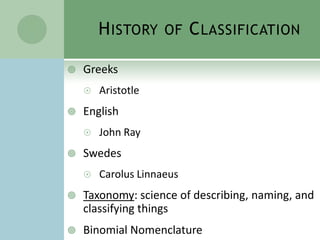
History of ClassificationGreeksAristotleEnglishJohn RaySwedesCarolus LinnaeusTaxonomy: science of describing, naming, and classifying thingsBinomial Nomenclature
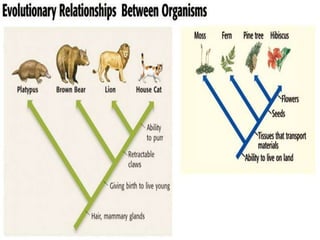
How do Scientists Classify Organisms?Taxonomists use the seven-level system to classify living things based on shared characteristics.On a branching diagram, several characteristics are listed along the line that points to the right. Each characteristic is shared by the organisms to the right of it.
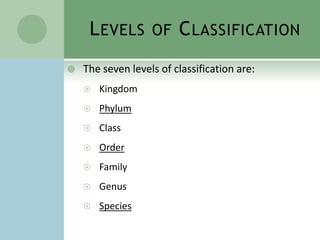
Levels of ClassificationThe seven levels of classification are:KingdomPhylumClassOrderFamilyGenusSpecies
Scientific NamesA scientific name is always the same for a specific kind of organism no matter how many common names there might be.Ex: Mountain lion, puma, cougar, panther are all the Puma concolorThe first part of a species' name is the genus name which is always capitalized. The second part of the name is the species name.
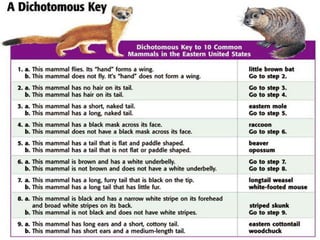
Dichotomous KeysA dichotomous key is a tool for identifying organisms that uses a series of paired descriptive statements.By working through the statements in a dichotomous key in order, a person can eventually identify an unknown organism.
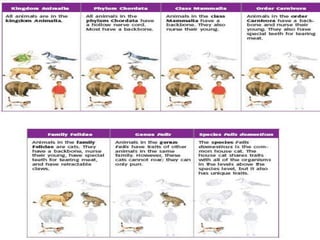
Biologists Use Seven Levels Of Classification

Biologists Use Seven Levels Of Classification

  • 1.
  • 2.
    ObjectivesExplain why andhow organisms are classified. List the eight levels of classification. Explain scientific names.Describe how dichotomous keys help in identifying organisms.
  • 3.
    Why Classify?The classificationof living things makes it easier for biologist to answer many important questions such as:How many known species are there?What are the defining characteristics of each species?What are the relationships between these species?
  • 4.
    History of ClassificationGreeksAristotleEnglishJohnRaySwedesCarolus LinnaeusTaxonomy: science of describing, naming, and classifying thingsBinomial Nomenclature
  • 5.
    How do ScientistsClassify Organisms?Taxonomists use the seven-level system to classify living things based on shared characteristics.On a branching diagram, several characteristics are listed along the line that points to the right. Each characteristic is shared by the organisms to the right of it.
  • 7.
    Levels of ClassificationTheseven levels of classification are:KingdomPhylumClassOrderFamilyGenusSpecies
  • 9.
    Scientific NamesA scientificname is always the same for a specific kind of organism no matter how many common names there might be.Ex: Mountain lion, puma, cougar, panther are all the Puma concolorThe first part of a species' name is the genus name which is always capitalized. The second part of the name is the species name.
  • 10.
    Dichotomous KeysA dichotomouskey is a tool for identifying organisms that uses a series of paired descriptive statements.By working through the statements in a dichotomous key in order, a person can eventually identify an unknown organism.