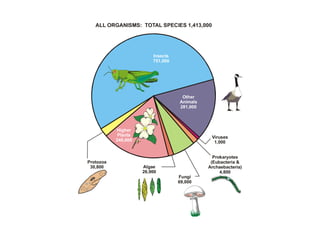
Viruses
1,000
Fungi
69,000
Protozoa
30,800 Algae
26,900
Prokaryotes
(Eubacteria &
Archaebacteria)
4,800
ALL ORGANISMS: TOTAL SPECIES 1,413,000
Higher
Plants
248,000
Insects
751,000
Other
Animals
281,000
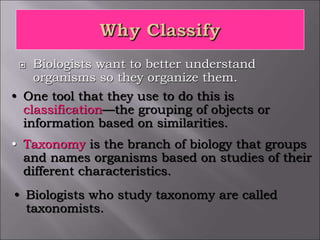
 Biologists want to better understand
organisms so they organize them.
• One tool that they use to do this is
classification—the grouping of objects or
information based on similarities.
• Taxonomy is the branch of biology that groups
and names organisms based on studies of their
different characteristics.
• Biologists who study taxonomy are called
taxonomists.
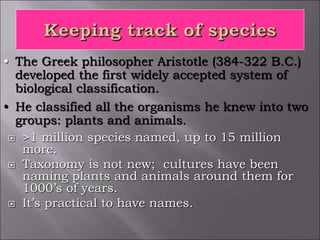
 >1 million species named, up to 15 million
more.
 Taxonomy is not new; cultures have been
naming plants and animals around them for
1000’s of years.
 It’s practical to have names.
• The Greek philosopher Aristotle (384-322 B.C.)
developed the first widely accepted system of
biological classification.
• He classified all the organisms he knew into two
groups: plants and animals.
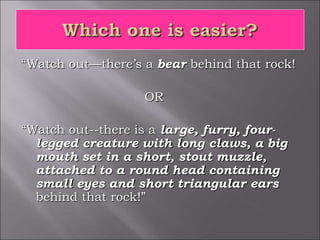
“Watch out—there’s a bear behind that rock!
OR
“Watch out--there is a large, furry, four-
legged creature with long claws, a big
mouth set in a short, stout muzzle,
attached to a round head containing
small eyes and short triangular ears
behind that rock!”
Q. What is the largest wild felid (cat) in
the United States?
Mountain Lion
Cougar
Panther
Painter
Puma
Catamount
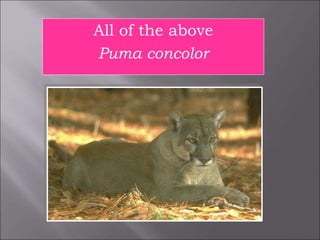
All of the above
Puma concolor
 Carolus Linneaus (1707 -
1778) a swedish naturalist.
 Devised a two part naming
system known as binomial
nomenclature.
 Standard two-part system for naming things.
 In this system, the first word identifies the
genus of the organism.
 A genus (genera-plural) consists of a group of
similar species.
 The second word, which sometimes describes
a characteristic of the organism, is called the
specific epithet.
Linnaeus described and named > 6,000
animals and >4,000 plants using Latin
Scientific name does not replace, but instead
further defines common name
• Scientific names should be italicized in print
and underlined when handwritten.
• Taxonomists are required to use Latin
because the language is no longer used in
conversation and, therefore, does not change.
• The first letter of the genus name is
uppercase, but the first letter of the specific
epithet is lowercase.
Passer domesticus
Scientific and common names
 Even though the genus and species are
thorough sometimes more is needed.
 Varities are splits of species. Example
peaches & nectarines are both from a
peach tree.
 Subspecies are variations of species that
occur in different regions.
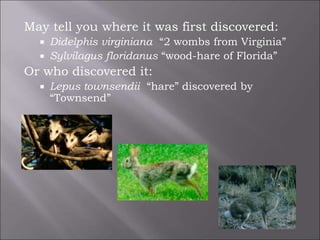
May tell you where it was first discovered:
 Didelphis virginiana “2 wombs from Virginia”
 Sylvilagus floridanus “wood-hare of Florida”
Or who discovered it:
 Lepus townsendii “hare” discovered by
“Townsend”
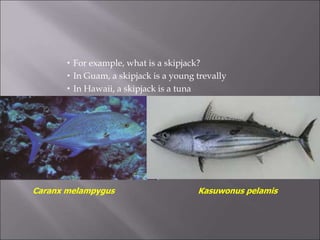
 For example, what is a skipjack?
 In Guam, a skipjack is a young trevally
 In Hawaii, a skipjack is a tuna
Caranx melampygus Kasuwonus pelamis
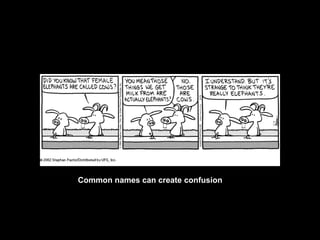
Common names can create confusion
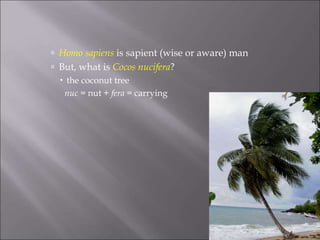
 Homo sapiens is sapient (wise or aware) man
 But, what is Cocos nucifera?
 the coconut tree
nuc = nut + fera = carrying
• Grouping organisms on the basis of their
evolutionary relationships makes it easier to
understand biological diversity.
Modern Classification
• Expanding on Linnaeus’s work, today’s
taxonomists try to identify the underlying
evolutionary relationships of organisms and
use the information gathered as a basis for
classification.
• Taxonomists group similar organisms, both
living and extinct. Classification provides a
framework in which to study the relationships
among living and extinct species.
How Living Things Are Classified
• In any classification system, items are
categorized, making them easier to find and
discuss.
• Although biologists group organisms, they
subdivide the groups on the basis of more
specific criteria.
• A group of organisms is called a taxon (plural,
taxa).
• Organisms are ranked in taxa that range from
having very broad characteristics to very specific
ones.
• The broader a taxon, the more general its
characteristics, and the more species it contains.
Mnemonic
Kingdom kings
Phylum play
Class cards
Order on
Family fine
Genus green
Specific epithet (species) sofas
Taxonomic rankings
• The smallest taxon is species. Organisms
that look alike and successfully interbreed
belong to the same species.
• The next largest taxon is a genus—a group of
similar species that have similar features and
are closely related.
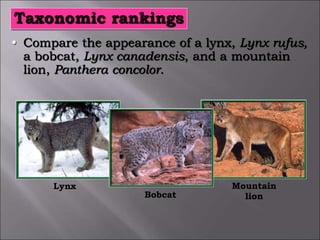
• Compare the appearance of a lynx, Lynx rufus,
a bobcat, Lynx canadensis, and a mountain
lion, Panthera concolor.
Lynx Mountain
lion
Bobcat
Taxonomic rankings
Place organisms into logical categories
 system must be capable of being used for
information retrieval, so anyone can properly
identify any organism
Place organisms into categories that show
ancestor-descendant relationships
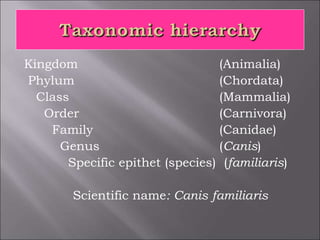
Kingdom (Animalia)
Phylum (Chordata)
Class (Mammalia)
Order (Carnivora)
Family (Canidae)
Genus (Canis)
Specific epithet (species) (familiaris)
Scientific name: Canis familiaris
THIS IS NOT MY DOG!!!!
• The evolutionary history of a species is called its
phylogeny.
Phylogenetic Classification: Models
• A classification system that shows the
evolutionary history of species is a phylogenetic
classification and reveals the evolutionary
relationships of species.
• One biological system of classification that is
based on phylogeny is cladistics.
• Scientists who use cladistics assume that as
groups of organisms diverge and evolve
from a common ancestral group, they retain
some unique inherited characteristics that
taxonomists call derived traits.
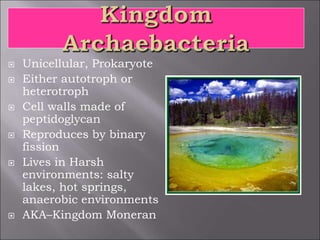
 Unicellular, Prokaryote
 Either autotroph or
heterotroph
 Cell walls made of
peptidoglycan
 Reproduces by binary
fission
 Lives in Harsh
environments: salty
lakes, hot springs,
anaerobic environments
 AKA–Kingdom Moneran
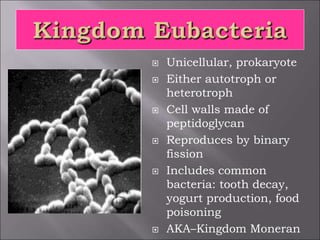
 Unicellular, prokaryote
 Either autotroph or
heterotroph
 Cell walls made of
peptidoglycan
 Reproduces by binary
fission
 Includes common
bacteria: tooth decay,
yogurt production, food
poisoning
 AKA–Kingdom Moneran
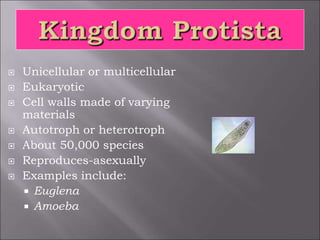
 Unicellular or multicellular
 Eukaryotic
 Cell walls made of varying
materials
 Autotroph or heterotroph
 About 50,000 species
 Reproduces-asexually
 Examples include:
 Euglena
 Amoeba
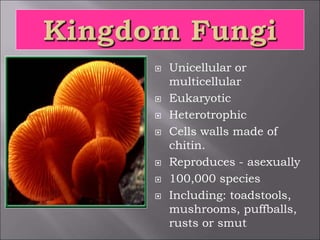
 Unicellular or
multicellular
 Eukaryotic
 Heterotrophic
 Cells walls made of
chitin.
 Reproduces - asexually
 100,000 species
 Including: toadstools,
mushrooms, puffballs,
rusts or smut
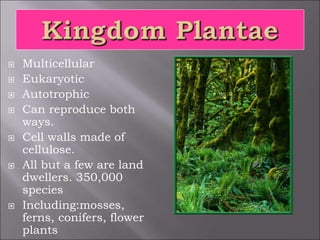
 Multicellular
 Eukaryotic
 Autotrophic
 Can reproduce both
ways.
 Cell walls made of
cellulose.
 All but a few are land
dwellers. 350,000
species
 Including:mosses,
ferns, conifers, flower
plants
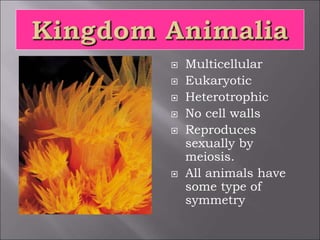
 Multicellular
 Eukaryotic
 Heterotrophic
 No cell walls
 Reproduces
sexually by
meiosis.
 All animals have
some type of
symmetry

Taxonomy_Classification_17_.ppt

  • 2.
    Viruses 1,000 Fungi 69,000 Protozoa 30,800 Algae 26,900 Prokaryotes (Eubacteria & Archaebacteria) 4,800 ALLORGANISMS: TOTAL SPECIES 1,413,000 Higher Plants 248,000 Insects 751,000 Other Animals 281,000
  • 3.
     Biologists wantto better understand organisms so they organize them. • One tool that they use to do this is classification—the grouping of objects or information based on similarities. • Taxonomy is the branch of biology that groups and names organisms based on studies of their different characteristics. • Biologists who study taxonomy are called taxonomists.
  • 4.
     >1 millionspecies named, up to 15 million more.  Taxonomy is not new; cultures have been naming plants and animals around them for 1000’s of years.  It’s practical to have names. • The Greek philosopher Aristotle (384-322 B.C.) developed the first widely accepted system of biological classification. • He classified all the organisms he knew into two groups: plants and animals.
  • 5.
    “Watch out—there’s abear behind that rock! OR “Watch out--there is a large, furry, four- legged creature with long claws, a big mouth set in a short, stout muzzle, attached to a round head containing small eyes and short triangular ears behind that rock!”
  • 6.
    Q. What isthe largest wild felid (cat) in the United States? Mountain Lion Cougar Panther Painter Puma Catamount
  • 7.
    All of theabove Puma concolor
  • 8.
     Carolus Linneaus(1707 - 1778) a swedish naturalist.  Devised a two part naming system known as binomial nomenclature.
  • 9.
     Standard two-partsystem for naming things.  In this system, the first word identifies the genus of the organism.  A genus (genera-plural) consists of a group of similar species.  The second word, which sometimes describes a characteristic of the organism, is called the specific epithet. Linnaeus described and named > 6,000 animals and >4,000 plants using Latin Scientific name does not replace, but instead further defines common name
  • 10.
    • Scientific namesshould be italicized in print and underlined when handwritten. • Taxonomists are required to use Latin because the language is no longer used in conversation and, therefore, does not change. • The first letter of the genus name is uppercase, but the first letter of the specific epithet is lowercase. Passer domesticus Scientific and common names
  • 11.
     Even thoughthe genus and species are thorough sometimes more is needed.  Varities are splits of species. Example peaches & nectarines are both from a peach tree.  Subspecies are variations of species that occur in different regions.
  • 12.
    May tell youwhere it was first discovered:  Didelphis virginiana “2 wombs from Virginia”  Sylvilagus floridanus “wood-hare of Florida” Or who discovered it:  Lepus townsendii “hare” discovered by “Townsend”
  • 13.
     For example,what is a skipjack?  In Guam, a skipjack is a young trevally  In Hawaii, a skipjack is a tuna Caranx melampygus Kasuwonus pelamis
  • 14.
    Common names cancreate confusion
  • 15.
     Homo sapiensis sapient (wise or aware) man  But, what is Cocos nucifera?  the coconut tree nuc = nut + fera = carrying
  • 16.
    • Grouping organismson the basis of their evolutionary relationships makes it easier to understand biological diversity. Modern Classification • Expanding on Linnaeus’s work, today’s taxonomists try to identify the underlying evolutionary relationships of organisms and use the information gathered as a basis for classification. • Taxonomists group similar organisms, both living and extinct. Classification provides a framework in which to study the relationships among living and extinct species.
  • 17.
    How Living ThingsAre Classified • In any classification system, items are categorized, making them easier to find and discuss. • Although biologists group organisms, they subdivide the groups on the basis of more specific criteria. • A group of organisms is called a taxon (plural, taxa). • Organisms are ranked in taxa that range from having very broad characteristics to very specific ones. • The broader a taxon, the more general its characteristics, and the more species it contains.
  • 18.
    Mnemonic Kingdom kings Phylum play Classcards Order on Family fine Genus green Specific epithet (species) sofas
  • 19.
    Taxonomic rankings • Thesmallest taxon is species. Organisms that look alike and successfully interbreed belong to the same species. • The next largest taxon is a genus—a group of similar species that have similar features and are closely related.
  • 20.
    • Compare theappearance of a lynx, Lynx rufus, a bobcat, Lynx canadensis, and a mountain lion, Panthera concolor. Lynx Mountain lion Bobcat Taxonomic rankings
  • 21.
    Place organisms intological categories  system must be capable of being used for information retrieval, so anyone can properly identify any organism Place organisms into categories that show ancestor-descendant relationships
  • 22.
    Kingdom (Animalia) Phylum (Chordata) Class(Mammalia) Order (Carnivora) Family (Canidae) Genus (Canis) Specific epithet (species) (familiaris) Scientific name: Canis familiaris
  • 23.
    THIS IS NOTMY DOG!!!!
  • 24.
    • The evolutionaryhistory of a species is called its phylogeny. Phylogenetic Classification: Models • A classification system that shows the evolutionary history of species is a phylogenetic classification and reveals the evolutionary relationships of species. • One biological system of classification that is based on phylogeny is cladistics. • Scientists who use cladistics assume that as groups of organisms diverge and evolve from a common ancestral group, they retain some unique inherited characteristics that taxonomists call derived traits.
  • 26.
     Unicellular, Prokaryote Either autotroph or heterotroph  Cell walls made of peptidoglycan  Reproduces by binary fission  Lives in Harsh environments: salty lakes, hot springs, anaerobic environments  AKA–Kingdom Moneran
  • 27.
     Unicellular, prokaryote Either autotroph or heterotroph  Cell walls made of peptidoglycan  Reproduces by binary fission  Includes common bacteria: tooth decay, yogurt production, food poisoning  AKA–Kingdom Moneran
  • 28.
     Unicellular ormulticellular  Eukaryotic  Cell walls made of varying materials  Autotroph or heterotroph  About 50,000 species  Reproduces-asexually  Examples include:  Euglena  Amoeba
  • 29.
     Unicellular or multicellular Eukaryotic  Heterotrophic  Cells walls made of chitin.  Reproduces - asexually  100,000 species  Including: toadstools, mushrooms, puffballs, rusts or smut
  • 30.
     Multicellular  Eukaryotic Autotrophic  Can reproduce both ways.  Cell walls made of cellulose.  All but a few are land dwellers. 350,000 species  Including:mosses, ferns, conifers, flower plants
  • 31.
     Multicellular  Eukaryotic Heterotrophic  No cell walls  Reproduces sexually by meiosis.  All animals have some type of symmetry

Editor's Notes

  • #3 The number of undescribed species may be as many as 99 million Therefore, scientists must be able to arrange life forms into a workable classification scheme
  • #4 Over the centuries, several classification schemes have been proposed All are hierarchical—reflecting different degrees of similarity among organisms, i.e., similar organisms are placed together in the same taxon In the early years, similarity in appearance was believed to be a result of common ancestry, but there were some exceptions
  • #9 Carolus Linnaeus (1707–1778) is considered the Father of Modern Taxonomic Classification Linnaeus was a Swedish medical student studying in Belgium His real name was Carl Ingemarsson To help pay his tuition costs, Linnaeus was contracted by wealthy Dutch patrons to catalog all species in their curio cabinets
  • #11 A scientific name is always italicized or underlined A genus name begins with UPPERCASE, while a species name is lower case, e.g., Homo sapiens or Boa constrictor The genus is a noun, and the specific epithet is an adjective that must agree with its noun in both number and gender When a binomial designation has been published, then it cannot be used for any other species Why? Binomials are unique to eliminate confusion that often arises from regional differences in common names
  • #17 Higher systematics include the following taxa in order of increasing similarity and common ancestry