Introduction of Internal Medicine Professor of Cardiology The Second Affiliated Hospital Sun Yat-sen University Liu Pinming, M.D., Ph.D
Overview Concept History Progress in Internal medicine  Medical Education The Way of Learning Establishing a high aim Combining theories with Practices Three basics: theories, knowledge,  skills How to approach to a patient
What is Medicine   Medicine is the art and science of healing. It encompasses range of health care practices evolved to maintain and restore health by prevention and treatment of illnesses Internal medicine is the medical specialty concerned with the diagnosis, management and mainly nonsurgical treatment of illnesses Internists/Physicians
Internal Medicine Subspecialties Respiratory Medicine Cardiovascular Medicine Endocrinology Gastroenterology & Hepatology Hematology Nephrology Rheumatology Infectious Diseases Oncology Critical Care Medicine Geruatrics
The Origins of Medicine   Early records on medicine: Ayurvedic medicine in the Indian subcontinent ,  ancient Egyptian medicine ,  Traditional Chinese medicine, ancient Greek medicine, Islamic medicine As science and technology developed, medicine became more reliant on medications  Vaccines: Edward Jenner in 1796, Louis Pasteur in 1889  Arsphenamine/Sulvarsan, Paul Ehilich, in 1908  Insulin: discovered and isolated by Frederick Banting in 1921   Penicillin : discovered by Alexander Fleming in 1928  Sulfa drug: 1932 Shift from biomedical model to bio-psycho-social medical model Biological factors  Broadly environmental factors
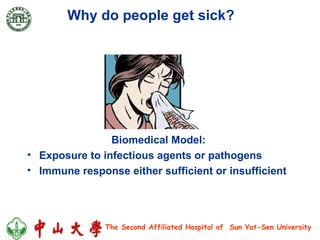
Why do people get sick? Biomedical Model:  Exposure to infectious agents or pathogens Immune response either sufficient or insufficient
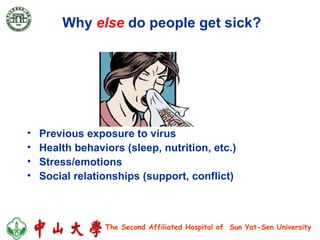
Why  else   do people get sick? Previous exposure to virus Health behaviors (sleep, nutrition, etc.) Stress/emotions Social relationships (support, conflict)
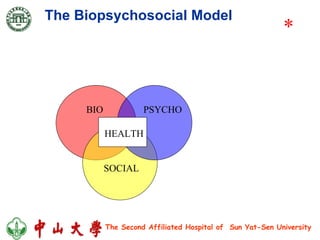
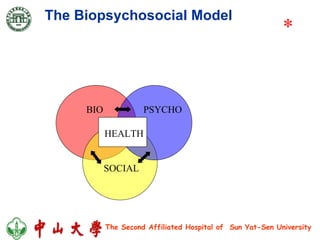
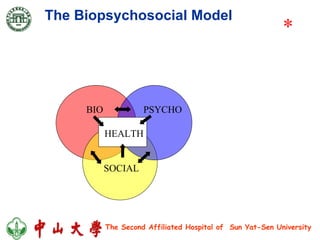
The Biopsychosocial Model HEALTH BIO PSYCHO SOCIAL *
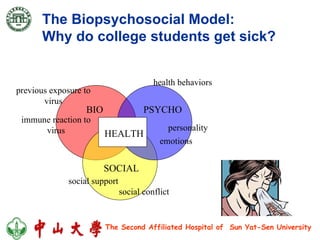
The Biopsychosocial Model:  Why do college students get sick? HEALTH BIO PSYCHO SOCIAL personality emotions social conflict social support immune reaction to virus previous exposure to virus health behaviors
Shift from Experience-Based Medicine  to EBM  “ E vidence- B ased  M edicine is the conscientious, explicit and judicious use of current best evidence in making decisions about the care of individual patients. [In] practice, [this] means integrating individual clinical experience with the best available external evidence from systematic research.” (Sackett et al., 1996.  Evidence based medicine: what it is and what it isn't. BMJ ,  312 : 71-2)
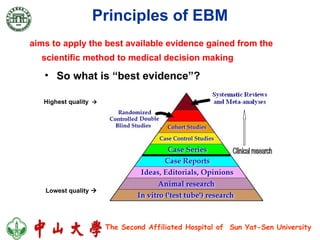
Principles of EBM Highest quality   Lowest quality   Clinical research aims to apply the best available evidence gained from the scientific method to medical decision making   So what is “best evidence”?
Evidence  B ased  M edicine Best practice based on current knowledge Formul ate of the  probl e m Find the evidence Critical evaluation of the evidence Practical application Evaluation of the results Evidence based and  creative  medicine
Progress in Internal Medicine With the development of techniques in molecular biology, cellular biology, genetics and immunology, etc at  Etiology & Pathogenesis Diagnostic Management & Treatment
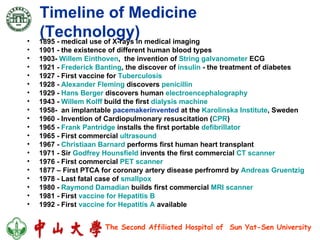
Timeline of Medicine (Technology)   1895 - medical use of X-rays in medical imaging  1901 - the existence of different human blood types  1903-  Willem Einthoven ,  the invention of  String galvanometer  ECG 1921 -  Frederick Banting , the discover of  insulin  - the treatment of diabetes  1927 - First vaccine for  Tuberculosis   1928 -  Alexander Fleming  discovers  penicillin   1929 -  Hans Berger  discovers human  electroencephalography   1943 -  Willem Kolff  build the first  dialysis machine   1958-  an implantable  pacemakerinvented  at the  Karolinska Institute , Sweden 1960 - Invention of Cardiopulmonary resuscitation ( CPR )  1965 -  Frank Pantridge  installs the first portable  defibrillator   1965 - First commercial  ultrasound   1967 -  Christiaan Barnard  performs first human heart transplant  1971 - Sir  Godfrey Hounsfield  invents the first commercial  CT scanner   1976 - First commercial  PET scanner   1877 – First PTCA for coronary artery disease perfromrd by  Andreas Gruentzig 1978 - Last fatal case of  smallpox   1980 -  Raymond Damadian  builds first commercial  MRI scanner   1981 - First  vaccine for Hepatitis B   1992 - First  vaccine for Hepatitis A  available
Internal Medicine   Internal Medicine plays a vital role in clinical medicine Not only fundamentals to other clinical medicine subjects, but also closely related to them Mastering Internal Medicine well & laying a solid foundation
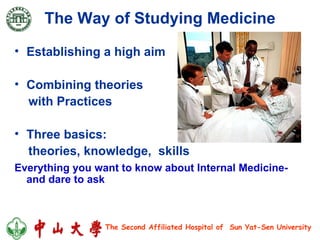
The Way of Studying Medicine Establishing a high aim Combining theories with Practices Three basics: theories, knowledge,  skills Everything you want to know about Internal Medicine-and dare to ask
Learning Skills throughout Lectures Diseased-Centered, Learner-Driven  Focused on: Etiology & Pathogenesis Pathophysiology Clinical Manifestations: symptoms, signs Laboratory Findings & other Additional testing Diagnosis & Differential Diagnosis Management Principles
Problem-based Learning   Characteristics: Learning: driven by challenging, open-ended problems  Students: in small collaborative groups  Teachers: the role as "facilitators" of learning.  student-centered instructional strategy in which students collaboratively solve problems and reflect on their experiences
Problem-based Learning   Advocates of PBL claim it can be used to enhance content knowledge and foster the development of communication, problem-solving, and self-directed learning skill Students are encouraged to take responsibility for their group and organize and direct the learning process with support from a tutor or instructor Problem-based learning is widely used in many medical universities world wide
Doctoring Skills Rotation Patient-Centered, Learner-Driven  Focused on: History taking and communications skills Physical diagnosis Real patients and patient simulation technology Decision-making skills Life-long learning skills Clinical teaching skills Direct Feedback from Specially Trained Teaching Faculty
SUMMARY The key to study internal medicine: Care  about what you are learning Try  your hardest at all that you do Think  and  reason  through things Learn  every day Work  as a team Have  fun
谢谢!

1 introduction

  • 1.
    Introduction of InternalMedicine Professor of Cardiology The Second Affiliated Hospital Sun Yat-sen University Liu Pinming, M.D., Ph.D
  • 2.
    Overview Concept HistoryProgress in Internal medicine Medical Education The Way of Learning Establishing a high aim Combining theories with Practices Three basics: theories, knowledge, skills How to approach to a patient
  • 3.
    What is Medicine Medicine is the art and science of healing. It encompasses range of health care practices evolved to maintain and restore health by prevention and treatment of illnesses Internal medicine is the medical specialty concerned with the diagnosis, management and mainly nonsurgical treatment of illnesses Internists/Physicians
  • 4.
    Internal Medicine SubspecialtiesRespiratory Medicine Cardiovascular Medicine Endocrinology Gastroenterology & Hepatology Hematology Nephrology Rheumatology Infectious Diseases Oncology Critical Care Medicine Geruatrics
  • 5.
    The Origins ofMedicine Early records on medicine: Ayurvedic medicine in the Indian subcontinent , ancient Egyptian medicine , Traditional Chinese medicine, ancient Greek medicine, Islamic medicine As science and technology developed, medicine became more reliant on medications Vaccines: Edward Jenner in 1796, Louis Pasteur in 1889 Arsphenamine/Sulvarsan, Paul Ehilich, in 1908 Insulin: discovered and isolated by Frederick Banting in 1921 Penicillin : discovered by Alexander Fleming in 1928 Sulfa drug: 1932 Shift from biomedical model to bio-psycho-social medical model Biological factors Broadly environmental factors
  • 6.
    Why do peopleget sick? Biomedical Model: Exposure to infectious agents or pathogens Immune response either sufficient or insufficient
  • 7.
    Why else do people get sick? Previous exposure to virus Health behaviors (sleep, nutrition, etc.) Stress/emotions Social relationships (support, conflict)
  • 8.
    The Biopsychosocial ModelHEALTH BIO PSYCHO SOCIAL *
  • 9.
    The Biopsychosocial ModelHEALTH BIO PSYCHO SOCIAL *
  • 10.
    The Biopsychosocial ModelHEALTH BIO PSYCHO SOCIAL *
  • 11.
    The Biopsychosocial Model: Why do college students get sick? HEALTH BIO PSYCHO SOCIAL personality emotions social conflict social support immune reaction to virus previous exposure to virus health behaviors
  • 12.
    Shift from Experience-BasedMedicine to EBM “ E vidence- B ased M edicine is the conscientious, explicit and judicious use of current best evidence in making decisions about the care of individual patients. [In] practice, [this] means integrating individual clinical experience with the best available external evidence from systematic research.” (Sackett et al., 1996. Evidence based medicine: what it is and what it isn't. BMJ , 312 : 71-2)
  • 13.
    Principles of EBMHighest quality  Lowest quality  Clinical research aims to apply the best available evidence gained from the scientific method to medical decision making So what is “best evidence”?
  • 14.
    Evidence Based M edicine Best practice based on current knowledge Formul ate of the probl e m Find the evidence Critical evaluation of the evidence Practical application Evaluation of the results Evidence based and creative medicine
  • 15.
    Progress in InternalMedicine With the development of techniques in molecular biology, cellular biology, genetics and immunology, etc at Etiology & Pathogenesis Diagnostic Management & Treatment
  • 16.
    Timeline of Medicine(Technology) 1895 - medical use of X-rays in medical imaging 1901 - the existence of different human blood types 1903- Willem Einthoven , the invention of String galvanometer ECG 1921 - Frederick Banting , the discover of insulin - the treatment of diabetes 1927 - First vaccine for Tuberculosis 1928 - Alexander Fleming discovers penicillin 1929 - Hans Berger discovers human electroencephalography 1943 - Willem Kolff build the first dialysis machine 1958- an implantable pacemakerinvented at the Karolinska Institute , Sweden 1960 - Invention of Cardiopulmonary resuscitation ( CPR ) 1965 - Frank Pantridge installs the first portable defibrillator 1965 - First commercial ultrasound 1967 - Christiaan Barnard performs first human heart transplant 1971 - Sir Godfrey Hounsfield invents the first commercial CT scanner 1976 - First commercial PET scanner 1877 – First PTCA for coronary artery disease perfromrd by Andreas Gruentzig 1978 - Last fatal case of smallpox 1980 - Raymond Damadian builds first commercial MRI scanner 1981 - First vaccine for Hepatitis B 1992 - First vaccine for Hepatitis A available
  • 17.
    Internal Medicine Internal Medicine plays a vital role in clinical medicine Not only fundamentals to other clinical medicine subjects, but also closely related to them Mastering Internal Medicine well & laying a solid foundation
  • 18.
    The Way ofStudying Medicine Establishing a high aim Combining theories with Practices Three basics: theories, knowledge, skills Everything you want to know about Internal Medicine-and dare to ask
  • 19.
    Learning Skills throughoutLectures Diseased-Centered, Learner-Driven Focused on: Etiology & Pathogenesis Pathophysiology Clinical Manifestations: symptoms, signs Laboratory Findings & other Additional testing Diagnosis & Differential Diagnosis Management Principles
  • 20.
    Problem-based Learning Characteristics: Learning: driven by challenging, open-ended problems Students: in small collaborative groups Teachers: the role as "facilitators" of learning. student-centered instructional strategy in which students collaboratively solve problems and reflect on their experiences
  • 21.
    Problem-based Learning Advocates of PBL claim it can be used to enhance content knowledge and foster the development of communication, problem-solving, and self-directed learning skill Students are encouraged to take responsibility for their group and organize and direct the learning process with support from a tutor or instructor Problem-based learning is widely used in many medical universities world wide
  • 22.
    Doctoring Skills RotationPatient-Centered, Learner-Driven Focused on: History taking and communications skills Physical diagnosis Real patients and patient simulation technology Decision-making skills Life-long learning skills Clinical teaching skills Direct Feedback from Specially Trained Teaching Faculty
  • 23.
    SUMMARY The keyto study internal medicine: Care about what you are learning Try your hardest at all that you do Think and reason through things Learn every day Work as a team Have fun
  • 24.

Editor's Notes

  • #5 These fields are subspecialties of internal medicine and thus require an additional fellowship of 2-3 years’ duration in order to practice.
  • #7 Introduce the biomedical model as an extension of the biomedical definition of health given earlier. Modern medicine has looked to two explanations for disease: exposure to infectious agents, i.e. tuberculosis, and changes in physical systems, such as the changes to blood vessels that increase risk for heart disease. Move into thought experiment…..(next slide)
  • #8 Imagine that I release a large quantity of cold virus into the ventilation system of the room, enough to guarantee that everyone in this room is exposed to the virus. Not everyone will develop symptoms – why not? Discuss each of these briefly, in terms of the their effects on the immune system in handling infections.
  • #10 Use multiple languages in a room metaphor to compare biomedical and biopsychosocial models.
  • #11 Use multiple languages in a room metaphor to compare biomedical and biopsychosocial models.
  • #14 Case reports and below are considered clinically relevant but of lower quality that the above layers. So they make good background resources