Evidence Based Medicine
Noha Salah Baghdady, M. Sc.
Learning Objectives
• Clinical Questions types .
• A Hierarchy of Preprocessed Evidence.
• EBM definition and value.
• Knowledge and Skills Necessary for Optimal
Evidence-Based Practice.
• Basic computer and internet knowledge for
electronic searching of the literature
Case Study
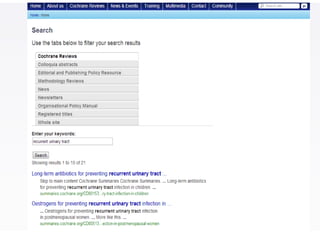
• A 30-year-old female presents with recurrent
Urinary tract infection for past 8 months;
these episodes have been treated with several
courses of antibiotics but keep recurring. She
asks if recurrences can be prevented with
antibiotics.
History
1980
• The researchers found that physicians were
using very different standards to decide which
patients required surgery.
• The variation rates of prostate surgery &
hysterectomy of up to 300% between similar
countries.
Definition
Evidence based medicine could be defined as
the science of integrating the best available
evidence from clinical research with physicians
experience and patients' unique values and
preferences.
(David Sackett and colleagues)
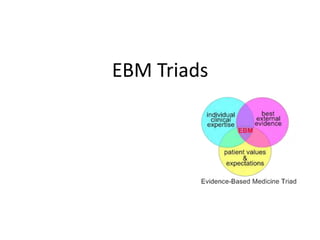
EBM Triads
Gordon Guyatt and colleagues from
McMaster University (Canada) in 1992
The clinical question
background vs. foreground
1- Background questions:
• Their answers are “fiber of medicine.”
• Answers usually found in medical textbooks.
The clinical question
background vs. foreground
2- Foreground questions
• are those usually found at the cutting edge of
medicine.
• They are questions about the most recent
therapies, diagnostic tests, or current theories
of illness causation.
• These are the questions that are the heart of
the practice of EBM.
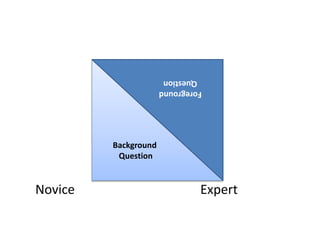
Novice Expert
Background
Question
Foreground
Question
Examples
• Background questions:
1- The causative microbiologic agent of disease.
2- A recommended dose of a drug.
3- A list of the attributes of syndrome.
• Foreground questions:
1- Intervention or exposure
2- A possible comparison intervention
3- Outcomes of interest.
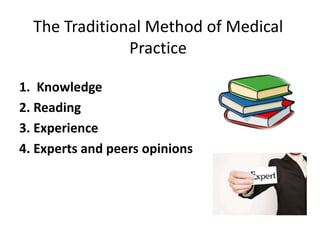
The Traditional Method of Medical
Practice
1. Knowledge
2. Reading
3. Experience
4. Experts and peers opinions
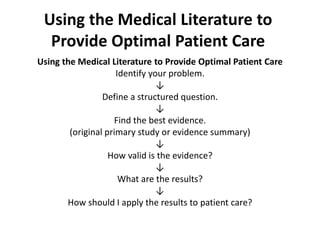
Using the Medical Literature to
Provide Optimal Patient Care
Using the Medical Literature to Provide Optimal Patient Care
Identify your problem.
↓
Define a structured question.
↓
Find the best evidence.
(original primary study or evidence summary)
↓
How valid is the evidence?
↓
What are the results?
↓
How should I apply the results to patient care?
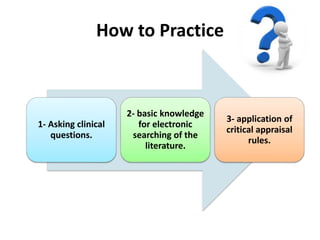
How to Practice
1- Asking clinical
questions.
2- basic knowledge
for electronic
searching of the
literature.
3- application of
critical appraisal
rules.
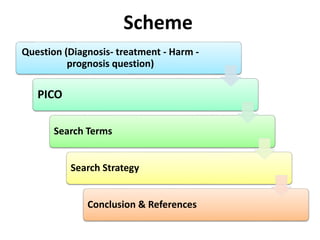
Scheme
Question (Diagnosis- treatment - Harm -
prognosis question)
PICO
Search Terms
Search Strategy
Conclusion & References
1- Asking
Examples
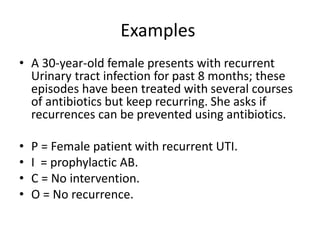
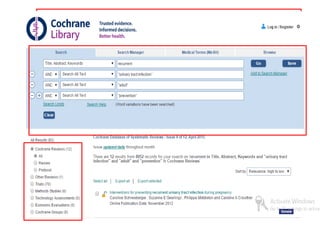
• A 30-year-old female presents with recurrent
Urinary tract infection for past 8 months; these
episodes have been treated with several courses
of antibiotics but keep recurring. She asks if
recurrences can be prevented using antibiotics.
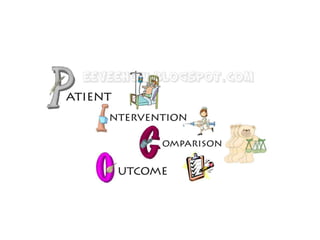
• P = Female patient with recurrent UTI.
• I = prophylactic AB.
• C = No intervention.
• O = No recurrence.
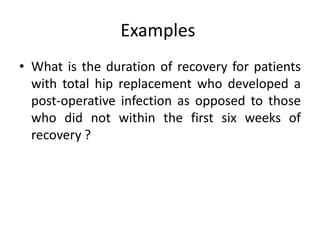
Examples
• What is the duration of recovery for patients
with total hip replacement who developed a
post-operative infection as opposed to those
who did not within the first six weeks of
recovery ?
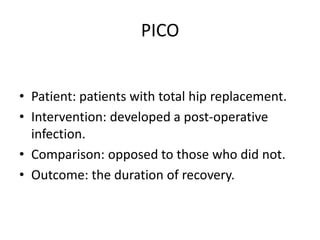
PICO
• Patient: patients with total hip replacement.
• Intervention: developed a post-operative
infection.
• Comparison: opposed to those who did not.
• Outcome: the duration of recovery.
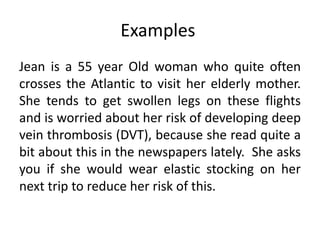
Examples
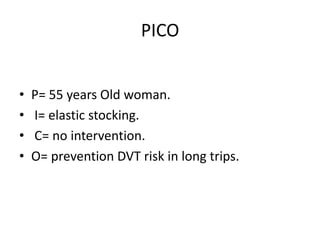
Jean is a 55 year Old woman who quite often
crosses the Atlantic to visit her elderly mother.
She tends to get swollen legs on these flights
and is worried about her risk of developing deep
vein thrombosis (DVT), because she read quite a
bit about this in the newspapers lately. She asks
you if she would wear elastic stocking on her
next trip to reduce her risk of this.
PICO
• P= 55 years Old woman.
• I= elastic stocking.
• C= no intervention.
• O= prevention DVT risk in long trips.
Basic computer and internet knowledge for
electronic searching of the literature
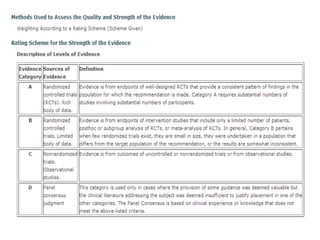
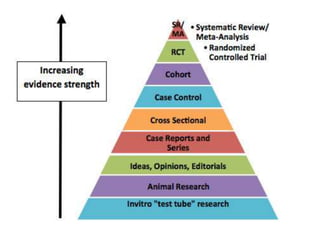
A Hierarchy of Preprocessed Evidence
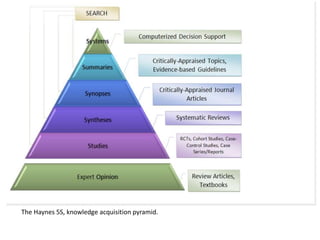
The Haynes 5S, knowledge acquisition pyramid.
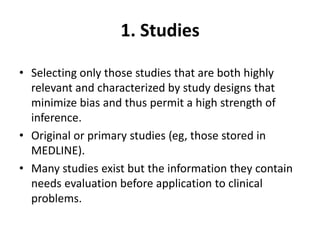
1. Studies
• Selecting only those studies that are both highly
relevant and characterized by study designs that
minimize bias and thus permit a high strength of
inference.
• Original or primary studies (eg, those stored in
MEDLINE).
• Many studies exist but the information they contain
needs evaluation before application to clinical
problems.
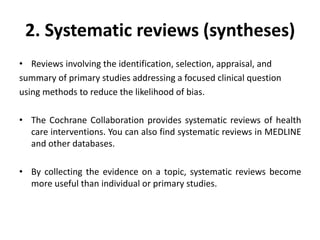
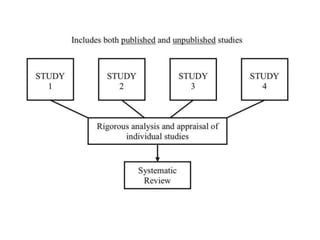
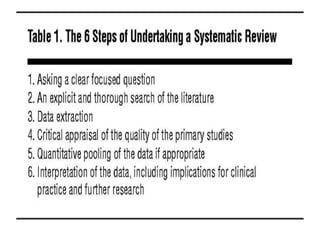
2. Systematic reviews (syntheses)
• Reviews involving the identification, selection, appraisal, and
summary of primary studies addressing a focused clinical question
using methods to reduce the likelihood of bias.
• The Cochrane Collaboration provides systematic reviews of health
care interventions. You can also find systematic reviews in MEDLINE
and other databases.
• By collecting the evidence on a topic, systematic reviews become
more useful than individual or primary studies.
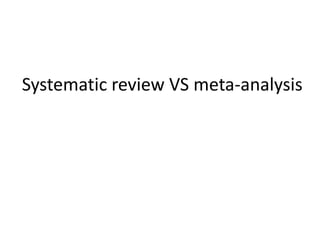
Systematic review VS meta-analysis
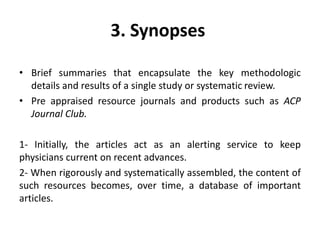
3. Synopses
• Brief summaries that encapsulate the key methodologic
details and results of a single study or systematic review.
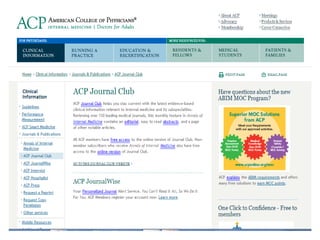
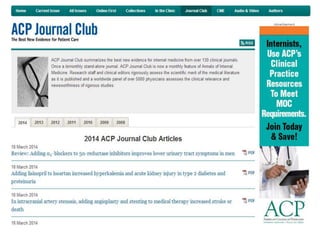
• Pre appraised resource journals and products such as ACP
Journal Club.
1- Initially, the articles act as an alerting service to keep
physicians current on recent advances.
2- When rigorously and systematically assembled, the content of
such resources becomes, over time, a database of important
articles.
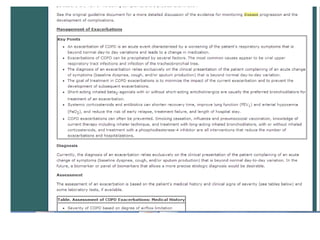
4. Summaries & Systems
• Practice guidelines, clinical pathways, or evidence-based
textbook summaries that integrate evidence-based
information about specific clinical problems and provide
regular updates to guide the care of individual patients.
Extract “Key Words”
Boolean operators
“AND” “OR’’ “NOT’’
Boolean operators
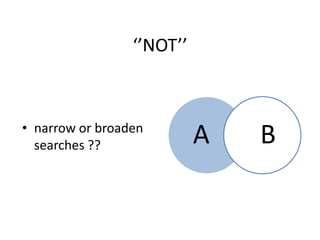
• The basic Boolean logic operators for
searching are: AND, OR and NOT
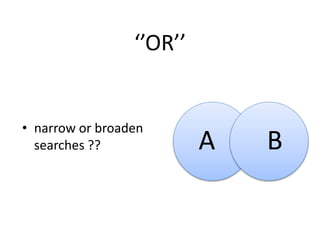
• These operators can be used to narrow or
broaden searches
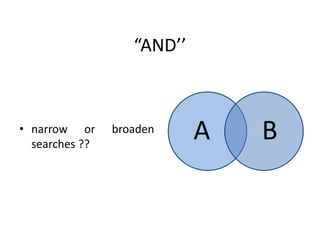
“AND’’
A B• narrow or broaden
searches ??
‘’OR’’
A B
• narrow or broaden
searches ??
‘’NOT’’
A B• narrow or broaden
searches ??
Try Boolean operators
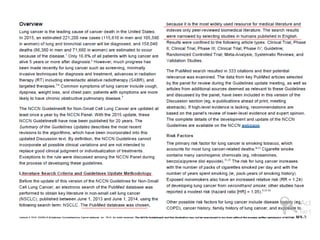
Evidence Based Guidelines
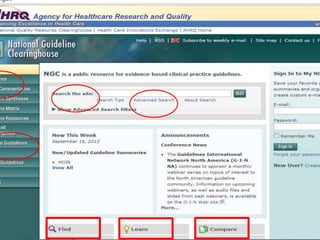
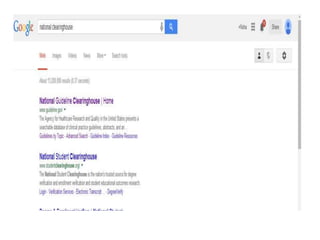
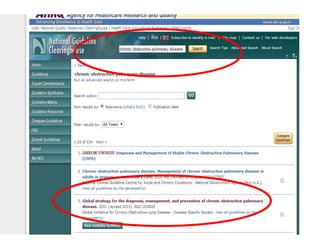
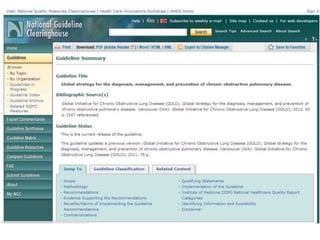
National Guideline Clearinghouse
• A database of evidence-based clinical practice guidelines and
related documents. It is maintained as a public resource by
the Agency for Healthcare Research and Quality (AHRQ) of the
U.S. Department of Health and Human Services.
• The database is updated weekly with new and revised
guidelines. The currency of all guidelines is verified annually
through NGC's Annual Verification process.
National Guideline
Clearinghouse
The site features:
• A Guideline Comparison utility that gives users the ability
to generate side-by-side comparisons.
• Guideline Syntheses prepared by NGC staff, comparing
guidelines covering similar topics, highlighting areas of
similarity and difference.
• An electronic forum, NGC-L for exchanging information on
clinical practice guidelines, their development,
implementation and use
• An Annotated Bibliography database where users can
search for citations for publications and resources about
guidelines, including guideline development and
methodology, structure, evaluation, and implementation.
Clinical practice guidelines
illustrate that this classification (like any other)
has its limitations: guidelines have aspects of
systems and summaries, and sometimes of
synopses.
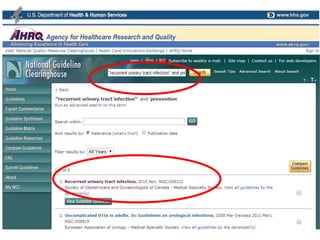
National Guideline Clearinghouse
Use:
• Quotation marks “ “
• Boolean operators (AND, OR, NOT)
• Asterisk (*)
Scenario
• A 30-year-old female presents with recurrent
Urinary tract infection for past 8 months;
these episodes have been treated with several
courses of antibiotics but keep recurring. She
asks if recurrences can be prevented.
Scenario
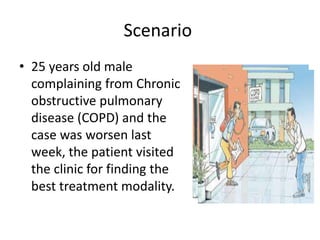
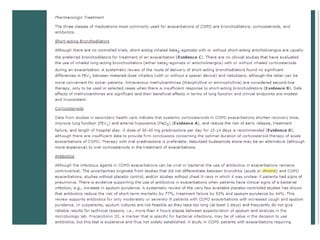
• 25 years old male
complaining from Chronic
obstructive pulmonary
disease (COPD) and the
case was worsen last
week, the patient visited
the clinic for finding the
best treatment modality.
Systematic Reviews
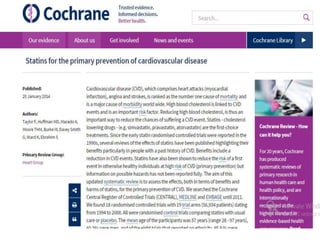
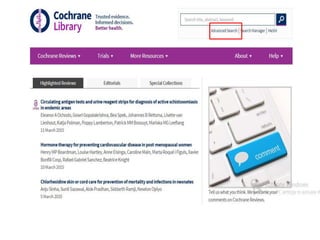
Cochrane Collaboration
• The Cochrane Collaboration is an independent nonprofit
organization consisting of a group of more than 31,000
volunteers in more than 120 countries.
• The collaboration was formed to organize medical research
information in a systematic way to facilitate the choices that
health professionals, patients, policy makers and others face
in health interventions according to the principles
of evidence-based medicine.
Cochrane Collaboration
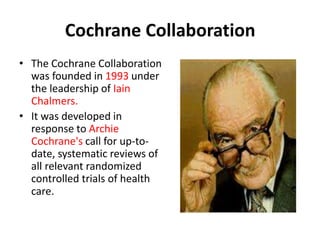
• The Cochrane Collaboration
was founded in 1993 under
the leadership of Iain
Chalmers.
• It was developed in
response to Archie
Cochrane's call for up-to-
date, systematic reviews of
all relevant randomized
controlled trials of health
care.
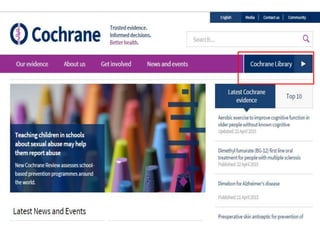
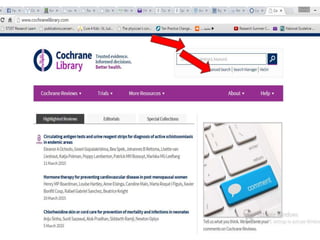
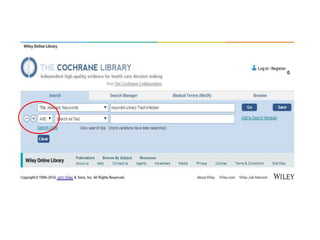
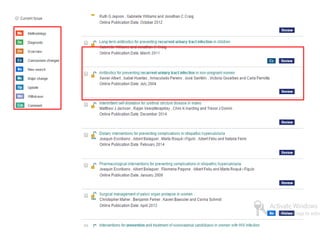
THE COCHRANE LIBRARY
• Relies only on high quality randomized
controlled trials for generating its evidence.
• Contains systematic reviews.
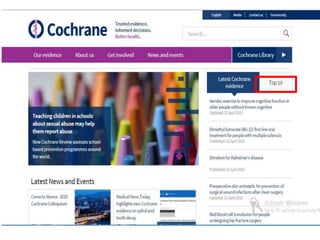
http://www.cochrane.org
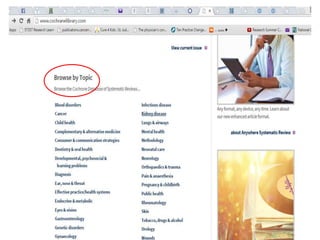
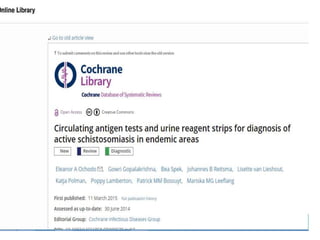
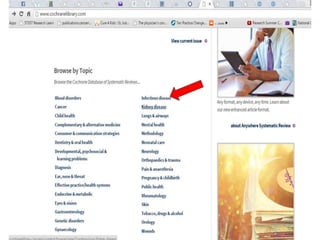
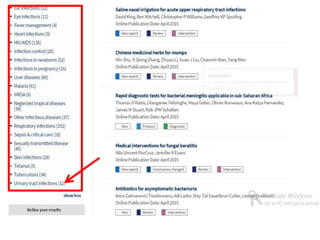
http://www.thecochranelibrary.com
THE COCHRANE LIBRARY
Database of Systematic Reviews Covers broad
range of disciplines.
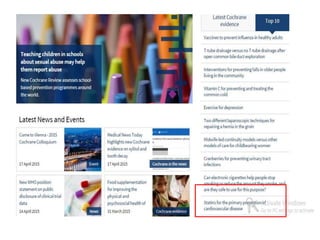
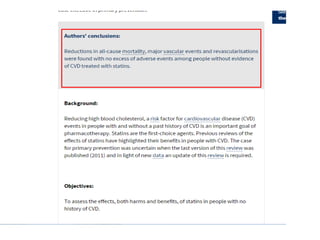
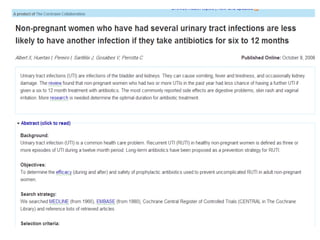
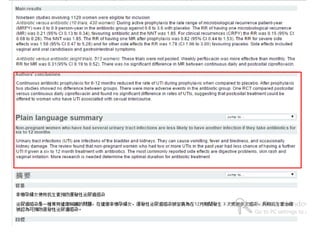
Authors' conclusions
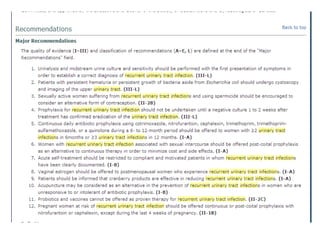
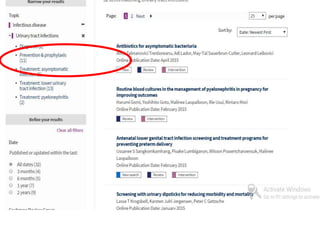
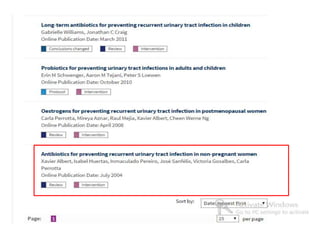
• Continuous antibiotic prophylaxis for 6-12 months
reduced the rate of UTI during prophylaxis when
compared to placebo.
• After prophylaxis two studies showed no difference
between groups. There were more adverse events in
the antibiotic group.
• One RCT compared postictal versus continuous daily
ciprofloxacin and found no significant difference in
rates of UTIs, suggesting that postcoital treatment
could be offered to woman who have UTI associated
with sexual intercourse.
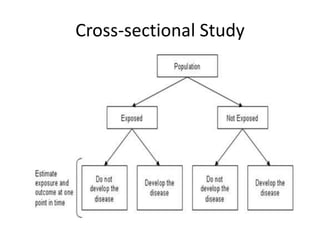
Studies
Cross-sectional Study
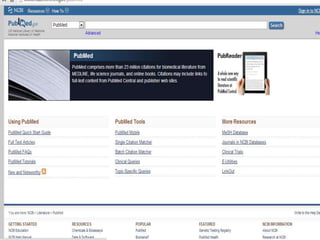
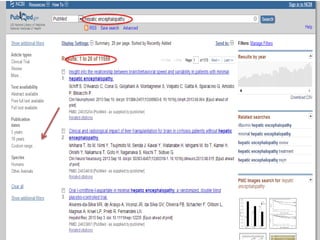
MEDLINE
(Indexing system)
www.pubmed.gov.
The Medline
• The Medline database represents the largest
resource for non-appraised evidence all over
the world.
• It contains over sixteen million abstract of
scientific publications from about 480 medical
journals in the USA, Europe and the rest of the
world.
• It covers almost 40-50% of the worlds'
scientific publications.
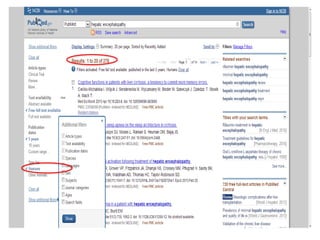
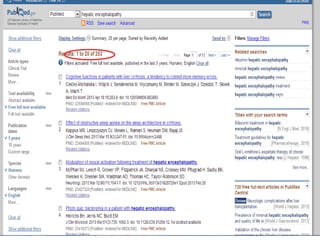
Filters
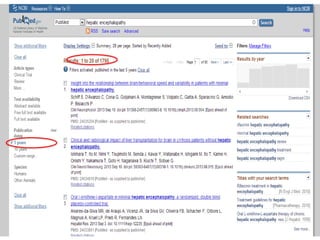
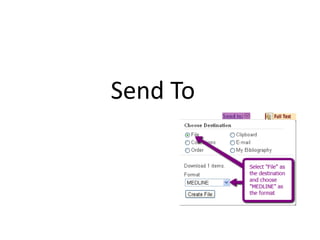
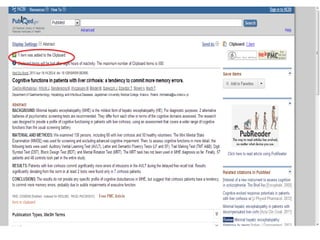
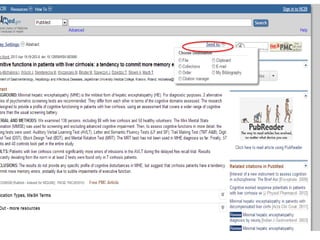
Send To
Saving
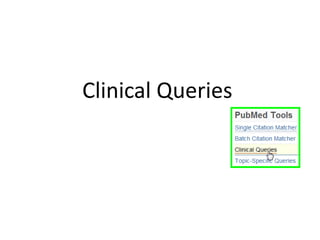
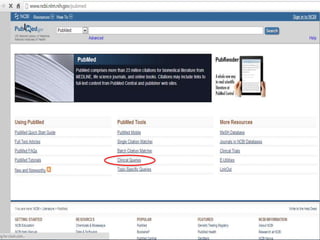
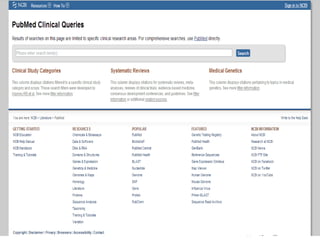
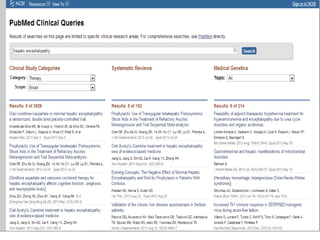
Clinical Queries
Clinical Queries
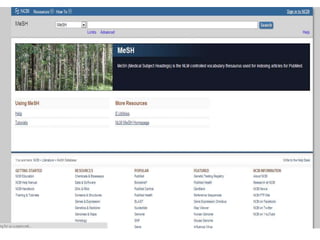
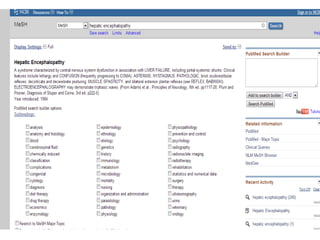
(Medical Subject Headings) MeSH
• MeSHis a list of controlled vocabulary
generated by the U.S. National Library of
Medicine
(http://www.nlm.nih.gov/mesh/2002)to index
abstracts of research papers published in the
Pubmed.
• A subject heading search is a powerful tool for
finding sets of only the most relevant records.
Scenario
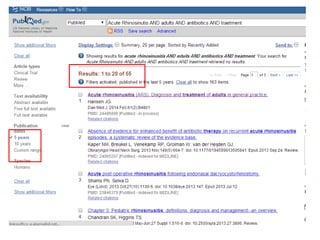
22 years old male diagnosed with rhinosinusitis
(RS), the physician prescribed an antibiotic for
him and tolled him to come back after 10 days ..
You remembered that you read something
about the effectiveness of antibiotic treatment
for acute RS.. You go to check this !!
PICO
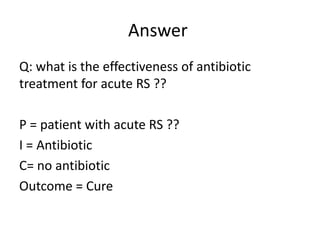
Answer
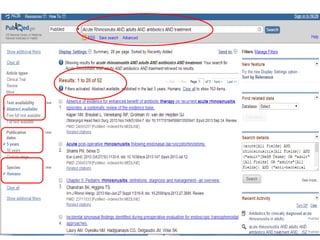
Q: what is the effectiveness of antibiotic
treatment for acute RS ??
P = patient with acute RS ??
I = Antibiotic
C= no antibiotic
Outcome = Cure
Authors’ conclusion
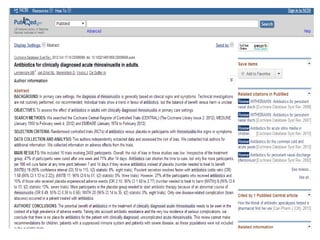
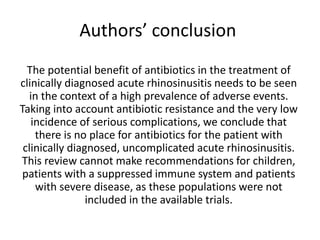
The potential benefit of antibiotics in the treatment of
clinically diagnosed acute rhinosinusitis needs to be seen
in the context of a high prevalence of adverse events.
Taking into account antibiotic resistance and the very low
incidence of serious complications, we conclude that
there is no place for antibiotics for the patient with
clinically diagnosed, uncomplicated acute rhinosinusitis.
This review cannot make recommendations for children,
patients with a suppressed immune system and patients
with severe disease, as these populations were not
included in the available trials.
Conclusion
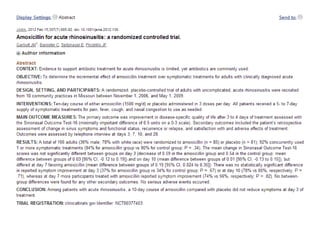
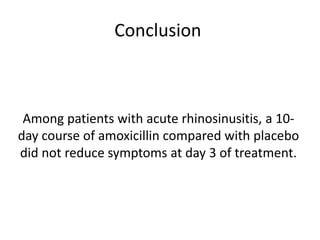
Among patients with acute rhinosinusitis, a 10-
day course of amoxicillin compared with placebo
did not reduce symptoms at day 3 of treatment.
THANK YOU 

Evidence Based Medicine

  • 1.
    Evidence Based Medicine NohaSalah Baghdady, M. Sc.
  • 2.
    Learning Objectives • ClinicalQuestions types . • A Hierarchy of Preprocessed Evidence. • EBM definition and value. • Knowledge and Skills Necessary for Optimal Evidence-Based Practice. • Basic computer and internet knowledge for electronic searching of the literature
  • 3.
    Case Study • A30-year-old female presents with recurrent Urinary tract infection for past 8 months; these episodes have been treated with several courses of antibiotics but keep recurring. She asks if recurrences can be prevented with antibiotics.
  • 4.
    History 1980 • The researchersfound that physicians were using very different standards to decide which patients required surgery. • The variation rates of prostate surgery & hysterectomy of up to 300% between similar countries.
  • 5.
    Definition Evidence based medicinecould be defined as the science of integrating the best available evidence from clinical research with physicians experience and patients' unique values and preferences. (David Sackett and colleagues)
  • 6.
  • 7.
    Gordon Guyatt andcolleagues from McMaster University (Canada) in 1992
  • 8.
    The clinical question backgroundvs. foreground 1- Background questions: • Their answers are “fiber of medicine.” • Answers usually found in medical textbooks.
  • 9.
    The clinical question backgroundvs. foreground 2- Foreground questions • are those usually found at the cutting edge of medicine. • They are questions about the most recent therapies, diagnostic tests, or current theories of illness causation. • These are the questions that are the heart of the practice of EBM.
  • 10.
  • 11.
    Examples • Background questions: 1-The causative microbiologic agent of disease. 2- A recommended dose of a drug. 3- A list of the attributes of syndrome. • Foreground questions: 1- Intervention or exposure 2- A possible comparison intervention 3- Outcomes of interest.
  • 12.
    The Traditional Methodof Medical Practice 1. Knowledge 2. Reading 3. Experience 4. Experts and peers opinions
  • 13.
    Using the MedicalLiterature to Provide Optimal Patient Care Using the Medical Literature to Provide Optimal Patient Care Identify your problem. ↓ Define a structured question. ↓ Find the best evidence. (original primary study or evidence summary) ↓ How valid is the evidence? ↓ What are the results? ↓ How should I apply the results to patient care?
  • 14.
    How to Practice 1-Asking clinical questions. 2- basic knowledge for electronic searching of the literature. 3- application of critical appraisal rules.
  • 15.
    Scheme Question (Diagnosis- treatment- Harm - prognosis question) PICO Search Terms Search Strategy Conclusion & References
  • 16.
  • 18.
    Examples • A 30-year-oldfemale presents with recurrent Urinary tract infection for past 8 months; these episodes have been treated with several courses of antibiotics but keep recurring. She asks if recurrences can be prevented using antibiotics. • P = Female patient with recurrent UTI. • I = prophylactic AB. • C = No intervention. • O = No recurrence.
  • 19.
    Examples • What isthe duration of recovery for patients with total hip replacement who developed a post-operative infection as opposed to those who did not within the first six weeks of recovery ?
  • 20.
    PICO • Patient: patientswith total hip replacement. • Intervention: developed a post-operative infection. • Comparison: opposed to those who did not. • Outcome: the duration of recovery.
  • 21.
    Examples Jean is a55 year Old woman who quite often crosses the Atlantic to visit her elderly mother. She tends to get swollen legs on these flights and is worried about her risk of developing deep vein thrombosis (DVT), because she read quite a bit about this in the newspapers lately. She asks you if she would wear elastic stocking on her next trip to reduce her risk of this.
  • 22.
    PICO • P= 55years Old woman. • I= elastic stocking. • C= no intervention. • O= prevention DVT risk in long trips.
  • 23.
    Basic computer andinternet knowledge for electronic searching of the literature
  • 24.
    A Hierarchy ofPreprocessed Evidence
  • 25.
    The Haynes 5S,knowledge acquisition pyramid.
  • 26.
    1. Studies • Selectingonly those studies that are both highly relevant and characterized by study designs that minimize bias and thus permit a high strength of inference. • Original or primary studies (eg, those stored in MEDLINE). • Many studies exist but the information they contain needs evaluation before application to clinical problems.
  • 27.
    2. Systematic reviews(syntheses) • Reviews involving the identification, selection, appraisal, and summary of primary studies addressing a focused clinical question using methods to reduce the likelihood of bias. • The Cochrane Collaboration provides systematic reviews of health care interventions. You can also find systematic reviews in MEDLINE and other databases. • By collecting the evidence on a topic, systematic reviews become more useful than individual or primary studies.
  • 28.
    Systematic review VSmeta-analysis
  • 29.
    3. Synopses • Briefsummaries that encapsulate the key methodologic details and results of a single study or systematic review. • Pre appraised resource journals and products such as ACP Journal Club. 1- Initially, the articles act as an alerting service to keep physicians current on recent advances. 2- When rigorously and systematically assembled, the content of such resources becomes, over time, a database of important articles.
  • 32.
    4. Summaries &Systems • Practice guidelines, clinical pathways, or evidence-based textbook summaries that integrate evidence-based information about specific clinical problems and provide regular updates to guide the care of individual patients.
  • 33.
  • 34.
  • 35.
    Boolean operators • Thebasic Boolean logic operators for searching are: AND, OR and NOT • These operators can be used to narrow or broaden searches
  • 36.
    “AND’’ A B• narrowor broaden searches ??
  • 37.
    ‘’OR’’ A B • narrowor broaden searches ??
  • 38.
    ‘’NOT’’ A B• narrowor broaden searches ??
  • 39.
  • 40.
  • 41.
    National Guideline Clearinghouse •A database of evidence-based clinical practice guidelines and related documents. It is maintained as a public resource by the Agency for Healthcare Research and Quality (AHRQ) of the U.S. Department of Health and Human Services. • The database is updated weekly with new and revised guidelines. The currency of all guidelines is verified annually through NGC's Annual Verification process.
  • 42.
    National Guideline Clearinghouse The sitefeatures: • A Guideline Comparison utility that gives users the ability to generate side-by-side comparisons. • Guideline Syntheses prepared by NGC staff, comparing guidelines covering similar topics, highlighting areas of similarity and difference. • An electronic forum, NGC-L for exchanging information on clinical practice guidelines, their development, implementation and use • An Annotated Bibliography database where users can search for citations for publications and resources about guidelines, including guideline development and methodology, structure, evaluation, and implementation.
  • 43.
    Clinical practice guidelines illustratethat this classification (like any other) has its limitations: guidelines have aspects of systems and summaries, and sometimes of synopses.
  • 45.
    National Guideline Clearinghouse Use: •Quotation marks “ “ • Boolean operators (AND, OR, NOT) • Asterisk (*)
  • 46.
    Scenario • A 30-year-oldfemale presents with recurrent Urinary tract infection for past 8 months; these episodes have been treated with several courses of antibiotics but keep recurring. She asks if recurrences can be prevented.
  • 51.
    Scenario • 25 yearsold male complaining from Chronic obstructive pulmonary disease (COPD) and the case was worsen last week, the patient visited the clinic for finding the best treatment modality.
  • 57.
  • 60.
    Cochrane Collaboration • TheCochrane Collaboration is an independent nonprofit organization consisting of a group of more than 31,000 volunteers in more than 120 countries. • The collaboration was formed to organize medical research information in a systematic way to facilitate the choices that health professionals, patients, policy makers and others face in health interventions according to the principles of evidence-based medicine.
  • 61.
    Cochrane Collaboration • TheCochrane Collaboration was founded in 1993 under the leadership of Iain Chalmers. • It was developed in response to Archie Cochrane's call for up-to- date, systematic reviews of all relevant randomized controlled trials of health care.
  • 62.
    THE COCHRANE LIBRARY •Relies only on high quality randomized controlled trials for generating its evidence. • Contains systematic reviews. http://www.cochrane.org http://www.thecochranelibrary.com
  • 63.
    THE COCHRANE LIBRARY Databaseof Systematic Reviews Covers broad range of disciplines.
  • 81.
    Authors' conclusions • Continuousantibiotic prophylaxis for 6-12 months reduced the rate of UTI during prophylaxis when compared to placebo. • After prophylaxis two studies showed no difference between groups. There were more adverse events in the antibiotic group. • One RCT compared postictal versus continuous daily ciprofloxacin and found no significant difference in rates of UTIs, suggesting that postcoital treatment could be offered to woman who have UTI associated with sexual intercourse.
  • 86.
  • 89.
  • 90.
  • 91.
    The Medline • TheMedline database represents the largest resource for non-appraised evidence all over the world. • It contains over sixteen million abstract of scientific publications from about 480 medical journals in the USA, Europe and the rest of the world. • It covers almost 40-50% of the worlds' scientific publications.
  • 94.
  • 98.
  • 99.
  • 101.
  • 102.
  • 105.
  • 106.
    (Medical Subject Headings)MeSH • MeSHis a list of controlled vocabulary generated by the U.S. National Library of Medicine (http://www.nlm.nih.gov/mesh/2002)to index abstracts of research papers published in the Pubmed. • A subject heading search is a powerful tool for finding sets of only the most relevant records.
  • 110.
    Scenario 22 years oldmale diagnosed with rhinosinusitis (RS), the physician prescribed an antibiotic for him and tolled him to come back after 10 days .. You remembered that you read something about the effectiveness of antibiotic treatment for acute RS.. You go to check this !!
  • 112.
  • 113.
    Answer Q: what isthe effectiveness of antibiotic treatment for acute RS ?? P = patient with acute RS ?? I = Antibiotic C= no antibiotic Outcome = Cure
  • 117.
    Authors’ conclusion The potentialbenefit of antibiotics in the treatment of clinically diagnosed acute rhinosinusitis needs to be seen in the context of a high prevalence of adverse events. Taking into account antibiotic resistance and the very low incidence of serious complications, we conclude that there is no place for antibiotics for the patient with clinically diagnosed, uncomplicated acute rhinosinusitis. This review cannot make recommendations for children, patients with a suppressed immune system and patients with severe disease, as these populations were not included in the available trials.
  • 119.
    Conclusion Among patients withacute rhinosinusitis, a 10- day course of amoxicillin compared with placebo did not reduce symptoms at day 3 of treatment.
  • 120.

Editor's Notes

  • #8 Born in 1953 …. First paper was in 1992 !!! Was 39 years Old … still alive
  • #13 Knowledge: Doctors forget what they have learnt with time and Knowledge of best care declines since the year of graduation, increased amount of scientific research. 2. Reading: Facing clinical problems, clinicians who usually have a busy schedule and very little time to read, might try to do some readings about their patients problems. However, they usually do that in a non-systematic approach. 3. Experience: Physicians value their experiences. However, studies showed that experienced physicians form a subgroup that needs special attention, as there is an inverse relationship between the quality of care provided to patients and the experience of physicians. 4. Experts and peers opinions: Experts are sometimes wrong as they do not agree together on a given treatment for a given disorder. To choose between variable opinions of experts is mere speculation.
  • #17 WHY??? SAVE TIME HOW ???1- Clarify the problem and the information 2- Define the kind of evidence, and the internet source. 3- Give you terms to search more effectively More likely to find relevant and appropriate evidence
  • #20 What is the duration of recovery (O) for patients with total hip replacement (P) who developed a post-operative infection (I) as opposed to those who did not (C) within the first six weeks of recovery (T)
  • #22 P= 55 years Old woman, I= elastic stocking, C= no intervention, O= prevention DVT risk in long trips
  • #35 Boolean Operators العوامل المنطقية
  • #43 Considered systems AND UPTODATE.
  • #82 Postcoital = after intercourse
  • #90 Prevelance
  • #93 NCCN guidline