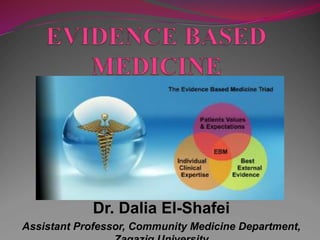
Dr. Dalia El-Shafei
Assistant Professor, Community Medicine Department,
Learning Objectives:
1) Define evidence based medicine (EBM).
2) To list its importance and limitations.
3) To describe how to apply EBM on any problem.
Evidence based medicine
(EBM)
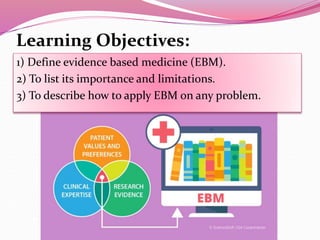
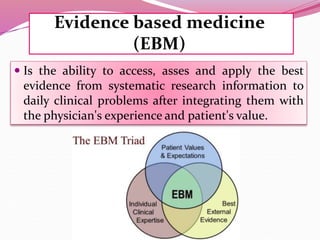
 Is the ability to access, asses and apply the best
evidence from systematic research information to
daily clinical problems after integrating them with
the physician's experience and patient's value.
It is a process of
lifelong, self-
directed,
problem-based
learning.
It is the
conscientious,
clear & judicious
use of current
best evidence in
making decision
about the care of
individual
patients.
May be
extended to
benefit not only
individual
patients or even
health care
services in the
community.
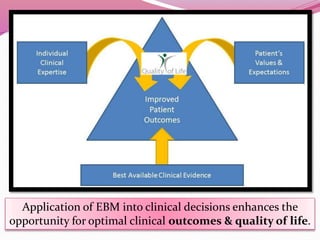
Application of EBM into clinical decisions enhances the
opportunity for optimal clinical outcomes & quality of life.
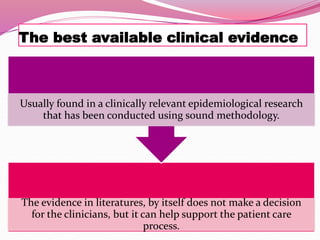
The best available clinical evidence
The evidence in literatures, by itself does not make a decision
for the clinicians, but it can help support the patient care
process.
Usually found in a clinically relevant epidemiological research
that has been conducted using sound methodology.
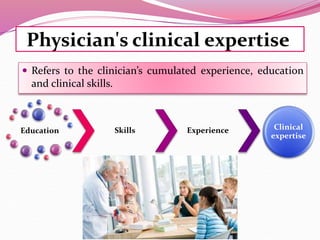
Physician's clinical expertise
 Refers to the clinician’s cumulated experience, education
and clinical skills.
Education Skills Experience Clinical
expertise
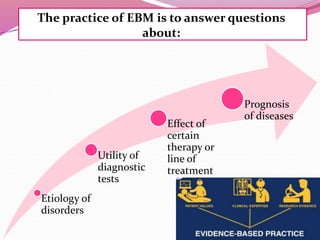
Etiology of
disorders
Utility of
diagnostic
tests
Effect of
certain
therapy or
line of
treatment
Prognosis
of diseases
The practice of EBM is to answer questions
about:
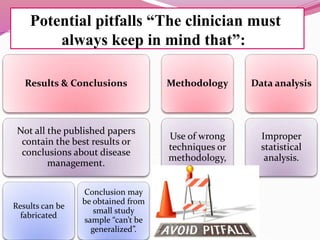
Potential pitfalls “The clinician must
always keep in mind that”:
Results & Conclusions
Not all the published papers
contain the best results or
conclusions about disease
management.
Results can be
fabricated
Conclusion may
be obtained from
small study
sample “can’t be
generalized”.
Methodology
Use of wrong
techniques or
methodology,
Data analysis
Improper
statistical
analysis.
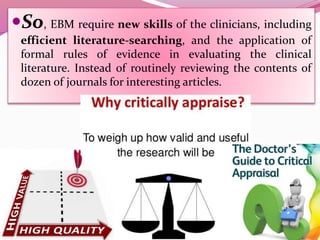
So, EBM require new skills of the clinicians, including
efficient literature-searching, and the application of
formal rules of evidence in evaluating the clinical
literature. Instead of routinely reviewing the contents of
dozen of journals for interesting articles.
EBM process “the 6 As”
Assess
patient
Ask clinical
question
Acquire the
evidence(s)
Appraise the
evidence(s)
Apply the
best
evidence
Assess your
performance
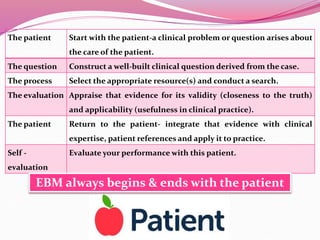
The patient Start with the patient-a clinical problem or question arises about
the care of the patient.
The question Construct a well-built clinical question derived from the case.
The process Select the appropriate resource(s) and conduct a search.
The evaluation Appraise that evidence for its validity (closeness to the truth)
and applicability (usefulness in clinical practice).
The patient Return to the patient- integrate that evidence with clinical
expertise, patient references and apply it to practice.
Self -
evaluation
Evaluate your performance with this patient.
EBM always begins & ends with the patient
Example for EBM application
Mrs. Mona is a new patient who recently moved to the area to be
closer to her son and his family. She is 67 years old and has a
history of congestive heart failure following several
myocardial infarctions. She has been hospitalized twice
within the last 6 months for worsening of heart failure. At the
present time she remains in normal sinus rhythm. She is
extremely diligent about taking her medications (enalapril,
aspirin and simvastatin) and wants to stay out of the hospital.
She lives alone. You think she should take digoxin but this will
make her under medical supervision in the hospital. You decide
to research this question before her next visit.
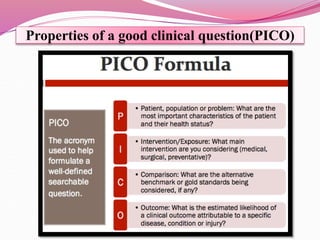
Properties of a good clinical question(PICO)
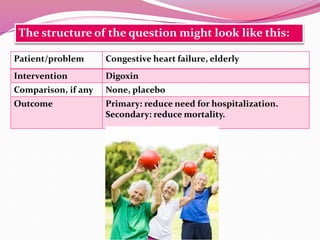
The structure of the question might look like this:
Patient/problem Congestive heart failure, elderly
Intervention Digoxin
Comparison, if any None, placebo
Outcome Primary: reduce need for hospitalization.
Secondary: reduce mortality.
For our patient, the clinical question might be:
In elderly patients with congestive heart failure, is
digoxin effective in reducing the need for
hospitalization?
It is a therapy question and the best evidence would be a
randomized controlled clinical trial.
For this question:
1. We have chosen MEDLINE as our resource. MEDLINE is
the most comprehensive resource for health–related
literature searches and is accessible to everyone through
PubMed.
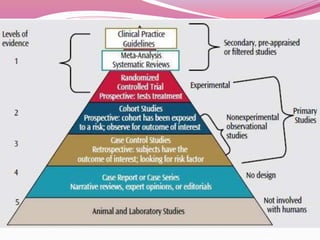
2. After writing your question you will obtain thousands of
research studies. You must filter the obtained research
studies by reviewing the type of study (methodology).
The different types of methodology are arranged in a
pyramid called “evidence pyramid”.
Evidence based medicine

Evidence based medicine

  • 1.
    Dr. Dalia El-Shafei AssistantProfessor, Community Medicine Department,
  • 2.
    Learning Objectives: 1) Defineevidence based medicine (EBM). 2) To list its importance and limitations. 3) To describe how to apply EBM on any problem.
  • 3.
    Evidence based medicine (EBM) Is the ability to access, asses and apply the best evidence from systematic research information to daily clinical problems after integrating them with the physician's experience and patient's value.
  • 4.
    It is aprocess of lifelong, self- directed, problem-based learning. It is the conscientious, clear & judicious use of current best evidence in making decision about the care of individual patients. May be extended to benefit not only individual patients or even health care services in the community.
  • 5.
    Application of EBMinto clinical decisions enhances the opportunity for optimal clinical outcomes & quality of life.
  • 6.
    The best availableclinical evidence The evidence in literatures, by itself does not make a decision for the clinicians, but it can help support the patient care process. Usually found in a clinically relevant epidemiological research that has been conducted using sound methodology.
  • 7.
    Physician's clinical expertise Refers to the clinician’s cumulated experience, education and clinical skills. Education Skills Experience Clinical expertise
  • 8.
    Etiology of disorders Utility of diagnostic tests Effectof certain therapy or line of treatment Prognosis of diseases The practice of EBM is to answer questions about:
  • 9.
    Potential pitfalls “Theclinician must always keep in mind that”: Results & Conclusions Not all the published papers contain the best results or conclusions about disease management. Results can be fabricated Conclusion may be obtained from small study sample “can’t be generalized”. Methodology Use of wrong techniques or methodology, Data analysis Improper statistical analysis.
  • 10.
    So, EBM requirenew skills of the clinicians, including efficient literature-searching, and the application of formal rules of evidence in evaluating the clinical literature. Instead of routinely reviewing the contents of dozen of journals for interesting articles.
  • 11.
    EBM process “the6 As” Assess patient Ask clinical question Acquire the evidence(s) Appraise the evidence(s) Apply the best evidence Assess your performance
  • 12.
    The patient Startwith the patient-a clinical problem or question arises about the care of the patient. The question Construct a well-built clinical question derived from the case. The process Select the appropriate resource(s) and conduct a search. The evaluation Appraise that evidence for its validity (closeness to the truth) and applicability (usefulness in clinical practice). The patient Return to the patient- integrate that evidence with clinical expertise, patient references and apply it to practice. Self - evaluation Evaluate your performance with this patient. EBM always begins & ends with the patient
  • 13.
    Example for EBMapplication Mrs. Mona is a new patient who recently moved to the area to be closer to her son and his family. She is 67 years old and has a history of congestive heart failure following several myocardial infarctions. She has been hospitalized twice within the last 6 months for worsening of heart failure. At the present time she remains in normal sinus rhythm. She is extremely diligent about taking her medications (enalapril, aspirin and simvastatin) and wants to stay out of the hospital. She lives alone. You think she should take digoxin but this will make her under medical supervision in the hospital. You decide to research this question before her next visit.
  • 14.
    Properties of agood clinical question(PICO)
  • 15.
    The structure ofthe question might look like this: Patient/problem Congestive heart failure, elderly Intervention Digoxin Comparison, if any None, placebo Outcome Primary: reduce need for hospitalization. Secondary: reduce mortality.
  • 16.
    For our patient,the clinical question might be: In elderly patients with congestive heart failure, is digoxin effective in reducing the need for hospitalization? It is a therapy question and the best evidence would be a randomized controlled clinical trial.
  • 17.
    For this question: 1.We have chosen MEDLINE as our resource. MEDLINE is the most comprehensive resource for health–related literature searches and is accessible to everyone through PubMed. 2. After writing your question you will obtain thousands of research studies. You must filter the obtained research studies by reviewing the type of study (methodology). The different types of methodology are arranged in a pyramid called “evidence pyramid”.