Environmental Sustainability
Instructor: Cheunboran Chanborey
1. Why Care about Environment?
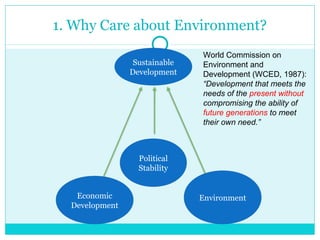
Economic
Development
Political
Stability
Environment
Sustainable
Development
World Commission on
Environment and
Development (WCED, 1987):
“Development that meets the
needs of the present without
compromising the ability of
future generations to meet
their own need.”
1. Why Care about Environment?
1. Environmental Pollution:
 A disease caused by environmental degradation
was found in Minamata city of Japan. (Minamata
disease).
 Disease destroys a neurological system of humans:
numbness in hands and feet, muscle weakness,
hearing and speech damage.
1. Why Care about Environment?
Did the Japanese government pay attention to the
Minamata people?
1968, the government recognized the existence of the
disease, but not ask Chisso to compensate victims.
Why so?
Late 1970s, the Government started compensating
victims.
Is Minamata the only case of Environmental
pollution?
 In 1984, a nuclear leak in Bophal, India.
 In 1986, a nuclear leak in Chernobyl, Ukraine
 In 2011, Fukushima Daiichi nuclear plants
1. Why Care about Environment?
2. Climate Change
1. Why Care about Environment?
Intergovernmental panel on Climate Change (IPCC)
predicted will increase between 1.4-5.8 degree
Celsius between 1990-2100.
Global Warming could cause land loss.
 Egypt: 3 meter sea level rise causes 12%-15% land loss (6
million people), 13 million in Bangladesh, and 72 million
people in China will suffer.
 Some places become arid.
2. Do all Countries Have the Same Concern about
Environmental problems?
Developed Countries agreed on the New Model of
Development, except the US.
Developing Countries dissatisfied with the new
model. Why?
Global Governance on Environment
1972 Stockholm UN Conference on Human Envir.
 Creating UNEP
 Spaceship Earth
 “Think globally, and act locally”
 More involvement of NGOs, Scientists
Moving toward Sustainable Development
 UNGA established Word Commission on Environment and
Development
The United Nation Conference on the Environment and
Development (UNCED) was held in Rio in 1992, or the
Earth Summit. RELEVANT! Agenda 21:
 Adoption of the two treaties: the Convention on Climate
Change and the Convention on Biological Diversity.
 The Kyoto Protocol was adopted in 1997, entered into force in
2005, 5% reduction of GHG within (2008-2012) vis-à-vis 1990
level.
 Developed Countries agreed on “Common but
Differentiated Responsibilities.”
 Financial Pledge: 0.7 % of GNP of Developed Countries to foreign
assistance by 2000.
 Pledge: US$607 annually to implement environment related
conventions of the UN.
Sovereign Rights of States (Developing countries) to
exploit their natural resources.
 Para 2 of Chapter 3: “While managing resources sustainably,
an environmental policy that focuses mainly on the
conservation and protection of resources must take due
account of those who depend on the resources for their
livelihoods.”
NGOs’ role has been promoted.
Polluter Pay Principle: Principle 16
“National authorities should endeavour to promote
the internalization of environmental costs
and the use of economic instruments, taking into
account the approach that the polluter should, in
principle, bear the cost of pollution, with due regard
to the public interest and without distorting
international trade and investment.”
2002 Johannesburg Summit (PoA)
 Restoration of fisheries by 2015
 Reduction of biodiversity loss by 2015
 Better use of chemicals by 2020
 More use of renewable energy
COP15?
COP16?
COP17?
COP18?

9. environment

  • 1.
  • 2.
    1. Why Careabout Environment? Economic Development Political Stability Environment Sustainable Development World Commission on Environment and Development (WCED, 1987): “Development that meets the needs of the present without compromising the ability of future generations to meet their own need.”
  • 3.
    1. Why Careabout Environment? 1. Environmental Pollution:  A disease caused by environmental degradation was found in Minamata city of Japan. (Minamata disease).  Disease destroys a neurological system of humans: numbness in hands and feet, muscle weakness, hearing and speech damage.
  • 4.
    1. Why Careabout Environment?
  • 5.
    1. Why Careabout Environment? Did the Japanese government pay attention to the Minamata people? 1968, the government recognized the existence of the disease, but not ask Chisso to compensate victims. Why so? Late 1970s, the Government started compensating victims. Is Minamata the only case of Environmental pollution?  In 1984, a nuclear leak in Bophal, India.  In 1986, a nuclear leak in Chernobyl, Ukraine  In 2011, Fukushima Daiichi nuclear plants
  • 6.
    1. Why Careabout Environment? 2. Climate Change
  • 7.
    1. Why Careabout Environment? Intergovernmental panel on Climate Change (IPCC) predicted will increase between 1.4-5.8 degree Celsius between 1990-2100. Global Warming could cause land loss.  Egypt: 3 meter sea level rise causes 12%-15% land loss (6 million people), 13 million in Bangladesh, and 72 million people in China will suffer.  Some places become arid.
  • 8.
    2. Do allCountries Have the Same Concern about Environmental problems? Developed Countries agreed on the New Model of Development, except the US. Developing Countries dissatisfied with the new model. Why?
  • 9.
    Global Governance onEnvironment 1972 Stockholm UN Conference on Human Envir.  Creating UNEP  Spaceship Earth  “Think globally, and act locally”  More involvement of NGOs, Scientists Moving toward Sustainable Development  UNGA established Word Commission on Environment and Development
  • 10.
    The United NationConference on the Environment and Development (UNCED) was held in Rio in 1992, or the Earth Summit. RELEVANT! Agenda 21:  Adoption of the two treaties: the Convention on Climate Change and the Convention on Biological Diversity.  The Kyoto Protocol was adopted in 1997, entered into force in 2005, 5% reduction of GHG within (2008-2012) vis-à-vis 1990 level.  Developed Countries agreed on “Common but Differentiated Responsibilities.”  Financial Pledge: 0.7 % of GNP of Developed Countries to foreign assistance by 2000.  Pledge: US$607 annually to implement environment related conventions of the UN.
  • 11.
    Sovereign Rights ofStates (Developing countries) to exploit their natural resources.  Para 2 of Chapter 3: “While managing resources sustainably, an environmental policy that focuses mainly on the conservation and protection of resources must take due account of those who depend on the resources for their livelihoods.” NGOs’ role has been promoted.
  • 12.
    Polluter Pay Principle:Principle 16 “National authorities should endeavour to promote the internalization of environmental costs and the use of economic instruments, taking into account the approach that the polluter should, in principle, bear the cost of pollution, with due regard to the public interest and without distorting international trade and investment.”
  • 13.
    2002 Johannesburg Summit(PoA)  Restoration of fisheries by 2015  Reduction of biodiversity loss by 2015  Better use of chemicals by 2020  More use of renewable energy COP15? COP16? COP17? COP18?