Contemporary
Global
Governance
Balondo, Japhet
Delgado, Clarence Jay
Lesson 5
Global Governance
What is global Governance and it does:
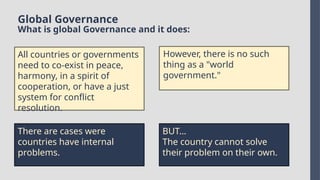
All countries or governments
need to co-exist in peace,
harmony, in a spirit of
cooperation, or have a just
system for conflict
resolution.
However, there is no such
thing as a "world
government."
There are cases were
countries have internal
problems.
BUT…
The country cannot solve
their problem on their own.
Global Governance
What is global Governance and it does:
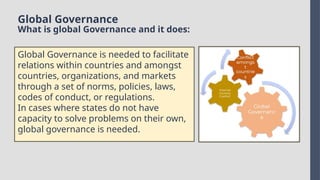
Global Governance is needed to facilitate
relations within countries and amongst
countries, organizations, and markets
through a set of norms, policies, laws,
codes of conduct, or regulations.
In cases where states do not have
capacity to solve problems on their own,
global governance is needed.
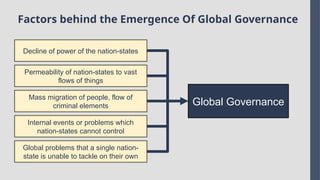
Factors behind the Emergence Of Global Governance
Decline of power of the nation-states
Permeability of nation-states to vast
flows of things
Mass migration of people, flow of
criminal elements
Internal events or problems which
nation-states cannot control
Global problems that a single nation-
state is unable to tackle on their own
Global Governance
Factors behind the Emergence Of Global Governance
Decline of power of the nation-states
Global Governance
Other actors are becoming more powerful such as global
corporations. With the increasing economic prowess of global
corporations in key areas such as energy, food, transport, health
care, they yield strong influence on many global policies.
Global civil society organizations likewise, have established
historical credibility, relevance and effectives in helping resolve
problems in times of conflict or disaster. They also have a strong
voice and influence on global matters.
Factors behind the Emergence Of Global Governance
Permeability of nation-states to vast
flows of things Global Governance
The easy, fast and difficult-to-
control flow of digital information
has led to new phenomena such as
fake news, cyber bullying, invasion
of privacy, and other digital
fraudulent activities which calls for
Global Governance.
Factors behind the Emergence Of Global Governance
Mass migration of people, flow of
criminal elements Global Governance
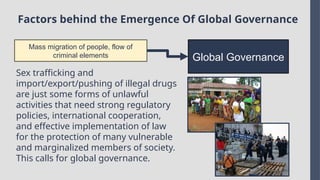
Sex trafficking and
import/export/pushing of illegal drugs
are just some forms of unlawful
activities that need strong regulatory
policies, international cooperation,
and effective implementation of law
for the protection of many vulnerable
and marginalized members of society.
This calls for global governance.
Factors behind the Emergence Of Global Governance
Internal events or problems which
nation-states cannot control Global Governance
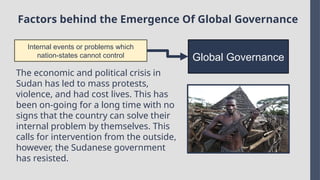
The economic and political crisis in
Sudan has led to mass protests,
violence, and had cost lives. This has
been on-going for a long time with no
signs that the country can solve their
internal problem by themselves. This
calls for intervention from the outside,
however, the Sudanese government
has resisted.
Factors behind the Emergence Of Global Governance
Global problems that a single nation-
state is unable to tackle on their own Global Governance
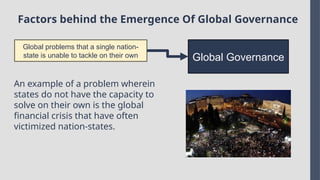
An example of a problem wherein
states do not have the capacity to
solve on their own is the global
financial crisis that have often
victimized nation-states.
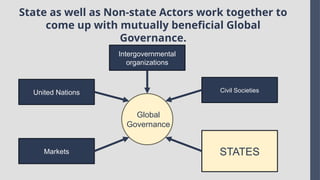
State as well as Non-state Actors work together to
come up with mutually beneficial Global
Governance.
Intergovernmental
organizations
United Nations Civil Societies
Markets STATES
Global
Governance
The Role of the United Nations in Global Governance
There is no "Central Authority" in Global Governance.
But the United Nations, with its 193 state-membership and
capability to involve many non-state actors, come close as to
being a "Central Authority" to raise global issues and to help
resolve them.
What is the United Nations?
• a global organization composed of
193 nation-states, while a wide
network of international
organizations, treaties, and
conventions
• fosters cooperation among nation-
states to address global problems
together
• Founded in 1945 after WWII
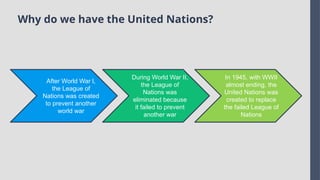
Why do we have the United Nations?
After World War l,
the League of
Nations was created
to prevent another
world war
During World War II,
the League of
Nations was
eliminated because
it failed to prevent
another war
In 1945, with WWII
almost ending, the
United Nations was
created to replace
the failed League of
Nations
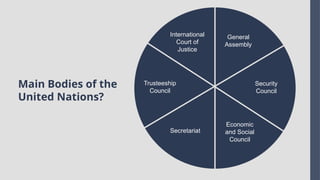
Main Bodies of the
United Nations?
International
Court of
Justice
Trusteeship
Council
Secretariat
Economic
and Social
Council
Security
Council
General
Assembly
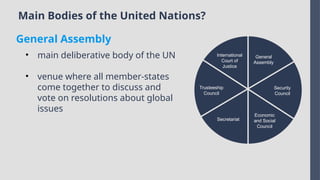
Main Bodies of the United Nations?
International
Court of
Justice
Trusteeship
Council
Secretariat
Economic
and Social
Council
Security
Council
General
Assembly
• main deliberative body of the UN
• venue where all member-states
come together to discuss and
vote on resolutions about global
issues
General Assembly
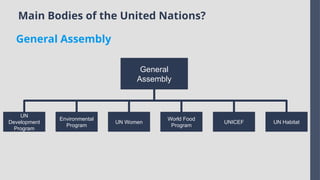
Main Bodies of the United Nations?
General Assembly
World Food
Program
UN
Development
Program
Environmental
Program
UNICEF
UN Women UN Habitat
General
Assembly
Main Bodies of the United Nations?
International
Court of
Justice
Trusteeship
Council
Secretariat
Economic
and Social
Council
Security
Council
General
Assembly
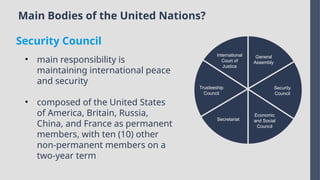
• main responsibility is
maintaining international peace
and security
• composed of the United States
of America, Britain, Russia,
China, and France as permanent
members, with ten (10) other
non-permanent members on a
two-year term
Security Council
Main Bodies of the United Nations?
International
Court of
Justice
Trusteeship
Council
Secretariat
Economic
and Social
Council
Security
Council
General
Assembly
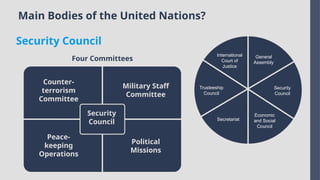
Security Council
Four Committees
Security
Council
Counter-
terrorism
Committee
Military Staff
Committee
Peace-
keeping
Operations
Political
Missions
Main Bodies of the United Nations?
International
Court of
Justice
Trusteeship
Council
Secretariat
Economic
and Social
Council
Security
Council
General
Assembly
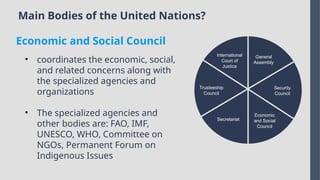
• coordinates the economic, social,
and related concerns along with
the specialized agencies and
organizations
• The specialized agencies and
other bodies are: FAO, IMF,
UNESCO, WHO, Committee on
NGOs, Permanent Forum on
Indigenous Issues
Economic and Social Council
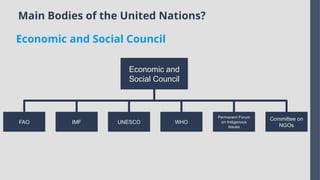
Main Bodies of the United Nations?
Economic and Social Council
WHO
FAO IMF
Permanent Forum
on Indigenous
Issues
UNESCO
Committee on
NGOs
Economic and
Social Council
Main Bodies of the United Nations?
International
Court of
Justice
Trusteeship
Council
Secretariat
Economic
and Social
Council
Security
Council
General
Assembly
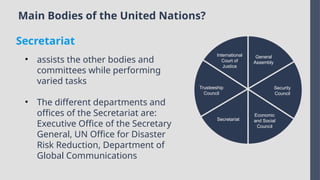
• assists the other bodies and
committees while performing
varied tasks
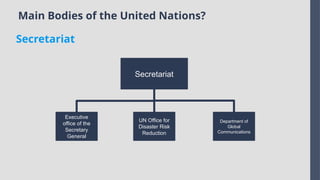
• The different departments and
offices of the Secretariat are:
Executive Office of the Secretary
General, UN Office for Disaster
Risk Reduction, Department of
Global Communications
Secretariat
Main Bodies of the United Nations?
Secretariat
Department of
Global
Communications
UN Office for
Disaster Risk
Reduction
Secretariat
Executive
office of the
Secretary
General
Main Bodies of the United Nations?
International
Court of
Justice
Trusteeship
Council
Secretariat
Economic
and Social
Council
Security
Council
General
Assembly
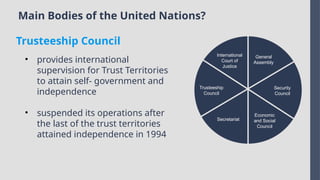
• provides international
supervision for Trust Territories
to attain self- government and
independence
• suspended its operations after
the last of the trust territories
attained independence in 1994
Trusteeship Council
Main Bodies of the United Nations?
International
Court of
Justice
Trusteeship
Council
Secretariat
Economic
and Social
Council
Security
Council
General
Assembly
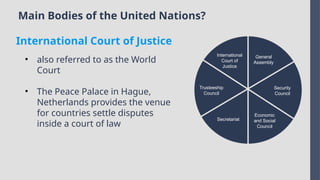
• also referred to as the World
Court
• The Peace Palace in Hague,
Netherlands provides the venue
for countries settle disputes
inside a court of law
International Court of Justice
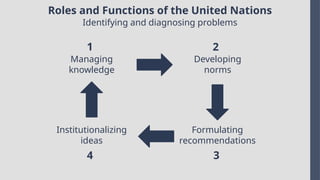
Roles and Functions of the United Nations
Identifying and diagnosing problems
Managing
knowledge
Developing
norms
Formulating
recommendations
Institutionalizing
ideas
1 2
3
4
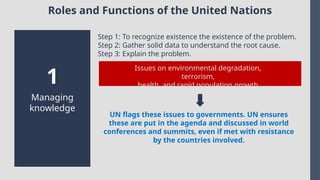
Roles and Functions of the United Nations
Managing
knowledge
1
Step 1: To recognize existence the existence of the problem.
Step 2: Gather solid data to understand the root cause.
Step 3: Explain the problem.
Issues on environmental degradation,
terrorism,
health, and rapid population growth
UN flags these issues to governments. UN ensures
these are put in the agenda and discussed in world
conferences and summits, even if met with resistance
by the countries involved.
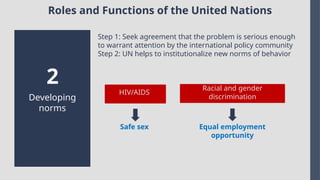
Roles and Functions of the United Nations
Developing
norms
2
Step 1: Seek agreement that the problem is serious enough
to warrant attention by the international policy community
Step 2: UN helps to institutionalize new norms of behavior
HIV/AIDS
Racial and gender
discrimination
Safe sex Equal employment
opportunity
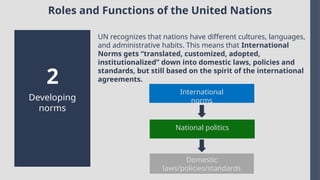
Roles and Functions of the United Nations
Developing
norms
2
UN recognizes that nations have different cultures, languages,
and administrative habits. This means that International
Norms gets “translated, customized, adopted,
institutionalized” down into domestic laws, policies and
standards, but still based on the spirit of the international
agreements.
International
norms
National politics
Domestic
laws/policies/standards
Roles and Functions of the United Nations
Institutionalizing
ideas
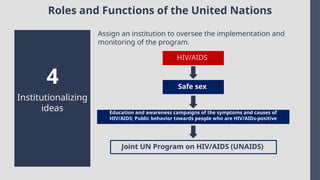
4
Assign an institution to oversee the implementation and
monitoring of the program.
HIV/AIDS
Safe sex
Education and awareness campaigns of the symptoms and causes of
HIV/AIDS; Public behavior towards people who are HIV/AIDs-positive
Joint UN Program on HIV/AIDS (UNAIDS)
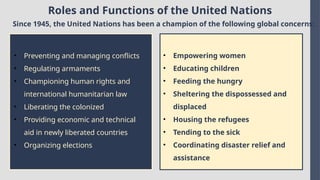
Roles and Functions of the United Nations
Since 1945, the United Nations has been a champion of the following global concerns:
• Preventing and managing conflicts
• Regulating armaments
• Championing human rights and
international humanitarian law
• Liberating the colonized
• Providing economic and technical
aid in newly liberated countries
• Organizing elections
• Empowering women
• Educating children
• Feeding the hungry
• Sheltering the dispossessed and
displaced
• Housing the refugees
• Tending to the sick
• Coordinating disaster relief and
assistance
Roles and Functions of the United Nations
To help us understand the beginnings and roles of United
Nations, let us watch the following video:
The United Nations: It’s Your World
https://www.youtube.com/watch?v=bHmXZXsABm0
Challenges of Global Governance in the 21st
Century
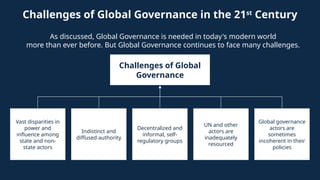
As discussed, Global Governance is needed in today's modern world
more than ever before. But Global Governance continues to face many challenges.
Challenges of Global
Governance
Vast disparities in
power and
influence among
state and non-
state actors
Indistinct and
diffused authority
Decentralized and
informal, self-
regulatory groups
UN and other
actors are
inadequately
resourced
Global governance
actors are
sometimes
incoherent in their
policies
Challenges of Global Governance in the 21st
Century
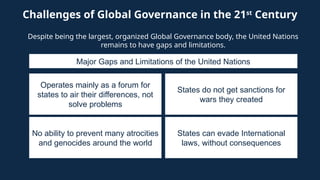
Despite being the largest, organized Global Governance body, the United Nations
remains to have gaps and limitations.
Operates mainly as a forum for
states to air their differences, not
solve problems
Major Gaps and Limitations of the United Nations
States do not get sanctions for
wars they created
No ability to prevent many atrocities
and genocides around the world
States can evade International
laws, without consequences
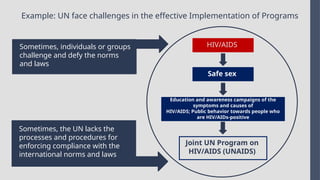
Example: UN face challenges in the effective Implementation of Programs
Sometimes, individuals or groups
challenge and defy the norms
and laws
HIV/AIDS
Safe sex
Education and awareness campaigns of the
symptoms and causes of
HIV/AIDS; Public behavior towards people who
are HIV/AIDs-positive
Joint UN Program on
HIV/AIDS (UNAIDS)
Sometimes, the UN lacks the
processes and procedures for
enforcing compliance with the
international norms and laws
Challenges of Global Governance in the 21st
Century
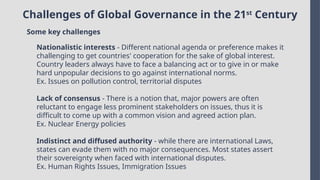
Some key challenges
Nationalistic interests - Different national agenda or preference makes it
challenging to get countries' cooperation for the sake of global interest.
Country leaders always have to face a balancing act or to give in or make
hard unpopular decisions to go against international norms.
Ex. Issues on pollution control, territorial disputes
Lack of consensus - There is a notion that, major powers are often
reluctant to engage less prominent stakeholders on issues, thus it is
difficult to come up with a common vision and agreed action plan.
Ex. Nuclear Energy policies
Indistinct and diffused authority - while there are international Laws,
states can evade them with no major consequences. Most states assert
their sovereignty when faced with international disputes.
Ex. Human Rights Issues, Immigration Issues
The Relevance of the State amid Globalization
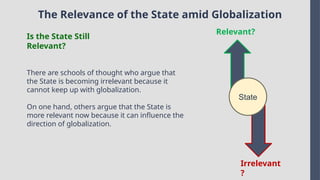
Is the State Still
Relevant?
There are schools of thought who argue that
the State is becoming irrelevant because it
cannot keep up with globalization.
On one hand, others argue that the State is
more relevant now because it can influence the
direction of globalization.
State
Relevant?
Irrelevant
?
The Relevance of the State amid Globalization
Is the State Still
Relevant?
But both arguments miss the point.
A State's legitimacy is not based on
how it can effectively handle
globalization, rather, how effective
can it utilize its public goods vs. the
other Actors in this on-going process
of Globalization.
Intergovernmenta
l organizations
United Nations Civil Societies
Markets STATES
Global
Governan
ce
Actors in Globalization
The Relevance of the State amid Globalization
Is the State Still
Relevant?
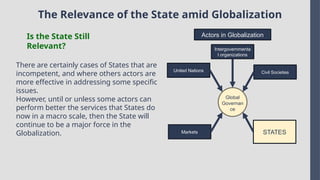
There are certainly cases of States that are
incompetent, and where others actors are
more effective in addressing some specific
issues.
However, until or unless some actors can
perform better the services that States do
now in a macro scale, then the State will
continue to be a major force in the
Globalization.
Intergovernmenta
l organizations
United Nations Civil Societies
Markets STATES
Global
Governan
ce
Actors in Globalization
The Relevance of the State amid Globalization
Is the State Still
Relevant?
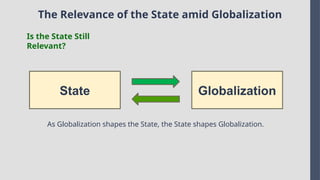
As Globalization shapes the State, the State shapes Globalization.
State Globalization
The Relevance of the State amid Globalization
Is the State Still
Relevant?
Faced with globalization, states have to deal with global concerns
in addition to its internal affairs. Some examples of global
concerns are:
• Terrorism
• Economic globalization i.e. threat of foreign competition, impact
of global economy to the local economy
• Threats to the national identity due to immigration, inflows of
information and culture
• Environmental Protection
The Relevance of the State amid Globalization
Definition - the terms State and Nation so far have been used
inter-changeably, but it is important to distinguish the two.
State
refers to a distinctive political community with its own government which
asserts sovereignty over its land and people
Nation
refers to socially-constructed communities that hold together people bound
by common history and culture, cutting across some identities such as
ethnicity, language and religion
The Relevance of the State amid Globalization
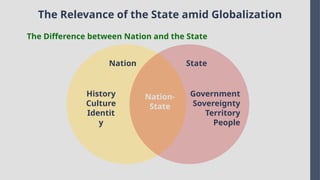
The Difference between Nation and the State
Nation State
Nation-
State
History
Culture
Identit
y
Government
Sovereignty
Territory
People
The Relevance of the State amid Globalization
The Difference between Nation and the State
Nation-State
• sovereign institution which governs individuals sharing a collective history,
culture identity, and culture within a bounded territory
• state is considered the representative of 'the people’.
• 'the people' is the source of the state's sovereignty; it is the people who
give the state its legitimacy

The Contemporary Global Governance Powerpoint Presentation

  • 1.
  • 2.
    Global Governance What isglobal Governance and it does: All countries or governments need to co-exist in peace, harmony, in a spirit of cooperation, or have a just system for conflict resolution. However, there is no such thing as a "world government." There are cases were countries have internal problems. BUT… The country cannot solve their problem on their own.
  • 3.
    Global Governance What isglobal Governance and it does: Global Governance is needed to facilitate relations within countries and amongst countries, organizations, and markets through a set of norms, policies, laws, codes of conduct, or regulations. In cases where states do not have capacity to solve problems on their own, global governance is needed.
  • 4.
    Factors behind theEmergence Of Global Governance Decline of power of the nation-states Permeability of nation-states to vast flows of things Mass migration of people, flow of criminal elements Internal events or problems which nation-states cannot control Global problems that a single nation- state is unable to tackle on their own Global Governance
  • 5.
    Factors behind theEmergence Of Global Governance Decline of power of the nation-states Global Governance Other actors are becoming more powerful such as global corporations. With the increasing economic prowess of global corporations in key areas such as energy, food, transport, health care, they yield strong influence on many global policies. Global civil society organizations likewise, have established historical credibility, relevance and effectives in helping resolve problems in times of conflict or disaster. They also have a strong voice and influence on global matters.
  • 6.
    Factors behind theEmergence Of Global Governance Permeability of nation-states to vast flows of things Global Governance The easy, fast and difficult-to- control flow of digital information has led to new phenomena such as fake news, cyber bullying, invasion of privacy, and other digital fraudulent activities which calls for Global Governance.
  • 7.
    Factors behind theEmergence Of Global Governance Mass migration of people, flow of criminal elements Global Governance Sex trafficking and import/export/pushing of illegal drugs are just some forms of unlawful activities that need strong regulatory policies, international cooperation, and effective implementation of law for the protection of many vulnerable and marginalized members of society. This calls for global governance.
  • 8.
    Factors behind theEmergence Of Global Governance Internal events or problems which nation-states cannot control Global Governance The economic and political crisis in Sudan has led to mass protests, violence, and had cost lives. This has been on-going for a long time with no signs that the country can solve their internal problem by themselves. This calls for intervention from the outside, however, the Sudanese government has resisted.
  • 9.
    Factors behind theEmergence Of Global Governance Global problems that a single nation- state is unable to tackle on their own Global Governance An example of a problem wherein states do not have the capacity to solve on their own is the global financial crisis that have often victimized nation-states.
  • 10.
    State as wellas Non-state Actors work together to come up with mutually beneficial Global Governance. Intergovernmental organizations United Nations Civil Societies Markets STATES Global Governance
  • 11.
    The Role ofthe United Nations in Global Governance There is no "Central Authority" in Global Governance. But the United Nations, with its 193 state-membership and capability to involve many non-state actors, come close as to being a "Central Authority" to raise global issues and to help resolve them.
  • 12.
    What is theUnited Nations? • a global organization composed of 193 nation-states, while a wide network of international organizations, treaties, and conventions • fosters cooperation among nation- states to address global problems together • Founded in 1945 after WWII
  • 13.
    Why do wehave the United Nations? After World War l, the League of Nations was created to prevent another world war During World War II, the League of Nations was eliminated because it failed to prevent another war In 1945, with WWII almost ending, the United Nations was created to replace the failed League of Nations
  • 14.
    Main Bodies ofthe United Nations? International Court of Justice Trusteeship Council Secretariat Economic and Social Council Security Council General Assembly
  • 15.
    Main Bodies ofthe United Nations? International Court of Justice Trusteeship Council Secretariat Economic and Social Council Security Council General Assembly • main deliberative body of the UN • venue where all member-states come together to discuss and vote on resolutions about global issues General Assembly
  • 16.
    Main Bodies ofthe United Nations? General Assembly World Food Program UN Development Program Environmental Program UNICEF UN Women UN Habitat General Assembly
  • 17.
    Main Bodies ofthe United Nations? International Court of Justice Trusteeship Council Secretariat Economic and Social Council Security Council General Assembly • main responsibility is maintaining international peace and security • composed of the United States of America, Britain, Russia, China, and France as permanent members, with ten (10) other non-permanent members on a two-year term Security Council
  • 18.
    Main Bodies ofthe United Nations? International Court of Justice Trusteeship Council Secretariat Economic and Social Council Security Council General Assembly Security Council Four Committees Security Council Counter- terrorism Committee Military Staff Committee Peace- keeping Operations Political Missions
  • 19.
    Main Bodies ofthe United Nations? International Court of Justice Trusteeship Council Secretariat Economic and Social Council Security Council General Assembly • coordinates the economic, social, and related concerns along with the specialized agencies and organizations • The specialized agencies and other bodies are: FAO, IMF, UNESCO, WHO, Committee on NGOs, Permanent Forum on Indigenous Issues Economic and Social Council
  • 20.
    Main Bodies ofthe United Nations? Economic and Social Council WHO FAO IMF Permanent Forum on Indigenous Issues UNESCO Committee on NGOs Economic and Social Council
  • 21.
    Main Bodies ofthe United Nations? International Court of Justice Trusteeship Council Secretariat Economic and Social Council Security Council General Assembly • assists the other bodies and committees while performing varied tasks • The different departments and offices of the Secretariat are: Executive Office of the Secretary General, UN Office for Disaster Risk Reduction, Department of Global Communications Secretariat
  • 22.
    Main Bodies ofthe United Nations? Secretariat Department of Global Communications UN Office for Disaster Risk Reduction Secretariat Executive office of the Secretary General
  • 23.
    Main Bodies ofthe United Nations? International Court of Justice Trusteeship Council Secretariat Economic and Social Council Security Council General Assembly • provides international supervision for Trust Territories to attain self- government and independence • suspended its operations after the last of the trust territories attained independence in 1994 Trusteeship Council
  • 24.
    Main Bodies ofthe United Nations? International Court of Justice Trusteeship Council Secretariat Economic and Social Council Security Council General Assembly • also referred to as the World Court • The Peace Palace in Hague, Netherlands provides the venue for countries settle disputes inside a court of law International Court of Justice
  • 25.
    Roles and Functionsof the United Nations Identifying and diagnosing problems Managing knowledge Developing norms Formulating recommendations Institutionalizing ideas 1 2 3 4
  • 26.
    Roles and Functionsof the United Nations Managing knowledge 1 Step 1: To recognize existence the existence of the problem. Step 2: Gather solid data to understand the root cause. Step 3: Explain the problem. Issues on environmental degradation, terrorism, health, and rapid population growth UN flags these issues to governments. UN ensures these are put in the agenda and discussed in world conferences and summits, even if met with resistance by the countries involved.
  • 27.
    Roles and Functionsof the United Nations Developing norms 2 Step 1: Seek agreement that the problem is serious enough to warrant attention by the international policy community Step 2: UN helps to institutionalize new norms of behavior HIV/AIDS Racial and gender discrimination Safe sex Equal employment opportunity
  • 28.
    Roles and Functionsof the United Nations Developing norms 2 UN recognizes that nations have different cultures, languages, and administrative habits. This means that International Norms gets “translated, customized, adopted, institutionalized” down into domestic laws, policies and standards, but still based on the spirit of the international agreements. International norms National politics Domestic laws/policies/standards
  • 29.
    Roles and Functionsof the United Nations Institutionalizing ideas 4 Assign an institution to oversee the implementation and monitoring of the program. HIV/AIDS Safe sex Education and awareness campaigns of the symptoms and causes of HIV/AIDS; Public behavior towards people who are HIV/AIDs-positive Joint UN Program on HIV/AIDS (UNAIDS)
  • 30.
    Roles and Functionsof the United Nations Since 1945, the United Nations has been a champion of the following global concerns: • Preventing and managing conflicts • Regulating armaments • Championing human rights and international humanitarian law • Liberating the colonized • Providing economic and technical aid in newly liberated countries • Organizing elections • Empowering women • Educating children • Feeding the hungry • Sheltering the dispossessed and displaced • Housing the refugees • Tending to the sick • Coordinating disaster relief and assistance
  • 31.
    Roles and Functionsof the United Nations To help us understand the beginnings and roles of United Nations, let us watch the following video: The United Nations: It’s Your World https://www.youtube.com/watch?v=bHmXZXsABm0
  • 32.
    Challenges of GlobalGovernance in the 21st Century As discussed, Global Governance is needed in today's modern world more than ever before. But Global Governance continues to face many challenges. Challenges of Global Governance Vast disparities in power and influence among state and non- state actors Indistinct and diffused authority Decentralized and informal, self- regulatory groups UN and other actors are inadequately resourced Global governance actors are sometimes incoherent in their policies
  • 33.
    Challenges of GlobalGovernance in the 21st Century Despite being the largest, organized Global Governance body, the United Nations remains to have gaps and limitations. Operates mainly as a forum for states to air their differences, not solve problems Major Gaps and Limitations of the United Nations States do not get sanctions for wars they created No ability to prevent many atrocities and genocides around the world States can evade International laws, without consequences
  • 34.
    Example: UN facechallenges in the effective Implementation of Programs Sometimes, individuals or groups challenge and defy the norms and laws HIV/AIDS Safe sex Education and awareness campaigns of the symptoms and causes of HIV/AIDS; Public behavior towards people who are HIV/AIDs-positive Joint UN Program on HIV/AIDS (UNAIDS) Sometimes, the UN lacks the processes and procedures for enforcing compliance with the international norms and laws
  • 35.
    Challenges of GlobalGovernance in the 21st Century Some key challenges Nationalistic interests - Different national agenda or preference makes it challenging to get countries' cooperation for the sake of global interest. Country leaders always have to face a balancing act or to give in or make hard unpopular decisions to go against international norms. Ex. Issues on pollution control, territorial disputes Lack of consensus - There is a notion that, major powers are often reluctant to engage less prominent stakeholders on issues, thus it is difficult to come up with a common vision and agreed action plan. Ex. Nuclear Energy policies Indistinct and diffused authority - while there are international Laws, states can evade them with no major consequences. Most states assert their sovereignty when faced with international disputes. Ex. Human Rights Issues, Immigration Issues
  • 36.
    The Relevance ofthe State amid Globalization Is the State Still Relevant? There are schools of thought who argue that the State is becoming irrelevant because it cannot keep up with globalization. On one hand, others argue that the State is more relevant now because it can influence the direction of globalization. State Relevant? Irrelevant ?
  • 37.
    The Relevance ofthe State amid Globalization Is the State Still Relevant? But both arguments miss the point. A State's legitimacy is not based on how it can effectively handle globalization, rather, how effective can it utilize its public goods vs. the other Actors in this on-going process of Globalization. Intergovernmenta l organizations United Nations Civil Societies Markets STATES Global Governan ce Actors in Globalization
  • 38.
    The Relevance ofthe State amid Globalization Is the State Still Relevant? There are certainly cases of States that are incompetent, and where others actors are more effective in addressing some specific issues. However, until or unless some actors can perform better the services that States do now in a macro scale, then the State will continue to be a major force in the Globalization. Intergovernmenta l organizations United Nations Civil Societies Markets STATES Global Governan ce Actors in Globalization
  • 39.
    The Relevance ofthe State amid Globalization Is the State Still Relevant? As Globalization shapes the State, the State shapes Globalization. State Globalization
  • 40.
    The Relevance ofthe State amid Globalization Is the State Still Relevant? Faced with globalization, states have to deal with global concerns in addition to its internal affairs. Some examples of global concerns are: • Terrorism • Economic globalization i.e. threat of foreign competition, impact of global economy to the local economy • Threats to the national identity due to immigration, inflows of information and culture • Environmental Protection
  • 41.
    The Relevance ofthe State amid Globalization Definition - the terms State and Nation so far have been used inter-changeably, but it is important to distinguish the two. State refers to a distinctive political community with its own government which asserts sovereignty over its land and people Nation refers to socially-constructed communities that hold together people bound by common history and culture, cutting across some identities such as ethnicity, language and religion
  • 42.
    The Relevance ofthe State amid Globalization The Difference between Nation and the State Nation State Nation- State History Culture Identit y Government Sovereignty Territory People
  • 43.
    The Relevance ofthe State amid Globalization The Difference between Nation and the State Nation-State • sovereign institution which governs individuals sharing a collective history, culture identity, and culture within a bounded territory • state is considered the representative of 'the people’. • 'the people' is the source of the state's sovereignty; it is the people who give the state its legitimacy