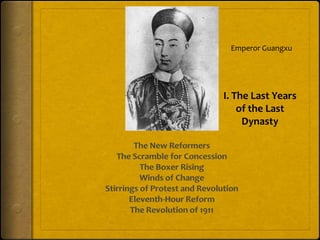
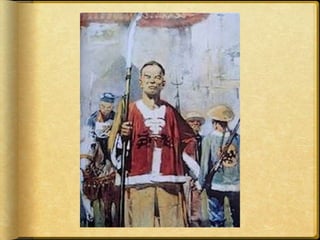
Emperor Guangxu
I. The Last Years
of the Last
Dynasty
The New Reformers
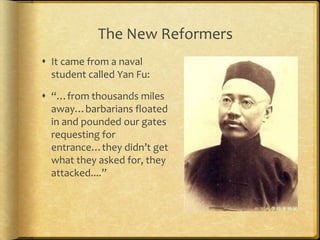
 It came from a naval
student called Yan Fu:
 “…from thousands miles
away…barbarians floated
in and pounded our gates
requesting for
entrance…they didn’t get
what they asked for, they
attacked....”
New Reformers
 Yang argued that Western learning was needed to
release Chinese energies, and rejected much of
Chinese including even Confucius.
 Kang Yuwei (1858-1927) and his followers sought to
transformed the government into a modern and
modernizing constitutional monarchy along the line
of Meiji Japan.
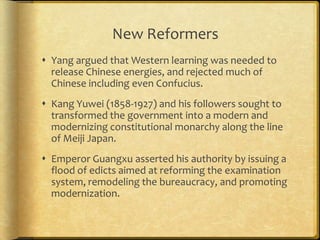
 Emperor Guangxu asserted his authority by issuing a
flood of edicts aimed at reforming the examination
system, remodeling the bureaucracy, and promoting
modernization.
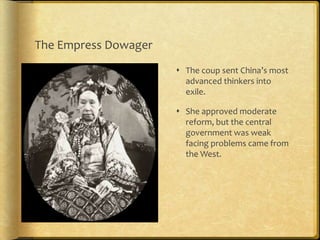
The Empress Dowager
 The coup sent China’s most
advanced thinkers into
exile.
 She approved moderate
reform, but the central
government was weak
facing problems came from
the West.
The Scramble for Concessions
 Germany leased territory in Shandong
 Russia leased Port Arthur in the southern Liaodong
 France held leases on land around Guangzhou Bay
 Britain obtained Weihaiwei and Hong Kong
 Finally, China made the decision by not ceding a given
area to any power other than signatory:
 The Yangzi Valley to Britain
 The provinces bordering French Indochina to France
 Fujian to Japan and Russia received special rights in
Manchuria
The Boxer Rising
 Popular anxieties were fueled by anti-foreignism, flood
and famine in Shandong, combined with the advance of
the Germans, led to the first Boxer rising in May 1898.
 Later they were given support by high Qing officials to
prepare to fight against the foreign powers.
 In June 13 1900, they entered Beijing and 8 days later the
court declared war on all the treaty powers.
 They were officially placed under the command of
imperial princes.
 The Boxers and the Chinese troops were undisciplined,
poorly-organized, and uncoordinated.
The Winds of Change
 Foreigners controlled much of China’s mining and shipping, and
were a major factor in manufacturing both export and
domestic market.
 They were an important part of China’s economic
modernization.
 Groups of modern or semi-modern entrepreneurs, tradesmen,
financiers, industrial leaders… emerged.
 170 presses supplying 2 to 4 million readers: depravity novels,
science fantasy novels..
 On provincial affairs was exercised by a semi-modern urban
elite composed by merchants and bankers, and military and
professional men trained in modern methods.
Stirrings of Protest and Revolution
 The first anti-footbinding movement in 1894, which
resulted in a law banning the practice in 1902.
 Expressions of public opinion, protests at Russia’s
refusal to leave Manchuria, a boycott against the US,
and a boycott against Japan as well as movement to
regain railway rights.
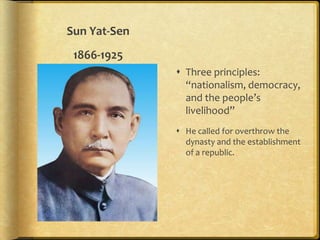
Sun Yat-Sen
1866-1925
 Three principles:
“nationalism, democracy,
and the people’s
livelihood”
 He called for overthrow the
dynasty and the establishment
of a republic.
Eleventh-Hour Reform
 By 1911 even remote provinces boasted new schools, teaching
new subjects and ideas.
 Students also studied abroad in record number who enjoyed
new personal and intellectual liberty.
 They learned about Western history, law, science, and logic.
 Manchu political reform included restructuring the government
along modern lines, developing a constitution, and creating a
modern military with Yuan Shikai.
 The Empress Dowager and Emperor Guangxu both died in
November 1908.
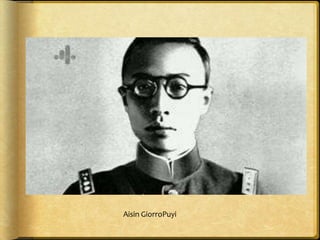
Aisin GiorroPuyi
The Revolution of 1911
 Provincial and merchant elites who created their own railway
companies.
 The Qing government, however, also wanted to nationalize the
major railways lines by doing foreign loaning.
 The loans and the disbanding of provincial companies caused a
furor.
 The nationalists were indignant over the foreign loans.
 Revolt broke out carried by men led by Sun Yet-Sen
 The revolutionaries had formed a government at Nanjing with
Sen as provisional president
The Revolution of 1911
 A compromising between Yuan Shikai and the
revolutionaries toke place, and an agreement was
reached.
 The Manchu child-emperor formally abdicated on
Feb.2, 1912, bringing an end not only to a dynasty but
also to a political system whose foundation had
been laid in 221 B.C.E.
 China became a republic.
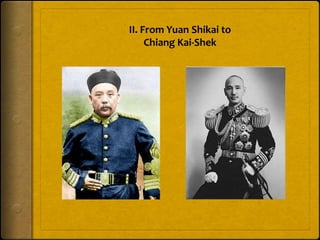
II. From Yuan Shikai to
Chiang Kai-Shek
Yuan Shikai
 Sun Yat-Sen stepped aside and Yuan accepted the presidency of a
republic with a two-chambered legislature.
 Elections were held in Feb. 1913 with about 5% of China’s population
entitled to vote.
 Yuan stayed in power by depending on military authority.
 During WWI, Japan presented in China with Twenty-One Demands:
 Recognition of Japanese rights in Shandong
 Extension its rights in Mongolia and Manchuria
 Sino-Japanese joint operation of China’s largest iron and steel
companies
 China not ceding or leasing any coastal area to any power other than
Japan
 Provisions that would have obliged the Chinese government to
employ Japanese political, financial, and military advisors…..
Yuan Shikai
 Yuan was forced to accept Japan’s seizure of Germany’s
holdings in Shandong, grant Japan new rights in southern
Manchuria and Inner Mongolia, and acknowledge its
special interest in China’s largest iron and steel works.
 The domestic result was a wave of anti-Japanese
nationalist outrage, which expressed itself in protests and
boycotts.
 Yuan wanted to reinstating the emperorship, but he did
nothing to tap or mobilize mass to support him. He
proclaimed the new regime, but the new dynasty was
overwhelming in March 1916 and he abandoned his
imperial ambition and died in the same year.
Warlord Era
 In 1917 there was even a two-week restoration of the
Qing.
 In the same year, China was under the premier and
warlord DuangQirui.
 Although a national government ruled in Beijing, actual
power lay in the hands of regional strongmen (warlord).
 After WWI ended, foreigners continued to enjoy
extraterritoriality wherever they went.
 Economically, the modern sector expanded during the
global postwar boom so that 1917 through 1923 had been
called “the golden age of Chinese capitalism.”
Intellectual Ferment
 The abolition of the examinations and the collapse of the Qing
opened the floodgates to new ideas.
 The major landmark was the founding in 1915 of New Youth,
the journal that came to stand at the core of new intellectual
tide.
 Confucianism was something about old state and society, the old
class system, the old politics,…
 Opposed both traditional teachings and the language
 Some of these new intellectuals taught at Beijing University,
so their ideas found a ready following among students at this
and other universities.
 Demonstrations
 May Fourth Movement: attacked every aspects of Chinese
tradition, new journals appeared, organized labor unions.
Intellectual Alternatives
 Proponents of scientism who believe that science
holds for arriving at truth.
 Their opponents argued that science is applicable
only to a narrow field of study and that moral values
have to be based on deeper metaphysical
truths, which by their very nature are beyond the
reach of scientific methodology.
Culture Alternatives
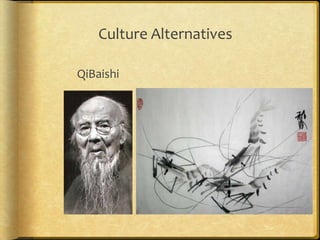
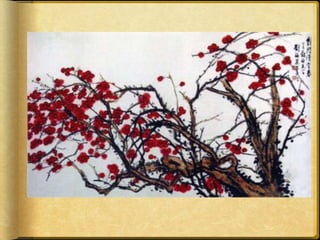
QiBaishi
Culture Alternatives
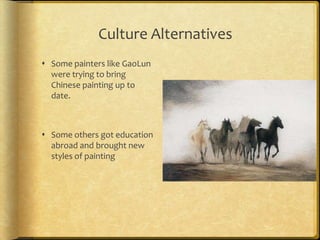
 Some painters like GaoLun
were trying to bring
Chinese painting up to
date.
 Some others got education
abroad and brought new
styles of painting
Culture Alternatives
 A steady and swelling stream of translation were
made.
 The May Fourth Movement had a strong effect on
literature.
 Writers of revolutionary persuasion such as the
Communist Mao Dun.
Marxism in China: the Early Year
 Marxism created by Marx and Engel
 The success of the Russian Revolution in 1917
 For the Chinese Marxism was modern, scientific and
advanced ideas.
 Some Chinese scholars, Marxism is a more effective
means to achieve modernization, solve China’s ill.
 CCP took place in 1921 by cooperating with Guomindang
The Guomindang and Sun Yat-Sen
(1913-1923)
 After the second revolution of 1913 Sun Yat-Sen was
forced into exile in Japan.
 After the death of Yuan Shikai, Sun was able to return
to China and establish a precarious foothold in Canton,
depending on the local warlord.
 He was ready to work with the Communists, but in his
view China was not ready for socialism and immediate
task was the national unity and independence.
 The GMD was recognized into a more structure and
disciplined organization
GMD and CCP Cooperation (1923-
1927)
 CCP leaders occupied important GMD office
 The CCP devoted itself mainly to organizing the
urban labor movement
 Sun Yat-Sen died in March 1925
 Nationalism: directed against foreign imperialism,
provided self-determination
 Democracy: popular elections, referendum
 The people’s livelihood: egalitarianism (equality) and
economic development.
GMD and CCP Cooperation (1923-
1927)
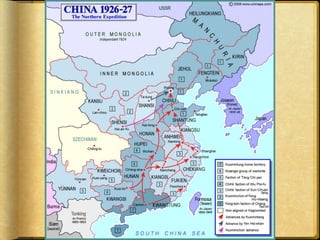
 Wang Jingwei replaced him
 Chian Kai-shek decided to act: arrested Soviet
advisors, took steps to restrain the CCP influence in
GMD, and launched Northern Expedition.
The Break
 Bankers and industrialists supported
Chiang Kai-shek to move away from CCP.
 In April 1927, Chiang broke with the CCP
in a bloody campaign.
 CCP got support from city factory
workers and peasants in rural
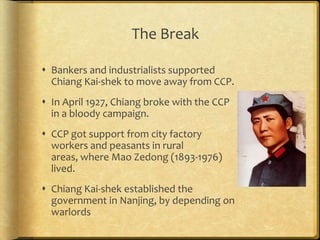
areas, where Mao Zedong (1893-1976)
lived.
 Chiang Kai-shek established the
government in Nanjing, by depending on
warlords
Thanks, A2.2

Presentation 9

  • 4.
    Emperor Guangxu I. TheLast Years of the Last Dynasty
  • 5.
    The New Reformers It came from a naval student called Yan Fu:  “…from thousands miles away…barbarians floated in and pounded our gates requesting for entrance…they didn’t get what they asked for, they attacked....”
  • 6.
    New Reformers  Yangargued that Western learning was needed to release Chinese energies, and rejected much of Chinese including even Confucius.  Kang Yuwei (1858-1927) and his followers sought to transformed the government into a modern and modernizing constitutional monarchy along the line of Meiji Japan.  Emperor Guangxu asserted his authority by issuing a flood of edicts aimed at reforming the examination system, remodeling the bureaucracy, and promoting modernization.
  • 7.
    The Empress Dowager The coup sent China’s most advanced thinkers into exile.  She approved moderate reform, but the central government was weak facing problems came from the West.
  • 8.
    The Scramble forConcessions  Germany leased territory in Shandong  Russia leased Port Arthur in the southern Liaodong  France held leases on land around Guangzhou Bay  Britain obtained Weihaiwei and Hong Kong  Finally, China made the decision by not ceding a given area to any power other than signatory:  The Yangzi Valley to Britain  The provinces bordering French Indochina to France  Fujian to Japan and Russia received special rights in Manchuria
  • 10.
    The Boxer Rising Popular anxieties were fueled by anti-foreignism, flood and famine in Shandong, combined with the advance of the Germans, led to the first Boxer rising in May 1898.  Later they were given support by high Qing officials to prepare to fight against the foreign powers.  In June 13 1900, they entered Beijing and 8 days later the court declared war on all the treaty powers.  They were officially placed under the command of imperial princes.  The Boxers and the Chinese troops were undisciplined, poorly-organized, and uncoordinated.
  • 11.
    The Winds ofChange  Foreigners controlled much of China’s mining and shipping, and were a major factor in manufacturing both export and domestic market.  They were an important part of China’s economic modernization.  Groups of modern or semi-modern entrepreneurs, tradesmen, financiers, industrial leaders… emerged.  170 presses supplying 2 to 4 million readers: depravity novels, science fantasy novels..  On provincial affairs was exercised by a semi-modern urban elite composed by merchants and bankers, and military and professional men trained in modern methods.
  • 12.
    Stirrings of Protestand Revolution  The first anti-footbinding movement in 1894, which resulted in a law banning the practice in 1902.  Expressions of public opinion, protests at Russia’s refusal to leave Manchuria, a boycott against the US, and a boycott against Japan as well as movement to regain railway rights.
  • 13.
    Sun Yat-Sen 1866-1925  Threeprinciples: “nationalism, democracy, and the people’s livelihood”  He called for overthrow the dynasty and the establishment of a republic.
  • 14.
    Eleventh-Hour Reform  By1911 even remote provinces boasted new schools, teaching new subjects and ideas.  Students also studied abroad in record number who enjoyed new personal and intellectual liberty.  They learned about Western history, law, science, and logic.  Manchu political reform included restructuring the government along modern lines, developing a constitution, and creating a modern military with Yuan Shikai.  The Empress Dowager and Emperor Guangxu both died in November 1908.
  • 15.
  • 16.
    The Revolution of1911  Provincial and merchant elites who created their own railway companies.  The Qing government, however, also wanted to nationalize the major railways lines by doing foreign loaning.  The loans and the disbanding of provincial companies caused a furor.  The nationalists were indignant over the foreign loans.  Revolt broke out carried by men led by Sun Yet-Sen  The revolutionaries had formed a government at Nanjing with Sen as provisional president
  • 17.
    The Revolution of1911  A compromising between Yuan Shikai and the revolutionaries toke place, and an agreement was reached.  The Manchu child-emperor formally abdicated on Feb.2, 1912, bringing an end not only to a dynasty but also to a political system whose foundation had been laid in 221 B.C.E.  China became a republic.
  • 18.
    II. From YuanShikai to Chiang Kai-Shek
  • 19.
    Yuan Shikai  SunYat-Sen stepped aside and Yuan accepted the presidency of a republic with a two-chambered legislature.  Elections were held in Feb. 1913 with about 5% of China’s population entitled to vote.  Yuan stayed in power by depending on military authority.  During WWI, Japan presented in China with Twenty-One Demands:  Recognition of Japanese rights in Shandong  Extension its rights in Mongolia and Manchuria  Sino-Japanese joint operation of China’s largest iron and steel companies  China not ceding or leasing any coastal area to any power other than Japan  Provisions that would have obliged the Chinese government to employ Japanese political, financial, and military advisors…..
  • 20.
    Yuan Shikai  Yuanwas forced to accept Japan’s seizure of Germany’s holdings in Shandong, grant Japan new rights in southern Manchuria and Inner Mongolia, and acknowledge its special interest in China’s largest iron and steel works.  The domestic result was a wave of anti-Japanese nationalist outrage, which expressed itself in protests and boycotts.  Yuan wanted to reinstating the emperorship, but he did nothing to tap or mobilize mass to support him. He proclaimed the new regime, but the new dynasty was overwhelming in March 1916 and he abandoned his imperial ambition and died in the same year.
  • 21.
    Warlord Era  In1917 there was even a two-week restoration of the Qing.  In the same year, China was under the premier and warlord DuangQirui.  Although a national government ruled in Beijing, actual power lay in the hands of regional strongmen (warlord).  After WWI ended, foreigners continued to enjoy extraterritoriality wherever they went.  Economically, the modern sector expanded during the global postwar boom so that 1917 through 1923 had been called “the golden age of Chinese capitalism.”
  • 22.
    Intellectual Ferment  Theabolition of the examinations and the collapse of the Qing opened the floodgates to new ideas.  The major landmark was the founding in 1915 of New Youth, the journal that came to stand at the core of new intellectual tide.  Confucianism was something about old state and society, the old class system, the old politics,…  Opposed both traditional teachings and the language  Some of these new intellectuals taught at Beijing University, so their ideas found a ready following among students at this and other universities.  Demonstrations  May Fourth Movement: attacked every aspects of Chinese tradition, new journals appeared, organized labor unions.
  • 23.
    Intellectual Alternatives  Proponentsof scientism who believe that science holds for arriving at truth.  Their opponents argued that science is applicable only to a narrow field of study and that moral values have to be based on deeper metaphysical truths, which by their very nature are beyond the reach of scientific methodology.
  • 24.
  • 25.
    Culture Alternatives  Somepainters like GaoLun were trying to bring Chinese painting up to date.  Some others got education abroad and brought new styles of painting
  • 27.
    Culture Alternatives  Asteady and swelling stream of translation were made.  The May Fourth Movement had a strong effect on literature.  Writers of revolutionary persuasion such as the Communist Mao Dun.
  • 28.
    Marxism in China:the Early Year  Marxism created by Marx and Engel  The success of the Russian Revolution in 1917  For the Chinese Marxism was modern, scientific and advanced ideas.  Some Chinese scholars, Marxism is a more effective means to achieve modernization, solve China’s ill.  CCP took place in 1921 by cooperating with Guomindang
  • 29.
    The Guomindang andSun Yat-Sen (1913-1923)  After the second revolution of 1913 Sun Yat-Sen was forced into exile in Japan.  After the death of Yuan Shikai, Sun was able to return to China and establish a precarious foothold in Canton, depending on the local warlord.  He was ready to work with the Communists, but in his view China was not ready for socialism and immediate task was the national unity and independence.  The GMD was recognized into a more structure and disciplined organization
  • 30.
    GMD and CCPCooperation (1923- 1927)  CCP leaders occupied important GMD office  The CCP devoted itself mainly to organizing the urban labor movement  Sun Yat-Sen died in March 1925  Nationalism: directed against foreign imperialism, provided self-determination  Democracy: popular elections, referendum  The people’s livelihood: egalitarianism (equality) and economic development.
  • 31.
    GMD and CCPCooperation (1923- 1927)  Wang Jingwei replaced him  Chian Kai-shek decided to act: arrested Soviet advisors, took steps to restrain the CCP influence in GMD, and launched Northern Expedition.
  • 33.
    The Break  Bankersand industrialists supported Chiang Kai-shek to move away from CCP.  In April 1927, Chiang broke with the CCP in a bloody campaign.  CCP got support from city factory workers and peasants in rural areas, where Mao Zedong (1893-1976) lived.  Chiang Kai-shek established the government in Nanjing, by depending on warlords
  • 34.