THE GLOBAL INTERSTATE
SYSTEM
LEARNING OBJECTIVES:
At the end of the lesson, the students should be able to:
• Explain the effects of globalization on governments
• Identify the institutions that govern international relations
• Differentiate internationalism from globalism.
Global Interstate system is an institutional arrangement of
governance that addresses regional or globalized issues that
go beyond the scope of a nation-state (Chase-Dunn, 1981)
GLOBAL INTERSTATE SYSTEM?
WHAT IS AN INTERSTATE SYSTEM?
Chase-Dunn defines an interstate system as a "system of
unequally powerful and competing states in which no single state
is capable of imposing control on all others. These states are in
interaction with one another in a set of shifting alliance and wars
and changes in relative power of states upsets any temporary set
of alliances, leading to a restructuring of the balance of power"
(Chase-Dunn, 1981:20).
Thus, an interstate system is the form of governance for a
globalization (Chase-Dunn, 1981).
As the world becomes more interconnected through politics,
trade, and communications, the role of nation-states and
government are also shifting. Thus, national and local policies are
not only based on local context but also international and global
realities. One example of a global treaty is the Montreal Protocol
on Substances that Deplete the Ozone Layer.
EFFECTS OF GLOBALIZATION ON
GOVERNMENTS
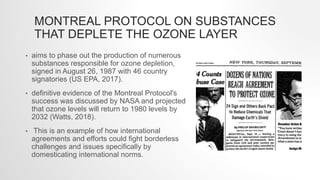
MONTREAL PROTOCOL ON SUBSTANCES
THAT DEPLETE THE OZONE LAYER
• aims to phase out the production of numerous
substances responsible for ozone depletion,
signed in August 26, 1987 with 46 country
signatories (US EPA, 2017).
• definitive evidence of the Montreal Protocol's
success was discussed by NASA and projected
that ozone levels will return to 1980 levels by
2032 (Watts, 2018).
• This is an example of how international
agreements and efforts could fight borderless
challenges and issues specifically by
domesticating international norms.
HOW DOES GLOBALIZATION NEGATIVELY AFFECT
LOCAL GOVERNMENTS AND LOCAL COMMUNITIES?
A local government would like to attract major global investors in their
community by setting up for instance their manufacturing firm in the area.
This could create jobs for the local people and generate income for local
businesses.
However, it entails converting tracks of agricultural land into an industrial
zone. Farmers will be displaced and agricultural production of the area will
be affected.
The global corporation is also demanding lower taxes and lower income
wage in order to finalize their investment in the area. They argue that they
will create more jobs and more income from the local community and
government.
INSTITUTIONS THAT GOVERN GLOBALIZATION
With the growing globalization, the governance of global
relations goes beyond nation-state governments. Nation-state
governments' scale and scope are limited in addressing
regional and global issues like climate change, cybercrime,
and global financial crises. Works by authors like Dryzek
(2012) and Castells (2008) show the growing emphasis on the
role of non-state actors in global governance.
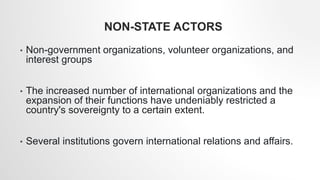
NON-STATE ACTORS
• Non-government organizations, volunteer organizations, and
interest groups
• The increased number of international organizations and the
expansion of their functions have undeniably restricted a
country's sovereignty to a certain extent.
• Several institutions govern international relations and affairs.
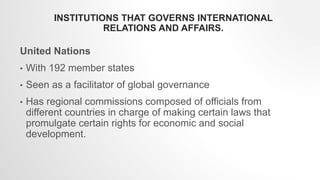
INSTITUTIONS THAT GOVERNS INTERNATIONAL
RELATIONS AND AFFAIRS.
United Nations
• With 192 member states
• Seen as a facilitator of global governance
• Has regional commissions composed of officials from
different countries in charge of making certain laws that
promulgate certain rights for economic and social
development.
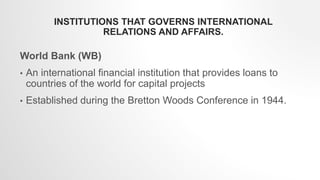
INSTITUTIONS THAT GOVERNS INTERNATIONAL
RELATIONS AND AFFAIRS.
World Bank (WB)
• An international financial institution that provides loans to
countries of the world for capital projects
• Established during the Bretton Woods Conference in 1944.
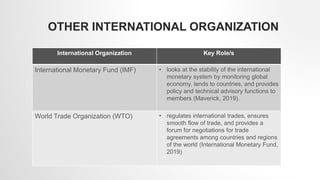
OTHER INTERNATIONAL ORGANIZATION
International Organization Key Role/s
International Monetary Fund (IMF) • looks at the stability of the international
monetary system by monitoring global
economy, lends to countries, and provides
policy and technical advisory functions to
members (Maverick, 2019).
World Trade Organization (WTO) • regulates international trades, ensures
smooth flow of trade, and provides a
forum for negotiations for trade
agreements among countries and regions
of the world (International Monetary Fund,
2019)
OTHER INTERNATIONAL ORGANIZATION
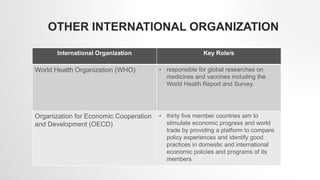
International Organization Key Role/s
World Health Organization (WHO) • responsible for global researches on
medicines and vaccines including the
World Health Report and Survey.
Organization for Economic Cooperation
and Development (OECD)
• thirty five member countries aim to
stimulate economic progress and world
trade by providing a platform to compare
policy experiences and identify good
practices in domestic and international
economic policies and programs of its
members
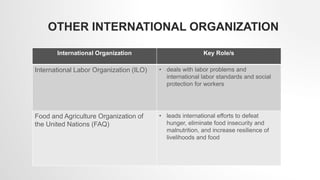
OTHER INTERNATIONAL ORGANIZATION
International Organization Key Role/s
International Labor Organization (ILO) • deals with labor problems and
international labor standards and social
protection for workers
Food and Agriculture Organization of
the United Nations (FAQ)
• leads international efforts to defeat
hunger, eliminate food insecurity and
malnutrition, and increase resilience of
livelihoods and food
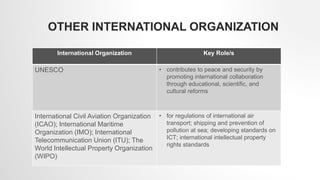
OTHER INTERNATIONAL ORGANIZATION
International Organization Key Role/s
UNESCO • contributes to peace and security by
promoting international collaboration
through educational, scientific, and
cultural reforms
International Civil Aviation Organization
(ICAO); International Maritime
Organization (IMO); International
Telecommunication Union (ITU); The
World Intellectual Property Organization
(WIPO)
• for regulations of international air
transport; shipping and prevention of
pollution at sea; developing standards on
ICT; international intellectual property
rights standards
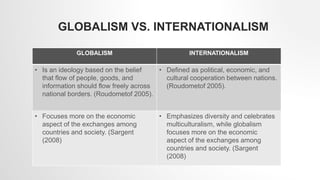
GLOBALISM VS. INTERNATIONALISM
GLOBALISM INTERNATIONALISM
• Is an ideology based on the belief
that flow of people, goods, and
information should flow freely across
national borders. (Roudometof 2005).
• Defined as political, economic, and
cultural cooperation between nations.
(Roudometof 2005).
• Focuses more on the economic
aspect of the exchanges among
countries and society. (Sargent
(2008)
• Emphasizes diversity and celebrates
multiculturalism, while globalism
focuses more on the economic
aspect of the exchanges among
countries and society. (Sargent
(2008)
THANK YOU!!

THE-GLOBAL-INTERSTATE-SYSTEM contemporary.pptx

  • 1.
  • 2.
    LEARNING OBJECTIVES: At theend of the lesson, the students should be able to: • Explain the effects of globalization on governments • Identify the institutions that govern international relations • Differentiate internationalism from globalism.
  • 3.
    Global Interstate systemis an institutional arrangement of governance that addresses regional or globalized issues that go beyond the scope of a nation-state (Chase-Dunn, 1981) GLOBAL INTERSTATE SYSTEM?
  • 4.
    WHAT IS ANINTERSTATE SYSTEM? Chase-Dunn defines an interstate system as a "system of unequally powerful and competing states in which no single state is capable of imposing control on all others. These states are in interaction with one another in a set of shifting alliance and wars and changes in relative power of states upsets any temporary set of alliances, leading to a restructuring of the balance of power" (Chase-Dunn, 1981:20). Thus, an interstate system is the form of governance for a globalization (Chase-Dunn, 1981).
  • 5.
    As the worldbecomes more interconnected through politics, trade, and communications, the role of nation-states and government are also shifting. Thus, national and local policies are not only based on local context but also international and global realities. One example of a global treaty is the Montreal Protocol on Substances that Deplete the Ozone Layer. EFFECTS OF GLOBALIZATION ON GOVERNMENTS
  • 6.
    MONTREAL PROTOCOL ONSUBSTANCES THAT DEPLETE THE OZONE LAYER • aims to phase out the production of numerous substances responsible for ozone depletion, signed in August 26, 1987 with 46 country signatories (US EPA, 2017). • definitive evidence of the Montreal Protocol's success was discussed by NASA and projected that ozone levels will return to 1980 levels by 2032 (Watts, 2018). • This is an example of how international agreements and efforts could fight borderless challenges and issues specifically by domesticating international norms.
  • 7.
    HOW DOES GLOBALIZATIONNEGATIVELY AFFECT LOCAL GOVERNMENTS AND LOCAL COMMUNITIES? A local government would like to attract major global investors in their community by setting up for instance their manufacturing firm in the area. This could create jobs for the local people and generate income for local businesses. However, it entails converting tracks of agricultural land into an industrial zone. Farmers will be displaced and agricultural production of the area will be affected. The global corporation is also demanding lower taxes and lower income wage in order to finalize their investment in the area. They argue that they will create more jobs and more income from the local community and government.
  • 8.
    INSTITUTIONS THAT GOVERNGLOBALIZATION With the growing globalization, the governance of global relations goes beyond nation-state governments. Nation-state governments' scale and scope are limited in addressing regional and global issues like climate change, cybercrime, and global financial crises. Works by authors like Dryzek (2012) and Castells (2008) show the growing emphasis on the role of non-state actors in global governance.
  • 9.
    NON-STATE ACTORS • Non-governmentorganizations, volunteer organizations, and interest groups • The increased number of international organizations and the expansion of their functions have undeniably restricted a country's sovereignty to a certain extent. • Several institutions govern international relations and affairs.
  • 10.
    INSTITUTIONS THAT GOVERNSINTERNATIONAL RELATIONS AND AFFAIRS. United Nations • With 192 member states • Seen as a facilitator of global governance • Has regional commissions composed of officials from different countries in charge of making certain laws that promulgate certain rights for economic and social development.
  • 11.
    INSTITUTIONS THAT GOVERNSINTERNATIONAL RELATIONS AND AFFAIRS. World Bank (WB) • An international financial institution that provides loans to countries of the world for capital projects • Established during the Bretton Woods Conference in 1944.
  • 12.
    OTHER INTERNATIONAL ORGANIZATION InternationalOrganization Key Role/s International Monetary Fund (IMF) • looks at the stability of the international monetary system by monitoring global economy, lends to countries, and provides policy and technical advisory functions to members (Maverick, 2019). World Trade Organization (WTO) • regulates international trades, ensures smooth flow of trade, and provides a forum for negotiations for trade agreements among countries and regions of the world (International Monetary Fund, 2019)
  • 13.
    OTHER INTERNATIONAL ORGANIZATION InternationalOrganization Key Role/s World Health Organization (WHO) • responsible for global researches on medicines and vaccines including the World Health Report and Survey. Organization for Economic Cooperation and Development (OECD) • thirty five member countries aim to stimulate economic progress and world trade by providing a platform to compare policy experiences and identify good practices in domestic and international economic policies and programs of its members
  • 14.
    OTHER INTERNATIONAL ORGANIZATION InternationalOrganization Key Role/s International Labor Organization (ILO) • deals with labor problems and international labor standards and social protection for workers Food and Agriculture Organization of the United Nations (FAQ) • leads international efforts to defeat hunger, eliminate food insecurity and malnutrition, and increase resilience of livelihoods and food
  • 15.
    OTHER INTERNATIONAL ORGANIZATION InternationalOrganization Key Role/s UNESCO • contributes to peace and security by promoting international collaboration through educational, scientific, and cultural reforms International Civil Aviation Organization (ICAO); International Maritime Organization (IMO); International Telecommunication Union (ITU); The World Intellectual Property Organization (WIPO) • for regulations of international air transport; shipping and prevention of pollution at sea; developing standards on ICT; international intellectual property rights standards
  • 16.
    GLOBALISM VS. INTERNATIONALISM GLOBALISMINTERNATIONALISM • Is an ideology based on the belief that flow of people, goods, and information should flow freely across national borders. (Roudometof 2005). • Defined as political, economic, and cultural cooperation between nations. (Roudometof 2005). • Focuses more on the economic aspect of the exchanges among countries and society. (Sargent (2008) • Emphasizes diversity and celebrates multiculturalism, while globalism focuses more on the economic aspect of the exchanges among countries and society. (Sargent (2008)
  • 17.