The Emergence of
Modern Japan: 1874-
1894
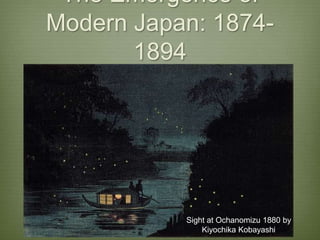
Sight at Ochanomizu 1880 by
Kiyochika Kobayashi
Political Development
 Several uprisings occurred
during the 1870s and 1980s.
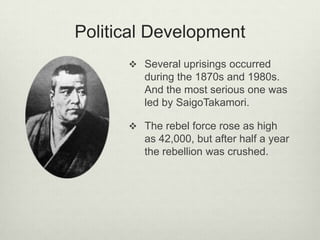
And the most serious one was
led by SaigoTakamori.
 The rebel force rose as high
as 42,000, but after half a year
the rebellion was crushed.
Political Development
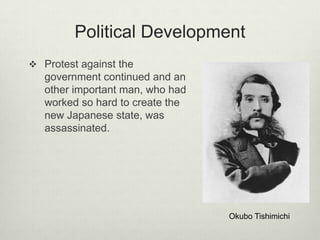
 Protest against the
government continued and an
other important man, who had
worked so hard to create the
new Japanese state, was
assassinated.
Okubo Tishimichi
Political Development
Everywhere, antigovernment organizations voiced
the discontent of local interests, demanding political
rights, local-government, and formation of a national
assembly.
Political Development
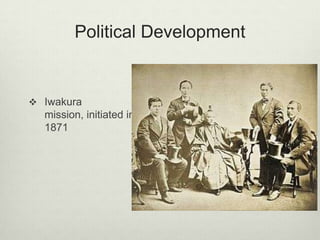
 Iwakura
mission, initiated in
1871
Political Development
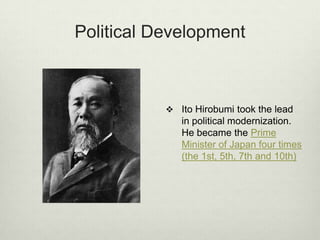
 Ito Hirobumi took the lead
in political modernization.
He became the Prime
Minister of Japan four times
(the 1st, 5th, 7th and 10th)
Political Development
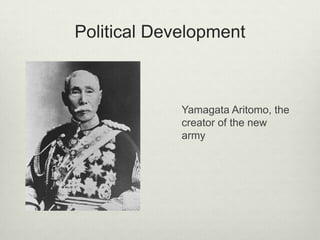
Yamagata Aritomo, the
creator of the new
army
Political Development
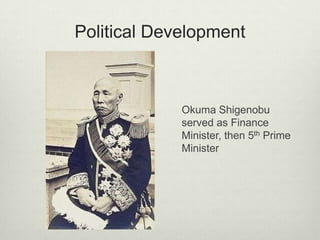
Okuma Shigenobu
served as Finance
Minister, then 5th Prime
Minister
Political Development
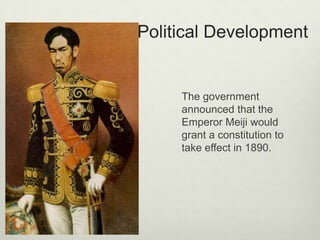
The government
announced that the
Emperor Meiji would
grant a constitution to
take effect in 1890.
Formation of Parties
 The Jiyuto (Liberal party) formed by Itagaki and his
associates
 Drew its support from rural areas
 It proclaimed itself “devoted to the expansion of
liberty, protection of rights, promotion happiness and
reform of society.”
 The Kaishinto (Progressive party) formed by Okuma
 More urban and more moderate
 Advocating English-style liberalism and setting forth
more specific proposals
Formation of Parties
 Japan’s first newspaper appeared in 1871, and
press laws enacted in 1875.
 The Liberal party was hurt by differences among its
leaders, but was damaged even more by
antagonism within its membership, it was dissolved
in 1884.
 A system of centralizing local administration was
established, villages and town were now headed by
officials, and local assemblies were created.
The Emperor and the
Constitution
 The emperor was a divine being embodying a timeless spirit, but this was
a modern divinity, resplendent in his flashy, new, world-class uniform.
 The emperor, “sacred and inviolable” father of the family state, was
supreme.
 He was the locus and source of sovereignty: the land and people
belonged to him.
 He had power to declare war, conclude treaties, and command the army.
 He also had the right to open, recess (suspend), and dissolved the
legislature
 Only the emperor could take the initiative to revise the constitution
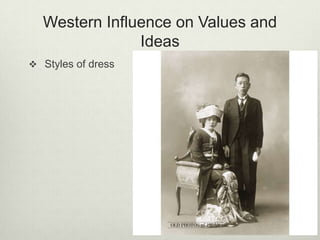
Western Influence on Values and
Ideas
 Styles of dress
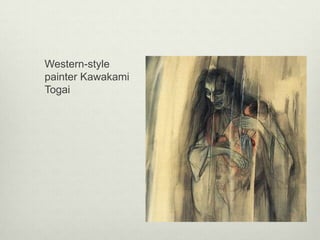
Western-style
painter Kawakami
Togai
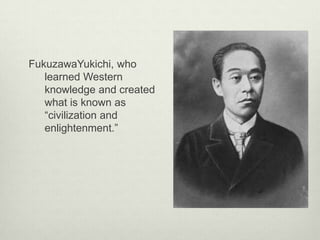
FukuzawaYukichi, who
learned Western
knowledge and created
what is known as
“civilization and
enlightenment.”
Civilization and Enlightenment
 In 18th century Europe, the intellectual movement known
as the Enlightenment sought to put all traditional ideas
and institutions to the test of reason.
 FukuzawaYukichi was strongly influenced by the
European Enlightenment.
 He goals were to stimulate the development of an
independent and responsible citizenry in Japan.
 While he reviewed the role of women in terms of family
and home, Fukuzawa also recommended greater
equality between sexes, championed monogamy argued
that women should be educated and allowed to hold
property.
Civilization and Enlightenment
 According to Fukuzawa, history was made by the
people, not by a few great leaders.
 He established what became Keio University, a
distinguished private university in Tokyo whose
graduates were important in business and industry.
 He believed that human affairs should be governed
by inherent concepts of justice like the physical
world is governed by laws of nature.
Social Darwinism
 It’s all based on the theory of evolution by natural
selection presented in Darwin’s famous On the Origin of
Species (1859).
 The theory was summarized by the catch phrase
“survive of the fittest.”
 It applies to the success or failure of individuals within
society, it justified brutal competition.
 Similarly, applied to the rise and fall of nations, it focuses
on military as well as civil competition.
 In both case, “the fittest” were those came out on the top
and thereby contributed to human progress.
The Arts
 Western influence was both audible and visible.
 Music taught in school
 Literature, “the age of translation”
 Painting, “Morning Toilet” by Kuroda Seiki, painting of
nude
 The coming of Western art led to the neglect of
traditional art.
Conservatism and Nationalism
 Some Japanese feared that acceptance of a foreign culture was a
step towards national decline, and should adopt some of Western
culture while retaining valuable aspects of their past.
 Western individualism, fostered by the policy of
modernization, clashed with the old family values.
 ……
 Okakura went on to define a wider world role for Japan by
emphasizing Japan’s Asian roots.
 His book, The Ideals of the Eat presents the nation’s mission in
term of preserving an Asian cultural essence.
Education
 Education was important in fashioning a new Japan
capable of competing with the West.
 At the beginning of the Meiji period (1873), One-
eighth of ME’s first budget was designed for
sending students overseas.
 Many foreign instructors were brought to Japan to
teach various specialized schools.
 The Ministry of Education was created since 1871
to determine what was taught.
Education
 Political leaders agreed to provide people with skills
necessary for modernization.
 In the 1870s, more books were frequently translated
for use in Japanese schools.
 However, there were also critics who insisted that
schools should preserve traditional
Confucian/Japanese values.
Modernizing the Economy
 The nation was still primarily agrarian, but Western experience brought
the country to the condition for industrial development.
 Japanese agriculture had become more efficient with the introduction of
new seed trains, new fertilizers, and new methods of cultivation.
 Trade helped generate capital needed for investment in manufacturing.
 However, Benefits resulting from the commercialization of agriculture
went to the landlord.
 The Meiji regime invested heavily in the economic infrastructure
 The government took the lead in establishing and operating cement
works, plants manufacturing tiles, textile mills…..
The Zaibatsu
 The zaibatsu (huge financial and industrial
combines) were usually organized by new
entrepreneurs to make a successful tradition into
the new world of Meiji.
 The Mitsui was vigorous and capable, establishing
first a bank and then a trading company which
became important factors in foreign commerce.
Military
 The Taiwan expedition of 1874
 The Satuma Rebellion of 1877
 The Sino-Japanese War of 1894-1895
 Yamagata established a general staff along German
lines, and the Germany became the overall model
for the army, previously influenced by France.
 The army got modern equipment, the creation of a
Staff College and improve training, and Naval
modernization.
East asia 3
East asia 3
East asia 3
East asia 3
East asia 3

East asia 3

  • 1.
    The Emergence of ModernJapan: 1874- 1894 Sight at Ochanomizu 1880 by Kiyochika Kobayashi
  • 5.
    Political Development  Severaluprisings occurred during the 1870s and 1980s. And the most serious one was led by SaigoTakamori.  The rebel force rose as high as 42,000, but after half a year the rebellion was crushed.
  • 6.
    Political Development  Protestagainst the government continued and an other important man, who had worked so hard to create the new Japanese state, was assassinated. Okubo Tishimichi
  • 7.
    Political Development Everywhere, antigovernmentorganizations voiced the discontent of local interests, demanding political rights, local-government, and formation of a national assembly.
  • 8.
  • 9.
    Political Development  ItoHirobumi took the lead in political modernization. He became the Prime Minister of Japan four times (the 1st, 5th, 7th and 10th)
  • 10.
    Political Development Yamagata Aritomo,the creator of the new army
  • 11.
    Political Development Okuma Shigenobu servedas Finance Minister, then 5th Prime Minister
  • 12.
    Political Development The government announcedthat the Emperor Meiji would grant a constitution to take effect in 1890.
  • 13.
    Formation of Parties The Jiyuto (Liberal party) formed by Itagaki and his associates  Drew its support from rural areas  It proclaimed itself “devoted to the expansion of liberty, protection of rights, promotion happiness and reform of society.”  The Kaishinto (Progressive party) formed by Okuma  More urban and more moderate  Advocating English-style liberalism and setting forth more specific proposals
  • 14.
    Formation of Parties Japan’s first newspaper appeared in 1871, and press laws enacted in 1875.  The Liberal party was hurt by differences among its leaders, but was damaged even more by antagonism within its membership, it was dissolved in 1884.  A system of centralizing local administration was established, villages and town were now headed by officials, and local assemblies were created.
  • 15.
    The Emperor andthe Constitution  The emperor was a divine being embodying a timeless spirit, but this was a modern divinity, resplendent in his flashy, new, world-class uniform.  The emperor, “sacred and inviolable” father of the family state, was supreme.  He was the locus and source of sovereignty: the land and people belonged to him.  He had power to declare war, conclude treaties, and command the army.  He also had the right to open, recess (suspend), and dissolved the legislature  Only the emperor could take the initiative to revise the constitution
  • 16.
    Western Influence onValues and Ideas  Styles of dress
  • 17.
  • 18.
    FukuzawaYukichi, who learned Western knowledgeand created what is known as “civilization and enlightenment.”
  • 19.
    Civilization and Enlightenment In 18th century Europe, the intellectual movement known as the Enlightenment sought to put all traditional ideas and institutions to the test of reason.  FukuzawaYukichi was strongly influenced by the European Enlightenment.  He goals were to stimulate the development of an independent and responsible citizenry in Japan.  While he reviewed the role of women in terms of family and home, Fukuzawa also recommended greater equality between sexes, championed monogamy argued that women should be educated and allowed to hold property.
  • 20.
    Civilization and Enlightenment According to Fukuzawa, history was made by the people, not by a few great leaders.  He established what became Keio University, a distinguished private university in Tokyo whose graduates were important in business and industry.  He believed that human affairs should be governed by inherent concepts of justice like the physical world is governed by laws of nature.
  • 21.
    Social Darwinism  It’sall based on the theory of evolution by natural selection presented in Darwin’s famous On the Origin of Species (1859).  The theory was summarized by the catch phrase “survive of the fittest.”  It applies to the success or failure of individuals within society, it justified brutal competition.  Similarly, applied to the rise and fall of nations, it focuses on military as well as civil competition.  In both case, “the fittest” were those came out on the top and thereby contributed to human progress.
  • 22.
    The Arts  Westerninfluence was both audible and visible.  Music taught in school  Literature, “the age of translation”  Painting, “Morning Toilet” by Kuroda Seiki, painting of nude  The coming of Western art led to the neglect of traditional art.
  • 23.
    Conservatism and Nationalism Some Japanese feared that acceptance of a foreign culture was a step towards national decline, and should adopt some of Western culture while retaining valuable aspects of their past.  Western individualism, fostered by the policy of modernization, clashed with the old family values.  ……  Okakura went on to define a wider world role for Japan by emphasizing Japan’s Asian roots.  His book, The Ideals of the Eat presents the nation’s mission in term of preserving an Asian cultural essence.
  • 24.
    Education  Education wasimportant in fashioning a new Japan capable of competing with the West.  At the beginning of the Meiji period (1873), One- eighth of ME’s first budget was designed for sending students overseas.  Many foreign instructors were brought to Japan to teach various specialized schools.  The Ministry of Education was created since 1871 to determine what was taught.
  • 25.
    Education  Political leadersagreed to provide people with skills necessary for modernization.  In the 1870s, more books were frequently translated for use in Japanese schools.  However, there were also critics who insisted that schools should preserve traditional Confucian/Japanese values.
  • 26.
    Modernizing the Economy The nation was still primarily agrarian, but Western experience brought the country to the condition for industrial development.  Japanese agriculture had become more efficient with the introduction of new seed trains, new fertilizers, and new methods of cultivation.  Trade helped generate capital needed for investment in manufacturing.  However, Benefits resulting from the commercialization of agriculture went to the landlord.  The Meiji regime invested heavily in the economic infrastructure  The government took the lead in establishing and operating cement works, plants manufacturing tiles, textile mills…..
  • 27.
    The Zaibatsu  Thezaibatsu (huge financial and industrial combines) were usually organized by new entrepreneurs to make a successful tradition into the new world of Meiji.  The Mitsui was vigorous and capable, establishing first a bank and then a trading company which became important factors in foreign commerce.
  • 28.
    Military  The Taiwanexpedition of 1874  The Satuma Rebellion of 1877  The Sino-Japanese War of 1894-1895  Yamagata established a general staff along German lines, and the Germany became the overall model for the army, previously influenced by France.  The army got modern equipment, the creation of a Staff College and improve training, and Naval modernization.