GLOBALISATION
1.Globalisation is the new buzzword that has
come to dominate the world since the nineties
of the last century with the end of the cold war
and the break-up of the former Soviet Union.
2.The term implies worldly
integration/amalgamation of various cultures,
styles, economic policies, ideas, etc.
3.It must not be confused with “making things
common around the world”. It is an integration,
not simulation.
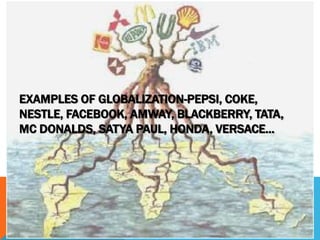
EXAMPLES OF GLOBALIZATION-PEPSI, COKE,
NESTLE, FACEBOOK, AMWAY, BLACKBERRY, TATA,
MC DONALDS, SATYA PAUL, HONDA, VERSACE…
CONTD.
Globalization is a consequence of increase
trade across nations.
Anthony Giddens (1990) describes
globalization as “the intensifications of
worldwide social relations which link
distinct localities in such a way that local
happenings are shaped by events
occurring miles away.”
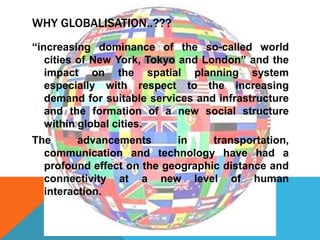
WHY GLOBALISATION..???
“increasing dominance of the so-called world
cities of New York, Tokyo and London” and the
impact on the spatial planning system
especially with respect to the increasing
demand for suitable services and infrastructure
and the formation of a new social structure
within global cities.
The advancements in transportation,
communication and technology have had a
profound effect on the geographic distance and
connectivity at a new level of human
interaction.
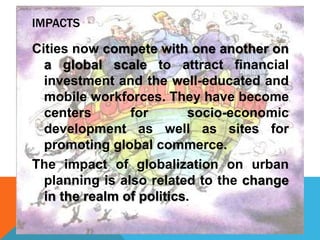
IMPACTS
Cities now compete with one another on
a global scale to attract financial
investment and the well-educated and
mobile workforces. They have become
centers for socio-economic
development as well as sites for
promoting global commerce.
The impact of globalization on urban
planning is also related to the change
in the realm of politics.
IMPACTS CONTD.
Urbanization is one of the negative impacts of the
globalization and integration of economies.
Globalisation leads to urbanisation. According to
the United Nations Center for Human
Settlements, in 1900 there were only four cities
with a population over 100,000 or more and in
1961 there were 141 cities and today the world
urban population is increasing at the rate of 1.3
per cent per annum in the period 1995-2000
(Oucho, 2001; Toffler, 1970).
IMPACTS CONTD.
The increased economic investment and
proliferation in infrastructure
development projects are exerting
enormous pressure on the existing
resources and the capacity of the cities
to accommodate this unprecedented
growth.
Other detrimental consequences include
poverty, housing shortage, inefficient
and inequitable delivery of infrastructure
services, economic inequality, social
exclusion and poor quality local
environments.
IMPACTS CONTD.
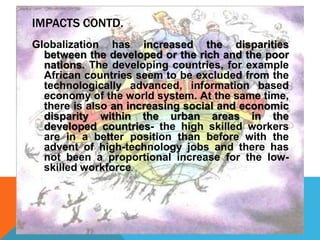
Globalization has increased the disparities
between the developed or the rich and the poor
nations. The developing countries, for example
African countries seem to be excluded from the
technologically advanced, information based
economy of the world system. At the same time,
there is also an increasing social and economic
disparity within the urban areas in the
developed countries- the high skilled workers
are in a better position than before with the
advent of high-technology jobs and there has
not been a proportional increase for the low-
skilled workforce.
IMPACTS CONTD.
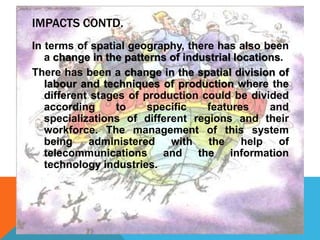
In terms of spatial geography, there has also been
a change in the patterns of industrial locations.
There has been a change in the spatial division of
labour and techniques of production where the
different stages of production could be divided
according to specific features and
specializations of different regions and their
workforce. The management of this system
being administered with the help of
telecommunications and the information
technology industries.
GLOBALISATION & PLANNING
the pressures on urban planning arise from :
global hierarchy of cities and the impact these cities
have in a regional and local context.
“economic globalization within the world cities” of
local employment sources has led to a
transformation at the level of human interaction has
transformed into a new dimension never
experienced before, with telecommunication and
transportation being the key players in stimulating
the experience.
the concept of „globalization‟ as means to represent
the combination of these two forces- the pressure to
integrate the global forces and the local pressures.
GLOBALISATION & PLANNING CONTD.
The challenges faced by governments
have become even more complex, and
apart from responding to the pressures
of the domestic demands and their
political legitimacy, their internal needs
and self-interests, they have to balance
the pressures from super-governmental
or global political structures like the
World Bank and United Nations.
GLOBALISATION & PLANNING CONTD.
Globalization also presents new avenues for
planning practice and academia.
The process of globalization requires planners to
become more sensitive to the flexibility and the
plethora of options offered by the globalization
effect to develop solutions and mechanisms
that are timely and rapid solutions.
GLOBALISATION & PLANNING CONTD.
For example, the increased use of geographic information
system data and remote sensing data can facilitate the
research and flow of information in urban growth and
development and effective spatial planning.
Newman and Thornley (2002) observe that in the global era,
“planning lies at the interface of market and politics”.
Globalization has its advantages and disadvantages and
from the perspective of the planning profession an
increased flow of information internationally is one of the
advantages that would be effective tools to facilitate two-
way learning by comparisons.
PLANNING FOR GLOBALISATION
1.Globalization is essentially a process that involves
the following general tasks:
a. Identifying the languages and locales that must be
supported.
b. Designing features that support targeted markets,
languages, and locales.
c. Writing code that functions equally well in any of the
supported locales.
These tasks are all centered on the concept of
locale and cultural awareness
GLOBALISATION OF LAW
Globalization of law may be defined as the
worldwide progression of transnational legal
structures and discourses along the
dimensions of extensity, intensity, velocity, and
impact.
Research demonstrates that globalization is
variably contested in several domains of
research on law:
(a) the construction and regulation of global markets,
(b) crimes against humanity and genocide,
(c) the diffusion of political liberalism and
constitutionalism, and
(d) the institutionalization of women's rights.
GLOBALISATION OF LAW
Effectiveness : the farther globalizing legal norms
and practices are located from core local
cultural institutions and beliefs, the less likely
global norms will provoke explicit contestation
and confrontation. Future research will be
productively directed to where and how global
law originates, how and when global norms and
law are transmitted and enforced, and how
global-local settlements are negotiated.
HOW DOES GLOBALISATION AFFECT WOMEN..??
1.Economically, through discrimination in favour of male
workers, marginalization of women in unpaid or informal
labour, exploitation of women in low-wage sweatshop
settings, and/or impoverishment though loss of
traditional sources of income.
2.Politically, through exclusion from the domestic political
process and loss of control to global pressures.
3.Culturally, through loss of identity and autonomy to a
hegemonic global culture.
4.In situations where women have been historically
repressed or discriminated under a patriarchal division of
labour, some features of globalization may have liberating
consequences.
HOW GLOBALISATION EFFECTS POVERTY..??
1.competition among workers, or foreign investment,
or trade, or government borrowing. There is no
single measure of integration into the world
economy.
2.globalization has become a dominant factor in
producing a new kind of poverty.
3.When governments assume debt in private capital
markets and declining world demand for their
commodities depresses prices and they seek funds
from the IMF to repay loans and they agree to
conditions for internal reform and these conditions
impose hardship on their people, it is tempting to
conclude that therefore "globalization" causes
poverty.
WHY SOME ARE AGAINST GLOBALISATION..??
1.Globalisation is used as an ideology by the powerful to
deceive the people about illusory benefits of a
dehumanizing system; in other words, globalization is a
form of false consciousness that prevents people from
seeing their true interests.
2.It perpetuates the inequity and exploitation inherent in
capitalism; globalization polarizes the globe and therefore
creates an even more unjust world.
3.It is not subject to democratic control and therefore cannot
serve the interests of the people at large; new forms of
democratic governance and economic regulation will be
needed to overcome this problem.
4.Due to the scale of change, it intensifies long-standing
problems, such as the deterioration of the environment.
GLOBALISATION AND CULTURAL DIVERSITY
Negatives :
1.multinational corporations promote a certain kind of
consumerist culture, in which standard commodities,
promoted by global marketing campaigns exploiting
basic material desires, create similar lifestyles--"Coca-
Colonization"
2.backed by the power of certain states, Western ideals (or,
ideals of the powerful) are falsely established as
universal, overriding local traditions--"cultural
imperialism"
3.modern institutions have an inherently rationalizing thrust,
making all human practices more efficient, controllable,
and predictable, as exemplified by the spread of fast
food--"McDonaldization"
4.the United States exerts hegemonic influence in promoting
its values and habits through popular culture and the
news media--"Americanization"
Positives :
1.interaction across boundaries leads to the mixing of
cultures in particular places and practice--Pluralisation
2.cultural flows occur differently in different spheres and
may originate in many places--differentiation
3.integration and the spread of ideas and images provoke
reactions and resistance--contestation
4.global norms or practices are interpreted differently
according to local tradition; the universal must take
particular forms--globalization
5.diversity has itself become a global value, promoted
through international organizations and movements, not
to mention nation-states--institutionalization
Globalisation and cultural diversity
REFERENCES
MUKHERJEE, T. NARULA, H (2011),
GLOBALIZATION AND ITS CRISES AROUND THE
WORLD, UNIVERSITY OF TENNESSEE.

Globalisation slideshare

  • 2.
    GLOBALISATION 1.Globalisation is thenew buzzword that has come to dominate the world since the nineties of the last century with the end of the cold war and the break-up of the former Soviet Union. 2.The term implies worldly integration/amalgamation of various cultures, styles, economic policies, ideas, etc. 3.It must not be confused with “making things common around the world”. It is an integration, not simulation.
  • 3.
    EXAMPLES OF GLOBALIZATION-PEPSI,COKE, NESTLE, FACEBOOK, AMWAY, BLACKBERRY, TATA, MC DONALDS, SATYA PAUL, HONDA, VERSACE…
  • 4.
    CONTD. Globalization is aconsequence of increase trade across nations. Anthony Giddens (1990) describes globalization as “the intensifications of worldwide social relations which link distinct localities in such a way that local happenings are shaped by events occurring miles away.”
  • 6.
    WHY GLOBALISATION..??? “increasing dominanceof the so-called world cities of New York, Tokyo and London” and the impact on the spatial planning system especially with respect to the increasing demand for suitable services and infrastructure and the formation of a new social structure within global cities. The advancements in transportation, communication and technology have had a profound effect on the geographic distance and connectivity at a new level of human interaction.
  • 7.
    IMPACTS Cities now competewith one another on a global scale to attract financial investment and the well-educated and mobile workforces. They have become centers for socio-economic development as well as sites for promoting global commerce. The impact of globalization on urban planning is also related to the change in the realm of politics.
  • 8.
    IMPACTS CONTD. Urbanization isone of the negative impacts of the globalization and integration of economies. Globalisation leads to urbanisation. According to the United Nations Center for Human Settlements, in 1900 there were only four cities with a population over 100,000 or more and in 1961 there were 141 cities and today the world urban population is increasing at the rate of 1.3 per cent per annum in the period 1995-2000 (Oucho, 2001; Toffler, 1970).
  • 9.
    IMPACTS CONTD. The increasedeconomic investment and proliferation in infrastructure development projects are exerting enormous pressure on the existing resources and the capacity of the cities to accommodate this unprecedented growth. Other detrimental consequences include poverty, housing shortage, inefficient and inequitable delivery of infrastructure services, economic inequality, social exclusion and poor quality local environments.
  • 10.
    IMPACTS CONTD. Globalization hasincreased the disparities between the developed or the rich and the poor nations. The developing countries, for example African countries seem to be excluded from the technologically advanced, information based economy of the world system. At the same time, there is also an increasing social and economic disparity within the urban areas in the developed countries- the high skilled workers are in a better position than before with the advent of high-technology jobs and there has not been a proportional increase for the low- skilled workforce.
  • 11.
    IMPACTS CONTD. In termsof spatial geography, there has also been a change in the patterns of industrial locations. There has been a change in the spatial division of labour and techniques of production where the different stages of production could be divided according to specific features and specializations of different regions and their workforce. The management of this system being administered with the help of telecommunications and the information technology industries.
  • 12.
    GLOBALISATION & PLANNING thepressures on urban planning arise from : global hierarchy of cities and the impact these cities have in a regional and local context. “economic globalization within the world cities” of local employment sources has led to a transformation at the level of human interaction has transformed into a new dimension never experienced before, with telecommunication and transportation being the key players in stimulating the experience. the concept of „globalization‟ as means to represent the combination of these two forces- the pressure to integrate the global forces and the local pressures.
  • 13.
    GLOBALISATION & PLANNINGCONTD. The challenges faced by governments have become even more complex, and apart from responding to the pressures of the domestic demands and their political legitimacy, their internal needs and self-interests, they have to balance the pressures from super-governmental or global political structures like the World Bank and United Nations.
  • 14.
    GLOBALISATION & PLANNINGCONTD. Globalization also presents new avenues for planning practice and academia. The process of globalization requires planners to become more sensitive to the flexibility and the plethora of options offered by the globalization effect to develop solutions and mechanisms that are timely and rapid solutions.
  • 15.
    GLOBALISATION & PLANNINGCONTD. For example, the increased use of geographic information system data and remote sensing data can facilitate the research and flow of information in urban growth and development and effective spatial planning. Newman and Thornley (2002) observe that in the global era, “planning lies at the interface of market and politics”. Globalization has its advantages and disadvantages and from the perspective of the planning profession an increased flow of information internationally is one of the advantages that would be effective tools to facilitate two- way learning by comparisons.
  • 16.
    PLANNING FOR GLOBALISATION 1.Globalizationis essentially a process that involves the following general tasks: a. Identifying the languages and locales that must be supported. b. Designing features that support targeted markets, languages, and locales. c. Writing code that functions equally well in any of the supported locales. These tasks are all centered on the concept of locale and cultural awareness
  • 17.
    GLOBALISATION OF LAW Globalizationof law may be defined as the worldwide progression of transnational legal structures and discourses along the dimensions of extensity, intensity, velocity, and impact. Research demonstrates that globalization is variably contested in several domains of research on law: (a) the construction and regulation of global markets, (b) crimes against humanity and genocide, (c) the diffusion of political liberalism and constitutionalism, and (d) the institutionalization of women's rights.
  • 18.
    GLOBALISATION OF LAW Effectiveness: the farther globalizing legal norms and practices are located from core local cultural institutions and beliefs, the less likely global norms will provoke explicit contestation and confrontation. Future research will be productively directed to where and how global law originates, how and when global norms and law are transmitted and enforced, and how global-local settlements are negotiated.
  • 19.
    HOW DOES GLOBALISATIONAFFECT WOMEN..?? 1.Economically, through discrimination in favour of male workers, marginalization of women in unpaid or informal labour, exploitation of women in low-wage sweatshop settings, and/or impoverishment though loss of traditional sources of income. 2.Politically, through exclusion from the domestic political process and loss of control to global pressures. 3.Culturally, through loss of identity and autonomy to a hegemonic global culture. 4.In situations where women have been historically repressed or discriminated under a patriarchal division of labour, some features of globalization may have liberating consequences.
  • 20.
    HOW GLOBALISATION EFFECTSPOVERTY..?? 1.competition among workers, or foreign investment, or trade, or government borrowing. There is no single measure of integration into the world economy. 2.globalization has become a dominant factor in producing a new kind of poverty. 3.When governments assume debt in private capital markets and declining world demand for their commodities depresses prices and they seek funds from the IMF to repay loans and they agree to conditions for internal reform and these conditions impose hardship on their people, it is tempting to conclude that therefore "globalization" causes poverty.
  • 21.
    WHY SOME AREAGAINST GLOBALISATION..?? 1.Globalisation is used as an ideology by the powerful to deceive the people about illusory benefits of a dehumanizing system; in other words, globalization is a form of false consciousness that prevents people from seeing their true interests. 2.It perpetuates the inequity and exploitation inherent in capitalism; globalization polarizes the globe and therefore creates an even more unjust world. 3.It is not subject to democratic control and therefore cannot serve the interests of the people at large; new forms of democratic governance and economic regulation will be needed to overcome this problem. 4.Due to the scale of change, it intensifies long-standing problems, such as the deterioration of the environment.
  • 22.
    GLOBALISATION AND CULTURALDIVERSITY Negatives : 1.multinational corporations promote a certain kind of consumerist culture, in which standard commodities, promoted by global marketing campaigns exploiting basic material desires, create similar lifestyles--"Coca- Colonization" 2.backed by the power of certain states, Western ideals (or, ideals of the powerful) are falsely established as universal, overriding local traditions--"cultural imperialism" 3.modern institutions have an inherently rationalizing thrust, making all human practices more efficient, controllable, and predictable, as exemplified by the spread of fast food--"McDonaldization" 4.the United States exerts hegemonic influence in promoting its values and habits through popular culture and the news media--"Americanization"
  • 23.
    Positives : 1.interaction acrossboundaries leads to the mixing of cultures in particular places and practice--Pluralisation 2.cultural flows occur differently in different spheres and may originate in many places--differentiation 3.integration and the spread of ideas and images provoke reactions and resistance--contestation 4.global norms or practices are interpreted differently according to local tradition; the universal must take particular forms--globalization 5.diversity has itself become a global value, promoted through international organizations and movements, not to mention nation-states--institutionalization Globalisation and cultural diversity
  • 24.
    REFERENCES MUKHERJEE, T. NARULA,H (2011), GLOBALIZATION AND ITS CRISES AROUND THE WORLD, UNIVERSITY OF TENNESSEE.

Editor's Notes

  • #18 Example : International court of justice
  • #19 Indigenous practices and craftsmanship- a dying art