WHAT IS GLOBAL GOVERNANCE? 
Presented on December 1st, 2014 
BY 
AMINA MOHAMMED
Global Governance 
This presentation will look at the following: 
• The various definition of global governance. 
• The evolution and views of global governance. 
• The functions/ various aspects that drive global governance. 
• Achievements and challenges. 
• Conclusion and reference.
Global Governance 
Diverse definitions 
Definition depends on two factors: 
• The person defining 
• Under the circumstances it is used 
No Consensus on Definition Yet: 
• Not among academia 
• Not among policy makers 
• Not between academia and policy makers 
Rosenau (1995;13) views global governance as perceived to 
include systems of rule at all levels of human activity- from 
the family to the international organization- in which the 
pursuit of goals through the exercise of control has 
transnational repercussions.
Global Governance 
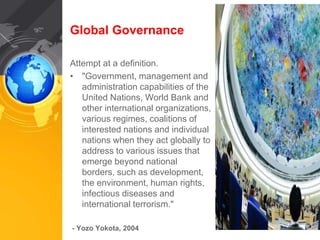
Attempt at a definition. 
• "Government, management and 
administration capabilities of the 
United Nations, World Bank and 
other international organizations, 
various regimes, coalitions of 
interested nations and individual 
nations when they act globally to 
address to various issues that 
emerge beyond national 
borders, such as development, 
the environment, human rights, 
infectious diseases and 
international terrorism." 
- Yozo Yokota, 2004
Global Governance 
“The collective effort by 
sovereign states, 
international organizations, 
and other non state actors to 
address common challenges 
and seize opportunities that 
transcend national frontiers.” 
- Stewart Patrick, 2014 
The WHO, defines global 
governance as the way in 
which global affairs are 
managed.
Global governance 
Evolution and views on global governance 
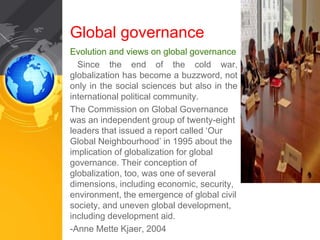
Since the end of the cold war, 
globalization has become a buzzword, not 
only in the social sciences but also in the 
international political community. 
The Commission on Global Governance 
was an independent group of twenty-eight 
leaders that issued a report called ‘Our 
Global Neighbourhood’ in 1995 about the 
implication of globalization for global 
governance. Their conception of 
globalization, too, was one of several 
dimensions, including economic, security, 
environment, the emergence of global civil 
society, and uneven global development, 
including development aid. 
-Anne Mette Kjaer, 2004
Global governance 
Views on global governance 
 Realist. 
The dominant analytical perspective of the time, posited that 
states were the only significant actors in world politics; that 
they act as units; and their military security interests trump of 
their other goals. 
 Liberalist. 
They succeeded in debunking the realist assumption, yet it 
was also clear that states remained the key factors in the 
international system. However, they believe international 
regimes are important in all national levels to dampen the 
effects of anarchy. 
 Global democracy. 
They believe in the existence of global civil society and a 
global citizenry call for more democratic global governance 
and cosmopolitan democracy which involves a global 
constitution and recasting of territorial boundaries.
Global Governance 
Governance covers overlapping categories of functions 
performed internationally, such as: 
• Formulation and promulgation of principles. 
• Promotion of consensual knowledge affecting the general 
international order, regional orders, particular issues on 
the international agenda, and efforts to influence the 
domestic rules and behaviour of states. 
• Good offices, conciliation, mediation, and compulsory 
resolution of disputes.
Global Governance 
Functions Continued 
• Information creation and exchange. 
• Regime formation, tending, and execution. 
• Adoption of rules, codes, and regulations; allocation of 
material and program resources. 
• Provision of technical assistance and development 
programs 
• Relief, humanitarian, emergency, and disaster activities. 
• Maintenance of peace and order. 
- Finkelstein, 1995.
Global Governance 
Analyzing the aspects of global governance: 
1. Targeted organizations/ Institutions. 
These would include: 
• International organizations such as the United Nations and UN 
organizations; 
• IMF, World bank, WTO, WHO. 
• Treaty organizations (regimes) that have been prominent 
recently in the fields of the environment and human rights. 
• Regional organizations, including the North Atlantic Treaty 
Organization (NATO); 
• Regional arrangements, including ASEAN and the Japan-U.S. 
Security Treaty. 
• Loose confederations of nations, including the Group of Eight 
(G8). 
• Individual nations dealing with global issues. 
- Yozo Yokota, 2004
Global Governance 
2. Targeted issues 
These would include: 
• Security 
• Terrorism 
• Disarmament 
• International Criminal organization 
• Poverty/ Education 
• Population 
• The environment 
• Human rights/ Labor 
• Infectious diseases/ Health 
• Gender politics 
• Culture 
- Yozo Yokoto, 2004
Global Governance 
3. Essential Factors of global governance 
These would include: 
• Efficiency (whether goals are achieved without wasting 
resources). 
• Effectiveness (whether issues are dealt with effectively and 
satisfactory outcomes are produced) 
• Fairness (whether costs and benefits are balanced) 
• Transparency (whether organizations and their procedures to 
resolve issues are open to public scrutiny) 
• Democracy (whether all interested parties participate in the 
decision-making and implementation process) 
• Accountability (whether the content of activities are 
sufficiently explained to interested parties and approved by 
them, and whether the organizations in charge are ready to 
take responsibility for the outcomes resulting from the 
measures taken). 
- Yozo Yokota, 2004
Global governance 
Achievements 
 Intergovernmental organizations have addressed a 
host of global needs such as UN, The World bank, 
WTO. 
 The peaceful rise of the BRIC’s. 
Challenges 
 Enhancing the role of global civil society. 
 Action needed in the field of green growth . 
 Efforts to meet the UN’s Millennium Development 
Goals with specific reference to education and health at 
both national and international levels. 
 National interest.
Global Governance 
What global governance is not: 
• It is not a world government 
• It has no “binding” sovereignty 
What global governance is: 
“Governance is the sum of the many ways individuals and 
institutions, public and private, manage their common affairs. 
At the global level, governance has been viewed primarily as 
intergovernmental relationships, but it must now be 
understood as also involving non-governmental organizations 
(NGOs), citizens’ movements, multinational corporations, and 
the global capital market (Commission on Global Governance, 
1995:2-3). 
“Global governance is governing, without sovereign authority, 
relationships that transcend national frontiers”. Global 
governance is doing internationally what governments do at 
home (Finkelstein, 1995).
Global governance 
Reference
Global Governance 
END 
THANK YOU FOR LISTENING

Amina s presentation

  • 1.
    WHAT IS GLOBALGOVERNANCE? Presented on December 1st, 2014 BY AMINA MOHAMMED
  • 2.
    Global Governance Thispresentation will look at the following: • The various definition of global governance. • The evolution and views of global governance. • The functions/ various aspects that drive global governance. • Achievements and challenges. • Conclusion and reference.
  • 3.
    Global Governance Diversedefinitions Definition depends on two factors: • The person defining • Under the circumstances it is used No Consensus on Definition Yet: • Not among academia • Not among policy makers • Not between academia and policy makers Rosenau (1995;13) views global governance as perceived to include systems of rule at all levels of human activity- from the family to the international organization- in which the pursuit of goals through the exercise of control has transnational repercussions.
  • 4.
    Global Governance Attemptat a definition. • "Government, management and administration capabilities of the United Nations, World Bank and other international organizations, various regimes, coalitions of interested nations and individual nations when they act globally to address to various issues that emerge beyond national borders, such as development, the environment, human rights, infectious diseases and international terrorism." - Yozo Yokota, 2004
  • 5.
    Global Governance “Thecollective effort by sovereign states, international organizations, and other non state actors to address common challenges and seize opportunities that transcend national frontiers.” - Stewart Patrick, 2014 The WHO, defines global governance as the way in which global affairs are managed.
  • 6.
    Global governance Evolutionand views on global governance Since the end of the cold war, globalization has become a buzzword, not only in the social sciences but also in the international political community. The Commission on Global Governance was an independent group of twenty-eight leaders that issued a report called ‘Our Global Neighbourhood’ in 1995 about the implication of globalization for global governance. Their conception of globalization, too, was one of several dimensions, including economic, security, environment, the emergence of global civil society, and uneven global development, including development aid. -Anne Mette Kjaer, 2004
  • 7.
    Global governance Viewson global governance  Realist. The dominant analytical perspective of the time, posited that states were the only significant actors in world politics; that they act as units; and their military security interests trump of their other goals.  Liberalist. They succeeded in debunking the realist assumption, yet it was also clear that states remained the key factors in the international system. However, they believe international regimes are important in all national levels to dampen the effects of anarchy.  Global democracy. They believe in the existence of global civil society and a global citizenry call for more democratic global governance and cosmopolitan democracy which involves a global constitution and recasting of territorial boundaries.
  • 8.
    Global Governance Governancecovers overlapping categories of functions performed internationally, such as: • Formulation and promulgation of principles. • Promotion of consensual knowledge affecting the general international order, regional orders, particular issues on the international agenda, and efforts to influence the domestic rules and behaviour of states. • Good offices, conciliation, mediation, and compulsory resolution of disputes.
  • 9.
    Global Governance FunctionsContinued • Information creation and exchange. • Regime formation, tending, and execution. • Adoption of rules, codes, and regulations; allocation of material and program resources. • Provision of technical assistance and development programs • Relief, humanitarian, emergency, and disaster activities. • Maintenance of peace and order. - Finkelstein, 1995.
  • 10.
    Global Governance Analyzingthe aspects of global governance: 1. Targeted organizations/ Institutions. These would include: • International organizations such as the United Nations and UN organizations; • IMF, World bank, WTO, WHO. • Treaty organizations (regimes) that have been prominent recently in the fields of the environment and human rights. • Regional organizations, including the North Atlantic Treaty Organization (NATO); • Regional arrangements, including ASEAN and the Japan-U.S. Security Treaty. • Loose confederations of nations, including the Group of Eight (G8). • Individual nations dealing with global issues. - Yozo Yokota, 2004
  • 11.
    Global Governance 2.Targeted issues These would include: • Security • Terrorism • Disarmament • International Criminal organization • Poverty/ Education • Population • The environment • Human rights/ Labor • Infectious diseases/ Health • Gender politics • Culture - Yozo Yokoto, 2004
  • 12.
    Global Governance 3.Essential Factors of global governance These would include: • Efficiency (whether goals are achieved without wasting resources). • Effectiveness (whether issues are dealt with effectively and satisfactory outcomes are produced) • Fairness (whether costs and benefits are balanced) • Transparency (whether organizations and their procedures to resolve issues are open to public scrutiny) • Democracy (whether all interested parties participate in the decision-making and implementation process) • Accountability (whether the content of activities are sufficiently explained to interested parties and approved by them, and whether the organizations in charge are ready to take responsibility for the outcomes resulting from the measures taken). - Yozo Yokota, 2004
  • 13.
    Global governance Achievements  Intergovernmental organizations have addressed a host of global needs such as UN, The World bank, WTO.  The peaceful rise of the BRIC’s. Challenges  Enhancing the role of global civil society.  Action needed in the field of green growth .  Efforts to meet the UN’s Millennium Development Goals with specific reference to education and health at both national and international levels.  National interest.
  • 14.
    Global Governance Whatglobal governance is not: • It is not a world government • It has no “binding” sovereignty What global governance is: “Governance is the sum of the many ways individuals and institutions, public and private, manage their common affairs. At the global level, governance has been viewed primarily as intergovernmental relationships, but it must now be understood as also involving non-governmental organizations (NGOs), citizens’ movements, multinational corporations, and the global capital market (Commission on Global Governance, 1995:2-3). “Global governance is governing, without sovereign authority, relationships that transcend national frontiers”. Global governance is doing internationally what governments do at home (Finkelstein, 1995).
  • 15.
  • 16.
    Global Governance END THANK YOU FOR LISTENING