GLOBAL
CITIZENSHIP
PREPARED BY: GROUP 7
TOPICS TO BE DISCUSSED:
DEFINITION OF GLOBAL CITIZENSHIP
HISTORICAL PERSPECTIVE: CITIZENSHIP
A TRIO OF TAPESTRY : CITIZENSHIP, GLOBALIZATION AND
MEDIA
DIFFERENCE BETWEEN GLOBAL CITIZENSHIP AND
GLOBAL CITIZEN
04
Global
Citizenship
WEB DEFINITION
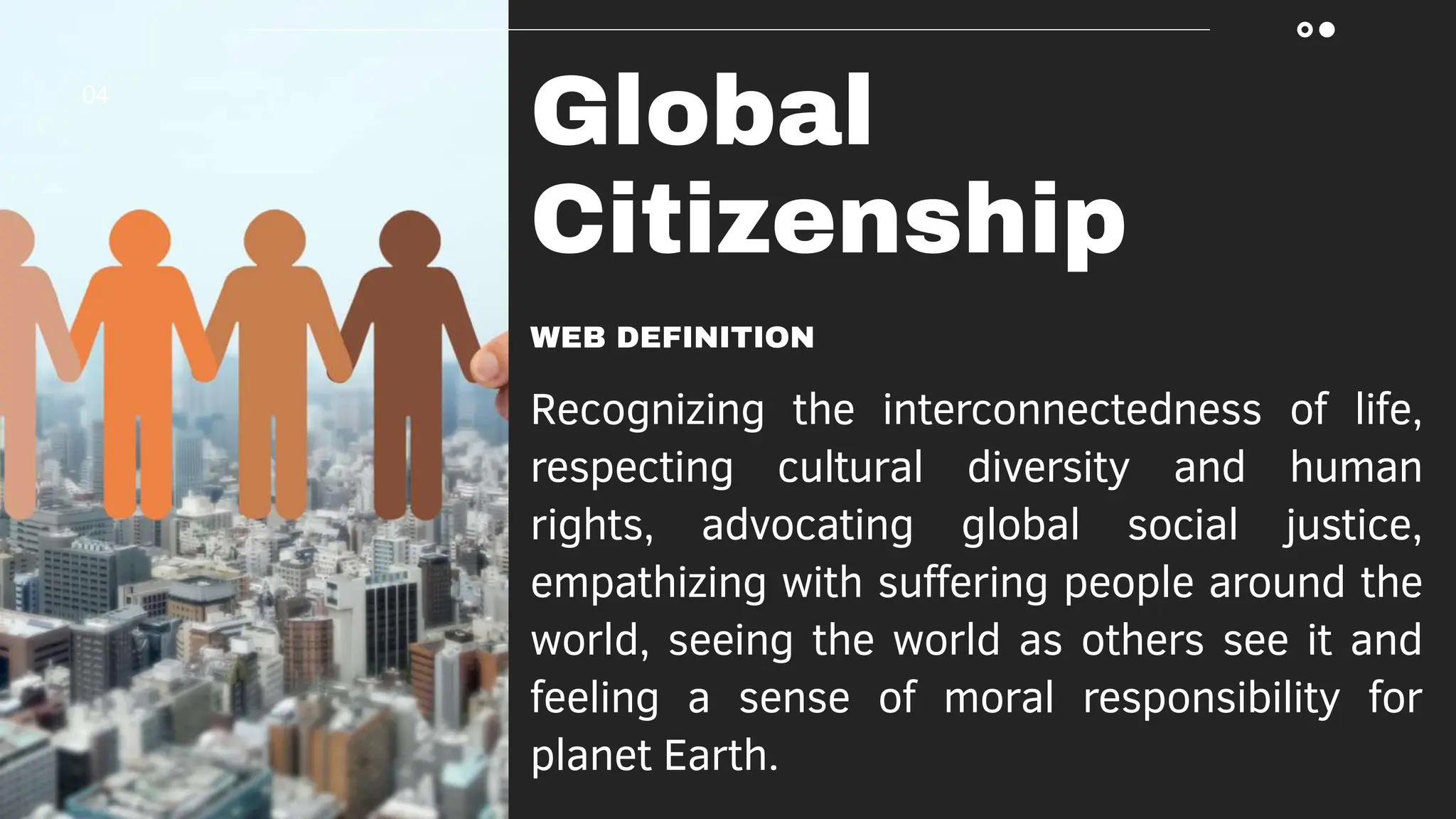
Recognizing the interconnectedness of life,
respecting cultural diversity and human
rights, advocating global social justice,
empathizing with suffering people around the
world, seeing the world as others see it and
feeling a sense of moral responsibility for
planet Earth.
04
CONT.
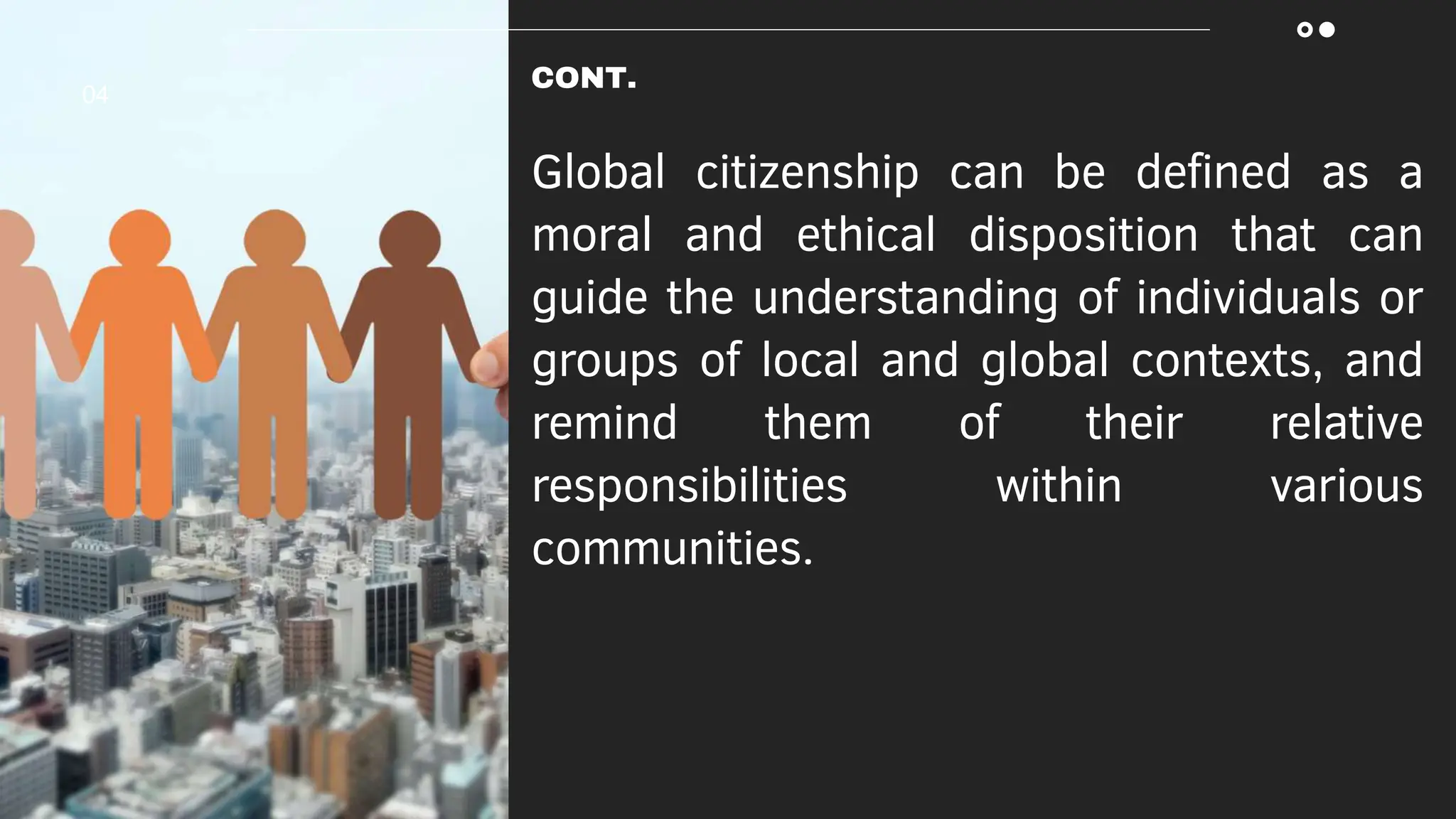
Global citizenship can be defined as a
moral and ethical disposition that can
guide the understanding of individuals or
groups of local and global contexts, and
remind them of their relative
responsibilities within various
communities.
HISTORICAL
PERSPECTIVE:
Citizenship
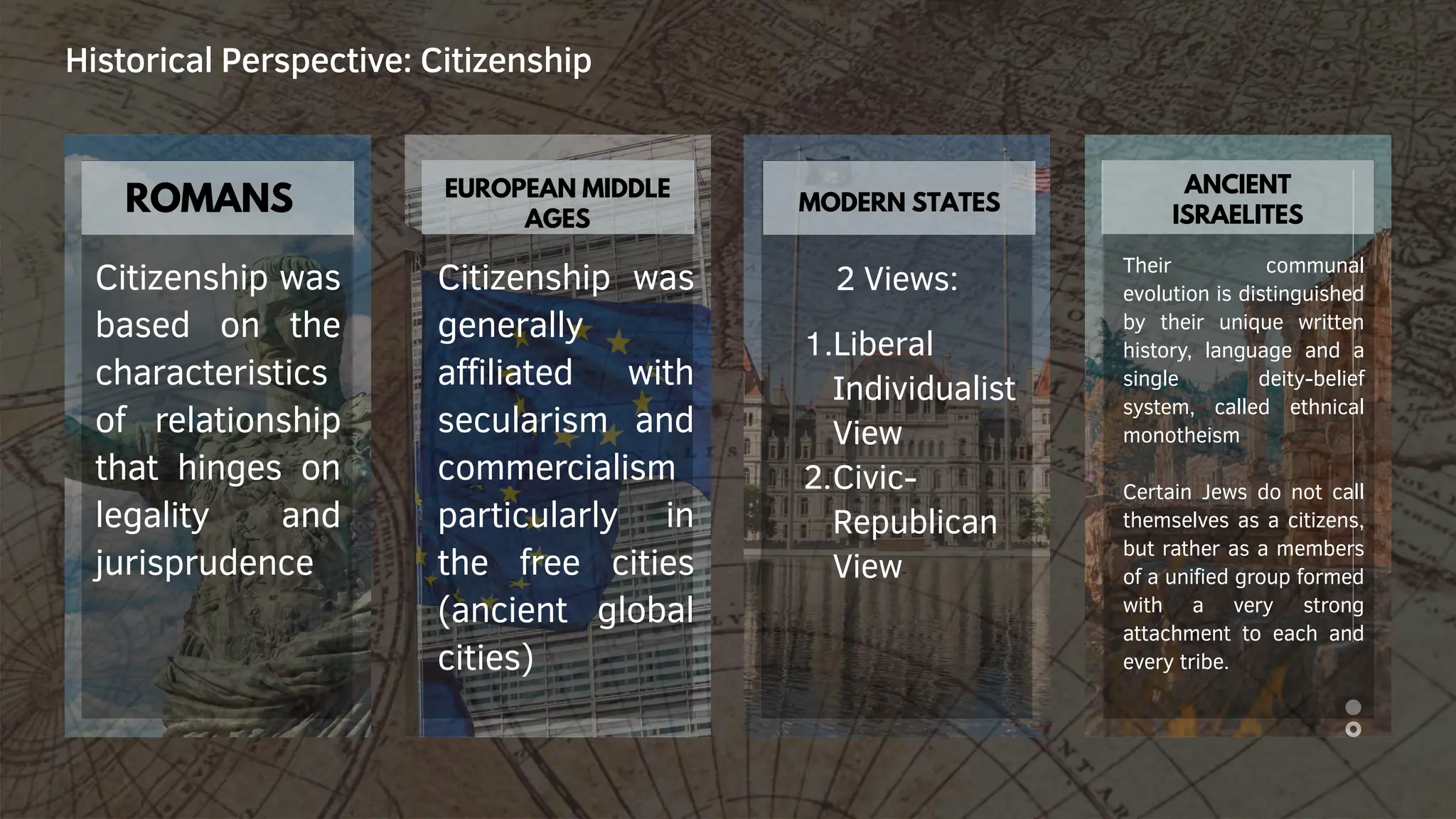
Historical Perspective: Citizenship
Citizenship was
based on the
characteristics
of relationship
that hinges on
legality and
jurisprudence
Citizenship was
generally
affiliated with
secularism and
commercialism
particularly in
the free cities
(ancient global
cities)
Their communal
evolution is distinguished
by their unique written
history, language and a
single deity-belief
system, called ethnical
monotheism
Certain Jews do not call
themselves as a citizens,
but rather as a members
of a unified group formed
with a very strong
attachment to each and
every tribe.
2 Views:
1.Liberal
Individualist
View
2.Civic-
Republican
View
ROMANS EUROPEAN MIDDLE
AGES
MODERN STATES
ANCIENT
ISRAELITES
2 VIEWS:
(Modern States)
highlighting
entitlements and
needs and the basic
reciprocal state
obligation of
protection for
inherently passive
political entities.
Liberal- Individualist
View
Stresses on democratic
participation and
considers citizenship not
as passive static
correlation between
states and individuals
but as an active and
dynamic legal- political
concept that traverse
around obligations,
rights and specific
privileges.
Civic-Republican
View
TRIO OF
TAPESTRY
CITIZENSHIP
Entails the reciprocal duties of allegiance on the
part of the citizens its state, and protection on
the part of the state to its citizens.
GLOBALIZATION
Multidimensional set of social processes
MEDIA
Medium or instrument that metamorphose the
citizenship concept into an active sprightly
undertaking within the meters and bound of
globalization.
GLOBAL
CITIZEN
GLOBAL
CITIZENSHIP
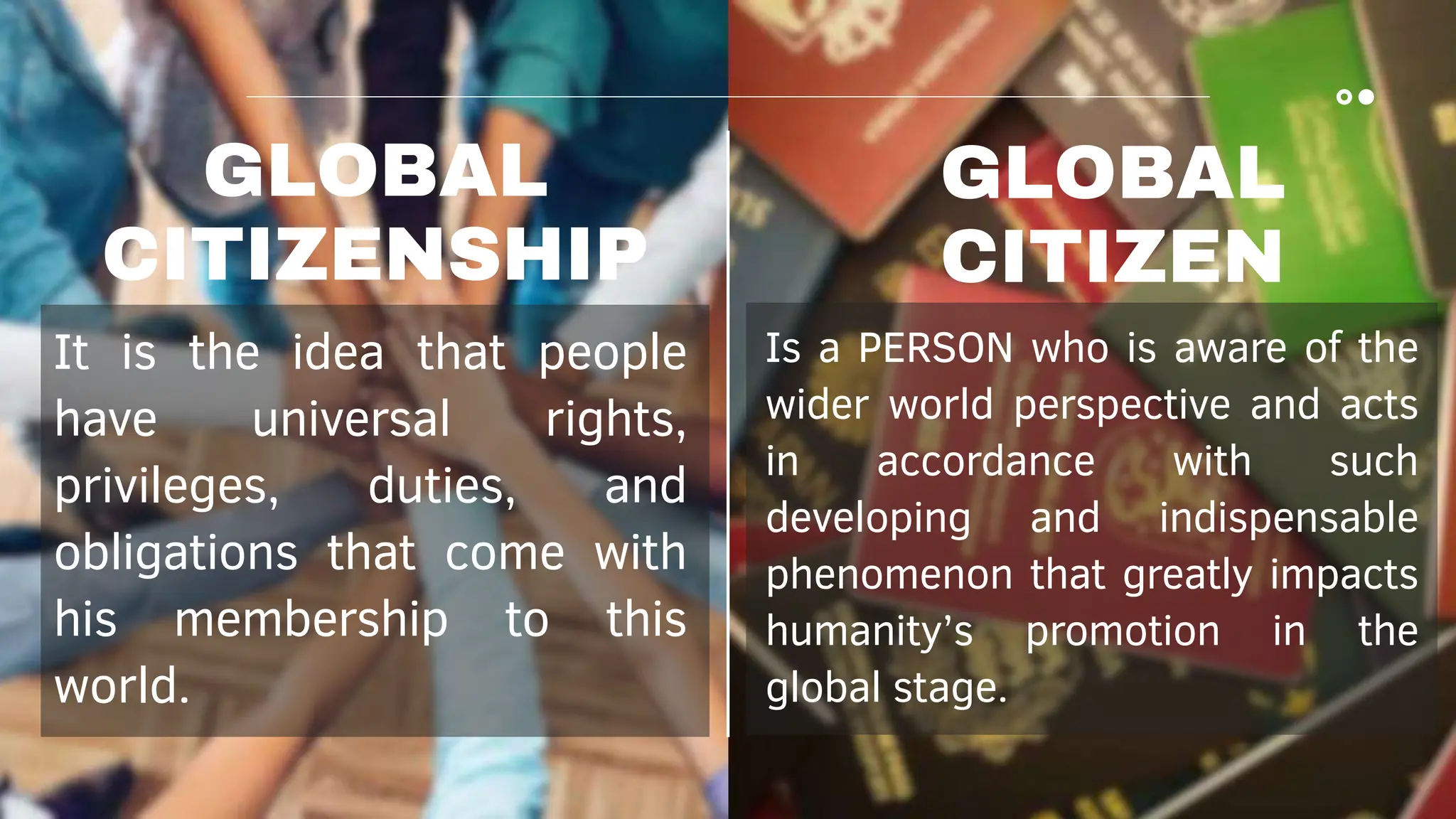
GLOBAL
CITIZENSHIP
It is the idea that people
have universal rights,
privileges, duties, and
obligations that come with
his membership to this
world.
GLOBAL
CITIZEN
Is a PERSON who is aware of the
wider world perspective and acts
in accordance with such
developing and indispensable
phenomenon that greatly impacts
humanity’s promotion in the
global stage.
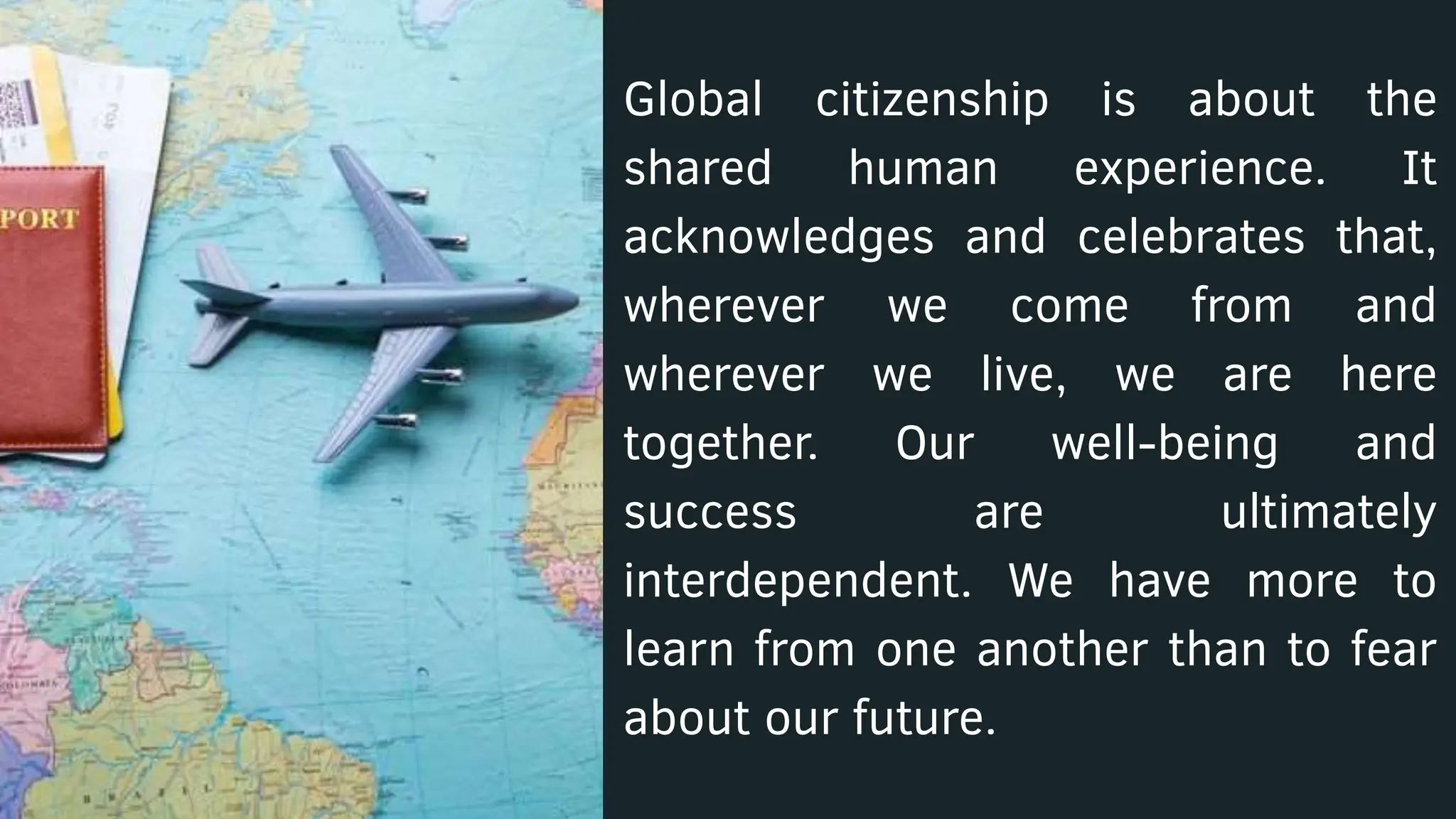
Global citizenship is about the
shared human experience. It
acknowledges and celebrates that,
wherever we come from and
wherever we live, we are here
together. Our well-being and
success are ultimately
interdependent. We have more to
learn from one another than to fear
about our future.
Global citizens include individuals,
corporations, global nomads, “glocals,”
young and old, big and small, for-profit
and non-profit, public and private,
introverts and extroverts, men and women
and children and anyone in between.
Global citizenship and long-term, visionary
leadership go hand-in-hand: Individual
leaders who espouse shared values, and
corporate citizens whose governance,
ethics, business model and investment
strategy create — not only extract — value
in each and every place they touch.
Global citizenship is not the same as globalization:
— the process by which organizations
develop international influence or
operate on an international scale — is
driven by economics, business and
money. It’s about the flow of products,
capital, people and information.
— is driven by identity and values.
Global citizens build bridges, mitigate
risk and safeguard humanity. Global
citizenship refers to a sense of
belonging to a broader community
beyond national or cultural boundaries.
GLOBALIZATION GLOBAL CITIZENSHIP
Global citizenship is not the same as globalization:
— It involves the flow of goods, services,
information, capital, technology, and
people across borders, facilitated by
advancements in transportation,
communication, and technology.
— Globalization has economic, political,
cultural, and social dimensions, affecting
various aspects of life including trade,
finance, culture, governance, and labor.
— It involves recognizing and embracing
the interconnectedness of people,
societies, and environments across the
globe.
— Global citizenship emphasizes
responsibilities towards humanity as a
whole, including promoting social justice,
environmental sustainability, and human
rights.
GLOBALIZATION GLOBAL CITIZENSHIP
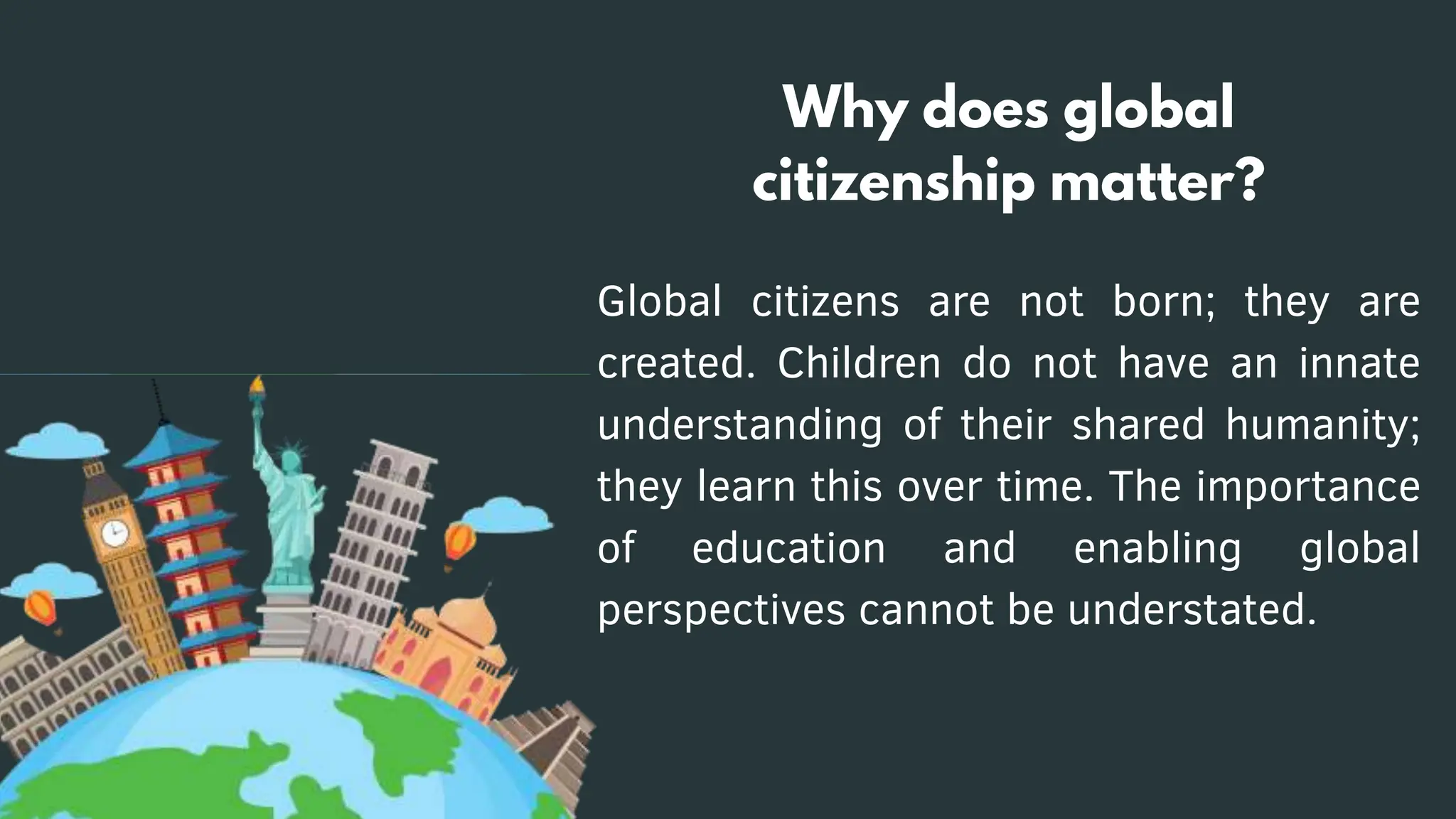
Global citizens are not born; they are
created. Children do not have an innate
understanding of their shared humanity;
they learn this over time. The importance
of education and enabling global
perspectives cannot be understated.
Why does global
citizenship matter?
Historically, global citizenship was
rooted in a common desire to
prevent war. Common reasoning was
that the more we knew about each
other, the more likely we would
ensure peace, progress and
prosperity. More recently, the
Human Genome Project has shown
us — for the first time in human
history — that scientifically, we are
all one.
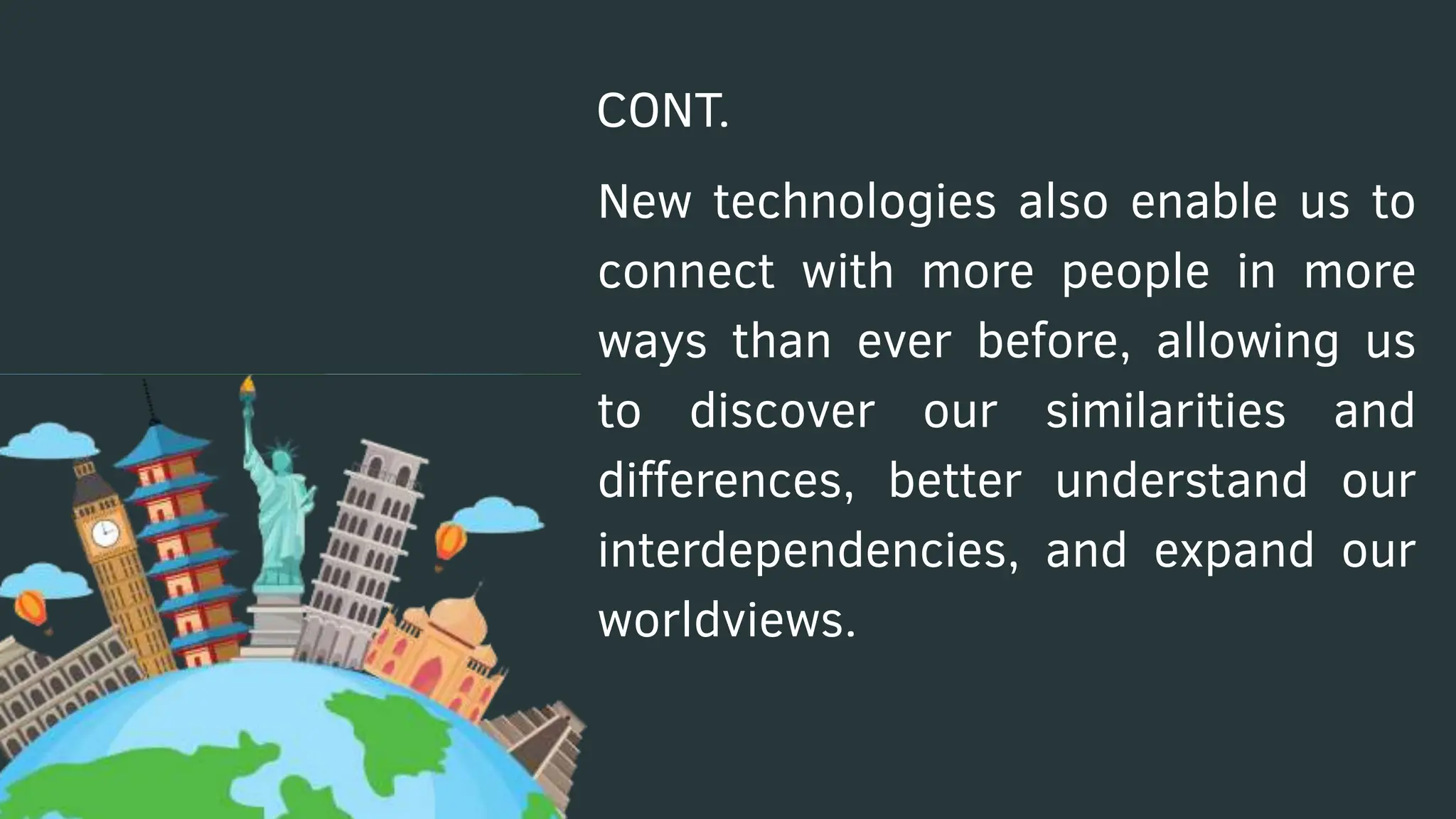
New technologies also enable us to
connect with more people in more
ways than ever before, allowing us
to discover our similarities and
differences, better understand our
interdependencies, and expand our
worldviews.
CONT.
Global citizenship is not a one-size-fits-all concept,
nor is it a panacea. But it is an extremely powerful
tool in our 21st century toolbox for building a more
sustainable, resilient and compassionate world.
Everyone can play an important part. The world is
waiting for you.
CONCLUSION:
THANK YOU
THANK YOU
THANK YOU

GLOBAL CITIZENSHIP contemporary world.pptx

  • 1.
  • 2.
    TOPICS TO BEDISCUSSED: DEFINITION OF GLOBAL CITIZENSHIP HISTORICAL PERSPECTIVE: CITIZENSHIP A TRIO OF TAPESTRY : CITIZENSHIP, GLOBALIZATION AND MEDIA DIFFERENCE BETWEEN GLOBAL CITIZENSHIP AND GLOBAL CITIZEN
  • 3.
    04 Global Citizenship WEB DEFINITION Recognizing theinterconnectedness of life, respecting cultural diversity and human rights, advocating global social justice, empathizing with suffering people around the world, seeing the world as others see it and feeling a sense of moral responsibility for planet Earth.
  • 4.
    04 CONT. Global citizenship canbe defined as a moral and ethical disposition that can guide the understanding of individuals or groups of local and global contexts, and remind them of their relative responsibilities within various communities.
  • 5.
  • 6.
    Historical Perspective: Citizenship Citizenshipwas based on the characteristics of relationship that hinges on legality and jurisprudence Citizenship was generally affiliated with secularism and commercialism particularly in the free cities (ancient global cities) Their communal evolution is distinguished by their unique written history, language and a single deity-belief system, called ethnical monotheism Certain Jews do not call themselves as a citizens, but rather as a members of a unified group formed with a very strong attachment to each and every tribe. 2 Views: 1.Liberal Individualist View 2.Civic- Republican View ROMANS EUROPEAN MIDDLE AGES MODERN STATES ANCIENT ISRAELITES
  • 7.
  • 8.
    highlighting entitlements and needs andthe basic reciprocal state obligation of protection for inherently passive political entities. Liberal- Individualist View Stresses on democratic participation and considers citizenship not as passive static correlation between states and individuals but as an active and dynamic legal- political concept that traverse around obligations, rights and specific privileges. Civic-Republican View
  • 9.
    TRIO OF TAPESTRY CITIZENSHIP Entails thereciprocal duties of allegiance on the part of the citizens its state, and protection on the part of the state to its citizens. GLOBALIZATION Multidimensional set of social processes MEDIA Medium or instrument that metamorphose the citizenship concept into an active sprightly undertaking within the meters and bound of globalization.
  • 10.
  • 11.
    GLOBAL CITIZENSHIP It is theidea that people have universal rights, privileges, duties, and obligations that come with his membership to this world. GLOBAL CITIZEN Is a PERSON who is aware of the wider world perspective and acts in accordance with such developing and indispensable phenomenon that greatly impacts humanity’s promotion in the global stage.
  • 12.
    Global citizenship isabout the shared human experience. It acknowledges and celebrates that, wherever we come from and wherever we live, we are here together. Our well-being and success are ultimately interdependent. We have more to learn from one another than to fear about our future.
  • 13.
    Global citizens includeindividuals, corporations, global nomads, “glocals,” young and old, big and small, for-profit and non-profit, public and private, introverts and extroverts, men and women and children and anyone in between. Global citizenship and long-term, visionary leadership go hand-in-hand: Individual leaders who espouse shared values, and corporate citizens whose governance, ethics, business model and investment strategy create — not only extract — value in each and every place they touch.
  • 14.
    Global citizenship isnot the same as globalization: — the process by which organizations develop international influence or operate on an international scale — is driven by economics, business and money. It’s about the flow of products, capital, people and information. — is driven by identity and values. Global citizens build bridges, mitigate risk and safeguard humanity. Global citizenship refers to a sense of belonging to a broader community beyond national or cultural boundaries. GLOBALIZATION GLOBAL CITIZENSHIP
  • 15.
    Global citizenship isnot the same as globalization: — It involves the flow of goods, services, information, capital, technology, and people across borders, facilitated by advancements in transportation, communication, and technology. — Globalization has economic, political, cultural, and social dimensions, affecting various aspects of life including trade, finance, culture, governance, and labor. — It involves recognizing and embracing the interconnectedness of people, societies, and environments across the globe. — Global citizenship emphasizes responsibilities towards humanity as a whole, including promoting social justice, environmental sustainability, and human rights. GLOBALIZATION GLOBAL CITIZENSHIP
  • 16.
    Global citizens arenot born; they are created. Children do not have an innate understanding of their shared humanity; they learn this over time. The importance of education and enabling global perspectives cannot be understated. Why does global citizenship matter?
  • 17.
    Historically, global citizenshipwas rooted in a common desire to prevent war. Common reasoning was that the more we knew about each other, the more likely we would ensure peace, progress and prosperity. More recently, the Human Genome Project has shown us — for the first time in human history — that scientifically, we are all one.
  • 18.
    New technologies alsoenable us to connect with more people in more ways than ever before, allowing us to discover our similarities and differences, better understand our interdependencies, and expand our worldviews. CONT.
  • 19.
    Global citizenship isnot a one-size-fits-all concept, nor is it a panacea. But it is an extremely powerful tool in our 21st century toolbox for building a more sustainable, resilient and compassionate world. Everyone can play an important part. The world is waiting for you. CONCLUSION:
  • 20.