G20 and Global Governance
Nicolas Foucras PhD
University TEC de Monterrey
nicolas.foucras@itesm.mx
• Created in 1999 by G7
• Goal at the beginning: To give an appropriate response to
Financial Crisis in DCs that could affect the global stability
(Mexico 95; Asia 97; Russia 98; Brazil 99; Argentina 2001)
To face instability of the International Monetary System (IMS)
i.e. To help IMF to stabilize global financial market
• This role has grown after the 2008 crisis (which is a crisis
originated in the ICs) as well as the number of countries:
– Creditors were invited (BRICS)
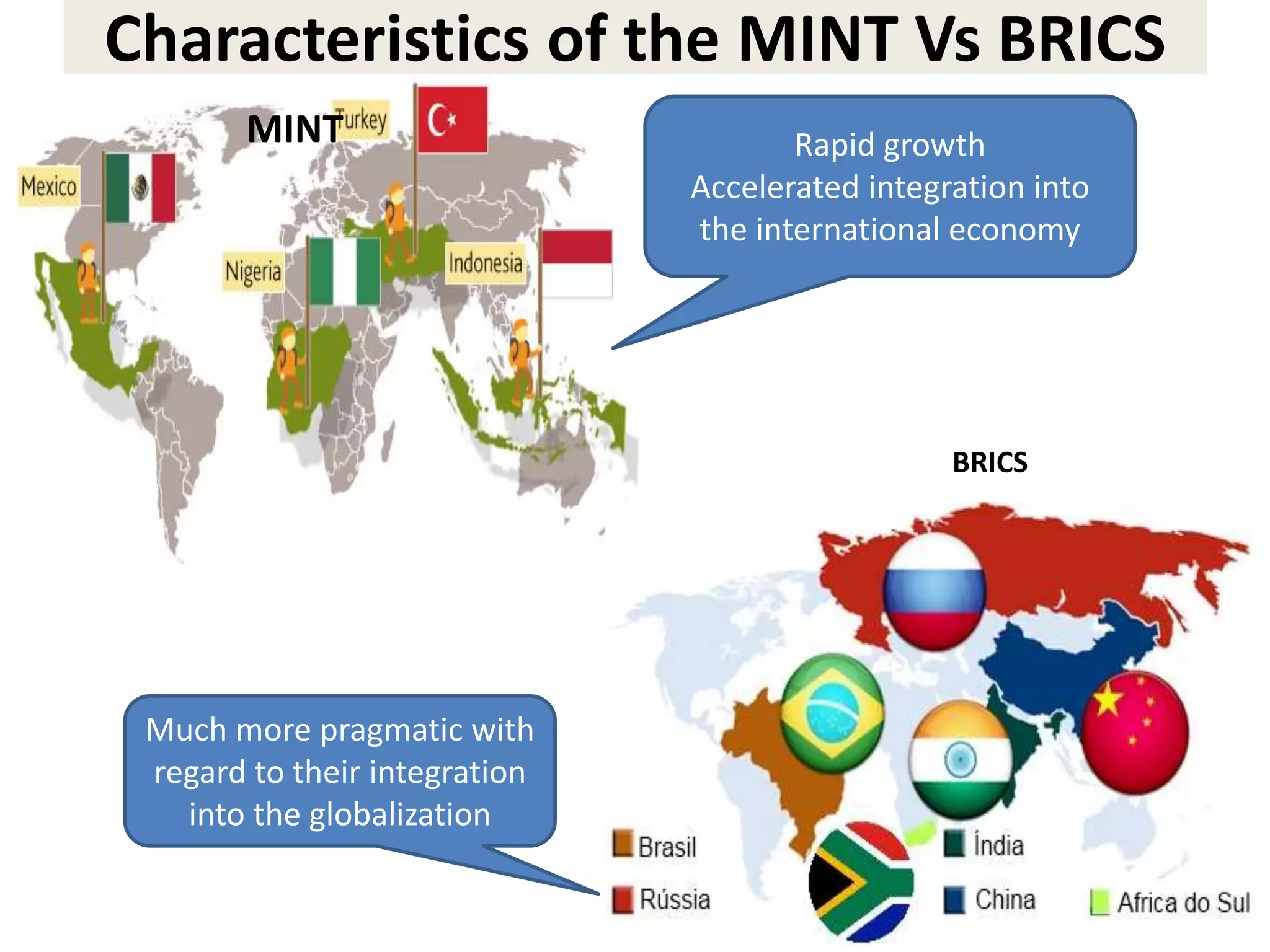
– MINT countries (except Nigeria): because they are key
countries for international economy due to their important
role in the global value chains (they received important FDI
from ICs during past 2 decades)
• The way to operate: promoting discussion (it does not create a
hard law) + formulate proposals and coordinated actions
Structure
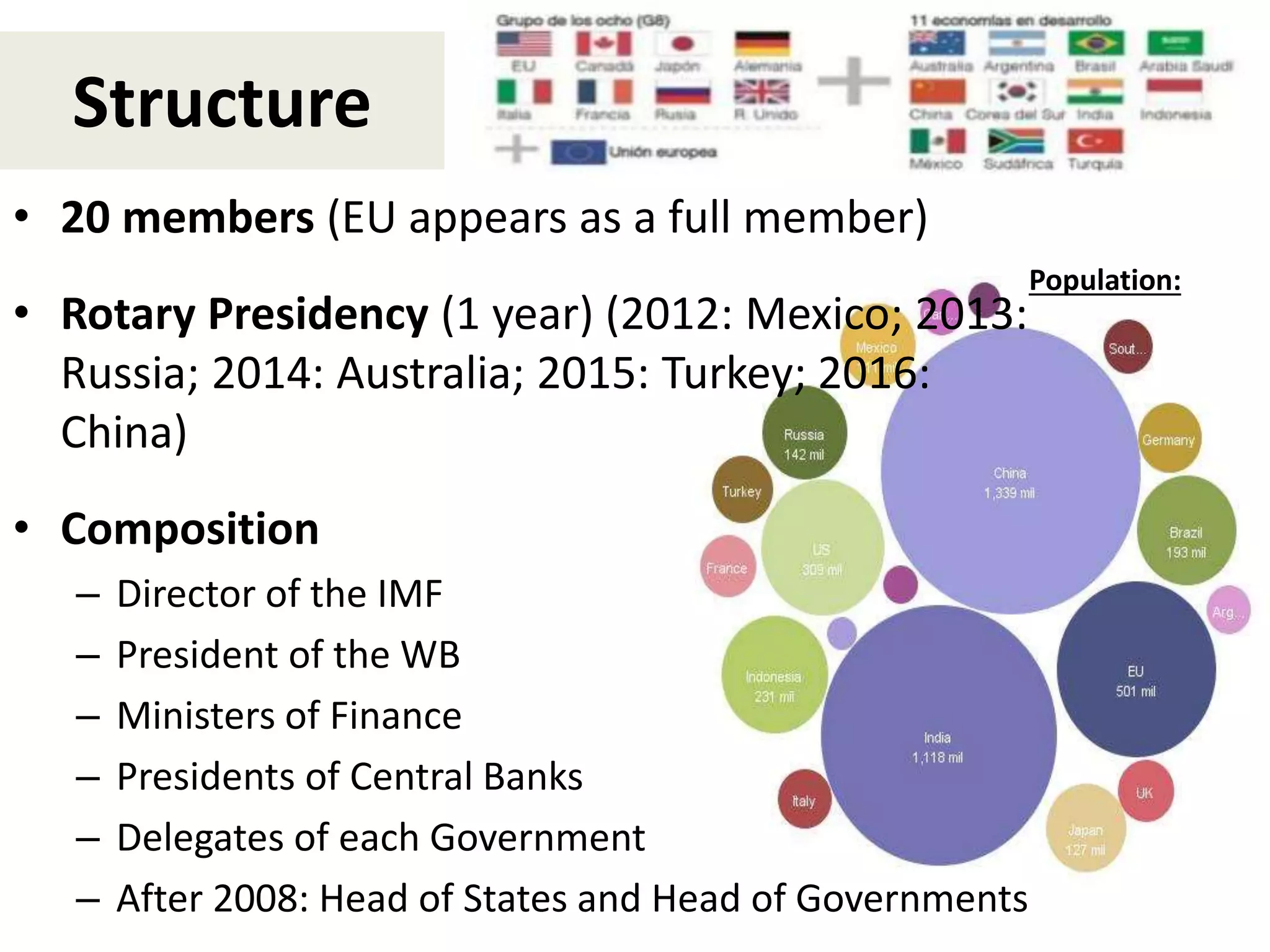
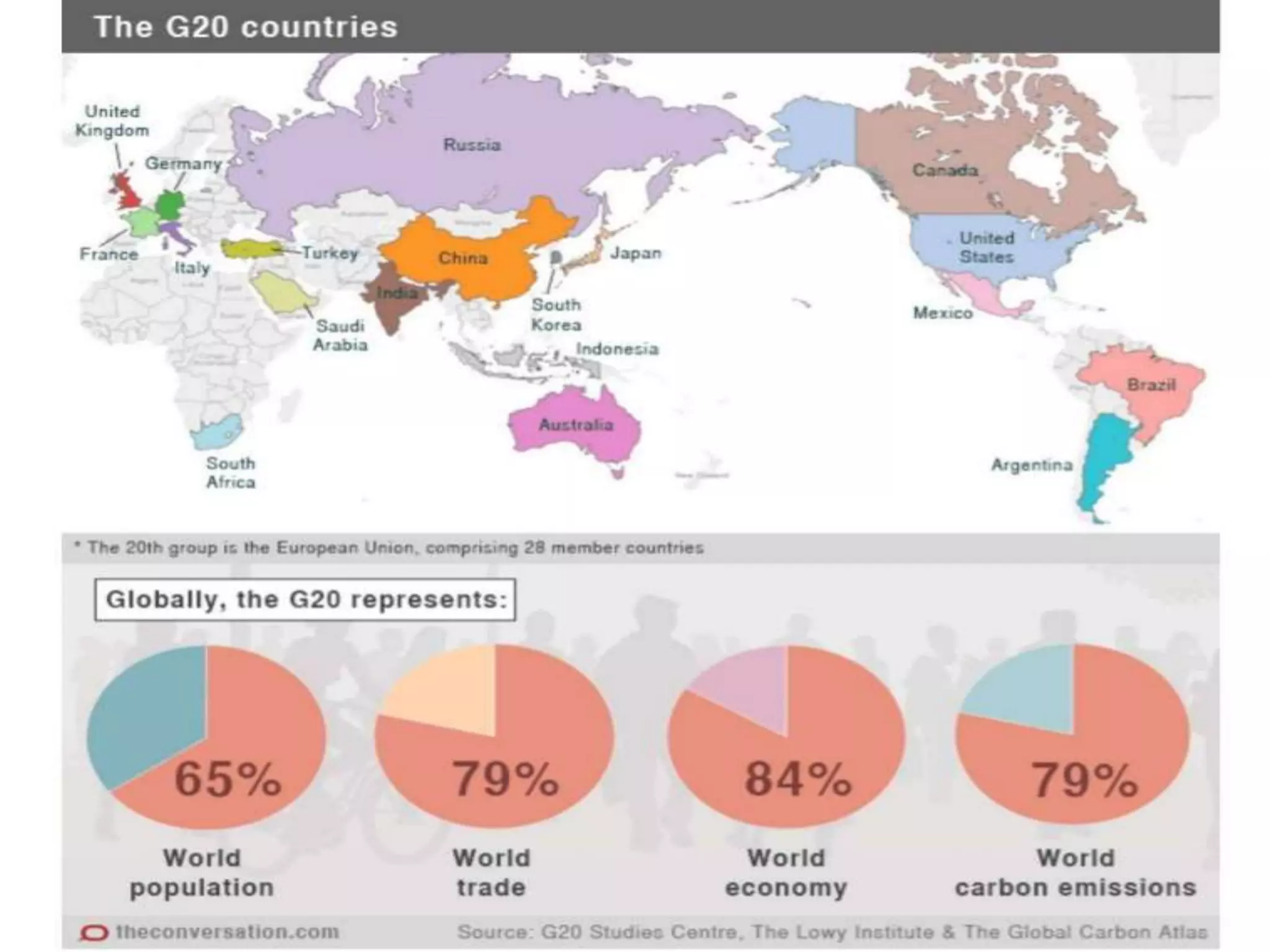
• 20 members (EU appears as a full member)
• Rotary Presidency (1 year) (2012: Mexico; 2013:
Russia; 2014: Australia; 2015: Turkey; 2016:
China)
• Composition
– Director of the IMF
– President of the WB
– Ministers of Finance
– Presidents of Central Banks
– Delegates of each Government
– After 2008: Head of States and Head of Governments
Population:
Special invitations
• Traditionally other actors are participating in pre-
summit meetings :
– Chair of the ASEAN
– Chair of the African Union (AU)
– A representative of the New Partnership for Africa's
Development (NEPAD):
• Economic development program of the AU
• Economic co-operation and integration among African countries
– Director of the International Labor Organization (ILO)
– Director of the Organization for Economic Co-operation and
Development (OCDE)
– Representatives of the UN
– Representatives of the WTO
– Spain is a permanent non-member
Characteristics of the MINT Vs BRICS
Rapid growth
Accelerated integration into
the international economy
MINT
BRICS
Much more pragmatic with
regard to their integration
into the globalization
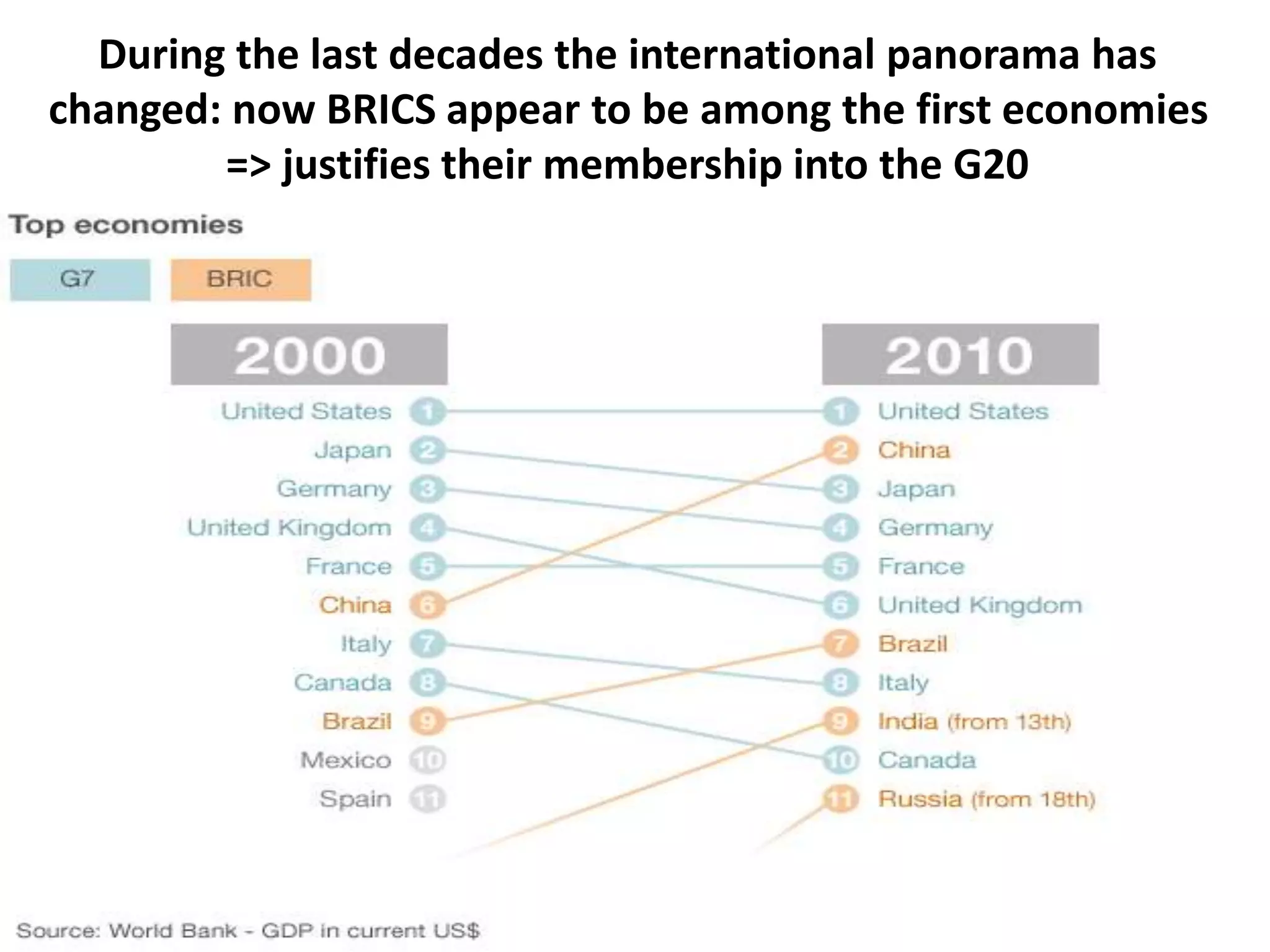
During the last decades the international panorama has
changed: now BRICS appear to be among the first economies
=> justifies their membership into the G20
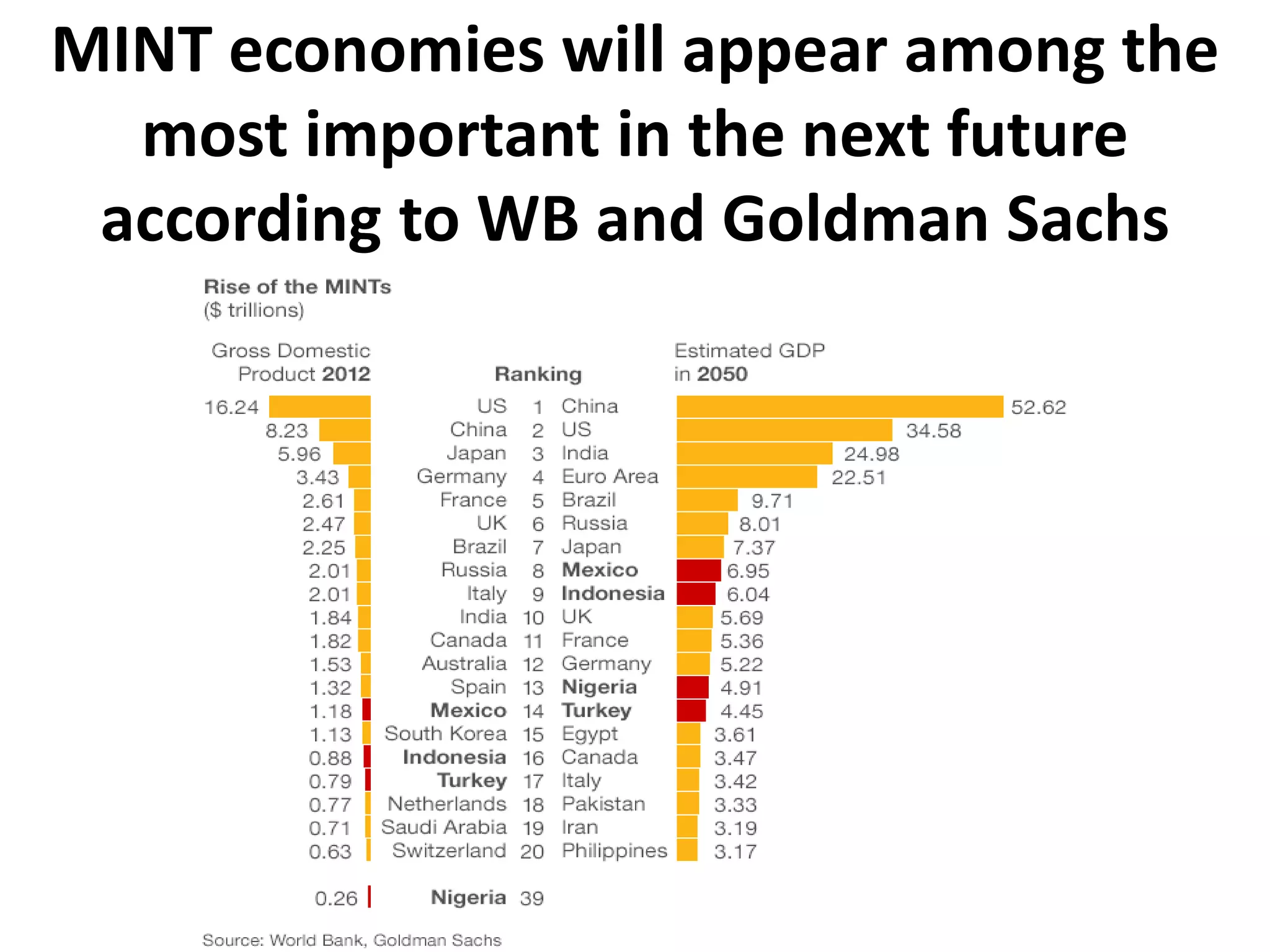
MINT economies will appear among the
most important in the next future
according to WB and Goldman Sachs
2 perspectives to explain G20:
• Hegemonic: ICs gather with other countries to legitimize their
decisions and their model of international economy
=> Goal = to save the hegemonic model established in 1944
and to preserve the current order
• Cooperative:
– It reflects a change in the hegemonic global governance
implemented by ICs in 1944
– It reflects the mutual influence/interdependence and ICs
accept this new situation
– It reflects a better equilibrium in the decision-making
process
– Goal: To organize the redistribution of powers between ICs
and DCs
Towards a Polycentric pattern that will
balance/threat the US hegemony?
• Zakari: consolidation of the BRICS reflects a process of
redistribution of power that is inevitable
• However it is difficult to talk about a “counter-power”
because there is not any real unified front representing
the “South” and able to counterbalance effectively the
hard core (Foucras)
• However on a long-term vision many agree that China
could threat the US hegemony if there is no change in the
current trend
Global issues negotiated and objectives (priority is
different depending on the country):
• The debt crisis and lack of liquidity for productive sectors and Gvts
• The financial regulation and transparency (fight against Tax havens,
tax evasion and corruption)
• Macro-policy cooperation (Goal: to coordinate public decisions to
foster international stability)
• The promotion of multilateral trade (to face the current difficulties in
the WTO)
• To develop energy sustainability and to consider what many call the
Green growth (to fight global warming)
• To coordinate policies and strategies to face unemployment in ICs
• To reduce Food insecurity in DCs and LDCs (to stabilize the situation
and to control migration)
• To reform the International Financial Architecture (IMF quotas)
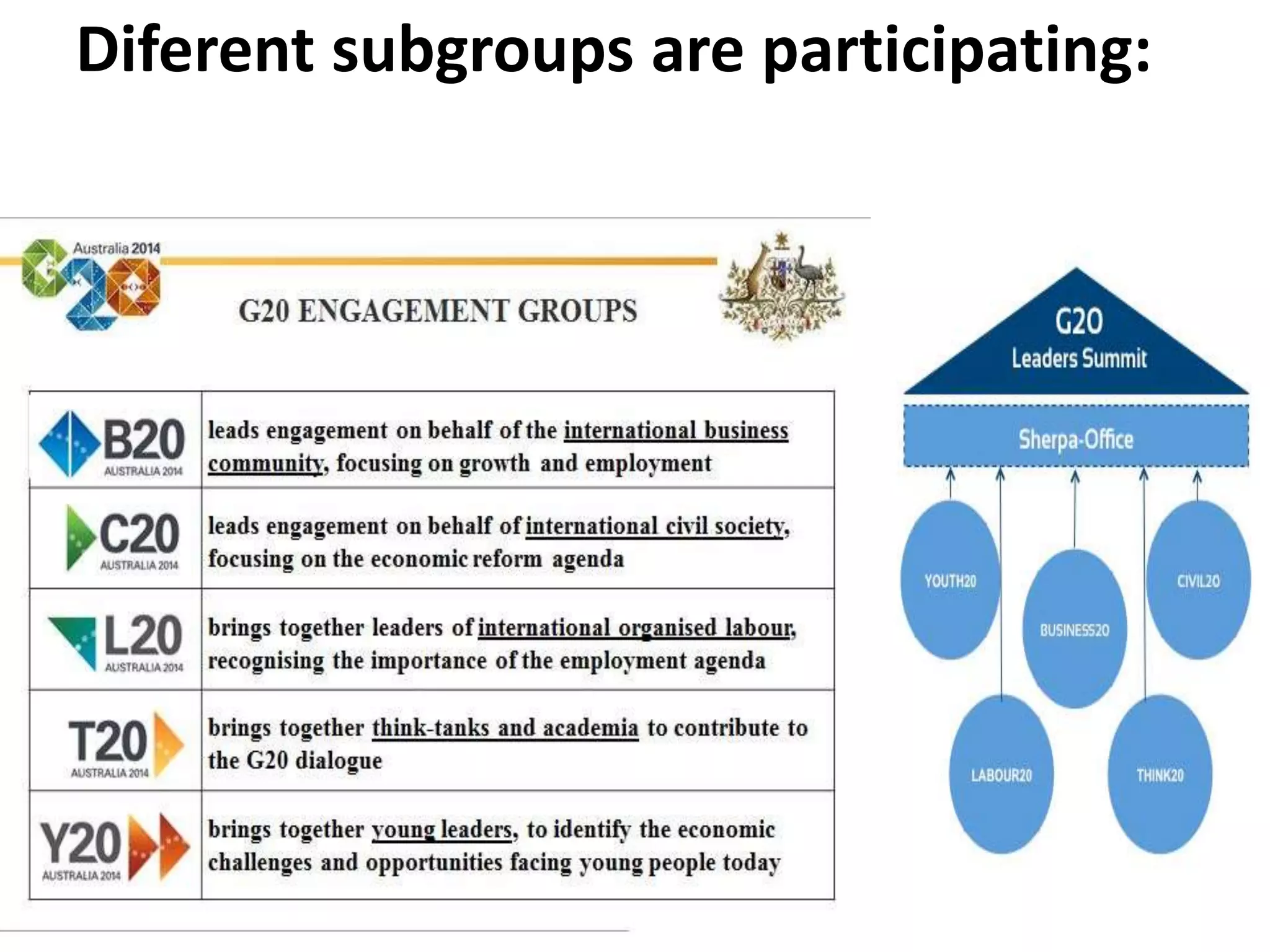
There are parallel summits
• B20: “20 Business” represents business community
• L20: “Labor 20” represents Labor Unions
• T20 “Think 20” “the world’s leading think tank’s
representatives”
• C20 represents Civil society
• Y20 represents youth
Diferent subgroups are participating:
There are important efforts/desires;
however…
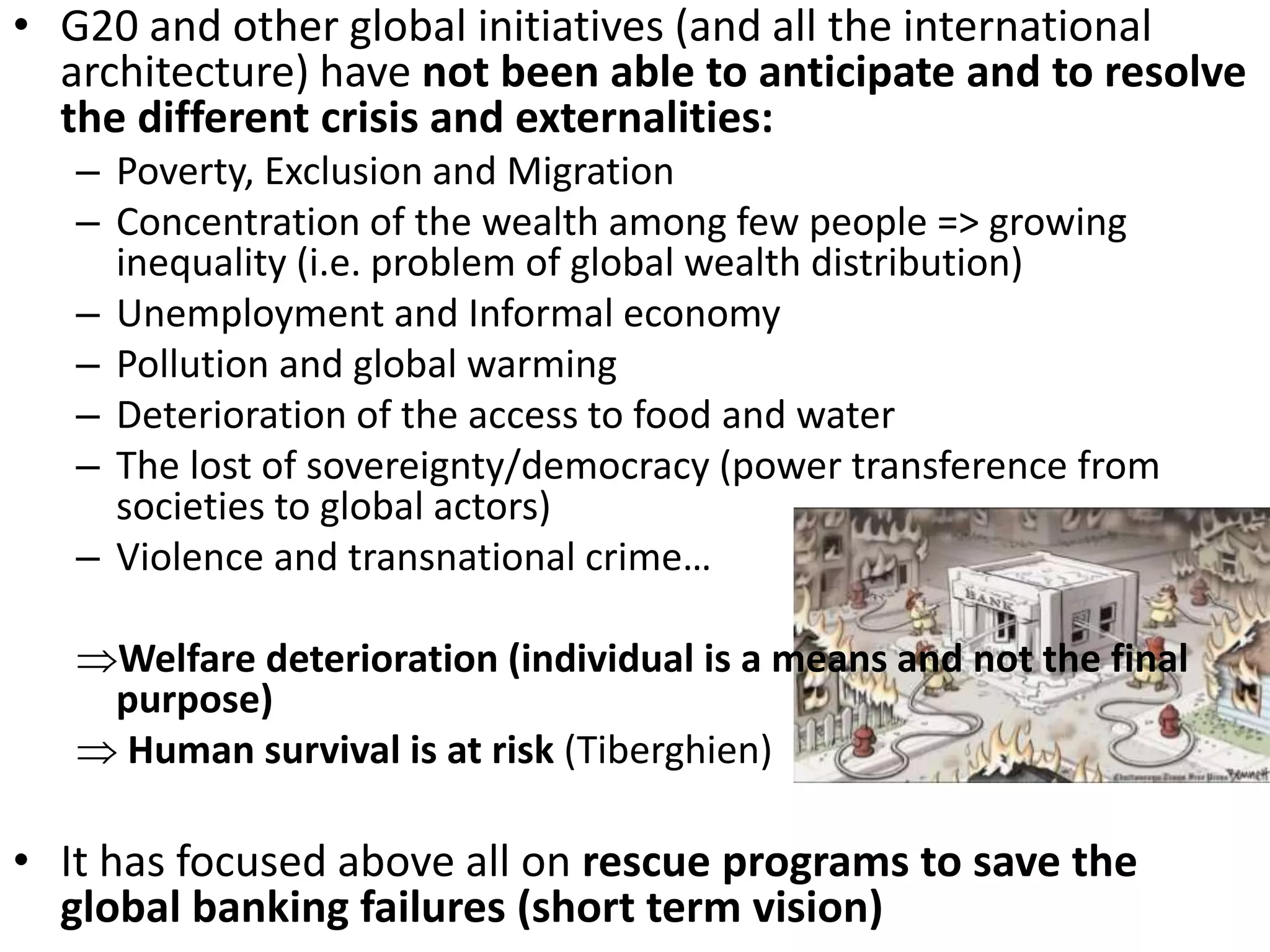
• G20 and other global initiatives (and all the international
architecture) have not been able to anticipate and to resolve
the different crisis and externalities:
– Poverty, Exclusion and Migration
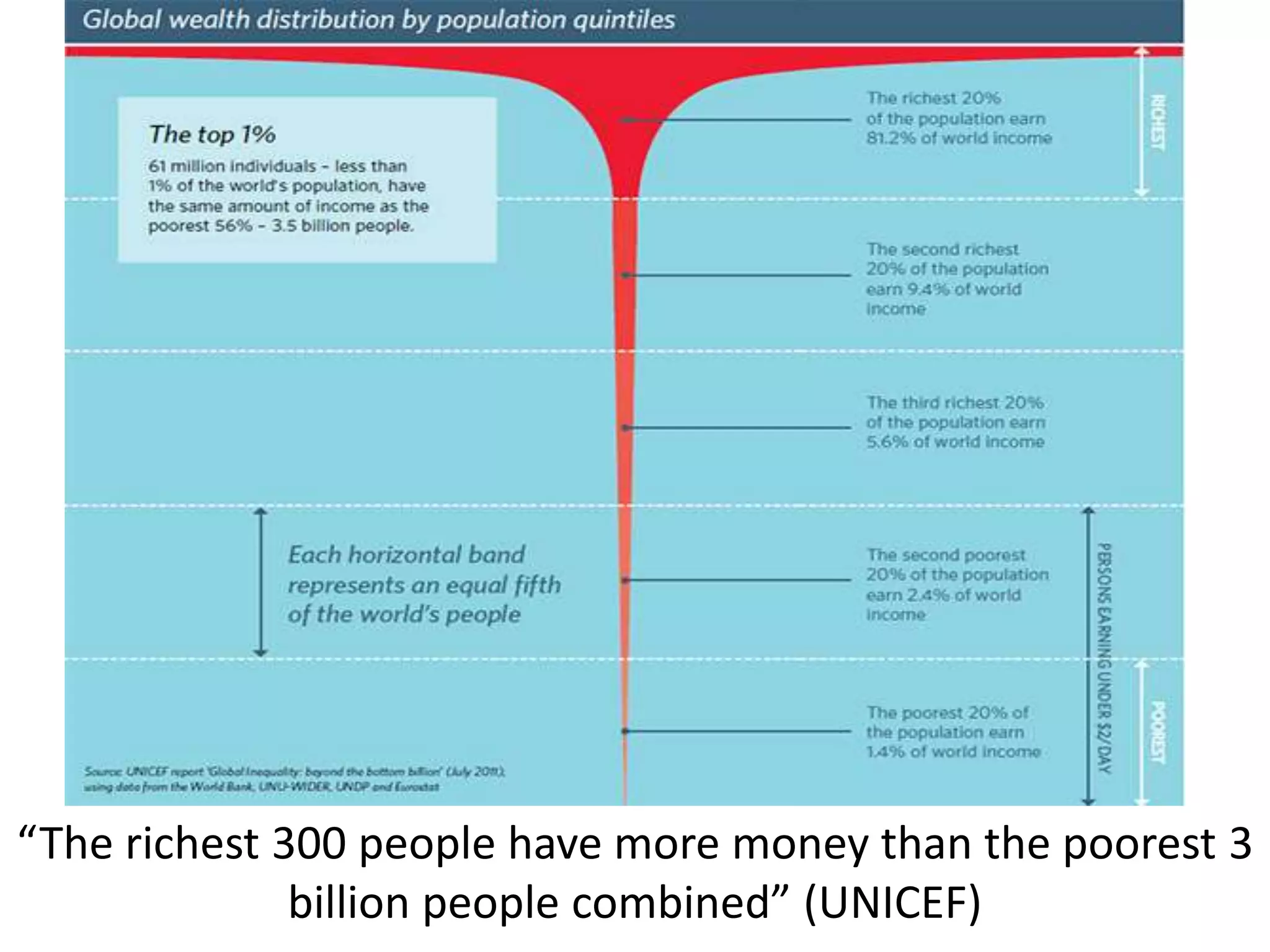
– Concentration of the wealth among few people => growing
inequality (i.e. problem of global wealth distribution)
– Unemployment and Informal economy
– Pollution and global warming
– Deterioration of the access to food and water
– The lost of sovereignty/democracy (power transference from
societies to global actors)
– Violence and transnational crime…
Welfare deterioration (individual is a means and not the final
purpose)
 Human survival is at risk (Tiberghien)
• It has focused above all on rescue programs to save the
global banking failures (short term vision)
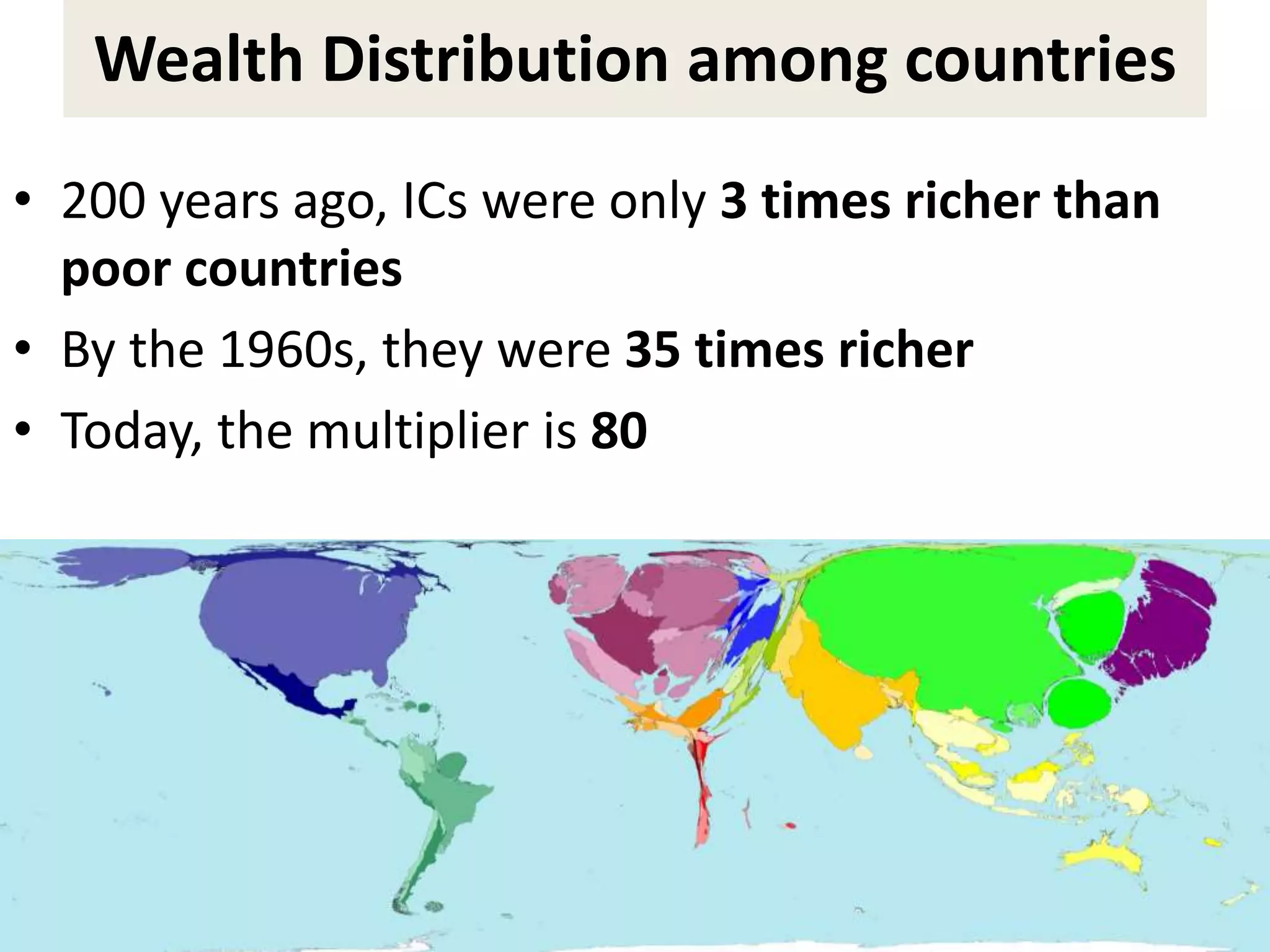
Wealth Distribution among countries
• 200 years ago, ICs were only 3 times richer than
poor countries
• By the 1960s, they were 35 times richer
• Today, the multiplier is 80
“The richest 300 people have more money than the poorest 3
billion people combined” (UNICEF)
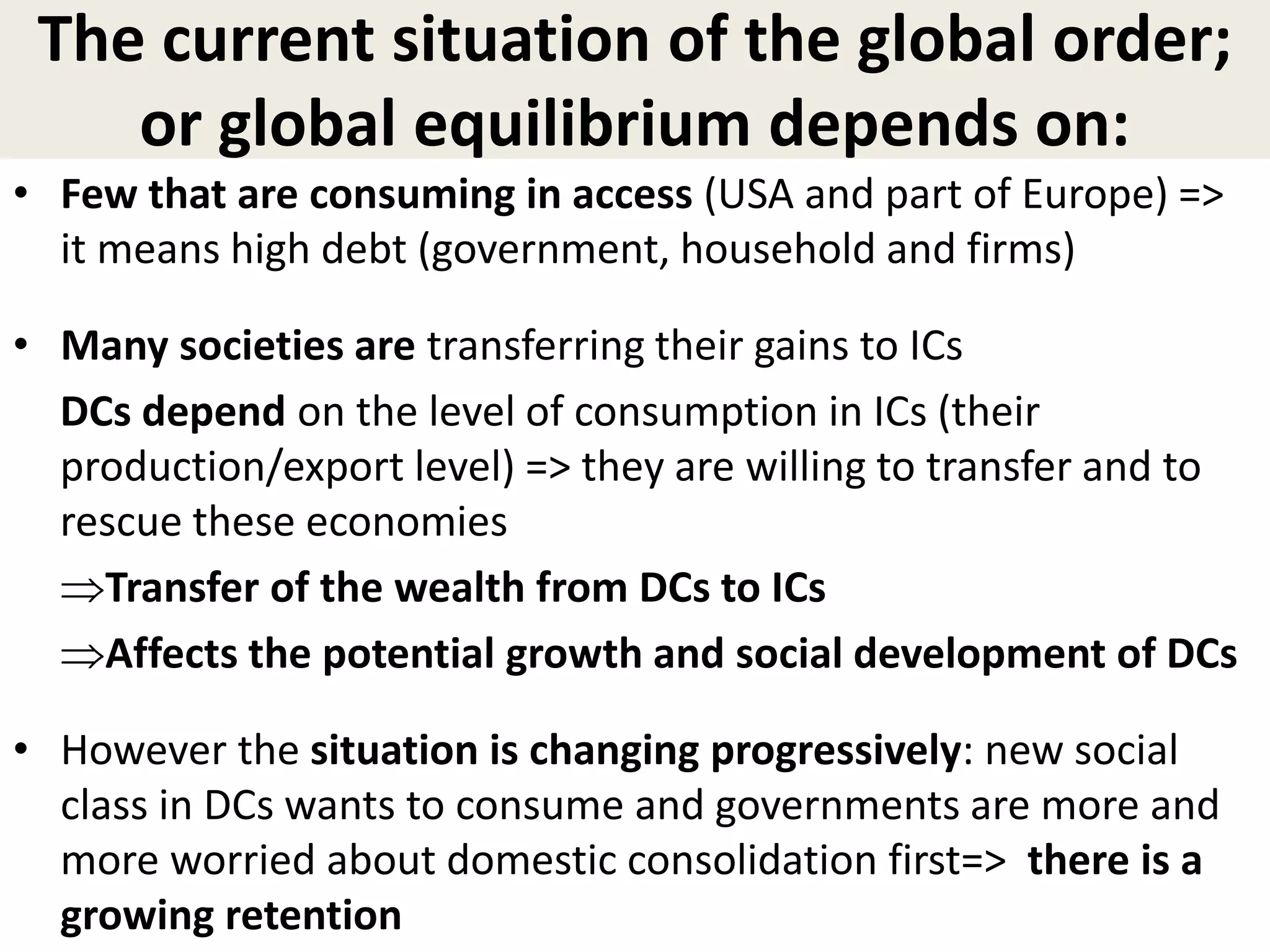
The current situation of the global order;
or global equilibrium depends on:
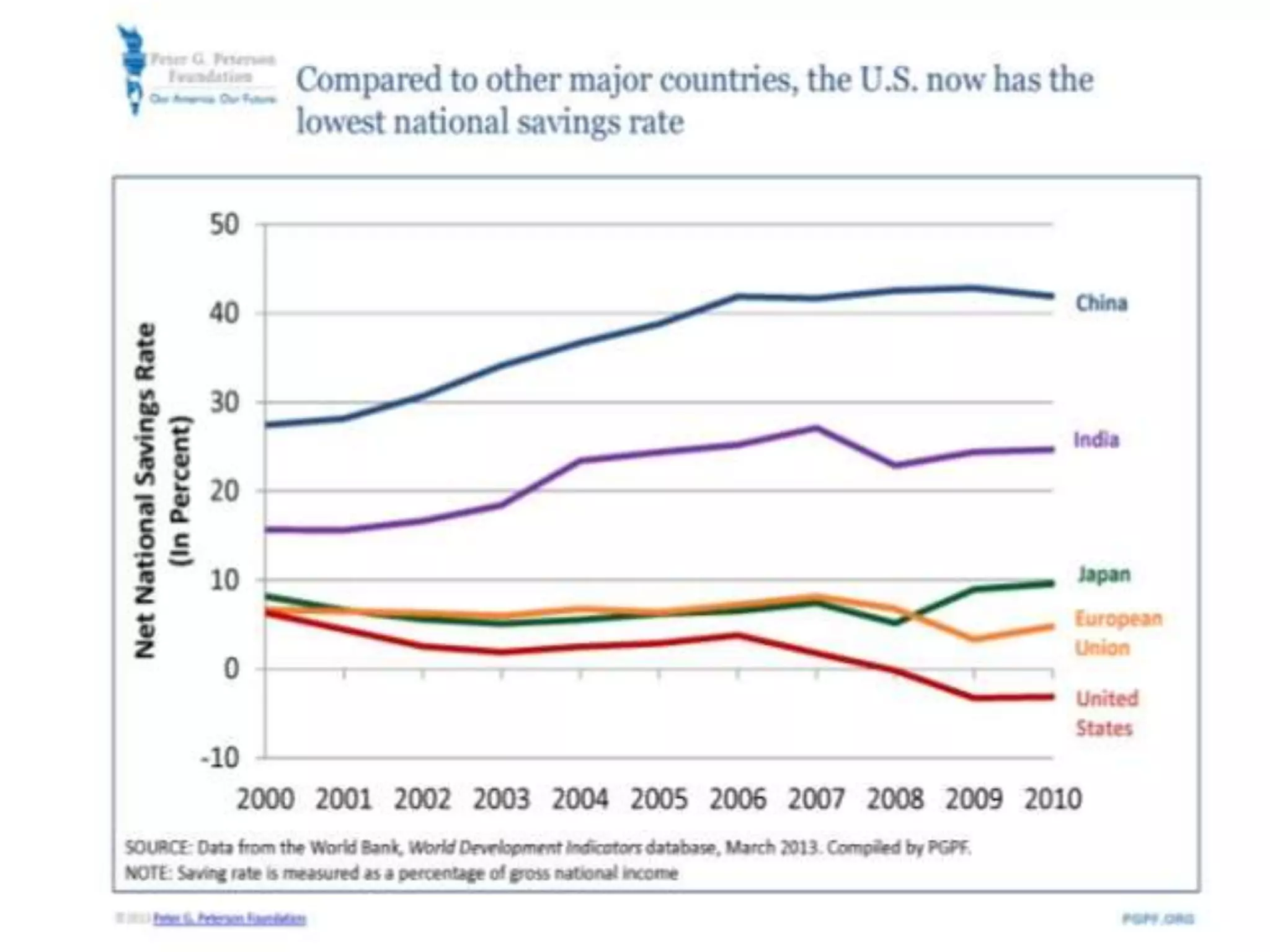
• Few that are consuming in access (USA and part of Europe) =>
it means high debt (government, household and firms)
• Many societies are transferring their gains to ICs
DCs depend on the level of consumption in ICs (their
production/export level) => they are willing to transfer and to
rescue these economies
Transfer of the wealth from DCs to ICs
Affects the potential growth and social development of DCs
• However the situation is changing progressively: new social
class in DCs wants to consume and governments are more and
more worried about domestic consolidation first=> there is a
growing retention
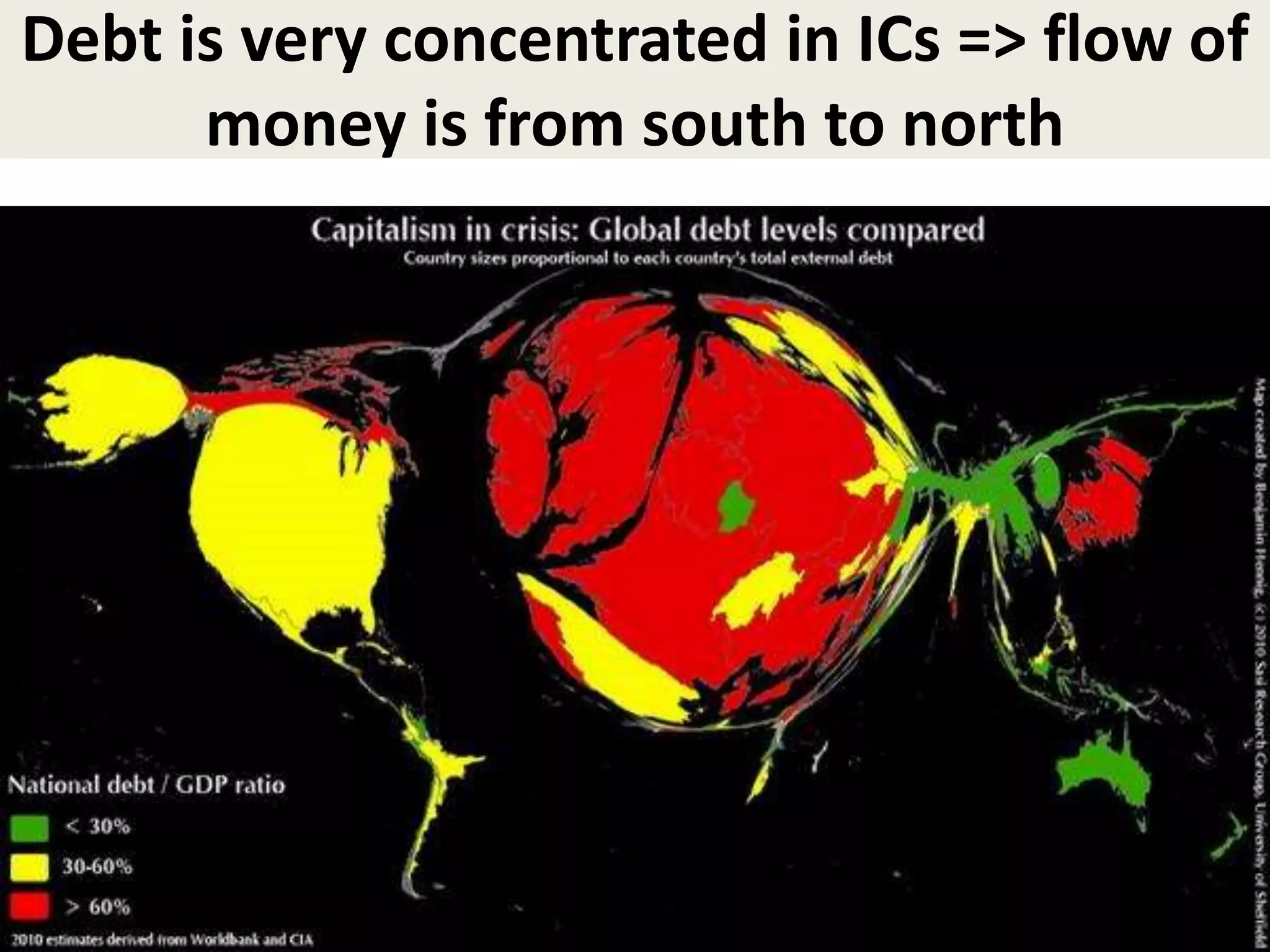
Debt is very concentrated in ICs => flow of
money is from south to north
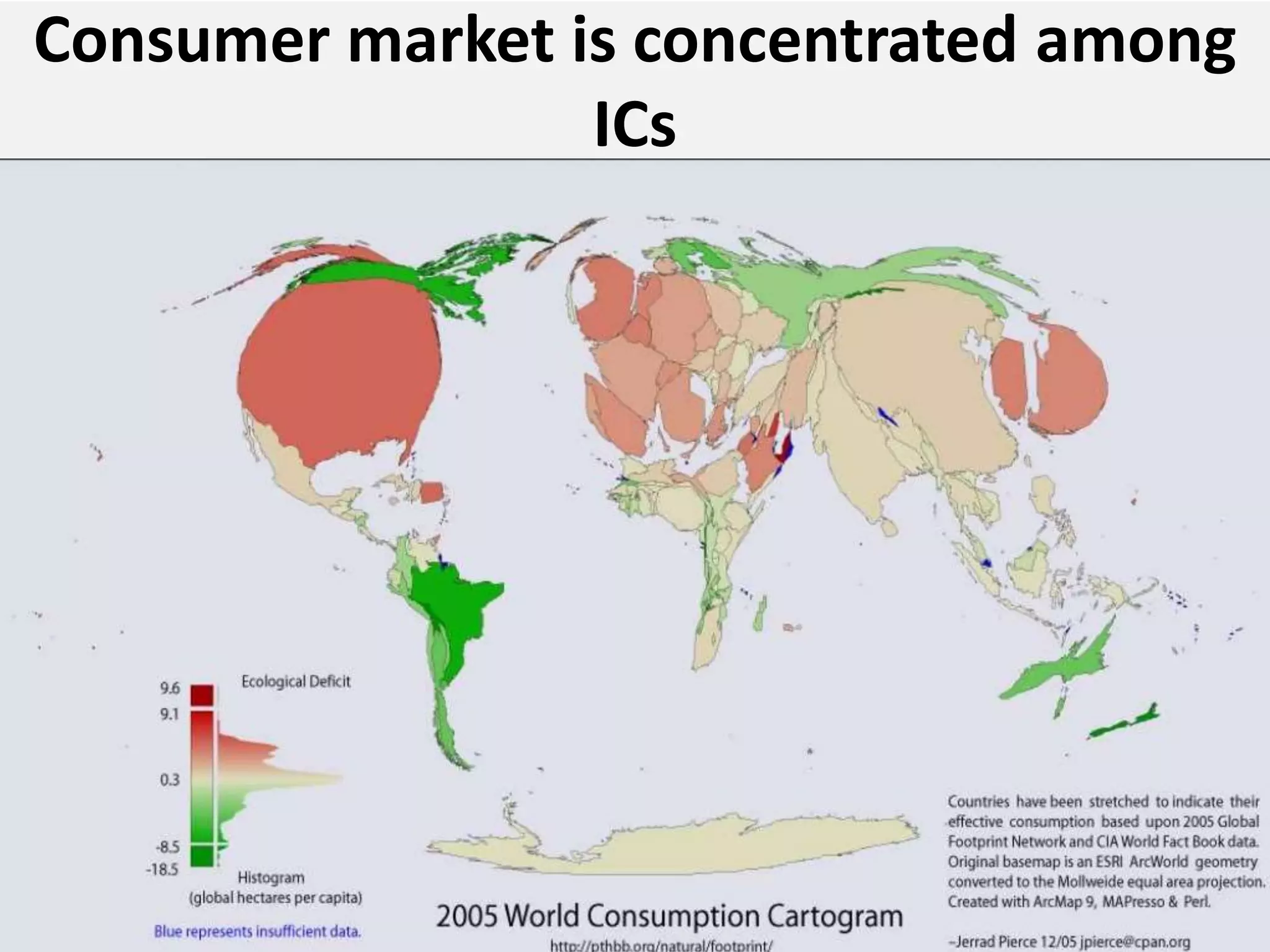
Consumer market is concentrated among
ICs
What are the obstacles for the construction of a new
economic governance with more justice for DCs?
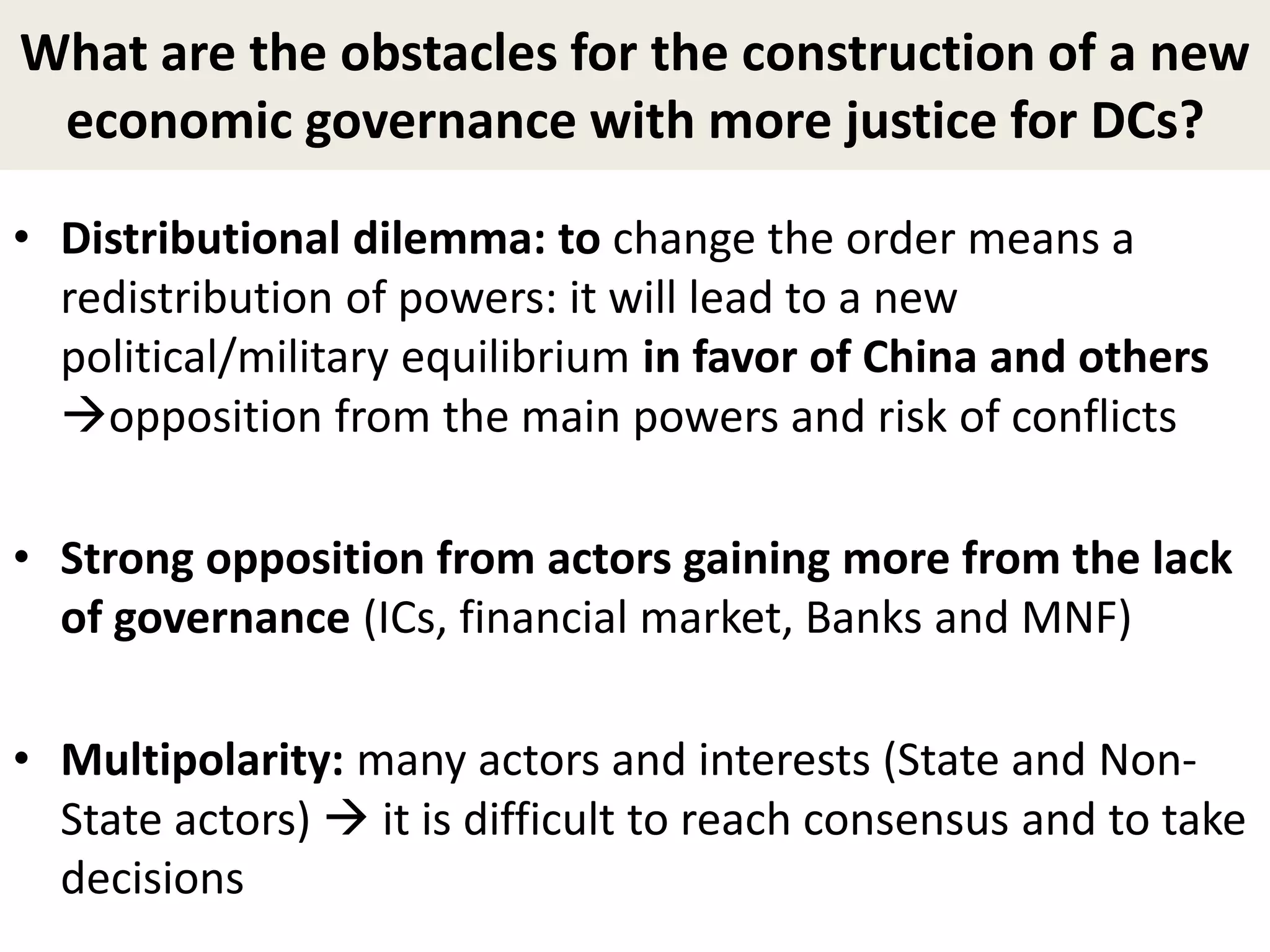
• Distributional dilemma: to change the order means a
redistribution of powers: it will lead to a new
political/military equilibrium in favor of China and others
opposition from the main powers and risk of conflicts
• Strong opposition from actors gaining more from the lack
of governance (ICs, financial market, Banks and MNF)
• Multipolarity: many actors and interests (State and Non-
State actors)  it is difficult to reach consensus and to take
decisions
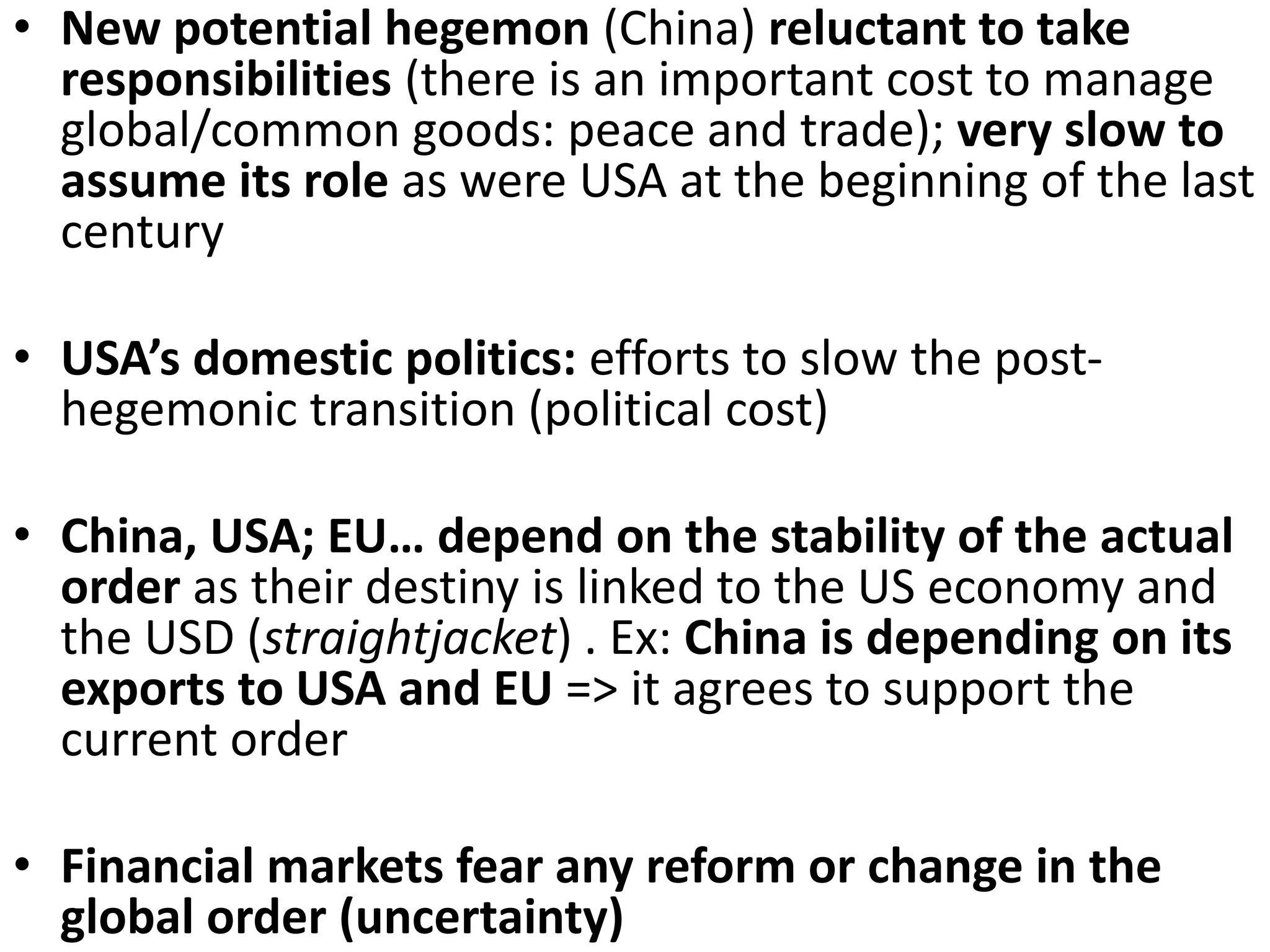
• New potential hegemon (China) reluctant to take
responsibilities (there is an important cost to manage
global/common goods: peace and trade); very slow to
assume its role as were USA at the beginning of the last
century
• USA’s domestic politics: efforts to slow the post-
hegemonic transition (political cost)
• China, USA; EU… depend on the stability of the actual
order as their destiny is linked to the US economy and
the USD (straightjacket) . Ex: China is depending on its
exports to USA and EU => it agrees to support the
current order
• Financial markets fear any reform or change in the
global order (uncertainty)
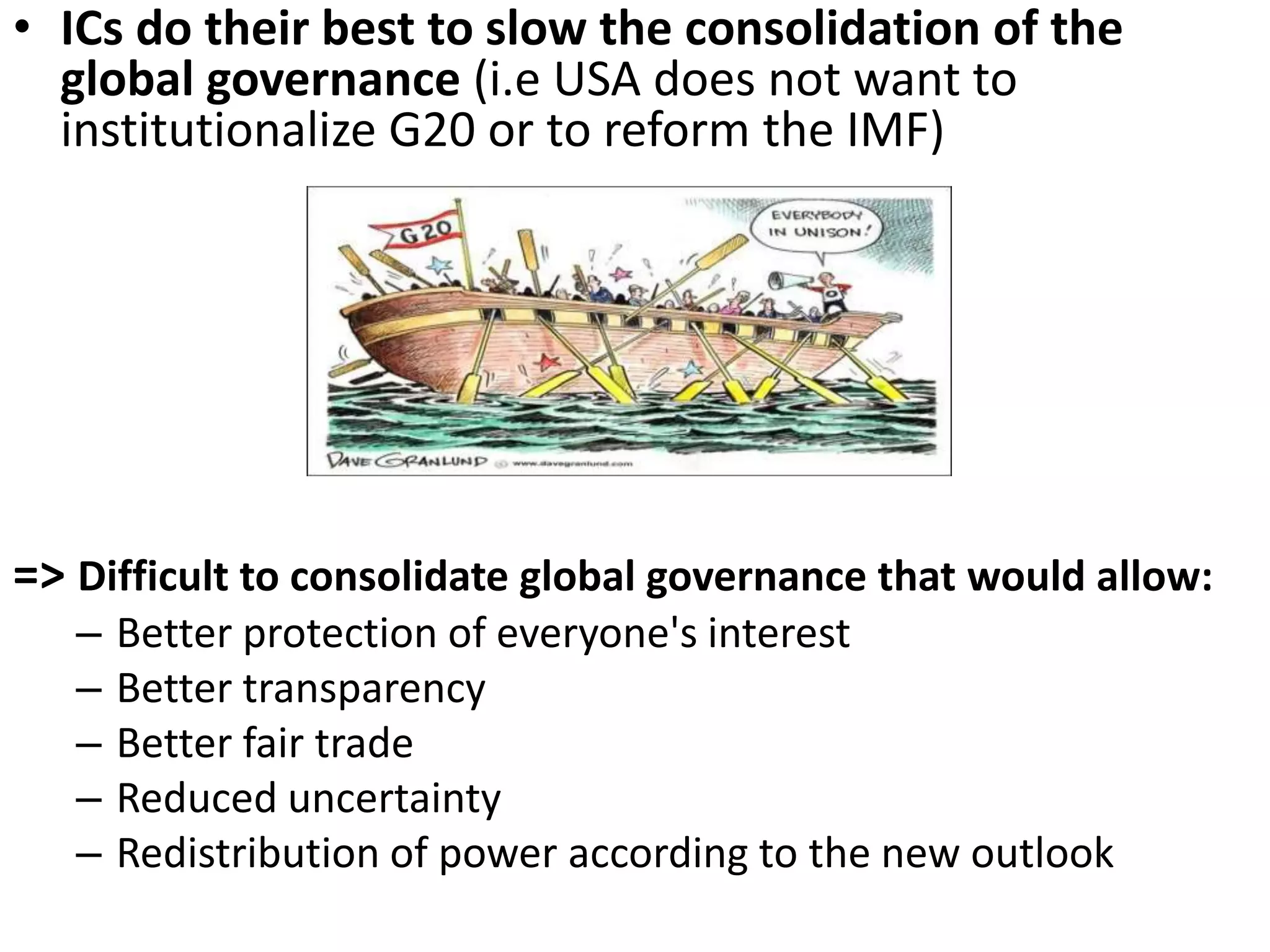
• ICs do their best to slow the consolidation of the
global governance (i.e USA does not want to
institutionalize G20 or to reform the IMF)
=> Difficult to consolidate global governance that would allow:
– Better protection of everyone's interest
– Better transparency
– Better fair trade
– Reduced uncertainty
– Redistribution of power according to the new outlook
Activity:
• Form groups of 3
• Answer the questions (15 minutes):
– What is the strength of the BRICS?
– What is the weakness of the BRICS?
– Do you think they are able to change the current order?
Why?
• Make your presentation

G20 and Global Governance

  • 1.
    G20 and GlobalGovernance Nicolas Foucras PhD University TEC de Monterrey nicolas.foucras@itesm.mx
  • 2.
    • Created in1999 by G7 • Goal at the beginning: To give an appropriate response to Financial Crisis in DCs that could affect the global stability (Mexico 95; Asia 97; Russia 98; Brazil 99; Argentina 2001) To face instability of the International Monetary System (IMS) i.e. To help IMF to stabilize global financial market • This role has grown after the 2008 crisis (which is a crisis originated in the ICs) as well as the number of countries: – Creditors were invited (BRICS) – MINT countries (except Nigeria): because they are key countries for international economy due to their important role in the global value chains (they received important FDI from ICs during past 2 decades) • The way to operate: promoting discussion (it does not create a hard law) + formulate proposals and coordinated actions
  • 3.
    Structure • 20 members(EU appears as a full member) • Rotary Presidency (1 year) (2012: Mexico; 2013: Russia; 2014: Australia; 2015: Turkey; 2016: China) • Composition – Director of the IMF – President of the WB – Ministers of Finance – Presidents of Central Banks – Delegates of each Government – After 2008: Head of States and Head of Governments Population:
  • 4.
    Special invitations • Traditionallyother actors are participating in pre- summit meetings : – Chair of the ASEAN – Chair of the African Union (AU) – A representative of the New Partnership for Africa's Development (NEPAD): • Economic development program of the AU • Economic co-operation and integration among African countries – Director of the International Labor Organization (ILO) – Director of the Organization for Economic Co-operation and Development (OCDE) – Representatives of the UN – Representatives of the WTO – Spain is a permanent non-member
  • 6.
    Characteristics of theMINT Vs BRICS Rapid growth Accelerated integration into the international economy MINT BRICS Much more pragmatic with regard to their integration into the globalization
  • 7.
    During the lastdecades the international panorama has changed: now BRICS appear to be among the first economies => justifies their membership into the G20
  • 8.
    MINT economies willappear among the most important in the next future according to WB and Goldman Sachs
  • 9.
    2 perspectives toexplain G20: • Hegemonic: ICs gather with other countries to legitimize their decisions and their model of international economy => Goal = to save the hegemonic model established in 1944 and to preserve the current order • Cooperative: – It reflects a change in the hegemonic global governance implemented by ICs in 1944 – It reflects the mutual influence/interdependence and ICs accept this new situation – It reflects a better equilibrium in the decision-making process – Goal: To organize the redistribution of powers between ICs and DCs
  • 10.
    Towards a Polycentricpattern that will balance/threat the US hegemony? • Zakari: consolidation of the BRICS reflects a process of redistribution of power that is inevitable • However it is difficult to talk about a “counter-power” because there is not any real unified front representing the “South” and able to counterbalance effectively the hard core (Foucras) • However on a long-term vision many agree that China could threat the US hegemony if there is no change in the current trend
  • 11.
    Global issues negotiatedand objectives (priority is different depending on the country): • The debt crisis and lack of liquidity for productive sectors and Gvts • The financial regulation and transparency (fight against Tax havens, tax evasion and corruption) • Macro-policy cooperation (Goal: to coordinate public decisions to foster international stability) • The promotion of multilateral trade (to face the current difficulties in the WTO) • To develop energy sustainability and to consider what many call the Green growth (to fight global warming) • To coordinate policies and strategies to face unemployment in ICs • To reduce Food insecurity in DCs and LDCs (to stabilize the situation and to control migration) • To reform the International Financial Architecture (IMF quotas)
  • 12.
    There are parallelsummits • B20: “20 Business” represents business community • L20: “Labor 20” represents Labor Unions • T20 “Think 20” “the world’s leading think tank’s representatives” • C20 represents Civil society • Y20 represents youth
  • 13.
    Diferent subgroups areparticipating:
  • 14.
    There are importantefforts/desires; however…
  • 15.
    • G20 andother global initiatives (and all the international architecture) have not been able to anticipate and to resolve the different crisis and externalities: – Poverty, Exclusion and Migration – Concentration of the wealth among few people => growing inequality (i.e. problem of global wealth distribution) – Unemployment and Informal economy – Pollution and global warming – Deterioration of the access to food and water – The lost of sovereignty/democracy (power transference from societies to global actors) – Violence and transnational crime… Welfare deterioration (individual is a means and not the final purpose)  Human survival is at risk (Tiberghien) • It has focused above all on rescue programs to save the global banking failures (short term vision)
  • 16.
    Wealth Distribution amongcountries • 200 years ago, ICs were only 3 times richer than poor countries • By the 1960s, they were 35 times richer • Today, the multiplier is 80
  • 17.
    “The richest 300people have more money than the poorest 3 billion people combined” (UNICEF)
  • 18.
    The current situationof the global order; or global equilibrium depends on: • Few that are consuming in access (USA and part of Europe) => it means high debt (government, household and firms) • Many societies are transferring their gains to ICs DCs depend on the level of consumption in ICs (their production/export level) => they are willing to transfer and to rescue these economies Transfer of the wealth from DCs to ICs Affects the potential growth and social development of DCs • However the situation is changing progressively: new social class in DCs wants to consume and governments are more and more worried about domestic consolidation first=> there is a growing retention
  • 19.
    Debt is veryconcentrated in ICs => flow of money is from south to north
  • 20.
    Consumer market isconcentrated among ICs
  • 22.
    What are theobstacles for the construction of a new economic governance with more justice for DCs? • Distributional dilemma: to change the order means a redistribution of powers: it will lead to a new political/military equilibrium in favor of China and others opposition from the main powers and risk of conflicts • Strong opposition from actors gaining more from the lack of governance (ICs, financial market, Banks and MNF) • Multipolarity: many actors and interests (State and Non- State actors)  it is difficult to reach consensus and to take decisions
  • 23.
    • New potentialhegemon (China) reluctant to take responsibilities (there is an important cost to manage global/common goods: peace and trade); very slow to assume its role as were USA at the beginning of the last century • USA’s domestic politics: efforts to slow the post- hegemonic transition (political cost) • China, USA; EU… depend on the stability of the actual order as their destiny is linked to the US economy and the USD (straightjacket) . Ex: China is depending on its exports to USA and EU => it agrees to support the current order • Financial markets fear any reform or change in the global order (uncertainty)
  • 24.
    • ICs dotheir best to slow the consolidation of the global governance (i.e USA does not want to institutionalize G20 or to reform the IMF) => Difficult to consolidate global governance that would allow: – Better protection of everyone's interest – Better transparency – Better fair trade – Reduced uncertainty – Redistribution of power according to the new outlook
  • 25.
    Activity: • Form groupsof 3 • Answer the questions (15 minutes): – What is the strength of the BRICS? – What is the weakness of the BRICS? – Do you think they are able to change the current order? Why? • Make your presentation