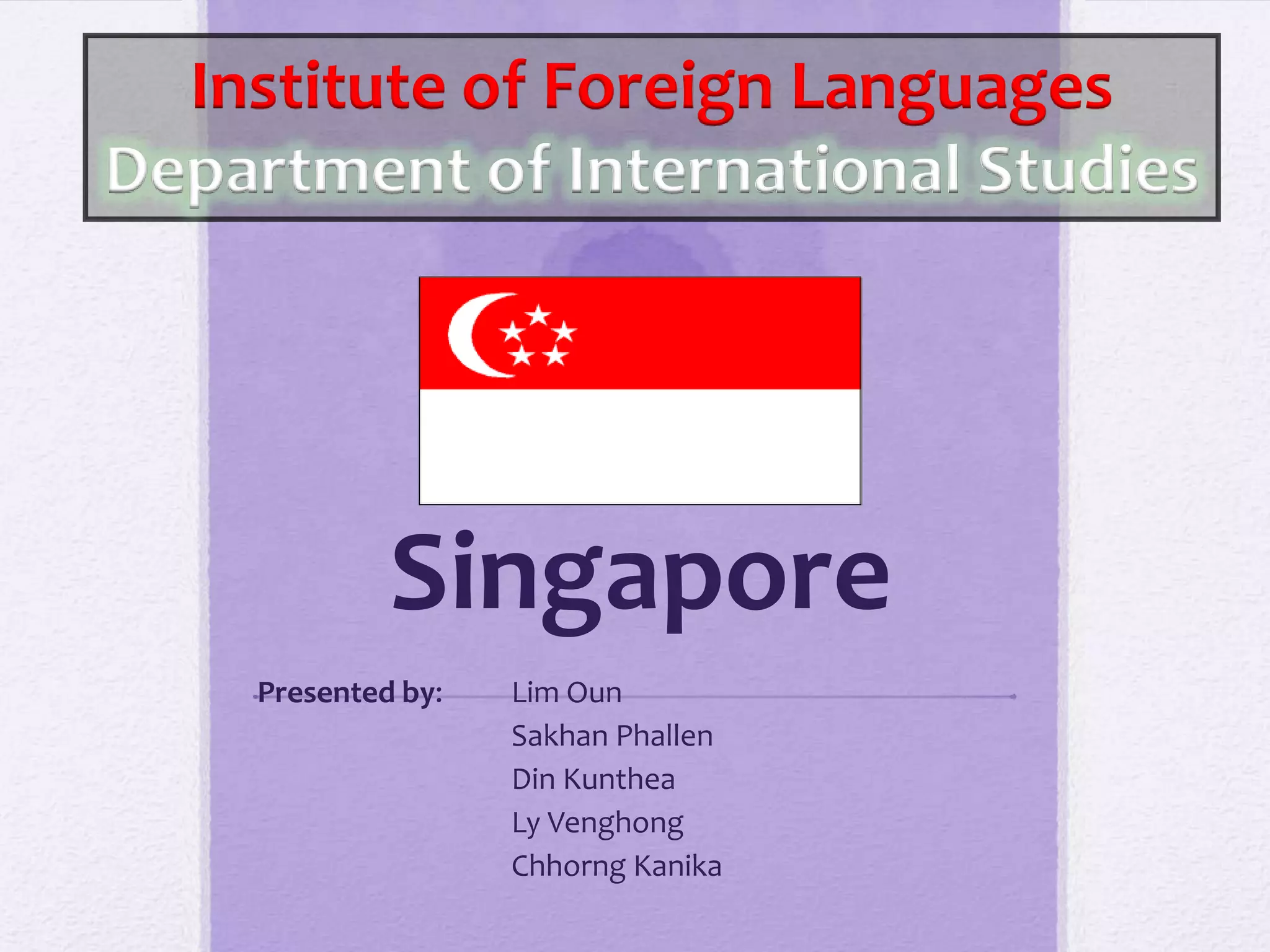

Singapore
Presented by: Lim Oun
Sakhan Phallen
Din Kunthea
Ly Venghong
Chhorng Kanika
Institute of Foreign Languages
Department of International Studies
Contents
• History of Political Events in Singapore
• Singapore Political Culture
• Political Parties
• The Constitution
• Election in Singapore
• Is Singapore a Democratic Country?
• Conclusion
• Q & A
History of Political Events
• A Republic with a parliamentary system of
government
• First and limited election was in 1948
• 1955 election was the most lively political contest
• Attain the self-government in 1959
• September 16, 1963 Singapore joined Malaya,
Sabah (North Berneo) and Sarawak in the
Federation of Malaysia
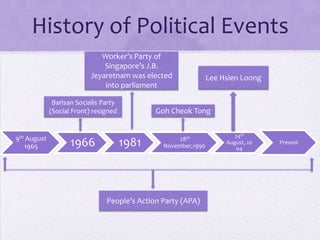
History of Political Events
9th August
1965 1966 1981 28th
November,1990
24th
August, 20
04
Present
Worker’s Party of
Singapore’s J.B.
Jeyaretnam was elected
into parliament
Goh Cheok Tong
Lee Hsien Loong
Barisan Socialis Party
(Social Front) resigned
People’s Action Party (APA)
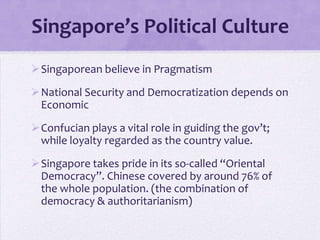
Singapore’s Political Culture
Singaporean believe in Pragmatism
National Security and Democratization depends on
Economic
Confucian plays a vital role in guiding the gov’t;
while loyalty regarded as the country value.
Singapore takes pride in its so-called “Oriental
Democracy”. Chinese covered by around 76% of
the whole population. (the combination of
democracy & authoritarianism)
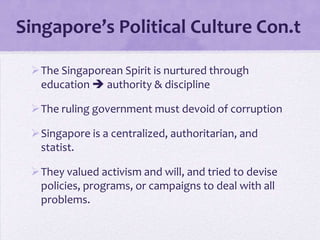
Singapore’s Political Culture Con.t
The Singaporean Spirit is nurtured through
education  authority & discipline
The ruling government must devoid of corruption
Singapore is a centralized, authoritarian, and
statist.
They valued activism and will, and tried to devise
policies, programs, or campaigns to deal with all
problems.
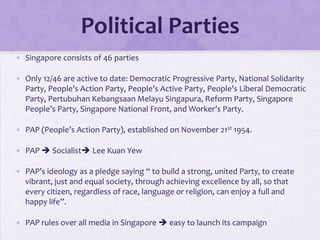
Political Parties
• Singapore consists of 46 parties
• Only 12/46 are active to date: Democratic Progressive Party, National Solidarity
Party, People’s Action Party, People’s Active Party, People’s Liberal Democratic
Party, Pertubuhan Kebangsaan Melayu Singapura, Reform Party, Singapore
People’s Party, Singapore National Front, and Worker’s Party.
• PAP (People’s Action Party), established on November 21st 1954.
• PAP  Socialist Lee Kuan Yew
• PAP’s ideology as a pledge saying “ to build a strong, united Party, to create
vibrant, just and equal society, through achieving excellence by all, so that
every citizen, regardless of race, language or religion, can enjoy a full and
happy life”.
• PAP rules over all media in Singapore  easy to launch its campaign
Political Parties (cont.)
• WP (Worker’s Party) established in 1957
• WP’s ideology: “to provide economic security and
stability, brighter education for younger
generation, and other aspects that are the same to
PAP”.
• WP Political parties exist to serve you!
• WP’s main objective:
• “To organize and maintain a political party to give
effect to the three-fold principle of
Merdeka, Democracy (Parliamentary) and Socialism”.
The Constitution
• 09 August, 1965
• 14 Parts:
• Three Branches
• Citizenship
• Fundamental Rights and Freedom
• Public Services, etc.
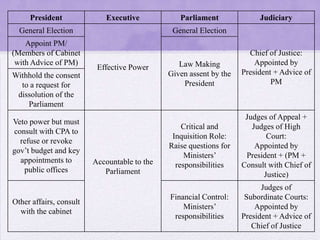
President Executive Parliament Judiciary
General Election
Effective Power
General Election
Chief of Justice:
Appointed by
President + Advice of
PM
Appoint PM/
(Members of Cabinet
with Advice of PM) Law Making
Given assent by the
President
Withhold the consent
to a request for
dissolution of the
Parliament
Veto power but must
consult with CPA to
refuse or revoke
gov’t budget and key
appointments to
public offices
Accountable to the
Parliament
Critical and
Inquisition Role:
Raise questions for
Ministers’
responsibilities
Judges of Appeal +
Judges of High
Court:
Appointed by
President + (PM +
Consult with Chief of
Justice)
Other affairs, consult
with the cabinet
Financial Control:
Ministers’
responsibilities
Judges of
Subordinate Courts:
Appointed by
President + Advice of
Chief of Justice
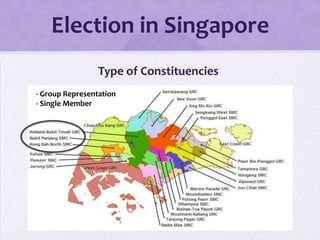
Election in Singapore
Type of Constituencies
- Group Representation
- Single Member
Election in Singapore
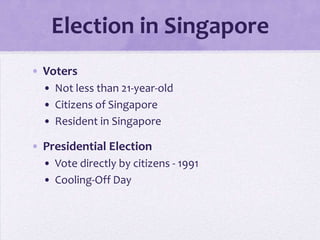
• Voters
• Not less than 21-year-old
• Citizens of Singapore
• Resident in Singapore
• Presidential Election
• Vote directly by citizens - 1991
• Cooling-Off Day
Election in Singapore Cont.
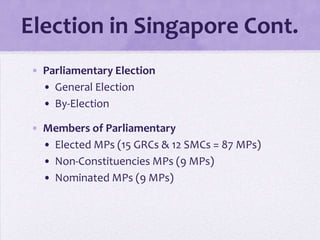
• Parliamentary Election
• General Election
• By-Election
• Members of Parliamentary
• Elected MPs (15 GRCs & 12 SMCs = 87 MPs)
• Non-Constituencies MPs (9 MPs)
• Nominated MPs (9 MPs)
Is Singapore a Democratic
Country?
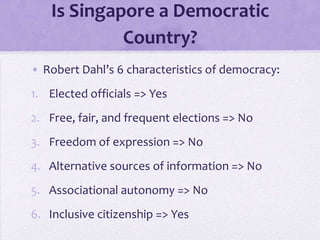
• Robert Dahl’s 6 characteristics of democracy:
1. Elected officials => Yes
2. Free, fair, and frequent elections => No
3. Freedom of expression => No
4. Alternative sources of information => No
5. Associational autonomy => No
6. Inclusive citizenship => Yes
Is Singapore a Democratic
Country? (cont.)
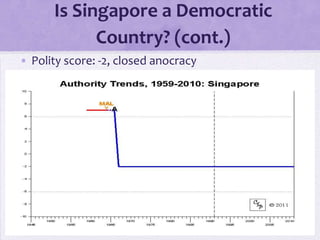
• Polity score: -2, closed anocracy
Conclusion
• The political system has not evolved much.
• PAP is the strongest party.
• General election in Singapore is unfair.
• Singapore is not a democratic country.
Singapore presentation

Singapore presentation

  • 1.
    Singapore Presented by: LimOun Sakhan Phallen Din Kunthea Ly Venghong Chhorng Kanika Institute of Foreign Languages Department of International Studies
  • 2.
    Contents • History ofPolitical Events in Singapore • Singapore Political Culture • Political Parties • The Constitution • Election in Singapore • Is Singapore a Democratic Country? • Conclusion • Q & A
  • 3.
    History of PoliticalEvents • A Republic with a parliamentary system of government • First and limited election was in 1948 • 1955 election was the most lively political contest • Attain the self-government in 1959 • September 16, 1963 Singapore joined Malaya, Sabah (North Berneo) and Sarawak in the Federation of Malaysia
  • 4.
    History of PoliticalEvents 9th August 1965 1966 1981 28th November,1990 24th August, 20 04 Present Worker’s Party of Singapore’s J.B. Jeyaretnam was elected into parliament Goh Cheok Tong Lee Hsien Loong Barisan Socialis Party (Social Front) resigned People’s Action Party (APA)
  • 5.
    Singapore’s Political Culture Singaporeanbelieve in Pragmatism National Security and Democratization depends on Economic Confucian plays a vital role in guiding the gov’t; while loyalty regarded as the country value. Singapore takes pride in its so-called “Oriental Democracy”. Chinese covered by around 76% of the whole population. (the combination of democracy & authoritarianism)
  • 6.
    Singapore’s Political CultureCon.t The Singaporean Spirit is nurtured through education  authority & discipline The ruling government must devoid of corruption Singapore is a centralized, authoritarian, and statist. They valued activism and will, and tried to devise policies, programs, or campaigns to deal with all problems.
  • 7.
    Political Parties • Singaporeconsists of 46 parties • Only 12/46 are active to date: Democratic Progressive Party, National Solidarity Party, People’s Action Party, People’s Active Party, People’s Liberal Democratic Party, Pertubuhan Kebangsaan Melayu Singapura, Reform Party, Singapore People’s Party, Singapore National Front, and Worker’s Party. • PAP (People’s Action Party), established on November 21st 1954. • PAP  Socialist Lee Kuan Yew • PAP’s ideology as a pledge saying “ to build a strong, united Party, to create vibrant, just and equal society, through achieving excellence by all, so that every citizen, regardless of race, language or religion, can enjoy a full and happy life”. • PAP rules over all media in Singapore  easy to launch its campaign
  • 8.
    Political Parties (cont.) •WP (Worker’s Party) established in 1957 • WP’s ideology: “to provide economic security and stability, brighter education for younger generation, and other aspects that are the same to PAP”. • WP Political parties exist to serve you! • WP’s main objective: • “To organize and maintain a political party to give effect to the three-fold principle of Merdeka, Democracy (Parliamentary) and Socialism”.
  • 9.
    The Constitution • 09August, 1965 • 14 Parts: • Three Branches • Citizenship • Fundamental Rights and Freedom • Public Services, etc.
  • 10.
    President Executive ParliamentJudiciary General Election Effective Power General Election Chief of Justice: Appointed by President + Advice of PM Appoint PM/ (Members of Cabinet with Advice of PM) Law Making Given assent by the President Withhold the consent to a request for dissolution of the Parliament Veto power but must consult with CPA to refuse or revoke gov’t budget and key appointments to public offices Accountable to the Parliament Critical and Inquisition Role: Raise questions for Ministers’ responsibilities Judges of Appeal + Judges of High Court: Appointed by President + (PM + Consult with Chief of Justice) Other affairs, consult with the cabinet Financial Control: Ministers’ responsibilities Judges of Subordinate Courts: Appointed by President + Advice of Chief of Justice
  • 11.
    Election in Singapore Typeof Constituencies - Group Representation - Single Member
  • 12.
    Election in Singapore •Voters • Not less than 21-year-old • Citizens of Singapore • Resident in Singapore • Presidential Election • Vote directly by citizens - 1991 • Cooling-Off Day
  • 13.
    Election in SingaporeCont. • Parliamentary Election • General Election • By-Election • Members of Parliamentary • Elected MPs (15 GRCs & 12 SMCs = 87 MPs) • Non-Constituencies MPs (9 MPs) • Nominated MPs (9 MPs)
  • 14.
    Is Singapore aDemocratic Country? • Robert Dahl’s 6 characteristics of democracy: 1. Elected officials => Yes 2. Free, fair, and frequent elections => No 3. Freedom of expression => No 4. Alternative sources of information => No 5. Associational autonomy => No 6. Inclusive citizenship => Yes
  • 15.
    Is Singapore aDemocratic Country? (cont.) • Polity score: -2, closed anocracy
  • 16.
    Conclusion • The politicalsystem has not evolved much. • PAP is the strongest party. • General election in Singapore is unfair. • Singapore is not a democratic country.