Regional OrganizationsRegional Organizations
Instructor: Cheunboran Chanborey
Introduction
 In the 21st century, regions have emerged as “a driving
force in world politics”, such as in Europe, Asia, Africa,
the Middle East, and the Americas.
 Regional Organizations have become new “new global
landscape”.
 Regions vary widely in terms of their scope, institutional
forms, membership and identity
 Europe has developed formal bureaucratic-legalistic
institutions.
 Regionalism in Asia is more informal and non-legalistic.
Definition of Regional Integration
 Regional integration is a process in which states enter
into a regional cooperation framework in order to
enhance regional cooperation and reduce regional
tension.
 It can be defined as an association of states based upon
location in given geographical area.
 Regional integration is the joining of individual states
within a region into a larger whole. The degree of
integration depends on the willingness and commitment
of independent sovereign states to share their
sovereignty.
Regional Integration: Old & New Regionalism
 Idea of regional integration or regionalism can be traced
back to the 19th
century, but given serious attention in the
1950s to 1960s.
 However, regional integration in many parts of the world,
except in Europe, were not very successful.
 In the 1990s, regional integration became increasingly
wide-spreading, mainly due to rising globalization and
slow progress in the WTO negotiations.
Old Regionalism vs. New Regionalism
Nowadays, especially after the 1980s, we can see
differences between old regionalism and new
regionalism.
(1) Under the old regionalism, the world was divided into
two camps in a bi-polar cold war context. The US set up
NATO in 1949, whereas the Soviet Union responded by
establishing the Warsaw Pact in 1955
Old Regionalism vs. New Regionalism
 In economic arena, the US initiated Marshall Plan or
European Recovery Program in 1947, while the Soviet
Union set up the Council for Mutual Economic
Assistance (COMECON) in 1949.
(2) The old regionalism was heavily influenced by the
outside major powers (Southeast Asia Treaty
Organization-SEATO, 1954), while the new regionalism
was driven by the need of countries within the region
(ASEAN in 1967, ASEAN+3 process in 1997).
Old Regionalism vs. New Regionalism
(3) From economic perspective, old regionalism was aimed
at protecting industries of the member countries, while
the new regionalism is more open to outside competition
due to the growing economic interdependence.
Old Regionalism vs. New Regionalism
(4) Old regionalism was more specific in its objective, such
as security (NATO), or economic cooperation
(COMECON), whereas new regionalism has a wider
objective, ASEAN, ASEAN+3 process, East Asia Summit
(EAS).
Type of Regionness
(1) Region as geographical unit is confined more or less
by natural physical barriers and marked by ecological
characteristics: “Europe from the Atlantic to the Urals”,
“Africa from South Africa to the Sahara”, “the Indian
subcontinent”, and “East Asia” from the west coast of the
Pacific Ocean to the east coast of the Indian Ocean.
Type of Regionness
(2) Region as social system implies trans-local relations
between human groups. “East Asia” used to refer region
strongly influenced by Confucianism (China, Japan,
ROK, Taiwan, Vietnam, even though Vietnam is
geographically a Southeast Asian country)
Type of Regionness
(3) Region as organized cooperation in any of fields, such
as cultural, economic, political, or military fields. It could
be called the “formal” region driven by “geo-political” or
“geo-economic” interests. This kind of regionness is
therefore based on common strategic interests, instead
of geographical proximity, e.g. “APEC region” and
“EAS region”.
Type of Regionness
(4) Region as acting subject with distinct identity, actor
capability, legitimacy and structure of decision-making.
This regional process is similar to state formation and
nation building and the ultimate outcome could be a
“region-state” whose terms of scope can be compared to
the classical empires but in terms of political order
constitutes a voluntary evolution of a group of formally
sovereign national political units into a supranational
security community where sovereignty is pooled for best
of all (EU?).
Approaches to Regional Integration
 In theory, regional integration can be divided into two
categories:
(1) Regionalism is defined as the process of
institutionalized cooperation in top-down manner that
normally requires formal government approval and
includes the establishment of permanent organizations
(governmental-driven integration). European integration
is the best example for this approach of integration.
Approaches to Regional Integration
(2) Regionalization is defined as progress in bottom-up
cooperation & relationships which take place outside the
governmental framework (market-driven integration).
East Asian integration is primarily based on this
approach.
Motivations for Regionalism
(1) Political Motivation
Power Dynamics
Identity and Ideology
Internal and External Threats
Domestic Politics (regionalization)
Leadership
Motivations for Regionalism
(2) Economic Motivation
 Reducing negative effects of bilateral FTA (“Spaghetti
Bowl” effect) by stimulating trade creation, and
reducing trade diversion
 Expanding trade and investment opportunities
 Providing impetus or incentive to undertake domestic
reform
 Coping with the dark side of globalization
 Countering regional integration in other parts of the
world
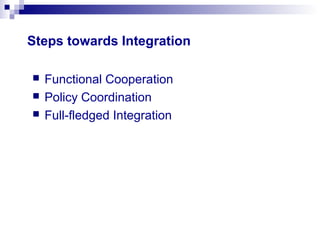
Steps towards Integration
 Functional Cooperation
 Policy Coordination
 Full-fledged Integration
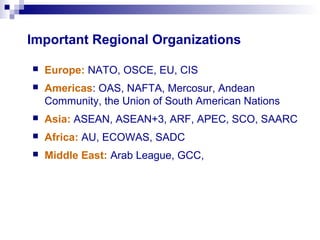
Important Regional Organizations
 Europe: NATO, OSCE, EU, CIS
 Americas: OAS, NAFTA, Mercosur, Andean
Community, the Union of South American Nations
 Asia: ASEAN, ASEAN+3, ARF, APEC, SCO, SAARC
 Africa: AU, ECOWAS, SADC
 Middle East: Arab League, GCC,

5. regional organizations

  • 1.
  • 2.
    Introduction  In the21st century, regions have emerged as “a driving force in world politics”, such as in Europe, Asia, Africa, the Middle East, and the Americas.  Regional Organizations have become new “new global landscape”.  Regions vary widely in terms of their scope, institutional forms, membership and identity  Europe has developed formal bureaucratic-legalistic institutions.  Regionalism in Asia is more informal and non-legalistic.
  • 3.
    Definition of RegionalIntegration  Regional integration is a process in which states enter into a regional cooperation framework in order to enhance regional cooperation and reduce regional tension.  It can be defined as an association of states based upon location in given geographical area.  Regional integration is the joining of individual states within a region into a larger whole. The degree of integration depends on the willingness and commitment of independent sovereign states to share their sovereignty.
  • 4.
    Regional Integration: Old& New Regionalism  Idea of regional integration or regionalism can be traced back to the 19th century, but given serious attention in the 1950s to 1960s.  However, regional integration in many parts of the world, except in Europe, were not very successful.  In the 1990s, regional integration became increasingly wide-spreading, mainly due to rising globalization and slow progress in the WTO negotiations.
  • 5.
    Old Regionalism vs.New Regionalism Nowadays, especially after the 1980s, we can see differences between old regionalism and new regionalism. (1) Under the old regionalism, the world was divided into two camps in a bi-polar cold war context. The US set up NATO in 1949, whereas the Soviet Union responded by establishing the Warsaw Pact in 1955
  • 6.
    Old Regionalism vs.New Regionalism  In economic arena, the US initiated Marshall Plan or European Recovery Program in 1947, while the Soviet Union set up the Council for Mutual Economic Assistance (COMECON) in 1949. (2) The old regionalism was heavily influenced by the outside major powers (Southeast Asia Treaty Organization-SEATO, 1954), while the new regionalism was driven by the need of countries within the region (ASEAN in 1967, ASEAN+3 process in 1997).
  • 7.
    Old Regionalism vs.New Regionalism (3) From economic perspective, old regionalism was aimed at protecting industries of the member countries, while the new regionalism is more open to outside competition due to the growing economic interdependence.
  • 8.
    Old Regionalism vs.New Regionalism (4) Old regionalism was more specific in its objective, such as security (NATO), or economic cooperation (COMECON), whereas new regionalism has a wider objective, ASEAN, ASEAN+3 process, East Asia Summit (EAS).
  • 9.
    Type of Regionness (1)Region as geographical unit is confined more or less by natural physical barriers and marked by ecological characteristics: “Europe from the Atlantic to the Urals”, “Africa from South Africa to the Sahara”, “the Indian subcontinent”, and “East Asia” from the west coast of the Pacific Ocean to the east coast of the Indian Ocean.
  • 10.
    Type of Regionness (2)Region as social system implies trans-local relations between human groups. “East Asia” used to refer region strongly influenced by Confucianism (China, Japan, ROK, Taiwan, Vietnam, even though Vietnam is geographically a Southeast Asian country)
  • 11.
    Type of Regionness (3)Region as organized cooperation in any of fields, such as cultural, economic, political, or military fields. It could be called the “formal” region driven by “geo-political” or “geo-economic” interests. This kind of regionness is therefore based on common strategic interests, instead of geographical proximity, e.g. “APEC region” and “EAS region”.
  • 12.
    Type of Regionness (4)Region as acting subject with distinct identity, actor capability, legitimacy and structure of decision-making. This regional process is similar to state formation and nation building and the ultimate outcome could be a “region-state” whose terms of scope can be compared to the classical empires but in terms of political order constitutes a voluntary evolution of a group of formally sovereign national political units into a supranational security community where sovereignty is pooled for best of all (EU?).
  • 13.
    Approaches to RegionalIntegration  In theory, regional integration can be divided into two categories: (1) Regionalism is defined as the process of institutionalized cooperation in top-down manner that normally requires formal government approval and includes the establishment of permanent organizations (governmental-driven integration). European integration is the best example for this approach of integration.
  • 14.
    Approaches to RegionalIntegration (2) Regionalization is defined as progress in bottom-up cooperation & relationships which take place outside the governmental framework (market-driven integration). East Asian integration is primarily based on this approach.
  • 15.
    Motivations for Regionalism (1)Political Motivation Power Dynamics Identity and Ideology Internal and External Threats Domestic Politics (regionalization) Leadership
  • 16.
    Motivations for Regionalism (2)Economic Motivation  Reducing negative effects of bilateral FTA (“Spaghetti Bowl” effect) by stimulating trade creation, and reducing trade diversion  Expanding trade and investment opportunities  Providing impetus or incentive to undertake domestic reform  Coping with the dark side of globalization  Countering regional integration in other parts of the world
  • 17.
    Steps towards Integration Functional Cooperation  Policy Coordination  Full-fledged Integration
  • 18.
    Important Regional Organizations Europe: NATO, OSCE, EU, CIS  Americas: OAS, NAFTA, Mercosur, Andean Community, the Union of South American Nations  Asia: ASEAN, ASEAN+3, ARF, APEC, SCO, SAARC  Africa: AU, ECOWAS, SADC  Middle East: Arab League, GCC,