Download as PDF, PPTX



![Principles of Communication Prof. V. Venkata Rao
Indian Institute of Technology Madras
3.6
Note that this is one among the simplest examples of RPs that can be used to
construe the concept.
Example 3.2
Consider the experiment of throwing a fair die. The sample space consists
of six sample points, 1 6, ........,s s corresponding to the six faces of the die. Let
the sample functions be given by ( ) ( )
1
1
2
ix t t i= + − for , 1, ......., 6is s i= = .
Let us find the mean value of the random variable ( ) 1| tX X t == .
A few of the sample functions of this random process are shown below
(Fig 3.3).
Fig. 3.3: A few sample functions of the RP of Example 3.2
The PDF of X is
( ) ( )
6
1
1 1
1
6 2
X
i
f x x i
=
⎡ ⎤⎛ ⎞
= δ − + −⎜ ⎟⎢ ⎥
⎝ ⎠⎣ ⎦
∑
[ ] ( )
1
1 3 5 7 9 11 3.0
12
E X = + + + + + =
The examples cited above have two features in common, namely (i) the
number of sample functions are finite (in fact, we could even say, quite small)](https://image.slidesharecdn.com/16-130805121015-phpapp01/85/1-6-6-320.jpg)



![Principles of Communication Prof. V. Venkata Rao
Indian Institute of Technology Madras
3.15
auto-covariance functions depend only on the time difference ( )k it t− , rather
than on the actual values of kt and it . This can be shown as follows.
( ) ( ) ( ),X k i k iR t t E X t X t⎡ ⎤= ⎣ ⎦
( ) ( )k iE X t T X t T⎡ ⎤= + +⎣ ⎦ , as ( )X t is stationary.
In particular if iT t= − , then
( ) ( ) ( ), 0X k i k iR t t E X t t X⎡ ⎤= −⎣ ⎦ (3.5b)
( ) ( ), , 0X k i X k iR t t R t t= −
In order to simplify the notation, it is conventional to drop the second argument
on the RHS of Eq. 3.5(b) and write as
( ) ( ),X k i X k iR t t R t t= −
In view of Eq. 3.4(b), it is not difficult to see that for a stationary process
( ) ( ),X k i X k iC t t C t t= −
It is important to realize that for a process that is SSS, Eq. 3.5(a) and Eq.
3.5(b) hold. However, we should not infer that any process for which Eq. 3.5 is
valid, is a stationary process. In any case, the processes satisfying Eq. 3.5 are
sufficiently useful and are termed Wide Sense Stationary (WSS) processes.
Def. 3.5: Wide Sense Stationarity
A process ( )X t is WSS or stationary in a wide sense1
, provided
( )X Xm t m= (3.6a)
and ( ) ( ),X k i X k iR t t R t t= − (3.6b)
Wide sense stationarity represents a weak kind of stationarity in that all
processes that are SSS are also WSS; but the converse is not necessarily true.
When we simply use the word stationary, we imply stationarity in the strict sense.
1
For definitions of other forms of stationarity (such as Nth
order stationary) see [1, P302]](https://image.slidesharecdn.com/16-130805121015-phpapp01/85/1-6-15-320.jpg)


![Principles of Communication Prof. V. Venkata Rao
Indian Institute of Technology Madras
3.19
Hence ( ) [ ]
1
2, 4 2 6 12 20 30 42
6
XR = + + + + +
112
18.66
6
= =
Exercise 3.1
Let a random process ( )X t consist of 6 equally likely sample
functions, given by ( ) , 1, 2, ......, 6ix t i t i= = . Let X and Y be the
random variables obtained by sampling process at 1t = and 2t =
respectively.
Find
a) [ ]E X and [ ]E Y
b) ( ), ,X Yf x y
c) ( )1, 2XR](https://image.slidesharecdn.com/16-130805121015-phpapp01/85/1-6-19-320.jpg)



![Principles of Communication Prof. V. Venkata Rao
Indian Institute of Technology Madras
3.26
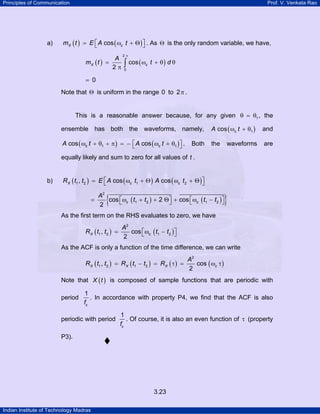
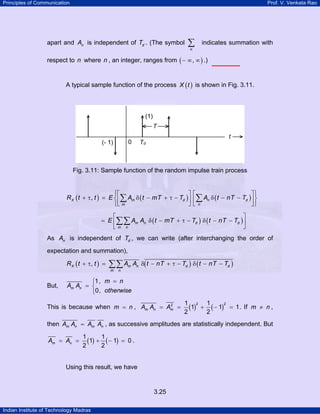
( ) ( ) ( ),X d d
n
R t t t nT T t nT T+ τ = δ − + τ − δ − −∑
( ) ( )
0
1
T
d d d
n
t nT t t nT t d t
T
= δ − + τ − δ − −∑ ∫
(Note that dT is uniformly distributed in the range 0 to T )
Let dt nT t x− − = . Then,
( ) ( ) ( )
( )1
1
,
t nT
X
n t n T
R t t x x d x
T
−
− +
+ τ = δ δ + τ∑ ∫
( ) ( )
−∞
+ ∞
= δ δ + τ∫ x x d x
T
1
Letting y x= − , we have
( ) ( ) ( ) ( ) ( )
1 1
,XR t t y y d y y y d y
T T
∞ ∞
− ∞ − ∞
+ τ = δ − δ τ − = δ δ τ −∫ ∫
( ) ( ) ( )
1 1
T T
⎡ ⎤= δ τ ∗ δ τ = δ τ⎣ ⎦
That is, the ACF is a function of τ alone and it is an impulse!
It is to be pointed out that in the case of a random process, we can also
define time averages such as time-averaged mean value or time-averaged ACF
etc., whose calculation is based on the individual sample functions. There are
certain processes, called ergodic processes where it is possible to interchange
the corresponding ensemble and time averages. More details on ergodic
processes can be found in [2].
3.4.2 Cross-correlation
Consider two random processes ( )X t and ( )Y t . We define the two
cross-correlation functions of ( )X t and ( )Y t as follows:
( ) ( ) ( ), 1 2 1 2,X YR t t E X t Y t⎡ ⎤= ⎣ ⎦](https://image.slidesharecdn.com/16-130805121015-phpapp01/85/1-6-26-320.jpg)

![Principles of Communication Prof. V. Venkata Rao
Indian Institute of Technology Madras
3.28
3.5 Systems with Random Signal Excitation
In Chapter 1, we discussed the transmission of deterministic signals
through linear systems. We had developed the relations for the input-output
spectral densities. We shall now develop the analogous relationships for the case
when a linear time-invariant system is excited by random signals.
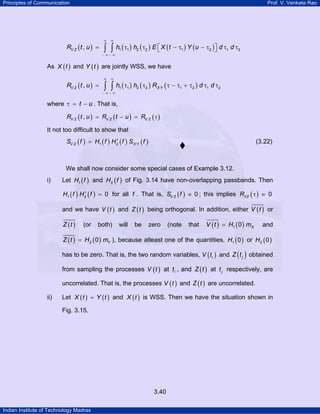
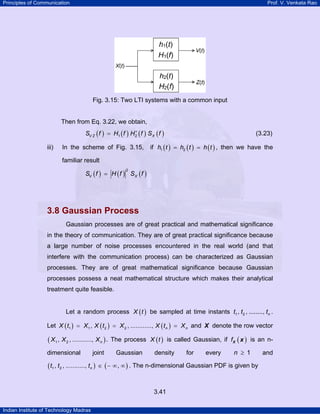
Consider the scheme shown in Fig. 3.12. ( )h t represents the (known)
impulse response of a linear time-invariant system that is excited by a random
process ( )X t , resulting in the output process ( )Y t .
Fig 3.12: Transmission of a random process through a linear filter
We shall now try to characterize the output process ( )Y t in terms of the
input process ( )X t and the impulse response ( )h t [third method of
specification]. Specifically, we would like to develop the relations for ( )Ym t and
( )1 2,YR t t when ( )X t is WSS.
Let ( )jx t be a sample function of ( )X t which is applied as input to the
linear time-invariant system. Let ( )jy t be the corresponding output where ( )jy t
belongs to ( )Y t . Then,
( ) ( ) ( )j jy t h x t d
∞
− ∞
= τ − τ τ∫
As the above relation is true for every sample function of ( )X t , we can write
( ) ( ) ( )Y t h X t d
∞
− ∞
= τ − τ τ∫
Consider first the mean of the output process](https://image.slidesharecdn.com/16-130805121015-phpapp01/85/1-6-28-320.jpg)


![Principles of Communication Prof. V. Venkata Rao
Indian Institute of Technology Madras
3.36
( ) ( )sinH f AT c f T=
Therefore, ( ) ( )2 2 21
sinXS f A T c f T
T
=
( )2 2
sinA T c f T=
Taking the inverse Fourier transform, we have
( )
2
1 , 0
0 ,
X
A T
R T
otherwise
⎧ ⎛ ⎞τ
− ≤ τ ≤⎪ ⎜ ⎟
τ = ⎨ ⎝ ⎠
⎪
⎩
The ACF of the random binary wave process can also be computed by direct
time domain arguments. The interested reader is referred to [3].
We note that the energy spectral density of a rectangular pulse ( )x t of
amplitude A and duration T , is ( ) ( )2 2 2
sinxE f A T c f T=
Hence, ( ) ( )x xS f E f T= .
Exercise 3.7
In the random binary wave process of example 3.9, let 1 be
represented by a pulse of amplitude A and duration T sec. The binary zero is
indicated by the absence of any pulse. The rest of the description of the
process is the same as in the example 3.9. Show that
( ) ( )
( )22
2 2
sin
4
X
f TA
S f f
f T
⎡ ⎤π
= δ +⎢ ⎥
π⎢ ⎥⎣ ⎦
Exercise 3.8
The input voltage to an RLC series circuit is a WSS process ( )X t with
( ) 2X t = and ( ) 2
4XR e
− τ
τ = + . Let ( )Y t be the voltage across the
capacitor. Find
a) ( )Y t
b) ( )YS f](https://image.slidesharecdn.com/16-130805121015-phpapp01/85/1-6-36-320.jpg)



![Principles of Communication Prof. V. Venkata Rao
Indian Institute of Technology Madras
3.44
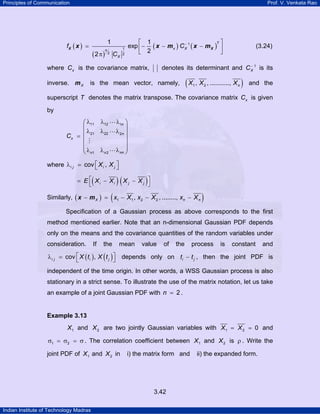
a) Let Y be the random variable obtained by sampling ( )X t at 5t = . Y is
Gaussian with the mean value 3, and the variance ( )0 4XC= = . That is,
Y is ( )3, 4N .
[ ] ( )
3 1
2 0.5
2 2
Y
P Y P Q
−⎡ ⎤
≤ = ≤ − =⎢ ⎥
⎣ ⎦
b) Let ( ) ( )8 5Z X X= − and ( )8Y X= , and ( )5W X= . Note that
Z Y W= − is Gaussian. We have 0Z = and
2 2 2
,2Z Y W Y W Y Wσ = σ + σ − ρ σ σ
[ ]2 2
2 cov ,Y W Y W= σ + σ −
0.2 3
4 4 2 4 e− ×
= + − ×
( )0.6
8 1 3.608e−
= − =
[ ] [ ]
1
1 2 0 1 2 1
2
P Z P Z P Z
⎧ ⎫
⎡ ⎤≤ = ≤ ≤ = − >⎨ ⎬⎣ ⎦
⎩ ⎭
( )
1
1 2 1 2 0.52
3.6 3.6
Z
P Q
⎡ ⎤
= − > = −⎢ ⎥
⎣ ⎦](https://image.slidesharecdn.com/16-130805121015-phpapp01/85/1-6-44-320.jpg)






![Principles of Communication Prof. V. Venkata Rao
Indian Institute of Technology Madras
3.56
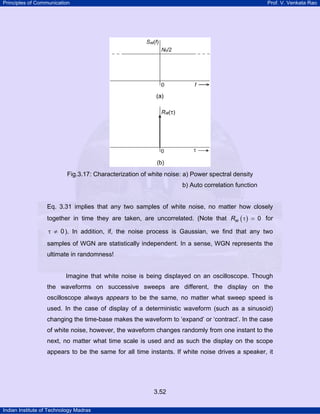
Fig 3.18: ( )NR τ of example 3.15
The filter output ( )N t is a stationary Gaussian process. Hence the PDF is
independent of the sampling time. As the variable Y is Gaussian, what we need
is the mean value and the variance of Y . Evidently [ ] 0E Y = and
( )2 2
00Y YY R N Bσ = = = . Hence Y is ( )00,N N B .
Note that ACF passes through zeros at
2
n
B
τ = where 1, 2, .....n = ± ± .
Hence any two random variables obtained by sampling the output process at
times 1t and 2t such that 1 2t t− is multiple of
1
2B
, are going to be statistically
independent.
Example 3.16: (White Noise through an RC-LPF)
Let ( )W t be input to an RC-LPF. Let us find the ACF of the output ( )N t .
If X and Y are two random variables obtained from sampling ( )N t with a
separation of 0.1 sec, let us find X Yρ .](https://image.slidesharecdn.com/16-130805121015-phpapp01/85/1-6-56-320.jpg)
![Principles of Communication Prof. V. Venkata Rao
Indian Institute of Technology Madras
3.57
The transfer function of the RC LPF is given by ( )
1
1 2
H f
j f RC
=
+ π
.
Therefore ( )
( )
0
2
2
1 2
N
N
S f
f RC
=
+ π
, and
( ) 0
exp
4
N
N
R
RC RC
⎛ ⎞− τ
τ = ⎜ ⎟
⎝ ⎠
[ ]
2
X Y
X Y
X Y
E XY
E X
λ
ρ = =
σ σ ⎡ ⎤⎣ ⎦
(Note that ( ) 0N t = and X Yσ = σ ).
[ ] ( ) 0.1 secNE XY R τ =
= τ
( )2 0
0
4
N
N
E X R
RCτ =
⎡ ⎤ = τ =⎣ ⎦
Hence, ( )0.1 RC
X Y e
−
ρ =
Exercise 3.11
( )X t is a zero mean Gaussian process with ( ) 2
1
1
XR τ =
+ τ
. Let
( ) ( )Y t X t= where ( )X t is the Hilbert transform of ( )X t . The process ( )X t
and ( )Y t are sampled at 1t = and 2t = sec. Let the corresponding random
variables be denoted by ( )1 2,X X and ( )1 2,Y Y respectively.
a) Write the covariance matrix of the four variables 1 2,X X 1 2andY Y .
b) Find the joint PDF of 2 ,X 1 2andY Y .](https://image.slidesharecdn.com/16-130805121015-phpapp01/85/1-6-57-320.jpg)












This document introduces the concept of random processes and provides examples to illustrate them. It defines a random process as a probability system composed of a sample space, an ensemble of time functions, and a probability measure. Random processes extend the concept of a random variable to incorporate the time parameter. Examples given include coin tossing, throwing a die, and thermal noise voltages across resistors. A random process is said to be stationary if its joint probability distribution is invariant to time shifts. Stationary processes have the property that the probability of waveforms passing through time-shifted windows remains the same. An example of a non-stationary process is also provided.


![Sensor Fusion Study - Ch2. Probability Theory [Stella]](https://cdn.slidesharecdn.com/ss_thumbnails/chapter2-200424170905-thumbnail.jpg?width=640&height=640&fit=bounds)


