An Overview ON
BSNL SUMMER TRAINING
SUBMITTED BY-
RAJAN MEENA
08EC071
VII SEM (ECE)
INDEX
1. COMPANY PROFILE
2. INTRODUCTION
3. ABOUT THE EXCHANGE
4. MDF
>TYPES OF FAULTS
>PROTECTIVE DEVICES
5. OCB
6. GSM
7. MEDIA
8. PROCEDURE FOR HANDLING COMPLAINTS
9.OPTICAL FIBER
INTRODUCTION
Today, BSNL is the No. 1 telecommunication company and
the largest public sector undertaking of India and its
responsibilities includes improvement of the already
impeccable quality of telecom services, expansion of telecom
services in all villages and instilling confidence among its
customers.
EXCHANGE:
Equipment which effects interconnected of telephones is
known as switching equipment.
The switching centre, which houses the terminating and
switching equipment is called telephone exchange.
EXCHANGE LAYOUT
 
Typical exchange consist of :
 Switch Room
Operations and Maintenance (OMC) Room
Input Output processor (IOP) Room
Power Plant Room
Battery Room
Main Distribution Frame (MDF) Room
 
ABOUT THE EXCHANGE
1. All telephone subscribers are served by automatic
exchanges.
2. Today’s automatic exchanges uses a pair of
computers.
 One, running the program that provides services.
 Second, monitoring the operation of the first, ready
to take over in a few seconds in the event of
equipment failure.
Various exchanges present in BSNL are:
> C-DOT
> OCB
> EWSD
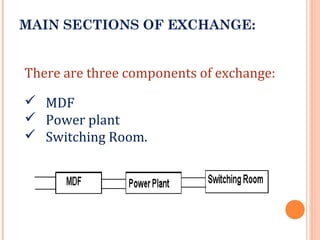
MAIN SECTIONS OF EXCHANGE:
There are three components of exchange:
 MDF
 Power plant
 Switching Room.
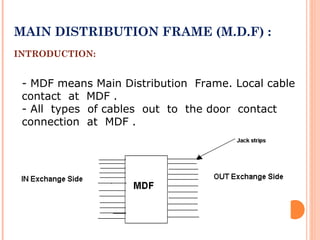
MAIN DISTRIBUTION FRAME (M.D.F) :
INTRODUCTION:
- MDF means Main Distribution Frame. Local cable
contact at MDF .
- All types of cables out to the door contact
connection at MDF .
THE MAIN PARTS OF THE POWER ROOM ARE:
1. BATTERIES
2. UPS (UNINTERRUPTED POWER SUPPLY)
3. CHARGING - DISCHARGING UNIT
4. INVERTER AND CONVERTER UNIT:
POWER PLANT :
SWITCHING ROOM :
Switch room consists of BM and CM
cabinets mounted in standard switch.
These cabinets are fastened to a switch
Room and interconnected by cables.
.
MAIN DISTRIBUTION FRAME
> The primary function of MDF is to remove
fault. It is also known as Fault Remove Section.
> The telephone numbers are also disconnected in
the MDF because of some specific reason.
ORGANISATION OF THE MDF
• Vertical side
• Horizontal side
VERTICAL SIDE
 
RACK: -On the rack, the tags are situated. One rack is having eight
tags. The counting is done from up (0) to down (7).
TAGS: -Each rack consists of eight tags.
1 tag = 4 core
1 core = 4 bunch
1 bunch = 2 line
N.E.:-The word NE stands for the ‘NUMBER OF EQUIPMENT’.
It is used for testing number.
WEDGE: Wedge is used as a device for checking the ring. Wedge
is placed in jack strips, which is connected to telephone for
checking.
HORIZONTAL SIDE:
The horizontal side connected to the underground cable.
This cable is having 100 pairs. These pair is distributed
when we allot the telephone number to the subscriber.
Horizontal side is again subdivided in two parts:
One part is connected with the vertical side.
 Another with the subscriber line by using 100 pair
underground cable.
CONSTRUCTION OF M.D.F:-
Main distribution frame is mainly divided in two
parts.
(1) Vertical Side or Line side.
(2) LEN side or Exchange side.
VERTICAL SIDE:
All the part from vertical side to the subscriber are
generally called outdoor section.:
1. One vertical has 10 tag blocks.
2. Each tag block has 10 rows and each row has 10 tags.
So each tag block has 100 tags.
3. Connection between vertical side & subscribers are
provided by jelly filled cables.
4. These wires are first terminated in cabinet box, then
according to requirements the group of the wires (e.g. 200
wires, 100 wires etc.) is terminated in pillar box
LEN SIDE:
• All the parts from LEN to the exchange is called
indoor section.
• The connection of subscriber from exchange is
terminated on this side of MDF.
• In 1 tag block there are 128 tags. Each tag block is
divided in 4 segments. That is 0, 1,2 & 3 and in each
segments.
. DIFFERENT TYPES OF FAULTS:-
LOOP FAULT:-IF TWO WIRES ARE JOINED TOGETHER
BECAUSE OF IMPROPER CONNECTION,
STORMING AIR ETC.
EARTH FAULT:-IF TWO WIRES GET SCRAPE AT SOME PLACES
AND IF THIS WIRE COMES IN
CONTACT WITH TREE, PILLAR OR ANY METAL OBJECTS THEN
THIS TYPE OF FAULT OCCURS.
CABLE FAULT:-FOR OUTDOOR CONNECTIONS, JELLY FILLED
WIRES ARE USED WHICH ARE AFFECTED BY NATURAL
CAUSES SUCH AS RAIN, EARTHQUAKE ETC. AT SUCH TIME
THIS FAULT OCCURS.
DISCONNECT FAULT:-THIS TYPE OF FAULT OCCURS DUE TO
THE BREAKING OF WIRES BETWEEN THE VERTICAL SIDE &
LEN SIDE.
ROTECTIVE DEVICES USED IN M.D.F
 Fuses
 Gas Discharge Tube(G.D Tube)
 Insertion Tool
 Wires
OCB
The new switching systems are based on Stored Program
Control concept. The call processing programmers are
distributed over different control organs of the system and
are stored in ROM/RAM of the units Processor in the
control units .
Features:
 It is a digital switching system.
 The system supports all the existing signaling system
.The system has ‘auto recovery’ feature. When a
serious fault occur in control unit, it gives a message
to SMM (operation & maintenance unit).
•GLOBAL SYSTEM FOR MOBILE
COMMUNICATION
(GSM)
Global system for mobile communication (GSM) is a
globally accepted standard for digital cellular
communication. GSM is the name of a standardization
group established in 1982 to create a common European
mobile telephone standard
GSM is a cellular network which means that mobile
phones connect to it by searching for cells in the
immediate vicinity. GSM operates in the 900 MHz
frequency band.
THERE ARE FIVE DIFFERENT CELL
SIZES IN A GSM NETWORK-
 Macro Cells
 Micro Cells
 Pico Cells
 Femto Cells
 Umbrella Cells
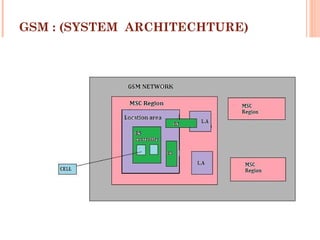
GSM : (SYSTEM ARCHITECHTURE)
This system structured hierarchically as shown:
 
 It consist of one administrative region, which is
assigned to a MSC(Mobile Switching Center).
 Each administrative Region is made up of atleast one
Location Area(LA). LA is also called the visited area.
 An LA consists of several cell groups.
 Each cell group is assigned to a base station
controller(BSC).
 Cells of one BSC may belong to different LA’s.
GSM : (SYSTEM ARCHITECHTURE)
BASIC BUILDING BLOCKS:
Mobile Station (MS)
 Base Station (BS)
 Mobile services Switching Center (MSC)
 Databases
 Operation and Maintenance Center (OMC)
SYSTEM CAPACITY
 Shannon’s Theory predicts the maximum amount of
information that can be transmitted over a channel
with given BW & SNR.
 The optimum usage of given BW is obtained when the
signal are noise – like & min SNR.
 Hence for increased capacity the choice is CDMA.
MEDIA : -
1.Carrier system
2. Co-axial Cable
3. Optical Fiber Cable(OFC).
4. Satellite.
PROCEDURE FOR HANDLING
SUBSCRIBER COMPLAINTS
Telephone Dead:
Case--I Problem concerns a particular subscriber.
Case-II Quit a few numbers of telephone reported dead:
Telephone Held-Up ( No Dial Tone ):
> PERMANENT RING
> PERMANENT DIAL TONE
> PERMANENT BUSY TONE
> PERMANENT RING – TRIP
 > SPEECH QUALITY POOR
 > WRONG NUMBERS
 
> ONE WAY SPEECH
> RINGER CADENCE
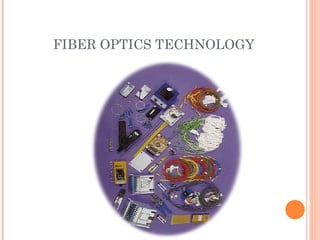
FIBER OPTICS TECHNOLOGY
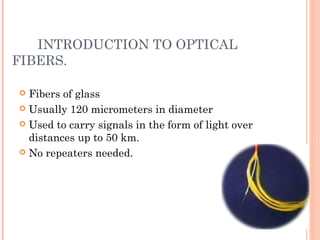
 Fibers of glass
 Usually 120 micrometers in diameter
 Used to carry signals in the form of light over
distances up to 50 km.
 No repeaters needed.
INTRODUCTION TO OPTICAL
FIBERS.
INTRODUCTION (CONT…)
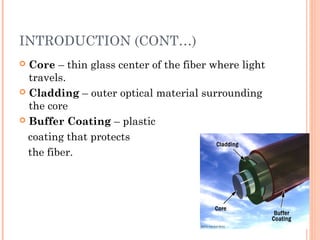
 Core – thin glass center of the fiber where light
travels.
 Cladding – outer optical material surrounding
the core
 Buffer Coating – plastic
coating that protects
the fiber.
EVOLUTION OF FIBER
 1880 – Alexander Graham Bell
 1930 – Patents on tubing
 1950 – Patent for two-layer glass wave-guide
 1960 – Laser first used as light source
 1965 – High loss of light discovered
 1970s – Refining of manufacturing process
 1980s – OF technology becomes backbone of
long distance telephone networks in NA.
ADVANTAGES OF OPTICAL FIBRE
 Thinner
 Less Expensive
 Higher Carrying Capacity
 Less Signal Degradation& Digital Signals
 Light Signals
 Non-Flammable
 Light Weight
AREAS OF APPLICATION
 Telecommunications
 Local Area Networks
 Cable TV
 CCTV
 Optical Fiber Sensors
TYPE OF FIBERS
Optical fibers come in two types:
 Single-mode fibers – used to transmit one
signal per fiber (used in telephone and cable TV).
They have small cores(9 microns in diameter) and
transmit infra-red light from laser.
 Multi-mode fibers – used to transmit many
signals per fiber (used in computer networks).
They have larger cores(62.5 microns in diameter)
and transmit infra-red light from LED.
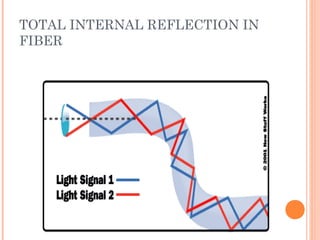
HOW DOES OPTICAL FIBRE
TRANSMIT LIGHT??
 Total Internal Reflection.
 Fibre Optics Relay Systems has
-Transmitter
-Optical Fibre
-Optical Regenerator
-Optical Receiver
TOTAL INTERNAL REFLECTION IN
FIBER
Final ppt

Final ppt

  • 1.
    An Overview ON BSNLSUMMER TRAINING SUBMITTED BY- RAJAN MEENA 08EC071 VII SEM (ECE)
  • 2.
    INDEX 1. COMPANY PROFILE 2.INTRODUCTION 3. ABOUT THE EXCHANGE 4. MDF >TYPES OF FAULTS >PROTECTIVE DEVICES 5. OCB 6. GSM 7. MEDIA 8. PROCEDURE FOR HANDLING COMPLAINTS 9.OPTICAL FIBER
  • 3.
    INTRODUCTION Today, BSNL isthe No. 1 telecommunication company and the largest public sector undertaking of India and its responsibilities includes improvement of the already impeccable quality of telecom services, expansion of telecom services in all villages and instilling confidence among its customers. EXCHANGE: Equipment which effects interconnected of telephones is known as switching equipment. The switching centre, which houses the terminating and switching equipment is called telephone exchange.
  • 4.
    EXCHANGE LAYOUT   Typical exchangeconsist of :  Switch Room Operations and Maintenance (OMC) Room Input Output processor (IOP) Room Power Plant Room Battery Room Main Distribution Frame (MDF) Room  
  • 5.
    ABOUT THE EXCHANGE 1.All telephone subscribers are served by automatic exchanges. 2. Today’s automatic exchanges uses a pair of computers.  One, running the program that provides services.  Second, monitoring the operation of the first, ready to take over in a few seconds in the event of equipment failure. Various exchanges present in BSNL are: > C-DOT > OCB > EWSD
  • 6.
    MAIN SECTIONS OFEXCHANGE: There are three components of exchange:  MDF  Power plant  Switching Room.
  • 7.
    MAIN DISTRIBUTION FRAME(M.D.F) : INTRODUCTION: - MDF means Main Distribution Frame. Local cable contact at MDF . - All types of cables out to the door contact connection at MDF .
  • 8.
    THE MAIN PARTSOF THE POWER ROOM ARE: 1. BATTERIES 2. UPS (UNINTERRUPTED POWER SUPPLY) 3. CHARGING - DISCHARGING UNIT 4. INVERTER AND CONVERTER UNIT: POWER PLANT :
  • 9.
    SWITCHING ROOM : Switchroom consists of BM and CM cabinets mounted in standard switch. These cabinets are fastened to a switch Room and interconnected by cables.
  • 10.
    . MAIN DISTRIBUTION FRAME >The primary function of MDF is to remove fault. It is also known as Fault Remove Section. > The telephone numbers are also disconnected in the MDF because of some specific reason. ORGANISATION OF THE MDF • Vertical side • Horizontal side
  • 11.
    VERTICAL SIDE   RACK: -Onthe rack, the tags are situated. One rack is having eight tags. The counting is done from up (0) to down (7). TAGS: -Each rack consists of eight tags. 1 tag = 4 core 1 core = 4 bunch 1 bunch = 2 line N.E.:-The word NE stands for the ‘NUMBER OF EQUIPMENT’. It is used for testing number. WEDGE: Wedge is used as a device for checking the ring. Wedge is placed in jack strips, which is connected to telephone for checking.
  • 12.
    HORIZONTAL SIDE: The horizontalside connected to the underground cable. This cable is having 100 pairs. These pair is distributed when we allot the telephone number to the subscriber. Horizontal side is again subdivided in two parts: One part is connected with the vertical side.  Another with the subscriber line by using 100 pair underground cable.
  • 13.
    CONSTRUCTION OF M.D.F:- Maindistribution frame is mainly divided in two parts. (1) Vertical Side or Line side. (2) LEN side or Exchange side.
  • 14.
    VERTICAL SIDE: All thepart from vertical side to the subscriber are generally called outdoor section.: 1. One vertical has 10 tag blocks. 2. Each tag block has 10 rows and each row has 10 tags. So each tag block has 100 tags. 3. Connection between vertical side & subscribers are provided by jelly filled cables. 4. These wires are first terminated in cabinet box, then according to requirements the group of the wires (e.g. 200 wires, 100 wires etc.) is terminated in pillar box
  • 15.
    LEN SIDE: • Allthe parts from LEN to the exchange is called indoor section. • The connection of subscriber from exchange is terminated on this side of MDF. • In 1 tag block there are 128 tags. Each tag block is divided in 4 segments. That is 0, 1,2 & 3 and in each segments.
  • 16.
    . DIFFERENT TYPESOF FAULTS:- LOOP FAULT:-IF TWO WIRES ARE JOINED TOGETHER BECAUSE OF IMPROPER CONNECTION, STORMING AIR ETC. EARTH FAULT:-IF TWO WIRES GET SCRAPE AT SOME PLACES AND IF THIS WIRE COMES IN CONTACT WITH TREE, PILLAR OR ANY METAL OBJECTS THEN THIS TYPE OF FAULT OCCURS. CABLE FAULT:-FOR OUTDOOR CONNECTIONS, JELLY FILLED WIRES ARE USED WHICH ARE AFFECTED BY NATURAL CAUSES SUCH AS RAIN, EARTHQUAKE ETC. AT SUCH TIME THIS FAULT OCCURS. DISCONNECT FAULT:-THIS TYPE OF FAULT OCCURS DUE TO THE BREAKING OF WIRES BETWEEN THE VERTICAL SIDE & LEN SIDE.
  • 17.
    ROTECTIVE DEVICES USEDIN M.D.F  Fuses  Gas Discharge Tube(G.D Tube)  Insertion Tool  Wires
  • 18.
    OCB The new switchingsystems are based on Stored Program Control concept. The call processing programmers are distributed over different control organs of the system and are stored in ROM/RAM of the units Processor in the control units . Features:  It is a digital switching system.  The system supports all the existing signaling system .The system has ‘auto recovery’ feature. When a serious fault occur in control unit, it gives a message to SMM (operation & maintenance unit).
  • 19.
    •GLOBAL SYSTEM FORMOBILE COMMUNICATION (GSM) Global system for mobile communication (GSM) is a globally accepted standard for digital cellular communication. GSM is the name of a standardization group established in 1982 to create a common European mobile telephone standard GSM is a cellular network which means that mobile phones connect to it by searching for cells in the immediate vicinity. GSM operates in the 900 MHz frequency band.
  • 20.
    THERE ARE FIVEDIFFERENT CELL SIZES IN A GSM NETWORK-  Macro Cells  Micro Cells  Pico Cells  Femto Cells  Umbrella Cells
  • 21.
    GSM : (SYSTEMARCHITECHTURE) This system structured hierarchically as shown:    It consist of one administrative region, which is assigned to a MSC(Mobile Switching Center).  Each administrative Region is made up of atleast one Location Area(LA). LA is also called the visited area.  An LA consists of several cell groups.  Each cell group is assigned to a base station controller(BSC).  Cells of one BSC may belong to different LA’s.
  • 22.
    GSM : (SYSTEMARCHITECHTURE)
  • 23.
    BASIC BUILDING BLOCKS: MobileStation (MS)  Base Station (BS)  Mobile services Switching Center (MSC)  Databases  Operation and Maintenance Center (OMC)
  • 24.
    SYSTEM CAPACITY  Shannon’sTheory predicts the maximum amount of information that can be transmitted over a channel with given BW & SNR.  The optimum usage of given BW is obtained when the signal are noise – like & min SNR.  Hence for increased capacity the choice is CDMA.
  • 25.
    MEDIA : - 1.Carriersystem 2. Co-axial Cable 3. Optical Fiber Cable(OFC). 4. Satellite.
  • 26.
    PROCEDURE FOR HANDLING SUBSCRIBERCOMPLAINTS Telephone Dead: Case--I Problem concerns a particular subscriber. Case-II Quit a few numbers of telephone reported dead: Telephone Held-Up ( No Dial Tone ):
  • 27.
    > PERMANENT RING >PERMANENT DIAL TONE > PERMANENT BUSY TONE > PERMANENT RING – TRIP  > SPEECH QUALITY POOR  > WRONG NUMBERS   > ONE WAY SPEECH > RINGER CADENCE
  • 28.
  • 29.
     Fibers ofglass  Usually 120 micrometers in diameter  Used to carry signals in the form of light over distances up to 50 km.  No repeaters needed. INTRODUCTION TO OPTICAL FIBERS.
  • 30.
    INTRODUCTION (CONT…)  Core– thin glass center of the fiber where light travels.  Cladding – outer optical material surrounding the core  Buffer Coating – plastic coating that protects the fiber.
  • 31.
    EVOLUTION OF FIBER 1880 – Alexander Graham Bell  1930 – Patents on tubing  1950 – Patent for two-layer glass wave-guide  1960 – Laser first used as light source  1965 – High loss of light discovered  1970s – Refining of manufacturing process  1980s – OF technology becomes backbone of long distance telephone networks in NA.
  • 32.
    ADVANTAGES OF OPTICALFIBRE  Thinner  Less Expensive  Higher Carrying Capacity  Less Signal Degradation& Digital Signals  Light Signals  Non-Flammable  Light Weight
  • 33.
    AREAS OF APPLICATION Telecommunications  Local Area Networks  Cable TV  CCTV  Optical Fiber Sensors
  • 34.
    TYPE OF FIBERS Opticalfibers come in two types:  Single-mode fibers – used to transmit one signal per fiber (used in telephone and cable TV). They have small cores(9 microns in diameter) and transmit infra-red light from laser.  Multi-mode fibers – used to transmit many signals per fiber (used in computer networks). They have larger cores(62.5 microns in diameter) and transmit infra-red light from LED.
  • 35.
    HOW DOES OPTICALFIBRE TRANSMIT LIGHT??  Total Internal Reflection.  Fibre Optics Relay Systems has -Transmitter -Optical Fibre -Optical Regenerator -Optical Receiver
  • 36.