REGULAR EXPRESSIONS
M RATNAKAR BABU
Asst.Prof. CSE
Introduction
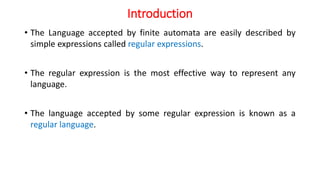
• The Language accepted by finite automata are easily described by
simple expressions called regular expressions.
• The regular expression is the most effective way to represent any
language.
• The language accepted by some regular expression is known as a
regular language.
Regular Expressions
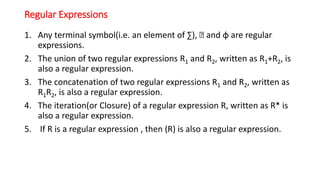
1. Any terminal symbol(i.e. an element of ∑), Ꜫ and φ are regular
expressions.
2. The union of two regular expressions R1 and R2, written as R1+R2, is
also a regular expression.
3. The concatenation of two regular expressions R1 and R2, written as
R1R2, is also a regular expression.
4. The iteration(or Closure) of a regular expression R, written as R* is
also a regular expression.
5. If R is a regular expression , then (R) is also a regular expression.
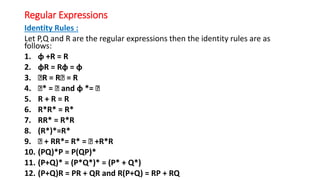
Identity Rules :
Let P,Q and R are the regular expressions then the identity rules are as
follows:
1. φ +R = R
2. φR = Rφ = φ
3. ꜪR = RꜪ = R
4. Ꜫ* = Ꜫ and φ *= Ꜫ
5. R + R = R
6. R*R* = R*
7. RR* = R*R
8. (R*)*=R*
9. Ꜫ + RR*= R* = Ꜫ +R*R
10. (PQ)*P = P(QP)*
11. (P+Q)* = (P*Q*)* = (P* + Q*)
12. (P+Q)R = PR + QR and R(P+Q) = RP + RQ
Regular Expressions
• Exercise 2: Construct the regular expression for the language which accepts
all the strings which begin or end with either 00 or 11.
Solution:
The R.E. can be categorized into two subparts.
R = L1 + L2
L1 = The String which begin with 00 or 11.
L2 = The String which end with 00 or 11.
Let us find out L1 and L2.
L1 = (00+11)( any number of 0’s and 1’s )
L1 = (00+11)(0+1)*
L2 = ( any number of 0’s and 1’s ) (00+11)
L2 = (0+1)*(00+11)
Hence
R = [(00+11)(0+1)*] + [(0+1)*(00+11)]
Regular Expressions
Algorithm to build R.E. from given DFA
1. Let q1 be the initial state.
2. There are q2,q3,q4,….qn number of states. The final state may be
some qj where j<=n.
3. Let ji represents the transition from qj to qi.
4. Calculate qi such that
qi = ji .qj
If qi is a start state
qi = ji .qj +Ꜫ
5. Similarly compute the final state which ultimately gives the regular
expression r.
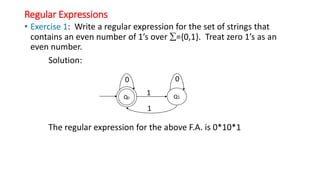
• Exercise 1: Write a regular expression for the set of strings that
contains an even number of 1’s over ={0,1}. Treat zero 1’s as an
even number.
Solution:
The regular expression for the above F.A. is 0*10*1
Regular Expressions
Q0 Q1
1
0 0
1
DFA to RE via State Elimination (1)
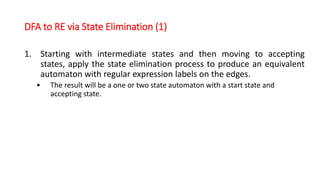
1. Starting with intermediate states and then moving to accepting
states, apply the state elimination process to produce an equivalent
automaton with regular expression labels on the edges.
• The result will be a one or two state automaton with a start state and
accepting state.
DFA to RE State Elimination (2)
2. If the two states are different, we will have
an automaton that looks like the following:
Start
S
R
T
U
We can describe this automaton as: (R+SU*T)*SU*
DFA to RE State Elimination (3)
3. If the start state is also an accepting state, then we must
also perform a state elimination from the original
automaton that gets rid of every state but the start state.
This leaves the following:
Start
R
We can describe this automaton as simply R*.
DFA to RE State Elimination (4)
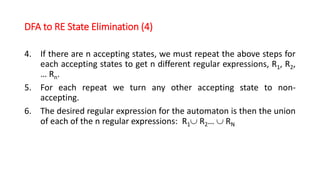
4. If there are n accepting states, we must repeat the above steps for
each accepting states to get n different regular expressions, R1, R2,
… Rn.
5. For each repeat we turn any other accepting state to non-
accepting.
6. The desired regular expression for the automaton is then the union
of each of the n regular expressions: R1 R2…  RN
DFARE Example
• Convert the following to a RE
• First convert the edges to RE’s:
3Start 1 2
1 1
0
0
0,1
3Start 1 2
1 1
0
0
0+1
DFA  RE Example (2)
• Eliminate State 1:
• To:
Start
0
0
3 1 2
1 1
0+1
3Start 2
11
0+10 0+1
Note edge from 33
Answer: (0+10)*11(0+1)*
Second Example
• Automata that accepts even number of 1’s
• Eliminate state 2:
1Start 2 3
1 1
0
1
00
0+10*1
1Start 3
0
10*1
Second Example (2)
• Two accepting states, turn off state 3 first
1Start 3
0 0+10*1
10*1
This is just 0*; can ignore going to state 3 since we would “die”
1Start
0
3
0+10*1
10*1
Second Example (3)
• Turn off state 1 second:
1Start 3
0 0+10*1
10*1
This is just 0*10*1(0+10*1)*
Combine from previous slide to get
0* + 0*10*1(0+10*1)*
0+10*1
1Start 3
0
10*1
Converting a RE to an Automata
• We have shown we can convert an automata to a RE. To show
equivalence we must also go the other direction, convert a RE to
an automaton.
• We can do this easiest by converting a RE to an ε-NFA
RE to ε-NFA
• Basis:
R=a
R=ε ε
R=Ø
a
Next slide: More complex RE’s
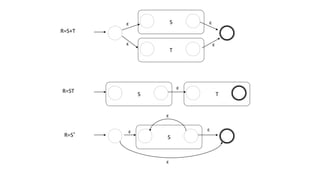
R=S+T
S
T
ε
ε
ε
ε
R=ST
S T
ε
R=S*
ε
S
ε
ε
ε
RE to ε-NFA Example
• Convert R= (ab+a)* to an NFA
• We proceed in stages, starting from simple elements and working our way up
a
a
b
b
ab
a bε
RE to ε-NFA Example (2)
ab+a
(ab+a)*
a bε
a
ε
ε
ε
ε
a bε
a
ε
ε
ε
ε
εε
ε
ε
End for Now
Continue in Next Class

Regular expressions

  • 1.
    REGULAR EXPRESSIONS M RATNAKARBABU Asst.Prof. CSE
  • 2.
    Introduction • The Languageaccepted by finite automata are easily described by simple expressions called regular expressions. • The regular expression is the most effective way to represent any language. • The language accepted by some regular expression is known as a regular language.
  • 3.
    Regular Expressions 1. Anyterminal symbol(i.e. an element of ∑), Ꜫ and φ are regular expressions. 2. The union of two regular expressions R1 and R2, written as R1+R2, is also a regular expression. 3. The concatenation of two regular expressions R1 and R2, written as R1R2, is also a regular expression. 4. The iteration(or Closure) of a regular expression R, written as R* is also a regular expression. 5. If R is a regular expression , then (R) is also a regular expression.
  • 4.
    Identity Rules : LetP,Q and R are the regular expressions then the identity rules are as follows: 1. φ +R = R 2. φR = Rφ = φ 3. ꜪR = RꜪ = R 4. Ꜫ* = Ꜫ and φ *= Ꜫ 5. R + R = R 6. R*R* = R* 7. RR* = R*R 8. (R*)*=R* 9. Ꜫ + RR*= R* = Ꜫ +R*R 10. (PQ)*P = P(QP)* 11. (P+Q)* = (P*Q*)* = (P* + Q*) 12. (P+Q)R = PR + QR and R(P+Q) = RP + RQ Regular Expressions
  • 5.
    • Exercise 2:Construct the regular expression for the language which accepts all the strings which begin or end with either 00 or 11. Solution: The R.E. can be categorized into two subparts. R = L1 + L2 L1 = The String which begin with 00 or 11. L2 = The String which end with 00 or 11. Let us find out L1 and L2. L1 = (00+11)( any number of 0’s and 1’s ) L1 = (00+11)(0+1)* L2 = ( any number of 0’s and 1’s ) (00+11) L2 = (0+1)*(00+11) Hence R = [(00+11)(0+1)*] + [(0+1)*(00+11)] Regular Expressions
  • 6.
    Algorithm to buildR.E. from given DFA 1. Let q1 be the initial state. 2. There are q2,q3,q4,….qn number of states. The final state may be some qj where j<=n. 3. Let ji represents the transition from qj to qi. 4. Calculate qi such that qi = ji .qj If qi is a start state qi = ji .qj +Ꜫ 5. Similarly compute the final state which ultimately gives the regular expression r.
  • 7.
    • Exercise 1:Write a regular expression for the set of strings that contains an even number of 1’s over ={0,1}. Treat zero 1’s as an even number. Solution: The regular expression for the above F.A. is 0*10*1 Regular Expressions Q0 Q1 1 0 0 1
  • 8.
    DFA to REvia State Elimination (1) 1. Starting with intermediate states and then moving to accepting states, apply the state elimination process to produce an equivalent automaton with regular expression labels on the edges. • The result will be a one or two state automaton with a start state and accepting state.
  • 9.
    DFA to REState Elimination (2) 2. If the two states are different, we will have an automaton that looks like the following: Start S R T U We can describe this automaton as: (R+SU*T)*SU*
  • 10.
    DFA to REState Elimination (3) 3. If the start state is also an accepting state, then we must also perform a state elimination from the original automaton that gets rid of every state but the start state. This leaves the following: Start R We can describe this automaton as simply R*.
  • 11.
    DFA to REState Elimination (4) 4. If there are n accepting states, we must repeat the above steps for each accepting states to get n different regular expressions, R1, R2, … Rn. 5. For each repeat we turn any other accepting state to non- accepting. 6. The desired regular expression for the automaton is then the union of each of the n regular expressions: R1 R2…  RN
  • 12.
    DFARE Example • Convertthe following to a RE • First convert the edges to RE’s: 3Start 1 2 1 1 0 0 0,1 3Start 1 2 1 1 0 0 0+1
  • 13.
    DFA  REExample (2) • Eliminate State 1: • To: Start 0 0 3 1 2 1 1 0+1 3Start 2 11 0+10 0+1 Note edge from 33 Answer: (0+10)*11(0+1)*
  • 14.
    Second Example • Automatathat accepts even number of 1’s • Eliminate state 2: 1Start 2 3 1 1 0 1 00 0+10*1 1Start 3 0 10*1
  • 15.
    Second Example (2) •Two accepting states, turn off state 3 first 1Start 3 0 0+10*1 10*1 This is just 0*; can ignore going to state 3 since we would “die” 1Start 0 3 0+10*1 10*1
  • 16.
    Second Example (3) •Turn off state 1 second: 1Start 3 0 0+10*1 10*1 This is just 0*10*1(0+10*1)* Combine from previous slide to get 0* + 0*10*1(0+10*1)* 0+10*1 1Start 3 0 10*1
  • 17.
    Converting a REto an Automata • We have shown we can convert an automata to a RE. To show equivalence we must also go the other direction, convert a RE to an automaton. • We can do this easiest by converting a RE to an ε-NFA
  • 18.
    RE to ε-NFA •Basis: R=a R=ε ε R=Ø a Next slide: More complex RE’s
  • 19.
  • 20.
    RE to ε-NFAExample • Convert R= (ab+a)* to an NFA • We proceed in stages, starting from simple elements and working our way up a a b b ab a bε
  • 21.
    RE to ε-NFAExample (2) ab+a (ab+a)* a bε a ε ε ε ε a bε a ε ε ε ε εε ε ε
  • 22.
    End for Now Continuein Next Class