Communication Systems
Probability and Random Processes
Dr. Irfan Arshad
Department of Electrical Engineering
Outline
• Probability
– How probability is defined
– cdf and pdf
– Mean and variance
Joint distribution
– Central limit theorem
• Random processes
– Definition
– Stationary random processes
– Power spectral density
Why Probability/Random Process?
• Probability is the core mathematical tool for communication
theory.
• The stochastic model is widely used in the study of
communication systems.
• Consider a radio communication system where the received
signal is a random process in nature:
– Message is random. No randomness, no information.
– Interference is random.
– Noise is a random process.
– And many more (delay, phase, fading, ...)
• Other real-world applications of probability and random
processes include
– Stock market modelling, gambling etc
Probabilistic Concepts
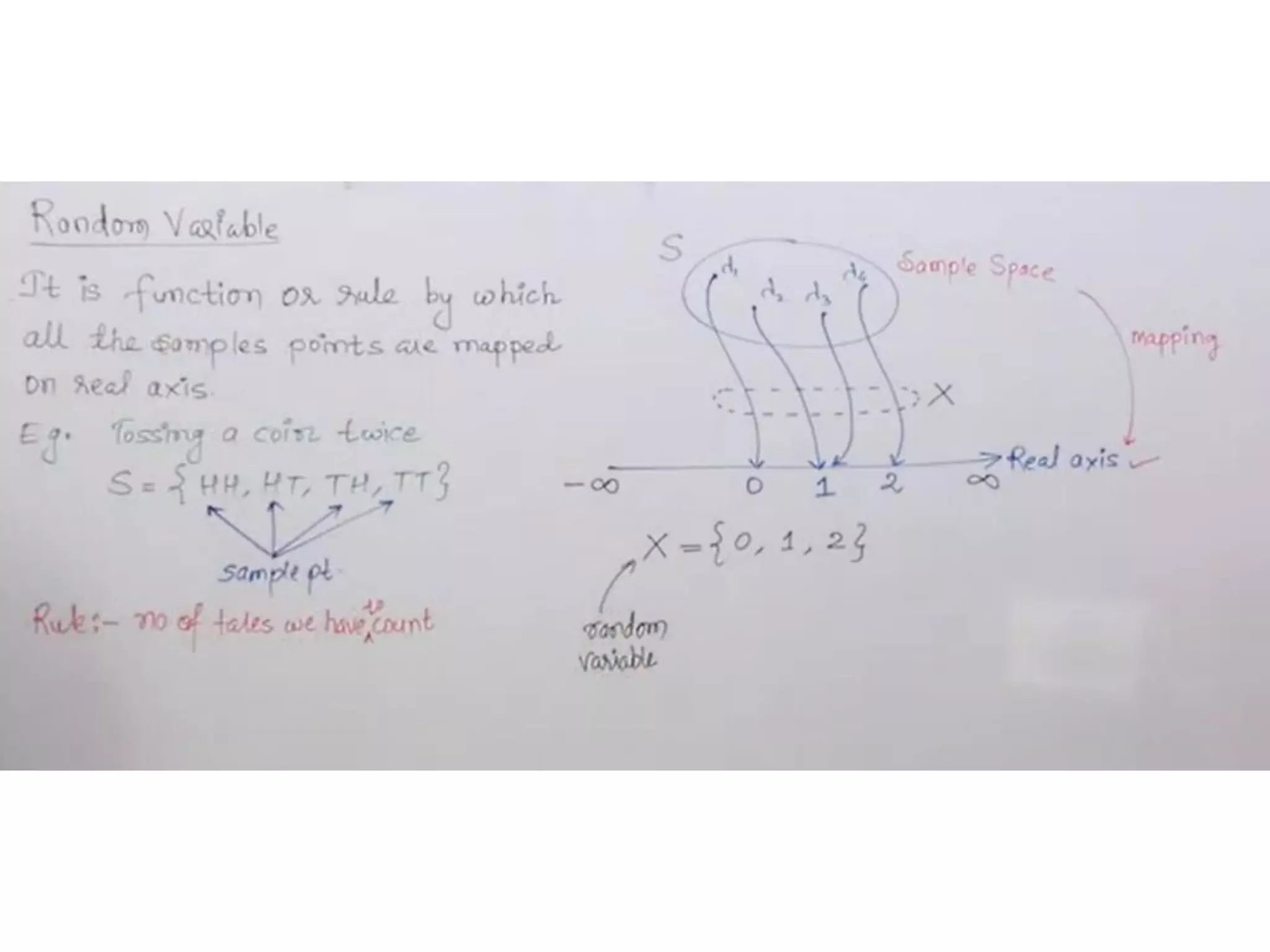
• What is a random variable (RV)?
– It is a variable that takes its values from the outputs of a random
experiment.
• What is a random experiment?
– It is an experiment the outcome of which cannot be predicted
precisely.
– All possible identifiable outcomes of a random experiment
constitute its sample space S.
– An event is a collection of possible outcomes of the random
experiment.
• Example
– For tossing a coin, S = { H, T }
– For rolling a die, S = { 1, 2, …, 6 }
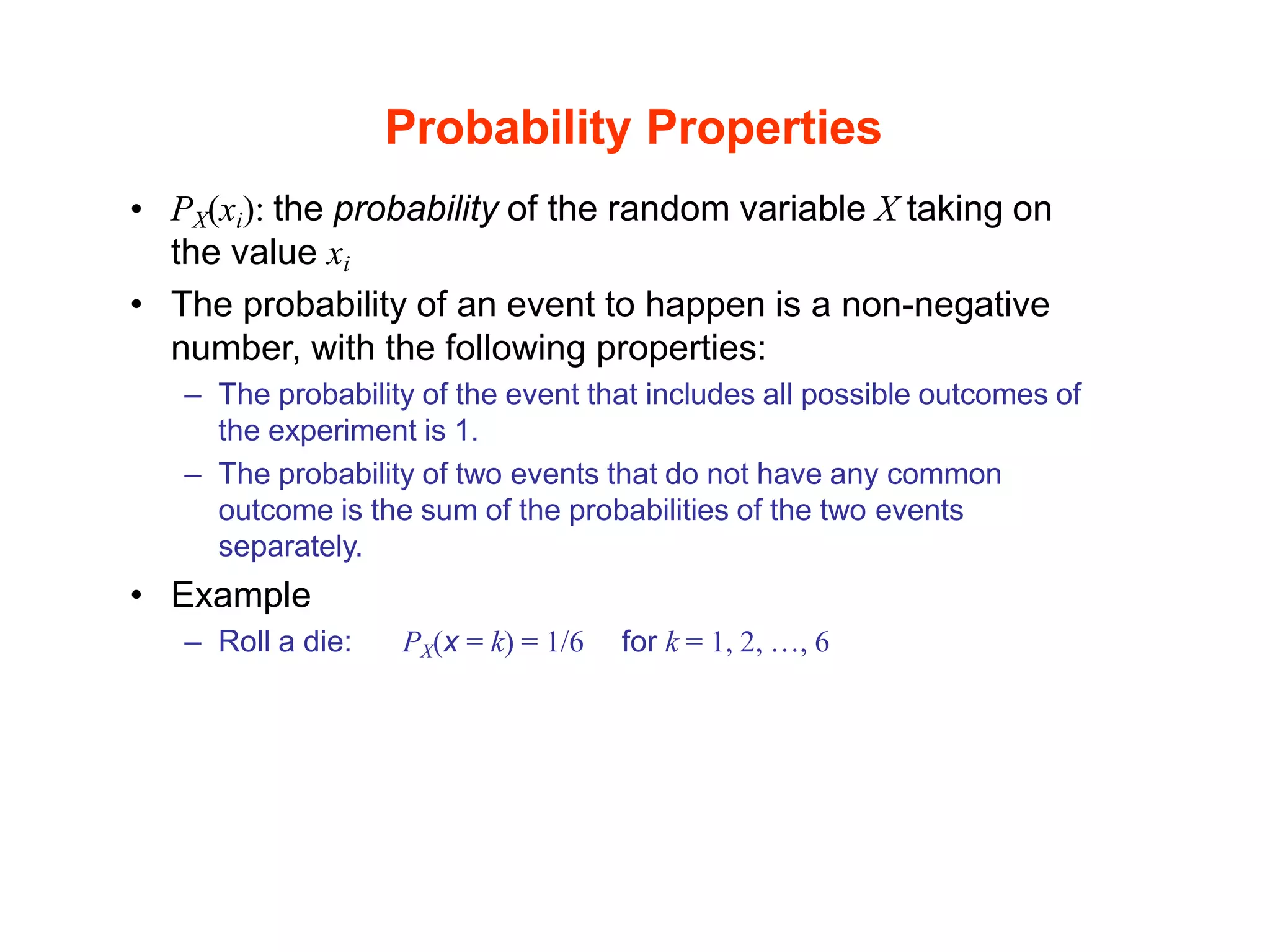
Probability Properties
• PX(xi): the probability of the random variable X taking on
the value xi
• The probability of an event to happen is a non-negative
number, with the following properties:
– The probability of the event that includes all possible outcomes of
the experiment is 1.
– The probability of two events that do not have any common
outcome is the sum of the probabilities of the two events
separately.
• Example
– Roll a die: PX(x = k) = 1/6 for k = 1, 2, …, 6
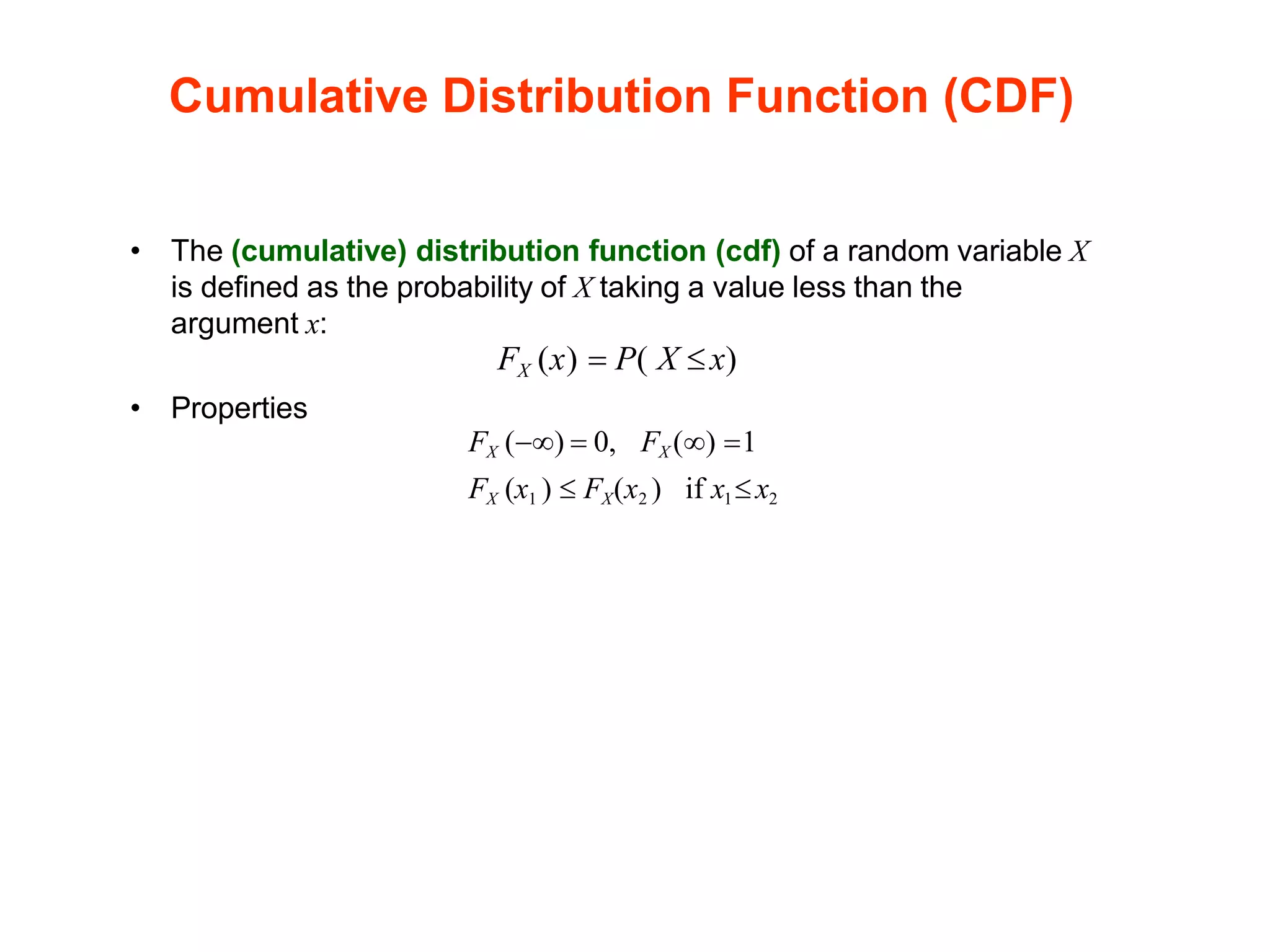
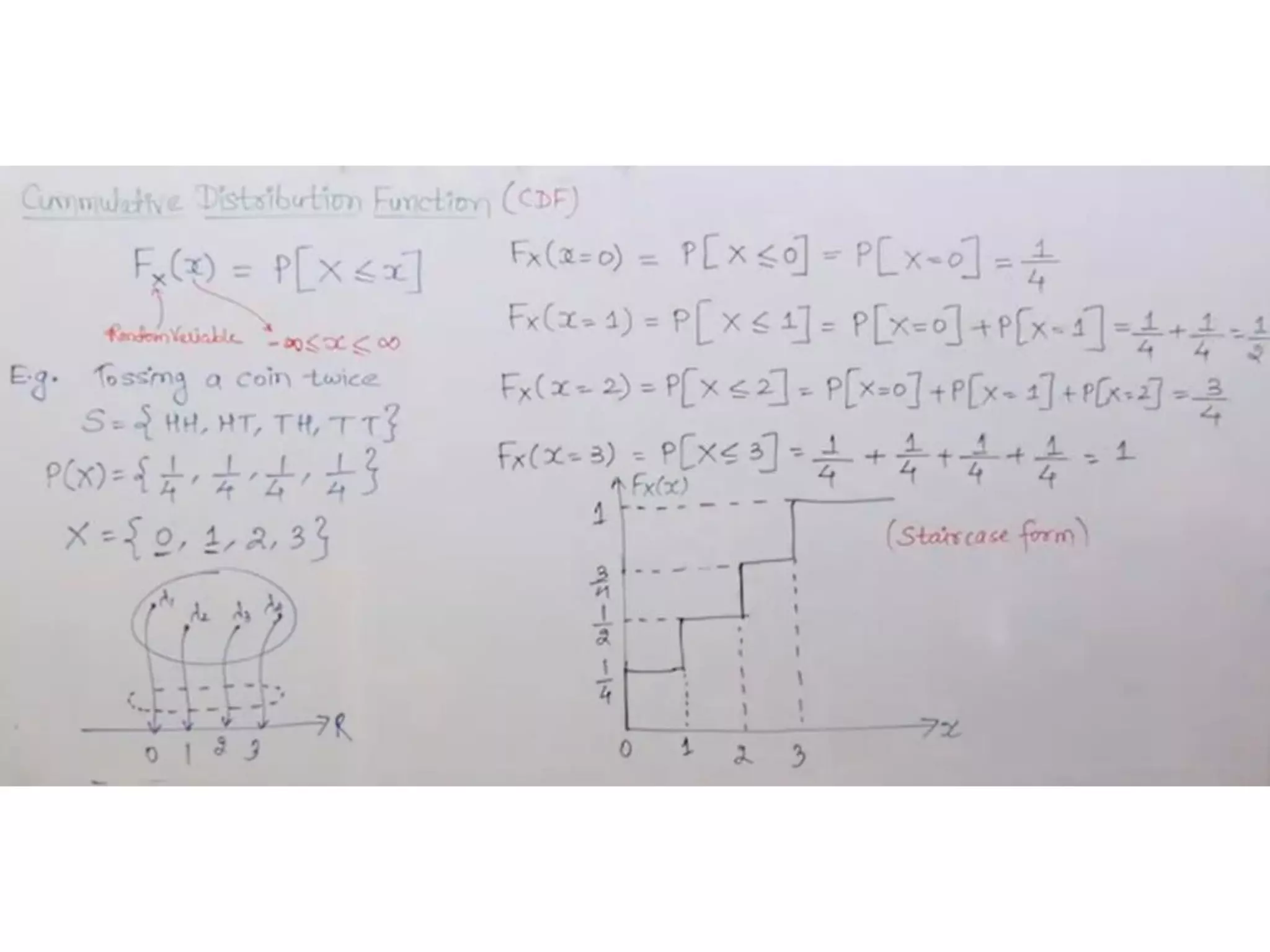
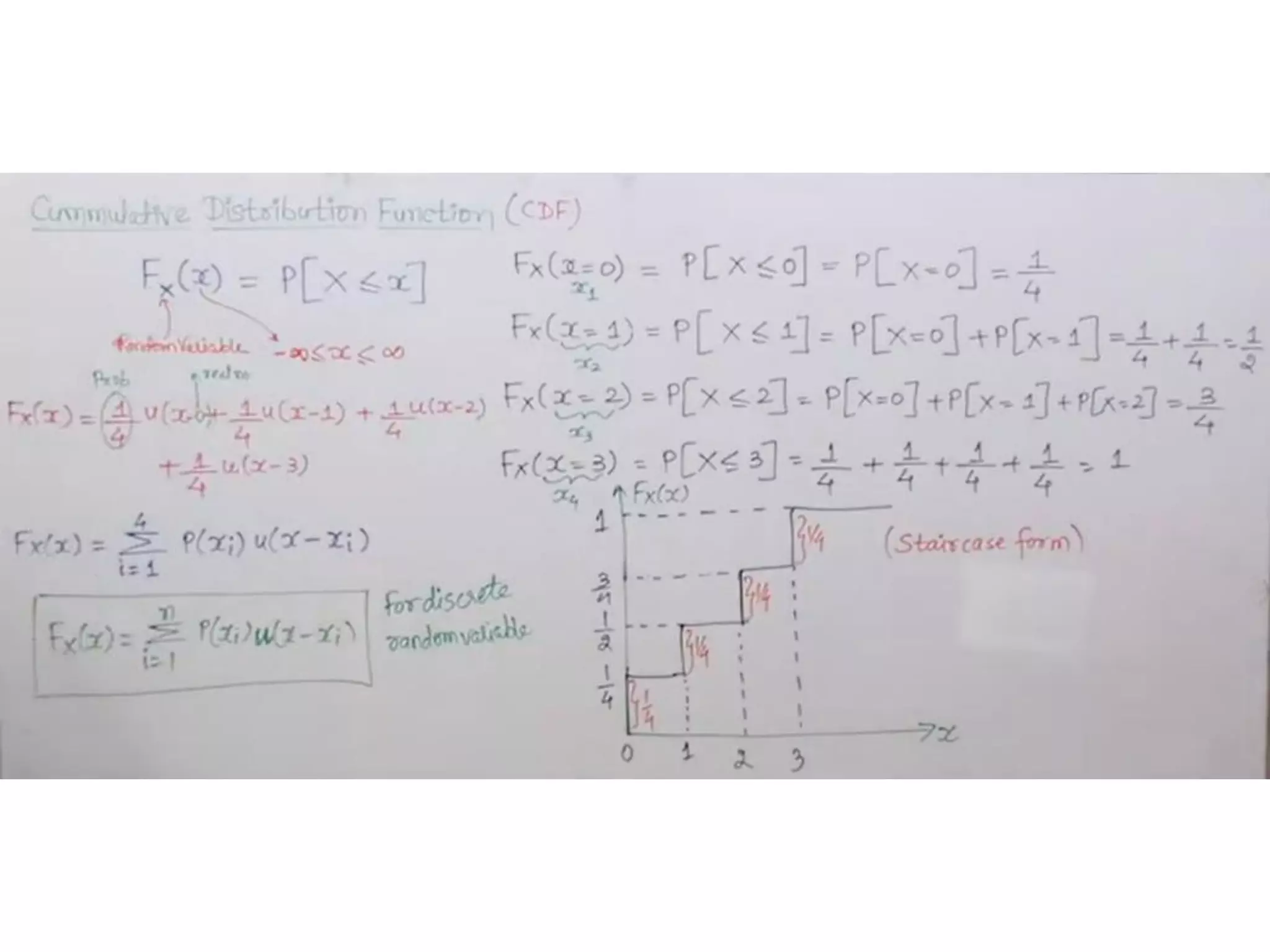
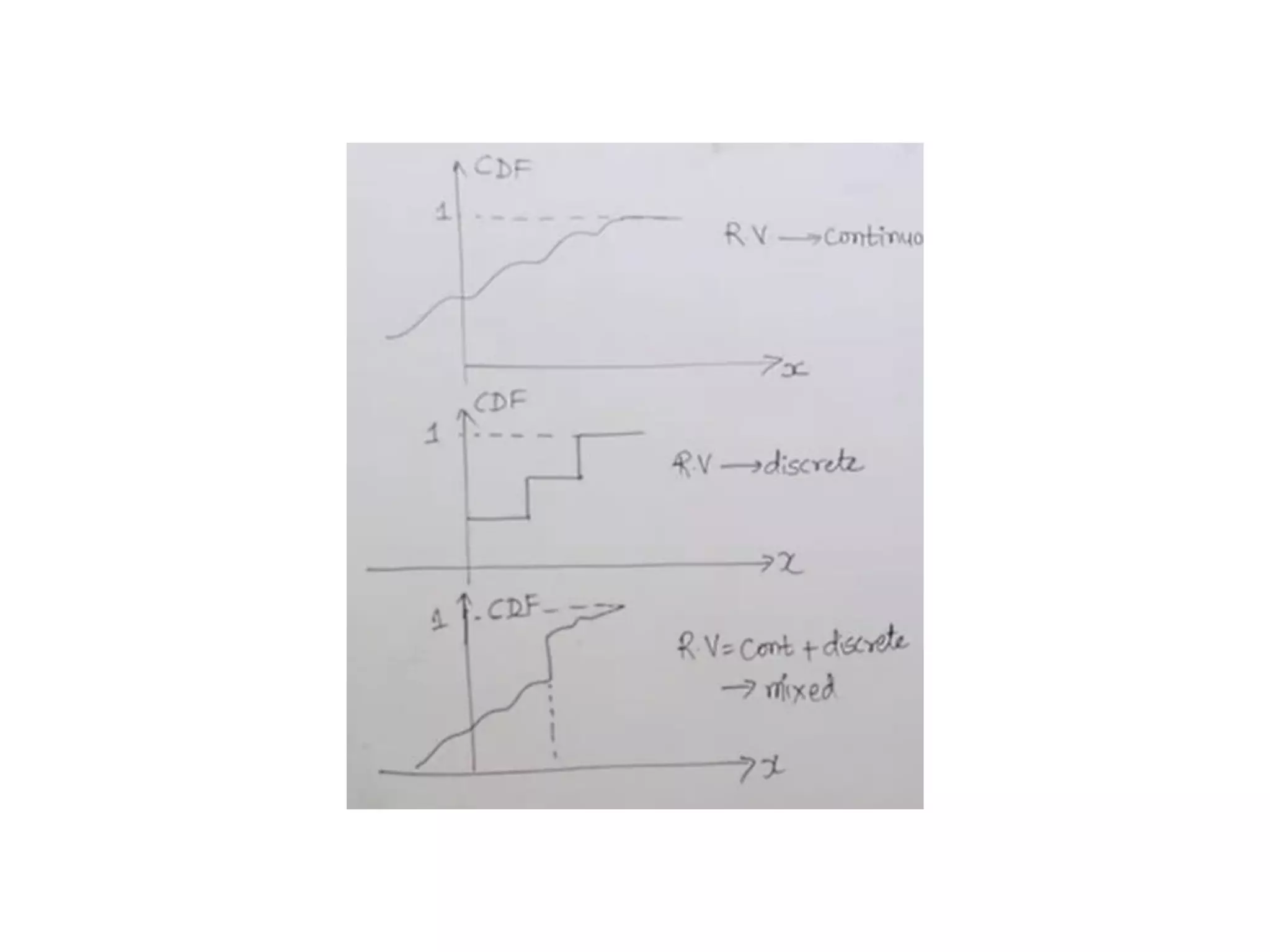
Cumulative Distribution Function (CDF)
• The (cumulative) distribution function (cdf) of a random variable X
is defined as the probability of X taking a value less than the
argument x:
FX (x) = P( X x)
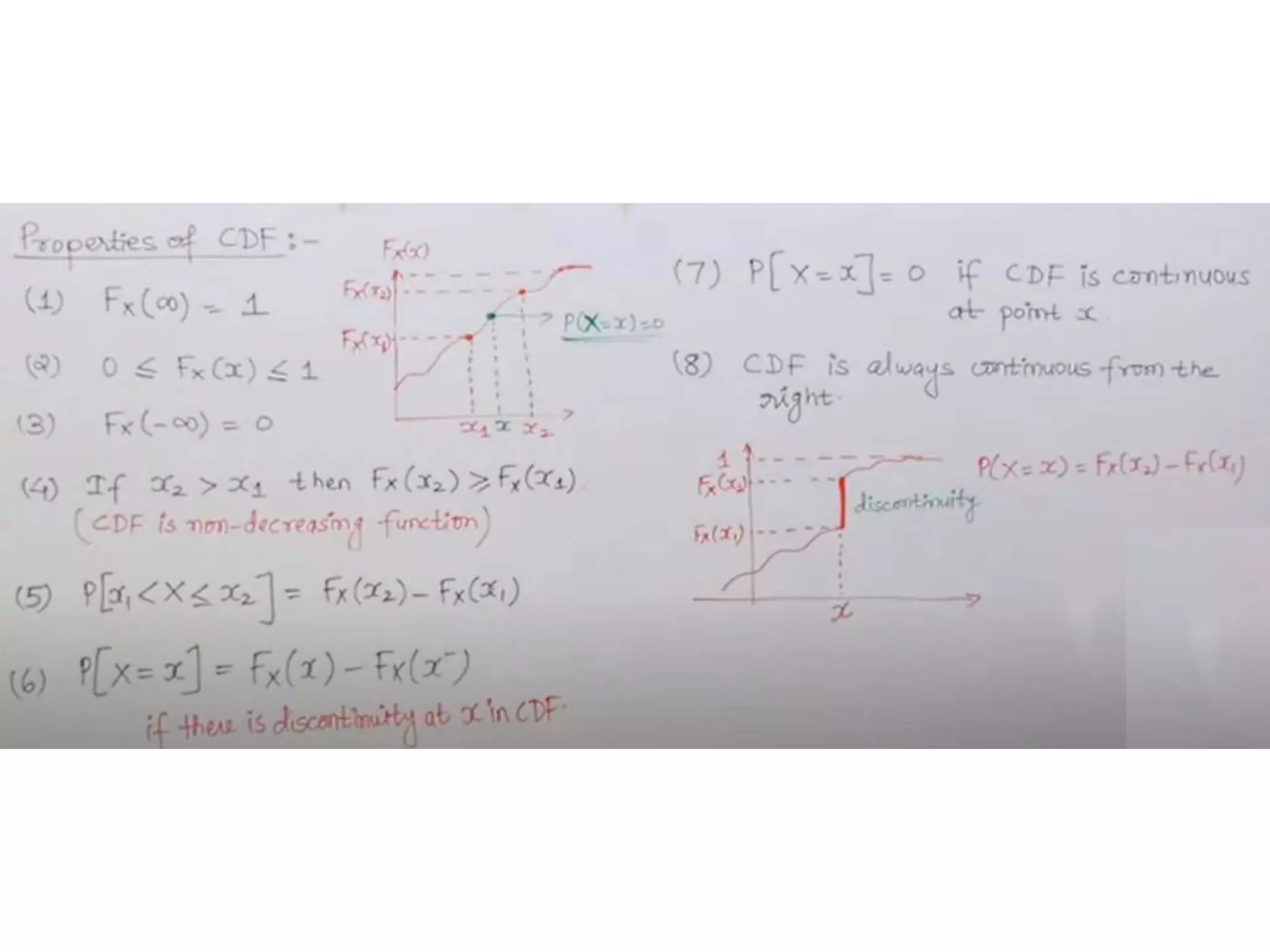
• Properties
FX (−) = 0, FX () =1
FX (x1 )  FX(x2 ) if x1x2
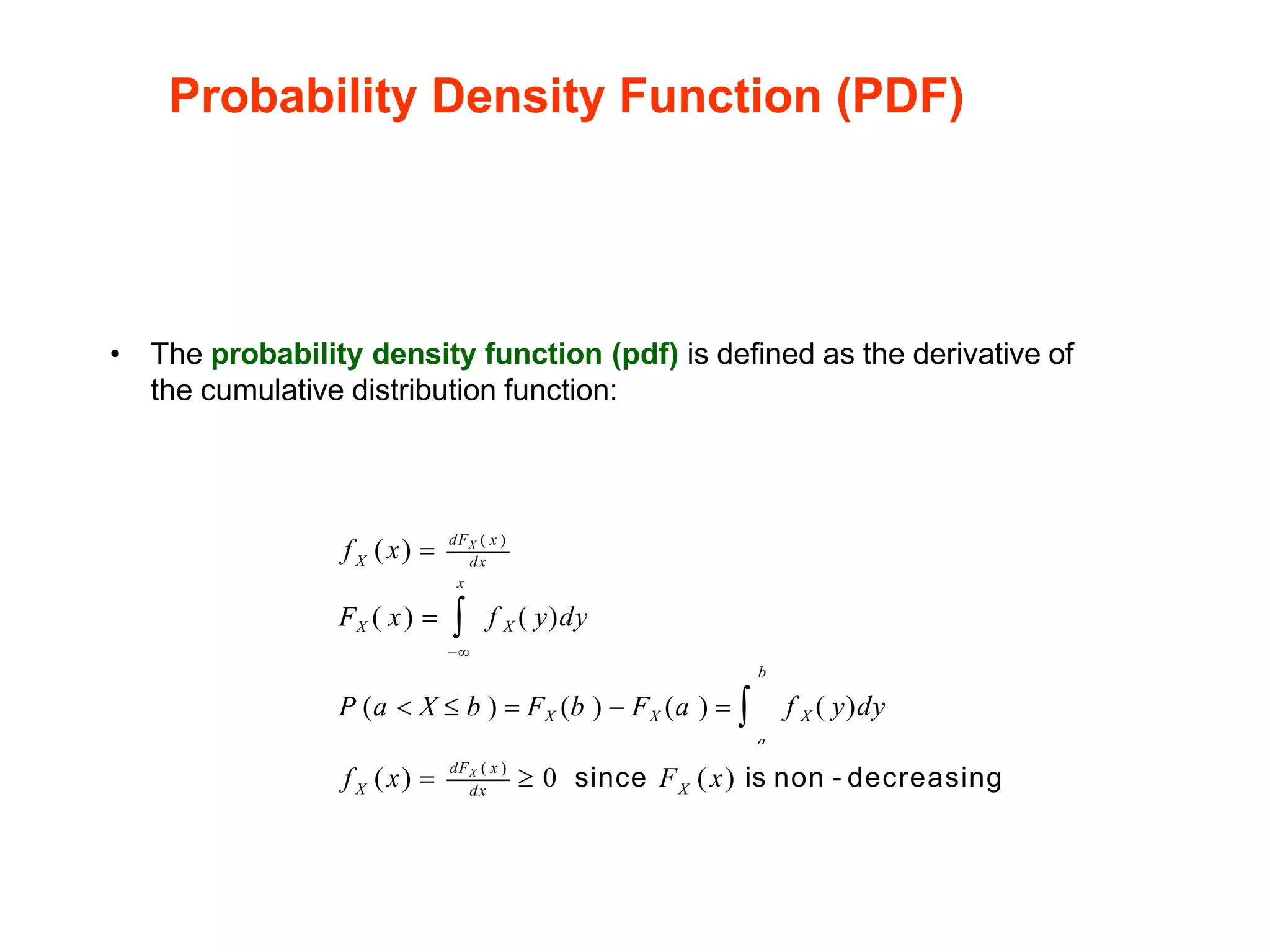
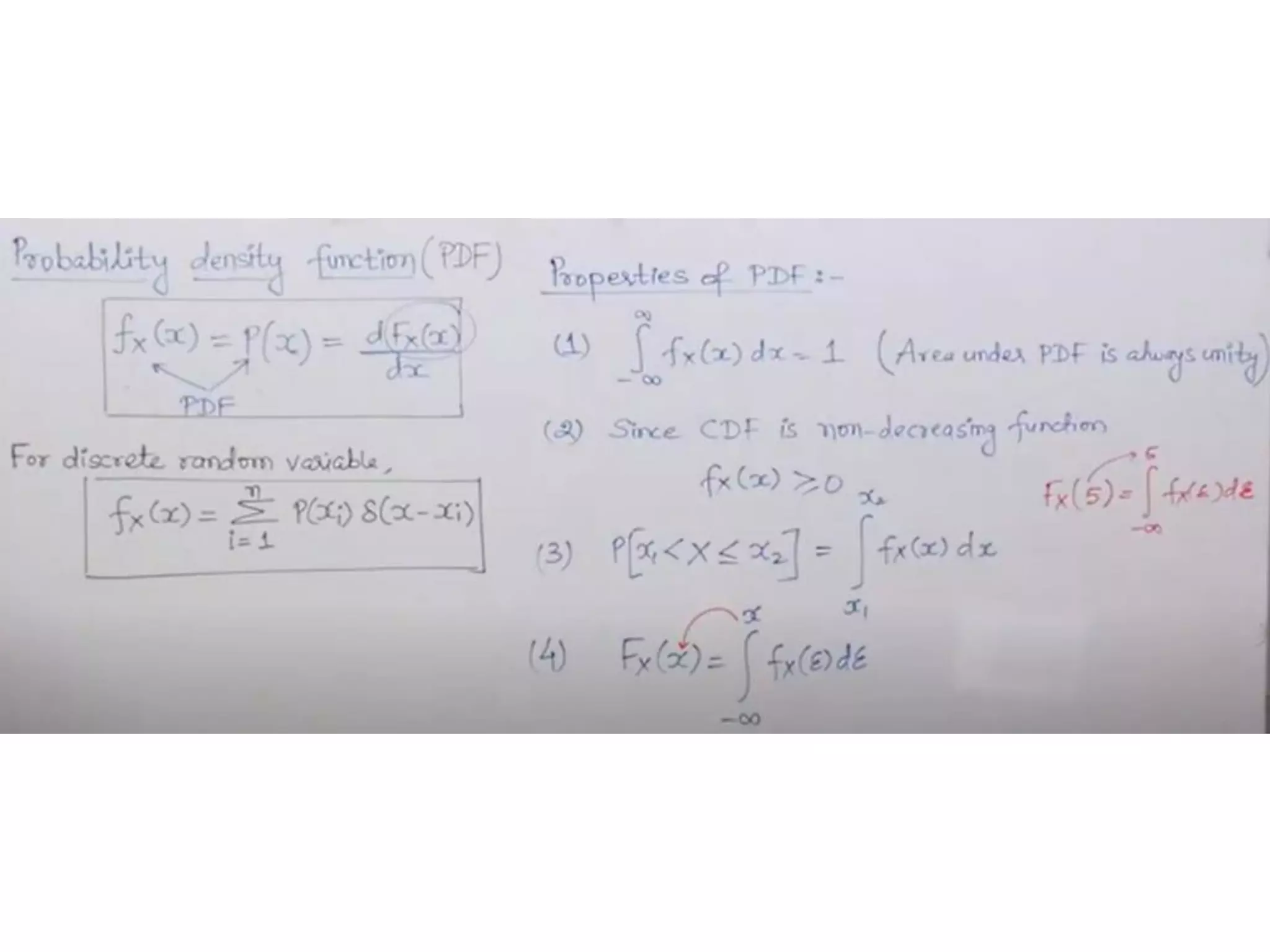
Probability Density Function (PDF)
• The probability density function (pdf) is defined as the derivative of
the cumulative distribution function:
dFX ( x )
X dx
f X ( y)dy
f (x) =
x
FX ( x) = 
a
f X ( y)dy
−
b
P (a  X  b ) = FX (b ) − FX (a ) = 
X X
dFX ( x )
dx
f (x) =  0 since F (x) is non - decreasing
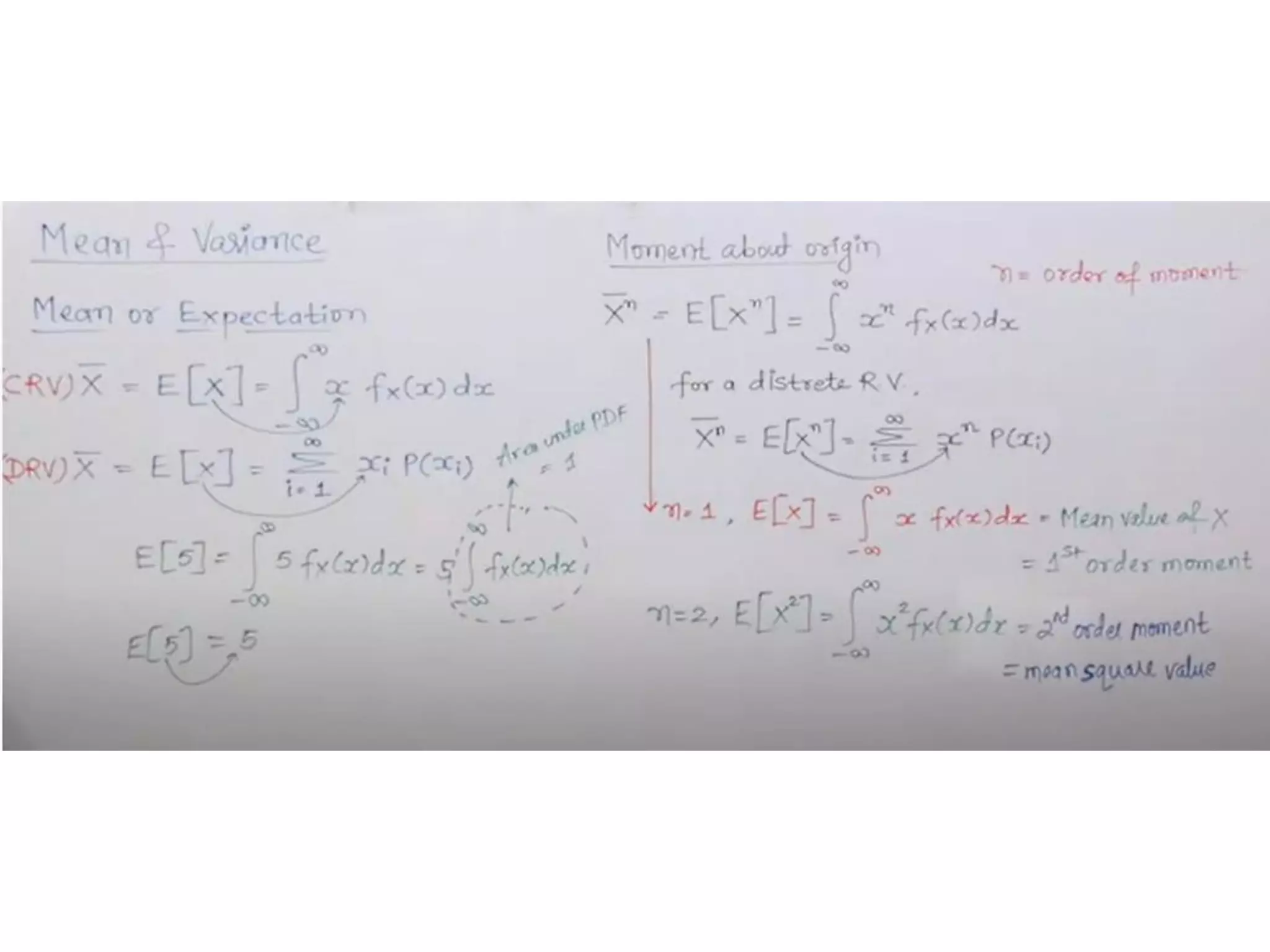
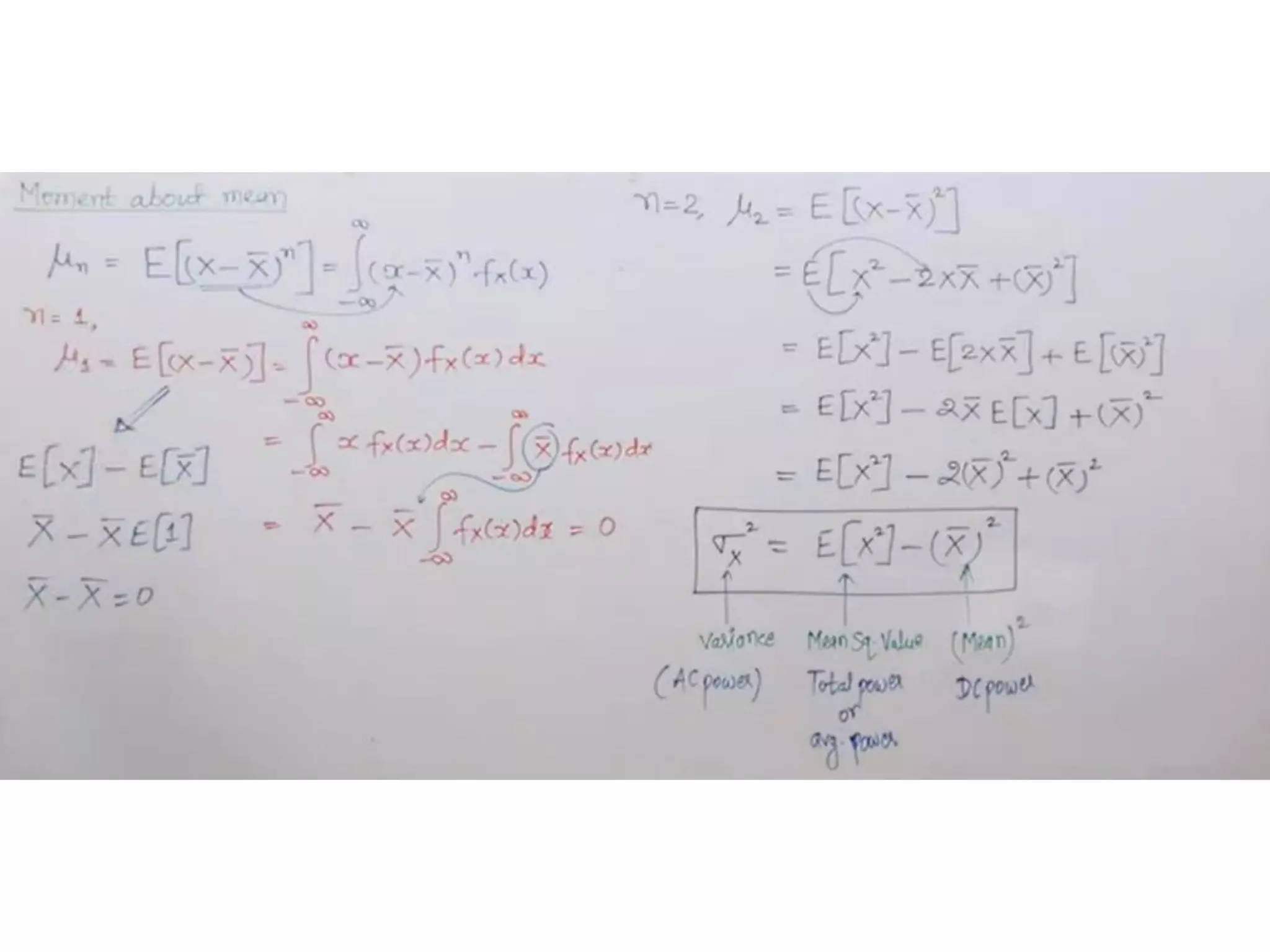
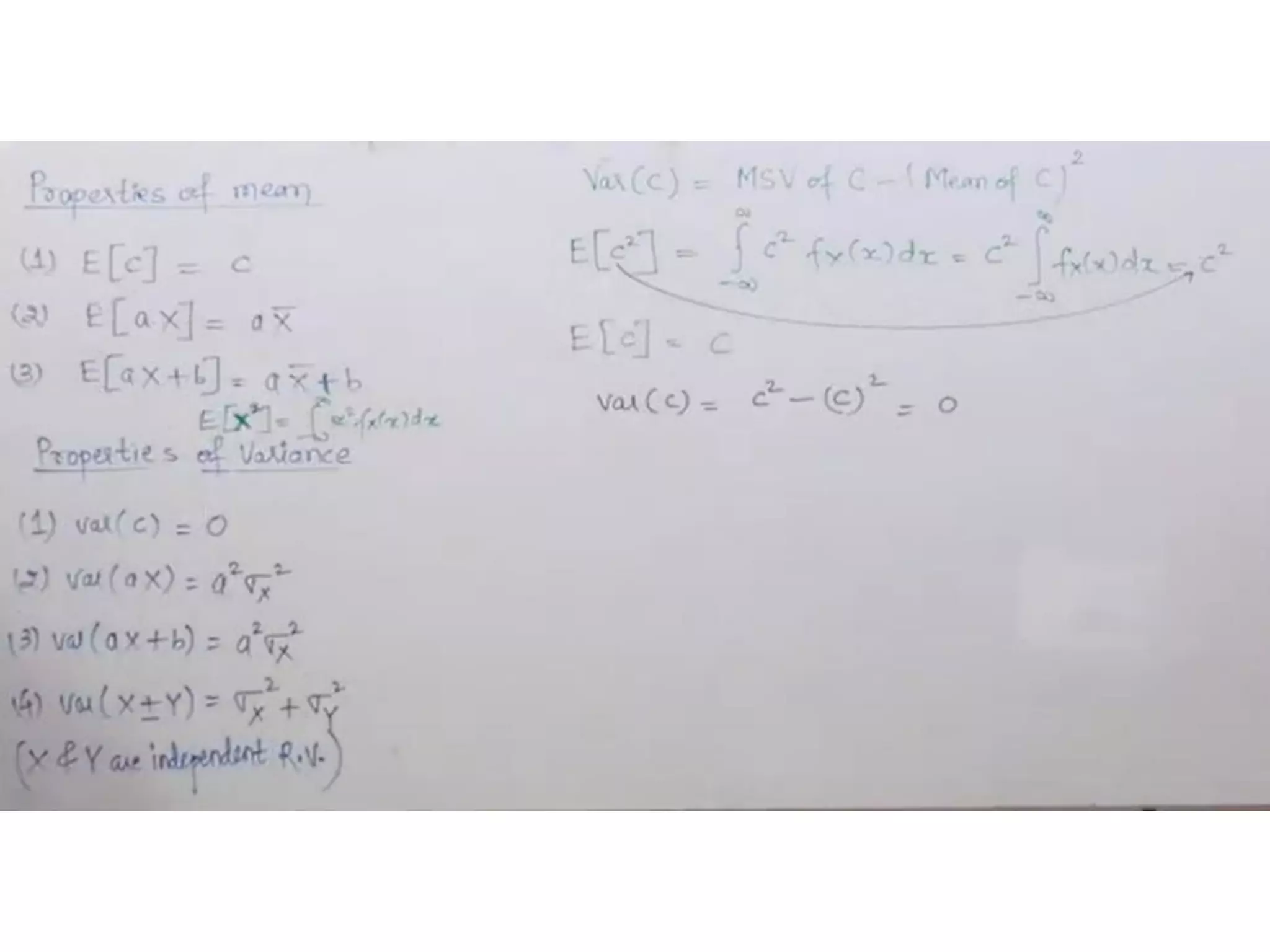
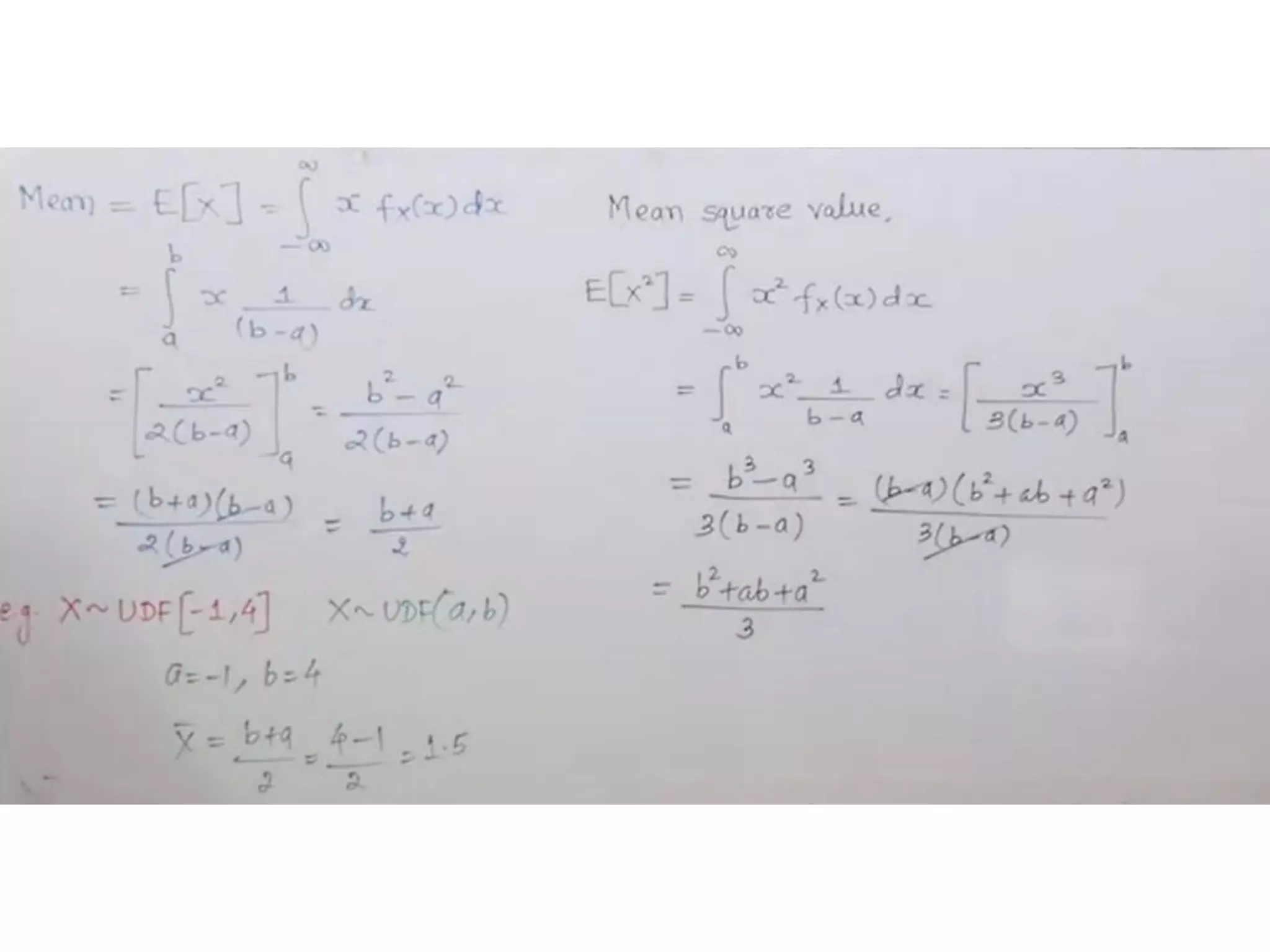
Mean and Variance
X X
x f (x)dx
• Mean (or expected value  DC level):

E[X ] =  = 
E[ ]: expectation operator
−
18
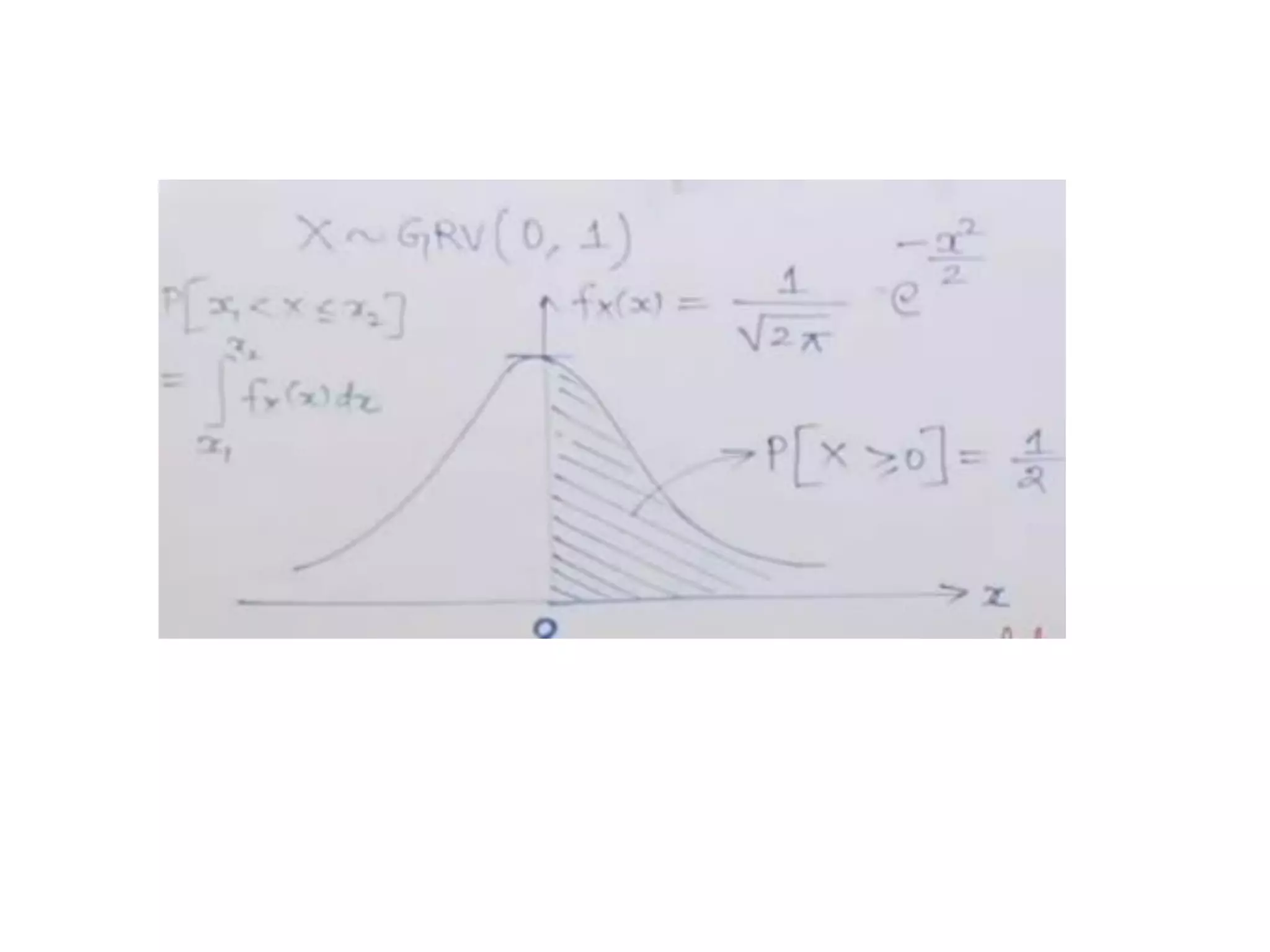
Normal (Gaussian) Distribution
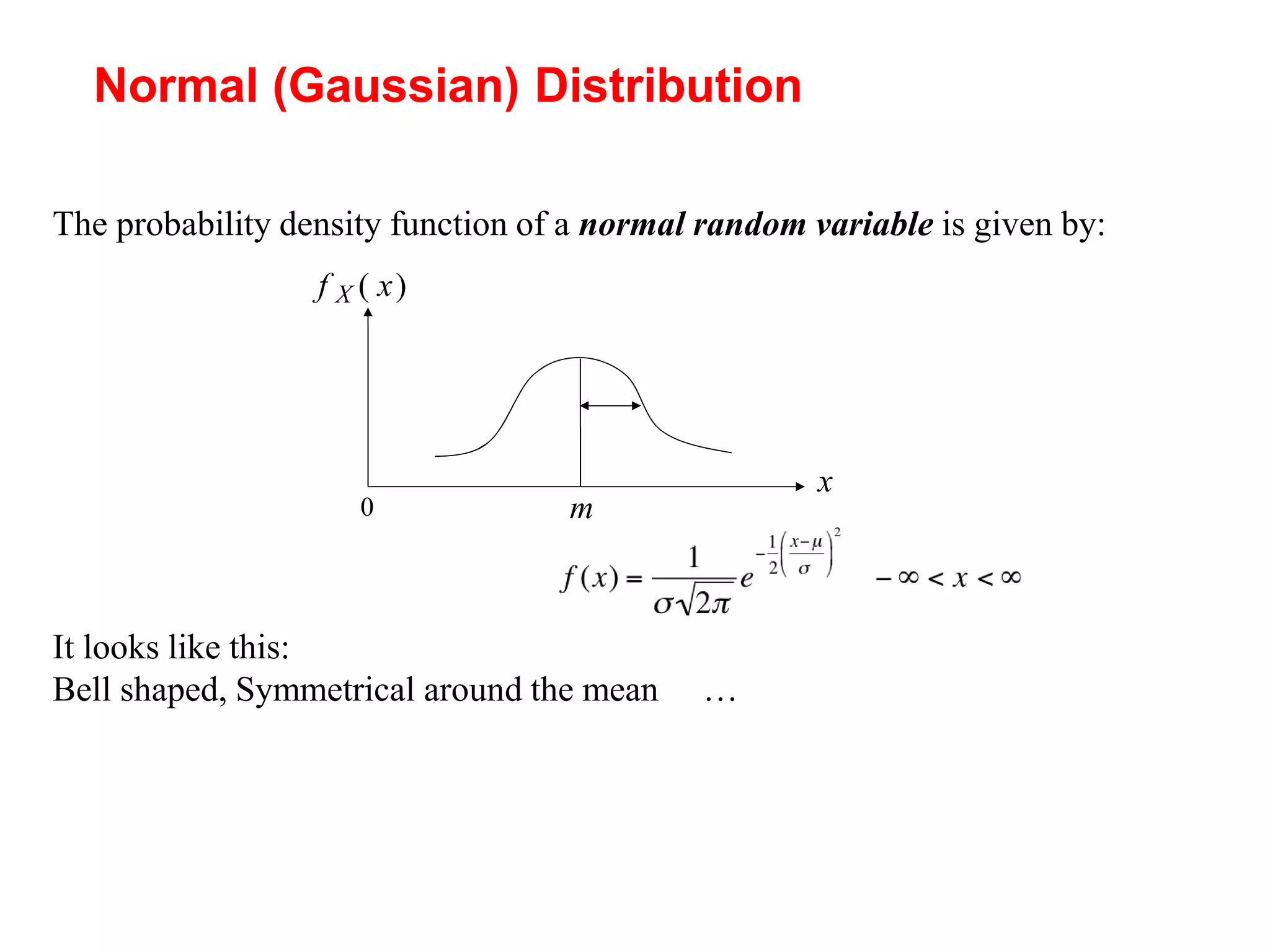
The probability density function of a normal random variable is given by:
It looks like this:
Bell shaped, Symmetrical around the mean …
f X ( x)
x
0 m
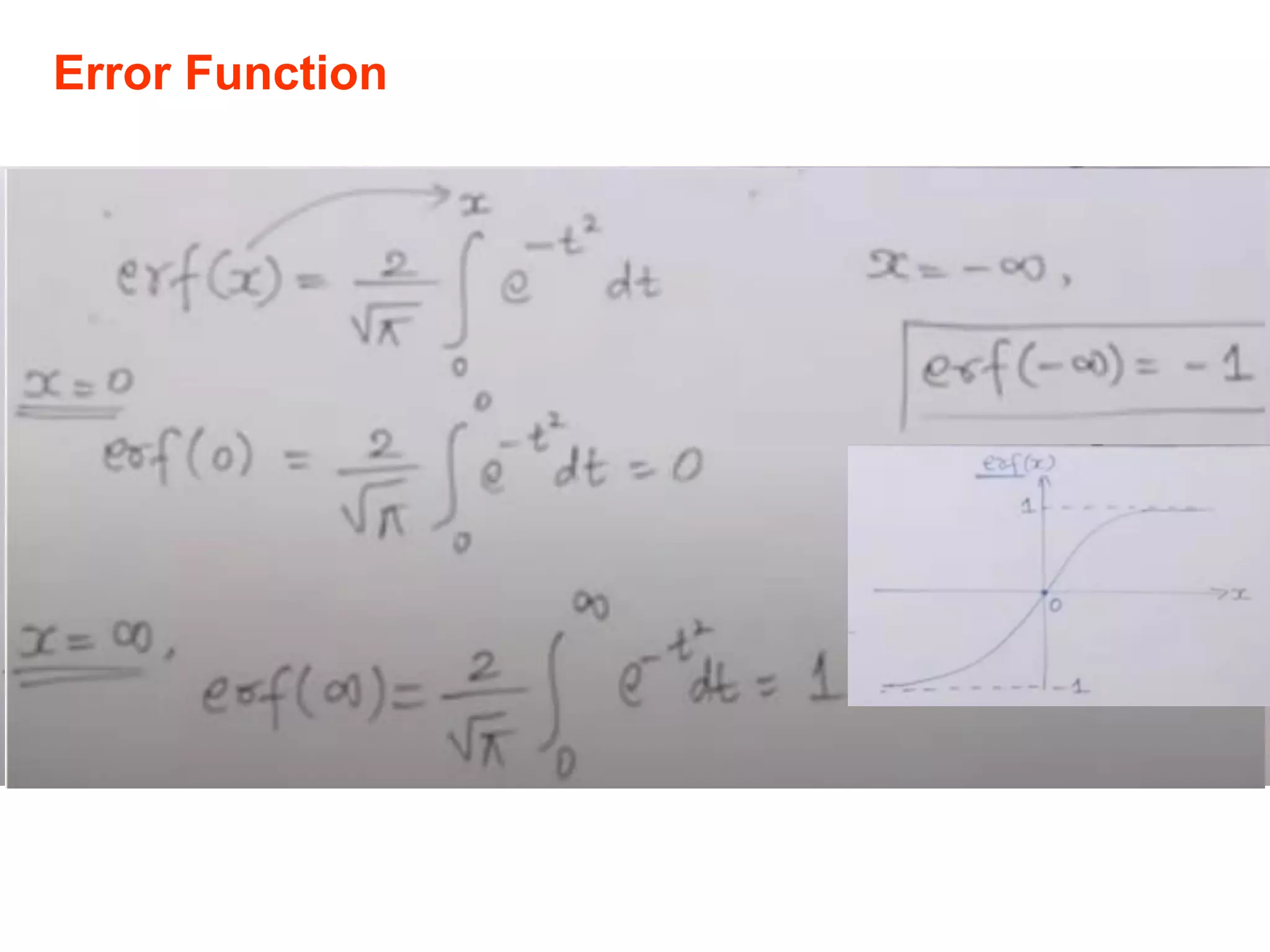
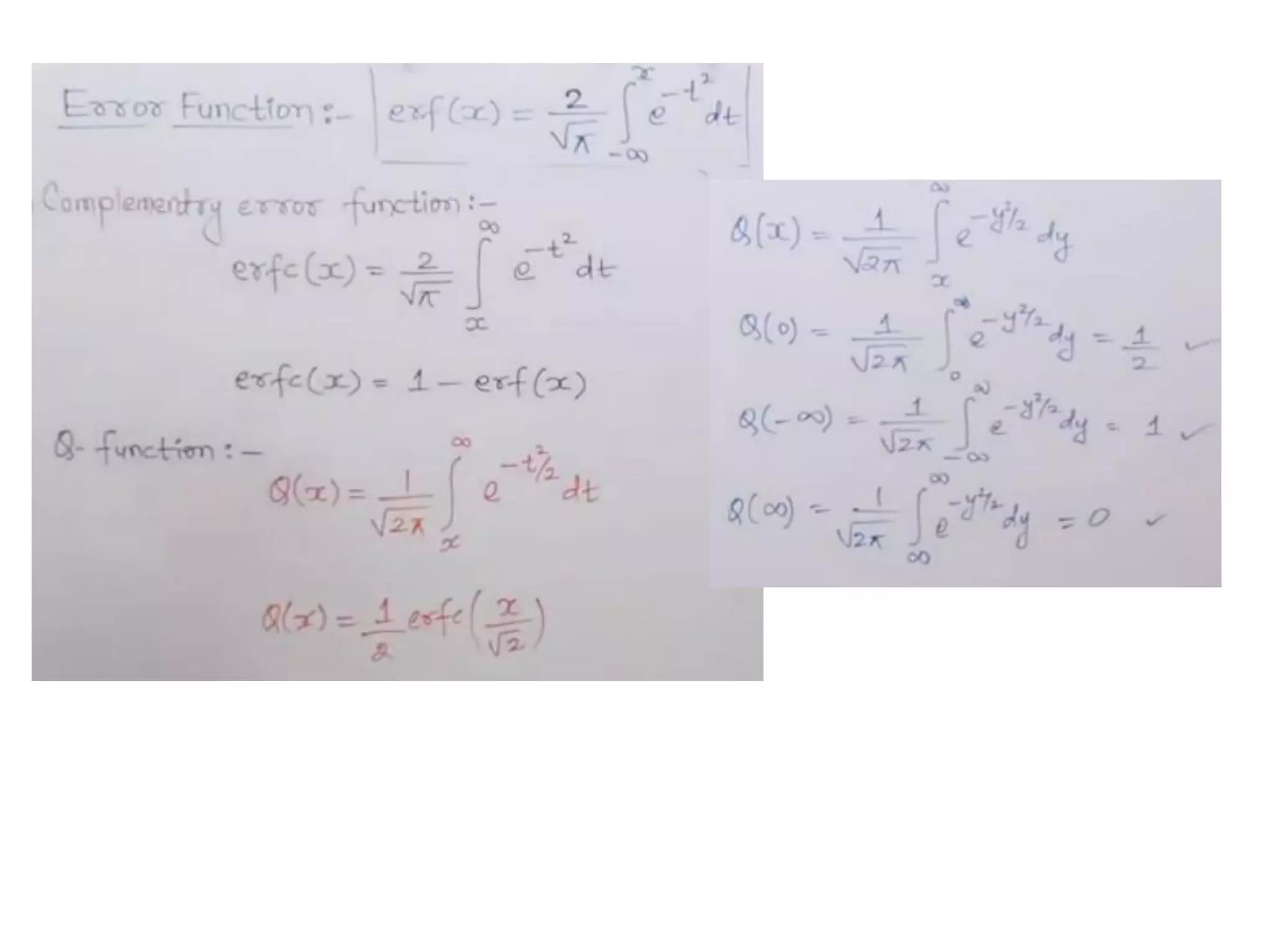
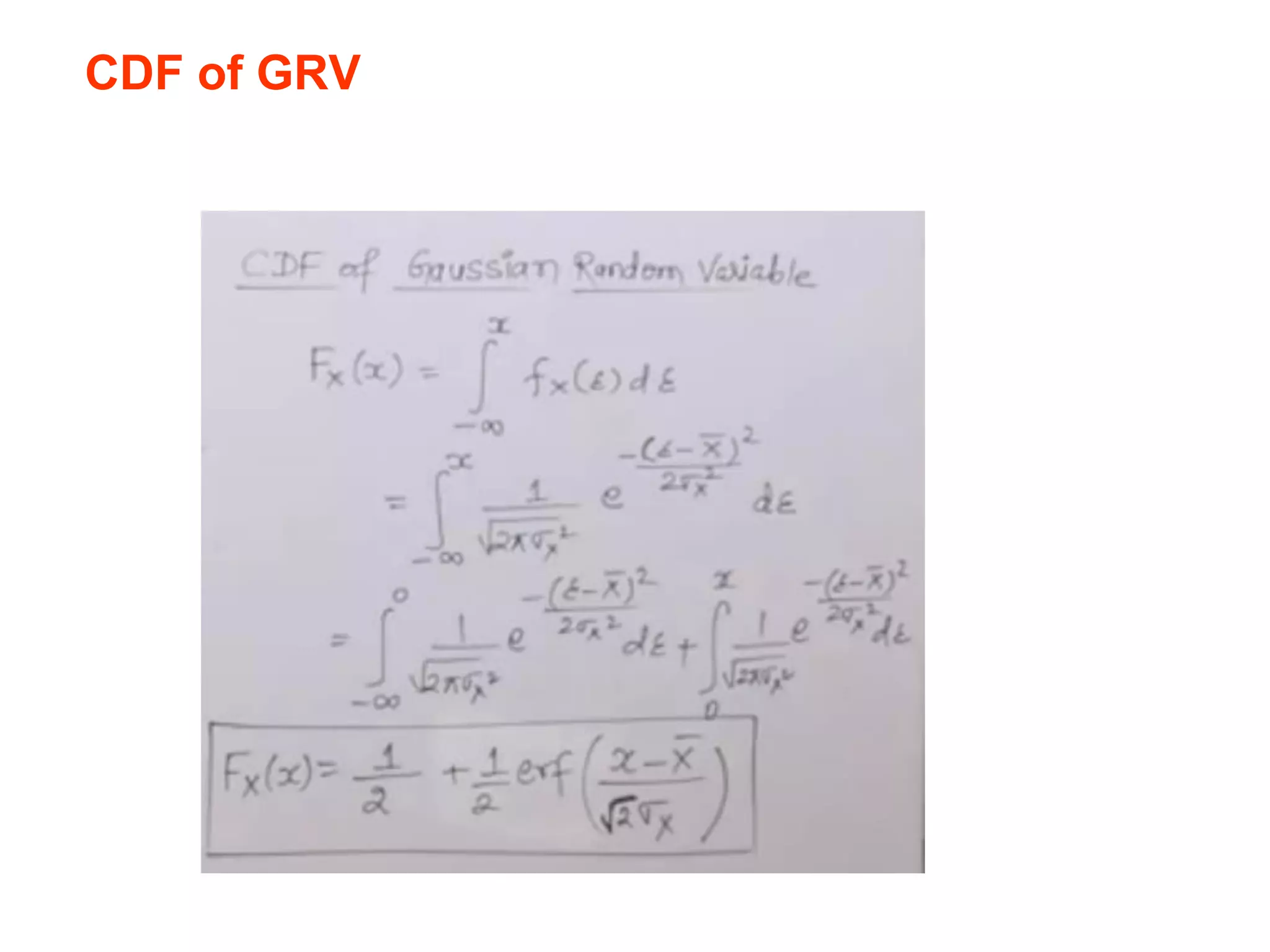
Error Function
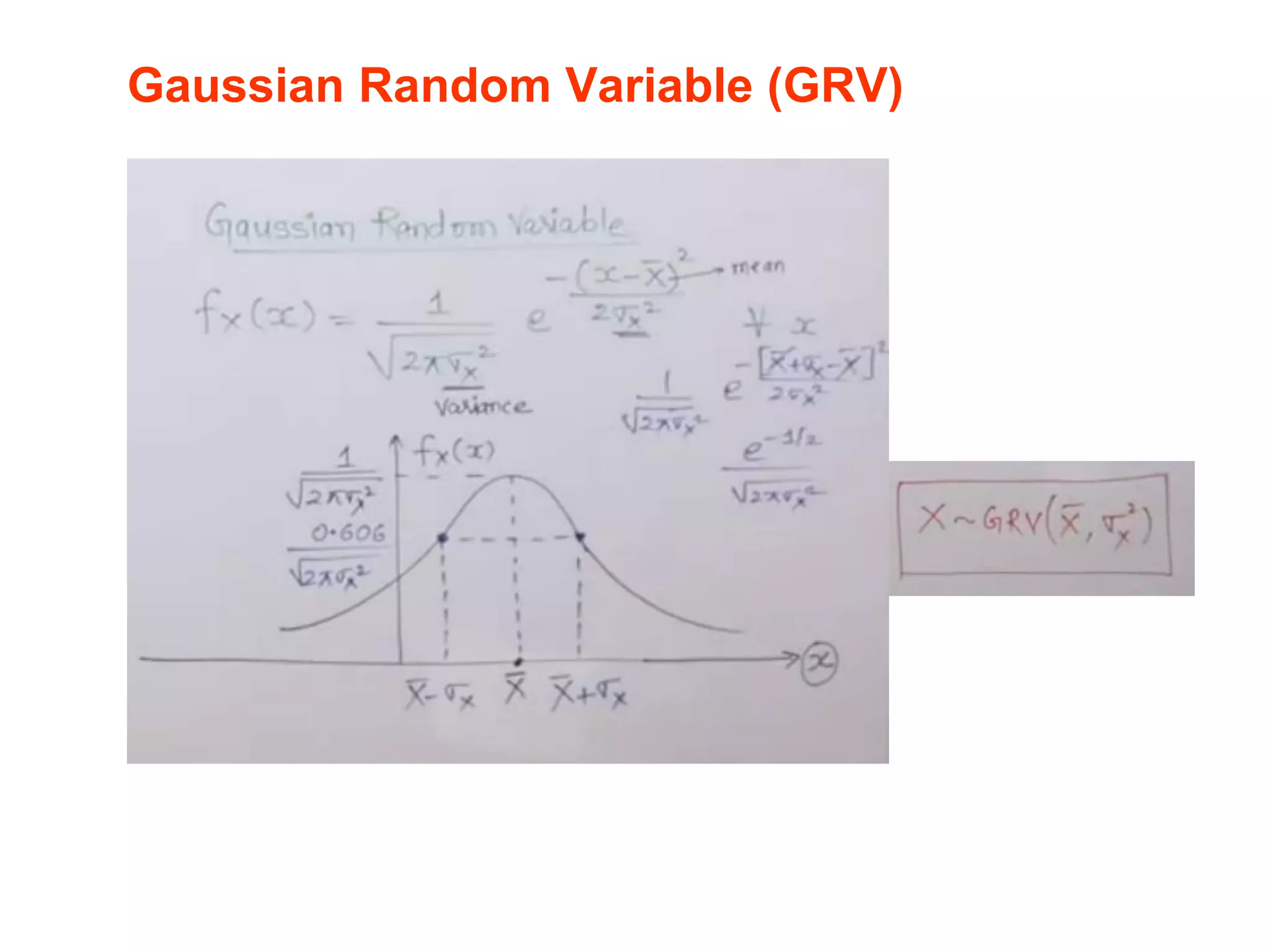
Gaussian Random Variable (GRV)
CDF of GRV
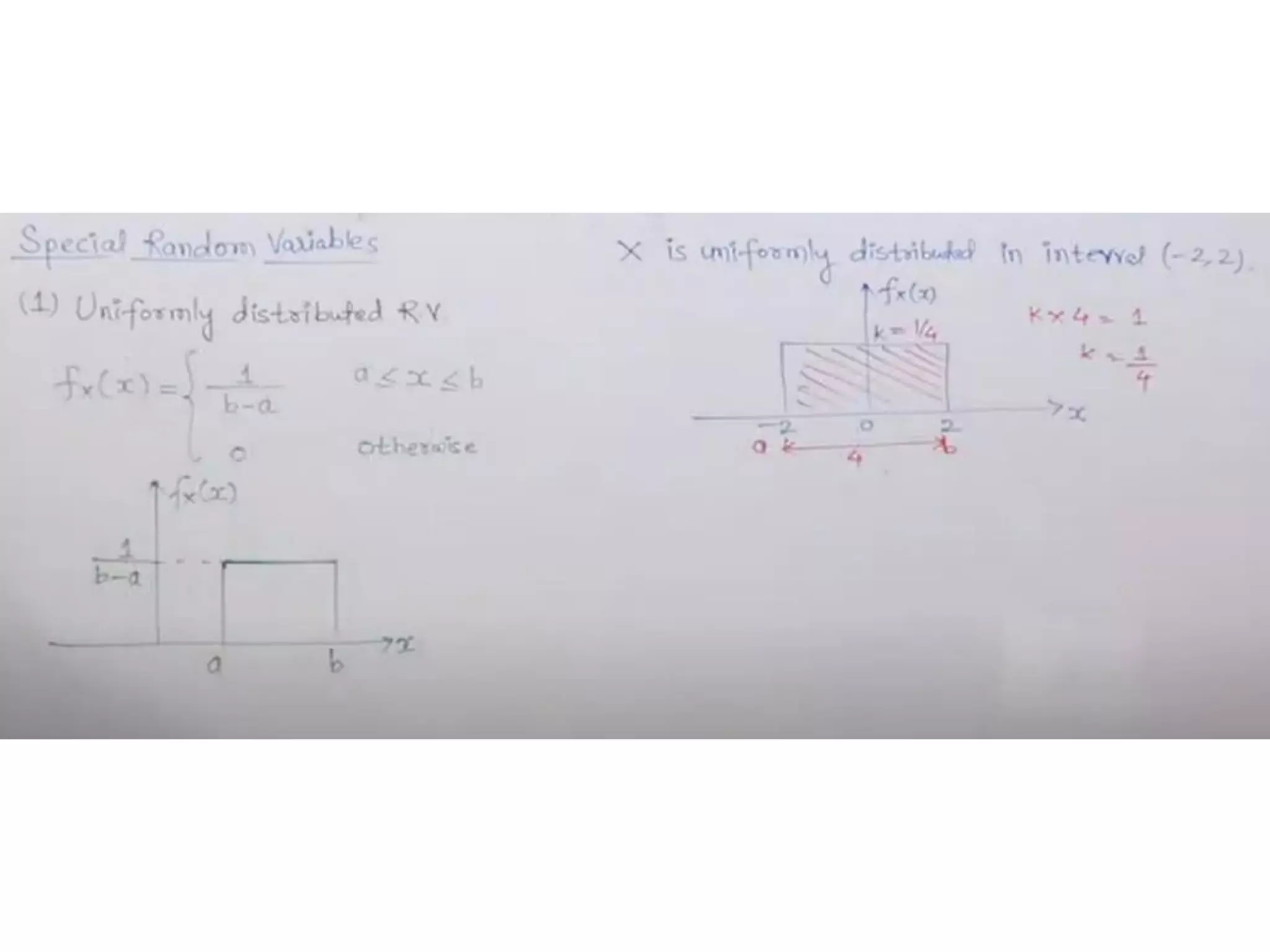
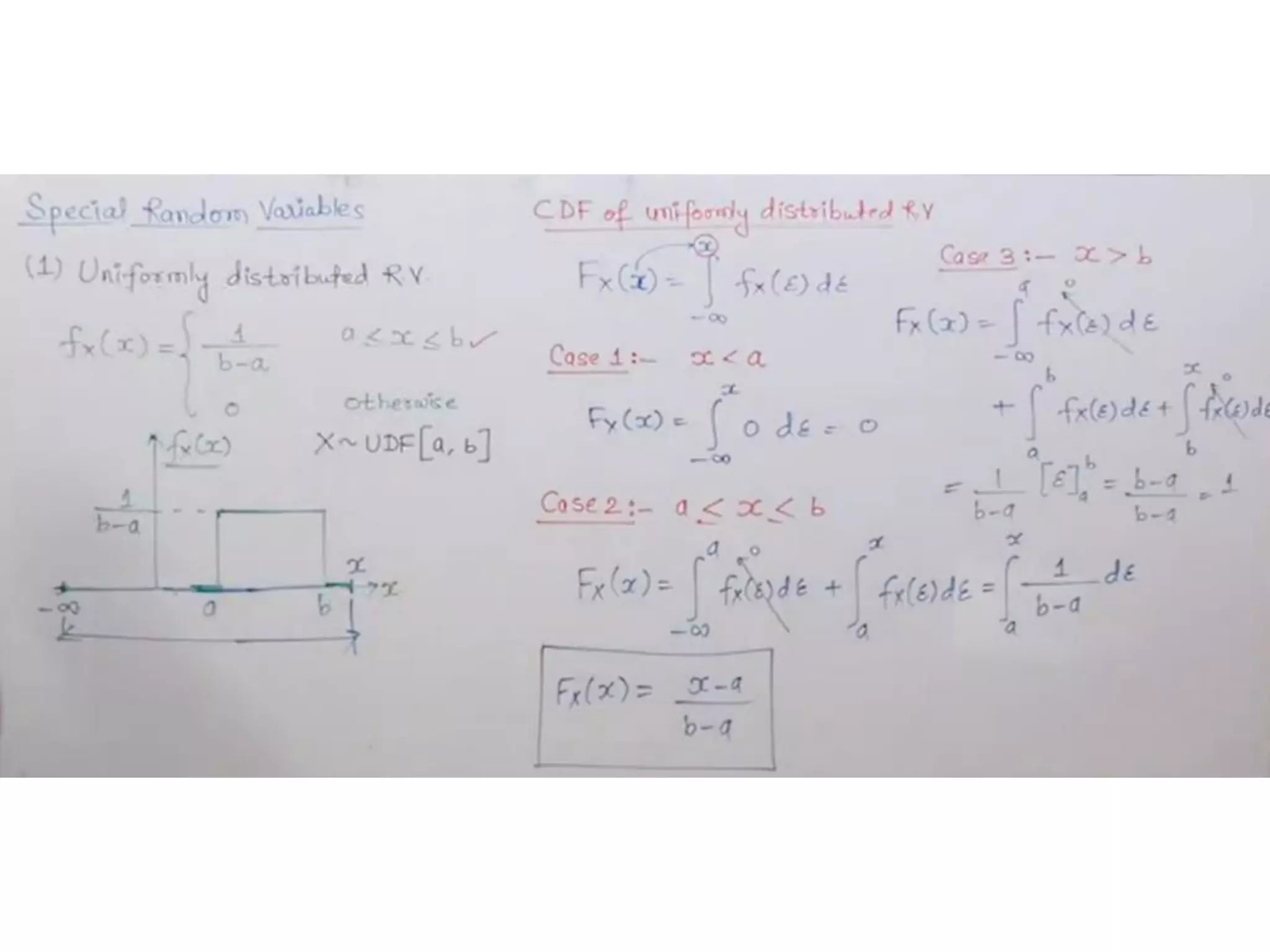
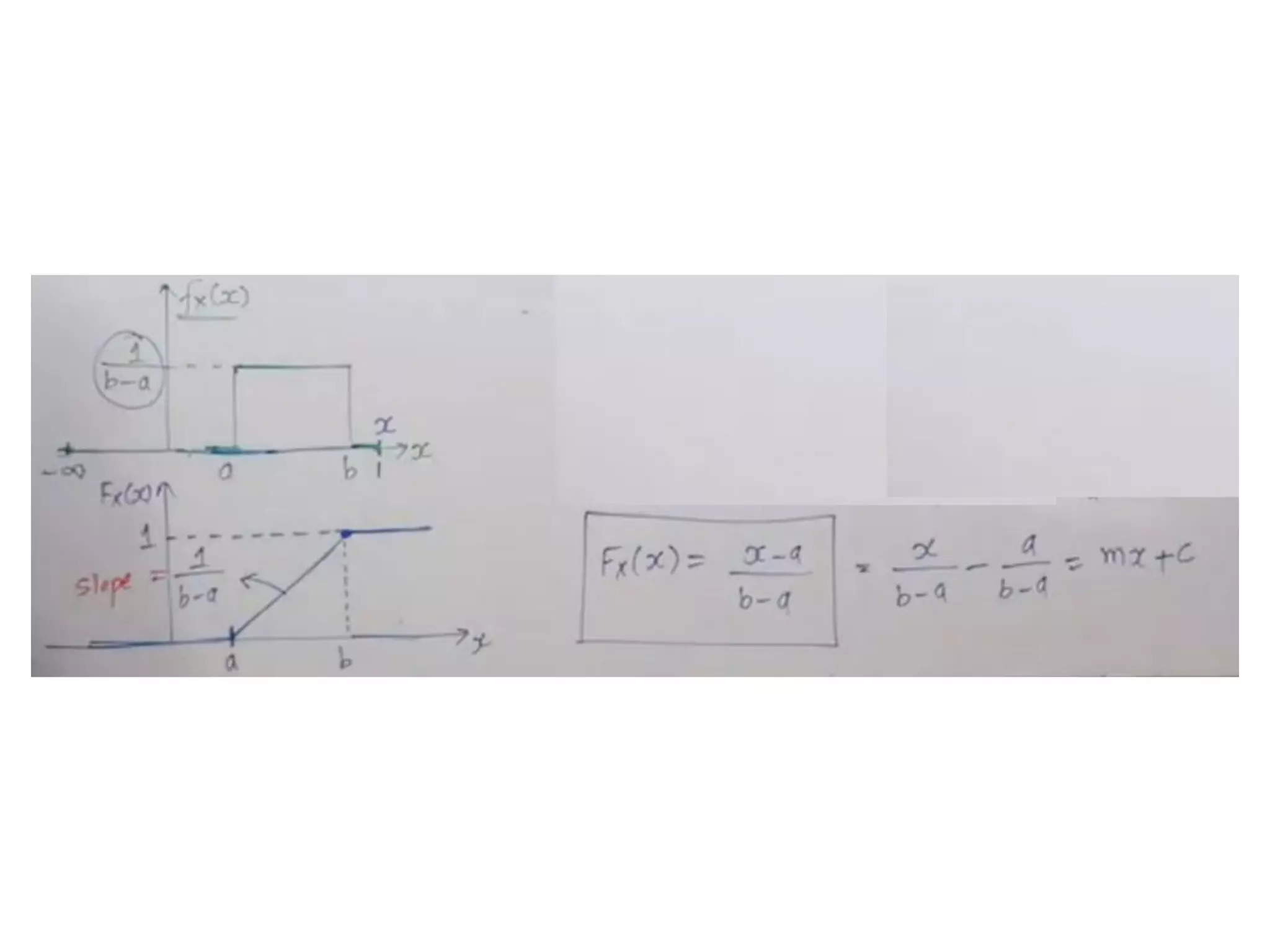
Uniform Distribution
fX(x)
1

X
a  x  b
f (x) = 
b − a

2
a + b
E [ X ]=
0
0
 x − a
FX ( x) = 
b −a
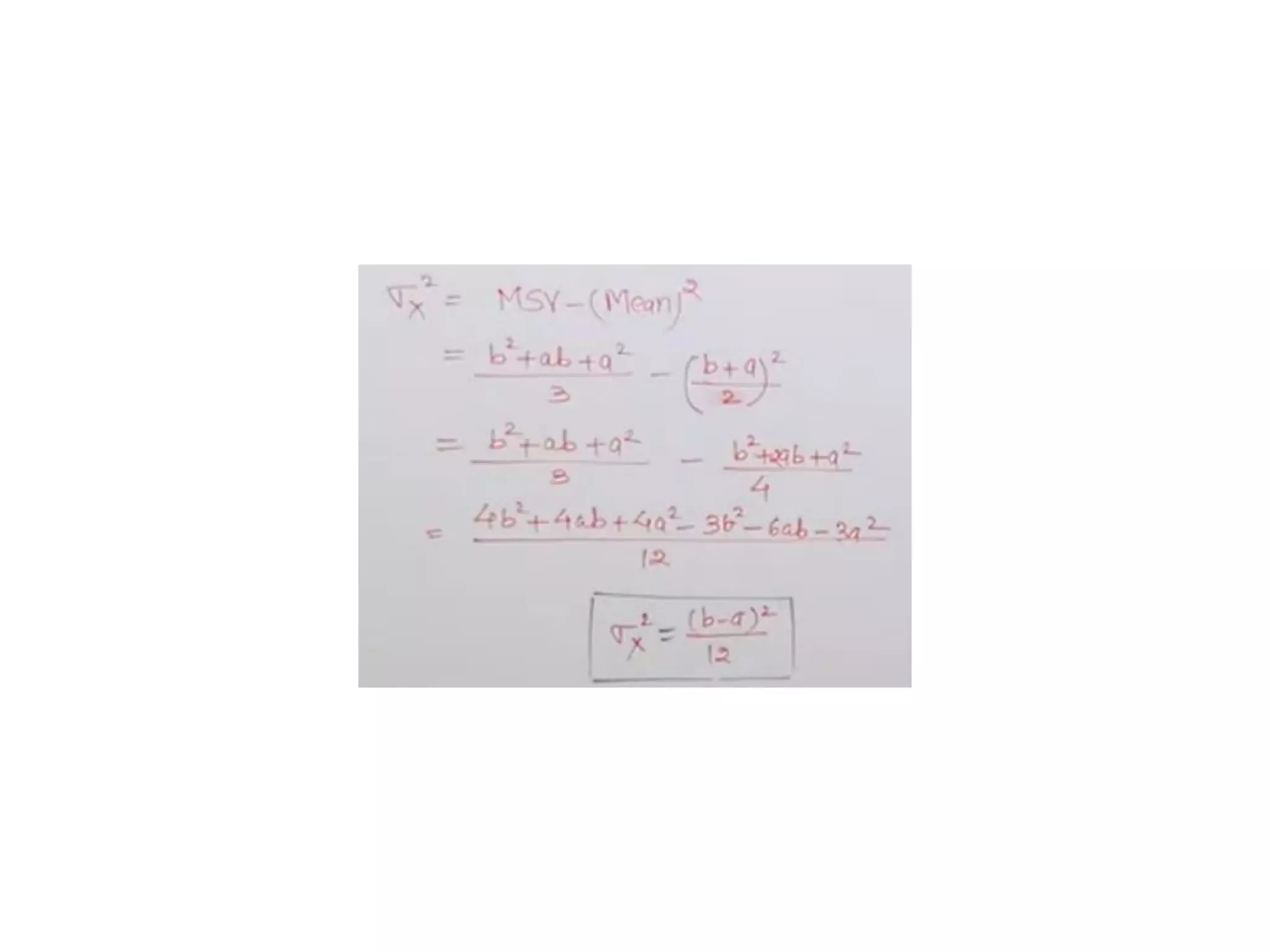
2
12
X

2
=
(b- a)
elsewhere
x  a
a  x  b
x  b

1
Joint Distribution
• Joint distribution function for two random variables X and Y
FXY (x, y) = P( X  x,Y  y)
• Joint probability density function
XY xy
2
FXY (x, y)
f (x, y) =
• Properties  
1) FXY (, ) =   f XY (u, v)dudv =1
− −
2) f X (x) = f XY (x,y)dy


3) fY (x) = f XY (x,y)dx
x=−
y=−


4) X , Y are independent  fXY (x, y) = fX (x) fY (y)
5) X , Y are uncorrelated  E[XY] = E[X ]E[Y]
Joint Distribution
• Joint distribution function for two random variables X and Y
FXY (x, y) = P( X  x,Y  y)
• Joint probability density function
XY xy
2
FXY (x, y)
f (x, y) =
• Properties  
1) FXY (, ) =   f XY (u, v)dudv =1
− −
2) f X (x) = f XY (x,y)dy


3) fY (x) = f XY (x,y)dx
x=−
y=−


4) X , Y are independent  fXY (x, y) = fX (x) fY (y)
5) X , Y are uncorrelated  E[XY] = E[X ]E[Y]
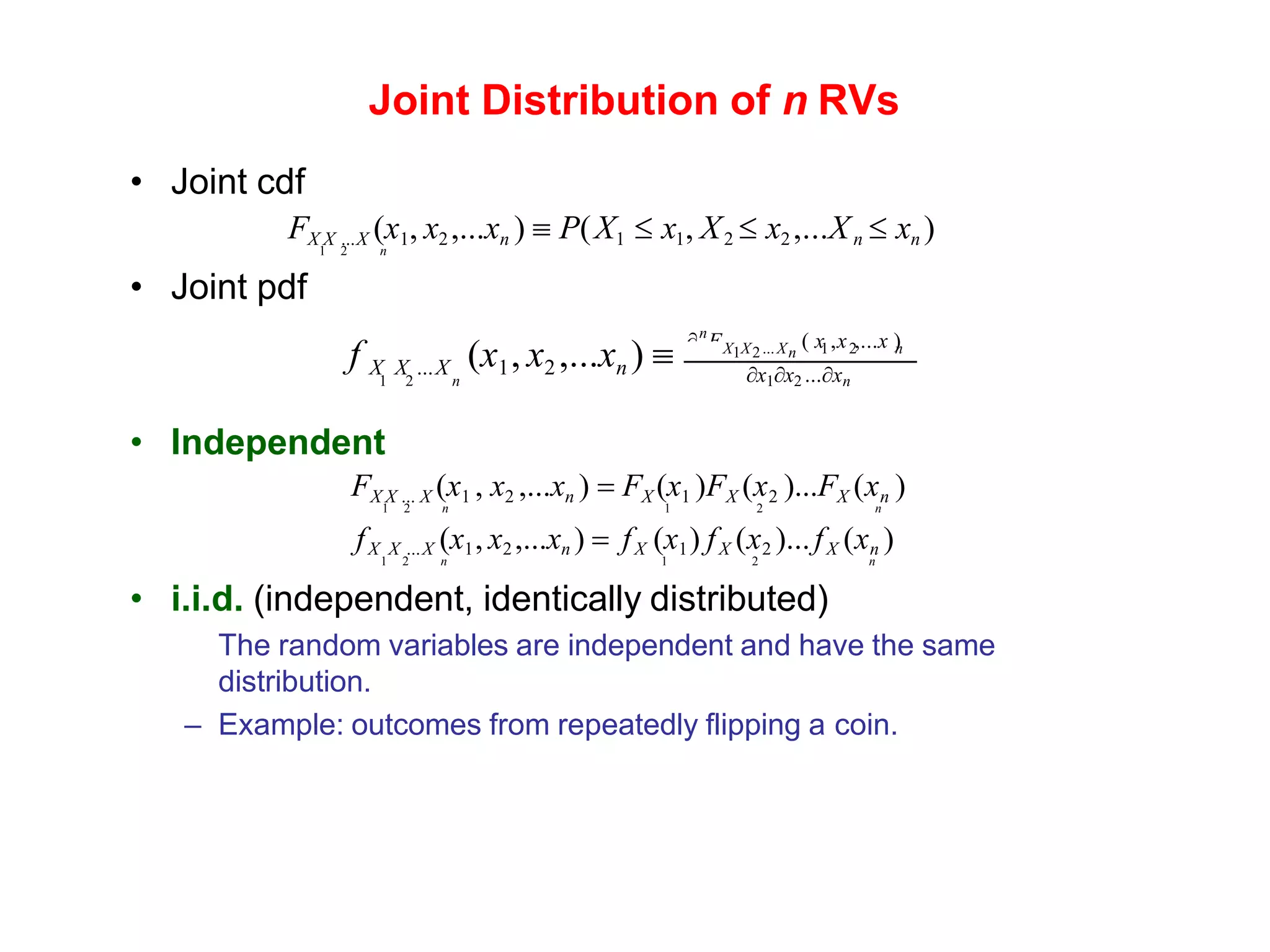
Joint Distribution of n RVs
• Joint cdf
FX X ...X (x1, x2 ,...xn )  P(X1  x1, X2  x2 ,...Xn  xn )
1 2 n
• Joint pdf
n
 F n
( x ,x ,...x )
x1x2 ...xn
X X ...X 1 2
1 2 n
f X X ...X (x1, x2 ,...xn ) 
1 2 n
• Independent
FX X ... X (x1 , x2 ,...xn ) = FX (x1 )FX (x2 )...FX (xn )
1 2 n 1 2 n
fX X ...X (x1, x2 ,...xn ) = fX (x1) fX (x2 )...fX (xn )
1 2 n 1 2 n
• i.i.d. (independent, identically distributed)
The random variables are independent and have the same
distribution.
– Example: outcomes from repeatedly flipping a coin.
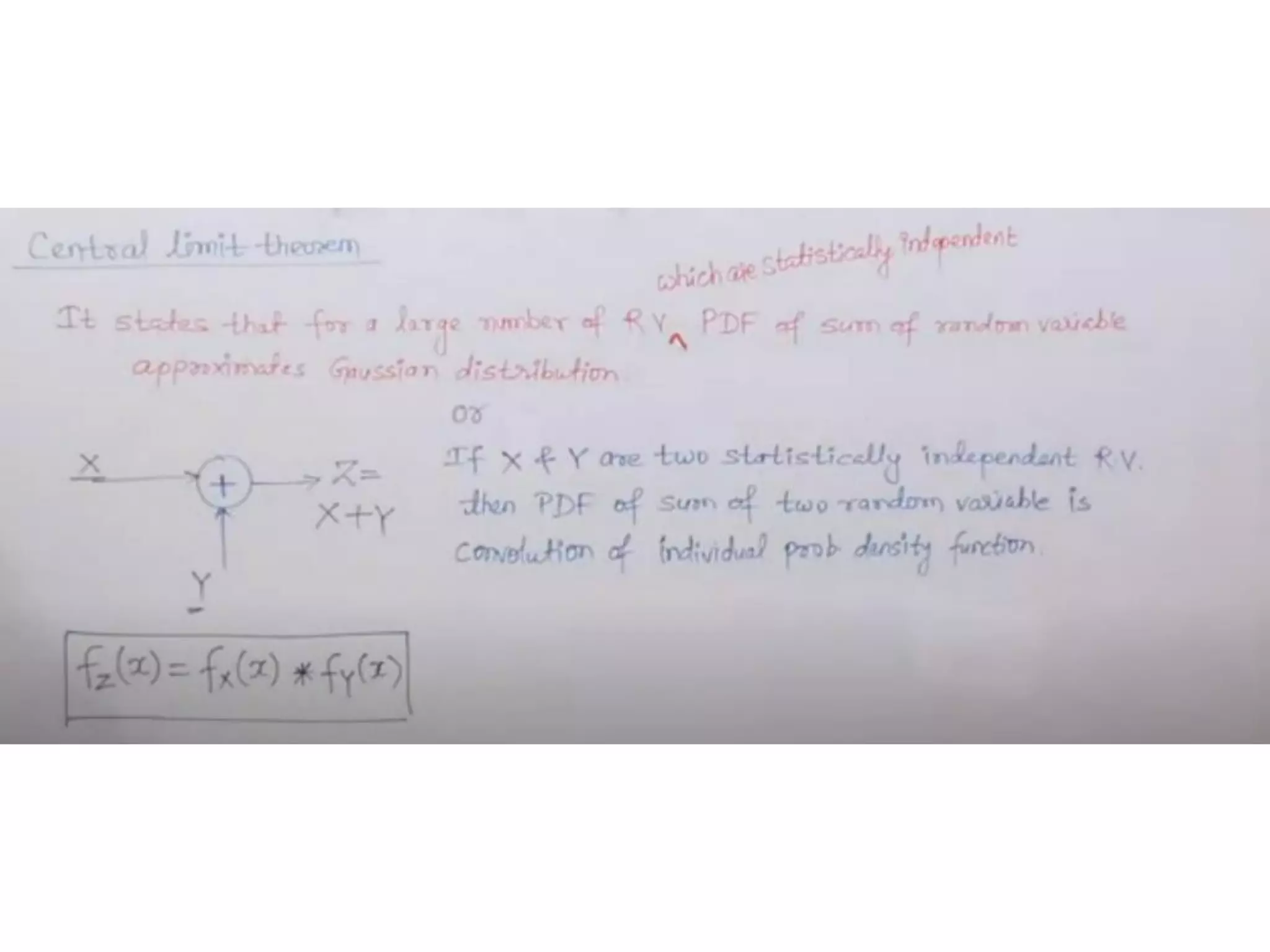
Central Limit Theorem
x1 +x2
x1
“
”
x1 +x2
+ x3
x1 + x2+
x3 +x4
• For i.i.d. random variables,
z = x1 + x2 +· · ·+ xn
tends to Gaussian as n
goes to infinity.
• Extremely useful in
communications.
• That’s why noise is usually
Gaussian. We often say
Gaussian noise or
“Gaussian channel” in
communications.
Illustration of convergence to Gaussian
distribution
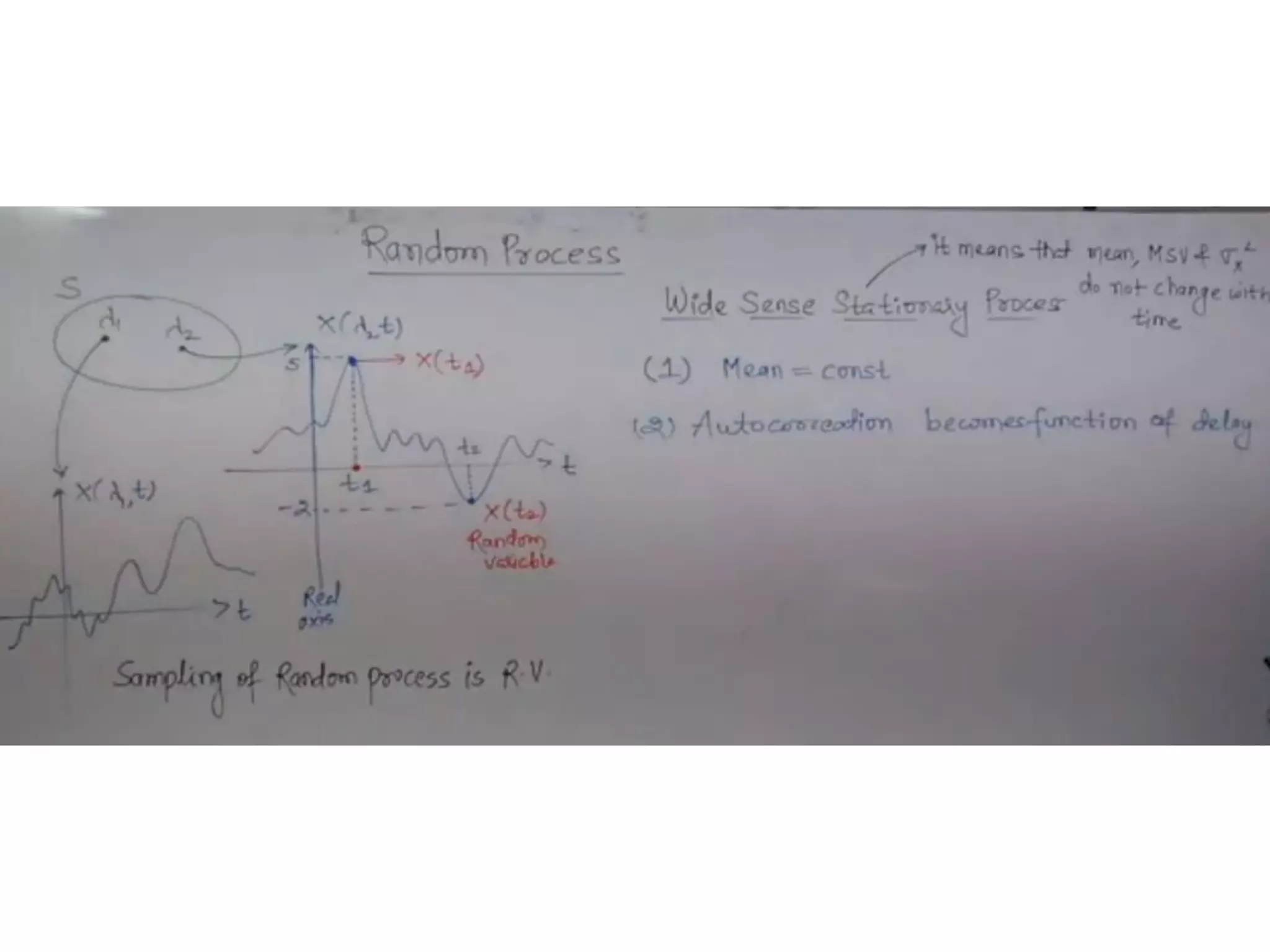
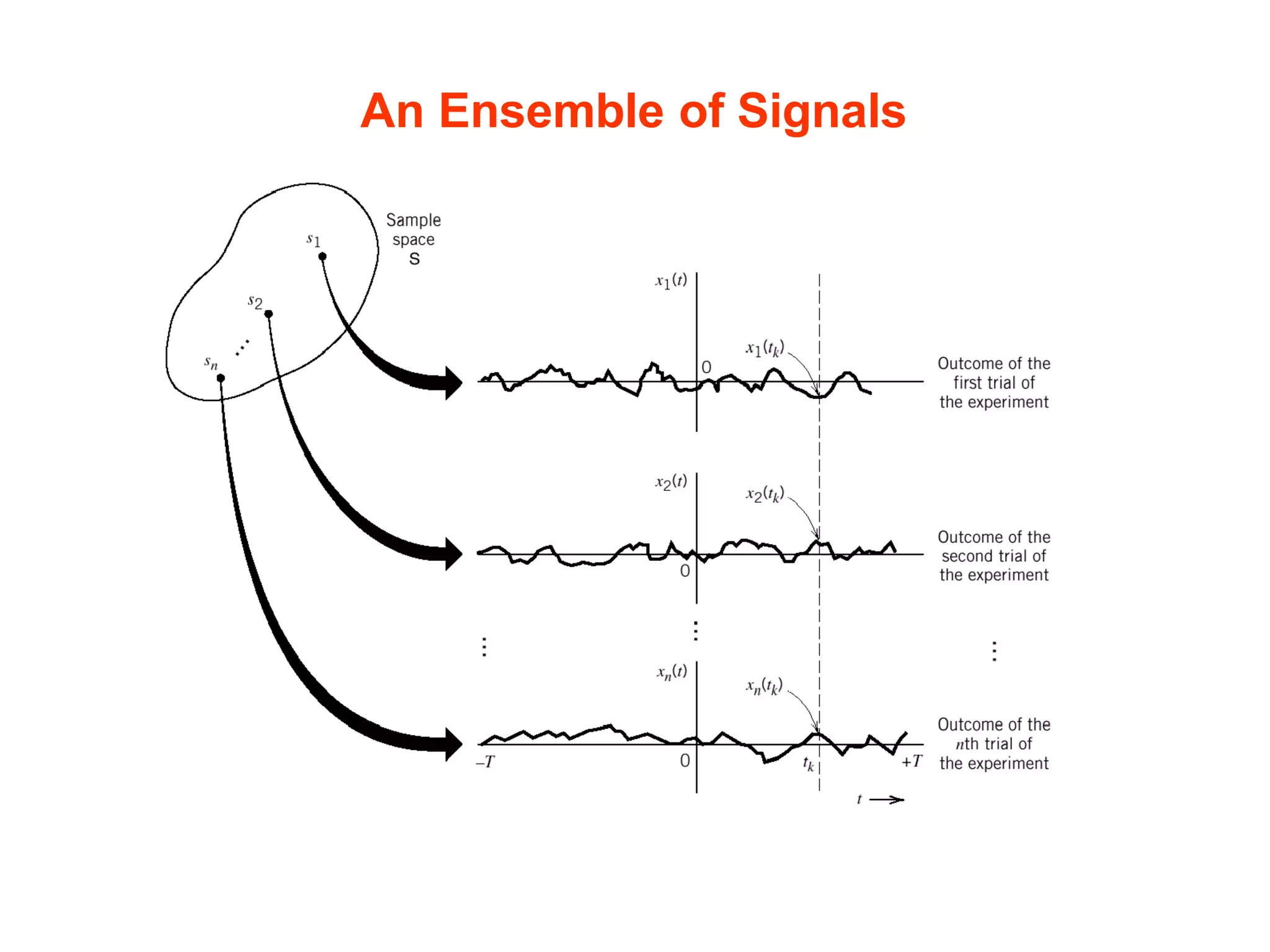
What is a Random Process?
• A random process is a time-varying function that assigns
the outcome of a random experiment to each time instant:
X(t).
• For a fixed (sample path): a random process is a time
varying function, e.g., a signal.
• For fixed t: a random process is a random variable.
• If one scans all possible outcomes of the underlying
random experiment, we shall get an ensemble of signals.
• Noise can often be modelled as a Gaussian random
process.
An Ensemble of Signals
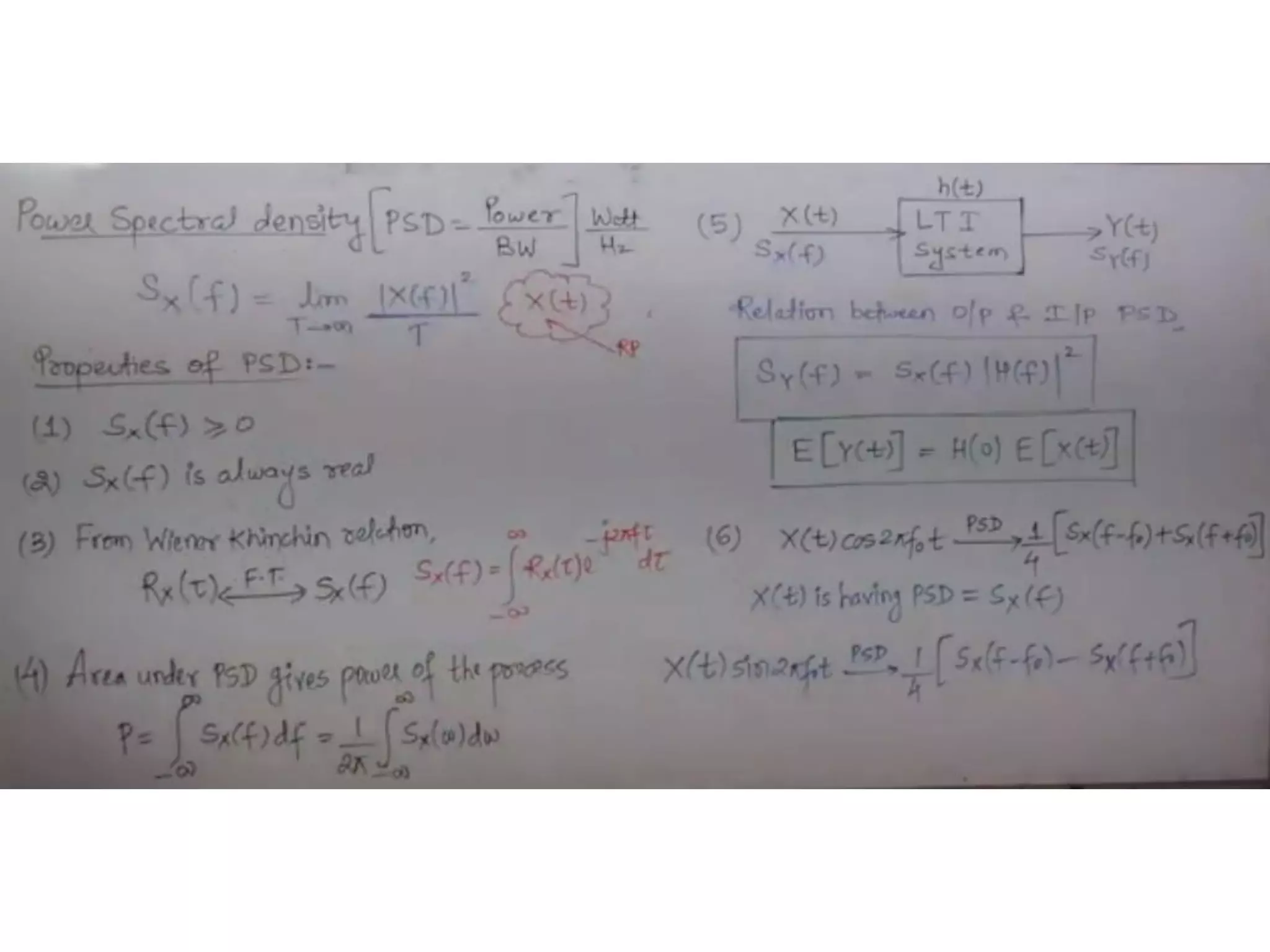
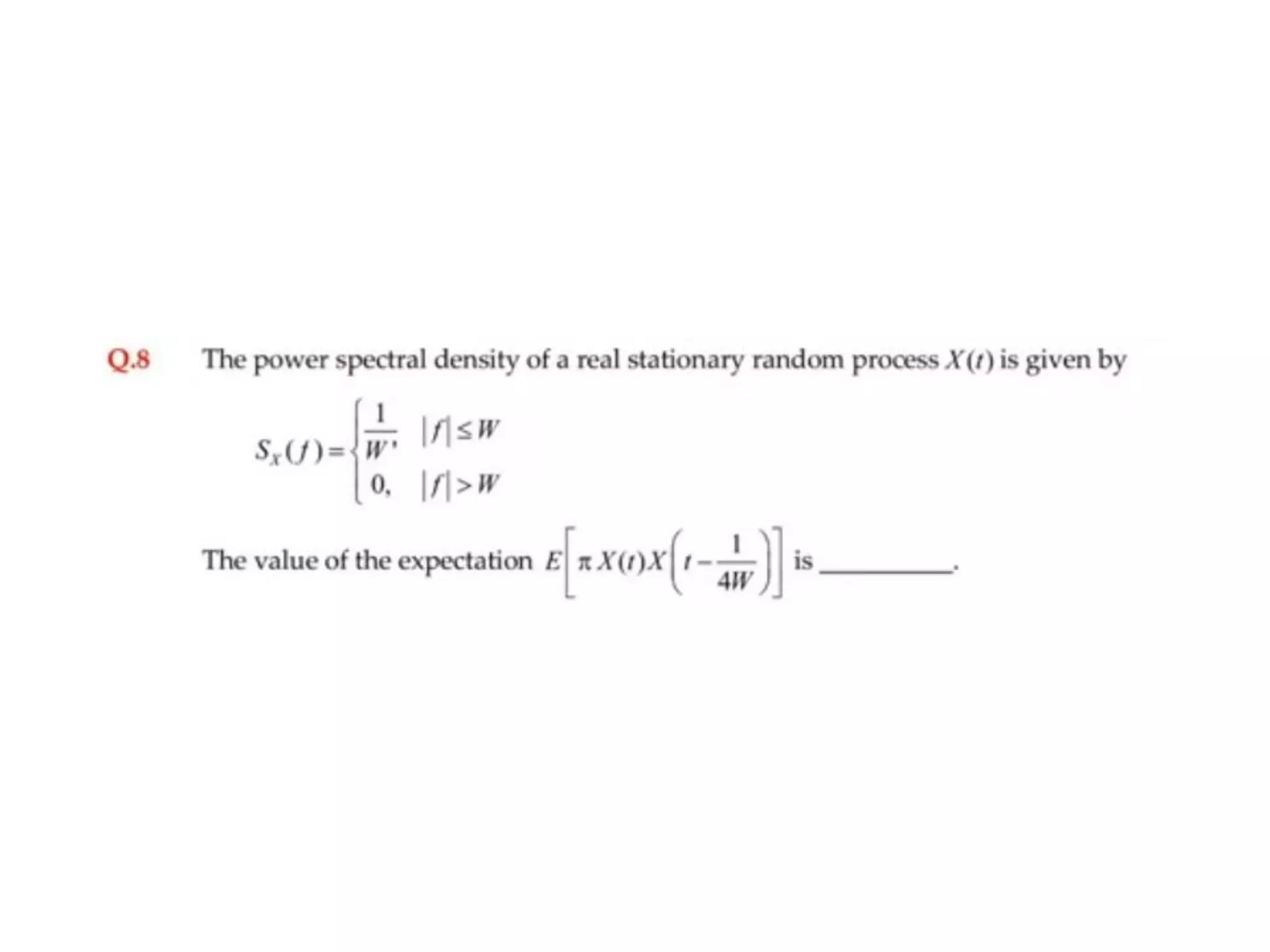
Power Spectral Density
• Power spectral density (PSD) is a function that measures
the distribution of power of a random process with
frequency.
• PSD is only defined for stationary processes.
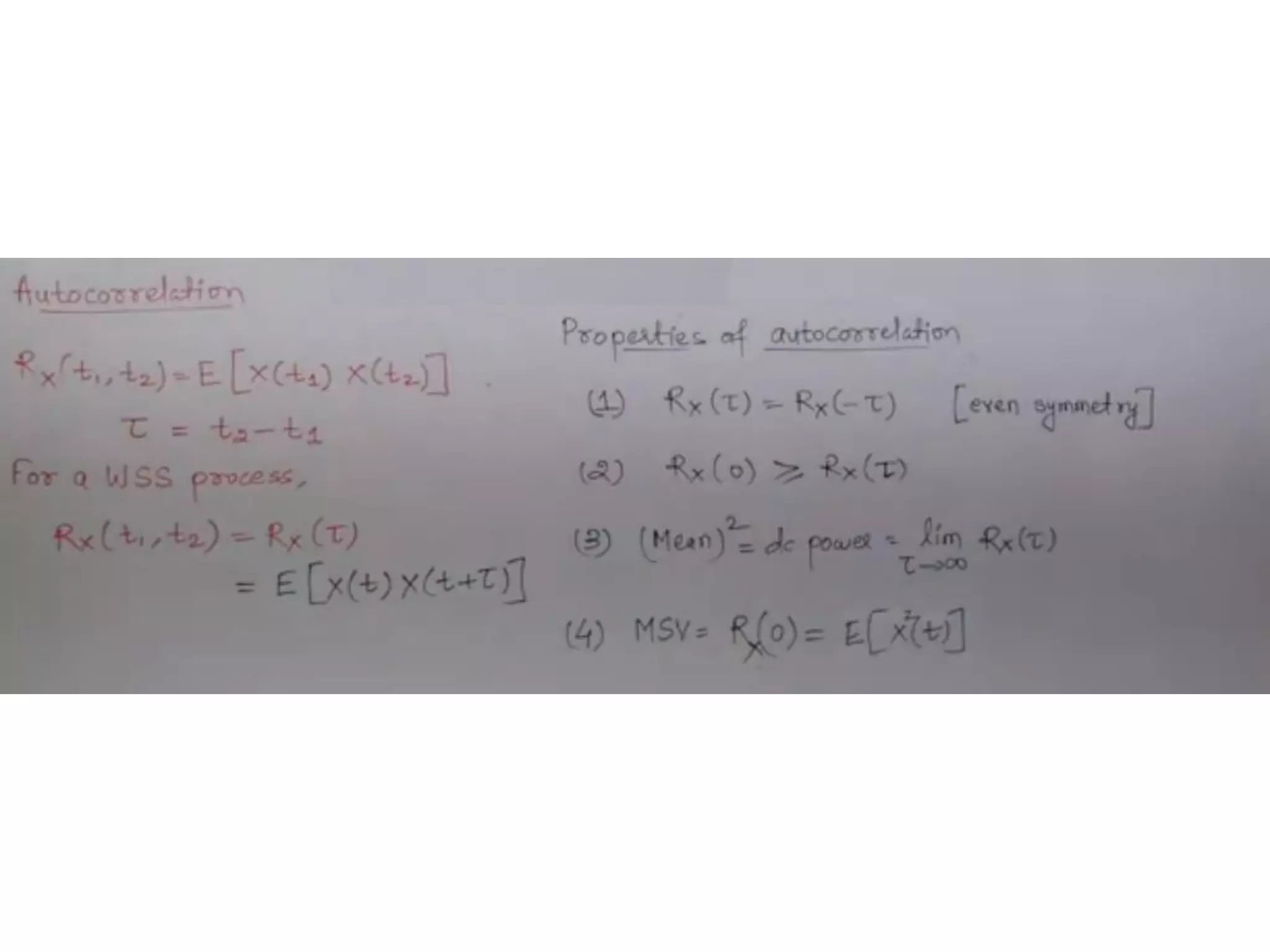
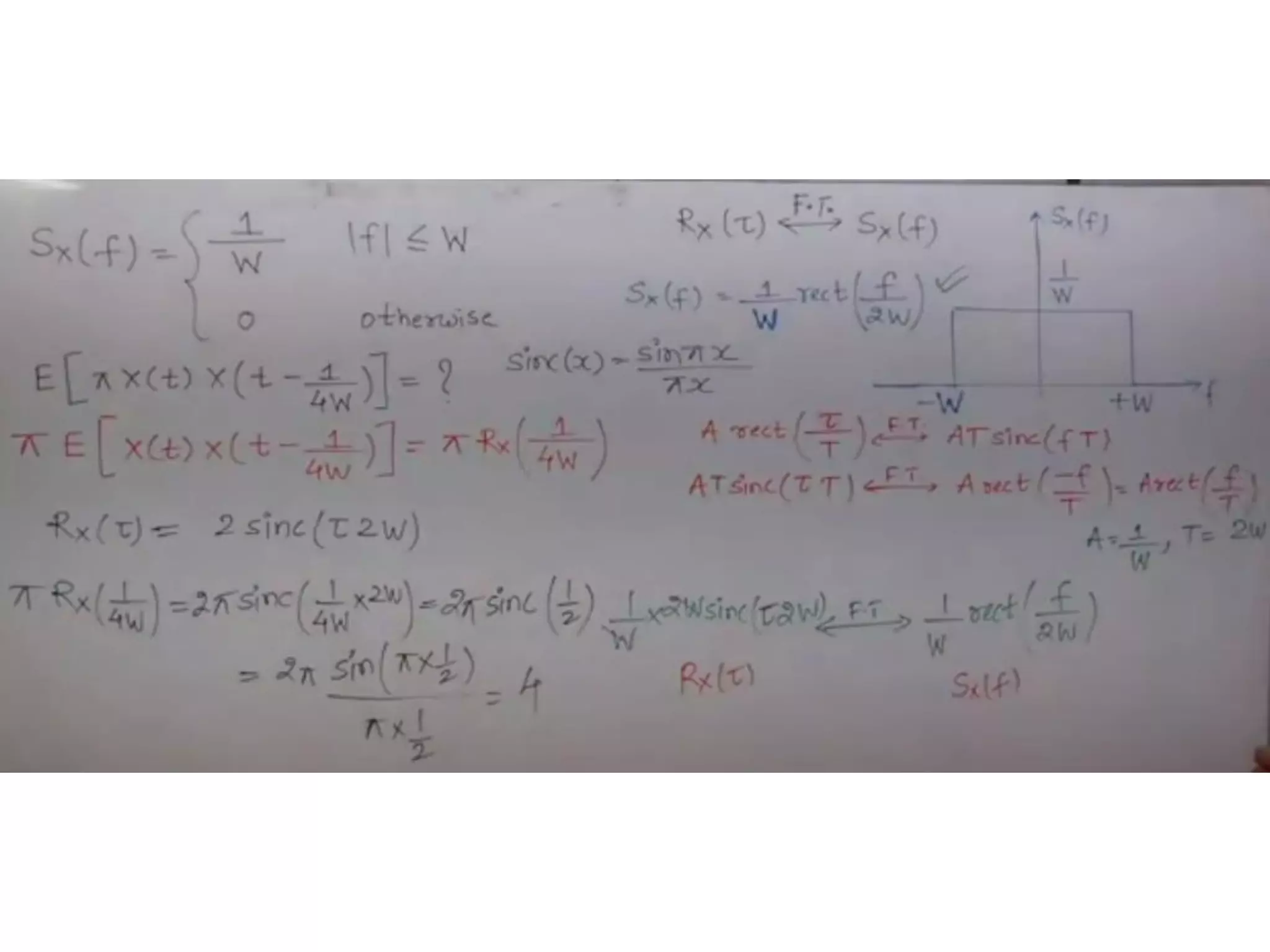
• Wiener-Khinchine relation: The PSD is equal to the
Fourier transform of its autocorrelation function:

X
X
−
R ( )e− j 2 f
d
S ( f ) =
– A similar relation exists for deterministic signals
• Then the average power can be found as
X X

S ( f )df
−
P = E[ X 2
(t)]= R (0) = 
• The frequency content of a process depends on how
rapidly the amplitude changes as a function of time.
– This can be measured by the autocorrelation function.
Passing Through a Linear System
• Let Y(t) obtained by passing random process X(t) through
a linear system of transfer function H(f). Then the PSD of
Y(t) 2
SY ( f ) = H (f ) SX ( f ) (2.1)
• If X(t) is a Gaussian process, then Y(t) is also a Gaussian
process.
– Gaussian processes are very important in communications.
Probability & RV Lec Slides.pdf

Probability & RV Lec Slides.pdf

  • 1.
    Communication Systems Probability andRandom Processes Dr. Irfan Arshad Department of Electrical Engineering
  • 2.
    Outline • Probability – Howprobability is defined – cdf and pdf – Mean and variance Joint distribution – Central limit theorem • Random processes – Definition – Stationary random processes – Power spectral density
  • 3.
    Why Probability/Random Process? •Probability is the core mathematical tool for communication theory. • The stochastic model is widely used in the study of communication systems. • Consider a radio communication system where the received signal is a random process in nature: – Message is random. No randomness, no information. – Interference is random. – Noise is a random process. – And many more (delay, phase, fading, ...) • Other real-world applications of probability and random processes include – Stock market modelling, gambling etc
  • 4.
    Probabilistic Concepts • Whatis a random variable (RV)? – It is a variable that takes its values from the outputs of a random experiment. • What is a random experiment? – It is an experiment the outcome of which cannot be predicted precisely. – All possible identifiable outcomes of a random experiment constitute its sample space S. – An event is a collection of possible outcomes of the random experiment. • Example – For tossing a coin, S = { H, T } – For rolling a die, S = { 1, 2, …, 6 }
  • 6.
    Probability Properties • PX(xi):the probability of the random variable X taking on the value xi • The probability of an event to happen is a non-negative number, with the following properties: – The probability of the event that includes all possible outcomes of the experiment is 1. – The probability of two events that do not have any common outcome is the sum of the probabilities of the two events separately. • Example – Roll a die: PX(x = k) = 1/6 for k = 1, 2, …, 6
  • 7.
    Cumulative Distribution Function(CDF) • The (cumulative) distribution function (cdf) of a random variable X is defined as the probability of X taking a value less than the argument x: FX (x) = P( X x) • Properties FX (−) = 0, FX () =1 FX (x1 )  FX(x2 ) if x1x2
  • 11.
    Probability Density Function(PDF) • The probability density function (pdf) is defined as the derivative of the cumulative distribution function: dFX ( x ) X dx f X ( y)dy f (x) = x FX ( x) =  a f X ( y)dy − b P (a  X  b ) = FX (b ) − FX (a ) =  X X dFX ( x ) dx f (x) =  0 since F (x) is non - decreasing
  • 14.
    Mean and Variance XX x f (x)dx • Mean (or expected value  DC level):  E[X ] =  =  E[ ]: expectation operator −
  • 18.
    18 Normal (Gaussian) Distribution Theprobability density function of a normal random variable is given by: It looks like this: Bell shaped, Symmetrical around the mean … f X ( x) x 0 m
  • 19.
  • 21.
  • 23.
  • 24.
    Uniform Distribution fX(x) 1  X a x  b f (x) =  b − a  2 a + b E [ X ]= 0 0  x − a FX ( x) =  b −a 2 12 X  2 = (b- a) elsewhere x  a a  x  b x  b  1
  • 30.
    Joint Distribution • Jointdistribution function for two random variables X and Y FXY (x, y) = P( X  x,Y  y) • Joint probability density function XY xy 2 FXY (x, y) f (x, y) = • Properties   1) FXY (, ) =   f XY (u, v)dudv =1 − − 2) f X (x) = f XY (x,y)dy   3) fY (x) = f XY (x,y)dx x=− y=−   4) X , Y are independent  fXY (x, y) = fX (x) fY (y) 5) X , Y are uncorrelated  E[XY] = E[X ]E[Y]
  • 31.
    Joint Distribution • Jointdistribution function for two random variables X and Y FXY (x, y) = P( X  x,Y  y) • Joint probability density function XY xy 2 FXY (x, y) f (x, y) = • Properties   1) FXY (, ) =   f XY (u, v)dudv =1 − − 2) f X (x) = f XY (x,y)dy   3) fY (x) = f XY (x,y)dx x=− y=−   4) X , Y are independent  fXY (x, y) = fX (x) fY (y) 5) X , Y are uncorrelated  E[XY] = E[X ]E[Y]
  • 32.
    Joint Distribution ofn RVs • Joint cdf FX X ...X (x1, x2 ,...xn )  P(X1  x1, X2  x2 ,...Xn  xn ) 1 2 n • Joint pdf n  F n ( x ,x ,...x ) x1x2 ...xn X X ...X 1 2 1 2 n f X X ...X (x1, x2 ,...xn )  1 2 n • Independent FX X ... X (x1 , x2 ,...xn ) = FX (x1 )FX (x2 )...FX (xn ) 1 2 n 1 2 n fX X ...X (x1, x2 ,...xn ) = fX (x1) fX (x2 )...fX (xn ) 1 2 n 1 2 n • i.i.d. (independent, identically distributed) The random variables are independent and have the same distribution. – Example: outcomes from repeatedly flipping a coin.
  • 33.
    Central Limit Theorem x1+x2 x1 “ ” x1 +x2 + x3 x1 + x2+ x3 +x4 • For i.i.d. random variables, z = x1 + x2 +· · ·+ xn tends to Gaussian as n goes to infinity. • Extremely useful in communications. • That’s why noise is usually Gaussian. We often say Gaussian noise or “Gaussian channel” in communications. Illustration of convergence to Gaussian distribution
  • 38.
    What is aRandom Process? • A random process is a time-varying function that assigns the outcome of a random experiment to each time instant: X(t). • For a fixed (sample path): a random process is a time varying function, e.g., a signal. • For fixed t: a random process is a random variable. • If one scans all possible outcomes of the underlying random experiment, we shall get an ensemble of signals. • Noise can often be modelled as a Gaussian random process.
  • 40.
  • 42.
    Power Spectral Density •Power spectral density (PSD) is a function that measures the distribution of power of a random process with frequency. • PSD is only defined for stationary processes. • Wiener-Khinchine relation: The PSD is equal to the Fourier transform of its autocorrelation function:  X X − R ( )e− j 2 f d S ( f ) = – A similar relation exists for deterministic signals • Then the average power can be found as X X  S ( f )df − P = E[ X 2 (t)]= R (0) =  • The frequency content of a process depends on how rapidly the amplitude changes as a function of time. – This can be measured by the autocorrelation function.
  • 44.
    Passing Through aLinear System • Let Y(t) obtained by passing random process X(t) through a linear system of transfer function H(f). Then the PSD of Y(t) 2 SY ( f ) = H (f ) SX ( f ) (2.1) • If X(t) is a Gaussian process, then Y(t) is also a Gaussian process. – Gaussian processes are very important in communications.