Stochastic Processes Elements of Stochastic Processes By Mahdi Malaki
Outline Basic Definitions Stationary/Ergodic Processes Stochastic Analysis of Systems Power Spectrum
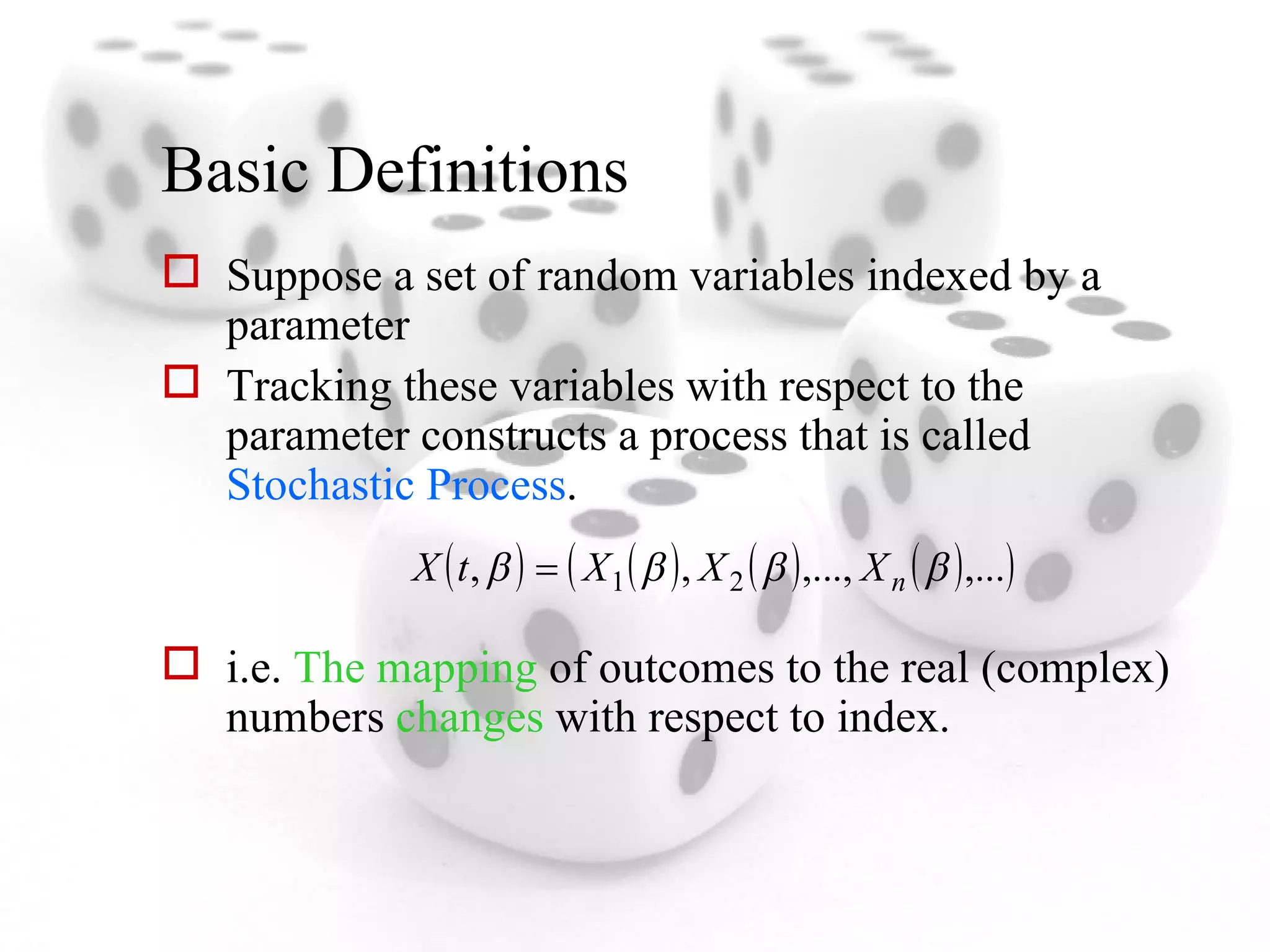
Basic Definitions Suppose a set of random variables indexed by a parameter Tracking these variables with respect to the parameter constructs a process that is called  Stochastic Process . i.e.  The mapping  of outcomes to the real (complex) numbers  changes  with respect to index.
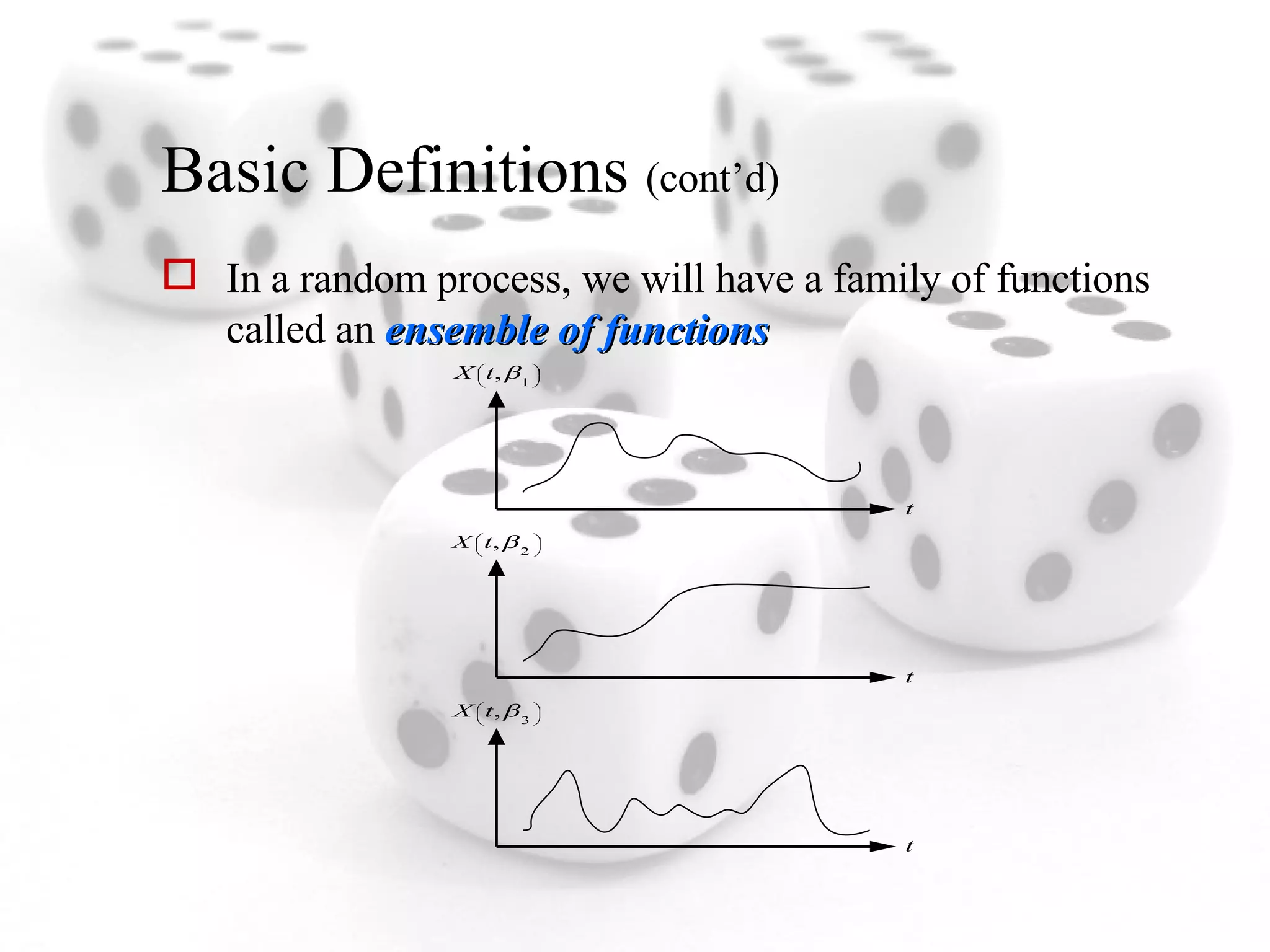
Basic Definitions  (cont’d) In a random process, we will have a family of functions called an  ensemble of functions
Basic Definitions  (cont’d) With fixed “beta”, we will have a  “time”  function called  sample path . Sometimes stochastic properties of a random process can be extracted  just  from a single sample path. (When?)
Basic Definitions  (cont’d) With fixed “t”, we will have a random variable. With fixed “t” and “beta”, we will have a real (complex) number.
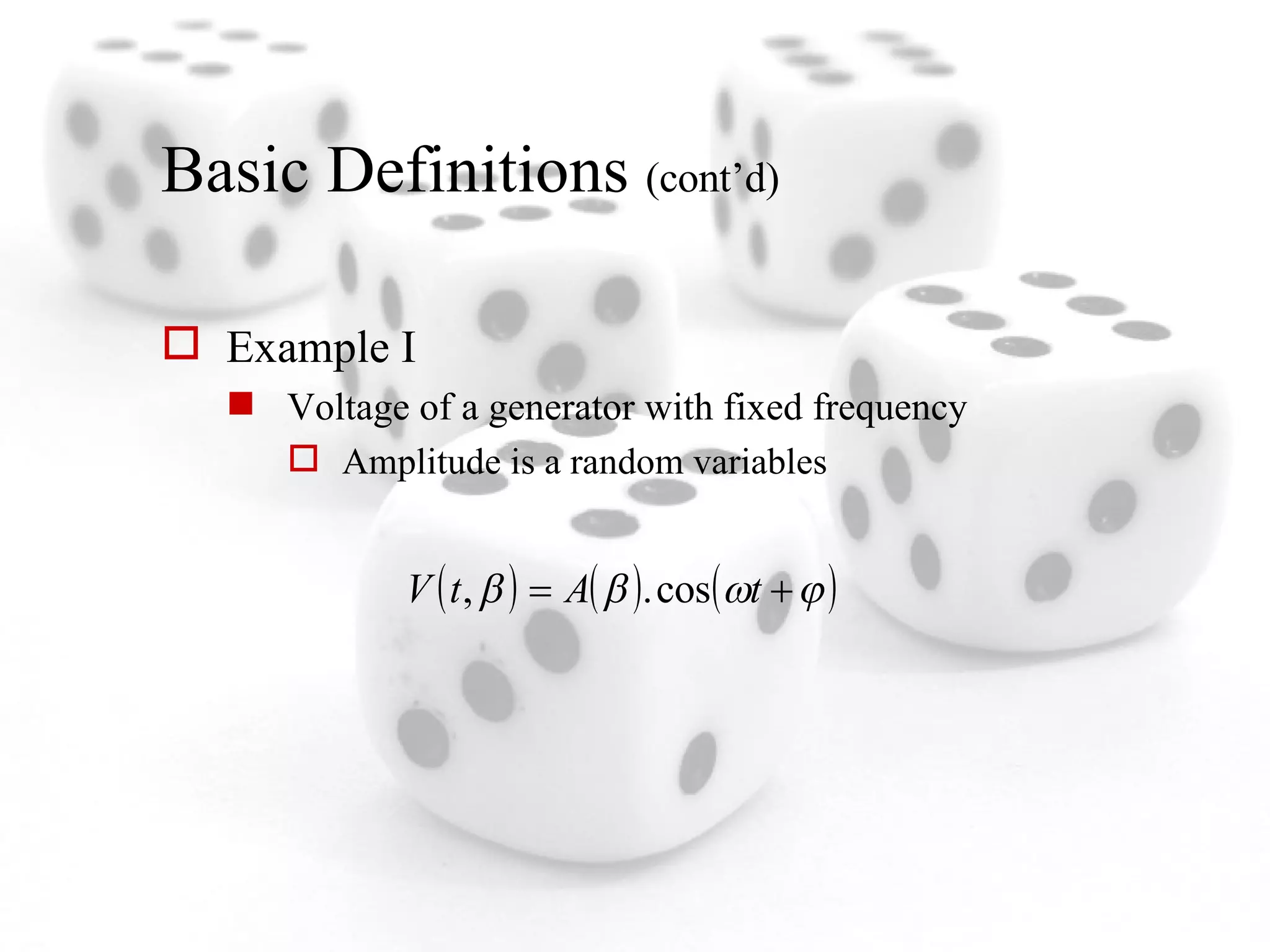
Basic Definitions  (cont’d) Example I Voltage of a generator with fixed frequency Amplitude is a random variables
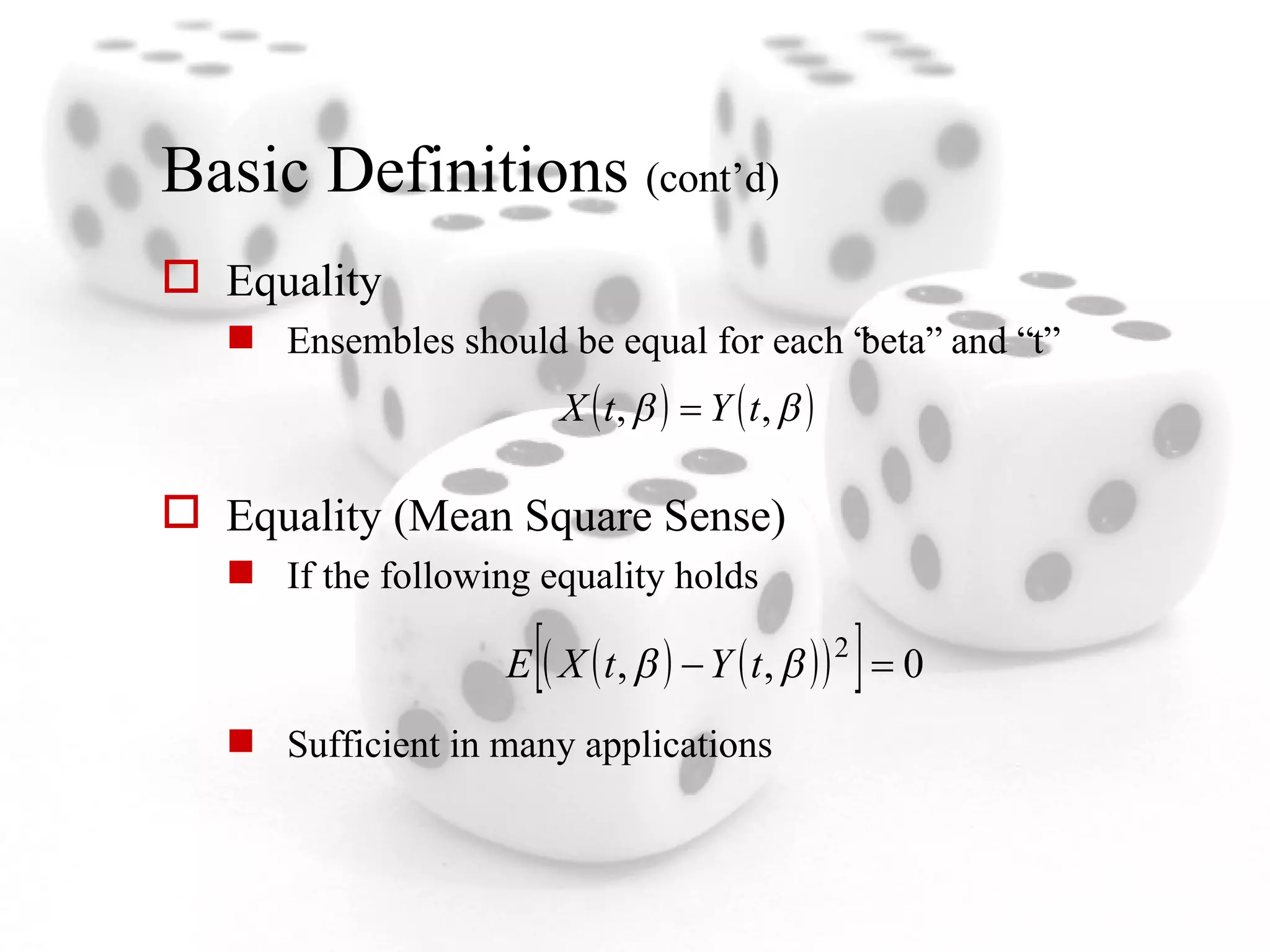
Basic Definitions  (cont’d) Equality Ensembles should be equal for each “beta” and “t” Equality (Mean Square Sense) If the following equality holds Sufficient in many applications
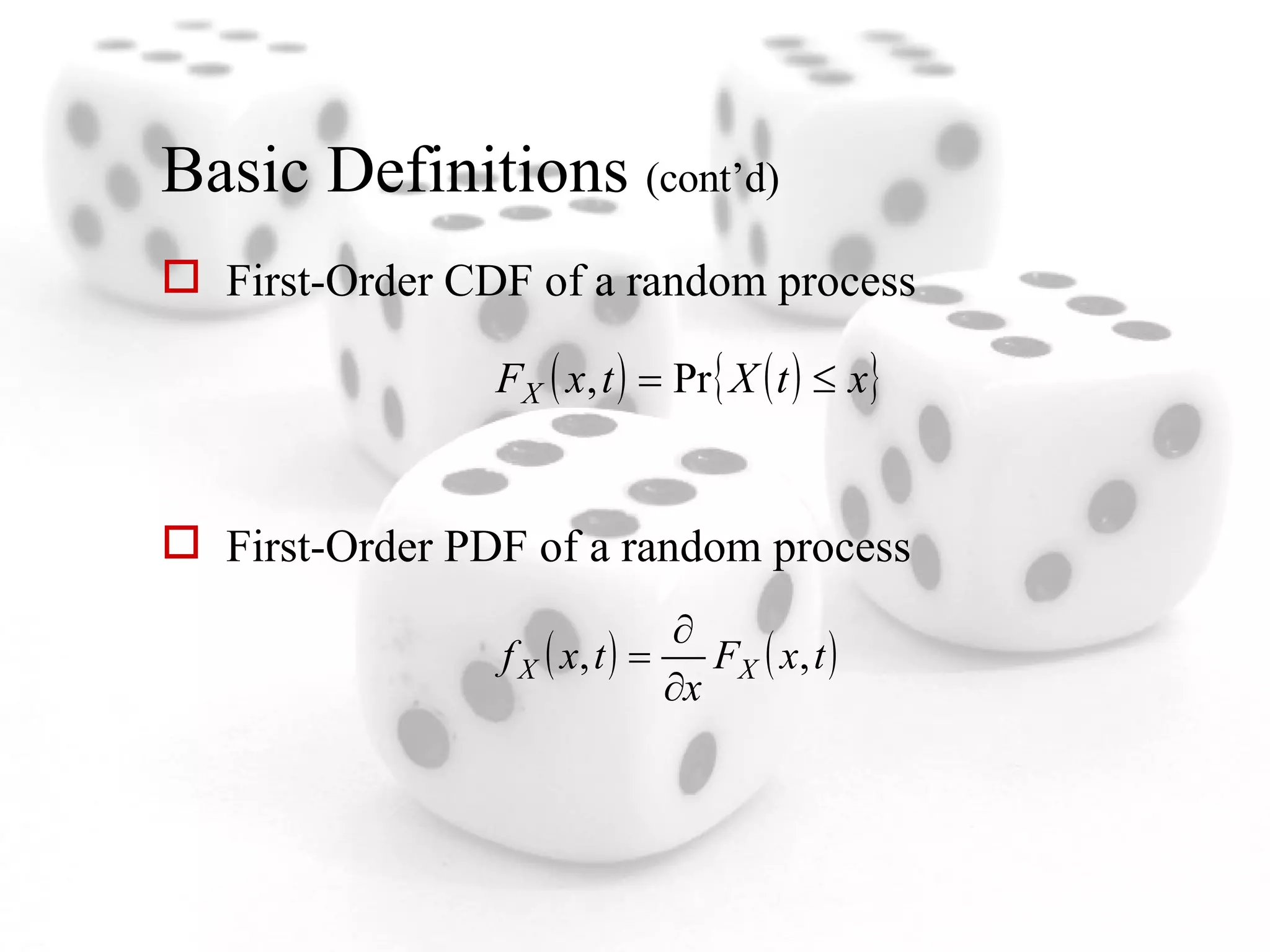
Basic Definitions  (cont’d) First-Order CDF of a random process First-Order PDF of a random process
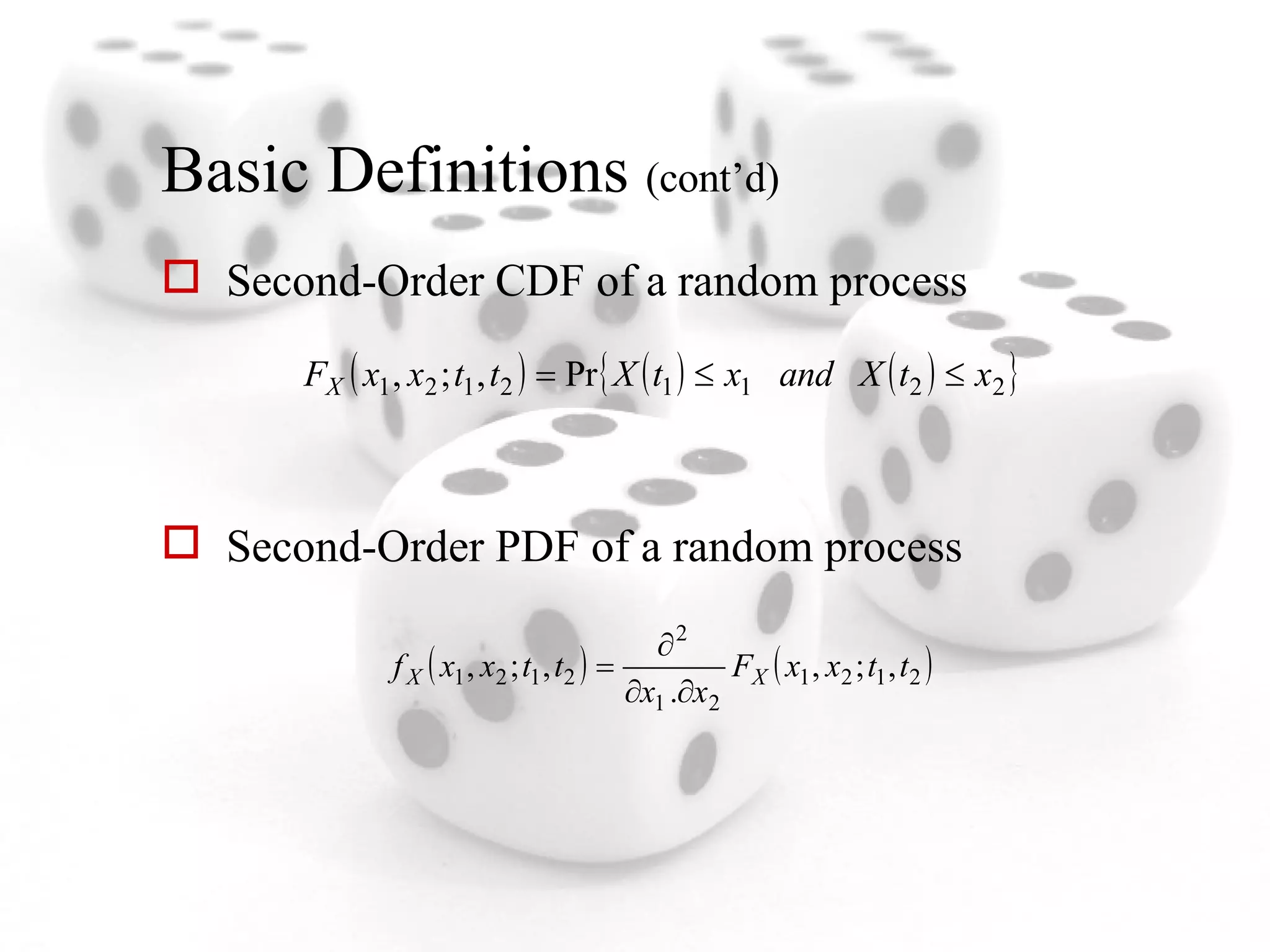
Basic Definitions  (cont’d) Second-Order CDF of a random process Second-Order PDF of a random process
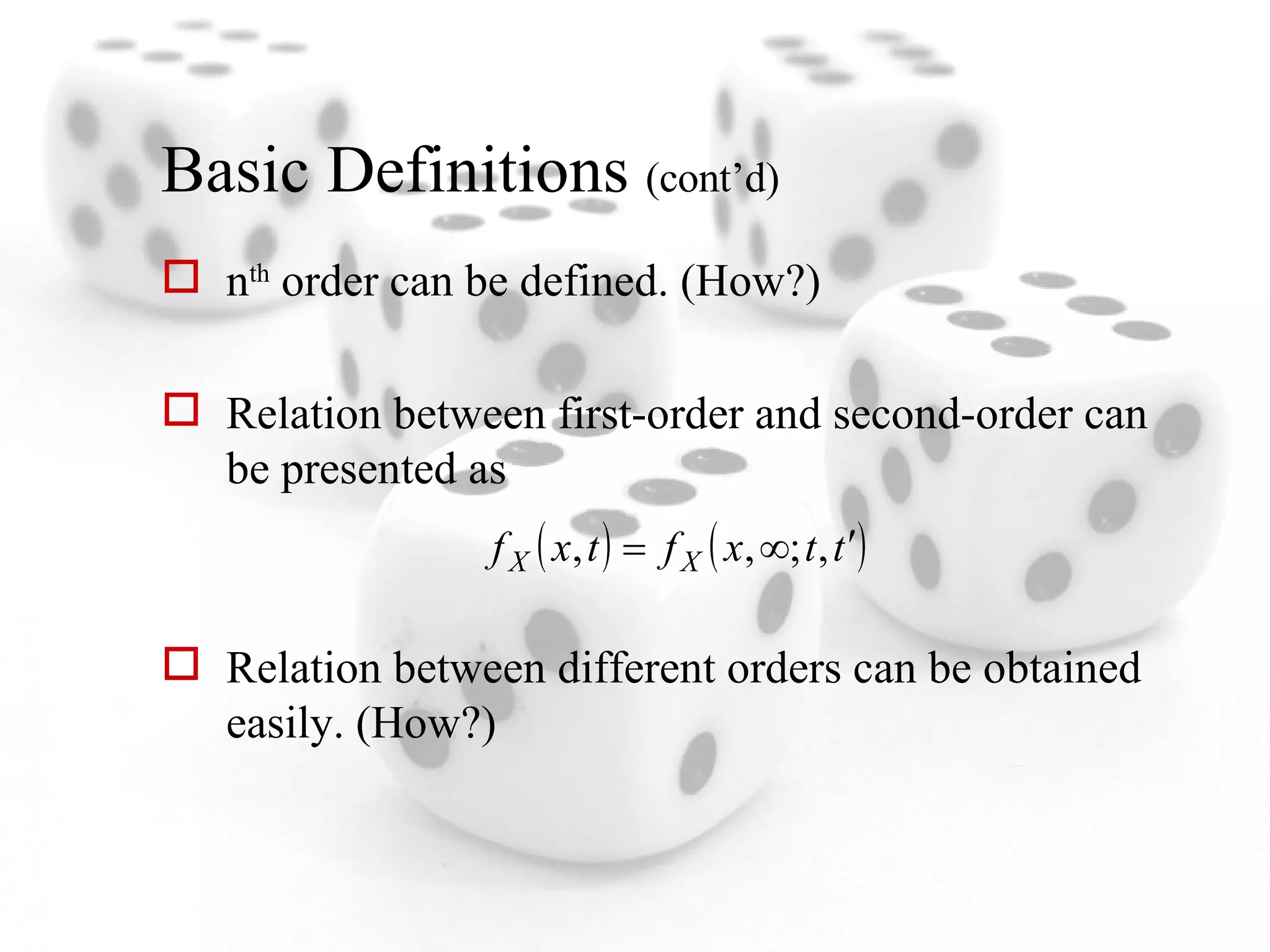
Basic Definitions  (cont’d) n th  order can be defined. (How?) Relation between first-order and second-order can be presented as Relation between different orders can be obtained easily. (How?)
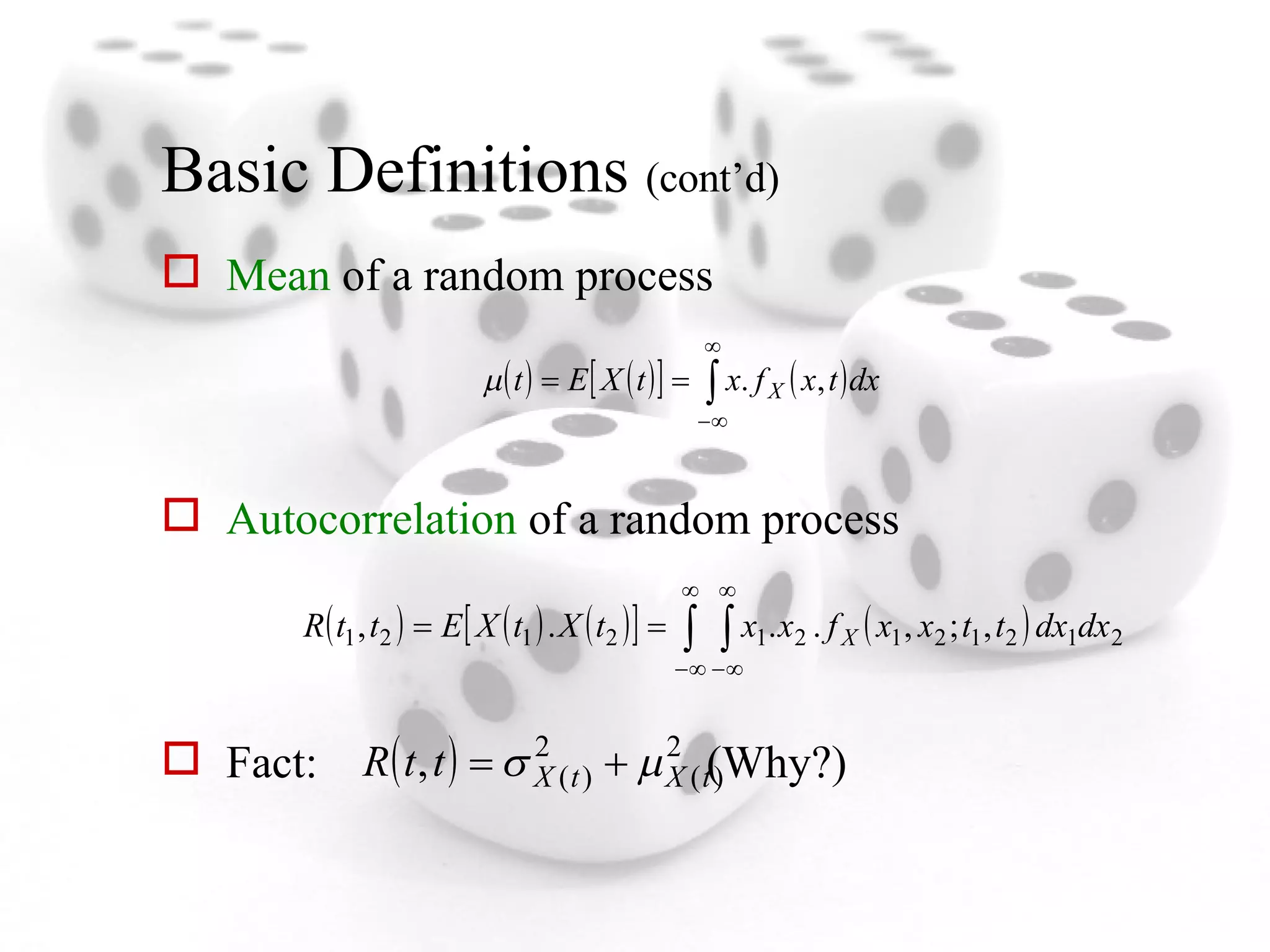
Basic Definitions  (cont’d) Mean  of a random process Autocorrelation  of a random process Fact:  (Why?)
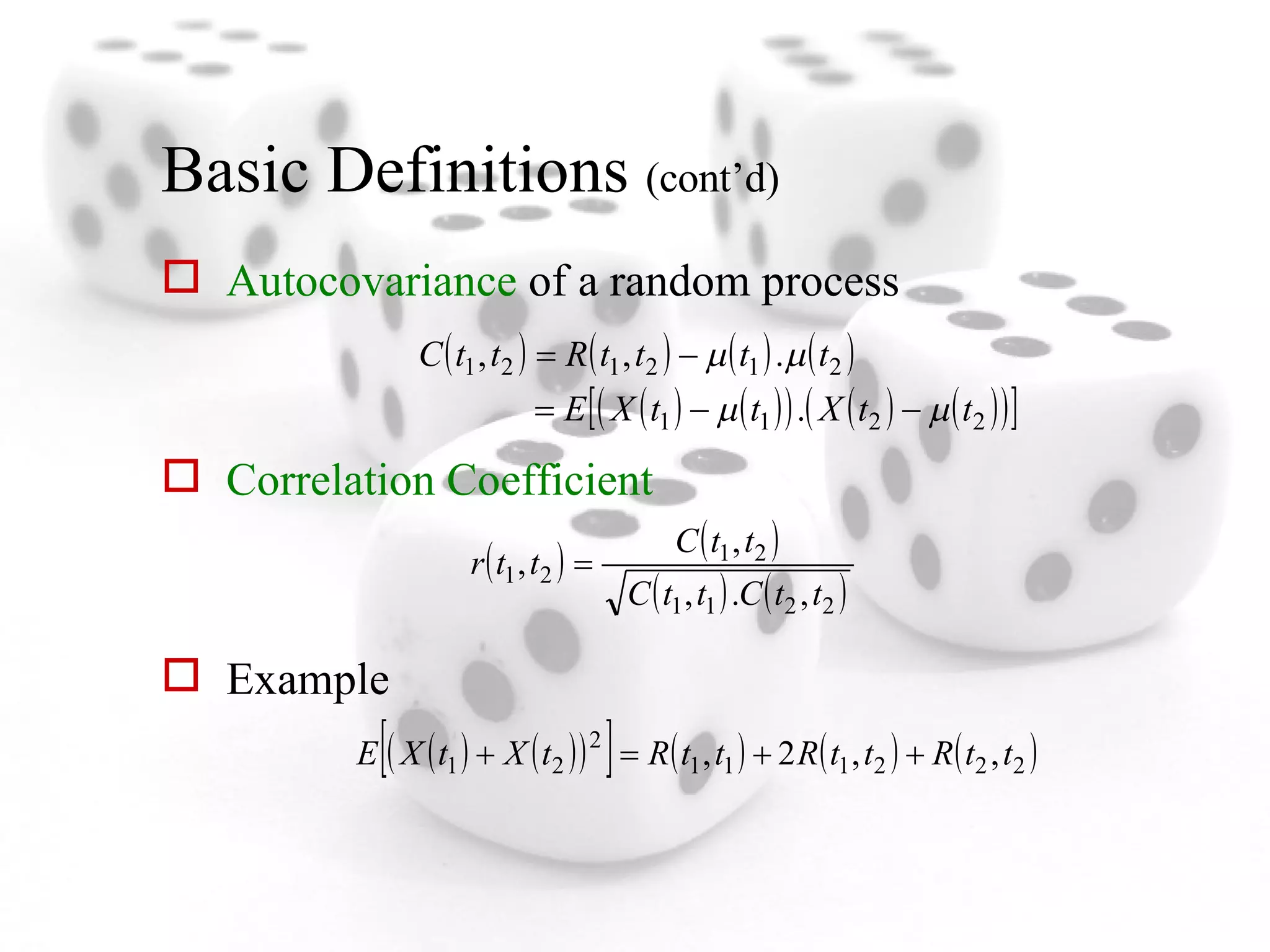
Basic Definitions  (cont’d) Autocovariance  of a random process Correlation Coefficient Example
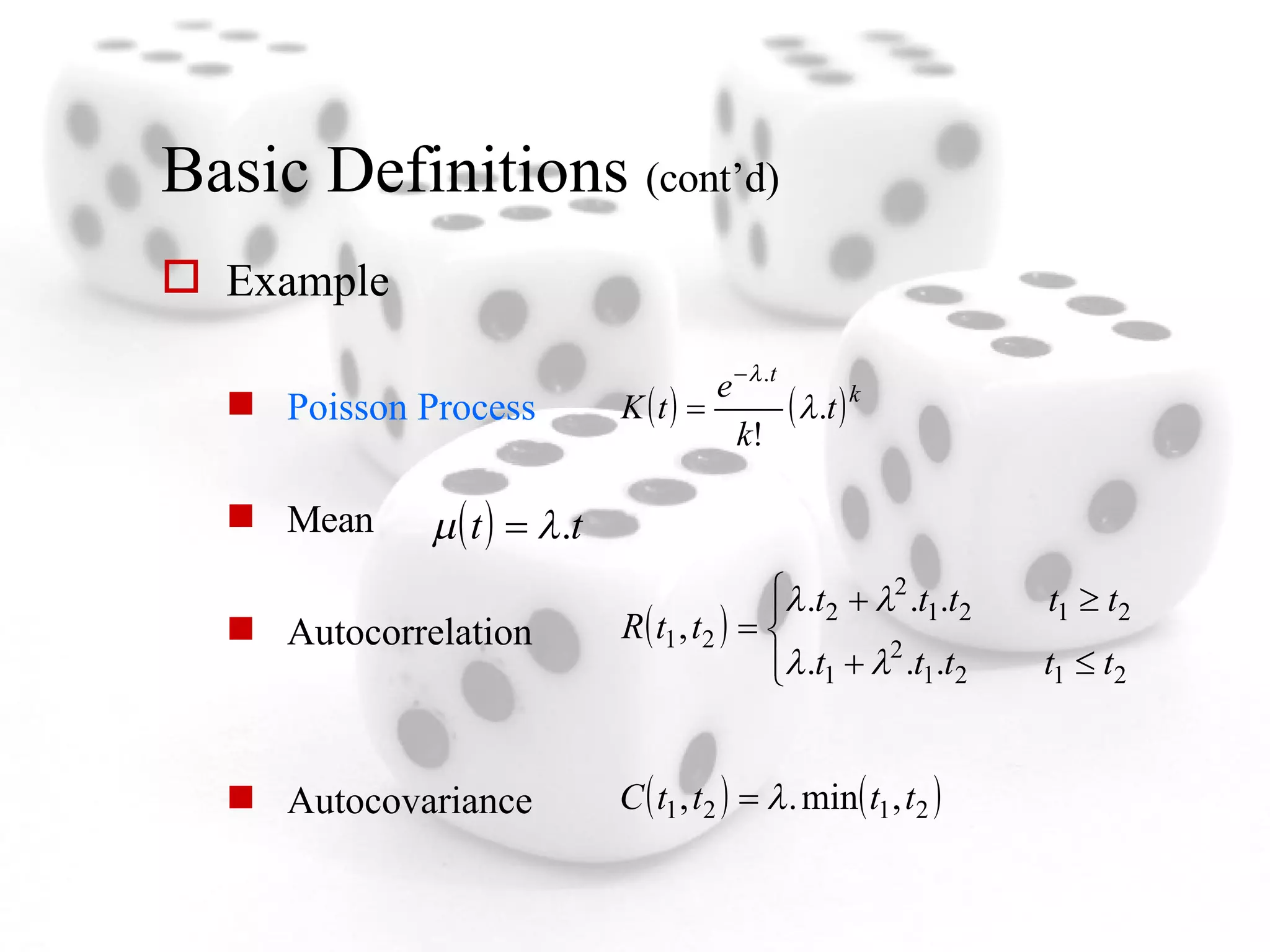
Basic Definitions  (cont’d) Example Poisson Process Mean Autocorrelation Autocovariance
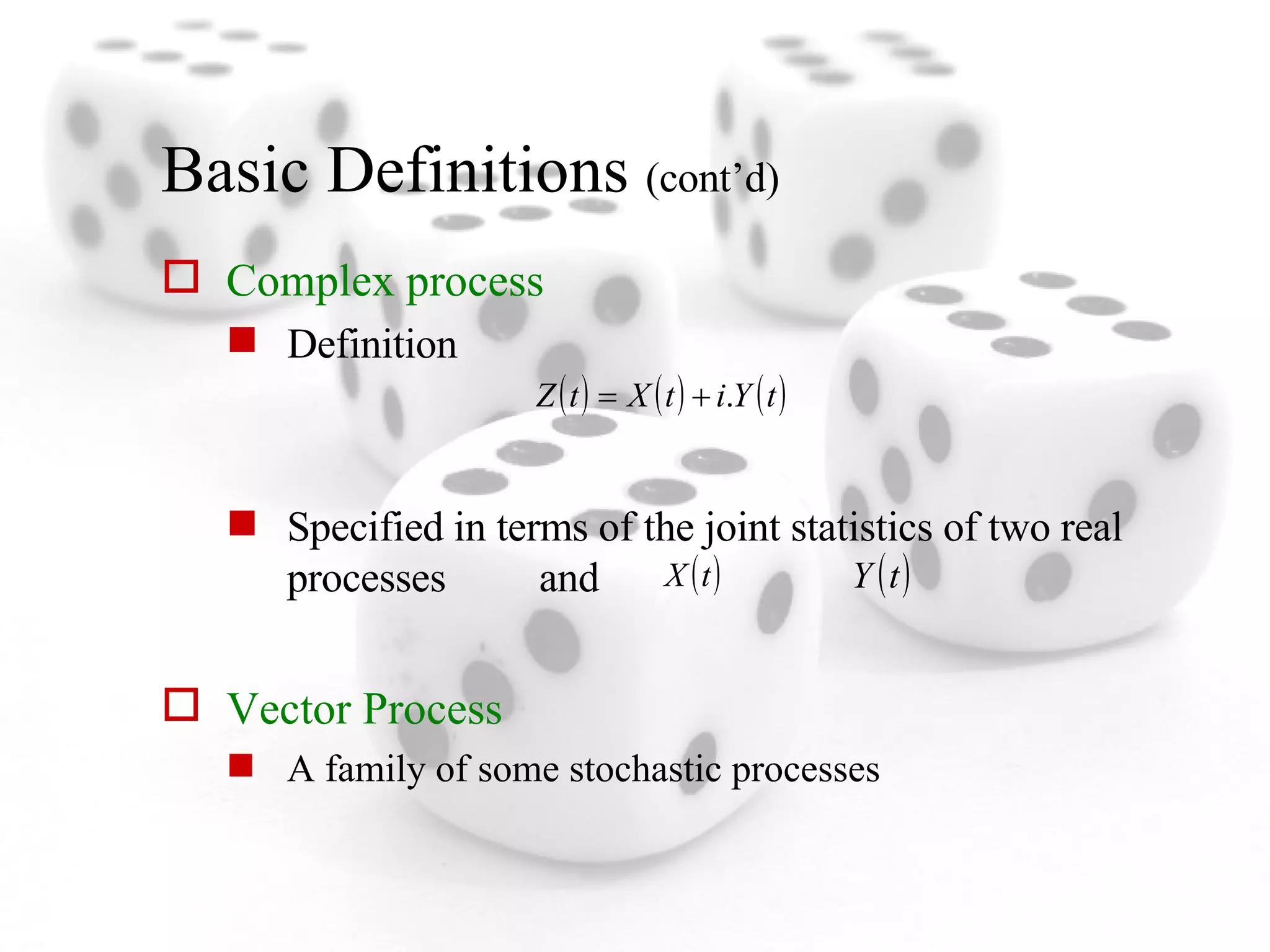
Basic Definitions  (cont’d) Complex process Definition Specified in terms of the joint statistics of two real processes  and   Vector Process A family of some stochastic processes
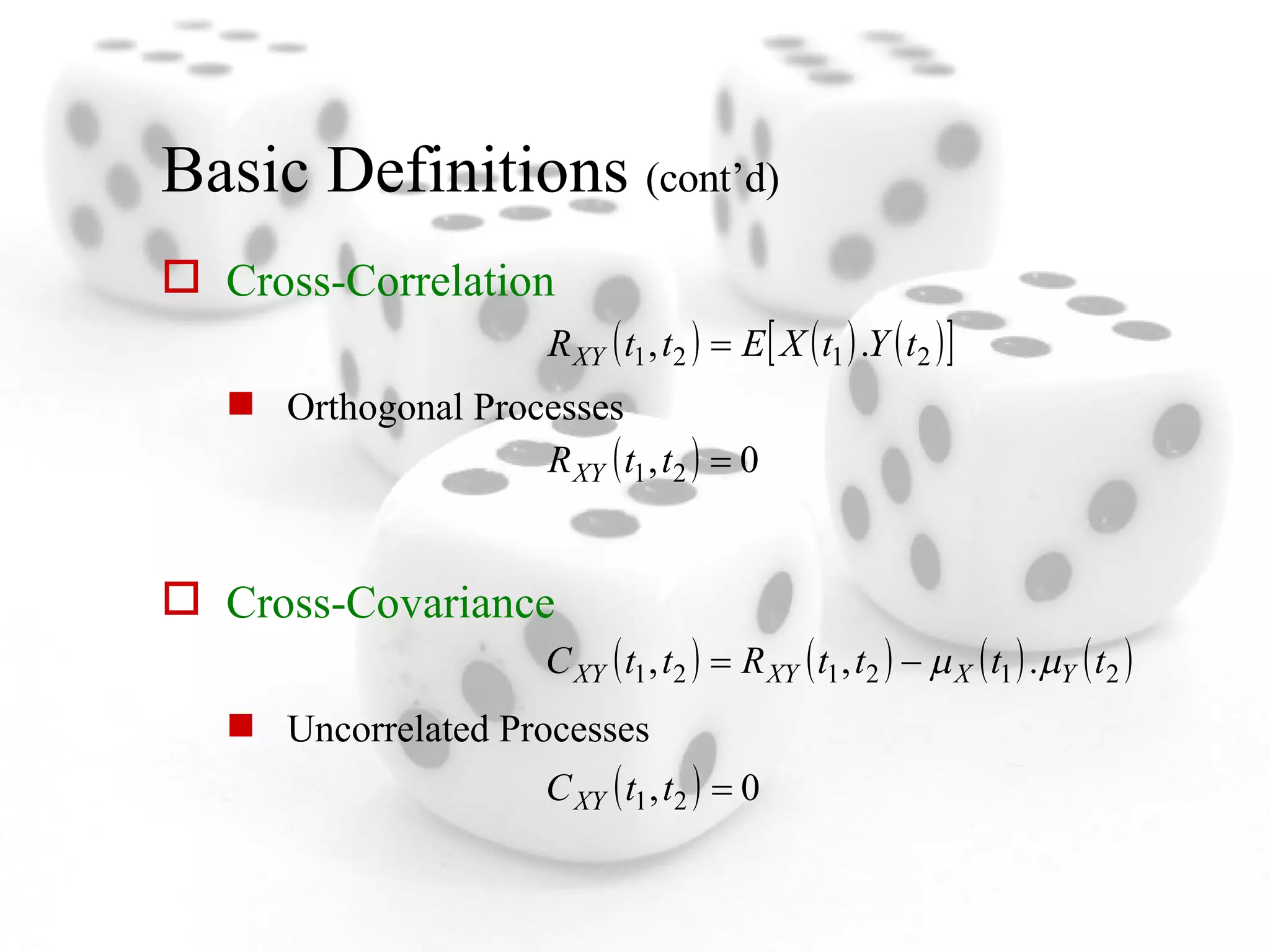
Basic Definitions  (cont’d) Cross-Correlation Orthogonal Processes Cross-Covariance Uncorrelated Processes
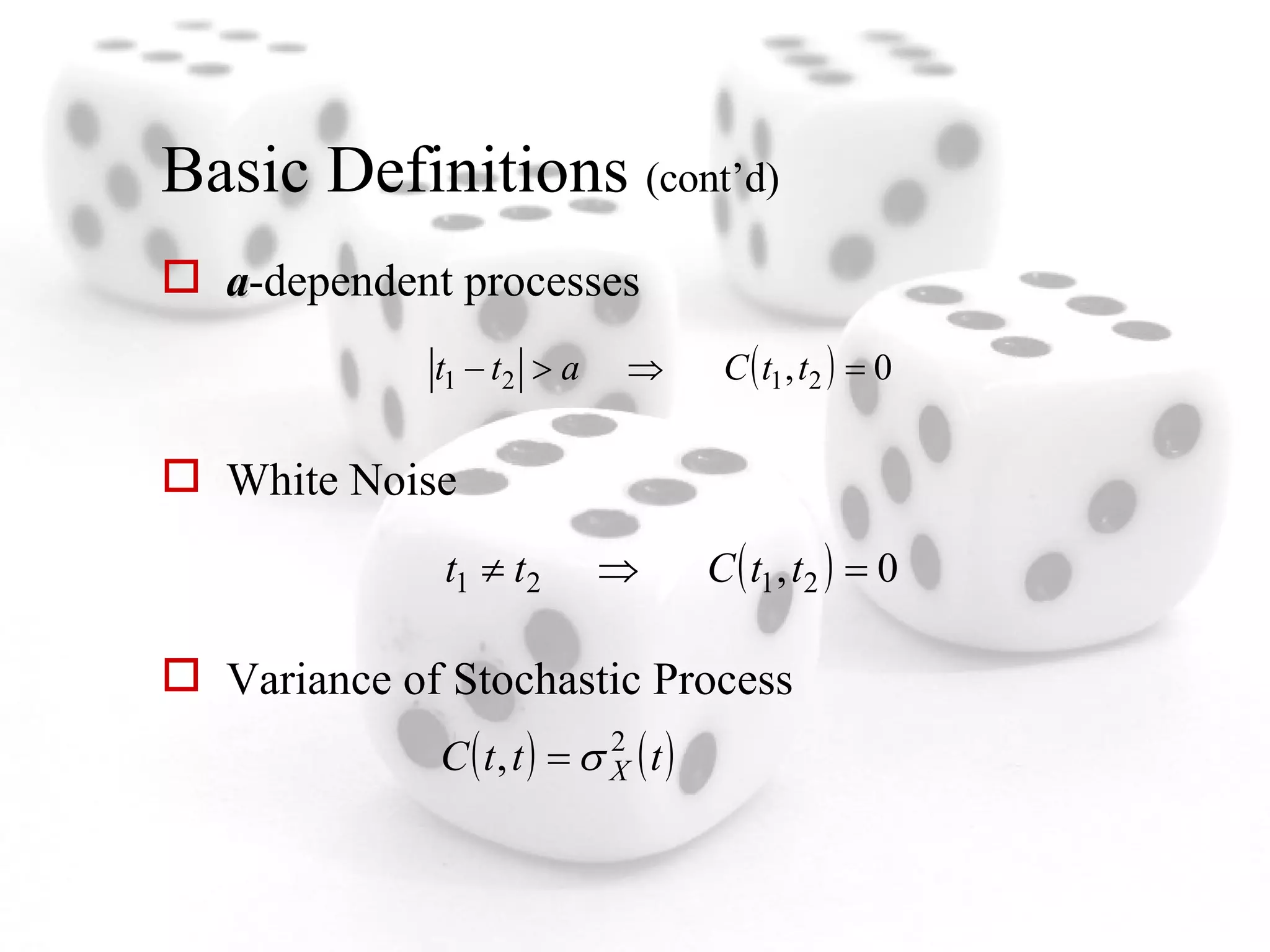
Basic Definitions  (cont’d) a -dependent processes White Noise Variance of Stochastic Process
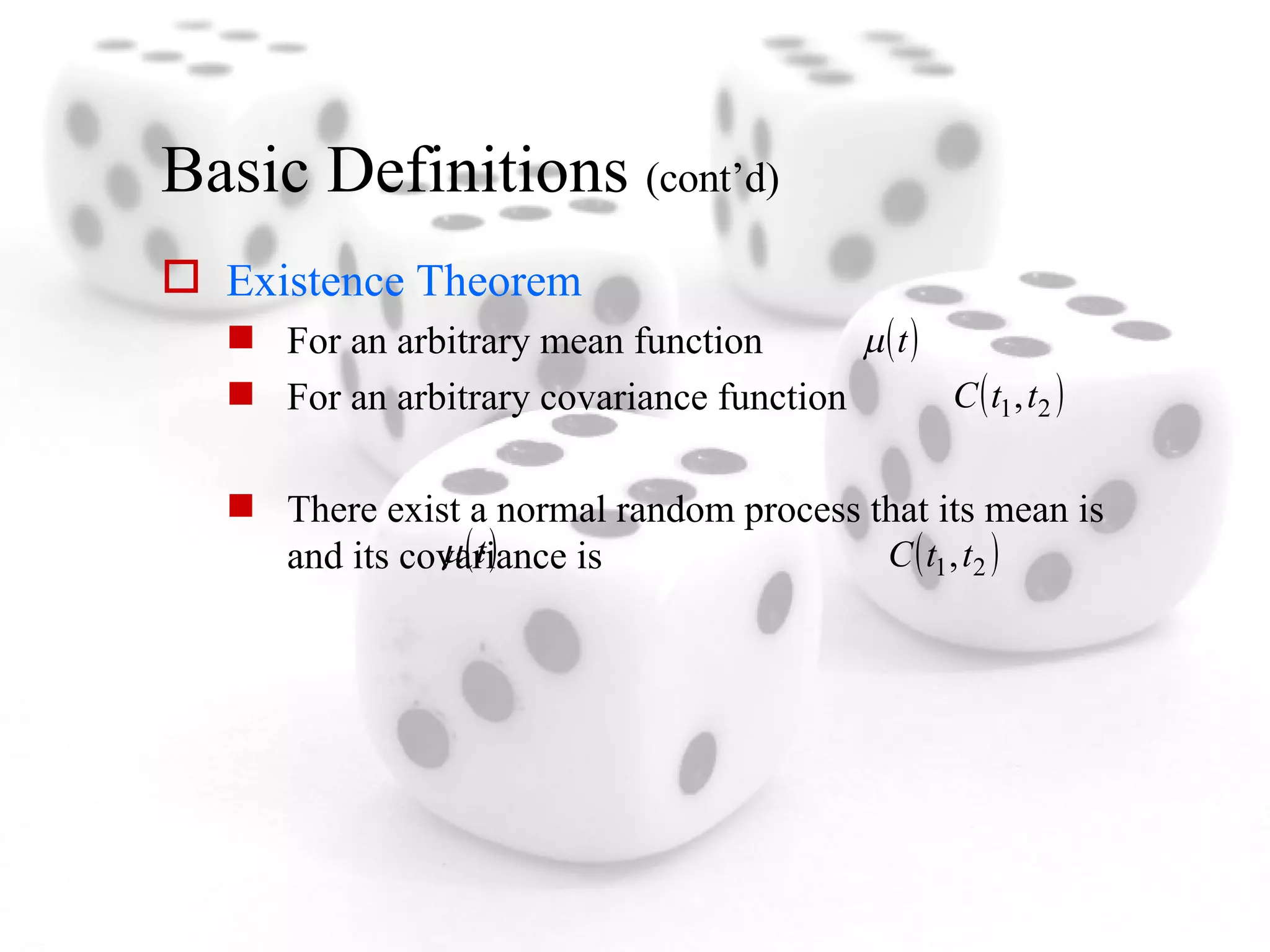
Basic Definitions  (cont’d) Existence Theorem For an arbitrary mean function  For an arbitrary covariance function There exist a normal random process that its mean is  and its covariance is
Outline Basic Definitions Stationary/Ergodic Processes Stochastic Analysis of Systems Power Spectrum
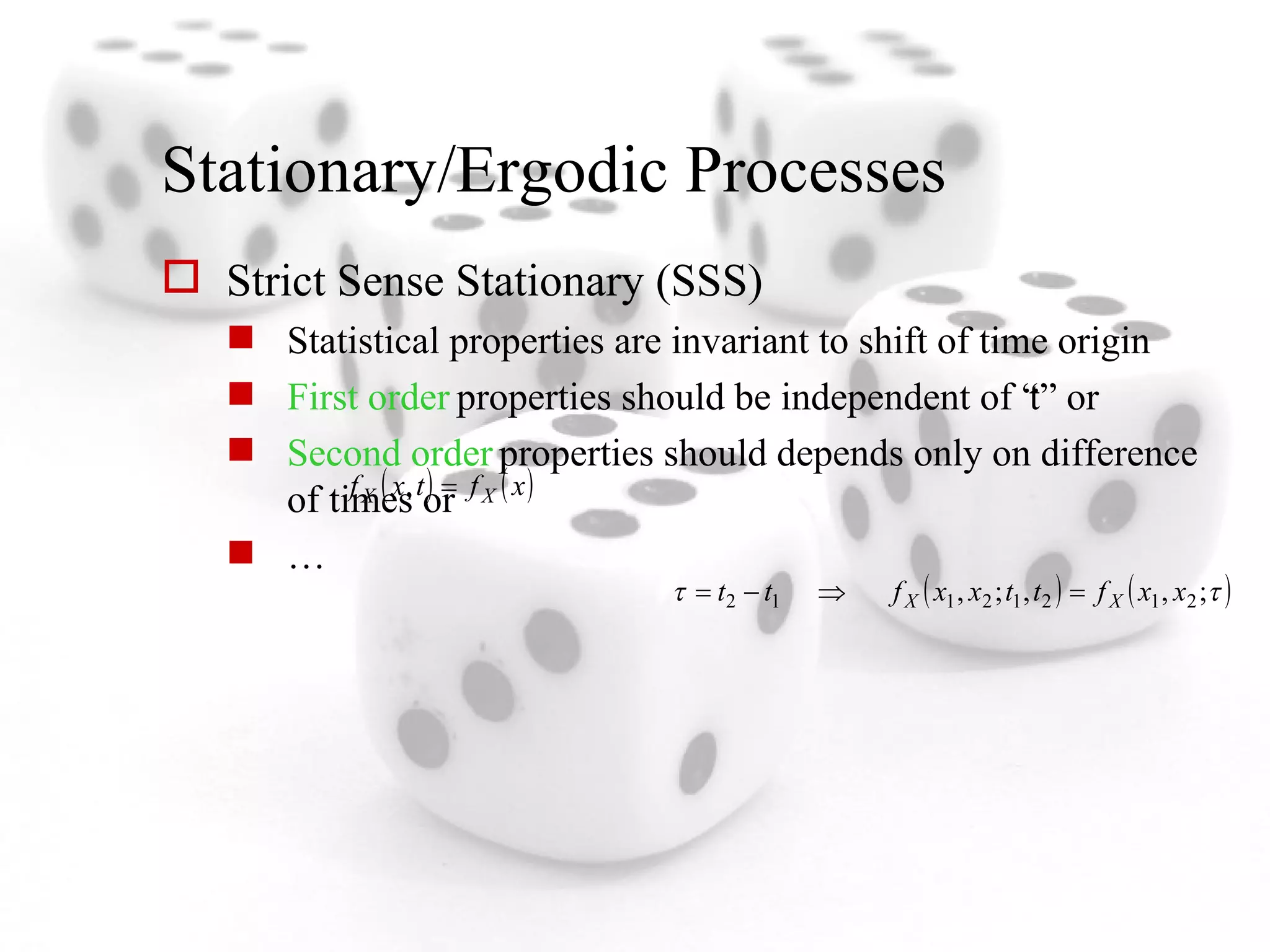
Stationary/Ergodic Processes Strict Sense Stationary (SSS) Statistical properties are invariant to shift of time origin First order  properties should be independent of “t” or  Second order  properties should depends only on difference of times or …
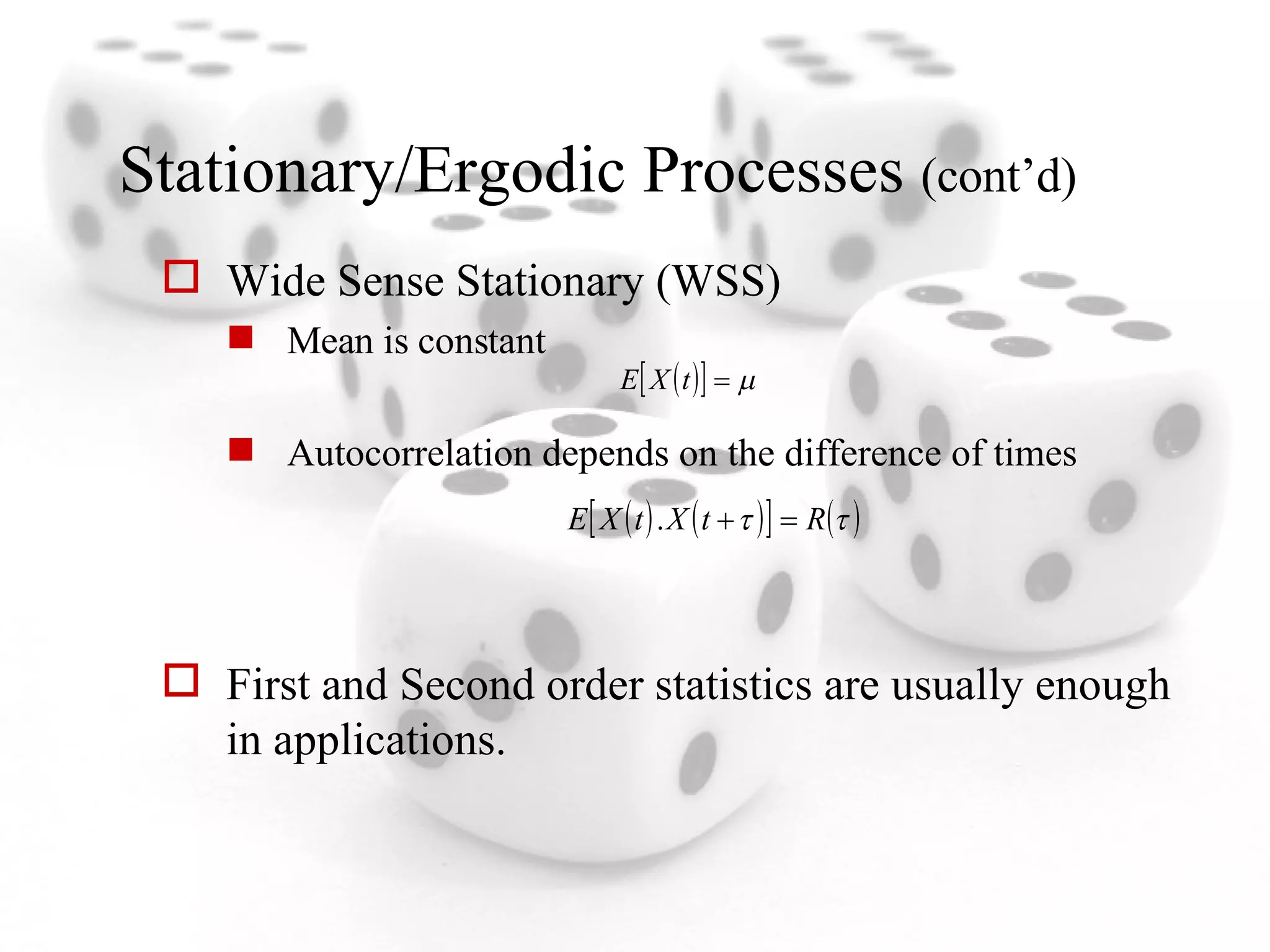
Stationary/Ergodic Processes  (cont’d) Wide Sense Stationary (WSS) Mean is constant Autocorrelation depends on the difference of times First and Second order statistics are usually enough in applications.
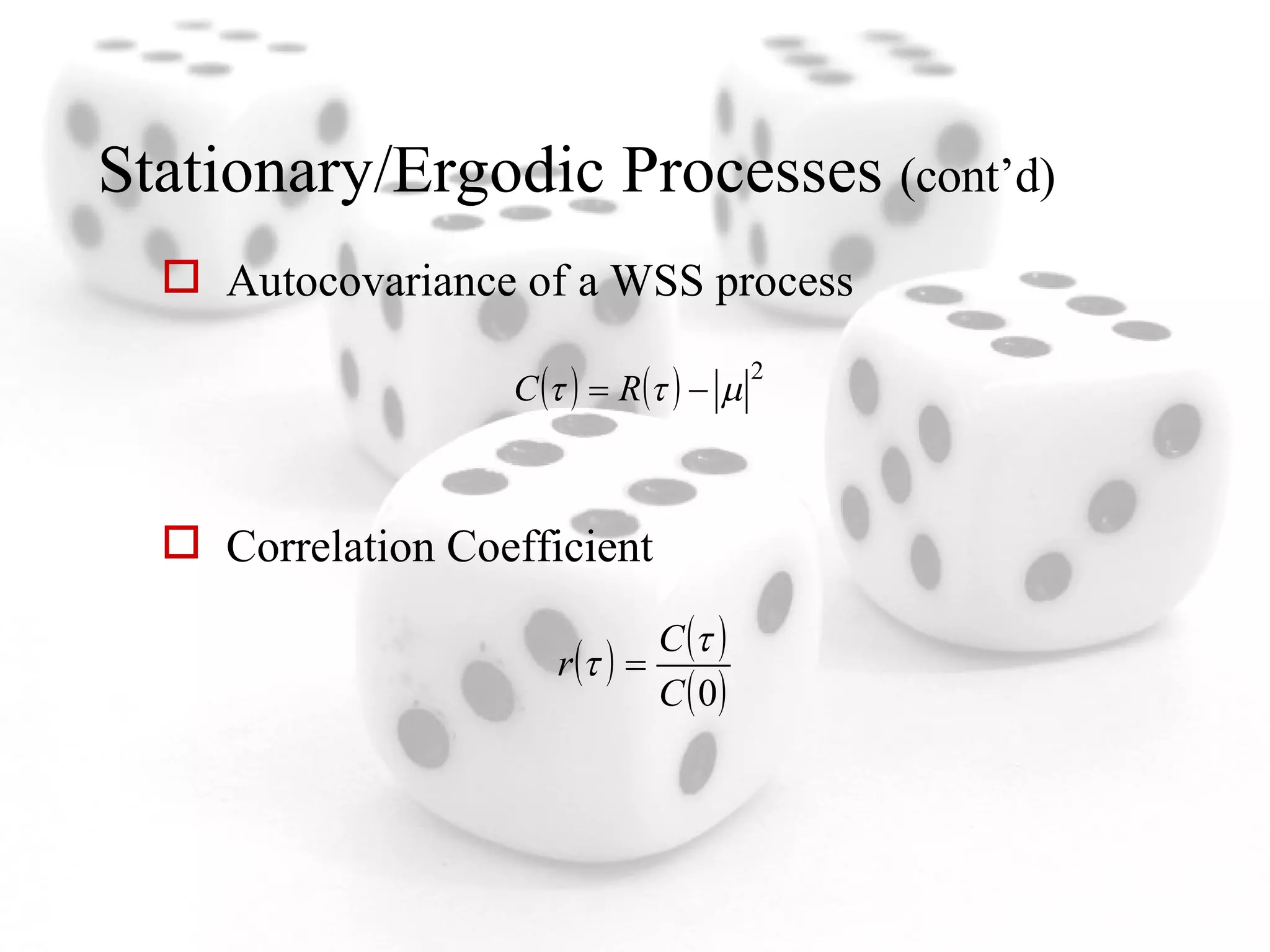
Stationary/Ergodic Processes  (cont’d) Autocovariance of a WSS process Correlation Coefficient
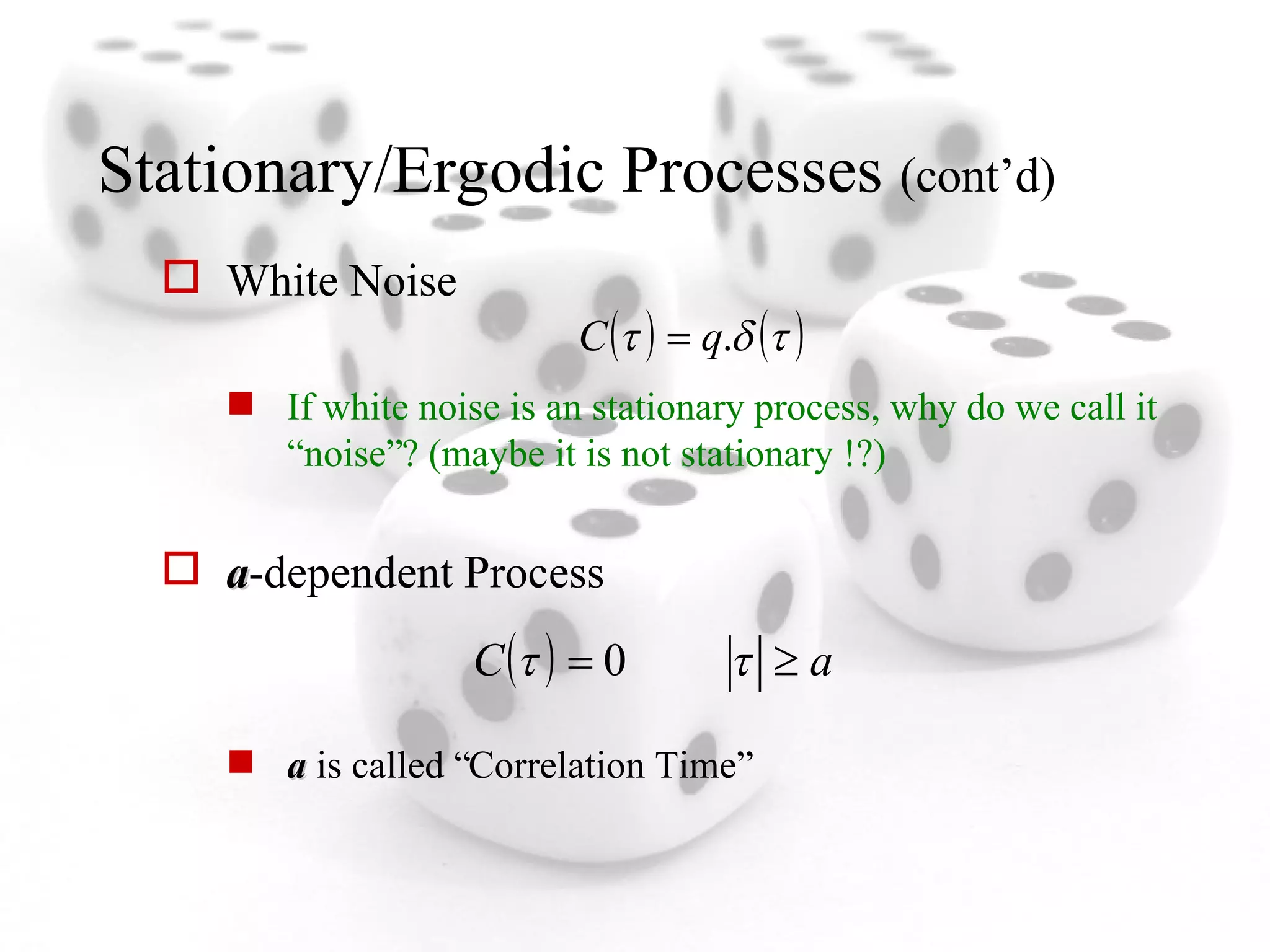
Stationary/Ergodic Processes  (cont’d) White Noise If white noise is an stationary process, why do we call it “noise”? (maybe it is not stationary !?) a -dependent Process a  is called “Correlation Time”
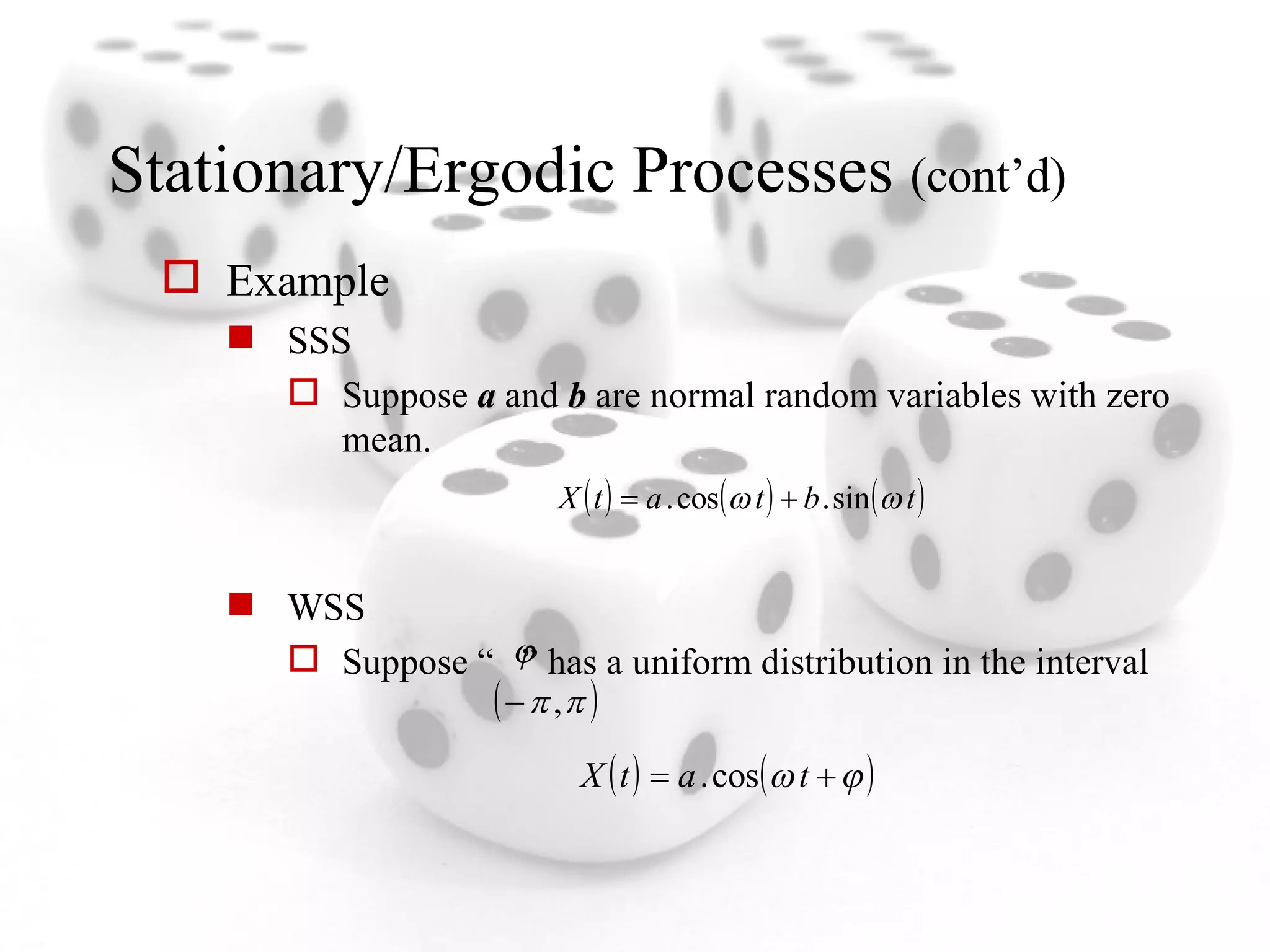
Stationary/Ergodic Processes  (cont’d) Example SSS Suppose  a  and  b  are normal random variables with zero mean. WSS Suppose “  ” has a uniform distribution in the interval
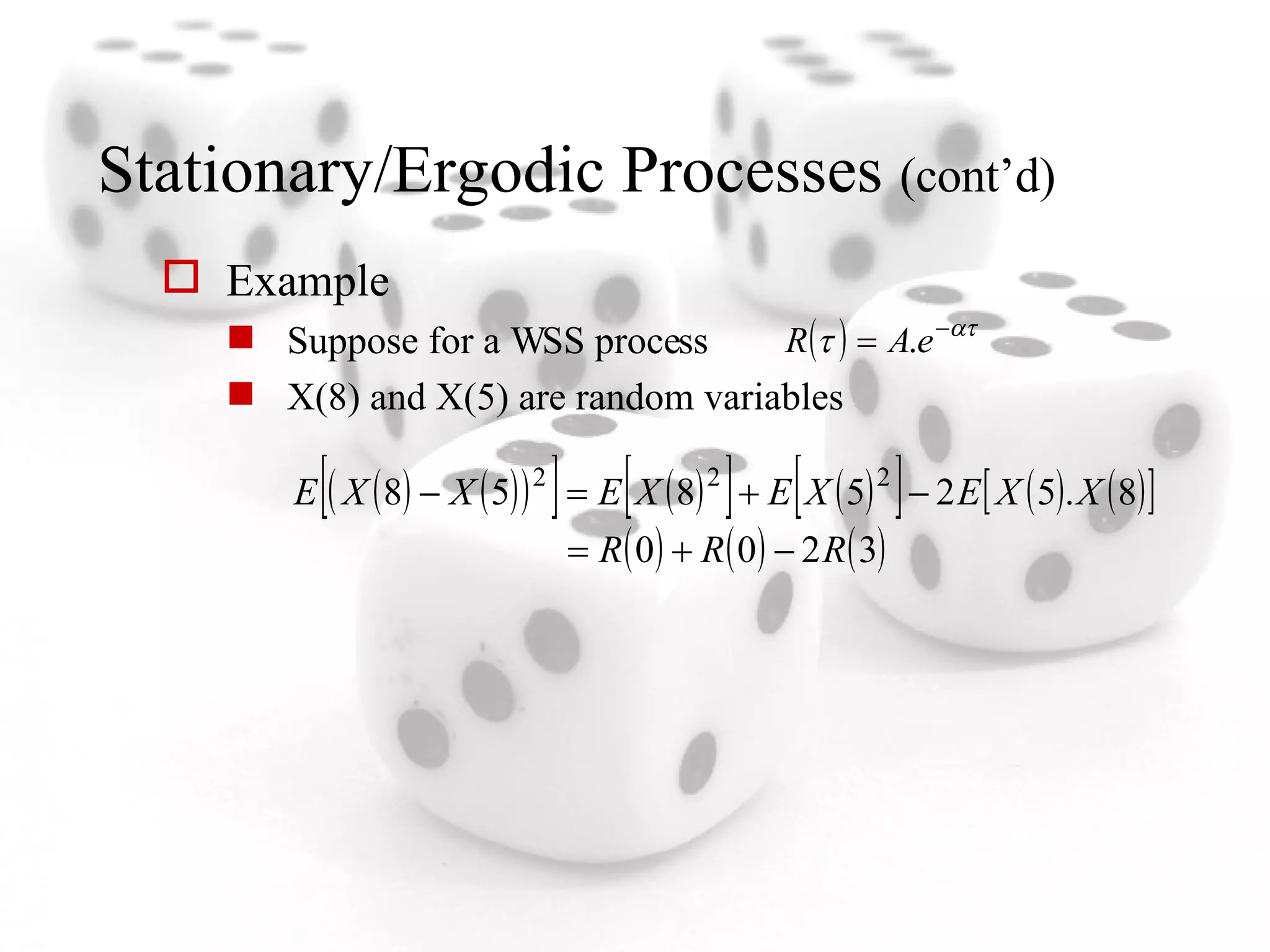
Stationary/Ergodic Processes  (cont’d) Example Suppose for a WSS process X(8) and X(5) are random variables
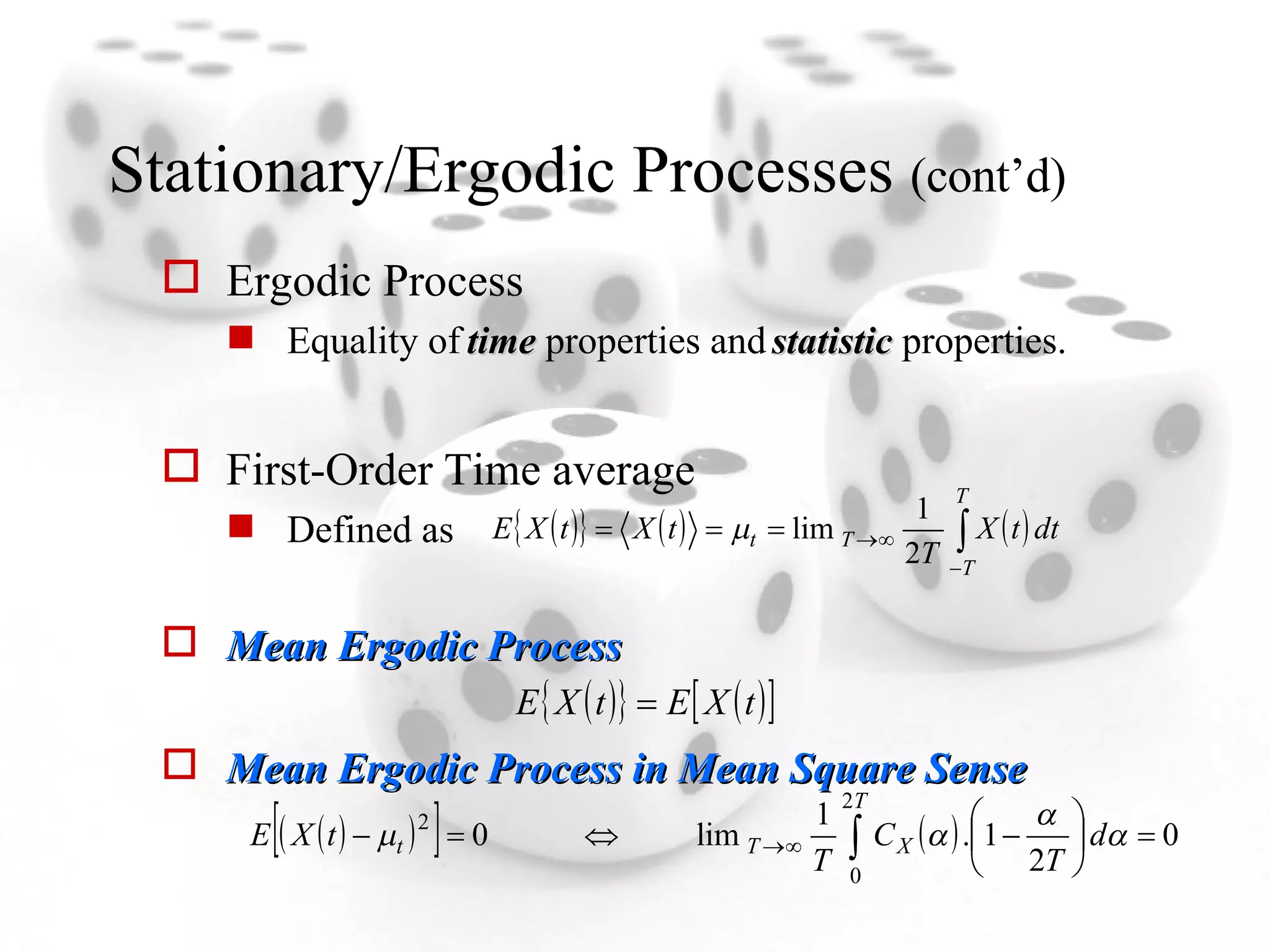
Stationary/Ergodic Processes  (cont’d) Ergodic Process Equality of  time  properties and  statistic  properties. First-Order Time average Defined as Mean Ergodic Process Mean Ergodic Process in Mean Square Sense
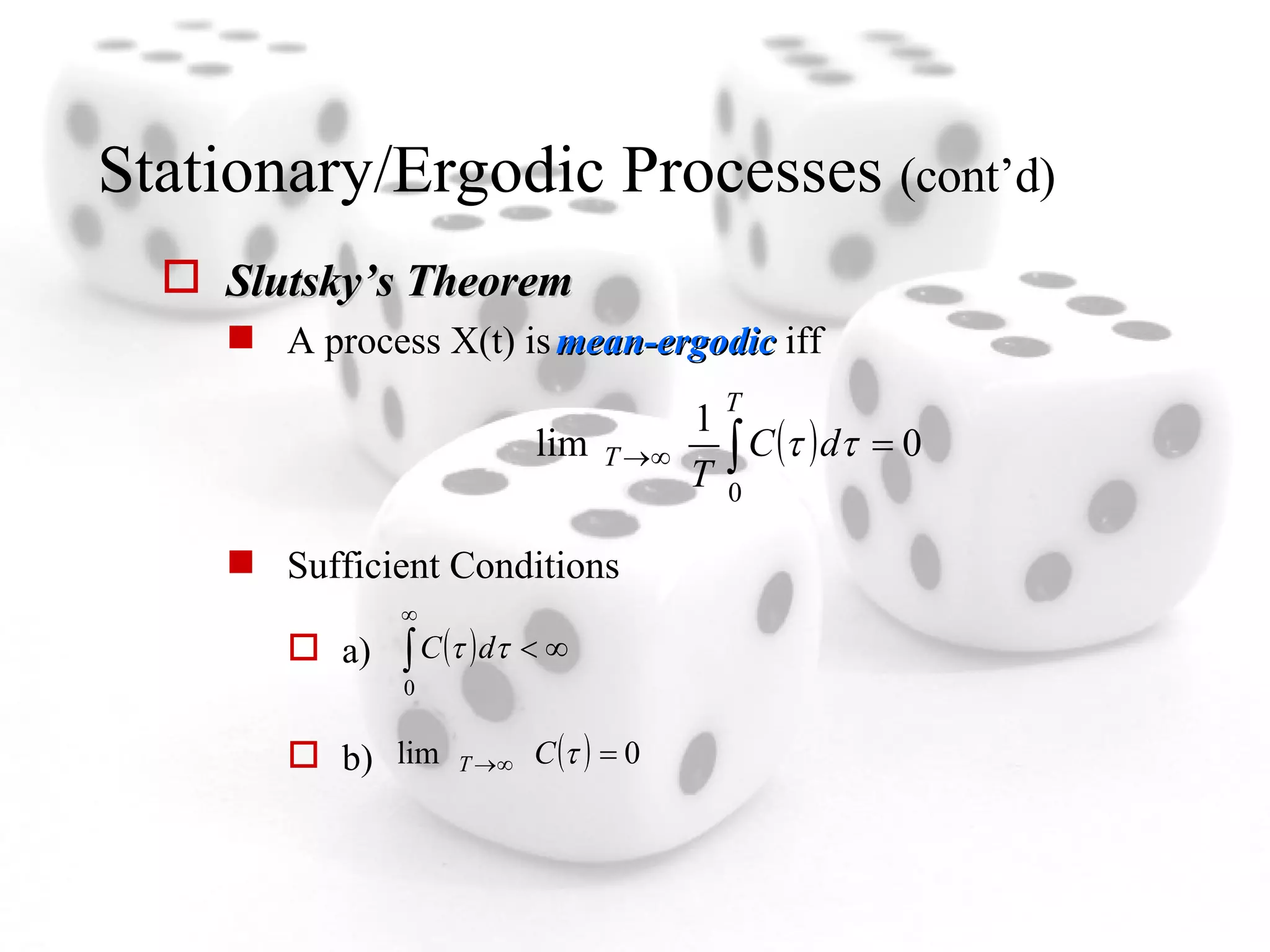
Stationary/Ergodic Processes  (cont’d) Slutsky’s Theorem A process X(t) is  mean-ergodic  iff Sufficient Conditions a) b)
Outline Basic Definitions Stationary/Ergodic Processes Stochastic Analysis of Systems Power Spectrum
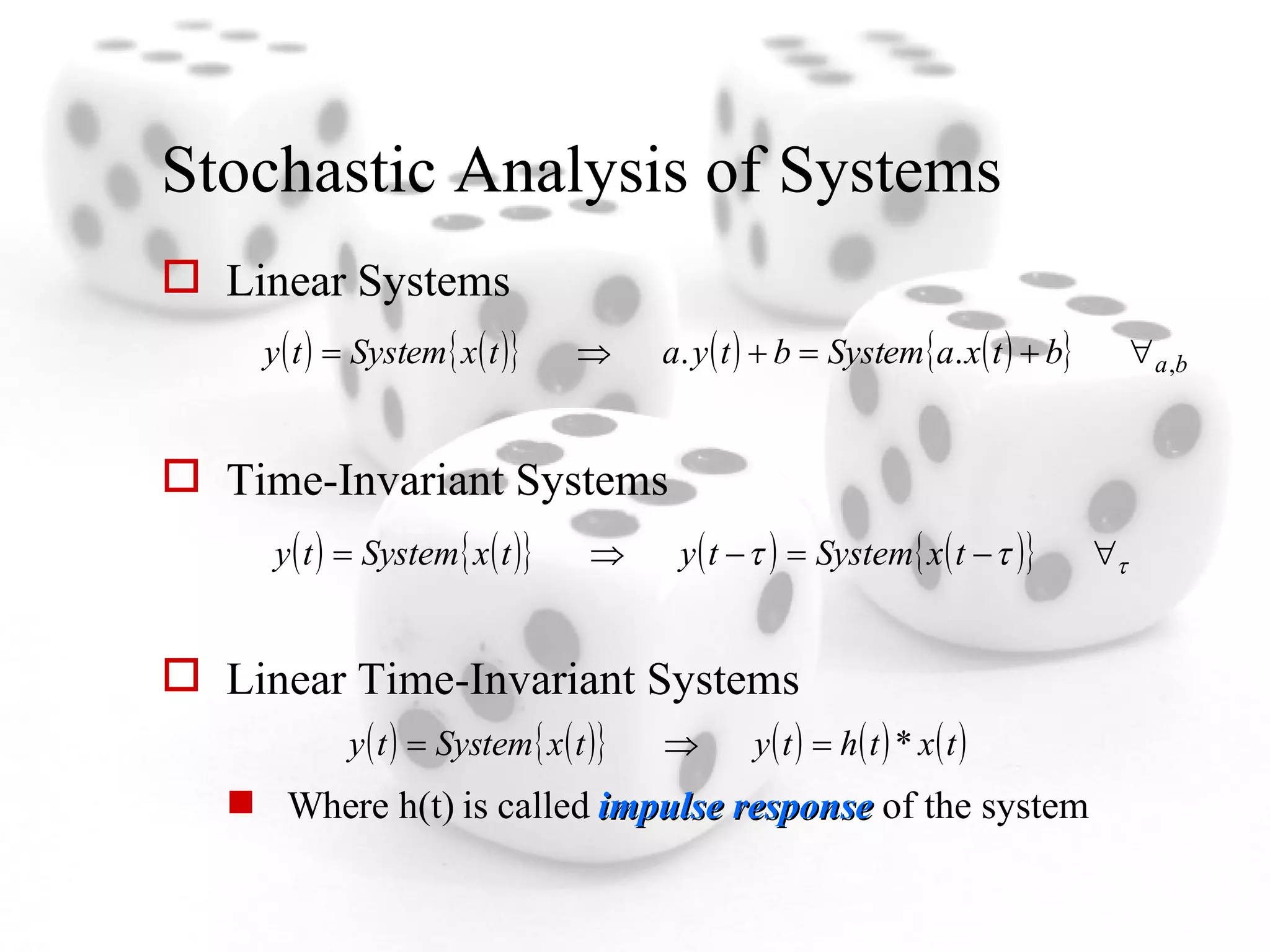
Stochastic Analysis of Systems Linear Systems Time-Invariant Systems Linear Time-Invariant Systems Where h(t) is called  impulse response  of the system
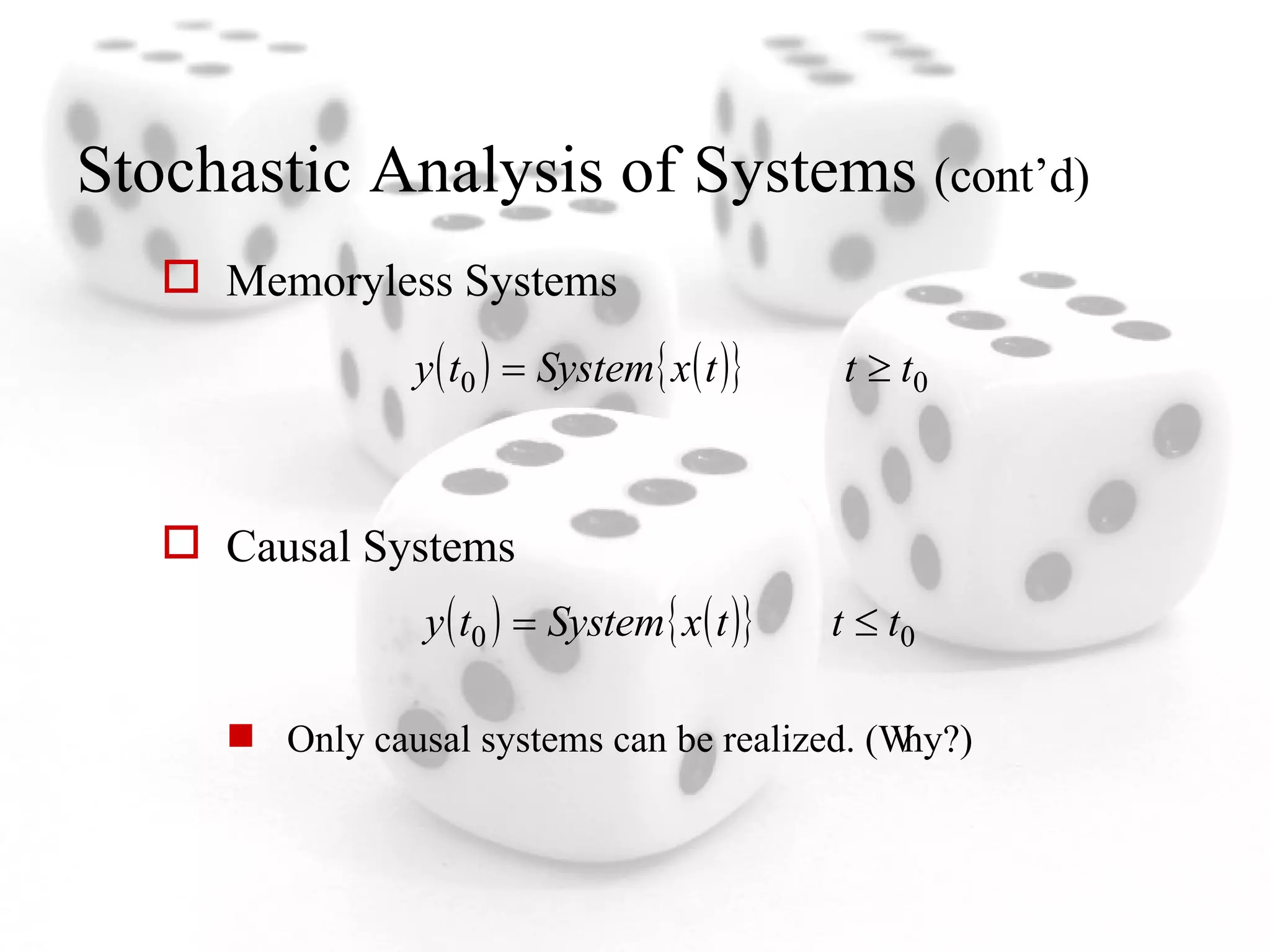
Stochastic Analysis of Systems  (cont’d) Memoryless Systems Causal Systems Only causal systems can be realized. (Why?)
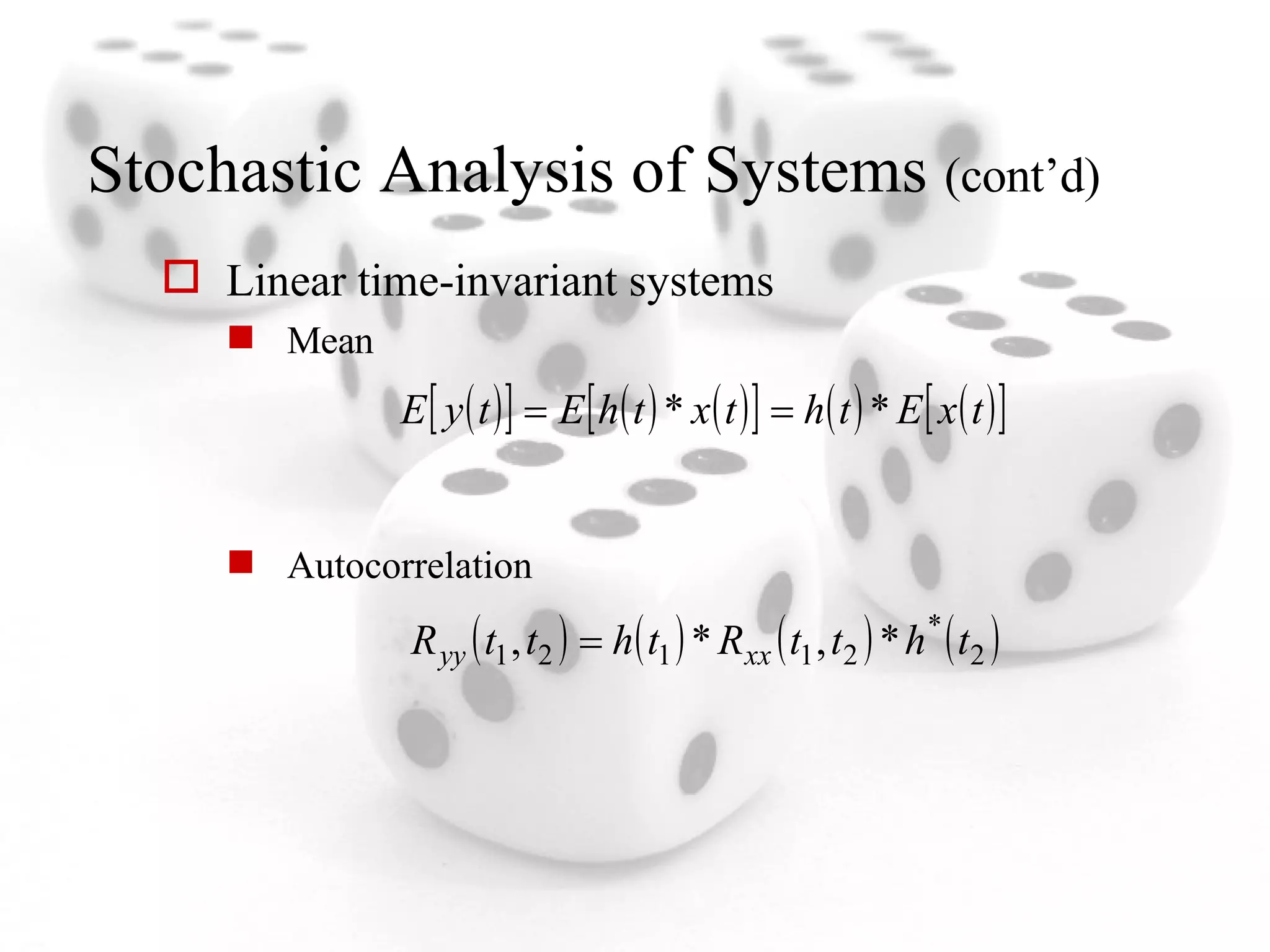
Stochastic Analysis of Systems  (cont’d) Linear time-invariant systems Mean Autocorrelation
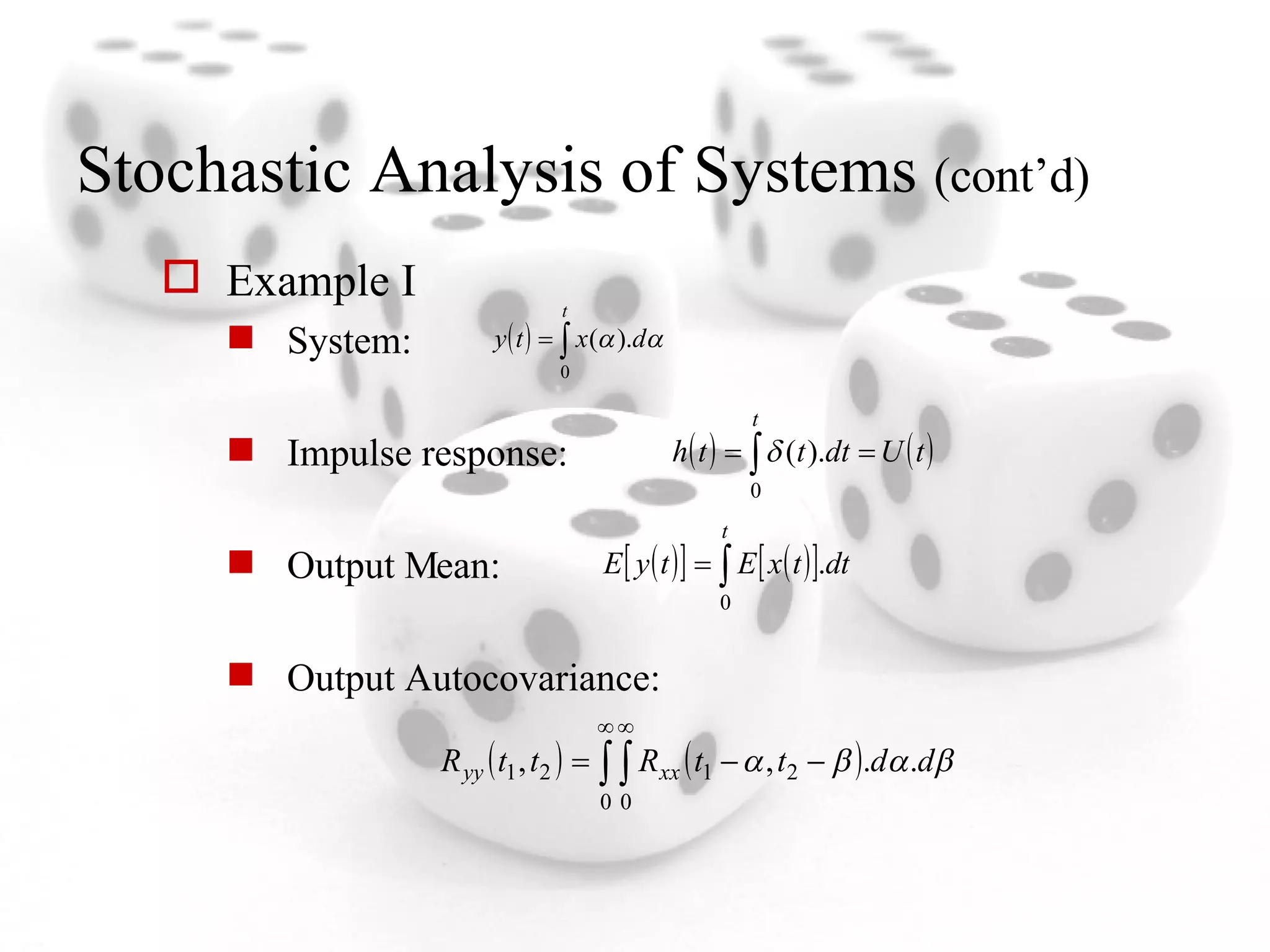
Stochastic Analysis of Systems  (cont’d) Example I  System:  Impulse response:  Output Mean: Output Autocovariance:
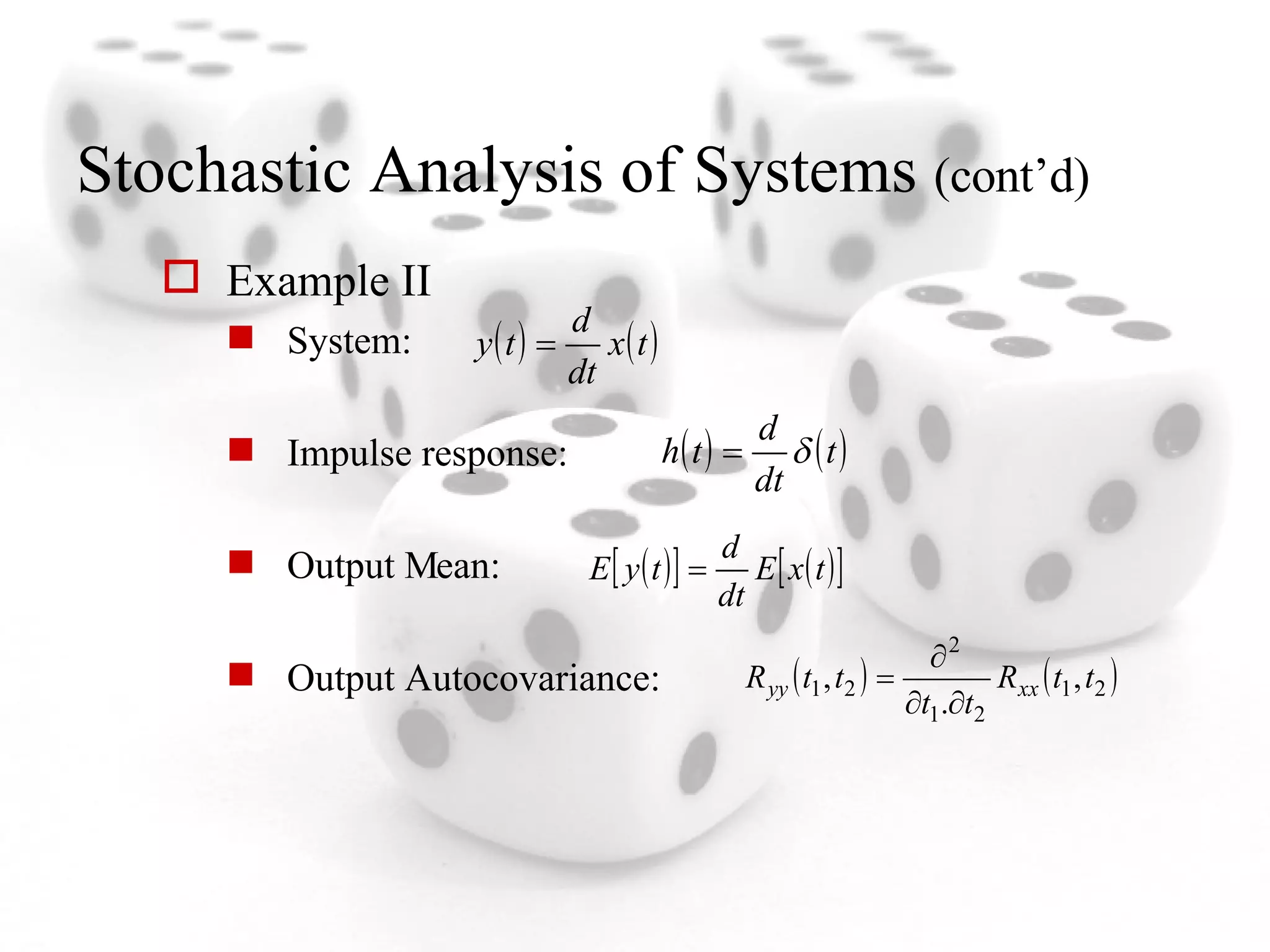
Stochastic Analysis of Systems  (cont’d) Example II System:  Impulse response:  Output Mean: Output Autocovariance:
Outline Basic Definitions Stationary/Ergodic Processes Stochastic Analysis of Systems Power Spectrum
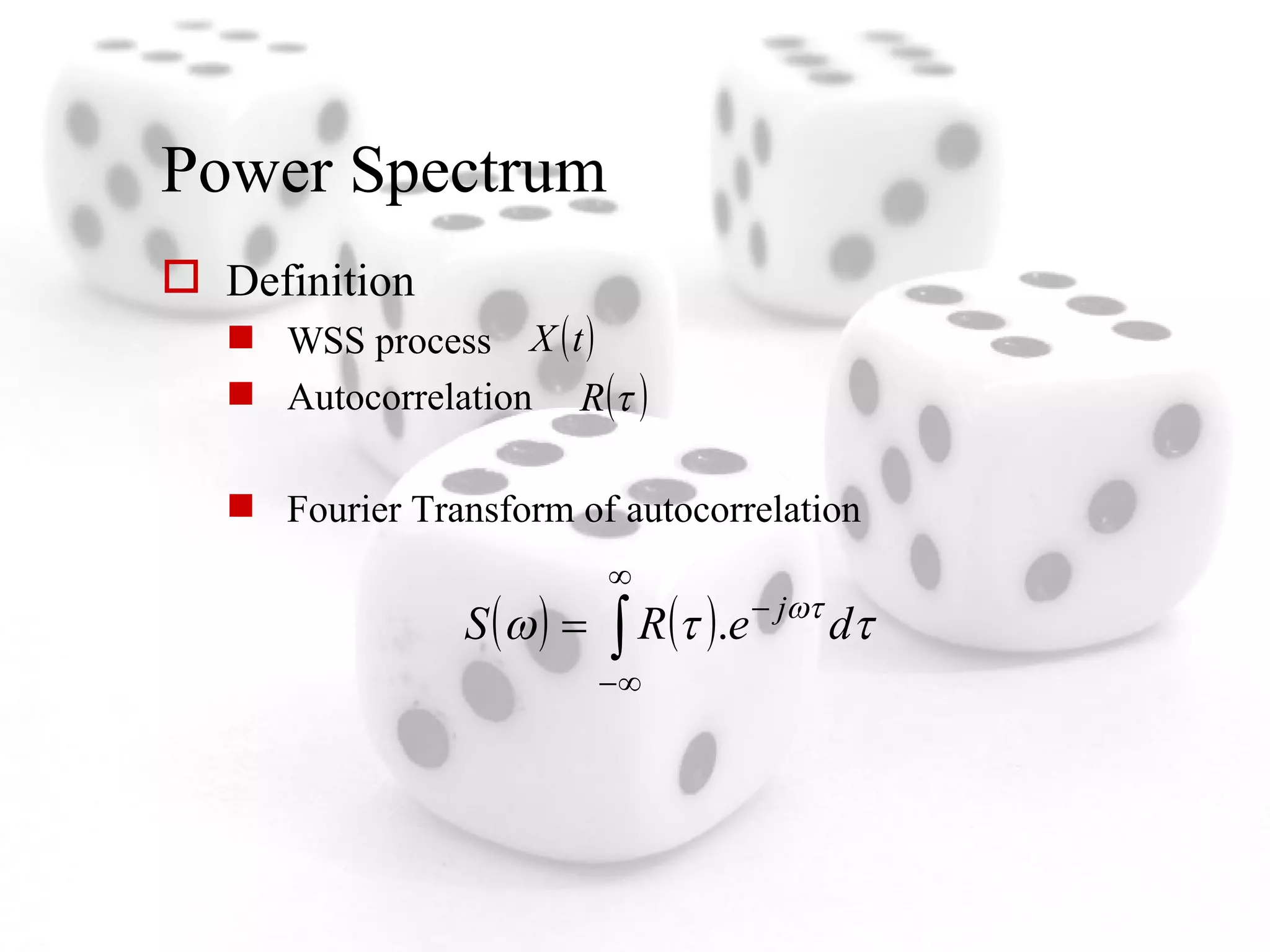
Power Spectrum Definition WSS process Autocorrelation Fourier Transform of autocorrelation
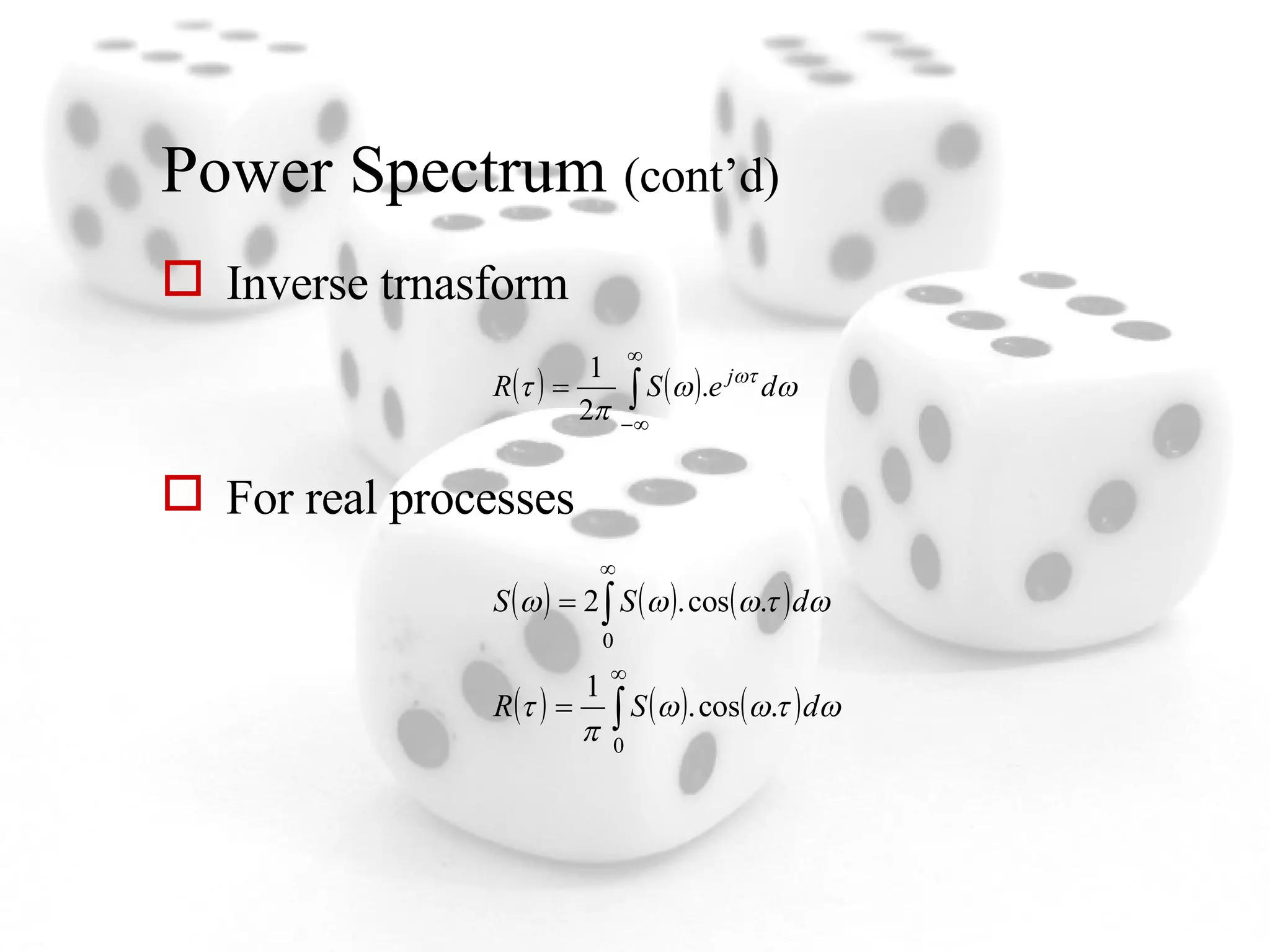
Power Spectrum  (cont’d) Inverse trnasform For real processes
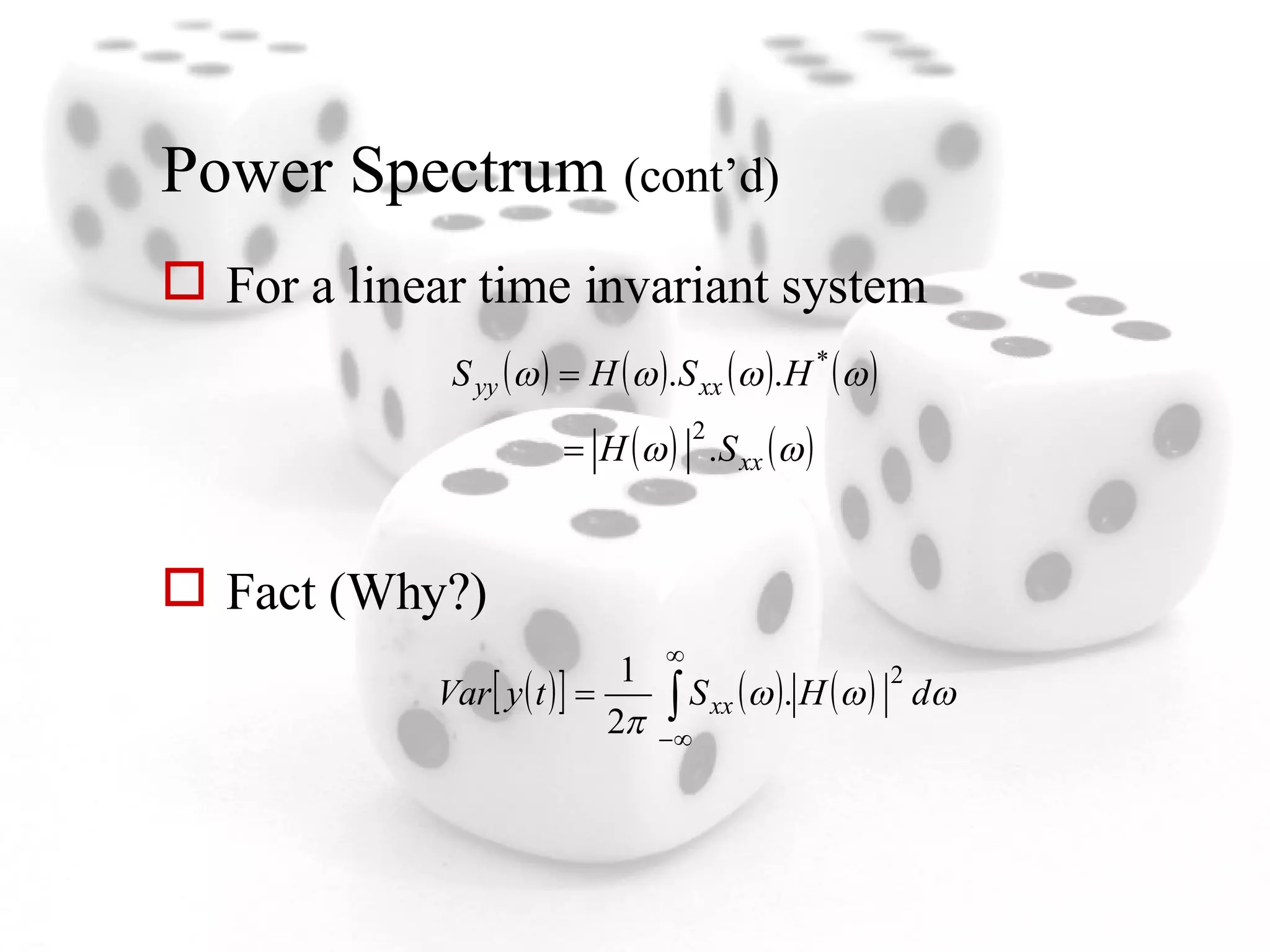
Power Spectrum  (cont’d) For a linear time invariant system Fact (Why?)
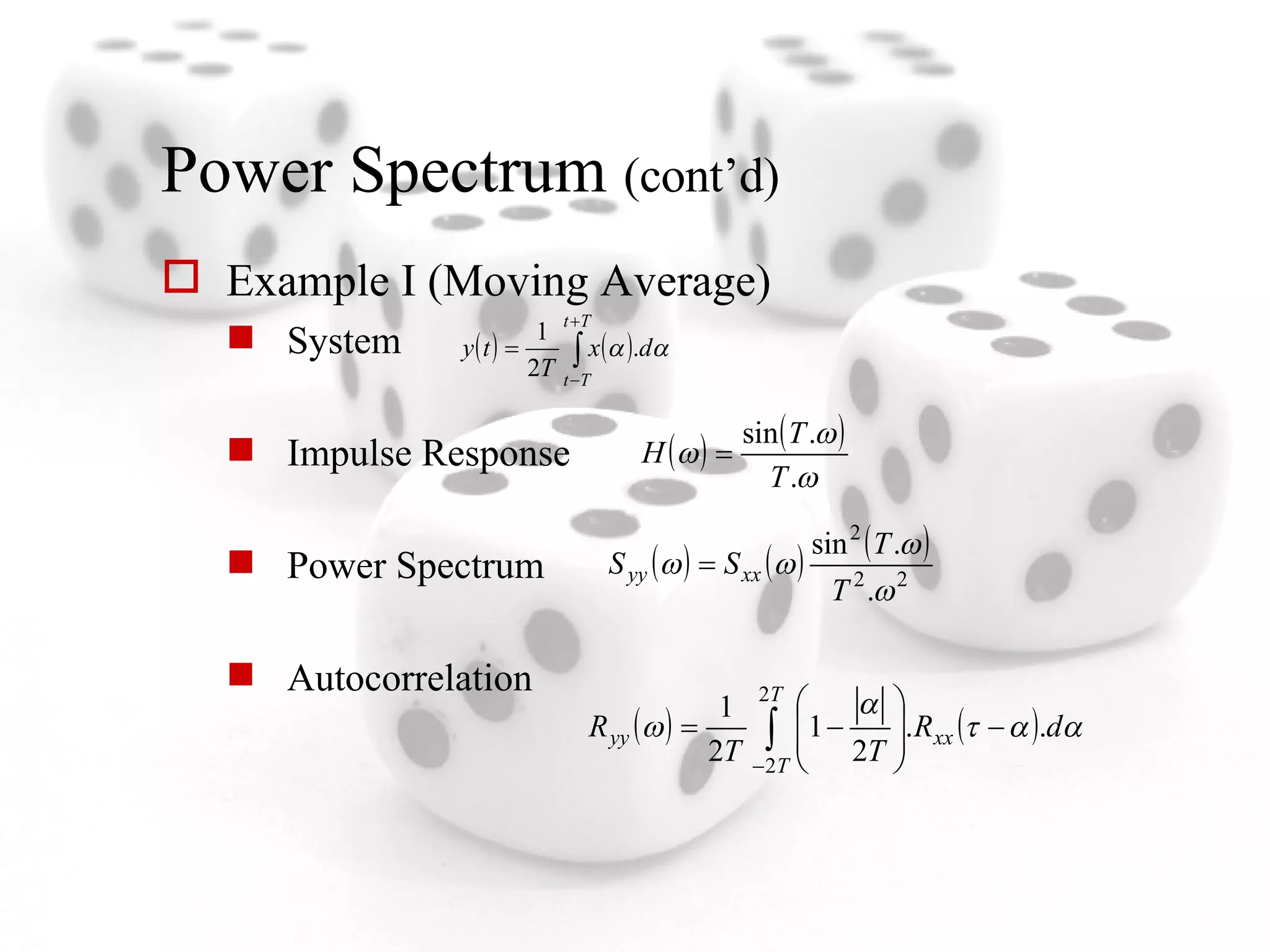
Power Spectrum  (cont’d) Example I (Moving Average) System Impulse Response Power Spectrum Autocorrelation
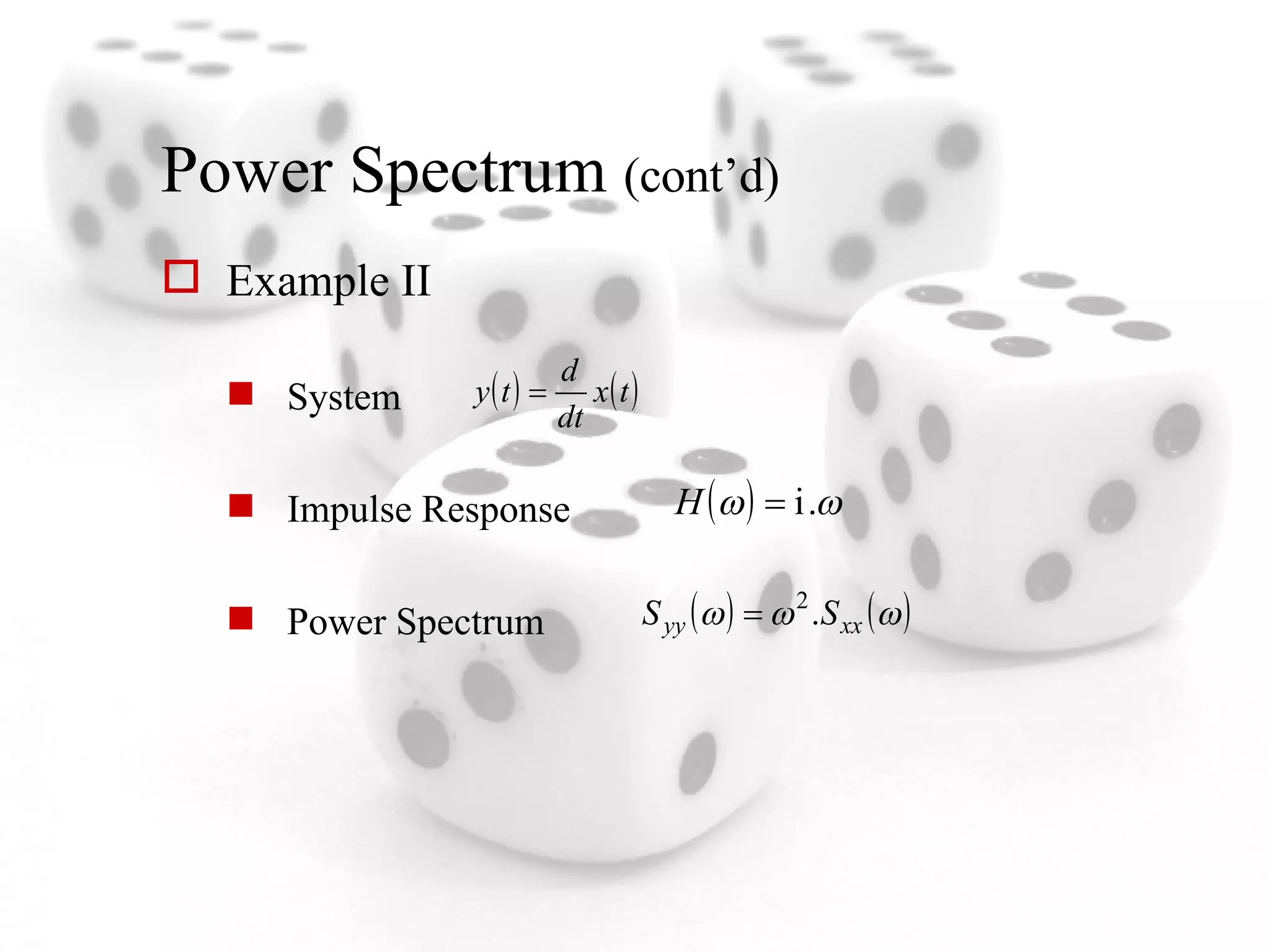
Power Spectrum  (cont’d) Example II System Impulse Response Power Spectrum
Question?

Elements Of Stochastic Processes

  • 1.
    Stochastic Processes Elementsof Stochastic Processes By Mahdi Malaki
  • 2.
    Outline Basic DefinitionsStationary/Ergodic Processes Stochastic Analysis of Systems Power Spectrum
  • 3.
    Basic Definitions Supposea set of random variables indexed by a parameter Tracking these variables with respect to the parameter constructs a process that is called Stochastic Process . i.e. The mapping of outcomes to the real (complex) numbers changes with respect to index.
  • 4.
    Basic Definitions (cont’d) In a random process, we will have a family of functions called an ensemble of functions
  • 5.
    Basic Definitions (cont’d) With fixed “beta”, we will have a “time” function called sample path . Sometimes stochastic properties of a random process can be extracted just from a single sample path. (When?)
  • 6.
    Basic Definitions (cont’d) With fixed “t”, we will have a random variable. With fixed “t” and “beta”, we will have a real (complex) number.
  • 7.
    Basic Definitions (cont’d) Example I Voltage of a generator with fixed frequency Amplitude is a random variables
  • 8.
    Basic Definitions (cont’d) Equality Ensembles should be equal for each “beta” and “t” Equality (Mean Square Sense) If the following equality holds Sufficient in many applications
  • 9.
    Basic Definitions (cont’d) First-Order CDF of a random process First-Order PDF of a random process
  • 10.
    Basic Definitions (cont’d) Second-Order CDF of a random process Second-Order PDF of a random process
  • 11.
    Basic Definitions (cont’d) n th order can be defined. (How?) Relation between first-order and second-order can be presented as Relation between different orders can be obtained easily. (How?)
  • 12.
    Basic Definitions (cont’d) Mean of a random process Autocorrelation of a random process Fact: (Why?)
  • 13.
    Basic Definitions (cont’d) Autocovariance of a random process Correlation Coefficient Example
  • 14.
    Basic Definitions (cont’d) Example Poisson Process Mean Autocorrelation Autocovariance
  • 15.
    Basic Definitions (cont’d) Complex process Definition Specified in terms of the joint statistics of two real processes and Vector Process A family of some stochastic processes
  • 16.
    Basic Definitions (cont’d) Cross-Correlation Orthogonal Processes Cross-Covariance Uncorrelated Processes
  • 17.
    Basic Definitions (cont’d) a -dependent processes White Noise Variance of Stochastic Process
  • 18.
    Basic Definitions (cont’d) Existence Theorem For an arbitrary mean function For an arbitrary covariance function There exist a normal random process that its mean is and its covariance is
  • 19.
    Outline Basic DefinitionsStationary/Ergodic Processes Stochastic Analysis of Systems Power Spectrum
  • 20.
    Stationary/Ergodic Processes StrictSense Stationary (SSS) Statistical properties are invariant to shift of time origin First order properties should be independent of “t” or Second order properties should depends only on difference of times or …
  • 21.
    Stationary/Ergodic Processes (cont’d) Wide Sense Stationary (WSS) Mean is constant Autocorrelation depends on the difference of times First and Second order statistics are usually enough in applications.
  • 22.
    Stationary/Ergodic Processes (cont’d) Autocovariance of a WSS process Correlation Coefficient
  • 23.
    Stationary/Ergodic Processes (cont’d) White Noise If white noise is an stationary process, why do we call it “noise”? (maybe it is not stationary !?) a -dependent Process a is called “Correlation Time”
  • 24.
    Stationary/Ergodic Processes (cont’d) Example SSS Suppose a and b are normal random variables with zero mean. WSS Suppose “ ” has a uniform distribution in the interval
  • 25.
    Stationary/Ergodic Processes (cont’d) Example Suppose for a WSS process X(8) and X(5) are random variables
  • 26.
    Stationary/Ergodic Processes (cont’d) Ergodic Process Equality of time properties and statistic properties. First-Order Time average Defined as Mean Ergodic Process Mean Ergodic Process in Mean Square Sense
  • 27.
    Stationary/Ergodic Processes (cont’d) Slutsky’s Theorem A process X(t) is mean-ergodic iff Sufficient Conditions a) b)
  • 28.
    Outline Basic DefinitionsStationary/Ergodic Processes Stochastic Analysis of Systems Power Spectrum
  • 29.
    Stochastic Analysis ofSystems Linear Systems Time-Invariant Systems Linear Time-Invariant Systems Where h(t) is called impulse response of the system
  • 30.
    Stochastic Analysis ofSystems (cont’d) Memoryless Systems Causal Systems Only causal systems can be realized. (Why?)
  • 31.
    Stochastic Analysis ofSystems (cont’d) Linear time-invariant systems Mean Autocorrelation
  • 32.
    Stochastic Analysis ofSystems (cont’d) Example I System: Impulse response: Output Mean: Output Autocovariance:
  • 33.
    Stochastic Analysis ofSystems (cont’d) Example II System: Impulse response: Output Mean: Output Autocovariance:
  • 34.
    Outline Basic DefinitionsStationary/Ergodic Processes Stochastic Analysis of Systems Power Spectrum
  • 35.
    Power Spectrum DefinitionWSS process Autocorrelation Fourier Transform of autocorrelation
  • 36.
    Power Spectrum (cont’d) Inverse trnasform For real processes
  • 37.
    Power Spectrum (cont’d) For a linear time invariant system Fact (Why?)
  • 38.
    Power Spectrum (cont’d) Example I (Moving Average) System Impulse Response Power Spectrum Autocorrelation
  • 39.
    Power Spectrum (cont’d) Example II System Impulse Response Power Spectrum
  • 40.