
PHYS 162 - Chapter 5 Transistor Bias Circuits
Prepared By: Syed Muhammad Asad – Semester 102 Page 1
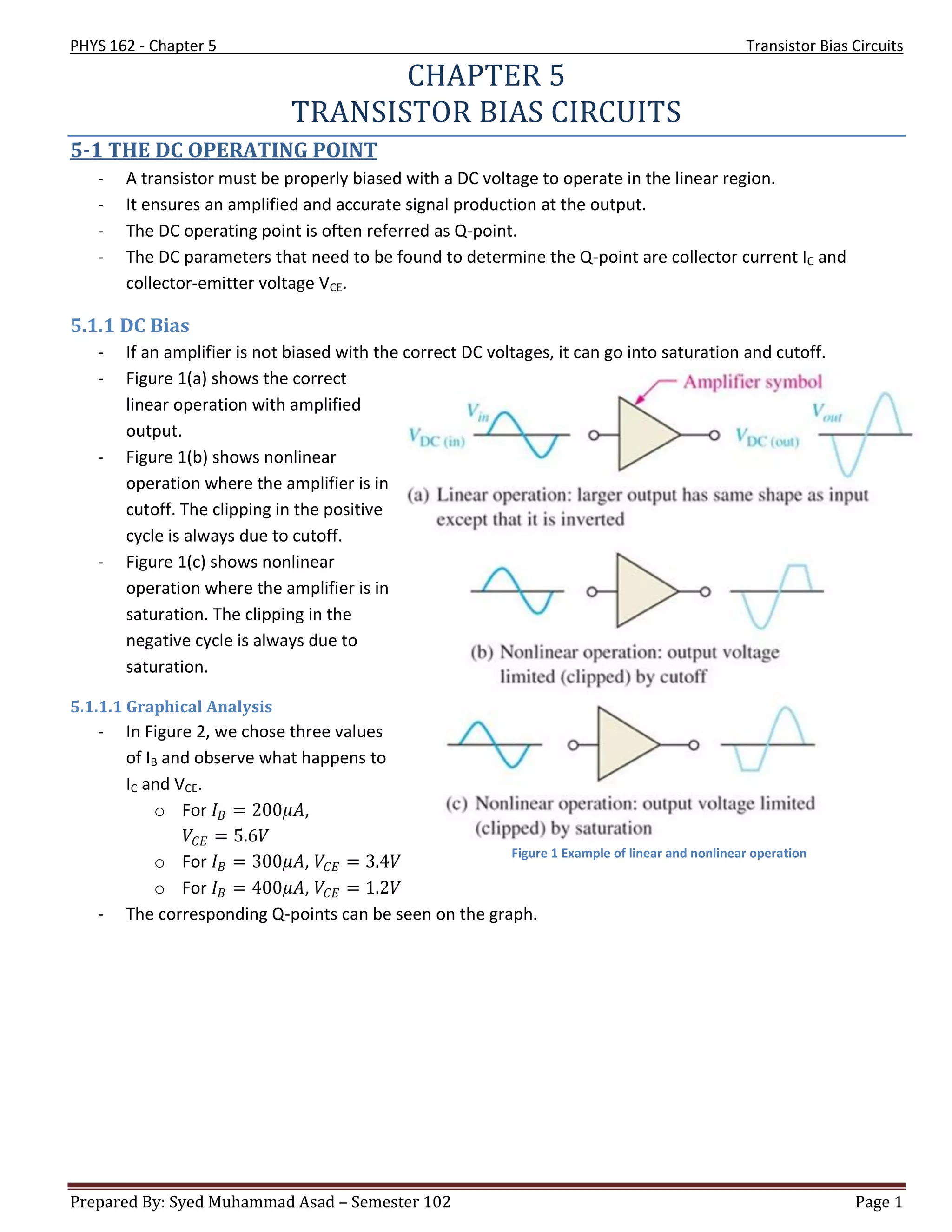
Figure 1 Example of linear and nonlinear operation
CHAPTER 5
TRANSISTOR BIAS CIRCUITS
5-1 THE DC OPERATING POINT
- A transistor must be properly biased with a DC voltage to operate in the linear region.
- It ensures an amplified and accurate signal production at the output.
- The DC operating point is often referred as Q-point.
- The DC parameters that need to be found to determine the Q-point are collector current IC and
collector-emitter voltage VCE.
5.1.1 DC Bias
- If an amplifier is not biased with the correct DC voltages, it can go into saturation and cutoff.
- Figure 1(a) shows the correct
linear operation with amplified
output.
- Figure 1(b) shows nonlinear
operation where the amplifier is in
cutoff. The clipping in the positive
cycle is always due to cutoff.
- Figure 1(c) shows nonlinear
operation where the amplifier is in
saturation. The clipping in the
negative cycle is always due to
saturation.
5.1.1.1 Graphical Analysis
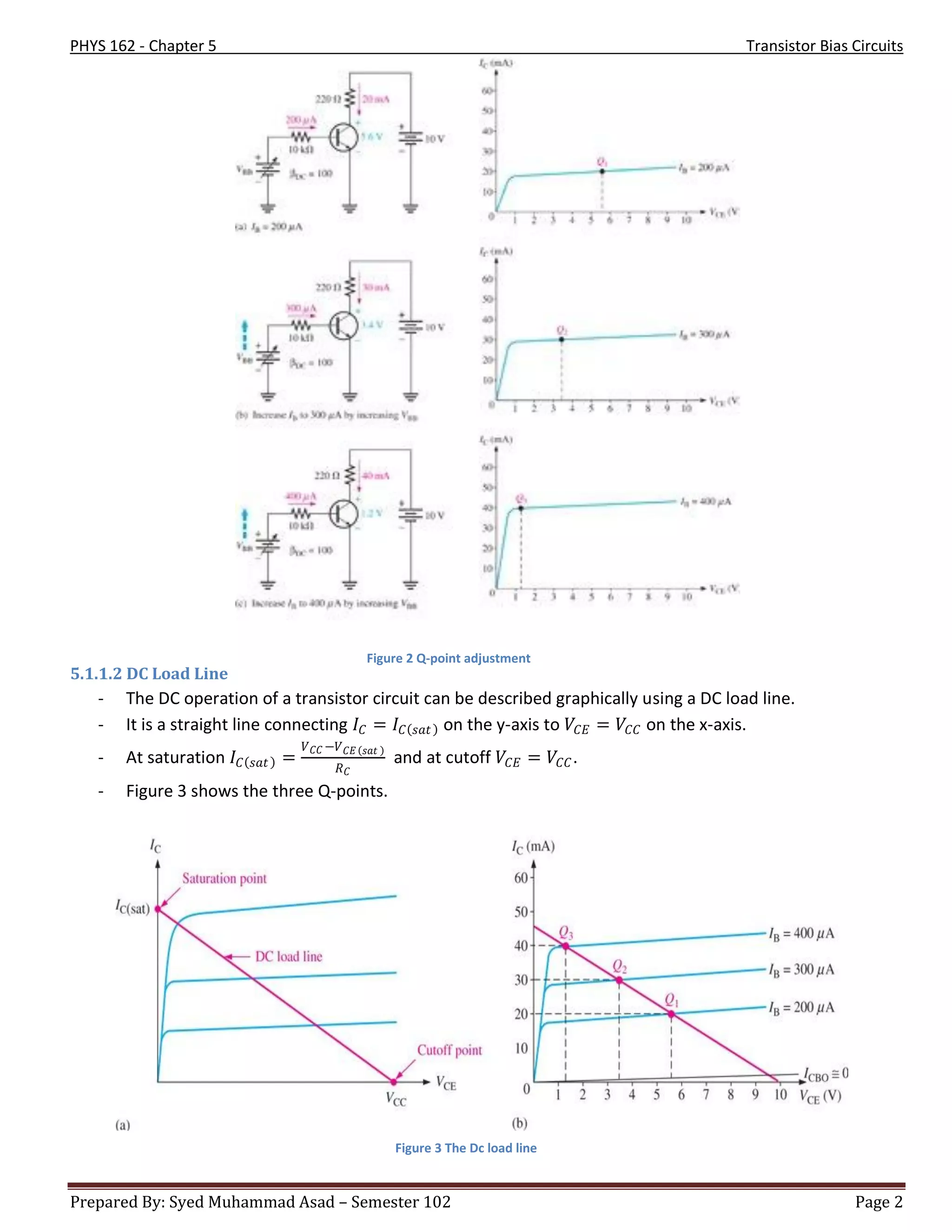
- In Figure 2, we chose three values
of IB and observe what happens to
IC and VCE.
o For 𝐼 𝐵 = 200𝜇𝐴,
𝑉𝐶𝐸 = 5.6𝑉
o For 𝐼 𝐵 = 300𝜇𝐴, 𝑉𝐶𝐸 = 3.4𝑉
o For 𝐼 𝐵 = 400𝜇𝐴, 𝑉𝐶𝐸 = 1.2𝑉
- The corresponding Q-points can be seen on the graph.
PHYS 162 - Chapter 5 Transistor Bias Circuits
Prepared By: Syed Muhammad Asad – Semester 102 Page 2
5.1.1.2 DC Load Line
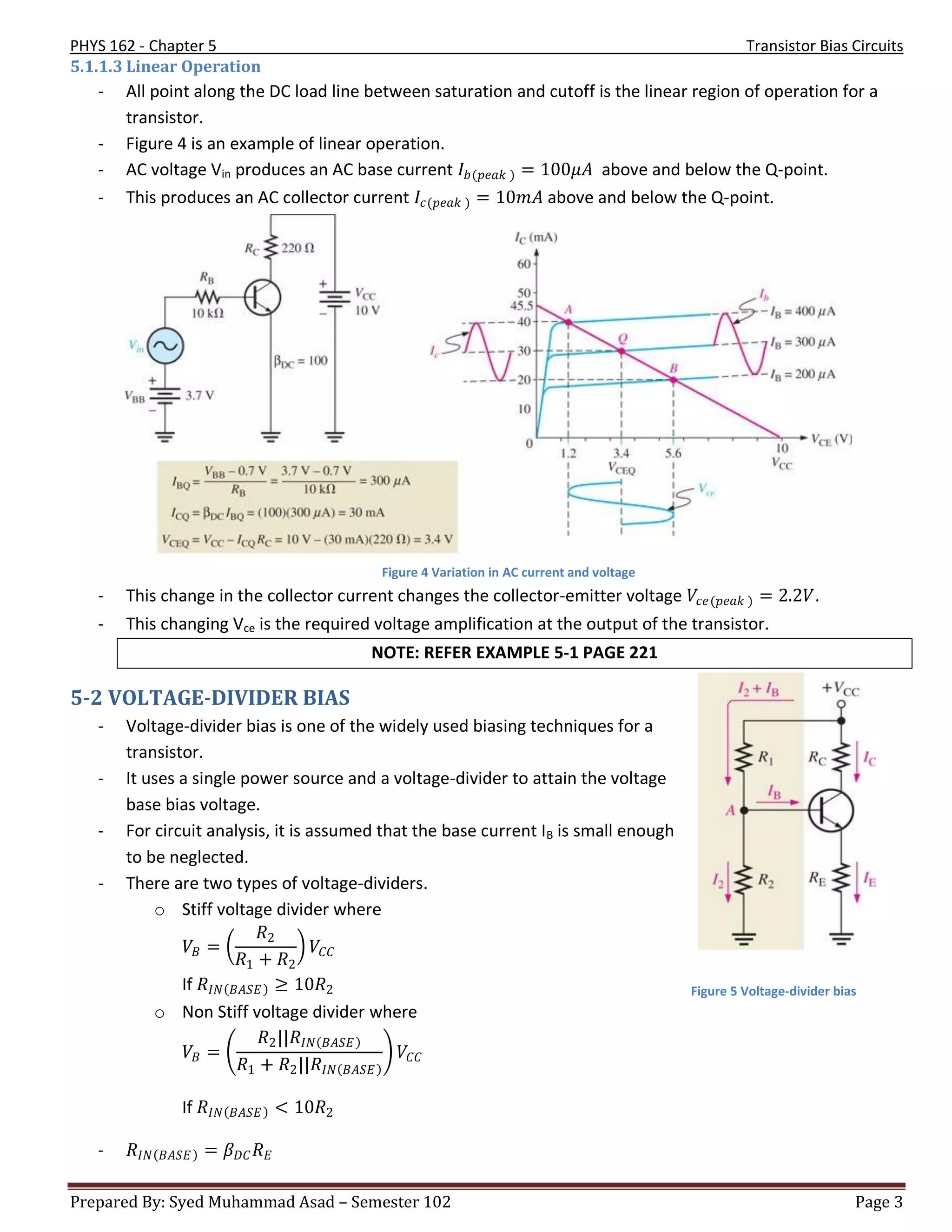
- The DC operation of a transistor circuit can be described graphically using a DC load line.
- It is a straight line connecting 𝐼 𝐶 = 𝐼 𝐶 𝑠𝑎𝑡 on the y-axis to 𝑉𝐶𝐸 = 𝑉𝐶𝐶 on the x-axis.
- At saturation 𝐼 𝐶 𝑠𝑎𝑡 =
𝑉 𝐶𝐶 −𝑉 𝐶𝐸 𝑠𝑎𝑡
𝑅 𝐶
and at cutoff 𝑉𝐶𝐸 = 𝑉𝐶𝐶.
- Figure 3 shows the three Q-points.
Figure 2 Q-point adjustment
Figure 3 The Dc load line
PHYS 162 - Chapter 5 Transistor Bias Circuits
Prepared By: Syed Muhammad Asad – Semester 102 Page 3
5.1.1.3 Linear Operation
- All point along the DC load line between saturation and cutoff is the linear region of operation for a
transistor.
- Figure 4 is an example of linear operation.
- AC voltage Vin produces an AC base current 𝐼𝑏(𝑝𝑒𝑎𝑘 ) = 100𝜇𝐴 above and below the Q-point.
- This produces an AC collector current 𝐼𝑐(𝑝𝑒𝑎𝑘 ) = 10𝑚𝐴 above and below the Q-point.
- This change in the collector current changes the collector-emitter voltage 𝑉𝑐𝑒(𝑝𝑒𝑎𝑘 ) = 2.2𝑉.
- This changing Vce is the required voltage amplification at the output of the transistor.
NOTE: REFER EXAMPLE 5-1 PAGE 221
5-2 VOLTAGE-DIVIDER BIAS
- Voltage-divider bias is one of the widely used biasing techniques for a
transistor.
- It uses a single power source and a voltage-divider to attain the voltage
base bias voltage.
- For circuit analysis, it is assumed that the base current IB is small enough
to be neglected.
- There are two types of voltage-dividers.
o Stiff voltage divider where
𝑉𝐵 =
𝑅2
𝑅1 + 𝑅2
𝑉𝐶𝐶
If 𝑅𝐼𝑁 𝐵𝐴𝑆𝐸 ≥ 10𝑅2
o Non Stiff voltage divider where
𝑉𝐵 =
𝑅2||𝑅𝐼𝑁 𝐵𝐴𝑆𝐸
𝑅1 + 𝑅2||𝑅𝐼𝑁 𝐵𝐴𝑆𝐸
𝑉𝐶𝐶
If 𝑅𝐼𝑁 𝐵𝐴𝑆𝐸 < 10𝑅2
- 𝑅𝐼𝑁 𝐵𝐴𝑆𝐸 = 𝛽 𝐷𝐶 𝑅 𝐸
Figure 4 Variation in AC current and voltage
Figure 5 Voltage-divider bias
PHYS 162 - Chapter 5 Transistor Bias Circuits
Prepared By: Syed Muhammad Asad – Semester 102 Page 4
NOTE: REFER EXAMPLE 5-2 PAGE 224
5-3 OTHER BIAS METHODS
- Other types of biasing methods are
o Emitter Bias
 Excellent Q-point stability.
 Uses two voltages sources instead of one.
o Base Bias
 Mainly used for switching circuits.
 Not suitable for linear amplifier because of poor Q-point stability.
o Emitter-Feedback Bias
 Adding an RE in Base bias circuits gives emitter-feedback bias.
 Better Q-point stability than the base bias but still not well enough for linear operation.
o Collector-Feedback Bias
 Better Q-point stability than emitter-feedback bias.
 Can be used in linear amplifier circuits.
- A summary of all the equations is given in Table 1.
Table 1 Transistor Bias Circuit Formula Sheet
Voltage-Divider Bias Emitter Bias Base Bias Emitter-Feedback
Bias
Collector-
Feedback Bias
Stiff voltage-divider
𝑉𝐵 =
𝑅2
𝑅1 + 𝑅2
𝑉𝐶𝐶
If 𝑅𝐼𝑁 𝐵𝐴𝑆𝐸 ≥ 10𝑅2
Non Stiff voltage divider
𝑉𝐵 =
𝑅2||𝑅𝐼𝑁 𝐵𝐴𝑆𝐸
𝑅1 + 𝑅2||𝑅𝐼𝑁 𝐵𝐴𝑆𝐸
𝑉𝐶𝐶
If 𝑅𝐼𝑁 𝐵𝐴𝑆𝐸 < 10𝑅2
𝑉𝐵 = 𝑉𝐸 + 𝑉𝐵𝐸
𝑅𝐼𝑁 𝐵𝐴𝑆𝐸 = 𝛽 𝐷𝐶 𝑅 𝐸
𝑉𝐸 = 𝑉𝐵 − 𝑉𝐵𝐸 𝑉𝐸 ≈ −1𝑉 (neglecting
effect of 𝛽 𝐷𝐶 )
𝑉𝐸 = 𝑉𝐸𝐸 + 𝐼 𝐸 𝑅 𝐸(taking
𝛽 𝐷𝐶 into account)
𝐼 𝐶 ≅ 𝐼 𝐸 =
𝑉𝐸
𝑅 𝐸
Without 𝛽 𝐷𝐶
𝐼 𝐶 ≅ 𝐼 𝐸 =
−𝑉𝐸𝐸 − 1𝑉
𝑅 𝐸
With 𝛽 𝐷𝐶
𝐼 𝐶 ≅ 𝐼 𝐸 =
−𝑉𝐸𝐸 − 𝑉𝐵𝐸
𝑅 𝐸 + 𝑅 𝐵/𝛽 𝐷𝐶
𝐼 𝐶 = 𝛽 𝐷𝐶
𝑉𝐶𝐶 − 𝑉𝐵𝐸
𝑅 𝐵
𝐼 𝐶 ≅ 𝐼 𝐸 =
𝑉𝐶𝐶 − 𝑉𝐵𝐸
𝑅 𝐸 + 𝑅 𝐵/𝛽 𝐷𝐶
𝐼 𝐶 =
𝑉𝐶𝐶 − 𝑉𝐵𝐸
𝑅 𝐶 + 𝑅 𝐵/𝛽 𝐷𝐶
𝑉𝐶 = 𝑉𝐶𝐶 − 𝐼 𝐶 𝑅 𝐶 𝑉𝐶 = 𝑉𝐶𝐶 − 𝐼 𝐶 𝑅 𝐶
𝑉𝐶𝐸 = 𝑉𝐶 − 𝑉𝐸 𝑉𝐶𝐸 = 𝑉𝐶 − 𝑉𝐸 𝑉𝐶𝐸 = 𝑉𝐶𝐶 − 𝐼 𝐶 𝑅 𝐶 𝑉𝐶𝐸 = 𝑉𝐶𝐶 − 𝐼 𝐶 𝑅 𝐶 + 𝑅 𝐸 𝑉𝐶𝐸 = 𝑉𝐶𝐶 − 𝐼 𝐶 𝑅 𝐶
NOTE: REFER EXAMPLE 5-6, 5-7, 5-8, 5-9, 5-10 PAGE 230-236

Ch05

  • 1.
    PHYS 162 -Chapter 5 Transistor Bias Circuits Prepared By: Syed Muhammad Asad – Semester 102 Page 1 Figure 1 Example of linear and nonlinear operation CHAPTER 5 TRANSISTOR BIAS CIRCUITS 5-1 THE DC OPERATING POINT - A transistor must be properly biased with a DC voltage to operate in the linear region. - It ensures an amplified and accurate signal production at the output. - The DC operating point is often referred as Q-point. - The DC parameters that need to be found to determine the Q-point are collector current IC and collector-emitter voltage VCE. 5.1.1 DC Bias - If an amplifier is not biased with the correct DC voltages, it can go into saturation and cutoff. - Figure 1(a) shows the correct linear operation with amplified output. - Figure 1(b) shows nonlinear operation where the amplifier is in cutoff. The clipping in the positive cycle is always due to cutoff. - Figure 1(c) shows nonlinear operation where the amplifier is in saturation. The clipping in the negative cycle is always due to saturation. 5.1.1.1 Graphical Analysis - In Figure 2, we chose three values of IB and observe what happens to IC and VCE. o For 𝐼 𝐵 = 200𝜇𝐴, 𝑉𝐶𝐸 = 5.6𝑉 o For 𝐼 𝐵 = 300𝜇𝐴, 𝑉𝐶𝐸 = 3.4𝑉 o For 𝐼 𝐵 = 400𝜇𝐴, 𝑉𝐶𝐸 = 1.2𝑉 - The corresponding Q-points can be seen on the graph.
  • 2.
    PHYS 162 -Chapter 5 Transistor Bias Circuits Prepared By: Syed Muhammad Asad – Semester 102 Page 2 5.1.1.2 DC Load Line - The DC operation of a transistor circuit can be described graphically using a DC load line. - It is a straight line connecting 𝐼 𝐶 = 𝐼 𝐶 𝑠𝑎𝑡 on the y-axis to 𝑉𝐶𝐸 = 𝑉𝐶𝐶 on the x-axis. - At saturation 𝐼 𝐶 𝑠𝑎𝑡 = 𝑉 𝐶𝐶 −𝑉 𝐶𝐸 𝑠𝑎𝑡 𝑅 𝐶 and at cutoff 𝑉𝐶𝐸 = 𝑉𝐶𝐶. - Figure 3 shows the three Q-points. Figure 2 Q-point adjustment Figure 3 The Dc load line
  • 3.
    PHYS 162 -Chapter 5 Transistor Bias Circuits Prepared By: Syed Muhammad Asad – Semester 102 Page 3 5.1.1.3 Linear Operation - All point along the DC load line between saturation and cutoff is the linear region of operation for a transistor. - Figure 4 is an example of linear operation. - AC voltage Vin produces an AC base current 𝐼𝑏(𝑝𝑒𝑎𝑘 ) = 100𝜇𝐴 above and below the Q-point. - This produces an AC collector current 𝐼𝑐(𝑝𝑒𝑎𝑘 ) = 10𝑚𝐴 above and below the Q-point. - This change in the collector current changes the collector-emitter voltage 𝑉𝑐𝑒(𝑝𝑒𝑎𝑘 ) = 2.2𝑉. - This changing Vce is the required voltage amplification at the output of the transistor. NOTE: REFER EXAMPLE 5-1 PAGE 221 5-2 VOLTAGE-DIVIDER BIAS - Voltage-divider bias is one of the widely used biasing techniques for a transistor. - It uses a single power source and a voltage-divider to attain the voltage base bias voltage. - For circuit analysis, it is assumed that the base current IB is small enough to be neglected. - There are two types of voltage-dividers. o Stiff voltage divider where 𝑉𝐵 = 𝑅2 𝑅1 + 𝑅2 𝑉𝐶𝐶 If 𝑅𝐼𝑁 𝐵𝐴𝑆𝐸 ≥ 10𝑅2 o Non Stiff voltage divider where 𝑉𝐵 = 𝑅2||𝑅𝐼𝑁 𝐵𝐴𝑆𝐸 𝑅1 + 𝑅2||𝑅𝐼𝑁 𝐵𝐴𝑆𝐸 𝑉𝐶𝐶 If 𝑅𝐼𝑁 𝐵𝐴𝑆𝐸 < 10𝑅2 - 𝑅𝐼𝑁 𝐵𝐴𝑆𝐸 = 𝛽 𝐷𝐶 𝑅 𝐸 Figure 4 Variation in AC current and voltage Figure 5 Voltage-divider bias
  • 4.
    PHYS 162 -Chapter 5 Transistor Bias Circuits Prepared By: Syed Muhammad Asad – Semester 102 Page 4 NOTE: REFER EXAMPLE 5-2 PAGE 224 5-3 OTHER BIAS METHODS - Other types of biasing methods are o Emitter Bias  Excellent Q-point stability.  Uses two voltages sources instead of one. o Base Bias  Mainly used for switching circuits.  Not suitable for linear amplifier because of poor Q-point stability. o Emitter-Feedback Bias  Adding an RE in Base bias circuits gives emitter-feedback bias.  Better Q-point stability than the base bias but still not well enough for linear operation. o Collector-Feedback Bias  Better Q-point stability than emitter-feedback bias.  Can be used in linear amplifier circuits. - A summary of all the equations is given in Table 1. Table 1 Transistor Bias Circuit Formula Sheet Voltage-Divider Bias Emitter Bias Base Bias Emitter-Feedback Bias Collector- Feedback Bias Stiff voltage-divider 𝑉𝐵 = 𝑅2 𝑅1 + 𝑅2 𝑉𝐶𝐶 If 𝑅𝐼𝑁 𝐵𝐴𝑆𝐸 ≥ 10𝑅2 Non Stiff voltage divider 𝑉𝐵 = 𝑅2||𝑅𝐼𝑁 𝐵𝐴𝑆𝐸 𝑅1 + 𝑅2||𝑅𝐼𝑁 𝐵𝐴𝑆𝐸 𝑉𝐶𝐶 If 𝑅𝐼𝑁 𝐵𝐴𝑆𝐸 < 10𝑅2 𝑉𝐵 = 𝑉𝐸 + 𝑉𝐵𝐸 𝑅𝐼𝑁 𝐵𝐴𝑆𝐸 = 𝛽 𝐷𝐶 𝑅 𝐸 𝑉𝐸 = 𝑉𝐵 − 𝑉𝐵𝐸 𝑉𝐸 ≈ −1𝑉 (neglecting effect of 𝛽 𝐷𝐶 ) 𝑉𝐸 = 𝑉𝐸𝐸 + 𝐼 𝐸 𝑅 𝐸(taking 𝛽 𝐷𝐶 into account) 𝐼 𝐶 ≅ 𝐼 𝐸 = 𝑉𝐸 𝑅 𝐸 Without 𝛽 𝐷𝐶 𝐼 𝐶 ≅ 𝐼 𝐸 = −𝑉𝐸𝐸 − 1𝑉 𝑅 𝐸 With 𝛽 𝐷𝐶 𝐼 𝐶 ≅ 𝐼 𝐸 = −𝑉𝐸𝐸 − 𝑉𝐵𝐸 𝑅 𝐸 + 𝑅 𝐵/𝛽 𝐷𝐶 𝐼 𝐶 = 𝛽 𝐷𝐶 𝑉𝐶𝐶 − 𝑉𝐵𝐸 𝑅 𝐵 𝐼 𝐶 ≅ 𝐼 𝐸 = 𝑉𝐶𝐶 − 𝑉𝐵𝐸 𝑅 𝐸 + 𝑅 𝐵/𝛽 𝐷𝐶 𝐼 𝐶 = 𝑉𝐶𝐶 − 𝑉𝐵𝐸 𝑅 𝐶 + 𝑅 𝐵/𝛽 𝐷𝐶 𝑉𝐶 = 𝑉𝐶𝐶 − 𝐼 𝐶 𝑅 𝐶 𝑉𝐶 = 𝑉𝐶𝐶 − 𝐼 𝐶 𝑅 𝐶 𝑉𝐶𝐸 = 𝑉𝐶 − 𝑉𝐸 𝑉𝐶𝐸 = 𝑉𝐶 − 𝑉𝐸 𝑉𝐶𝐸 = 𝑉𝐶𝐶 − 𝐼 𝐶 𝑅 𝐶 𝑉𝐶𝐸 = 𝑉𝐶𝐶 − 𝐼 𝐶 𝑅 𝐶 + 𝑅 𝐸 𝑉𝐶𝐸 = 𝑉𝐶𝐶 − 𝐼 𝐶 𝑅 𝐶 NOTE: REFER EXAMPLE 5-6, 5-7, 5-8, 5-9, 5-10 PAGE 230-236