INTRODUCTION
TO CELLULAR
ARCHITECTURE
Lecture Videos are available for this slides
at
www.youtube.com/gurukula
Support by Subscribing to my
Channel
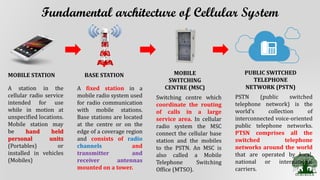
Fundamental architecture of Cellular System
MOBILE STATION BASE STATION MOBILE
SWITCHING
CENTRE (MSC)
PUBLIC SWITCHED
TELEPHONE
NETWORK (PSTN)A station in the
cellular radio service
intended for use
while in motion at
unspecified locations.
Mobile station may
be hand held
personal units
(Portables) or
installed in vehicles
(Mobiles)
A fixed station in a
mobile radio system used
for radio communication
with mobile stations.
Base stations are located
at the centre or on the
edge of a coverage region
and consists of radio
channels and
transmitter and
receiver antennas
mounted on a tower.
Switching centre which
coordinate the routing
of calls in a large
service area. In cellular
radio system the MSC
connect the cellular base
station and the mobiles
to the PSTN. An MSC is
also called a Mobile
Telephone Switching
Office (MTSO).
PSTN (public switched
telephone network) is the
world’s collection of
interconnected voice-oriented
public telephone networks.
PTSN comprises all the
switched telephone
networks around the world
that are operated by local,
national or international
carriers.
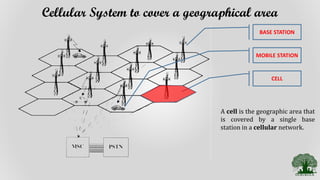
Cellular System to cover a geographical area
BASE STATION
MOBILE STATION
CELL
A cell is the geographic area that
is covered by a single base
station in a cellular network.
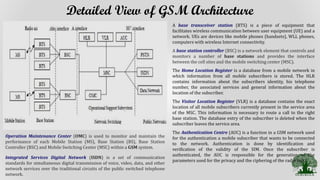
Detailed View of GSM Architecture
A base transceiver station (BTS) is a piece of equipment that
facilitates wireless communication between user equipment (UE) and a
network. UEs are devices like mobile phones (handsets), WLL phones,
computers with wireless Internet connectivity.
A base station controller (BSC) is a network element that controls and
monitors a number of base stations and provides the interface
between the cell sites and the mobile switching center (MSC).
The Home Location Register is a database from a mobile network in
which information from all mobile subscribers is stored. The HLR
contains information about the subscribers identity, his telephone
number, the associated services and general information about the
location of the subscriber.
The Visitor Location Register (VLR) is a database contains the exact
location of all mobile subscribers currently present in the service area
of the MSC. This information is necessary to route a call to the right
base station. The database entry of the subscriber is deleted when the
subscriber leaves the service area.
The Authentication Centre (AUC) is a function in a GSM network used
for the authentication a mobile subscriber that wants to be connected
to the network. Authentication is done by identification and
verification of the validity of the SIM. Once the subscriber is
authenticated, the AUC is responsible for the generation of the
parameters used for the privacy and the ciphering of the radio link.
Operation Maintenance Center (OMC) is used to monitor and maintain the
performance of each Mobile Station (MS), Base Station (BS), Base Station
Controller (BSC) and Mobile Switching Center (MSC) within a GSM system.
Integrated Services Digital Network (ISDN) is a set of communication
standards for simultaneous digital transmission of voice, video, data, and other
network services over the traditional circuits of the public switched telephone
network.
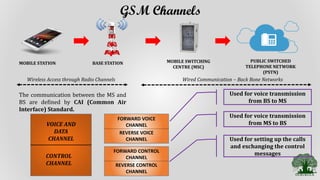
GSM Channels
MOBILE STATION BASE STATION MOBILE SWITCHING
CENTRE (MSC)
PUBLIC SWITCHED
TELEPHONE NETWORK
(PSTN)
Wireless Access through Radio Channels Wired Communication – Back Bone Networks
The communication between the MS and
BS are defined by CAI (Common Air
Interface) Standard.
VOICE AND
DATA
CHANNEL
CONTROL
CHANNEL
FORWARD VOICE
CHANNEL
REVERSE VOICE
CHANNEL
FORWARD CONTROL
CHANNEL
REVERSE CONTROL
CHANNEL
Used for voice transmission
from BS to MS
Used for voice transmission
from MS to BS
Used for setting up the calls
and exchanging the control
messages
Channel Access Mechanisms
In real time scenario a single Base
Station will serve several Mobile
Stations simultaneously. This gives
raise to 2 important questions
1. How Full duplexing is
achieved?
2. How mobile users share the
available finite amount of
spectrum
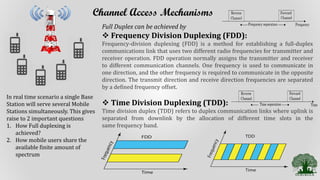
Full Duplex can be achieved by
 Frequency Division Duplexing (FDD):
Frequency-division duplexing (FDD) is a method for establishing a full-duplex
communications link that uses two different radio frequencies for transmitter and
receiver operation. FDD operation normally assigns the transmitter and receiver
to different communication channels. One frequency is used to communicate in
one direction, and the other frequency is required to communicate in the opposite
direction. The transmit direction and receive direction frequencies are separated
by a defined frequency offset.
 Time Division Duplexing (TDD):
Time division duplex (TDD) refers to duplex communication links where uplink is
separated from downlink by the allocation of different time slots in the
same frequency band.
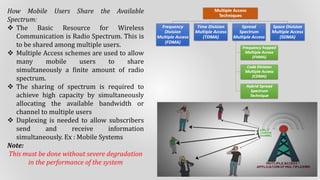
How Mobile Users Share the Available
Spectrum:
 The Basic Resource for Wireless
Communication is Radio Spectrum. This is
to be shared among multiple users.
 Multiple Access schemes are used to allow
many mobile users to share
simultaneously a finite amount of radio
spectrum.
 The sharing of spectrum is required to
achieve high capacity by simultaneously
allocating the available bandwidth or
channel to multiple users
 Duplexing is needed to allow subscribers
send and receive information
simultaneously. Ex : Mobile Systems
Note:
This must be done without severe degradation
in the performance of the system
Summary
• Basic Components and definition
• Architecture of Cellular Systems
• CAI Standards for GSM channels
• Concepts of Duplexing
• Concepts of Multiple Access Techniques

2.1 introduction to cellular architecture

  • 1.
  • 2.
    Lecture Videos areavailable for this slides at www.youtube.com/gurukula Support by Subscribing to my Channel
  • 3.
    Fundamental architecture ofCellular System MOBILE STATION BASE STATION MOBILE SWITCHING CENTRE (MSC) PUBLIC SWITCHED TELEPHONE NETWORK (PSTN)A station in the cellular radio service intended for use while in motion at unspecified locations. Mobile station may be hand held personal units (Portables) or installed in vehicles (Mobiles) A fixed station in a mobile radio system used for radio communication with mobile stations. Base stations are located at the centre or on the edge of a coverage region and consists of radio channels and transmitter and receiver antennas mounted on a tower. Switching centre which coordinate the routing of calls in a large service area. In cellular radio system the MSC connect the cellular base station and the mobiles to the PSTN. An MSC is also called a Mobile Telephone Switching Office (MTSO). PSTN (public switched telephone network) is the world’s collection of interconnected voice-oriented public telephone networks. PTSN comprises all the switched telephone networks around the world that are operated by local, national or international carriers.
  • 4.
    Cellular System tocover a geographical area BASE STATION MOBILE STATION CELL A cell is the geographic area that is covered by a single base station in a cellular network.
  • 5.
    Detailed View ofGSM Architecture A base transceiver station (BTS) is a piece of equipment that facilitates wireless communication between user equipment (UE) and a network. UEs are devices like mobile phones (handsets), WLL phones, computers with wireless Internet connectivity. A base station controller (BSC) is a network element that controls and monitors a number of base stations and provides the interface between the cell sites and the mobile switching center (MSC). The Home Location Register is a database from a mobile network in which information from all mobile subscribers is stored. The HLR contains information about the subscribers identity, his telephone number, the associated services and general information about the location of the subscriber. The Visitor Location Register (VLR) is a database contains the exact location of all mobile subscribers currently present in the service area of the MSC. This information is necessary to route a call to the right base station. The database entry of the subscriber is deleted when the subscriber leaves the service area. The Authentication Centre (AUC) is a function in a GSM network used for the authentication a mobile subscriber that wants to be connected to the network. Authentication is done by identification and verification of the validity of the SIM. Once the subscriber is authenticated, the AUC is responsible for the generation of the parameters used for the privacy and the ciphering of the radio link. Operation Maintenance Center (OMC) is used to monitor and maintain the performance of each Mobile Station (MS), Base Station (BS), Base Station Controller (BSC) and Mobile Switching Center (MSC) within a GSM system. Integrated Services Digital Network (ISDN) is a set of communication standards for simultaneous digital transmission of voice, video, data, and other network services over the traditional circuits of the public switched telephone network.
  • 6.
    GSM Channels MOBILE STATIONBASE STATION MOBILE SWITCHING CENTRE (MSC) PUBLIC SWITCHED TELEPHONE NETWORK (PSTN) Wireless Access through Radio Channels Wired Communication – Back Bone Networks The communication between the MS and BS are defined by CAI (Common Air Interface) Standard. VOICE AND DATA CHANNEL CONTROL CHANNEL FORWARD VOICE CHANNEL REVERSE VOICE CHANNEL FORWARD CONTROL CHANNEL REVERSE CONTROL CHANNEL Used for voice transmission from BS to MS Used for voice transmission from MS to BS Used for setting up the calls and exchanging the control messages
  • 7.
    Channel Access Mechanisms Inreal time scenario a single Base Station will serve several Mobile Stations simultaneously. This gives raise to 2 important questions 1. How Full duplexing is achieved? 2. How mobile users share the available finite amount of spectrum Full Duplex can be achieved by  Frequency Division Duplexing (FDD): Frequency-division duplexing (FDD) is a method for establishing a full-duplex communications link that uses two different radio frequencies for transmitter and receiver operation. FDD operation normally assigns the transmitter and receiver to different communication channels. One frequency is used to communicate in one direction, and the other frequency is required to communicate in the opposite direction. The transmit direction and receive direction frequencies are separated by a defined frequency offset.  Time Division Duplexing (TDD): Time division duplex (TDD) refers to duplex communication links where uplink is separated from downlink by the allocation of different time slots in the same frequency band.
  • 8.
    How Mobile UsersShare the Available Spectrum:  The Basic Resource for Wireless Communication is Radio Spectrum. This is to be shared among multiple users.  Multiple Access schemes are used to allow many mobile users to share simultaneously a finite amount of radio spectrum.  The sharing of spectrum is required to achieve high capacity by simultaneously allocating the available bandwidth or channel to multiple users  Duplexing is needed to allow subscribers send and receive information simultaneously. Ex : Mobile Systems Note: This must be done without severe degradation in the performance of the system
  • 9.
    Summary • Basic Componentsand definition • Architecture of Cellular Systems • CAI Standards for GSM channels • Concepts of Duplexing • Concepts of Multiple Access Techniques