WOOD

MATERIALS TECHNOLOGY
4th Edition
Chapter 8
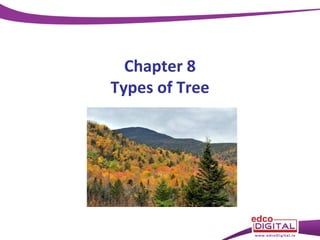
Types of Tree
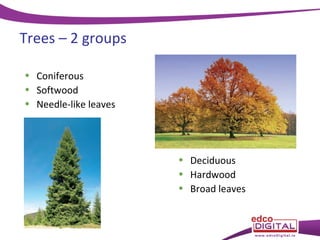
Trees – 2 groups
• Coniferous
• Softwood
• Needle-like leaves

• Deciduous
• Hardwood
• Broad leaves
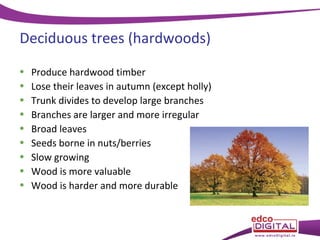
Deciduous trees (hardwoods)
•
•
•
•
•
•
•
•
•

Produce hardwood timber
Lose their leaves in autumn (except holly)
Trunk divides to develop large branches
Branches are larger and more irregular
Broad leaves
Seeds borne in nuts/berries
Slow growing
Wood is more valuable
Wood is harder and more durable
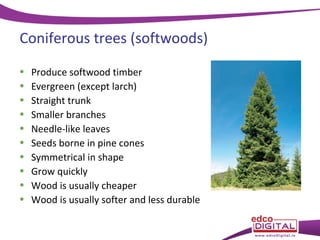
Coniferous trees (softwoods)
•
•
•
•
•
•
•
•
•
•

Produce softwood timber
Evergreen (except larch)
Straight trunk
Smaller branches
Needle-like leaves
Seeds borne in pine cones
Symmetrical in shape
Grow quickly
Wood is usually cheaper
Wood is usually softer and less durable
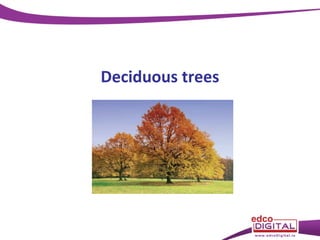
Deciduous trees
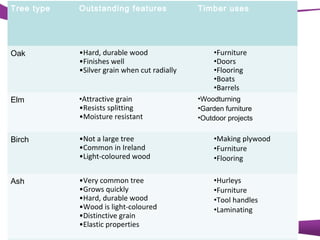
Tree type

Outstanding features

Timber uses

Oak

•Hard, durable wood
•Finishes well
•Silver grain when cut radially

Elm

•Attractive grain
•Resists splitting
•Moisture resistant

Birch

•Not a large tree
•Common in Ireland
•Light-coloured wood

•Making plywood
•Furniture
•Flooring

Ash

•Very common tree
•Grows quickly
•Hard, durable wood
•Wood is light-coloured
•Distinctive grain
•Elastic properties

•Hurleys
•Furniture
•Tool handles
•Laminating

•Furniture
•Doors
•Flooring
•Boats
•Barrels
•Woodturning
•Garden furniture
•Outdoor projects
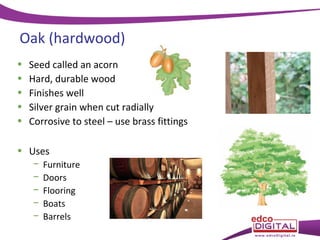
Oak (hardwood)
•
•
•
•
•

Seed called an acorn
Hard, durable wood
Finishes well
Silver grain when cut radially
Corrosive to steel – use brass fittings

• Uses
−
−
−
−
−

Furniture
Doors
Flooring
Boats
Barrels
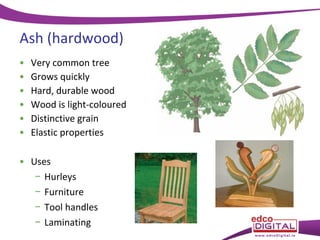
Ash (hardwood)
•
•
•
•
•
•

Very common tree
Grows quickly
Hard, durable wood
Wood is light-coloured
Distinctive grain
Elastic properties

• Uses
− Hurleys
− Furniture
− Tool handles
− Laminating
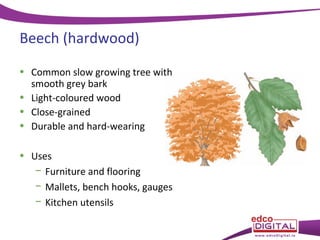
Beech (hardwood)
• Common slow growing tree with
smooth grey bark
• Light-coloured wood
• Close-grained
• Durable and hard-wearing
• Uses
− Furniture and flooring
− Mallets, bench hooks, gauges
− Kitchen utensils
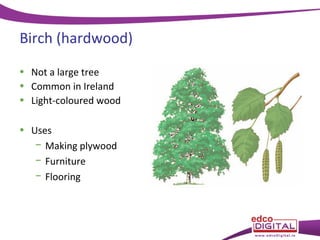
Birch (hardwood)
• Not a large tree
• Common in Ireland
• Light-coloured wood
• Uses
− Making plywood
− Furniture
− Flooring
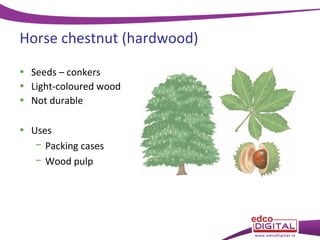
Horse chestnut (hardwood)
• Seeds – conkers
• Light-coloured wood
• Not durable
• Uses
− Packing cases
− Wood pulp
Other hardwood tree’s
•Elm
•Spanish chestnut
•Lime
•Cherry
•Sycamore
•Maple
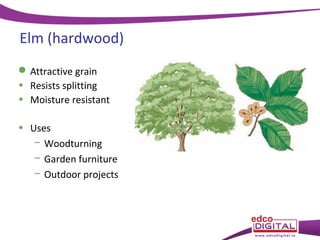
Elm (hardwood)
 Attractive grain
• Resists splitting
• Moisture resistant
• Uses
− Woodturning
− Garden furniture
− Outdoor projects
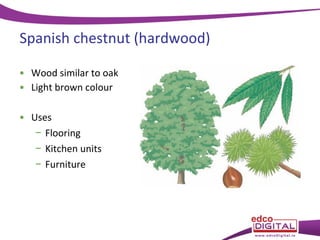
Spanish chestnut (hardwood)
• Wood similar to oak
• Light brown colour
• Uses
− Flooring
− Kitchen units
− Furniture
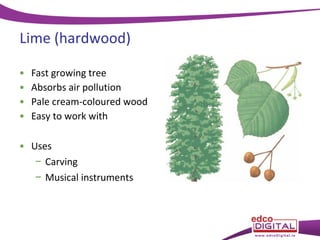
Lime (hardwood)
•
•
•
•

Fast growing tree
Absorbs air pollution
Pale cream-coloured wood
Easy to work with

• Uses
− Carving
− Musical instruments
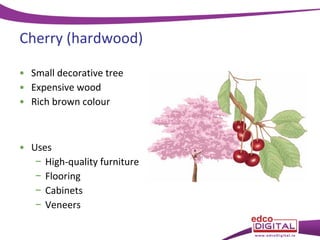
Cherry (hardwood)
• Small decorative tree
• Expensive wood
• Rich brown colour

• Uses
− High-quality furniture
− Flooring
− Cabinets
− Veneers
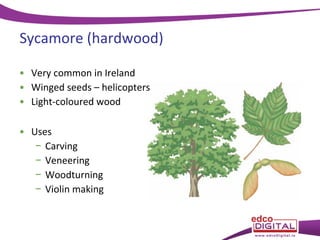
Sycamore (hardwood)
• Very common in Ireland
• Winged seeds – helicopters
• Light-coloured wood
• Uses
− Carving
− Veneering
− Woodturning
− Violin making
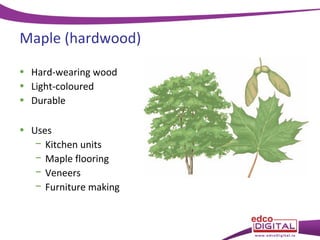
Maple (hardwood)
• Hard-wearing wood
• Light-coloured
• Durable
• Uses
− Kitchen units
− Maple flooring
− Veneers
− Furniture making
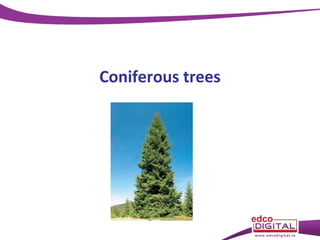
Coniferous trees
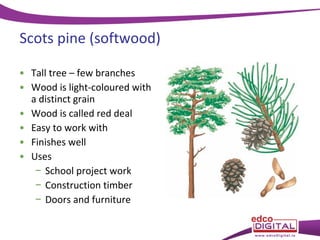
Scots pine (softwood)
• Tall tree – few branches
• Wood is light-coloured with
a distinct grain
• Wood is called red deal
• Easy to work with
• Finishes well
• Uses
− School project work
− Construction timber
− Doors and furniture
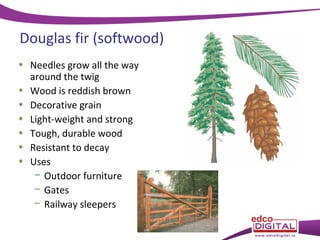
Douglas fir (softwood)
• Needles grow all the way
around the twig
• Wood is reddish brown
• Decorative grain
• Light-weight and strong
• Tough, durable wood
• Resistant to decay
• Uses
− Outdoor furniture
− Gates
− Railway sleepers
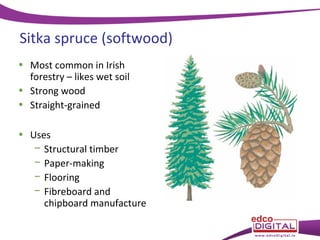
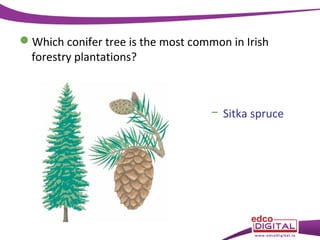
Sitka spruce (softwood)
• Most common in Irish
forestry – likes wet soil
• Strong wood
• Straight-grained
• Uses
− Structural timber
− Paper-making
− Flooring
− Fibreboard and
chipboard manufacture
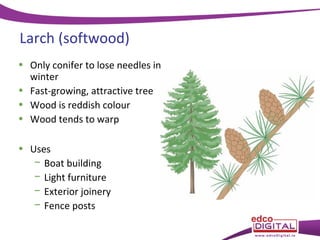
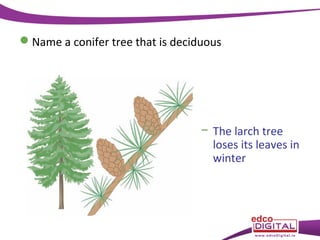
Larch (softwood)
• Only conifer to lose needles in
winter
• Fast-growing, attractive tree
• Wood is reddish colour
• Wood tends to warp
• Uses
− Boat building
− Light furniture
− Exterior joinery
− Fence posts
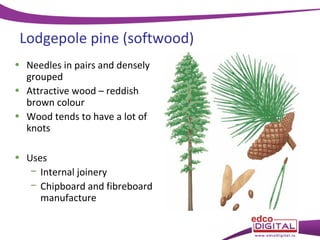
Lodgepole pine (softwood)
• Needles in pairs and densely
grouped
• Attractive wood – reddish
brown colour
• Wood tends to have a lot of
knots
• Uses
− Internal joinery
− Chipboard and fibreboard
manufacture
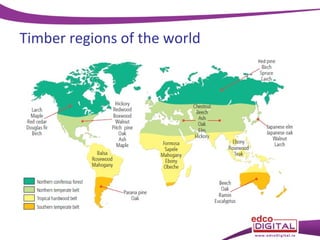
Timber regions of the world
Tropical Rainforests
Climate has high rainfall and high temperature
This area runs around the equator
As there are no seasons growth occurs all year
round
Examples:
Mahogany
Balsa
Ebony
Teak
Quiz

Do you know your trees?
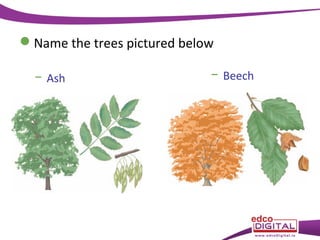
Name the trees pictured below
− Ash

− Beech
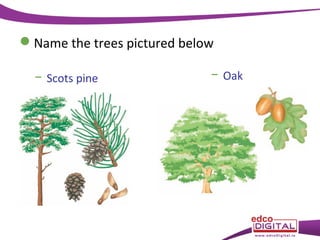
Name the trees pictured below
− Scots pine

− Oak
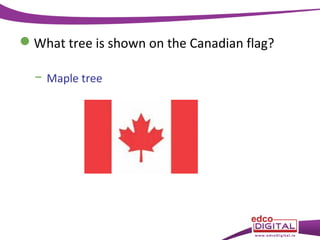
What tree is shown on the Canadian flag?
− Maple tree
Which conifer tree is the most common in Irish
forestry plantations?

− Sitka spruce
Name a conifer tree that is deciduous

− The larch tree
loses its leaves in
winter
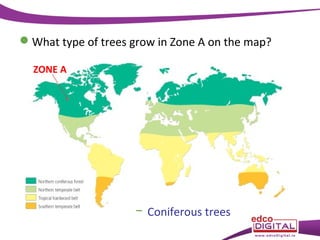
What type of trees grow in Zone A on the map?
ZONE A

− Coniferous trees

08 types of tree

  • 1.
  • 2.
  • 3.
    Trees – 2groups • Coniferous • Softwood • Needle-like leaves • Deciduous • Hardwood • Broad leaves
  • 4.
    Deciduous trees (hardwoods) • • • • • • • • • Producehardwood timber Lose their leaves in autumn (except holly) Trunk divides to develop large branches Branches are larger and more irregular Broad leaves Seeds borne in nuts/berries Slow growing Wood is more valuable Wood is harder and more durable
  • 5.
    Coniferous trees (softwoods) • • • • • • • • • • Producesoftwood timber Evergreen (except larch) Straight trunk Smaller branches Needle-like leaves Seeds borne in pine cones Symmetrical in shape Grow quickly Wood is usually cheaper Wood is usually softer and less durable
  • 6.
  • 7.
    Tree type Outstanding features Timberuses Oak •Hard, durable wood •Finishes well •Silver grain when cut radially Elm •Attractive grain •Resists splitting •Moisture resistant Birch •Not a large tree •Common in Ireland •Light-coloured wood •Making plywood •Furniture •Flooring Ash •Very common tree •Grows quickly •Hard, durable wood •Wood is light-coloured •Distinctive grain •Elastic properties •Hurleys •Furniture •Tool handles •Laminating •Furniture •Doors •Flooring •Boats •Barrels •Woodturning •Garden furniture •Outdoor projects
  • 8.
    Oak (hardwood) • • • • • Seed calledan acorn Hard, durable wood Finishes well Silver grain when cut radially Corrosive to steel – use brass fittings • Uses − − − − − Furniture Doors Flooring Boats Barrels
  • 9.
    Ash (hardwood) • • • • • • Very commontree Grows quickly Hard, durable wood Wood is light-coloured Distinctive grain Elastic properties • Uses − Hurleys − Furniture − Tool handles − Laminating
  • 10.
    Beech (hardwood) • Commonslow growing tree with smooth grey bark • Light-coloured wood • Close-grained • Durable and hard-wearing • Uses − Furniture and flooring − Mallets, bench hooks, gauges − Kitchen utensils
  • 11.
    Birch (hardwood) • Nota large tree • Common in Ireland • Light-coloured wood • Uses − Making plywood − Furniture − Flooring
  • 12.
    Horse chestnut (hardwood) •Seeds – conkers • Light-coloured wood • Not durable • Uses − Packing cases − Wood pulp
  • 13.
    Other hardwood tree’s •Elm •Spanishchestnut •Lime •Cherry •Sycamore •Maple
  • 14.
    Elm (hardwood)  Attractivegrain • Resists splitting • Moisture resistant • Uses − Woodturning − Garden furniture − Outdoor projects
  • 15.
    Spanish chestnut (hardwood) •Wood similar to oak • Light brown colour • Uses − Flooring − Kitchen units − Furniture
  • 16.
    Lime (hardwood) • • • • Fast growingtree Absorbs air pollution Pale cream-coloured wood Easy to work with • Uses − Carving − Musical instruments
  • 17.
    Cherry (hardwood) • Smalldecorative tree • Expensive wood • Rich brown colour • Uses − High-quality furniture − Flooring − Cabinets − Veneers
  • 18.
    Sycamore (hardwood) • Verycommon in Ireland • Winged seeds – helicopters • Light-coloured wood • Uses − Carving − Veneering − Woodturning − Violin making
  • 19.
    Maple (hardwood) • Hard-wearingwood • Light-coloured • Durable • Uses − Kitchen units − Maple flooring − Veneers − Furniture making
  • 20.
  • 21.
    Scots pine (softwood) •Tall tree – few branches • Wood is light-coloured with a distinct grain • Wood is called red deal • Easy to work with • Finishes well • Uses − School project work − Construction timber − Doors and furniture
  • 22.
    Douglas fir (softwood) •Needles grow all the way around the twig • Wood is reddish brown • Decorative grain • Light-weight and strong • Tough, durable wood • Resistant to decay • Uses − Outdoor furniture − Gates − Railway sleepers
  • 23.
    Sitka spruce (softwood) •Most common in Irish forestry – likes wet soil • Strong wood • Straight-grained • Uses − Structural timber − Paper-making − Flooring − Fibreboard and chipboard manufacture
  • 24.
    Larch (softwood) • Onlyconifer to lose needles in winter • Fast-growing, attractive tree • Wood is reddish colour • Wood tends to warp • Uses − Boat building − Light furniture − Exterior joinery − Fence posts
  • 25.
    Lodgepole pine (softwood) •Needles in pairs and densely grouped • Attractive wood – reddish brown colour • Wood tends to have a lot of knots • Uses − Internal joinery − Chipboard and fibreboard manufacture
  • 26.
  • 27.
    Tropical Rainforests Climate hashigh rainfall and high temperature This area runs around the equator As there are no seasons growth occurs all year round Examples: Mahogany Balsa Ebony Teak
  • 28.
    Quiz Do you knowyour trees?
  • 29.
    Name the treespictured below − Ash − Beech
  • 30.
    Name the treespictured below − Scots pine − Oak
  • 31.
    What tree isshown on the Canadian flag? − Maple tree
  • 32.
    Which conifer treeis the most common in Irish forestry plantations? − Sitka spruce
  • 33.
    Name a conifertree that is deciduous − The larch tree loses its leaves in winter
  • 34.
    What type oftrees grow in Zone A on the map? ZONE A − Coniferous trees