WOOD Coral A Mitchel
Antonio Blake
Delroy Garrison
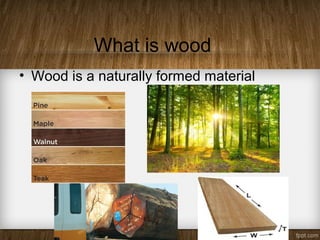
What is wood
• Wood is a naturally formed material
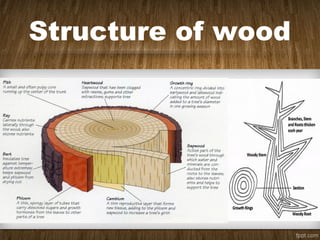
Structure of wood
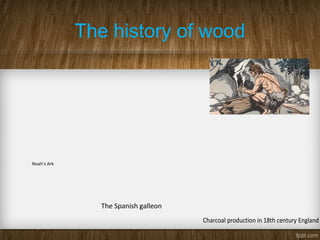
The history of wood
The Spanish galleon Charcoal produc
The Spanish galleon Charcoal production in 18th century England
Noah’s Ark
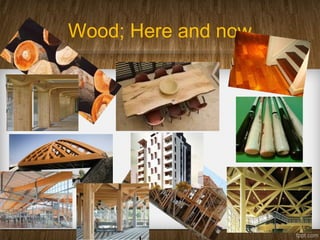
Wood; Here and now
The future of wood
• When we think of advanced materials;
some things that might come to mind are
carbon fibre, super alloys or Nano-
materials. Most often, wood will not be
high on that list. Although wood is not
new, some advanced engineering is
making it perform new tasks.
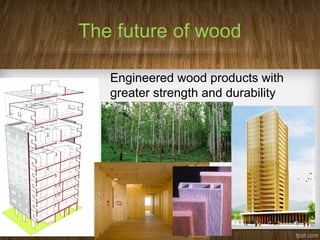
The future of wood
Engineered wood products with
greater strength and durability
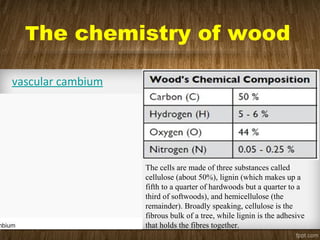
The chemistry of wood
mbium
vascular cambium
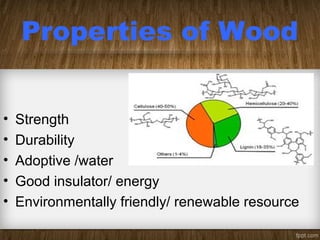
The cells are made of three substances called
cellulose (about 50%), lignin (which makes up a
fifth to a quarter of hardwoods but a quarter to a
third of softwoods), and hemicellulose (the
remainder). Broadly speaking, cellulose is the
fibrous bulk of a tree, while lignin is the adhesive
that holds the fibres together.
Properties of Wood
• Strength
• Durability
• Adoptive /water
• Good insulator/ energy
• Environmentally friendly/ renewable resource
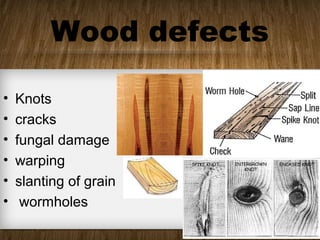
Wood defects
• Knots
• cracks
• fungal damage
• warping
• slanting of grain
• wormholes
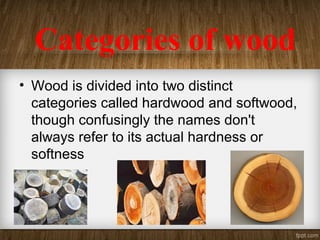
Categories of wood
• Wood is divided into two distinct
categories called hardwood and softwood,
though confusingly the names don't
always refer to its actual hardness or
softness
Hardwoods and softwoods
Hardwood
• broad-leaved (deciduous)
• drop their leaves each fall
• known as angiosperms
• seeds are encased in fruits
or pods
 Examples include ash,
beech, birch, mahogany,
maple, oak, teak, and walnut
Softwood
• evergreen (coniferous)
• have needles and cones and
retain those year-round
• called gymnosperms
 Examples include cedar,
cypress, fir, pine, spruce,
and redwood.
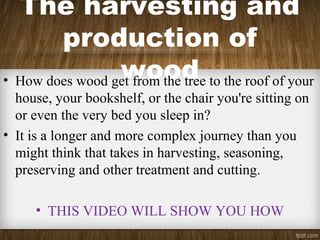
The harvesting and
production of
wood• How does wood get from the tree to the roof of your
house, your bookshelf, or the chair you're sitting on
or even the very bed you sleep in?
• It is a longer and more complex journey than you
might think that takes in harvesting, seasoning,
preserving and other treatment and cutting.
• THIS VIDEO WILL SHOW YOU HOW
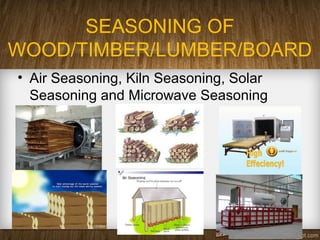
SEASONING OF
WOOD/TIMBER/LUMBER/BOARD
• Air Seasoning, Kiln Seasoning, Solar
Seasoning and Microwave Seasoning
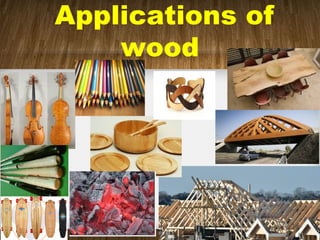
Applications of
wood
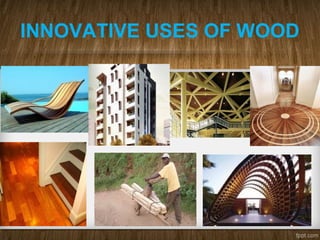
INNOVATIVE USES OF WOOD
A BOOST: G.M. WOOD
• genetically modified trees under experimental
development have been modified with traits
intended to provide benefit to industry, foresters or
consumers
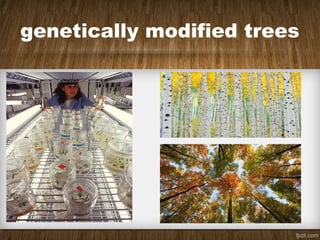
• GM trees in silviculture consist of plantation trees,
such as eucalyptus, poplar, and pine. In essence
genetically modified trees produces genetically
modified wood.
genetically modified trees
AN INTERESTING FACTS
• . “The total world consumption of wood is
3.500 million cubic meters and approx. 55%
of this is for use as fuel for cooking and
heating. Some 30% is harvested for sawn
timber and another 15% is harvested directly
for making paper and board. All leftovers
from trees cut for the sawmill industry (tree
tops, saw dust, etc.) are also used for
making pulp and paper.”
AN INTERESTING FACTS #2
• The Wold’s Most Expensive Wood
• The African Blackwood or Mpingo, as the natives of
Tanzania call it - is considered a threatened species. It is
also the most expensive tree in the world. Mpingo once
grew in southern Ethiopia and Kenya, but can now only
be found in Tanzania and northern Mozambique. It is a
slow-growing tree that survives on little water. It doesn’t
compete with corn, coffee or bananas and even fixes
nitrogen in soil. The world’s most expensive wood
commands a price commensurate with its utility and
rarity—$25,000 per cubic meter.
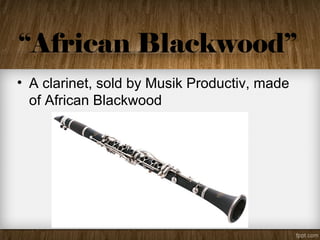
“African Blackwood”
• A clarinet, sold by Musik Productiv, made
of African Blackwood
WHAT “WOOD” YOU DO?
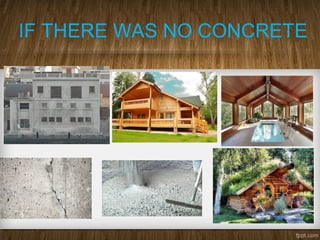
IF THERE WAS NO CONCRETE
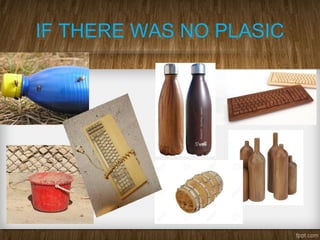
IF THERE WAS NO PLASIC
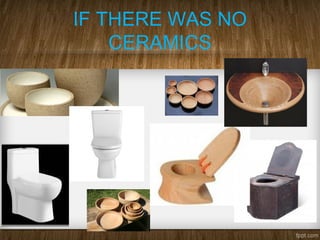
IF THERE WAS NO
CERAMICS
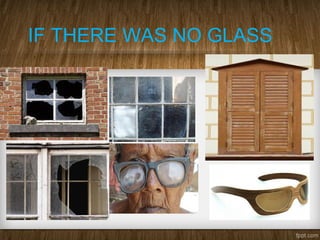
IF THERE WAS NO GLASS
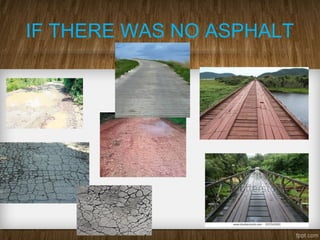
IF THERE WAS NO ASPHALT
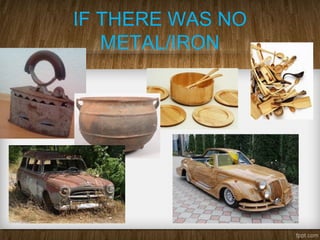
IF THERE WAS NO
METAL/IRON
“WOOD”
• A POEM ENJOY.
MOVING
• AS WE CLOSE OUR PRESENTATION
• A. Goldsworthy, An appreciation of wood from one of our leading "nature-sculptors.
• Thames & Hudson, 2010 /Article, Retrieved on March 12, 2015 from
www.explainthatstuff.com/wood.htm
• H. Johnson, Trees: A Lifetime's Journey Through Forests, Woods and Gardens 2010,
University of California Press. Accessed on March 13, 2015
• J. Guiles, Evaluating the Environmental Performance of Wood Building Materials; The
State University of New York College of Environmental Science and Forestry,
undated /article/ Accessed March 13, 2015 from
http://www.esf.edu/ecenter/eis/woodmaterials.htm
•
• R. B. Hoadley, Understanding Wood: A Craftsman's Guide to Wood Technology, 2nd
edition Taunton 2000, Internet Version 2015. Retrieved March 15, 2015 from
http://www.tauntonstore.com/understanding-wood-2nd-edition-r-bruce-hoadley-
070490.html

Wood

  • 1.
    WOOD Coral AMitchel Antonio Blake Delroy Garrison
  • 2.
    What is wood •Wood is a naturally formed material
  • 3.
  • 4.
    The history ofwood The Spanish galleon Charcoal produc The Spanish galleon Charcoal production in 18th century England Noah’s Ark
  • 5.
  • 6.
    The future ofwood • When we think of advanced materials; some things that might come to mind are carbon fibre, super alloys or Nano- materials. Most often, wood will not be high on that list. Although wood is not new, some advanced engineering is making it perform new tasks.
  • 7.
    The future ofwood Engineered wood products with greater strength and durability
  • 8.
    The chemistry ofwood mbium vascular cambium The cells are made of three substances called cellulose (about 50%), lignin (which makes up a fifth to a quarter of hardwoods but a quarter to a third of softwoods), and hemicellulose (the remainder). Broadly speaking, cellulose is the fibrous bulk of a tree, while lignin is the adhesive that holds the fibres together.
  • 9.
    Properties of Wood •Strength • Durability • Adoptive /water • Good insulator/ energy • Environmentally friendly/ renewable resource
  • 10.
    Wood defects • Knots •cracks • fungal damage • warping • slanting of grain • wormholes
  • 11.
    Categories of wood •Wood is divided into two distinct categories called hardwood and softwood, though confusingly the names don't always refer to its actual hardness or softness
  • 12.
    Hardwoods and softwoods Hardwood •broad-leaved (deciduous) • drop their leaves each fall • known as angiosperms • seeds are encased in fruits or pods  Examples include ash, beech, birch, mahogany, maple, oak, teak, and walnut Softwood • evergreen (coniferous) • have needles and cones and retain those year-round • called gymnosperms  Examples include cedar, cypress, fir, pine, spruce, and redwood.
  • 13.
    The harvesting and productionof wood• How does wood get from the tree to the roof of your house, your bookshelf, or the chair you're sitting on or even the very bed you sleep in? • It is a longer and more complex journey than you might think that takes in harvesting, seasoning, preserving and other treatment and cutting. • THIS VIDEO WILL SHOW YOU HOW
  • 14.
    SEASONING OF WOOD/TIMBER/LUMBER/BOARD • AirSeasoning, Kiln Seasoning, Solar Seasoning and Microwave Seasoning
  • 15.
  • 16.
  • 17.
    A BOOST: G.M.WOOD • genetically modified trees under experimental development have been modified with traits intended to provide benefit to industry, foresters or consumers • GM trees in silviculture consist of plantation trees, such as eucalyptus, poplar, and pine. In essence genetically modified trees produces genetically modified wood.
  • 18.
  • 19.
    AN INTERESTING FACTS •. “The total world consumption of wood is 3.500 million cubic meters and approx. 55% of this is for use as fuel for cooking and heating. Some 30% is harvested for sawn timber and another 15% is harvested directly for making paper and board. All leftovers from trees cut for the sawmill industry (tree tops, saw dust, etc.) are also used for making pulp and paper.”
  • 20.
    AN INTERESTING FACTS#2 • The Wold’s Most Expensive Wood • The African Blackwood or Mpingo, as the natives of Tanzania call it - is considered a threatened species. It is also the most expensive tree in the world. Mpingo once grew in southern Ethiopia and Kenya, but can now only be found in Tanzania and northern Mozambique. It is a slow-growing tree that survives on little water. It doesn’t compete with corn, coffee or bananas and even fixes nitrogen in soil. The world’s most expensive wood commands a price commensurate with its utility and rarity—$25,000 per cubic meter.
  • 21.
    “African Blackwood” • Aclarinet, sold by Musik Productiv, made of African Blackwood
  • 22.
  • 23.
    IF THERE WASNO CONCRETE
  • 24.
    IF THERE WASNO PLASIC
  • 25.
    IF THERE WASNO CERAMICS
  • 26.
    IF THERE WASNO GLASS
  • 27.
    IF THERE WASNO ASPHALT
  • 28.
    IF THERE WASNO METAL/IRON
  • 29.
    “WOOD” • A POEMENJOY. MOVING • AS WE CLOSE OUR PRESENTATION
  • 30.
    • A. Goldsworthy,An appreciation of wood from one of our leading "nature-sculptors. • Thames & Hudson, 2010 /Article, Retrieved on March 12, 2015 from www.explainthatstuff.com/wood.htm • H. Johnson, Trees: A Lifetime's Journey Through Forests, Woods and Gardens 2010, University of California Press. Accessed on March 13, 2015 • J. Guiles, Evaluating the Environmental Performance of Wood Building Materials; The State University of New York College of Environmental Science and Forestry, undated /article/ Accessed March 13, 2015 from http://www.esf.edu/ecenter/eis/woodmaterials.htm • • R. B. Hoadley, Understanding Wood: A Craftsman's Guide to Wood Technology, 2nd edition Taunton 2000, Internet Version 2015. Retrieved March 15, 2015 from http://www.tauntonstore.com/understanding-wood-2nd-edition-r-bruce-hoadley- 070490.html