Timber
The structure of natural timber
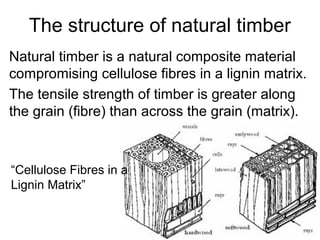
Natural timber is a natural composite material
compromising cellulose fibres in a lignin matrix.
The tensile strength of timber is greater along
the grain (fibre) than across the grain (matrix).
“Cellulose Fibres in a
Lignin Matrix”
Classifications of timber
Basically, trees break down into either
Hardwoods or Softwoods.
All softwoods grow in temperate forests.
Hardwoods can be either temperate or
tropical.
Where do woods come from?
Temperate regions (softwoods)
Where do woods come from?
Tropical regions (soft & hardwoods)
Softwoods originate from coniferous trees
(also known as evergreens, or
gymnosperms). Rather than losing their
leaves all at one time, they tend to shed
their leaves (which resemble and are
called "needles") throughout the year and
bear cones.
Hardwoods, on the other hand, come
from deciduous trees which lose their
leaves throughout the year and produce
seeds covered with some kind of covering
(sometimes a fruit or nut).
The classification of timber is based on the
species it comes from, rather than its
relative hardness or density.
Hardwoods include exotic deciduous species
(such as ash, mahogany, oak, walnut and
balsa) and Australian native evergreen
species (such as jarrah, silky oak,
brushbox, iron bark and spotted gum).
Softwoods come from coniferous species,
such as true cedar, fir, pine and spruce.
Conifer trees
Conifer trees are referred to as softwoods.
These grow only in temperate regions. They
are often referred to as evergreens.
Characteristics of softwood
trees
Cellulose content - 42% +/- 2%
Lignin content - 28% +/- 3%
Extractives content - 3% +/-
2%
Fibre length - 2-6 mm
Coarseness - 15-
35 mg/100 mm
Deciduous trees
Deciduous trees are referred to as hardwoods
and that these grow in both temperate and
tropical regions
Characteristics of
hardwood trees
Cellulose content - 45% +/-
2%
Lignin content - 20% +/- 4%
Extractives content - 5% +/-
3%
Fibre length - 0.6-1.5 mm
Coarseness - 5-10 mg/100m
Cellulose - consists of long, straight chains of
glucose molecules. It forms the skeleton of the plant
wall. These fibres are long, strong and translucent.
Lignin - is a three dimensional phenolic polymer
network. This "glue from hell" holds the cellulose
fibres together and makes them rigid. Chemical
pulping and bleaching processes selectively remove
the lignin without significantly degrading the cellulose
fibres.
Extractives - account for 3(+/-2)% of softwoods.
These materials include plant hormones, resin and
fatty acids along with other substances that help the
tree grow and resist disease and pests. These
substances are highly toxic to aquatic life and
account for much of the acute toxicity of pulp mill
effluent.
Characteristics of
softwood trees
Cellulose content - 42%
+/- 2%
Lignin content - 28% +/-
3%
Extractives content - 3%
+/- 2%
Fibre length - 2-6 mm
Coarseness - 15-
35 mg/100 mm
Characteristics of
hardwood trees
Cellulose content - 45% +/-
2%
Lignin content - 20% +/- 4%
Extractives content - 5% +/-
3%
Fibre length - 0.6-1.5 mm
Coarseness - 5-
10 mg/100m
Density: higher density thereby harder
Lower density thereby most
varieties are softer than
hardwood.
Found in
regions:
Trees supplying hardwood are found throughout the world
from the Boreal and Taiga forests of the North to the
tropics and down into the far South, excluding
Antarctica.
Found in the northern
hemisphere.
Definition:
Comes from deciduous trees that drop their leaves every
year.
Trees that are conifer and have
needles, and normally do
not lose needles.
Properties: Broad leaves; enclosed nuts; higher density.
Less dense; less durable; high
calorific values.
Type: Mostly deciduous. Evergreen
Cost Expensive. Less expensive.
Examples of
trees:
Aspen, Poplar, Birch, Elm, Maple, etc.
Pine, spruce, cedar, fir, larch,
Douglas-fir, etc.
Applications: Used for furniture but less frequently than softwood.
Widely used as wood ware for
building and furniture.
Hardwood Softwood
Renewable resources
Watch the following videos and discuss
the issues relating to the consideration of
timber as a renewable source.
Consider: time to reach maturity, soil
erosion, greenhouse effect and extinction
of species
• http://ibdtmlc2010.wikidot.com/4-3-timber
Composite timbers
Particle board, also known as chipboard, is
an engineered wood product made from
wood particles, such as wood chips, sawmill
shavings, or even saw dust. This type of
composite timber is generally cheaper,
denser and more uniform than conventional
wood and plywood. It is usually used as a
substitution for them when appearance and
strength are less important than cost.
Composite timbers
Plywood is an engineered board made from
thin sheets of wood, called plies or wood
veneers. Softwood plywood is usually made
either of Douglas fir or spruce, pine, and fir
(collectively known as Spruce-pine-fir), and is
typically used for construction and industrial
purposes. Hardwood plywood is used for
some demanding end use.
Watch the video on how plywood is made
Comparing the two
Particle Board
Compare the two materials in the
following table
Particle board Plywood
Composition
Hardness
Tensile strength
Resistance to damp
environments
Aesthetic properties
Draw a cross-sectional view for
each composite
Particle board Plywood
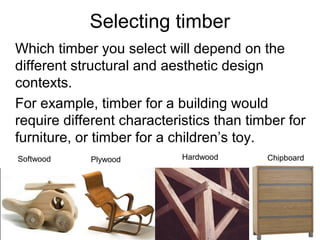
Selecting timber
Which timber you select will depend on the
different structural and aesthetic design
contexts.
For example, timber for a building would
require different characteristics than timber for
furniture, or timber for a children’s toy.
Softwood Plywood Hardwood Chipboard
Treating and Finishing wood
There are a number of reasons we treat of
finish wood.
• To reduce attack by organisms
• To reduce attack by chemicals
• To enhance aesthetic properties
• To modify other properties
Wood finishing refers to the process of embellishing
and/or protecting the surface of a wooden material.
The process starts with surface preparation, either
by sanding by hand (typically using a sanding block
or power sander), scraping, or planing.
Imperfections or nail holes on the surface may be
filled using wood putty or pores may be filled using
wood filler.
Often, the wood's colour is changed by staining,
bleaching, ammonia fuming and a number of other
techniques. Some woods such as pine or cherry do
not take stain evenly, resulting in “blotching". To
avoid blotching, a barrier coat such as shellac or
“wood conditioner" is applied before the stain. Gel
stains are also used to avoid blotching.
Wikipedia
Once the wood surface is prepared and
stained, a number of coats of finish may be
applied, often sanding between coats.
Commonly used wood finishes include wax,
shellac, drying oils (such as linseed oil or tung
oil), lacquer, varnish, or paint. Other finishes
called "oil finish" or "Danish Oil" are actually
thin varnishes with a relatively large amount of
oil and solvent. Water-based finishes can
cause what is called "raising the grain" where
surface fuzz emerges and requires sanding
down.
Wikipedia
All measures that are taken to ensure a long life of
wood fall under the definition wood preservation
(timber treatment). Apart from structural wood
preservation measures, there are a number of
different (chemical) preservatives and processes
(also known as timber treatment or lumber
treatment) that can extend the life of wood, timber,
wood structures or engineered wood. These
generally increase the durability and resistance from
being destroyed by insects or fungus.
Wikipedia
Visit this site to see detailed information on different timber treatments
http://en.wikipedia.org/wiki/Wood_preservation
Timber for flooring
Hardwood floors come in many types, finishes and
price ranges. The longevity of any type of flooring
depends on how it's used and cared for. Hardwood
and laminate floors are an attractive alternative to
enhance the look of a home. They are the preferred
alternative to carpet for anyone who suffers from
allergies. Anyone who wishes to keep a check on
microbes in the floor for the health of their children
should consider either of these types of flooring as
opposed to carpet.
Hardwood flooring comes in solid or engineered
varieties. Both solid and engineered hardwood
flooring is available finished or unfinished. Pre-
finished hardwood floors are also known as factory
finished. Unfinished hardwood floors may be
referred to as job-site finished. Laminate flooring is
an alternative to hardwood flooring but can have
some drawbacks, including the fact that walking on
it makes noise. Padding can be placed underneath
to address this issue, however. Laminate flooring
comes in three types: factory-glued, glueless and
pre-glued. The glueless type is easily installed by
snapping pieces together in grooves.
Durability
On scratch, stain, fade, moisture and impact resistance,
laminate flooring rates better than hardwood flooring.
However, some factory finishes of hardwood flooring are
able to resist stains very well. Both types have comparable
manufacturer's warranties. When hardwood flooring is
properly cared for and maintained, it can last a lifetime.
Laminate flooring can be expected to last less than 20
years. It is more scratch resistant than hardwood but it can
be scratched by a heavy or jagged object that is dragged
over it.
Laminate flooring can be used in an area of a house
where the floors get wet from time to time, but it can be
damaged if it gets very wet. Check the manufacturer's
warranty for specific information about how laminate
flooring will stand up to water and humidity.
Aesthetics
Hardwood flooring looks much better than
laminate flooring with a richer, warmer
appearance. Laminate floor has a good look.
Hardwood floors can be custom finished to
an exact colour. Hardwood expands or
contracts according to the amount of
humidity. If hardwood flooring is exposed to
too much direct sunlight, the colour can
change. Laminate floors resist colour change
from direct sunlight very well.
Maintenance and care
Laminate flooring is easier to maintain but harder to
repair than hardwood. All hardwood flooring, with the
exception of acrylic impregnated hardwood, can be
refinished. Laminate flooring cannot be. Hardwood
floors should not be mopped or cleaned with water
as this can cause permanent damage. Water also
causes the hardwood flooring's finish to become dull.
While hardwood flooring can be scratched, it can be
easily repaired if it's only as deep as the finish.
Laminate floors are easier to maintain because they
don't need wax.

Timber

  • 1.
  • 2.
    The structure ofnatural timber Natural timber is a natural composite material compromising cellulose fibres in a lignin matrix. The tensile strength of timber is greater along the grain (fibre) than across the grain (matrix). “Cellulose Fibres in a Lignin Matrix”
  • 3.
    Classifications of timber Basically,trees break down into either Hardwoods or Softwoods. All softwoods grow in temperate forests. Hardwoods can be either temperate or tropical.
  • 4.
    Where do woodscome from? Temperate regions (softwoods)
  • 5.
    Where do woodscome from? Tropical regions (soft & hardwoods)
  • 6.
    Softwoods originate fromconiferous trees (also known as evergreens, or gymnosperms). Rather than losing their leaves all at one time, they tend to shed their leaves (which resemble and are called "needles") throughout the year and bear cones. Hardwoods, on the other hand, come from deciduous trees which lose their leaves throughout the year and produce seeds covered with some kind of covering (sometimes a fruit or nut).
  • 7.
    The classification oftimber is based on the species it comes from, rather than its relative hardness or density. Hardwoods include exotic deciduous species (such as ash, mahogany, oak, walnut and balsa) and Australian native evergreen species (such as jarrah, silky oak, brushbox, iron bark and spotted gum). Softwoods come from coniferous species, such as true cedar, fir, pine and spruce.
  • 8.
    Conifer trees Conifer treesare referred to as softwoods. These grow only in temperate regions. They are often referred to as evergreens. Characteristics of softwood trees Cellulose content - 42% +/- 2% Lignin content - 28% +/- 3% Extractives content - 3% +/- 2% Fibre length - 2-6 mm Coarseness - 15- 35 mg/100 mm
  • 9.
    Deciduous trees Deciduous treesare referred to as hardwoods and that these grow in both temperate and tropical regions Characteristics of hardwood trees Cellulose content - 45% +/- 2% Lignin content - 20% +/- 4% Extractives content - 5% +/- 3% Fibre length - 0.6-1.5 mm Coarseness - 5-10 mg/100m
  • 10.
    Cellulose - consistsof long, straight chains of glucose molecules. It forms the skeleton of the plant wall. These fibres are long, strong and translucent. Lignin - is a three dimensional phenolic polymer network. This "glue from hell" holds the cellulose fibres together and makes them rigid. Chemical pulping and bleaching processes selectively remove the lignin without significantly degrading the cellulose fibres. Extractives - account for 3(+/-2)% of softwoods. These materials include plant hormones, resin and fatty acids along with other substances that help the tree grow and resist disease and pests. These substances are highly toxic to aquatic life and account for much of the acute toxicity of pulp mill effluent.
  • 11.
    Characteristics of softwood trees Cellulosecontent - 42% +/- 2% Lignin content - 28% +/- 3% Extractives content - 3% +/- 2% Fibre length - 2-6 mm Coarseness - 15- 35 mg/100 mm Characteristics of hardwood trees Cellulose content - 45% +/- 2% Lignin content - 20% +/- 4% Extractives content - 5% +/- 3% Fibre length - 0.6-1.5 mm Coarseness - 5- 10 mg/100m
  • 12.
    Density: higher densitythereby harder Lower density thereby most varieties are softer than hardwood. Found in regions: Trees supplying hardwood are found throughout the world from the Boreal and Taiga forests of the North to the tropics and down into the far South, excluding Antarctica. Found in the northern hemisphere. Definition: Comes from deciduous trees that drop their leaves every year. Trees that are conifer and have needles, and normally do not lose needles. Properties: Broad leaves; enclosed nuts; higher density. Less dense; less durable; high calorific values. Type: Mostly deciduous. Evergreen Cost Expensive. Less expensive. Examples of trees: Aspen, Poplar, Birch, Elm, Maple, etc. Pine, spruce, cedar, fir, larch, Douglas-fir, etc. Applications: Used for furniture but less frequently than softwood. Widely used as wood ware for building and furniture. Hardwood Softwood
  • 13.
    Renewable resources Watch thefollowing videos and discuss the issues relating to the consideration of timber as a renewable source. Consider: time to reach maturity, soil erosion, greenhouse effect and extinction of species • http://ibdtmlc2010.wikidot.com/4-3-timber
  • 14.
    Composite timbers Particle board,also known as chipboard, is an engineered wood product made from wood particles, such as wood chips, sawmill shavings, or even saw dust. This type of composite timber is generally cheaper, denser and more uniform than conventional wood and plywood. It is usually used as a substitution for them when appearance and strength are less important than cost.
  • 15.
    Composite timbers Plywood isan engineered board made from thin sheets of wood, called plies or wood veneers. Softwood plywood is usually made either of Douglas fir or spruce, pine, and fir (collectively known as Spruce-pine-fir), and is typically used for construction and industrial purposes. Hardwood plywood is used for some demanding end use. Watch the video on how plywood is made
  • 16.
  • 17.
    Compare the twomaterials in the following table Particle board Plywood Composition Hardness Tensile strength Resistance to damp environments Aesthetic properties
  • 18.
    Draw a cross-sectionalview for each composite Particle board Plywood
  • 19.
    Selecting timber Which timberyou select will depend on the different structural and aesthetic design contexts. For example, timber for a building would require different characteristics than timber for furniture, or timber for a children’s toy. Softwood Plywood Hardwood Chipboard
  • 20.
    Treating and Finishingwood There are a number of reasons we treat of finish wood. • To reduce attack by organisms • To reduce attack by chemicals • To enhance aesthetic properties • To modify other properties
  • 21.
    Wood finishing refersto the process of embellishing and/or protecting the surface of a wooden material. The process starts with surface preparation, either by sanding by hand (typically using a sanding block or power sander), scraping, or planing. Imperfections or nail holes on the surface may be filled using wood putty or pores may be filled using wood filler. Often, the wood's colour is changed by staining, bleaching, ammonia fuming and a number of other techniques. Some woods such as pine or cherry do not take stain evenly, resulting in “blotching". To avoid blotching, a barrier coat such as shellac or “wood conditioner" is applied before the stain. Gel stains are also used to avoid blotching. Wikipedia
  • 22.
    Once the woodsurface is prepared and stained, a number of coats of finish may be applied, often sanding between coats. Commonly used wood finishes include wax, shellac, drying oils (such as linseed oil or tung oil), lacquer, varnish, or paint. Other finishes called "oil finish" or "Danish Oil" are actually thin varnishes with a relatively large amount of oil and solvent. Water-based finishes can cause what is called "raising the grain" where surface fuzz emerges and requires sanding down. Wikipedia
  • 23.
    All measures thatare taken to ensure a long life of wood fall under the definition wood preservation (timber treatment). Apart from structural wood preservation measures, there are a number of different (chemical) preservatives and processes (also known as timber treatment or lumber treatment) that can extend the life of wood, timber, wood structures or engineered wood. These generally increase the durability and resistance from being destroyed by insects or fungus. Wikipedia Visit this site to see detailed information on different timber treatments http://en.wikipedia.org/wiki/Wood_preservation
  • 24.
    Timber for flooring Hardwoodfloors come in many types, finishes and price ranges. The longevity of any type of flooring depends on how it's used and cared for. Hardwood and laminate floors are an attractive alternative to enhance the look of a home. They are the preferred alternative to carpet for anyone who suffers from allergies. Anyone who wishes to keep a check on microbes in the floor for the health of their children should consider either of these types of flooring as opposed to carpet.
  • 25.
    Hardwood flooring comesin solid or engineered varieties. Both solid and engineered hardwood flooring is available finished or unfinished. Pre- finished hardwood floors are also known as factory finished. Unfinished hardwood floors may be referred to as job-site finished. Laminate flooring is an alternative to hardwood flooring but can have some drawbacks, including the fact that walking on it makes noise. Padding can be placed underneath to address this issue, however. Laminate flooring comes in three types: factory-glued, glueless and pre-glued. The glueless type is easily installed by snapping pieces together in grooves.
  • 26.
    Durability On scratch, stain,fade, moisture and impact resistance, laminate flooring rates better than hardwood flooring. However, some factory finishes of hardwood flooring are able to resist stains very well. Both types have comparable manufacturer's warranties. When hardwood flooring is properly cared for and maintained, it can last a lifetime. Laminate flooring can be expected to last less than 20 years. It is more scratch resistant than hardwood but it can be scratched by a heavy or jagged object that is dragged over it. Laminate flooring can be used in an area of a house where the floors get wet from time to time, but it can be damaged if it gets very wet. Check the manufacturer's warranty for specific information about how laminate flooring will stand up to water and humidity.
  • 27.
    Aesthetics Hardwood flooring looksmuch better than laminate flooring with a richer, warmer appearance. Laminate floor has a good look. Hardwood floors can be custom finished to an exact colour. Hardwood expands or contracts according to the amount of humidity. If hardwood flooring is exposed to too much direct sunlight, the colour can change. Laminate floors resist colour change from direct sunlight very well.
  • 28.
    Maintenance and care Laminateflooring is easier to maintain but harder to repair than hardwood. All hardwood flooring, with the exception of acrylic impregnated hardwood, can be refinished. Laminate flooring cannot be. Hardwood floors should not be mopped or cleaned with water as this can cause permanent damage. Water also causes the hardwood flooring's finish to become dull. While hardwood flooring can be scratched, it can be easily repaired if it's only as deep as the finish. Laminate floors are easier to maintain because they don't need wax.