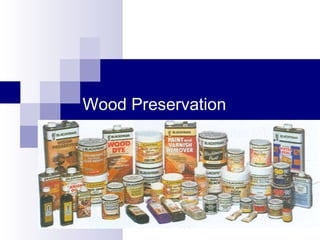
Wood Preservation


The preservation of wood includes painting and other
applied finishes.



Timber preservation became necessary because
naturally durable timbers became scarce, so ways of
improving the durability of cheaper timbers were
developed.
Wood Preservation


Timber needs to be protected from:
 Insects and fungi
 Wear and tear
 Effects of weathering



Timber is preserved to prolong the life of the wood and
prevent its natural decay.
Some timbers are more durable (resistant to decay) than
others, and in general hardwoods are more durable than
softwoods.


Preservative types
The main forms of preservative are:
 Tar oil preservatives
 Water borne preservatives
 Solvent-based preservatives.
These preservatives can protect the timber in two ways.
1.
They give physical protection by stopping fungi and
insects getting at the wood.
2.
They give chemical protection, making the wood
poisonous to insects and fungi.
Paint, for example, gives excellent physical protection.
Tar Oils








Normally dark liquids
Made from coal-tar mixed with chemicals
Suitable for outdoor use
Black / Brown colour
Example: creosote (ESB poles)
Applied by brushing, spraying, dipping or
pressure treatment
Tar Oils


Advantages
 Toxic to fungi and insects
 Easily absorbed by the wood
 Long lasting
 Inexpensive



Disadvantages
 Strong smell
 Toxic to plants
 Difficult to paint over
2: Water-Borne Preservatives








Made from mixture of toxic salts(copper and
zinc) and water.
When applied to wood, water evaporates leaving
toxic salts to act as preservatives
Usually pressure impregnated
Chemical protection given
Uses structural timber and furniture
Water-Borne Preservatives


Advantages
 Colourless
 Odourless
 Can be painted over



Disadvantages
 Timber needs to be dried out by a kiln after
treatment
 Can cause swelling
 Salts can be washed out from the wood
2 Solvent Based Preservatives







Made from toxic chemicals dissolved in a liquid
other than water (usually white spirits)
After treatment the solvent evaporates, leaving the
preservative in the wood
Can be applied with a brush or with a spray gun
Uses furniture and all external woodwork.
Solvent Based Preservatives


Advantages
 Resistant to leaching
 Can be painted over
 Can be used indoors



Disadvantages
 Have a strong smell
 Can be a fire hazard
 Expensive
Methods of application


Without pressure or with pressure.
 Brushing
 Spraying
 Dipping
 Pressure Treatment
Safety








Safety

All preservatives must be handled with care.
Read any instructions on the container carefully.
At all times ensure it is safe for use in the room
or house and that it will not harm people,
animals or the environment in any way.
When working with any chemicals you should
wear all the appropriate protective clothing.
Remember that safety and care of the
environment also applies to the disposal of
cartons and containers which hold the
preservatives.
Brushing and
spraying
Brushing and spraying




Preservatives can be applied using a brush or a spray
gun. This method is the easiest to use and is not too
costly.
The preservative, however, doesn't penetrate deep into
the wood and the treatment needs to be repeated
regularly to keep the wood protected.
A gate being brushed
with preservative
Immersion






The wood is placed into a container of preservative.
The wood absorbs the preservative over a short time.
The immersion can be done for a short time (dipping) or
for a longer period (steeping).
The immersion process penetrates better than brushing
and can be even more effective if the preservative is
heated.
Piece of timber being immersed
Pressure treatment




The most effective method of applying preservative is
by forcing the preservative into the wood under
pressure.
This pressure can come from inside (vacuum) or
outside (pressure).









The timber is put into a treating cylinder.
The air is sucked out of the cylinder and held for
a few minutes to let all the air come out of the
wood.
The cylinder is then flooded with preservative
while the vacuum is held. The vacuum is
released allowing the preservative to take the
place of the air in the wood.
Then pressure is applied forcing the preservative
into the wood.
A final vacuum is applied for a short time to
remove any excess preservative, this is done so
that no preservative is wasted.
Pressure treatment chamber
14 wood preservation

14 wood preservation

  • 1.
  • 2.
     The preservation ofwood includes painting and other applied finishes.  Timber preservation became necessary because naturally durable timbers became scarce, so ways of improving the durability of cheaper timbers were developed.
  • 3.
    Wood Preservation  Timber needsto be protected from:  Insects and fungi  Wear and tear  Effects of weathering  Timber is preserved to prolong the life of the wood and prevent its natural decay. Some timbers are more durable (resistant to decay) than others, and in general hardwoods are more durable than softwoods. 
  • 4.
    Preservative types The mainforms of preservative are:  Tar oil preservatives  Water borne preservatives  Solvent-based preservatives.
  • 5.
    These preservatives canprotect the timber in two ways. 1. They give physical protection by stopping fungi and insects getting at the wood. 2. They give chemical protection, making the wood poisonous to insects and fungi. Paint, for example, gives excellent physical protection.
  • 6.
    Tar Oils       Normally darkliquids Made from coal-tar mixed with chemicals Suitable for outdoor use Black / Brown colour Example: creosote (ESB poles) Applied by brushing, spraying, dipping or pressure treatment
  • 7.
    Tar Oils  Advantages  Toxicto fungi and insects  Easily absorbed by the wood  Long lasting  Inexpensive  Disadvantages  Strong smell  Toxic to plants  Difficult to paint over
  • 8.
    2: Water-Borne Preservatives      Madefrom mixture of toxic salts(copper and zinc) and water. When applied to wood, water evaporates leaving toxic salts to act as preservatives Usually pressure impregnated Chemical protection given Uses structural timber and furniture
  • 9.
    Water-Borne Preservatives  Advantages  Colourless Odourless  Can be painted over  Disadvantages  Timber needs to be dried out by a kiln after treatment  Can cause swelling  Salts can be washed out from the wood
  • 10.
    2 Solvent BasedPreservatives     Made from toxic chemicals dissolved in a liquid other than water (usually white spirits) After treatment the solvent evaporates, leaving the preservative in the wood Can be applied with a brush or with a spray gun Uses furniture and all external woodwork.
  • 11.
    Solvent Based Preservatives  Advantages Resistant to leaching  Can be painted over  Can be used indoors  Disadvantages  Have a strong smell  Can be a fire hazard  Expensive
  • 12.
    Methods of application  Withoutpressure or with pressure.  Brushing  Spraying  Dipping  Pressure Treatment
  • 13.
  • 14.
         Safety All preservatives mustbe handled with care. Read any instructions on the container carefully. At all times ensure it is safe for use in the room or house and that it will not harm people, animals or the environment in any way. When working with any chemicals you should wear all the appropriate protective clothing. Remember that safety and care of the environment also applies to the disposal of cartons and containers which hold the preservatives.
  • 15.
  • 16.
    Brushing and spraying   Preservativescan be applied using a brush or a spray gun. This method is the easiest to use and is not too costly. The preservative, however, doesn't penetrate deep into the wood and the treatment needs to be repeated regularly to keep the wood protected.
  • 17.
    A gate beingbrushed with preservative
  • 18.
  • 19.
        The wood isplaced into a container of preservative. The wood absorbs the preservative over a short time. The immersion can be done for a short time (dipping) or for a longer period (steeping). The immersion process penetrates better than brushing and can be even more effective if the preservative is heated.
  • 20.
    Piece of timberbeing immersed
  • 21.
    Pressure treatment   The mosteffective method of applying preservative is by forcing the preservative into the wood under pressure. This pressure can come from inside (vacuum) or outside (pressure).
  • 22.
         The timber isput into a treating cylinder. The air is sucked out of the cylinder and held for a few minutes to let all the air come out of the wood. The cylinder is then flooded with preservative while the vacuum is held. The vacuum is released allowing the preservative to take the place of the air in the wood. Then pressure is applied forcing the preservative into the wood. A final vacuum is applied for a short time to remove any excess preservative, this is done so that no preservative is wasted.
  • 23.
  • 24.