www.timber.org.au
timber in internal applications
Material Basics
Timber and Wood Products
Basic material properties and
characteristics.
www.timber.org.au
timber in internal applications
Material Basics
The nature of timber
• Timber is a natural
product, drawn from
the wood in the
trunks of trees.
• Its character is
consistent with the
species of tree and
the form and growth
over time of the
wood in it.
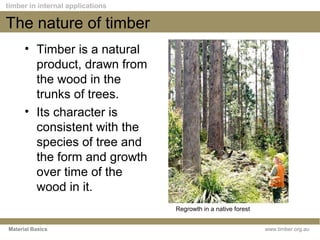
Regrowth in a native forest
www.timber.org.au
timber in internal applications
Material Basics
Tree growth
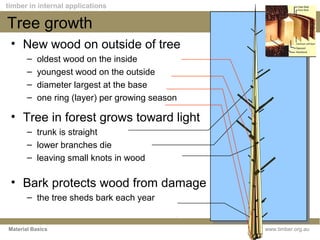
• New wood on outside of tree
– oldest wood on the inside
– youngest wood on the outside
– diameter largest at the base
– one ring (layer) per growing season
• Tree in forest grows toward light
– trunk is straight
– lower branches die
– leaving small knots in wood
• Bark protects wood from damage
– the tree sheds bark each year
www.timber.org.au
timber in internal applications
Material Basics
Production of wood
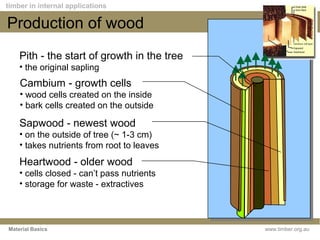
Cambium - growth cells
• wood cells created on the inside
• bark cells created on the outside
Sapwood - newest wood
• on the outside of tree (~ 1-3 cm)
• takes nutrients from root to leaves
Heartwood - older wood
• cells closed - can’t pass nutrients
• storage for waste - extractives
Pith - the start of growth in the tree
• the original sapling
www.timber.org.au
timber in internal applications
Material Basics
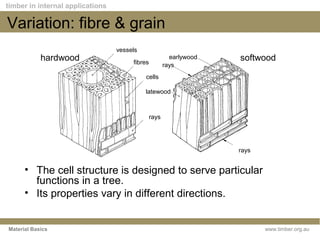
Variation: fibre & grain
• The cell structure is designed to serve particular
functions in a tree.
• Its properties vary in different directions.
rays
rays
cells
fibres
vessels
hardwood earlywood
rays
latewood
softwood
www.timber.org.au
timber in internal applications
Material Basics
Variation: species & growth
• Species and
genetics:
– selected stock or
natural seed.
• Climate:
– wet or dry, cold or
warm.
• Arrangement:
– native forest or
plantation.
www.timber.org.au
timber in internal applications
Material Basics
Each piece is unique
Myrtle burl veneer
Quarter sawn hardwood
www.timber.org.au
timber in internal applications
Material Basics
Properties are variable
• Drying (seasoning) & shrinkage
• Strength & hardness
• Durability
• Appearance
www.timber.org.au
timber in internal applications
Material Basics
Moisture and drying in wood cells
removed
bound
waterSeasoned
timber
15% MC
100% MC
Unseasoned
timber
Growing
tree
free water
25% MC
fibre saturation
bound water
Partially
seasoned
timber
www.timber.org.au
timber in internal applications
Material Basics
Benefits of drying
• Drying timber
increases its:
– strength;
– stiffness;
– stability
– durability; &
– ease of fastening.
• It is ideally dried to a
moisture content in
equilibrium with its
service environment.
Checking the moisture content
www.timber.org.au
timber in internal applications
Material Basics
Timber shrinks as it dries
• It shrinks at different rates in
different directions.
• Once dry, it will expand &
contract to be in equilibrium
with changing local conditions.
Shrinkage from 12% to 25% MC
Radiata pine Rad 3.5% Tang 4%
Hoop pine Rad 2.5% Tang 3.5%
Cypress Rad 3.5% Tang 4%
Spotted gum Rad 4.5% Tang 6%
Karri Rad 4.5% Tang 10%
Sydney blue gumRad 5% Tang 9%
Grey Ironbark Rad 5.5% Tang 7.5%
Mountain ash Rad 6.5% Tang 13%
SoftwoodHardwood
Tangential
shrinkage
Radial
shrinkage
Longitudinal
shrinkage
www.timber.org.au
timber in internal applications
Material Basics
Shrinkage in sawn sections
• Tangential shrinkage
is the highest;
• So, the growth rings
tend to shorten as the
timber dries.
www.timber.org.au
timber in internal applications
Material Basics
Timber dries at different rates
• Pines have a porous cell structure:
– They can be dried very quickly.
– Turnaround time from saw to store can
be as low as a week.
• Hardwoods have a non-porous cell
structure:
– The moisture must diffuse through the
cell wall.
– Drying can be very slow.
– It must be done carefully.
www.timber.org.au
timber in internal applications
Material Basics
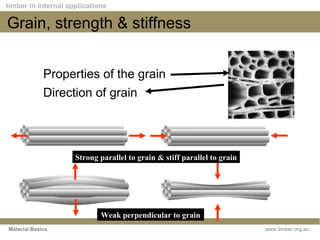
Grain, strength & stiffness
Direction of grain
Strong parallel to grain & stiff parallel to grain
Weak perpendicular to grain
Properties of the grain
www.timber.org.au
timber in internal applications
Material Basics
Summary of characteristics
• Timber is a natural material
• Each piece is unique in fibre, texture and
colour
• Its strength is dependant on the
properties of the wood and the slope of
the grain
• It takes up and gives up moisture
• It expands and shrinks as it does so
• It deteriorates in line with exposure
www.timber.org.au
timber in internal applications
Material Basics
Timber products
• Timber is available in a wide range of
products and species including:
– Solid sawn, moulded and laminated timber;
– Veneer;
– Plywood; and
– Wood panels.
www.timber.org.au
timber in internal applications
Material Basics
Timber products: sawn
• Hardwood or
softwood.
• Solid timber cut from
a log and dried.
• It is a versatile
material used for
moulding, frames and
exposed structures.
• Size is restricted.
www.timber.org.au
timber in internal applications
Material Basics
Timber products: mouldings
• Hardwood or
softwood.
• Solid seasoned
timber milled to a
wide variety of
shapes.
www.timber.org.au
timber in internal applications
Material Basics
Timber products: glue laminated
• Small pieces of
timber glued
together to form a
larger element.
• Used as both a
structural and
finishing element.
• Size is limited only
by transport
capacity.
bench top
beam
www.timber.org.au
timber in internal applications
Material Basics
Timber products: curved glulam
• Glue laminated
material can be
curved.
Curved bar
www.timber.org.au
timber in internal applications
Material Basics
Timber products: veneer
• Thin layers of solid
wood sliced from a
flitch or peeled from a
log and dried.
• High quality material
is used as a
decorative finish.
• Lower grade material
is used to make
plywood, LVL and
similar products.
Veneer leaf
www.timber.org.au
timber in internal applications
Material Basics
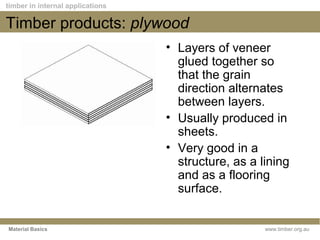
Timber products: plywood
• Layers of veneer
glued together so
that the grain
direction alternates
between layers.
• Usually produced in
sheets.
• Very good in a
structure, as a lining
and as a flooring
surface.
www.timber.org.au
timber in internal applications
Material Basics
Timber products: wood panels
• Panels made from
wood or wood fibres
bound together with
glue, or other binder:
– Particleboard
– Medium Density
Fibreboard (MDF)
– Hardboard
– Core board
MDF sheet
www.timber.org.au
timber in internal applications
Material Basics
Appearance grading
• Production process
of sorting products
into groups with
similar
characteristics &
properties.
• Timber identified by
calling up a specific
grade.
Visual grading
www.timber.org.au
timber in internal applications
Material Basics
Grading standards
• AS 1810-1995 Timber - Seasoned
cypress pine - Milled products
• AS 2796-1999 Timber - Hardwood -
Sawn and milled products
• AS 4785-2002 Timber - Softwood -
Sawn and milled products
www.timber.org.au
timber in internal applications
Material Basics
AS 2796 Hardwood - Sawn & milled
• This standard defines the requirements
for hardwood used for visual
applications: architectural (flooring, etc),
lining & cladding; &
• It is in two main sections:
– product requirements; &
– visual grades.
www.timber.org.au
timber in internal applications
Material Basics
Appearance grading - rules
• Establish permissible limits on:
– gum vein
– knot size & frequency (location unimportant)
– splits, cracks, checks (size and frequency)
– stain (colour), grain uniformity
– utility: want, wane, cup, bow, spring, twist
www.timber.org.au
timber in internal applications
Material Basics
Grade range
• From select grade
– uniform wood with
few natural features
• Through to high
feature grade
– including lively
natural feature as
part of a desirable
aesthetic.
www.timber.org.au
timber in internal applications
Material Basics
AS 2796 Hardwood - Sawn & milled
• Tolerances are established for the major
product groups (not grades):
– Joinery and dressed boards;
– Strip and overlay flooring, mouldings, sawn
boards for feedstock; &
– Light decking, lining boards, cladding, facia,
bargeboards.
www.timber.org.au
timber in internal applications
Material Basics
AS 2796 Part 1 - distortion
• Bow - depends on
thickness
• Spring - dependent on
width
• Twist - separate limits
for less or more than
25 mm thick
• Cup - 1mm per 100
mm width
www.timber.org.au
timber in internal applications
Material Basics
AS 2796 Part 1
• No lyctid susceptible sapwood is
allowed. (Lyctids are small wood eating insects.)
• MC anywhere in a piece must be
between:
– 9-14% for most products including flooring.
– 8-13% for parquet & furniture components.
www.timber.org.au
timber in internal applications
Material Basics
AS 2796 Hardwood - Sawn & milled
• The standard recognises feature as a
desirable visual characteristic;
• Therefore, distortion and machining
tolerances are associated with product,
not grade; &
• The timber can then be specified with
the desired appearance for any function.
www.timber.org.au
timber in internal applications
Material Basics
AS 4785 Softwood - Sawn & milled
• Layout is similar to AS 2796 with product
requirements & visual grades;
• Visual grades are Clear, Appearance,
Select, Standard, Utility Grade;
• With radiata, there is a much greater use
of industry grades; &
• Terms can vary between companies.
www.timber.org.au
timber in internal applications
Material Basics
Jointing
• Timber is a highly
versatile material
that can be shaped
and joined easily.
Mortice and tenon Housed
Half housed
www.timber.org.au
timber in internal applications
Material Basics
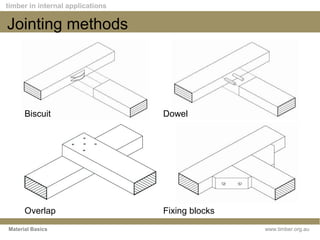
Jointing methods
Overlap Fixing blocks
DowelBiscuit
www.timber.org.au
timber in internal applications
Material Basics
Conclusions
• Timber is a natural product.
• It has been used for centuries.
• Skilled use and understanding of the
material can yield excellent results.

Timber Products

  • 1.
    www.timber.org.au timber in internalapplications Material Basics Timber and Wood Products Basic material properties and characteristics.
  • 2.
    www.timber.org.au timber in internalapplications Material Basics The nature of timber • Timber is a natural product, drawn from the wood in the trunks of trees. • Its character is consistent with the species of tree and the form and growth over time of the wood in it. Regrowth in a native forest
  • 3.
    www.timber.org.au timber in internalapplications Material Basics Tree growth • New wood on outside of tree – oldest wood on the inside – youngest wood on the outside – diameter largest at the base – one ring (layer) per growing season • Tree in forest grows toward light – trunk is straight – lower branches die – leaving small knots in wood • Bark protects wood from damage – the tree sheds bark each year
  • 4.
    www.timber.org.au timber in internalapplications Material Basics Production of wood Cambium - growth cells • wood cells created on the inside • bark cells created on the outside Sapwood - newest wood • on the outside of tree (~ 1-3 cm) • takes nutrients from root to leaves Heartwood - older wood • cells closed - can’t pass nutrients • storage for waste - extractives Pith - the start of growth in the tree • the original sapling
  • 5.
    www.timber.org.au timber in internalapplications Material Basics Variation: fibre & grain • The cell structure is designed to serve particular functions in a tree. • Its properties vary in different directions. rays rays cells fibres vessels hardwood earlywood rays latewood softwood
  • 6.
    www.timber.org.au timber in internalapplications Material Basics Variation: species & growth • Species and genetics: – selected stock or natural seed. • Climate: – wet or dry, cold or warm. • Arrangement: – native forest or plantation.
  • 7.
    www.timber.org.au timber in internalapplications Material Basics Each piece is unique Myrtle burl veneer Quarter sawn hardwood
  • 8.
    www.timber.org.au timber in internalapplications Material Basics Properties are variable • Drying (seasoning) & shrinkage • Strength & hardness • Durability • Appearance
  • 9.
    www.timber.org.au timber in internalapplications Material Basics Moisture and drying in wood cells removed bound waterSeasoned timber 15% MC 100% MC Unseasoned timber Growing tree free water 25% MC fibre saturation bound water Partially seasoned timber
  • 10.
    www.timber.org.au timber in internalapplications Material Basics Benefits of drying • Drying timber increases its: – strength; – stiffness; – stability – durability; & – ease of fastening. • It is ideally dried to a moisture content in equilibrium with its service environment. Checking the moisture content
  • 11.
    www.timber.org.au timber in internalapplications Material Basics Timber shrinks as it dries • It shrinks at different rates in different directions. • Once dry, it will expand & contract to be in equilibrium with changing local conditions. Shrinkage from 12% to 25% MC Radiata pine Rad 3.5% Tang 4% Hoop pine Rad 2.5% Tang 3.5% Cypress Rad 3.5% Tang 4% Spotted gum Rad 4.5% Tang 6% Karri Rad 4.5% Tang 10% Sydney blue gumRad 5% Tang 9% Grey Ironbark Rad 5.5% Tang 7.5% Mountain ash Rad 6.5% Tang 13% SoftwoodHardwood Tangential shrinkage Radial shrinkage Longitudinal shrinkage
  • 12.
    www.timber.org.au timber in internalapplications Material Basics Shrinkage in sawn sections • Tangential shrinkage is the highest; • So, the growth rings tend to shorten as the timber dries.
  • 13.
    www.timber.org.au timber in internalapplications Material Basics Timber dries at different rates • Pines have a porous cell structure: – They can be dried very quickly. – Turnaround time from saw to store can be as low as a week. • Hardwoods have a non-porous cell structure: – The moisture must diffuse through the cell wall. – Drying can be very slow. – It must be done carefully.
  • 14.
    www.timber.org.au timber in internalapplications Material Basics Grain, strength & stiffness Direction of grain Strong parallel to grain & stiff parallel to grain Weak perpendicular to grain Properties of the grain
  • 15.
    www.timber.org.au timber in internalapplications Material Basics Summary of characteristics • Timber is a natural material • Each piece is unique in fibre, texture and colour • Its strength is dependant on the properties of the wood and the slope of the grain • It takes up and gives up moisture • It expands and shrinks as it does so • It deteriorates in line with exposure
  • 16.
    www.timber.org.au timber in internalapplications Material Basics Timber products • Timber is available in a wide range of products and species including: – Solid sawn, moulded and laminated timber; – Veneer; – Plywood; and – Wood panels.
  • 17.
    www.timber.org.au timber in internalapplications Material Basics Timber products: sawn • Hardwood or softwood. • Solid timber cut from a log and dried. • It is a versatile material used for moulding, frames and exposed structures. • Size is restricted.
  • 18.
    www.timber.org.au timber in internalapplications Material Basics Timber products: mouldings • Hardwood or softwood. • Solid seasoned timber milled to a wide variety of shapes.
  • 19.
    www.timber.org.au timber in internalapplications Material Basics Timber products: glue laminated • Small pieces of timber glued together to form a larger element. • Used as both a structural and finishing element. • Size is limited only by transport capacity. bench top beam
  • 20.
    www.timber.org.au timber in internalapplications Material Basics Timber products: curved glulam • Glue laminated material can be curved. Curved bar
  • 21.
    www.timber.org.au timber in internalapplications Material Basics Timber products: veneer • Thin layers of solid wood sliced from a flitch or peeled from a log and dried. • High quality material is used as a decorative finish. • Lower grade material is used to make plywood, LVL and similar products. Veneer leaf
  • 22.
    www.timber.org.au timber in internalapplications Material Basics Timber products: plywood • Layers of veneer glued together so that the grain direction alternates between layers. • Usually produced in sheets. • Very good in a structure, as a lining and as a flooring surface.
  • 23.
    www.timber.org.au timber in internalapplications Material Basics Timber products: wood panels • Panels made from wood or wood fibres bound together with glue, or other binder: – Particleboard – Medium Density Fibreboard (MDF) – Hardboard – Core board MDF sheet
  • 24.
    www.timber.org.au timber in internalapplications Material Basics Appearance grading • Production process of sorting products into groups with similar characteristics & properties. • Timber identified by calling up a specific grade. Visual grading
  • 25.
    www.timber.org.au timber in internalapplications Material Basics Grading standards • AS 1810-1995 Timber - Seasoned cypress pine - Milled products • AS 2796-1999 Timber - Hardwood - Sawn and milled products • AS 4785-2002 Timber - Softwood - Sawn and milled products
  • 26.
    www.timber.org.au timber in internalapplications Material Basics AS 2796 Hardwood - Sawn & milled • This standard defines the requirements for hardwood used for visual applications: architectural (flooring, etc), lining & cladding; & • It is in two main sections: – product requirements; & – visual grades.
  • 27.
    www.timber.org.au timber in internalapplications Material Basics Appearance grading - rules • Establish permissible limits on: – gum vein – knot size & frequency (location unimportant) – splits, cracks, checks (size and frequency) – stain (colour), grain uniformity – utility: want, wane, cup, bow, spring, twist
  • 28.
    www.timber.org.au timber in internalapplications Material Basics Grade range • From select grade – uniform wood with few natural features • Through to high feature grade – including lively natural feature as part of a desirable aesthetic.
  • 29.
    www.timber.org.au timber in internalapplications Material Basics AS 2796 Hardwood - Sawn & milled • Tolerances are established for the major product groups (not grades): – Joinery and dressed boards; – Strip and overlay flooring, mouldings, sawn boards for feedstock; & – Light decking, lining boards, cladding, facia, bargeboards.
  • 30.
    www.timber.org.au timber in internalapplications Material Basics AS 2796 Part 1 - distortion • Bow - depends on thickness • Spring - dependent on width • Twist - separate limits for less or more than 25 mm thick • Cup - 1mm per 100 mm width
  • 31.
    www.timber.org.au timber in internalapplications Material Basics AS 2796 Part 1 • No lyctid susceptible sapwood is allowed. (Lyctids are small wood eating insects.) • MC anywhere in a piece must be between: – 9-14% for most products including flooring. – 8-13% for parquet & furniture components.
  • 32.
    www.timber.org.au timber in internalapplications Material Basics AS 2796 Hardwood - Sawn & milled • The standard recognises feature as a desirable visual characteristic; • Therefore, distortion and machining tolerances are associated with product, not grade; & • The timber can then be specified with the desired appearance for any function.
  • 33.
    www.timber.org.au timber in internalapplications Material Basics AS 4785 Softwood - Sawn & milled • Layout is similar to AS 2796 with product requirements & visual grades; • Visual grades are Clear, Appearance, Select, Standard, Utility Grade; • With radiata, there is a much greater use of industry grades; & • Terms can vary between companies.
  • 34.
    www.timber.org.au timber in internalapplications Material Basics Jointing • Timber is a highly versatile material that can be shaped and joined easily. Mortice and tenon Housed Half housed
  • 35.
    www.timber.org.au timber in internalapplications Material Basics Jointing methods Overlap Fixing blocks DowelBiscuit
  • 36.
    www.timber.org.au timber in internalapplications Material Basics Conclusions • Timber is a natural product. • It has been used for centuries. • Skilled use and understanding of the material can yield excellent results.

Editor's Notes

  • #25 Grading is simply sorting a production run into groups that have similar properties. The grouping of the properties can be any mixture of appearance and structural properties. In order to give some uniformity across the industry there are standards for the sorting of timber products. Many of these are Australian Standards, but some are industry-based standards. Grading standards make it easier for a designer to communicate what is required in a piece of timber to the supplier. A grade designation refers to a full suite of structural, utility or appearance properties. Thus reference to a grade designator will mean that the timber supplied should have the properties that enables it to meet those grading requirements.
  • #32 Producers therefore can legally supply anywhere in this range unless there is prior agreement.