DEPARTMENT OF
CIVIL ENGINEERING
Conventional Constructions
TIMBER
Er.Ramprasad Kumawat
(M.Tech)
Constructions
• Conventional constructions:
• Masonry,
• Timber,
• Steel and
• Concrete Constructions (CC)
• Introduction to Additive Construction methods
using concrete (3D Printed Building)
TIMBER
• The wood suitable for construction of building
or for other engineering purposes is called
Timber.
• The wood may be seasoned and preserved
before using it in the construction work.
• It has been sawn to various market forms such
as beams, battens, planks.
Classification of Timber
• Hard Wood :- The trees yielding hard wood
are deciduous and having broad leaves. Teak ,
sal, shisham belong to this category.
• Soft Wood :- The trees yielding soft wood are
coniferous and having pointed leaves. Deodar,
pine,kail belong to this category.
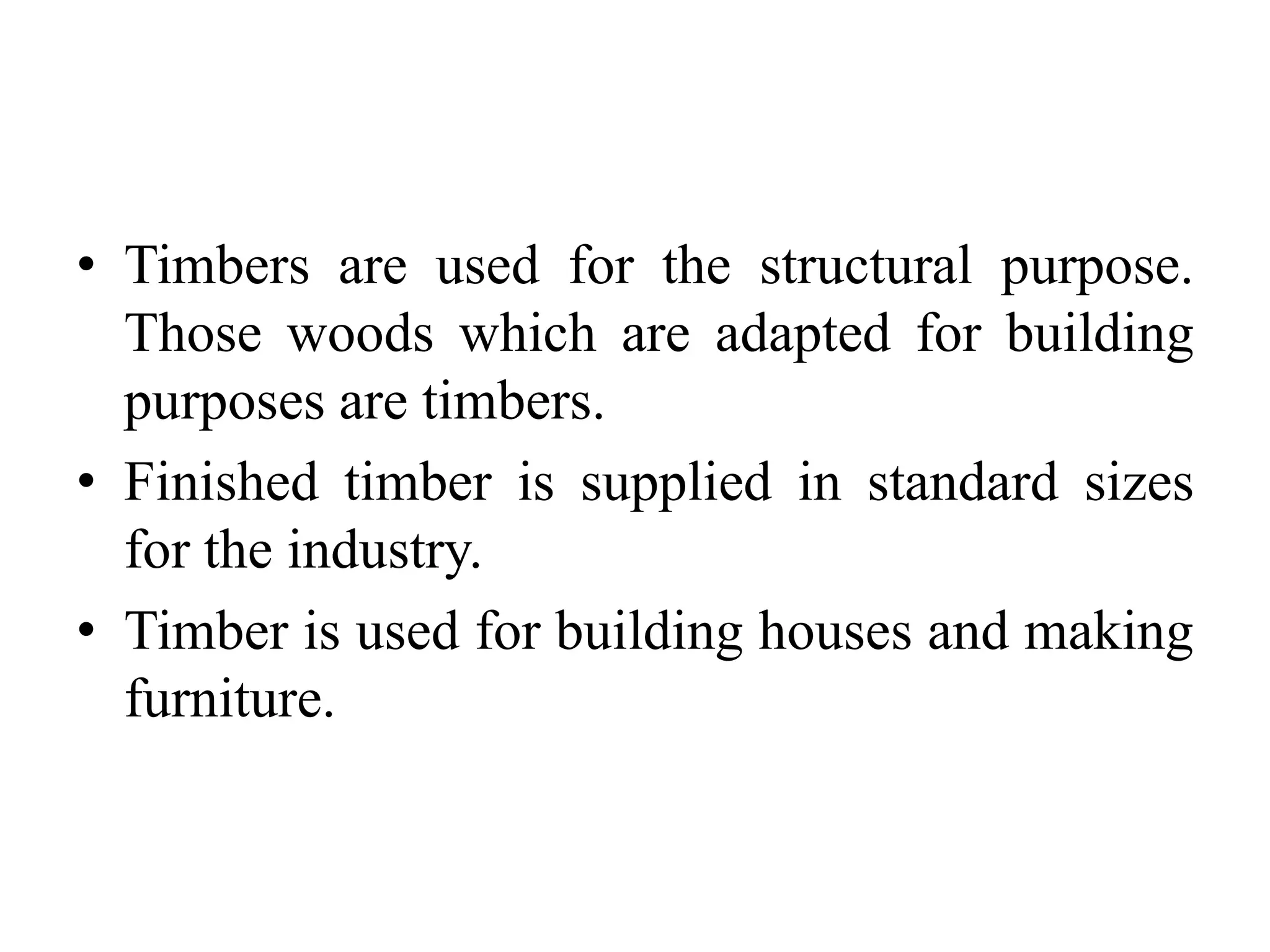
• Timbers are used for the structural purpose.
Those woods which are adapted for building
purposes are timbers.
• Finished timber is supplied in standard sizes
for the industry.
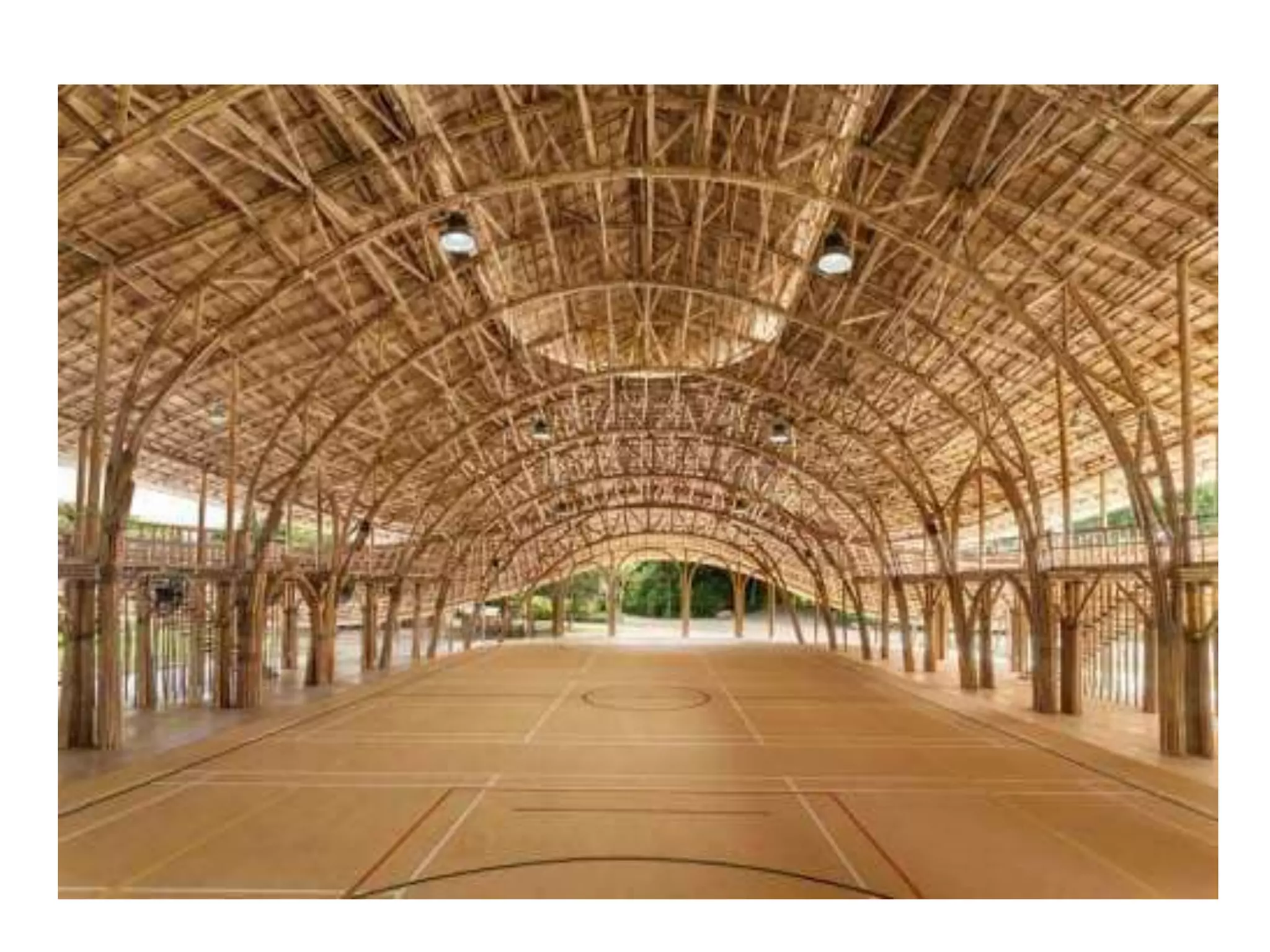
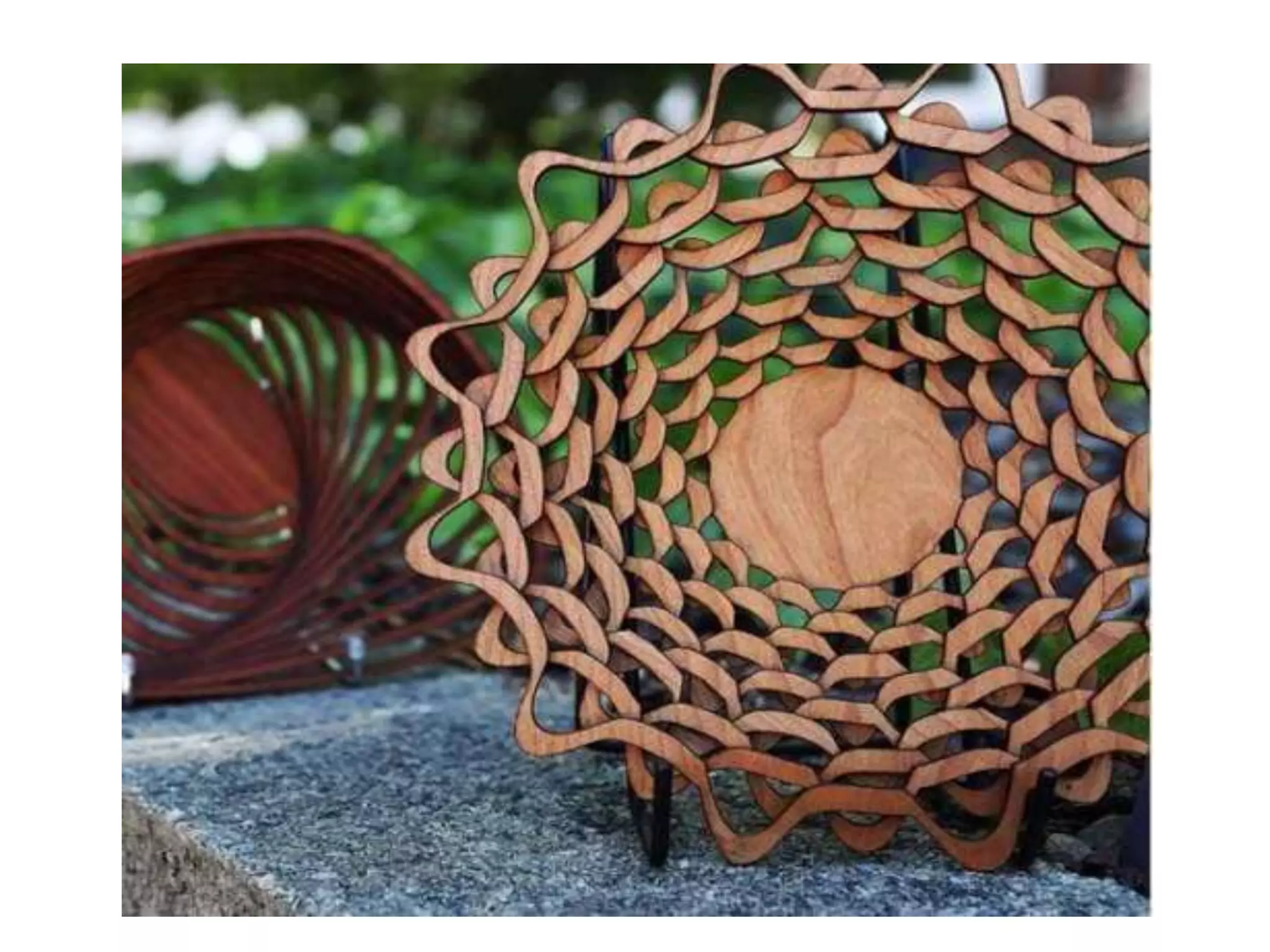
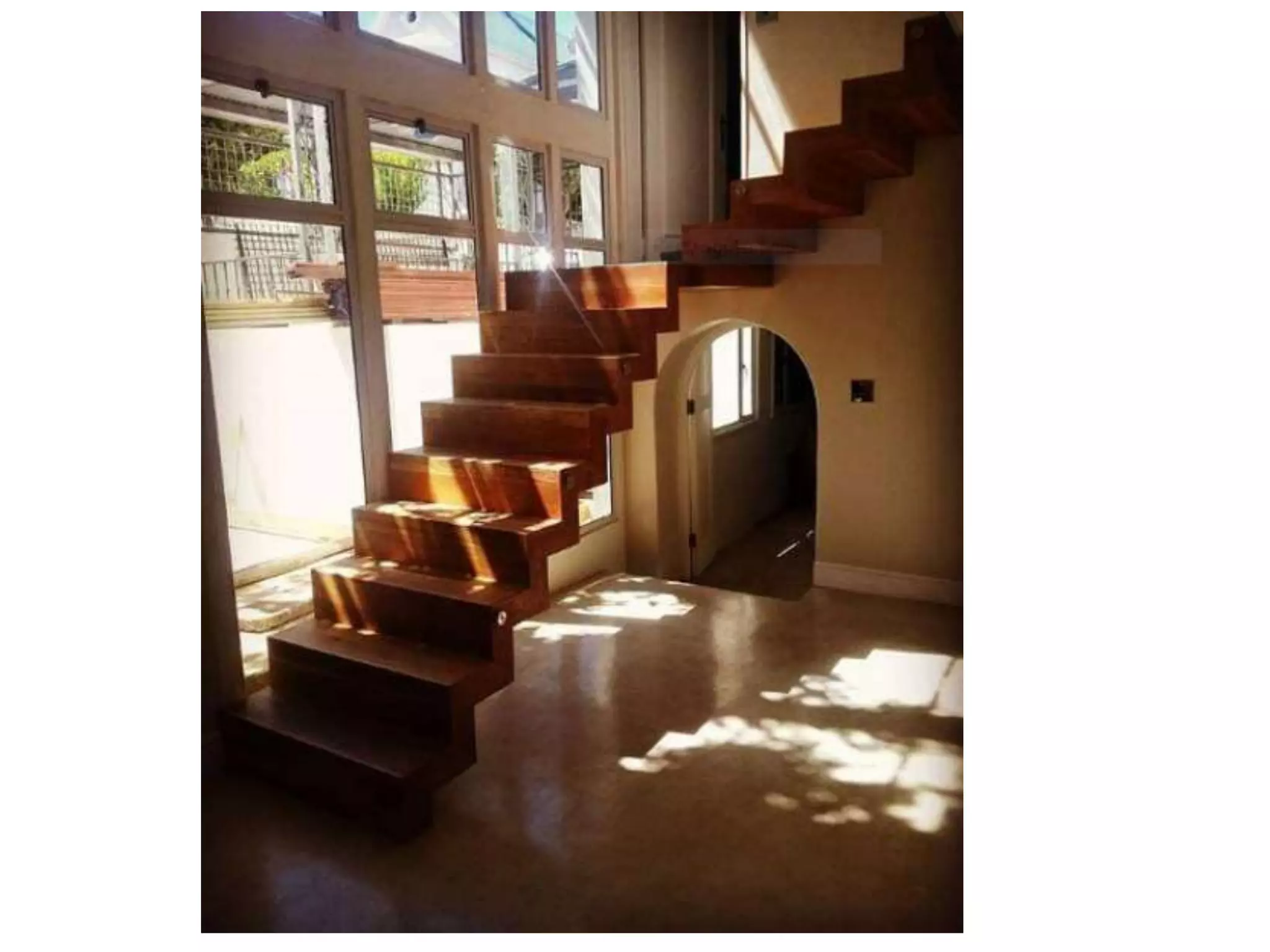
• Timber is used for building houses and making
furniture.
Types of Timber and Lumber
• Timber can be divided into two categories - hardwoods
and softwoods.
• There are many types of timber under these two
categories. They are-
• Bamboo Birch
• Cedar Cherry
• Cross-laminated Glulam
• Green timber Lime
• Mahogany Oak
• Pine Plywood
• Sapele wood Tulipwood
• Walnut Wood ash
• Spruce Fir
Bamboo
• Bamboo is a natural organic material.
• It is one of the most unique plants on earth.
• Bamboo is grown in abundance in many parts
of the world, especially in tropical and
subtropical regions.
• Most timber producing bamboos are from
South Asia.
• The color of bamboo timber is pale yellow to
almost gold.
• It is an industrial material also identified as the
most promising building material.
Advantages of Bamboo
• Bamboos are fast growing and high yielding.
• They are easily renewable.
• Bamboos quickly reach full maturity after only one or two
years.
• Bamboo timber has a unique earthy odor while being worked.
• Bamboo timber is energy extensive, processed and glued up
imported products.
• Strong bamboo fibers have tensile strength.
• It is highly resistant to warping and cupping in ambient
humidity.
• Bamboo timber requires little fertilizer.
• Grows initially at full width.
• Bamboo timbers are used in-veneer, paper, flute, window
blinds, fishing rods, ladders, scaffolding, carving etc.
Disadvantages of Bamboo
• Bamboo timber is a polluting material.
• Bamboo timber requires special care.
• It is susceptible to insect attack.
• Bamboo fibers tend to split and pull out when being
cross-cut.
• Bamboo timber has been reported to cause skin
irritation.
• Decay fungi are present in bamboo timber.
• The price of this timber is much higher which exceeds
the cost of domestic hardwoods sometimes.
• It is inconsistent.
Birch
• Birch is a great craft-wood.
• It is an important source of hardwood timber.
Birch is of many types of like-yellow birch,
white birch etc.
• Yellow birch is commonly used which is also
known as gray birch, or swamp birch.
• It is light reddish brown color.
• Birch gives low natural luster.
Advantages of Birch
• Birch is economical in most cases.
• Inner birch is aromatic.
• Birch is long-lasting.
• It is usually heavy, hard and strong.
• It is always easy to work with a birch and glues and it finishes
well.
• Birch gives widely ranging appearances.
• Birch is suitable for high-quality furniture. Birch has great
durability.
• Birch is used for creating strong plywood.
• Birch is waterproof.
• Birch can easily support a large structure.
• It is used in- boxes, crates, skateboards, furniture, and other
wood items.
Disadvantages of Birch
• Birch is perishable, readily rot and decay.
• Birch is susceptible to insect attack.
• Birch can cause tear-outs during machine
operations.
• Birch is reported as “sensitizer” which includes
respiratory irritation.
• Birch is slow-growing.
• Birch is harder than other hardwoods.
Cedar
• Cedar is a timber of high quality.
• It comes from several different trees known as
cedars.
• Where both strength and appearance of the
exposed wood beams are important, cedar is
the only savior and perfect fit for this.
• It is used in for-landscape, park, garden
structure. Its moderate strength and softness
make it unique.
• Cedar offers the advantage of the natural
advantage. Basically, it is a workable material.
Advantages of Cedar
• It is weather resistant.
• Cedar gives a natural wood look.
• Cedar is light in weight.
• It works easily.
• It is dimensionally stable.
• Cedar has long-time durability.
• Cedar has exceptional resistance to insects and decay.
• It is smooth to the touch.
• It has a high quality of consistency.
• It exhibits fairly prominent growth.
• Cedar shows high resistance to warping and twisting.
• Cedar helps to reduce noise in specific areas.
• It is sustainable.
• It is used in-cladding, decking, roofing, fencing.
Disadvantages of Cedar
• Cedar dust may be irritant.
• Cedar has low strength.
• Cedar can cause splintering during some
operations.
Cherry
• Cherry timber is grown as a tree plantation
timber.
• Among different types of cherry timbers, black
cherry timber is the largest of the native cherries
and the only of commercial value.
• It is found throughout the Eastern United Nations.
In cherry timber, the grain is generally straight. It
is a hardwood.
• It has medium density and moderately durable.
And used for small pieces of furniture's-veneers,
handles, cabinets, scientific instruments etc.
Advantages of Cherry
• Cherry timber is firm and strong.
• It has a fine and uniform texture.
• It works well and finishes smoothly.
• Cherry timber can contain pith flecks and gum pockets.
• It has a good workability.
• Cherry timber is easy to machine, nail, and glue.
• It is an excellent timber for turning and carving.
• It has good bending properties.
• It has low stiffness.
• Cherry timber is shock resistance.
• The best feature is it is used for high-end applications
like furniture, cabinet making.
• Boat making and musical instruments.
Disadvantages of Cherry
• It is highly prized.
• Cherry timber is sensitive to UV.
• It can tear on cross-grain.
• Cherry timber doesn’t have a grand dimension.
• If stained, it gives blotchy results.
• The sawdust of cherry timber has been
associated with respiratory effects such as
wheezing.
Mahogany
• Mahogany is a high-quality timber.
• It is grown commercially almost in every continent.
• Mahogany is widely used in the furniture and cabinet
building industry.
• It is made into plywoods and all kinds of trim.
• It displays hard grain.
• It is one of the softer of all the hardwoods that are
commonly in use.
• It is moderate natural luster.
• The color of mahogany timber darkens with age.
• The texture is medium and uniform.
• The price of this timber is in mid-range.
Advantages of Mahogany
• Mahogany timber is very stable.
• It is resistant to termites.
• It is very easy to work with tools in mahogany timber.
• It cuts and machines easily.
• Mahogany timber sandy very easily.
• It turns glues, stains, and finishes well.
• It can bend without splintering or shattering.
• It possesses a slightly flexible quality.
• Mahogany timber can resist warping and twist for many years.
• It is long lasting, strong and beautiful.
• It contains high density.
• Each piece of timber is long.
• Mahogany timber is used for-veneers, musicals instruments,
Disadvantages of Mahogany
• Mahogany timber is vulnerable to insects.
• It can tear out or chip during machining.
• It is reported as “sensitizer”.
• When mahogany timber gets in touch with water,
a strong mahogany color comes up.
• Slight dulling of cutters can occur in this timber.
• Mahogany timber includes respiratory irritation in
eye, skin which includes boil, nausea, dizziness,
asthma type symptoms etc.
• It is vulnerable.
Oak
• Oak timber is a type of hardwood from the oak
tree.
• It has been used as timber for thousands of
years.
• It is straight grained.
• It is used for light construction most of the
time.
• Oak timber is used for –home-ware, wine
barrels, firewood etc.
Advantages of Oak
• Oak timber is exceedingly strong.
• It is durable.
• It has a long living nature.
• Oak timber is used for cladding.
• Oak timber is resistant to fungal attack.
• It takes glues, nails, and screws well.
• It is lighter in weight.
• Oak timber is resistant to decay.
• Oak timber is extremely resistant to preservative
treatment.
• It is workable with machine or hand tools.
Disadvantages of Oak
• Oak timber is heavy.
• It is hard.
• It has low-moisture content.
• Oak timber is unsuitable for external use.
• It is difficult for oak timber to treat acid
content.
• Oak timber reacts with iron, galvanized or
copper nails.
Fir
• Fir is one of the world’s best-known timber
species.
• It is a premier building product for a wide range
of applications.
• It is a softwood species.
• Fir has a very straight grain.
• Fir has become the standard woods of choice for
timber framing.
• Fir timber is used tin-housing, framing, flooring,
lining fascias, bargeboards, and pergolas.
Advantages of Fir
• Fir timber ranges in color.
• Fir machines and turns well.
• Fir is moderately durable.
• It is permeable.
• It Is moderately resistant to decay.
• Fir timber has a low shock resistance.
• It has a good strength.
• Fir can be satisfactorily bonded using the standard
procedure.
Disadvantages of Fir
• Fir timber lacks tensile strength.
• It is extremely difficult to treat.
• Fir timber is very stiff.
• THANKS!

Conventional construction of Timber

  • 1.
    DEPARTMENT OF CIVIL ENGINEERING ConventionalConstructions TIMBER Er.Ramprasad Kumawat (M.Tech)
  • 2.
    Constructions • Conventional constructions: •Masonry, • Timber, • Steel and • Concrete Constructions (CC) • Introduction to Additive Construction methods using concrete (3D Printed Building)
  • 3.
    TIMBER • The woodsuitable for construction of building or for other engineering purposes is called Timber. • The wood may be seasoned and preserved before using it in the construction work. • It has been sawn to various market forms such as beams, battens, planks.
  • 4.
    Classification of Timber •Hard Wood :- The trees yielding hard wood are deciduous and having broad leaves. Teak , sal, shisham belong to this category. • Soft Wood :- The trees yielding soft wood are coniferous and having pointed leaves. Deodar, pine,kail belong to this category.
  • 5.
    • Timbers areused for the structural purpose. Those woods which are adapted for building purposes are timbers. • Finished timber is supplied in standard sizes for the industry. • Timber is used for building houses and making furniture.
  • 6.
    Types of Timberand Lumber • Timber can be divided into two categories - hardwoods and softwoods. • There are many types of timber under these two categories. They are- • Bamboo Birch • Cedar Cherry • Cross-laminated Glulam • Green timber Lime • Mahogany Oak • Pine Plywood • Sapele wood Tulipwood • Walnut Wood ash • Spruce Fir
  • 7.
    Bamboo • Bamboo isa natural organic material. • It is one of the most unique plants on earth. • Bamboo is grown in abundance in many parts of the world, especially in tropical and subtropical regions. • Most timber producing bamboos are from South Asia. • The color of bamboo timber is pale yellow to almost gold. • It is an industrial material also identified as the most promising building material.
  • 9.
    Advantages of Bamboo •Bamboos are fast growing and high yielding. • They are easily renewable. • Bamboos quickly reach full maturity after only one or two years. • Bamboo timber has a unique earthy odor while being worked. • Bamboo timber is energy extensive, processed and glued up imported products. • Strong bamboo fibers have tensile strength. • It is highly resistant to warping and cupping in ambient humidity. • Bamboo timber requires little fertilizer. • Grows initially at full width. • Bamboo timbers are used in-veneer, paper, flute, window blinds, fishing rods, ladders, scaffolding, carving etc.
  • 10.
    Disadvantages of Bamboo •Bamboo timber is a polluting material. • Bamboo timber requires special care. • It is susceptible to insect attack. • Bamboo fibers tend to split and pull out when being cross-cut. • Bamboo timber has been reported to cause skin irritation. • Decay fungi are present in bamboo timber. • The price of this timber is much higher which exceeds the cost of domestic hardwoods sometimes. • It is inconsistent.
  • 11.
    Birch • Birch isa great craft-wood. • It is an important source of hardwood timber. Birch is of many types of like-yellow birch, white birch etc. • Yellow birch is commonly used which is also known as gray birch, or swamp birch. • It is light reddish brown color. • Birch gives low natural luster.
  • 13.
    Advantages of Birch •Birch is economical in most cases. • Inner birch is aromatic. • Birch is long-lasting. • It is usually heavy, hard and strong. • It is always easy to work with a birch and glues and it finishes well. • Birch gives widely ranging appearances. • Birch is suitable for high-quality furniture. Birch has great durability. • Birch is used for creating strong plywood. • Birch is waterproof. • Birch can easily support a large structure. • It is used in- boxes, crates, skateboards, furniture, and other wood items.
  • 14.
    Disadvantages of Birch •Birch is perishable, readily rot and decay. • Birch is susceptible to insect attack. • Birch can cause tear-outs during machine operations. • Birch is reported as “sensitizer” which includes respiratory irritation. • Birch is slow-growing. • Birch is harder than other hardwoods.
  • 15.
    Cedar • Cedar isa timber of high quality. • It comes from several different trees known as cedars. • Where both strength and appearance of the exposed wood beams are important, cedar is the only savior and perfect fit for this. • It is used in for-landscape, park, garden structure. Its moderate strength and softness make it unique. • Cedar offers the advantage of the natural advantage. Basically, it is a workable material.
  • 17.
    Advantages of Cedar •It is weather resistant. • Cedar gives a natural wood look. • Cedar is light in weight. • It works easily. • It is dimensionally stable. • Cedar has long-time durability. • Cedar has exceptional resistance to insects and decay. • It is smooth to the touch. • It has a high quality of consistency. • It exhibits fairly prominent growth. • Cedar shows high resistance to warping and twisting. • Cedar helps to reduce noise in specific areas. • It is sustainable. • It is used in-cladding, decking, roofing, fencing.
  • 18.
    Disadvantages of Cedar •Cedar dust may be irritant. • Cedar has low strength. • Cedar can cause splintering during some operations.
  • 19.
    Cherry • Cherry timberis grown as a tree plantation timber. • Among different types of cherry timbers, black cherry timber is the largest of the native cherries and the only of commercial value. • It is found throughout the Eastern United Nations. In cherry timber, the grain is generally straight. It is a hardwood. • It has medium density and moderately durable. And used for small pieces of furniture's-veneers, handles, cabinets, scientific instruments etc.
  • 21.
    Advantages of Cherry •Cherry timber is firm and strong. • It has a fine and uniform texture. • It works well and finishes smoothly. • Cherry timber can contain pith flecks and gum pockets. • It has a good workability. • Cherry timber is easy to machine, nail, and glue. • It is an excellent timber for turning and carving. • It has good bending properties. • It has low stiffness. • Cherry timber is shock resistance. • The best feature is it is used for high-end applications like furniture, cabinet making. • Boat making and musical instruments.
  • 22.
    Disadvantages of Cherry •It is highly prized. • Cherry timber is sensitive to UV. • It can tear on cross-grain. • Cherry timber doesn’t have a grand dimension. • If stained, it gives blotchy results. • The sawdust of cherry timber has been associated with respiratory effects such as wheezing.
  • 23.
    Mahogany • Mahogany isa high-quality timber. • It is grown commercially almost in every continent. • Mahogany is widely used in the furniture and cabinet building industry. • It is made into plywoods and all kinds of trim. • It displays hard grain. • It is one of the softer of all the hardwoods that are commonly in use. • It is moderate natural luster. • The color of mahogany timber darkens with age. • The texture is medium and uniform. • The price of this timber is in mid-range.
  • 25.
    Advantages of Mahogany •Mahogany timber is very stable. • It is resistant to termites. • It is very easy to work with tools in mahogany timber. • It cuts and machines easily. • Mahogany timber sandy very easily. • It turns glues, stains, and finishes well. • It can bend without splintering or shattering. • It possesses a slightly flexible quality. • Mahogany timber can resist warping and twist for many years. • It is long lasting, strong and beautiful. • It contains high density. • Each piece of timber is long. • Mahogany timber is used for-veneers, musicals instruments,
  • 26.
    Disadvantages of Mahogany •Mahogany timber is vulnerable to insects. • It can tear out or chip during machining. • It is reported as “sensitizer”. • When mahogany timber gets in touch with water, a strong mahogany color comes up. • Slight dulling of cutters can occur in this timber. • Mahogany timber includes respiratory irritation in eye, skin which includes boil, nausea, dizziness, asthma type symptoms etc. • It is vulnerable.
  • 27.
    Oak • Oak timberis a type of hardwood from the oak tree. • It has been used as timber for thousands of years. • It is straight grained. • It is used for light construction most of the time. • Oak timber is used for –home-ware, wine barrels, firewood etc.
  • 29.
    Advantages of Oak •Oak timber is exceedingly strong. • It is durable. • It has a long living nature. • Oak timber is used for cladding. • Oak timber is resistant to fungal attack. • It takes glues, nails, and screws well. • It is lighter in weight. • Oak timber is resistant to decay. • Oak timber is extremely resistant to preservative treatment. • It is workable with machine or hand tools.
  • 30.
    Disadvantages of Oak •Oak timber is heavy. • It is hard. • It has low-moisture content. • Oak timber is unsuitable for external use. • It is difficult for oak timber to treat acid content. • Oak timber reacts with iron, galvanized or copper nails.
  • 31.
    Fir • Fir isone of the world’s best-known timber species. • It is a premier building product for a wide range of applications. • It is a softwood species. • Fir has a very straight grain. • Fir has become the standard woods of choice for timber framing. • Fir timber is used tin-housing, framing, flooring, lining fascias, bargeboards, and pergolas.
  • 33.
    Advantages of Fir •Fir timber ranges in color. • Fir machines and turns well. • Fir is moderately durable. • It is permeable. • It Is moderately resistant to decay. • Fir timber has a low shock resistance. • It has a good strength. • Fir can be satisfactorily bonded using the standard procedure.
  • 34.
    Disadvantages of Fir •Fir timber lacks tensile strength. • It is extremely difficult to treat. • Fir timber is very stiff.
  • 35.