Presented at:
CDRPC 2018 Spring Workshop
April 26, 2018
1
Financial Analysis for Planners
2
Outline
1.Introduction to Financial Analysis
2.Pro Forma Review and Hand Out
3.Case Studies
4.Question and Answer
3
Financial Analysis:
An Overview
Financial Analysis
4
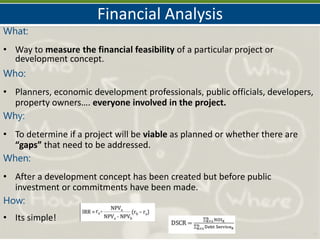
What:
• Way to measure the financial feasibility of a particular project or
development concept.
Who:
• Planners, economic development professionals, public officials, developers,
property owners…. everyone involved in the project.
Why:
• To determine if a project will be viable as planned or whether there are

“gaps” that need to be addressed.
When:
• After a development concept has been created but before public
investment or commitments have been made.
How:
• Its simple!
Financial Analysis
5
Back to Basics – Key Terms
6
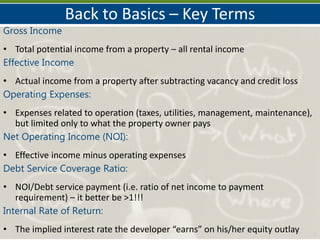
Gross Income
• Total potential income from a property – all rental income
Effective Income
• Actual income from a property after subtracting vacancy and credit loss
Operating Expenses:
• Expenses related to operation (taxes, utilities, management, maintenance),
but limited only to what the property owner pays
Net Operating Income (NOI):
• Effective income minus operating expenses
Debt Service Coverage Ratio:
• NOI/Debt service payment (i.e. ratio of net income to payment
requirement) – it better be >1!!!
Internal Rate of Return:
• The implied interest rate the developer “earns” on his/her equity outlay
Pro Forma Checklist
7
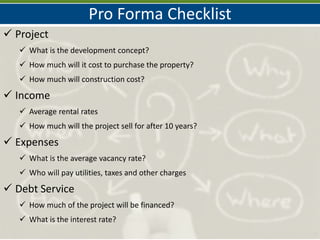
 Project
 What is the development concept?
 How much will it cost to purchase the property?
 How much will construction cost?
 Income
 Average rental rates
 How much will the project sell for after 10 years?
 Expenses
 What is the average vacancy rate?
 Who will pay utilities, taxes and other charges
 Debt Service
 How much of the project will be financed?
 What is the interest rate?
Pro Forma Example
8
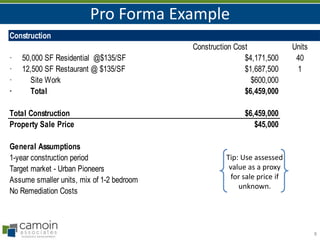
Construction
Construction Cost Units
· 50,000 SF Residential @$135/SF $4,171,500 40
· 12,500 SF Restaurant @ $135/SF $1,687,500 1
· Site Work $600,000
· Total $6,459,000
Total Construction $6,459,000
Property Sale Price $45,000
General Assumptions
1-year construction period
Target market - Urban Pioneers
Assume smaller units, mix of 1-2 bedroom
No Remediation Costs
Tip: Use assessed
value as a proxy
for sale price if
unknown.
Pro Forma Example
9
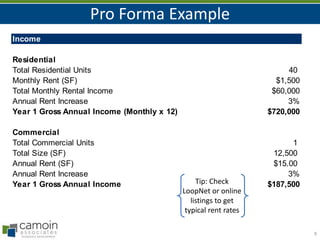
Income
Residential
Total Residential Units 40
Monthly Rent (SF) $1,500
Total Monthly Rental Income $60,000
Annual Rent Increase 3%
Year 1 Gross Annual Income (Monthly x 12) $720,000
Commercial
Total Commercial Units 1
Total Size (SF) 12,500
Annual Rent (SF) $15.00
Annual Rent Increase 3%
Year 1 Gross Annual Income $187,500Tip: Check
LoopNet or online
listings to get
typical rent rates
Pro Forma Example
10
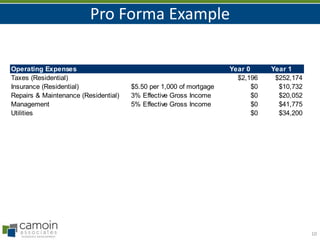
Operating Expenses Year 0 Year 1
Taxes (Residential) $2,196 $252,174
Insurance (Residential) $5.50 per 1,000 of mortgage $0 $10,732
Repairs & Maintenance (Residential) 3% Effective Gross Income $0 $20,052
Management 5% Effective Gross Income $0 $41,775
Utilities $0 $34,200
Pro Forma Example
11
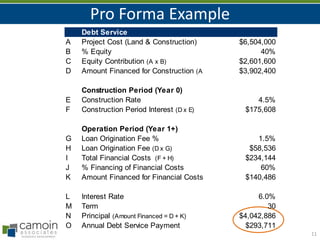
Debt Service
A Project Cost (Land & Construction) $6,504,000
B % Equity 40%
C Equity Contribution (A x B) $2,601,600
D Amount Financed for Construction (A - C) $3,902,400
Construction Period (Year 0)
E Construction Rate 4.5%
F Construction Period Interest (D x E) $175,608
Operation Period (Year 1+)
G Loan Origination Fee % 1.5%
H Loan Origination Fee (D x G) $58,536
I Total Financial Costs (F + H) $234,144
J % Financing of Financial Costs 60%
K Amount Financed for Financial Costs (I x J) $140,486
L Interest Rate 6.0%
M Term 30
N Principal (Amount Financed = D + K) $4,042,886
O Annual Debt Service Payment $293,711
Pro Forma Example
12
Debt Service
A Project Cost (Land & Construction) $6,504,000
B % Equity 40%
C Equity Contribution (A x B) $2,601,600
D Amount Financed for Construction (A - C) $3,902,400
Construction Period (Year 0)
E Construction Rate 4.5%
F Construction Period Interest (D x E) $175,608
Operation Period (Year 1+)
G Loan Origination Fee % 1.5%
H Loan Origination Fee (D x G) $58,536
I Total Financial Costs (F + H) $234,144
J % Financing of Financial Costs 60%
K Amount Financed for Financial Costs (I x J) $140,486
L Interest Rate 6.0%
M Term 30
N Principal (Amount Financed = D + K) $4,042,886
O Annual Debt Service Payment $293,711
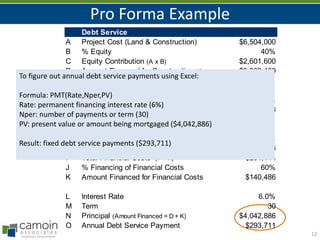
To figure out annual debt service payments using Excel:
Formula: PMT(Rate,Nper,PV)
Rate: permanent financing interest rate (6%)
Nper: number of payments or term (30)
PV: present value or amount being mortgaged ($4,042,886)
Result: fixed debt service payments ($293,711)
Pro Forma Example
13
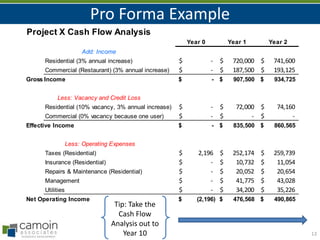
Project X Cash Flow Analysis
Year 0 Year 1 Year 2
Residential (3% annual increase) -$ 720,000$ 741,600$
Commercial (Restaurant) (3% annual increase) -$ 187,500$ 193,125$
-$ 907,500$ 934,725$
Residential (10% vacancy, 3% annual increase) -$ 72,000$ 74,160$
Commercial (0% vacancy because one user) -$ -$ -$
-$ 835,500$ 860,565$
Taxes (Residential) 2,196$ 252,174$ 259,739$
Insurance (Residential) -$ 10,732$ 11,054$
Repairs & Maintenance (Residential) -$ 20,052$ 20,654$
Management -$ 41,775$ 43,028$
Utilities -$ 34,200$ 35,226$
(2,196)$ 476,568$ 490,865$
Debt Service -$ (293,711)$ (293,711)$
Permanent Financing Draw 4,042,886$
Add: Inflow (Debt Service)
Add: Income
Gross Income
Less: Vacancy and Credit Loss
Effective Income
Less: Operating Expenses
Net Operating Income
Tip: Take the
Cash Flow
Analysis out to
Year 10
Pro Forma Example
14
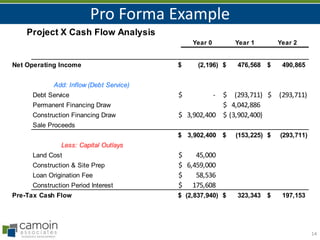
Taxes (Residential) 2,196$ 252,174$ 259,739$
Insurance (Residential) -$ 10,732$ 11,054$
Repairs & Maintenance (Residential) -$ 20,052$ 20,654$
Management -$ 41,775$ 43,028$
Utilities -$ 34,200$ 35,226$
(2,196)$ 476,568$ 490,865$
Debt Service -$ (293,711)$ (293,711)$
Permanent Financing Draw 4,042,886$
Construction Financing Draw 3,902,400$ (3,902,400)$
Sale Proceeds
3,902,400$ (153,225)$ (293,711)$
Land Cost 45,000$
Construction & Site Prep 6,459,000$
Loan Origination Fee 58,536$
Construction Period Interest 175,608$
Pre-Tax Cash Flow (2,837,940)$ 323,343$ 197,153$
Add: Inflow (Debt Service)
Less: Capital Outlays
Less: Operating Expenses
Net Operating Income
Project X Cash Flow Analysis
Year 0 Year 1 Year 2
Residential (3% annual increase) -$ 720,000$ 741,600$
Commercial (Restaurant) (3% annual increase) -$ 187,500$ 193,125$
-$ 907,500$ 934,725$
Residential (10% vacancy, 3% annual increase) -$ 72,000$ 74,160$
Commercial (0% vacancy because one user) -$ -$ -$
-$ 835,500$ 860,565$
Taxes (Residential) 2,196$ 252,174$ 259,739$
Insurance (Residential) -$ 10,732$ 11,054$
Repairs & Maintenance (Residential) -$ 20,052$ 20,654$
Management -$ 41,775$ 43,028$
Utilities -$ 34,200$ 35,226$
(2,196)$ 476,568$ 490,865$
Debt Service -$ (293,711)$ (293,711)$
Add: Inflow (Debt Service)
Add: Income
Gross Income
Less: Vacancy and Credit Loss
Effective Income
Less: Operating Expenses
Net Operating Income
Big Questions
15
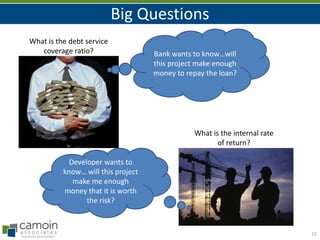
Bank wants to know…will
this project make enough
money to repay the loan?
Developer wants to
know… will this project
make me enough
money that it is worth
the risk?
What is the debt service
coverage ratio?
What is the internal rate
of return?
Bank – Debt Service Coverage Ratio
16
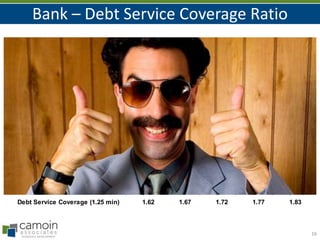
What is the debt service
coverage ratio?
= Net Operating Income
Debt Service
Must be greater than 1.25
Debt Service Coverage Ratio
Year 1 Year 2 Year 3 Year 4 Year 5 Ye
Net Operating Income 476,568$ 490,865$ 505,591$ 520,758$ 536,381$ 55$
Debt Service 293,711$ 293,711$ 293,711$ 293,711$ 293,711$ 29$
Debt Service Coverage (1.25 min) 1.62 1.67 1.72 1.77 1.83
Developer – Internal Rate of Return
17
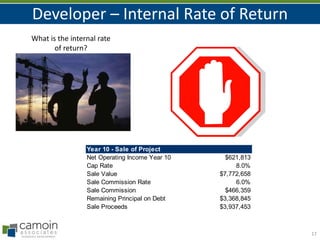
What is the internal rate
of return?
Year 10 - Sale of Project
Net Operating Income Year 10 $621,813
Cap Rate 8.0%
Sale Value $7,772,658
Sale Commission Rate 6.0%
Sale Commission $466,359
Remaining Principal on Debt $3,368,845
Sale Proceeds $3,937,453
3 Year 4 Year 5 Year 6 Year 7 Year 8 Year 9 Year 10
5,591 520,758$ 536,381$ 552,472$ 569,047$ 586,118$ 603,702$ 621,813$
3,711) (293,711)$ (293,711)$ (293,711)$ (293,711)$ (293,711)$ (293,711)$ 3,643,741$
- -$ -$ -$ -$ -$ -$ -$
1,879 227,047$ 242,670$ 258,761$ 275,335$ 292,407$ 309,990$ 4,265,554$
Developer – Internal Rate of Return
18
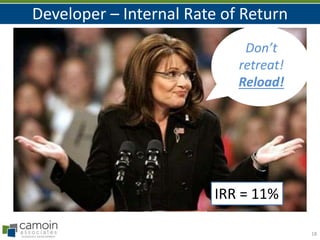
What is the internal rate
of return?
Internal Rate of Return
Year Year 0 Year 1 Year 2 Year 3 Year 4
Net Operating Income (2,196)$ 476,568$ 490,865$ 505,591$ 520,7$
Debt Service and Other 3,902,400$ (153,225)$ (293,711)$ (293,711)$ (293,7$
Capital Outlays (6,738,144)$ -$ -$ -$ $
Pre Tax Cash Flow (2,837,940)$ 323,343$ 197,153$ 211,879$ 227,0$
Interal Rate of Return (IRR) 11%
IRR = 11%
Don’t
retreat!
Reload!
The Numbers Don’t Work–What Now?
19
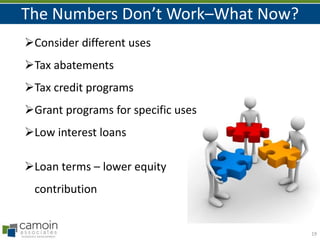
Consider different uses
Tax abatements
Tax credit programs
Grant programs for specific uses
Low interest loans
Loan terms – lower equity
contribution
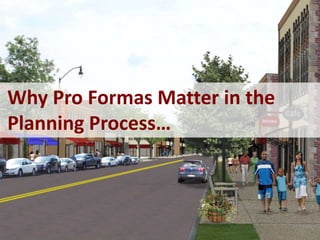
Why Pro Formas Matter in the
Planning Process…
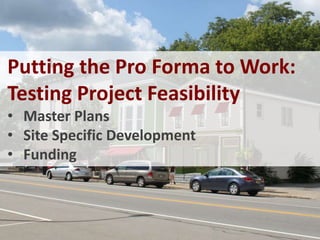
Putting the Pro Forma to Work:
Testing Project Feasibility
• Master Plans
• Site Specific Development
• Funding
• Avoid Un-Buildable Projects
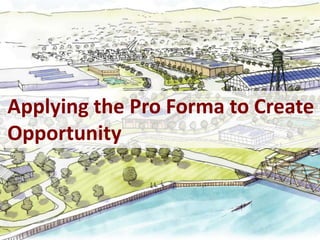
Applying the Pro Forma to Create
Opportunity
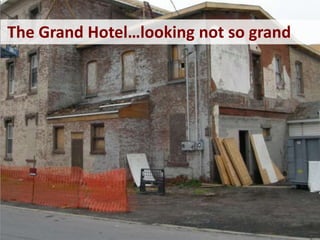
The Grand Hotel…looking not so grand
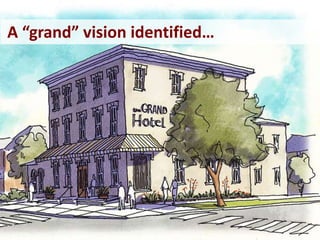
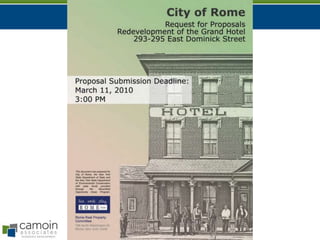
A “grand” vision identified…
But would it work?
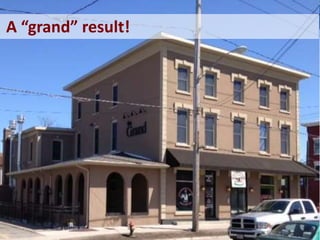
A “grand” result!
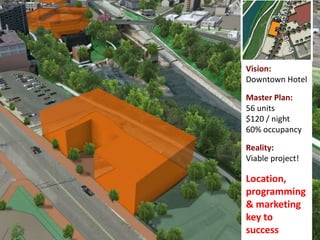
Vision:
Downtown Hotel
Master Plan:
56 units
$120 / night
60% occupancy
Reality:
Viable project!
Location,
programming
& marketing
key to
success
It’s Not Always Good News…but
Best to Know the Truth
• City of Lockport
• City of Binghamton
• Steuben County
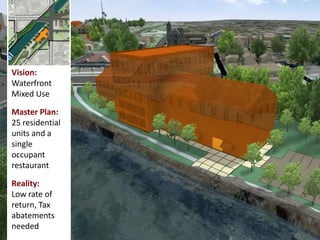
Vision:
Waterfront
Mixed Use
Master Plan:
25 residential
units and a
single
occupant
restaurant
Reality:
Low rate of
return, Tax
abatements
needed
• Re-evaluate mix of uses
• Weigh pros and cons of making building taller, to
accommodate more residential units
• Negotiate price of land purchase
• Research potential abatement and incentive programs,
such as 421-m
Now What?
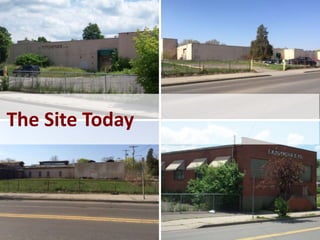
The Site Today
Future Vision
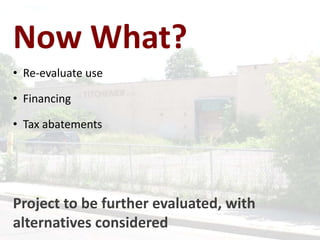
• Re-evaluate use
• Financing
• Tax abatements
Project to be further evaluated, with
alternatives considered
Now What?
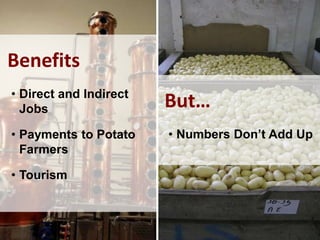
Potato Vodka Distillery
Craft farm distillery producing premium vodka made
with unused potatoes from Steuben County
Benefits
• Direct and Indirect
Jobs
• Payments to Potato
Farmers
• Tourism
But…
• Numbers Don’t Add Up
• Grant funding from CFA
• Preferential financing
• Free or reduced rent
Pro Forma provided direction to County and
stakeholders for future CFA application
Now What?
39
Thank You
Michael N’dolo, CEcD
Vice President, Camoin Associates
michael@camoinassociates.com
518-899-2608 x103
Kimberly Baptiste, AICP
Municipal Practice Leader, Bergmann
Associates
kbaptiste@BERGMANNPC.com
585-498-7770

Financial analysis for planners 2018 cdrpc spring conf

  • 1.
    Presented at: CDRPC 2018Spring Workshop April 26, 2018 1 Financial Analysis for Planners
  • 2.
    2 Outline 1.Introduction to FinancialAnalysis 2.Pro Forma Review and Hand Out 3.Case Studies 4.Question and Answer
  • 3.
  • 4.
    Financial Analysis 4 What: • Wayto measure the financial feasibility of a particular project or development concept. Who: • Planners, economic development professionals, public officials, developers, property owners…. everyone involved in the project. Why: • To determine if a project will be viable as planned or whether there are “gaps” that need to be addressed. When: • After a development concept has been created but before public investment or commitments have been made. How: • Its simple!
  • 5.
  • 6.
    Back to Basics– Key Terms 6 Gross Income • Total potential income from a property – all rental income Effective Income • Actual income from a property after subtracting vacancy and credit loss Operating Expenses: • Expenses related to operation (taxes, utilities, management, maintenance), but limited only to what the property owner pays Net Operating Income (NOI): • Effective income minus operating expenses Debt Service Coverage Ratio: • NOI/Debt service payment (i.e. ratio of net income to payment requirement) – it better be >1!!! Internal Rate of Return: • The implied interest rate the developer “earns” on his/her equity outlay
  • 7.
    Pro Forma Checklist 7 Project  What is the development concept?  How much will it cost to purchase the property?  How much will construction cost?  Income  Average rental rates  How much will the project sell for after 10 years?  Expenses  What is the average vacancy rate?  Who will pay utilities, taxes and other charges  Debt Service  How much of the project will be financed?  What is the interest rate?
  • 8.
    Pro Forma Example 8 Construction ConstructionCost Units · 50,000 SF Residential @$135/SF $4,171,500 40 · 12,500 SF Restaurant @ $135/SF $1,687,500 1 · Site Work $600,000 · Total $6,459,000 Total Construction $6,459,000 Property Sale Price $45,000 General Assumptions 1-year construction period Target market - Urban Pioneers Assume smaller units, mix of 1-2 bedroom No Remediation Costs Tip: Use assessed value as a proxy for sale price if unknown.
  • 9.
    Pro Forma Example 9 Income Residential TotalResidential Units 40 Monthly Rent (SF) $1,500 Total Monthly Rental Income $60,000 Annual Rent Increase 3% Year 1 Gross Annual Income (Monthly x 12) $720,000 Commercial Total Commercial Units 1 Total Size (SF) 12,500 Annual Rent (SF) $15.00 Annual Rent Increase 3% Year 1 Gross Annual Income $187,500Tip: Check LoopNet or online listings to get typical rent rates
  • 10.
    Pro Forma Example 10 OperatingExpenses Year 0 Year 1 Taxes (Residential) $2,196 $252,174 Insurance (Residential) $5.50 per 1,000 of mortgage $0 $10,732 Repairs & Maintenance (Residential) 3% Effective Gross Income $0 $20,052 Management 5% Effective Gross Income $0 $41,775 Utilities $0 $34,200
  • 11.
    Pro Forma Example 11 DebtService A Project Cost (Land & Construction) $6,504,000 B % Equity 40% C Equity Contribution (A x B) $2,601,600 D Amount Financed for Construction (A - C) $3,902,400 Construction Period (Year 0) E Construction Rate 4.5% F Construction Period Interest (D x E) $175,608 Operation Period (Year 1+) G Loan Origination Fee % 1.5% H Loan Origination Fee (D x G) $58,536 I Total Financial Costs (F + H) $234,144 J % Financing of Financial Costs 60% K Amount Financed for Financial Costs (I x J) $140,486 L Interest Rate 6.0% M Term 30 N Principal (Amount Financed = D + K) $4,042,886 O Annual Debt Service Payment $293,711
  • 12.
    Pro Forma Example 12 DebtService A Project Cost (Land & Construction) $6,504,000 B % Equity 40% C Equity Contribution (A x B) $2,601,600 D Amount Financed for Construction (A - C) $3,902,400 Construction Period (Year 0) E Construction Rate 4.5% F Construction Period Interest (D x E) $175,608 Operation Period (Year 1+) G Loan Origination Fee % 1.5% H Loan Origination Fee (D x G) $58,536 I Total Financial Costs (F + H) $234,144 J % Financing of Financial Costs 60% K Amount Financed for Financial Costs (I x J) $140,486 L Interest Rate 6.0% M Term 30 N Principal (Amount Financed = D + K) $4,042,886 O Annual Debt Service Payment $293,711 To figure out annual debt service payments using Excel: Formula: PMT(Rate,Nper,PV) Rate: permanent financing interest rate (6%) Nper: number of payments or term (30) PV: present value or amount being mortgaged ($4,042,886) Result: fixed debt service payments ($293,711)
  • 13.
    Pro Forma Example 13 ProjectX Cash Flow Analysis Year 0 Year 1 Year 2 Residential (3% annual increase) -$ 720,000$ 741,600$ Commercial (Restaurant) (3% annual increase) -$ 187,500$ 193,125$ -$ 907,500$ 934,725$ Residential (10% vacancy, 3% annual increase) -$ 72,000$ 74,160$ Commercial (0% vacancy because one user) -$ -$ -$ -$ 835,500$ 860,565$ Taxes (Residential) 2,196$ 252,174$ 259,739$ Insurance (Residential) -$ 10,732$ 11,054$ Repairs & Maintenance (Residential) -$ 20,052$ 20,654$ Management -$ 41,775$ 43,028$ Utilities -$ 34,200$ 35,226$ (2,196)$ 476,568$ 490,865$ Debt Service -$ (293,711)$ (293,711)$ Permanent Financing Draw 4,042,886$ Add: Inflow (Debt Service) Add: Income Gross Income Less: Vacancy and Credit Loss Effective Income Less: Operating Expenses Net Operating Income Tip: Take the Cash Flow Analysis out to Year 10
  • 14.
    Pro Forma Example 14 Taxes(Residential) 2,196$ 252,174$ 259,739$ Insurance (Residential) -$ 10,732$ 11,054$ Repairs & Maintenance (Residential) -$ 20,052$ 20,654$ Management -$ 41,775$ 43,028$ Utilities -$ 34,200$ 35,226$ (2,196)$ 476,568$ 490,865$ Debt Service -$ (293,711)$ (293,711)$ Permanent Financing Draw 4,042,886$ Construction Financing Draw 3,902,400$ (3,902,400)$ Sale Proceeds 3,902,400$ (153,225)$ (293,711)$ Land Cost 45,000$ Construction & Site Prep 6,459,000$ Loan Origination Fee 58,536$ Construction Period Interest 175,608$ Pre-Tax Cash Flow (2,837,940)$ 323,343$ 197,153$ Add: Inflow (Debt Service) Less: Capital Outlays Less: Operating Expenses Net Operating Income Project X Cash Flow Analysis Year 0 Year 1 Year 2 Residential (3% annual increase) -$ 720,000$ 741,600$ Commercial (Restaurant) (3% annual increase) -$ 187,500$ 193,125$ -$ 907,500$ 934,725$ Residential (10% vacancy, 3% annual increase) -$ 72,000$ 74,160$ Commercial (0% vacancy because one user) -$ -$ -$ -$ 835,500$ 860,565$ Taxes (Residential) 2,196$ 252,174$ 259,739$ Insurance (Residential) -$ 10,732$ 11,054$ Repairs & Maintenance (Residential) -$ 20,052$ 20,654$ Management -$ 41,775$ 43,028$ Utilities -$ 34,200$ 35,226$ (2,196)$ 476,568$ 490,865$ Debt Service -$ (293,711)$ (293,711)$ Add: Inflow (Debt Service) Add: Income Gross Income Less: Vacancy and Credit Loss Effective Income Less: Operating Expenses Net Operating Income
  • 15.
    Big Questions 15 Bank wantsto know…will this project make enough money to repay the loan? Developer wants to know… will this project make me enough money that it is worth the risk? What is the debt service coverage ratio? What is the internal rate of return?
  • 16.
    Bank – DebtService Coverage Ratio 16 What is the debt service coverage ratio? = Net Operating Income Debt Service Must be greater than 1.25 Debt Service Coverage Ratio Year 1 Year 2 Year 3 Year 4 Year 5 Ye Net Operating Income 476,568$ 490,865$ 505,591$ 520,758$ 536,381$ 55$ Debt Service 293,711$ 293,711$ 293,711$ 293,711$ 293,711$ 29$ Debt Service Coverage (1.25 min) 1.62 1.67 1.72 1.77 1.83
  • 17.
    Developer – InternalRate of Return 17 What is the internal rate of return? Year 10 - Sale of Project Net Operating Income Year 10 $621,813 Cap Rate 8.0% Sale Value $7,772,658 Sale Commission Rate 6.0% Sale Commission $466,359 Remaining Principal on Debt $3,368,845 Sale Proceeds $3,937,453
  • 18.
    3 Year 4Year 5 Year 6 Year 7 Year 8 Year 9 Year 10 5,591 520,758$ 536,381$ 552,472$ 569,047$ 586,118$ 603,702$ 621,813$ 3,711) (293,711)$ (293,711)$ (293,711)$ (293,711)$ (293,711)$ (293,711)$ 3,643,741$ - -$ -$ -$ -$ -$ -$ -$ 1,879 227,047$ 242,670$ 258,761$ 275,335$ 292,407$ 309,990$ 4,265,554$ Developer – Internal Rate of Return 18 What is the internal rate of return? Internal Rate of Return Year Year 0 Year 1 Year 2 Year 3 Year 4 Net Operating Income (2,196)$ 476,568$ 490,865$ 505,591$ 520,7$ Debt Service and Other 3,902,400$ (153,225)$ (293,711)$ (293,711)$ (293,7$ Capital Outlays (6,738,144)$ -$ -$ -$ $ Pre Tax Cash Flow (2,837,940)$ 323,343$ 197,153$ 211,879$ 227,0$ Interal Rate of Return (IRR) 11% IRR = 11% Don’t retreat! Reload!
  • 19.
    The Numbers Don’tWork–What Now? 19 Consider different uses Tax abatements Tax credit programs Grant programs for specific uses Low interest loans Loan terms – lower equity contribution
  • 20.
    Why Pro FormasMatter in the Planning Process…
  • 21.
    Putting the ProForma to Work: Testing Project Feasibility • Master Plans • Site Specific Development • Funding
  • 22.
  • 23.
    Applying the ProForma to Create Opportunity
  • 24.
  • 25.
    A “grand” visionidentified…
  • 26.
  • 28.
  • 29.
    Vision: Downtown Hotel Master Plan: 56units $120 / night 60% occupancy Reality: Viable project! Location, programming & marketing key to success
  • 30.
    It’s Not AlwaysGood News…but Best to Know the Truth • City of Lockport • City of Binghamton • Steuben County
  • 31.
    Vision: Waterfront Mixed Use Master Plan: 25residential units and a single occupant restaurant Reality: Low rate of return, Tax abatements needed
  • 32.
    • Re-evaluate mixof uses • Weigh pros and cons of making building taller, to accommodate more residential units • Negotiate price of land purchase • Research potential abatement and incentive programs, such as 421-m Now What?
  • 33.
  • 34.
  • 35.
    • Re-evaluate use •Financing • Tax abatements Project to be further evaluated, with alternatives considered Now What?
  • 36.
    Potato Vodka Distillery Craftfarm distillery producing premium vodka made with unused potatoes from Steuben County
  • 37.
    Benefits • Direct andIndirect Jobs • Payments to Potato Farmers • Tourism But… • Numbers Don’t Add Up
  • 38.
    • Grant fundingfrom CFA • Preferential financing • Free or reduced rent Pro Forma provided direction to County and stakeholders for future CFA application Now What?
  • 39.
    39 Thank You Michael N’dolo,CEcD Vice President, Camoin Associates michael@camoinassociates.com 518-899-2608 x103 Kimberly Baptiste, AICP Municipal Practice Leader, Bergmann Associates kbaptiste@BERGMANNPC.com 585-498-7770