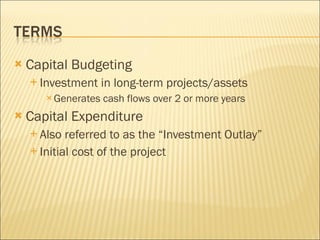

Capital Budgeting Investment in long-term projects/assets Generates cash flows over 2 or more years Capital Expenditure Also referred to as the “Investment Outlay” Initial cost of the project
We Need to Know the Following: Expected Cash Flows Investment outlay Operating Cash Flows Terminal Cash Flow Risk of the Project Appropriate Discount Rate for the Project
 
Significance of Cash Flows and  Cash Flow Estimation The concept of “relevant” versus “irrelevant” cash flows Points to watch in estimating cash flows How to estimate project operating cash flows? How to estimate project total cash flows?
To be consistent with wealth maximization principle, an evaluation of a project must be based on cash flows and not on accounting profits To be able to use NPV technique or any other technique of capital budgeting analysis successfully and accurately, we must have  an unbiased estimate of the expected future cash flows of the project  including time to completion and estimate initial investment/cost extremely important and most difficult task
The results of an acceptance of a project is to change the cash flows of a firm.  Cash flows of a firm that change because of the project are called “relevant” cash flows;  Any cash flows that does not change irrespective of the acceptance/rejection of the project is “irrelevant” to decision making and should not be considered.
Sunk Costs Opportunity Costs Project Externalities Change in Net Working Capital
Sunk Costs—A cost that has already been incurred and cannot be recovered irrespective of the decision to accept or reject the project.  R&D, Market Research, Consultant’s Fees Is it relevant or irrelevant?
Opportunity Costs--The cash flow foregone by using your resources in a particular way.  Resources have multiple uses You can use them in one way to the exclusion of other uses and this gives rise to opportunity costs By using your own building for your business, you forego the rent that you could have earned by renting it to some one else.  Is it relevant or irrelevant to decision making?
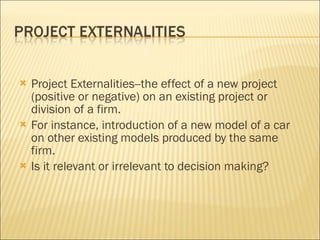
Project Externalities--the effect of a new project (positive or negative) on an existing project or division of a firm.  For instance, introduction of a new model of a car on other existing models produced by the same firm.  Is it relevant or irrelevant to decision making?
Change in Net Working Capital--Net working capital is defined as current assets minus current liabilities.  Investment in working capital is a cash outflow during the year in which investment takes place Any investment in working capital is a cash inflow during the last year of the project and must be treated accordingly
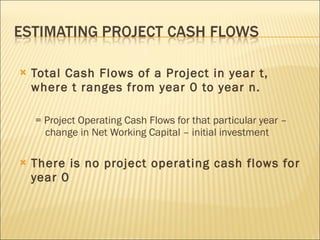
Total Cash Flows of a Project in year t, where t ranges from year 0 to year n. = Project Operating Cash Flows for that particular year – change in Net Working Capital – initial investment There is no project operating cash flows for year 0
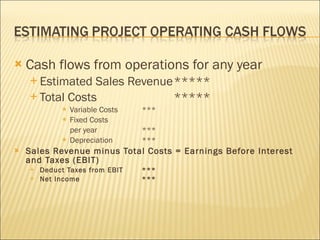
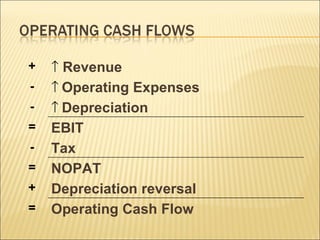
Cash flows from operations for any year Estimated Sales Revenue ***** Total Costs ***** Variable Costs  *** Fixed Costs  per year *** Depreciation *** Sales Revenue minus Total Costs = Earnings Before Interest and Taxes (EBIT) Deduct Taxes from EBIT *** Net Income ***
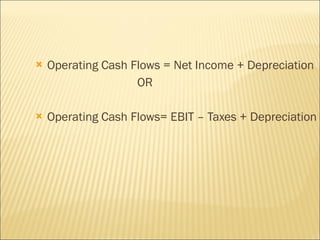
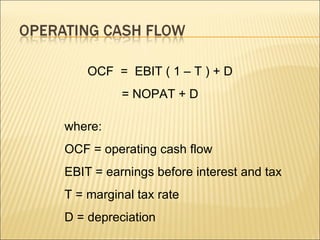
Operating Cash Flows = Net Income + Depreciation OR Operating Cash Flows= EBIT – Taxes + Depreciation
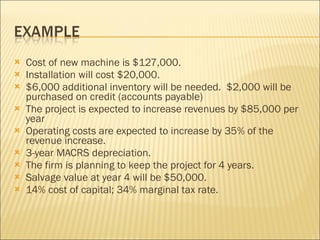
Cost of new machine is $127,000.  Installation will cost $20,000. $6,000 additional inventory will be needed.  $2,000 will be purchased on credit (accounts payable) The project is expected to increase revenues by $85,000 per year Operating costs are expected to increase by 35% of the revenue increase. 3-year MACRS depreciation. The firm is planning to keep the project for 4 years. Salvage value at year 4 will be $50,000. 14% cost of capital; 34% marginal tax rate.
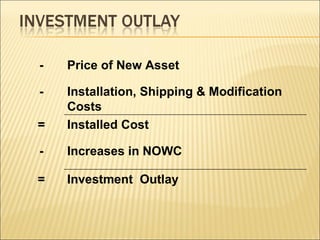
- Price of New Asset - Installation, Shipping & Modification Costs = Installed Cost - Increases in NOWC = Investment  Outlay
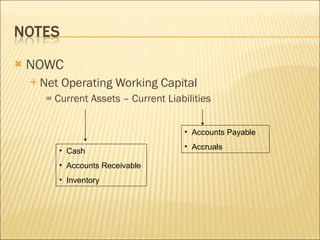
NOWC Net Operating Working Capital  = Current Assets – Current Liabilities Cash Accounts Receivable Inventory Accounts Payable Accruals
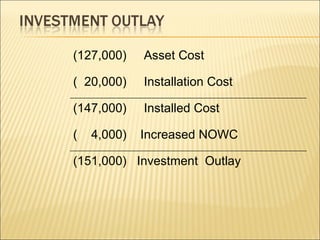
(127,000)  Asset Cost (  20,000)  Installation Cost (147,000)  Installed Cost (  4,000)  Increased NOWC (151,000)  Investment  Outlay
OCF  =  EBIT ( 1 – T ) + D = NOPAT + D where: OCF = operating cash flow EBIT = earnings before interest and tax T = marginal tax rate D = depreciation
+    Revenue -  Operating Expenses -  Depreciation = EBIT - Tax = NOPAT + Depreciation reversal = Operating Cash Flow
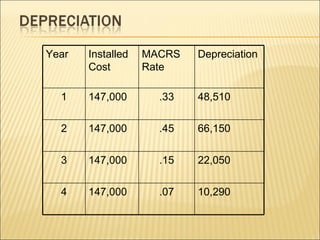
Year Installed Cost MACRS Rate Depreciation 1 147,000 .33 48,510 2 147,000 .45 66,150 3 147,000 .15 22,050 4 147,000 .07 10,290
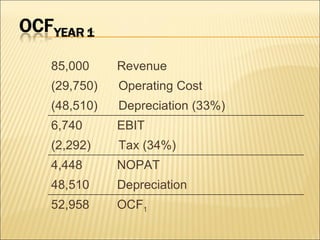
85,000  Revenue (29,750)  Operating Cost (48,510)  Depreciation (33%) 6,740  EBIT (2,292)  Tax (34%) 4,448  NOPAT 48,510  Depreciation 52,958  OCF 1
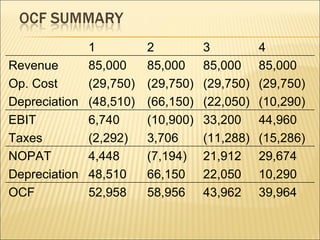
1 2 3 4 Revenue 85,000 85,000 85,000 85,000 Op. Cost (29,750) (29,750) (29,750) (29,750) Depreciation (48,510) (66,150) (22,050) (10,290) EBIT 6,740 (10,900) 33,200 44,960 Taxes (2,292) 3,706 (11,288) (15,286) NOPAT 4,448 (7,194) 21,912 29,674 Depreciation 48,510 66,150 22,050 10,290 OCF 52,958 58,956 43,962 39,964
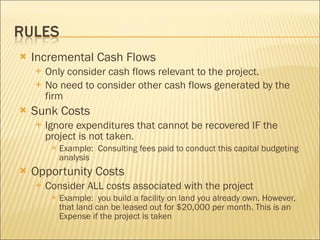
Incremental Cash Flows Only consider cash flows relevant to the project.  No need to consider other cash flows generated by the firm Sunk Costs Ignore expenditures that cannot be recovered IF the project is not taken. Example:  Consulting fees paid to conduct this capital budgeting analysis Opportunity Costs Consider ALL costs associated with the project Example:  you build a facility on land you already own. However, that land can be leased out for $20,000 per month. This is an Expense if the project is taken
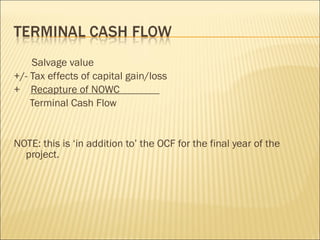
Salvage value +/- Tax effects of capital gain/loss +  Recapture of NOWC  Terminal Cash Flow NOTE: this is ‘in addition to’ the OCF for the final year of the project.
Salvage Value (SV)  Market value of the asset at time of sale Book Value (BV) Installed Cost – Accumulated Depreciation Taxes on Gain from Selling Asset at Project End: Tax Liability = [SV – BV] * t “ t” = marginal tax rate
$50,000  Salvage Value of Asset (17,000)  Taxes on Sale of Asset 4,000  Recovery of NWC  37,000  Terminal Cash Flow NOTE: tax = [SV-BV]*t = [$50,000 - $0] * 34% = $17,000
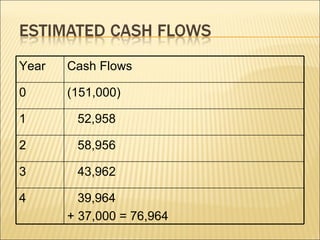
Year Cash Flows 0 (151,000) 1 52,958 2 58,956 3 43,962 4 39,964  + 37,000 = 76,964
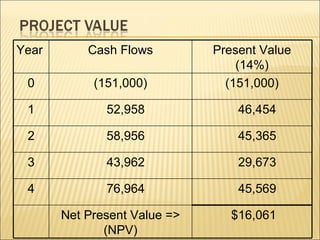
Year Cash Flows Present Value (14%) 0 (151,000) (151,000) 1 52,958 46,454 2 58,956 45,365 3 43,962 29,673 4 76,964 45,569 Net Present Value => (NPV) $16,061
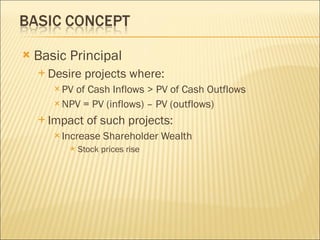
Basic Principal Desire projects where: PV of Cash Inflows > PV of Cash Outflows NPV = PV (inflows) – PV (outflows) Impact of such projects: Increase Shareholder Wealth Stock prices rise
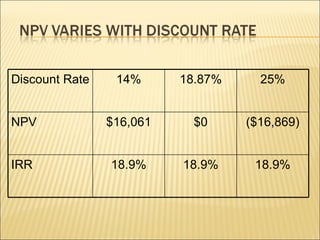
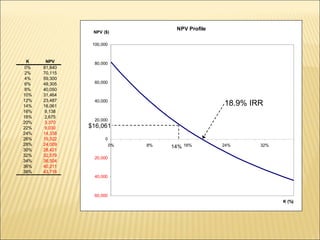
Discount Rate 14% 18.87% 25% NPV $16,061 $0 ($16,869) IRR 18.9% 18.9% 18.9%
$16,061 14% 18.9% IRR
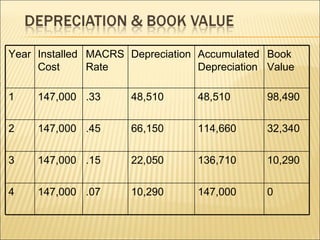
Year Installed Cost MACRS Rate Depreciation Accumulated Depreciation Book Value 1 147,000 .33 48,510 48,510 98,490 2 147,000 .45 66,150 114,660 32,340 3 147,000 .15 22,050 136,710 10,290 4 147,000 .07 10,290 147,000 0
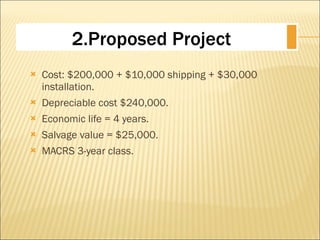
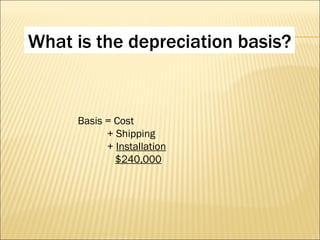
Cost: $200,000 + $10,000 shipping + $30,000 installation. Depreciable cost $240,000. Economic life = 4 years. Salvage value = $25,000. MACRS 3-year class. 2.Proposed Project
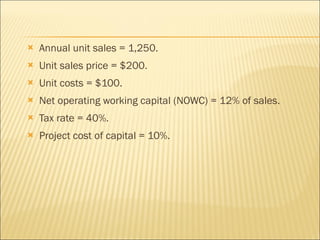
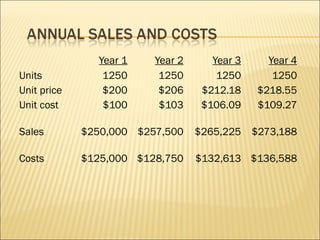
Annual unit sales = 1,250. Unit sales price = $200. Unit costs = $100. Net operating working capital (NOWC) = 12% of sales. Tax rate = 40%. Project cost of capital = 10%.
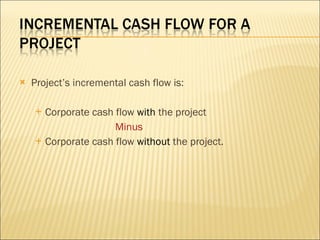
Project’s incremental cash flow is: Corporate cash flow  with  the project Minus   Corporate cash flow  without  the project.
N O. We discount project cash flows with a cost of capital that is the rate of return required by all investors (not just debtholders or stockholders), and so we should discount the total amount of cash flow available to all investors.  They are part of the costs of capital.  If we subtracted them from cash flows, we would be double counting capital costs.  Should you subtract interest expense or dividends when calculating CF?
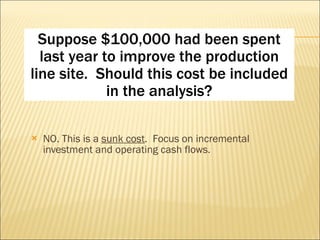
NO. This is a  sunk cost .  Focus on incremental investment and operating cash flows. Suppose $100,000 had been spent last year to improve the production line site.  Should this cost be included in the analysis?
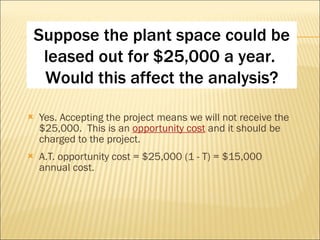
Yes. Accepting the project means we will not receive the $25,000.  This is an  opportunity cost  and it should be charged to the project. A.T. opportunity cost = $25,000 (1 - T) = $15,000 annual cost. Suppose the plant space could be leased out for $25,000 a year.  Would this affect the analysis?
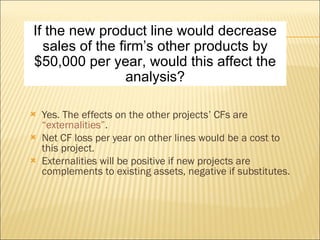
Yes. The effects on the other projects’ CFs are  “externalities” . Net CF loss per year on other lines would be a cost to this project. Externalities will be positive if new projects are complements to existing assets, negative if substitutes. If the new product line would decrease sales of the firm’s other products by $50,000 per year, would this affect the analysis?
Basis = Cost + Shipping +  Installation $240,000 What is the depreciation basis?
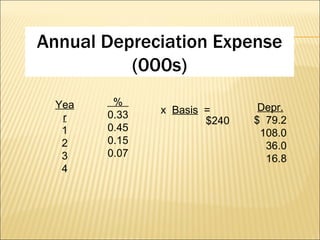
Year 1 2 3 4 %  0.33 0.45 0.15 0.07 Depr. $  79.2 108.0 36.0 16.8 x  Basis   = Annual Depreciation Expense (000s) $240
Year 1 Year 2 Year 3 Year 4 Units 1250 1250 1250 1250 Unit price $200 $206 $212.18 $218.55 Unit cost $100 $103 $106.09 $109.27 Sales $250,000 $257,500 $265,225 $273,188 Costs $125,000 $128,750 $132,613 $136,588
Nominal r > real r.  The cost of capital, r, includes a premium for inflation. Nominal CF > real CF.  This is because nominal cash flows incorporate inflation. If you discount real CF with the higher nominal r, then your NPV estimate is too low.  Continued…
Nominal CF should be discounted with nominal r, and real CF should be discounted with real r. It is more realistic to find the nominal CF (i.e., increase cash flow estimates with inflation) than it is to reduce the nominal r to a real r.
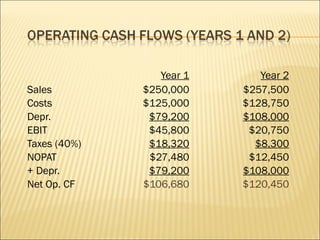
Year 1 Year 2 Sales $250,000 $257,500 Costs $125,000 $128,750 Depr. $79,200 $108,000 EBIT $45,800 $20,750 Taxes (40%) $18,320 $8,300 NOPAT $27,480 $12,450 + Depr. $79,200 $108,000 Net Op. CF $106,680 $120,450
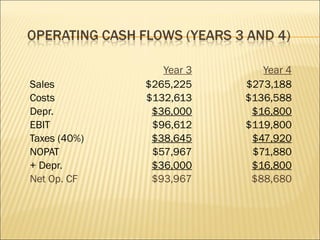
Year 3 Year 4 Sales $265,225 $273,188 Costs $132,613 $136,588 Depr. $36,000 $16,800 EBIT $96,612 $119,800 Taxes (40%) $38,645 $47,920 NOPAT $57,967 $71,880 + Depr. $36,000 $16,800 Net Op. CF $93,967 $88,680
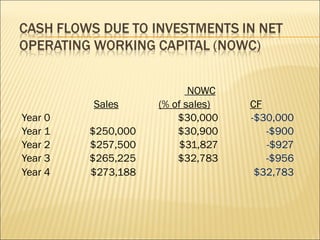
  NOWC   Sales   (% of sales)   CF Year 0 $30,000 -$30,000 Year 1 $250,000 $30,900 -$900 Year 2 $257,500 $31,827 -$927 Year 3 $265,225 $32,783 -$956 Year 4 $273,188 $32,783
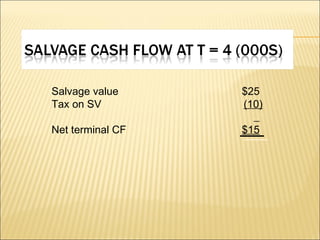
Salvage value Tax on SV Net terminal CF $25  (10) $15
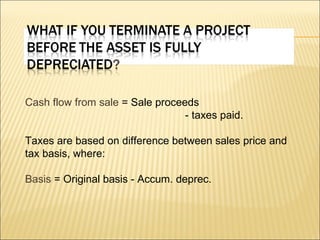
Cash flow from sale  = Sale proceeds - taxes paid. Taxes are based on difference between sales price and tax basis, where: Basis  = Original basis - Accum. deprec.
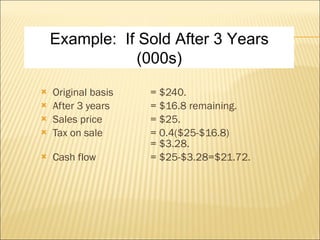
Original basis = $240. After 3 years = $16.8 remaining. Sales price = $25. Tax on sale = 0.4($25-$16.8) = $3.28. Cash flow  = $25-$3.28=$21.72. Example:  If Sold After 3 Years (000s)
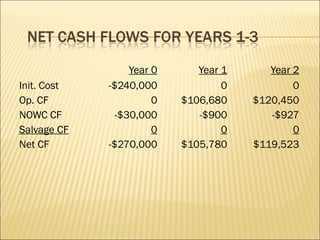
Year 0 Year 1 Year 2 Init. Cost -$240,000 0 0 Op. CF 0 $106,680 $120,450 NOWC CF -$30,000 -$900 -$927 Salvage CF 0 0 0 Net CF -$270,000 $105,780 $119,523
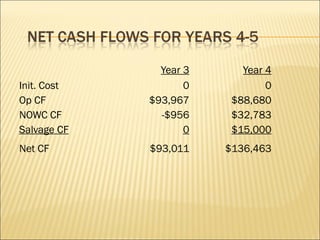
Year 3 Year 4 Init. Cost 0 0 Op CF $93,967 $88,680 NOWC CF -$956 $32,783 Salvage CF 0 $15,000 Net CF $93,011 $136,463
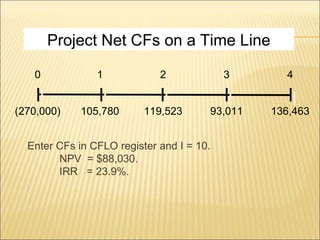
Project Net CFs on a Time Line Enter CFs in CFLO register and I = 10. NPV  = $88,030. IRR  = 23.9%. 0 1 2 3 4 (270,000) 105,780 119,523 93,011 136,463
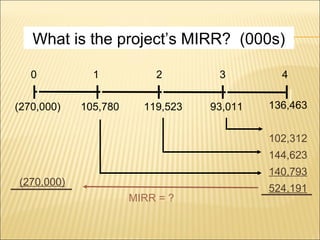
What is the project’s MIRR?  (000s) (270,000) MIRR = ? 0 1 2 3 4 (270,000) 105,780 119,523 93,011 136,463 102,312 144,623 140,793 524,191
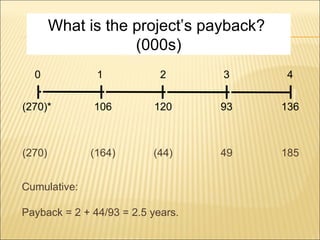
What is the project’s payback?  (000s) Cumulative: Payback = 2 + 44/93 = 2.5 years. 0 1 2 3 4 (270)* (270) 106 (164) 120 (44) 93 49 136 185
 

Capital budgeting cash flow estimation

  • 1.
  • 2.
    Capital Budgeting Investmentin long-term projects/assets Generates cash flows over 2 or more years Capital Expenditure Also referred to as the “Investment Outlay” Initial cost of the project
  • 3.
    We Need toKnow the Following: Expected Cash Flows Investment outlay Operating Cash Flows Terminal Cash Flow Risk of the Project Appropriate Discount Rate for the Project
  • 4.
  • 5.
    Significance of CashFlows and Cash Flow Estimation The concept of “relevant” versus “irrelevant” cash flows Points to watch in estimating cash flows How to estimate project operating cash flows? How to estimate project total cash flows?
  • 6.
    To be consistentwith wealth maximization principle, an evaluation of a project must be based on cash flows and not on accounting profits To be able to use NPV technique or any other technique of capital budgeting analysis successfully and accurately, we must have an unbiased estimate of the expected future cash flows of the project including time to completion and estimate initial investment/cost extremely important and most difficult task
  • 7.
    The results ofan acceptance of a project is to change the cash flows of a firm. Cash flows of a firm that change because of the project are called “relevant” cash flows; Any cash flows that does not change irrespective of the acceptance/rejection of the project is “irrelevant” to decision making and should not be considered.
  • 8.
    Sunk Costs OpportunityCosts Project Externalities Change in Net Working Capital
  • 9.
    Sunk Costs—A costthat has already been incurred and cannot be recovered irrespective of the decision to accept or reject the project. R&D, Market Research, Consultant’s Fees Is it relevant or irrelevant?
  • 10.
    Opportunity Costs--The cashflow foregone by using your resources in a particular way. Resources have multiple uses You can use them in one way to the exclusion of other uses and this gives rise to opportunity costs By using your own building for your business, you forego the rent that you could have earned by renting it to some one else. Is it relevant or irrelevant to decision making?
  • 11.
    Project Externalities--the effectof a new project (positive or negative) on an existing project or division of a firm. For instance, introduction of a new model of a car on other existing models produced by the same firm. Is it relevant or irrelevant to decision making?
  • 12.
    Change in NetWorking Capital--Net working capital is defined as current assets minus current liabilities. Investment in working capital is a cash outflow during the year in which investment takes place Any investment in working capital is a cash inflow during the last year of the project and must be treated accordingly
  • 13.
    Total Cash Flowsof a Project in year t, where t ranges from year 0 to year n. = Project Operating Cash Flows for that particular year – change in Net Working Capital – initial investment There is no project operating cash flows for year 0
  • 14.
    Cash flows fromoperations for any year Estimated Sales Revenue ***** Total Costs ***** Variable Costs *** Fixed Costs per year *** Depreciation *** Sales Revenue minus Total Costs = Earnings Before Interest and Taxes (EBIT) Deduct Taxes from EBIT *** Net Income ***
  • 15.
    Operating Cash Flows= Net Income + Depreciation OR Operating Cash Flows= EBIT – Taxes + Depreciation
  • 16.
    Cost of newmachine is $127,000. Installation will cost $20,000. $6,000 additional inventory will be needed. $2,000 will be purchased on credit (accounts payable) The project is expected to increase revenues by $85,000 per year Operating costs are expected to increase by 35% of the revenue increase. 3-year MACRS depreciation. The firm is planning to keep the project for 4 years. Salvage value at year 4 will be $50,000. 14% cost of capital; 34% marginal tax rate.
  • 17.
    - Price ofNew Asset - Installation, Shipping & Modification Costs = Installed Cost - Increases in NOWC = Investment Outlay
  • 18.
    NOWC Net OperatingWorking Capital = Current Assets – Current Liabilities Cash Accounts Receivable Inventory Accounts Payable Accruals
  • 19.
    (127,000) AssetCost ( 20,000) Installation Cost (147,000) Installed Cost ( 4,000) Increased NOWC (151,000) Investment Outlay
  • 20.
    OCF = EBIT ( 1 – T ) + D = NOPAT + D where: OCF = operating cash flow EBIT = earnings before interest and tax T = marginal tax rate D = depreciation
  • 21.
    +  Revenue -  Operating Expenses -  Depreciation = EBIT - Tax = NOPAT + Depreciation reversal = Operating Cash Flow
  • 22.
    Year Installed CostMACRS Rate Depreciation 1 147,000 .33 48,510 2 147,000 .45 66,150 3 147,000 .15 22,050 4 147,000 .07 10,290
  • 23.
    85,000 Revenue(29,750) Operating Cost (48,510) Depreciation (33%) 6,740 EBIT (2,292) Tax (34%) 4,448 NOPAT 48,510 Depreciation 52,958 OCF 1
  • 24.
    1 2 34 Revenue 85,000 85,000 85,000 85,000 Op. Cost (29,750) (29,750) (29,750) (29,750) Depreciation (48,510) (66,150) (22,050) (10,290) EBIT 6,740 (10,900) 33,200 44,960 Taxes (2,292) 3,706 (11,288) (15,286) NOPAT 4,448 (7,194) 21,912 29,674 Depreciation 48,510 66,150 22,050 10,290 OCF 52,958 58,956 43,962 39,964
  • 25.
    Incremental Cash FlowsOnly consider cash flows relevant to the project. No need to consider other cash flows generated by the firm Sunk Costs Ignore expenditures that cannot be recovered IF the project is not taken. Example: Consulting fees paid to conduct this capital budgeting analysis Opportunity Costs Consider ALL costs associated with the project Example: you build a facility on land you already own. However, that land can be leased out for $20,000 per month. This is an Expense if the project is taken
  • 26.
    Salvage value +/-Tax effects of capital gain/loss + Recapture of NOWC Terminal Cash Flow NOTE: this is ‘in addition to’ the OCF for the final year of the project.
  • 27.
    Salvage Value (SV) Market value of the asset at time of sale Book Value (BV) Installed Cost – Accumulated Depreciation Taxes on Gain from Selling Asset at Project End: Tax Liability = [SV – BV] * t “ t” = marginal tax rate
  • 28.
    $50,000 SalvageValue of Asset (17,000) Taxes on Sale of Asset 4,000 Recovery of NWC 37,000 Terminal Cash Flow NOTE: tax = [SV-BV]*t = [$50,000 - $0] * 34% = $17,000
  • 29.
    Year Cash Flows0 (151,000) 1 52,958 2 58,956 3 43,962 4 39,964 + 37,000 = 76,964
  • 30.
    Year Cash FlowsPresent Value (14%) 0 (151,000) (151,000) 1 52,958 46,454 2 58,956 45,365 3 43,962 29,673 4 76,964 45,569 Net Present Value => (NPV) $16,061
  • 31.
    Basic Principal Desireprojects where: PV of Cash Inflows > PV of Cash Outflows NPV = PV (inflows) – PV (outflows) Impact of such projects: Increase Shareholder Wealth Stock prices rise
  • 32.
    Discount Rate 14%18.87% 25% NPV $16,061 $0 ($16,869) IRR 18.9% 18.9% 18.9%
  • 33.
  • 34.
    Year Installed CostMACRS Rate Depreciation Accumulated Depreciation Book Value 1 147,000 .33 48,510 48,510 98,490 2 147,000 .45 66,150 114,660 32,340 3 147,000 .15 22,050 136,710 10,290 4 147,000 .07 10,290 147,000 0
  • 35.
    Cost: $200,000 +$10,000 shipping + $30,000 installation. Depreciable cost $240,000. Economic life = 4 years. Salvage value = $25,000. MACRS 3-year class. 2.Proposed Project
  • 36.
    Annual unit sales= 1,250. Unit sales price = $200. Unit costs = $100. Net operating working capital (NOWC) = 12% of sales. Tax rate = 40%. Project cost of capital = 10%.
  • 37.
    Project’s incremental cashflow is: Corporate cash flow with the project Minus Corporate cash flow without the project.
  • 38.
    N O. Wediscount project cash flows with a cost of capital that is the rate of return required by all investors (not just debtholders or stockholders), and so we should discount the total amount of cash flow available to all investors. They are part of the costs of capital. If we subtracted them from cash flows, we would be double counting capital costs. Should you subtract interest expense or dividends when calculating CF?
  • 39.
    NO. This isa sunk cost . Focus on incremental investment and operating cash flows. Suppose $100,000 had been spent last year to improve the production line site. Should this cost be included in the analysis?
  • 40.
    Yes. Accepting theproject means we will not receive the $25,000. This is an opportunity cost and it should be charged to the project. A.T. opportunity cost = $25,000 (1 - T) = $15,000 annual cost. Suppose the plant space could be leased out for $25,000 a year. Would this affect the analysis?
  • 41.
    Yes. The effectson the other projects’ CFs are “externalities” . Net CF loss per year on other lines would be a cost to this project. Externalities will be positive if new projects are complements to existing assets, negative if substitutes. If the new product line would decrease sales of the firm’s other products by $50,000 per year, would this affect the analysis?
  • 42.
    Basis = Cost+ Shipping + Installation $240,000 What is the depreciation basis?
  • 43.
    Year 1 23 4 % 0.33 0.45 0.15 0.07 Depr. $ 79.2 108.0 36.0 16.8 x Basis = Annual Depreciation Expense (000s) $240
  • 44.
    Year 1 Year2 Year 3 Year 4 Units 1250 1250 1250 1250 Unit price $200 $206 $212.18 $218.55 Unit cost $100 $103 $106.09 $109.27 Sales $250,000 $257,500 $265,225 $273,188 Costs $125,000 $128,750 $132,613 $136,588
  • 45.
    Nominal r >real r. The cost of capital, r, includes a premium for inflation. Nominal CF > real CF. This is because nominal cash flows incorporate inflation. If you discount real CF with the higher nominal r, then your NPV estimate is too low. Continued…
  • 46.
    Nominal CF shouldbe discounted with nominal r, and real CF should be discounted with real r. It is more realistic to find the nominal CF (i.e., increase cash flow estimates with inflation) than it is to reduce the nominal r to a real r.
  • 47.
    Year 1 Year2 Sales $250,000 $257,500 Costs $125,000 $128,750 Depr. $79,200 $108,000 EBIT $45,800 $20,750 Taxes (40%) $18,320 $8,300 NOPAT $27,480 $12,450 + Depr. $79,200 $108,000 Net Op. CF $106,680 $120,450
  • 48.
    Year 3 Year4 Sales $265,225 $273,188 Costs $132,613 $136,588 Depr. $36,000 $16,800 EBIT $96,612 $119,800 Taxes (40%) $38,645 $47,920 NOPAT $57,967 $71,880 + Depr. $36,000 $16,800 Net Op. CF $93,967 $88,680
  • 49.
    NOWC Sales (% of sales) CF Year 0 $30,000 -$30,000 Year 1 $250,000 $30,900 -$900 Year 2 $257,500 $31,827 -$927 Year 3 $265,225 $32,783 -$956 Year 4 $273,188 $32,783
  • 50.
    Salvage value Taxon SV Net terminal CF $25 (10) $15
  • 51.
    Cash flow fromsale = Sale proceeds - taxes paid. Taxes are based on difference between sales price and tax basis, where: Basis = Original basis - Accum. deprec.
  • 52.
    Original basis =$240. After 3 years = $16.8 remaining. Sales price = $25. Tax on sale = 0.4($25-$16.8) = $3.28. Cash flow = $25-$3.28=$21.72. Example: If Sold After 3 Years (000s)
  • 53.
    Year 0 Year1 Year 2 Init. Cost -$240,000 0 0 Op. CF 0 $106,680 $120,450 NOWC CF -$30,000 -$900 -$927 Salvage CF 0 0 0 Net CF -$270,000 $105,780 $119,523
  • 54.
    Year 3 Year4 Init. Cost 0 0 Op CF $93,967 $88,680 NOWC CF -$956 $32,783 Salvage CF 0 $15,000 Net CF $93,011 $136,463
  • 55.
    Project Net CFson a Time Line Enter CFs in CFLO register and I = 10. NPV = $88,030. IRR = 23.9%. 0 1 2 3 4 (270,000) 105,780 119,523 93,011 136,463
  • 56.
    What is theproject’s MIRR? (000s) (270,000) MIRR = ? 0 1 2 3 4 (270,000) 105,780 119,523 93,011 136,463 102,312 144,623 140,793 524,191
  • 57.
    What is theproject’s payback? (000s) Cumulative: Payback = 2 + 44/93 = 2.5 years. 0 1 2 3 4 (270)* (270) 106 (164) 120 (44) 93 49 136 185
  • 58.