helpdesk@construction-productivity.co.uk
htt://www.construction-productivity.co.uk
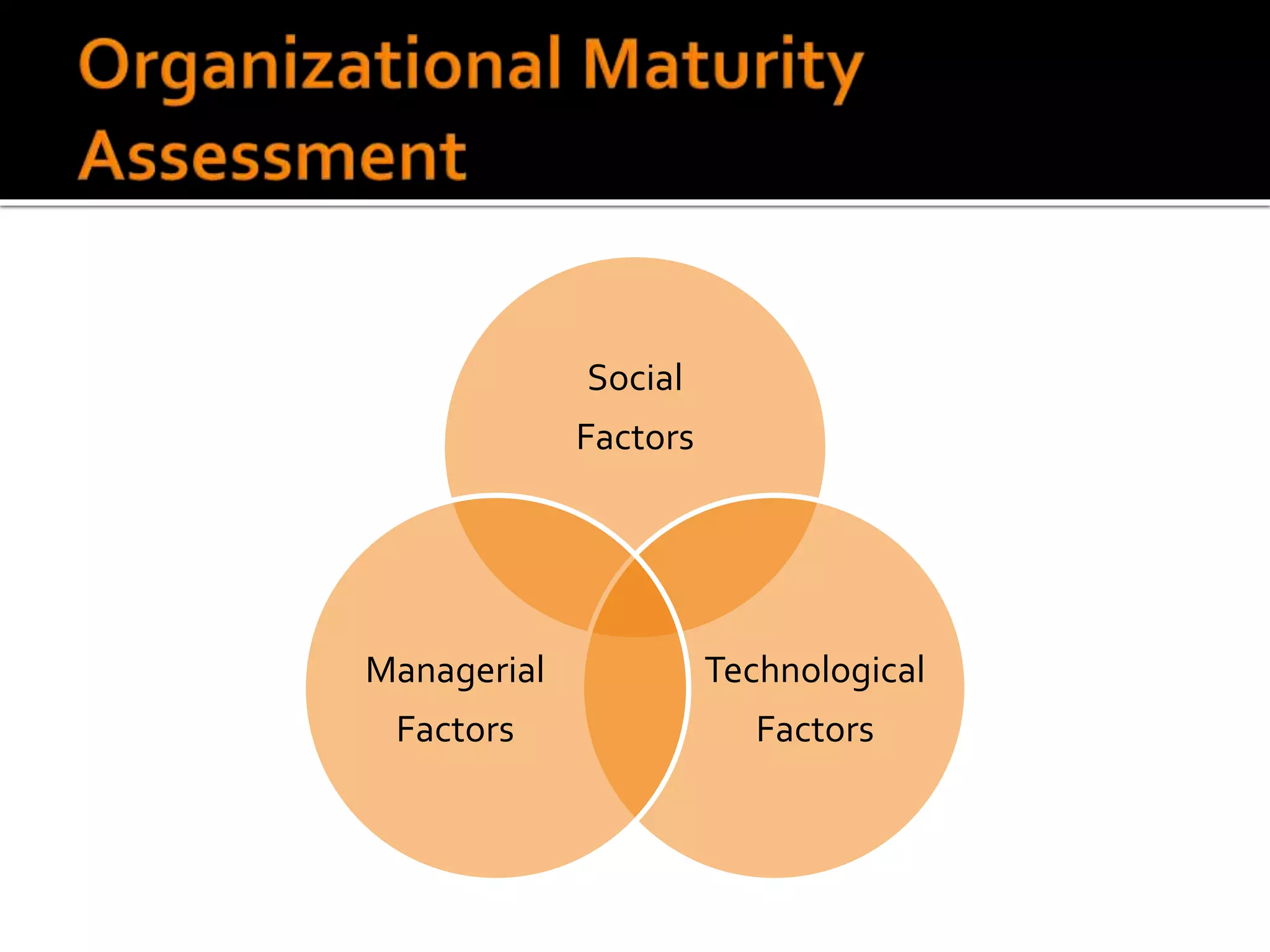
Social
Factors
Technological
Factors
Managerial
Factors
Organizational
Maturity
Assessment
• Project management is about managing
change and achieving business objectives.
Organizational
Maturity
Assessment
• The rapidly changing work environments for
many companies is pushing them to apply the
principles and practices of modern project
management.
Organizational
Maturity
Assessment
• It is through successful completion
of projects that organizations add
value to better serve their clients.
Organizational
Maturity
Assessment
• It is about how competitive they
are in nation and international
market.
There are restricted sources of funding the company
is willing to invest in new/improved products,
services, business process, and technology.
There are limited resources available to companies.
Due to these organizational and
budgetary constraints,
management team must not only
make the difficult decisions to select
only certain projects for execution,
but to defer or cancel others as
well.
Strong
management
team leads to:
more
effective business
procedures
higher quality
deliverables
lower project
costs
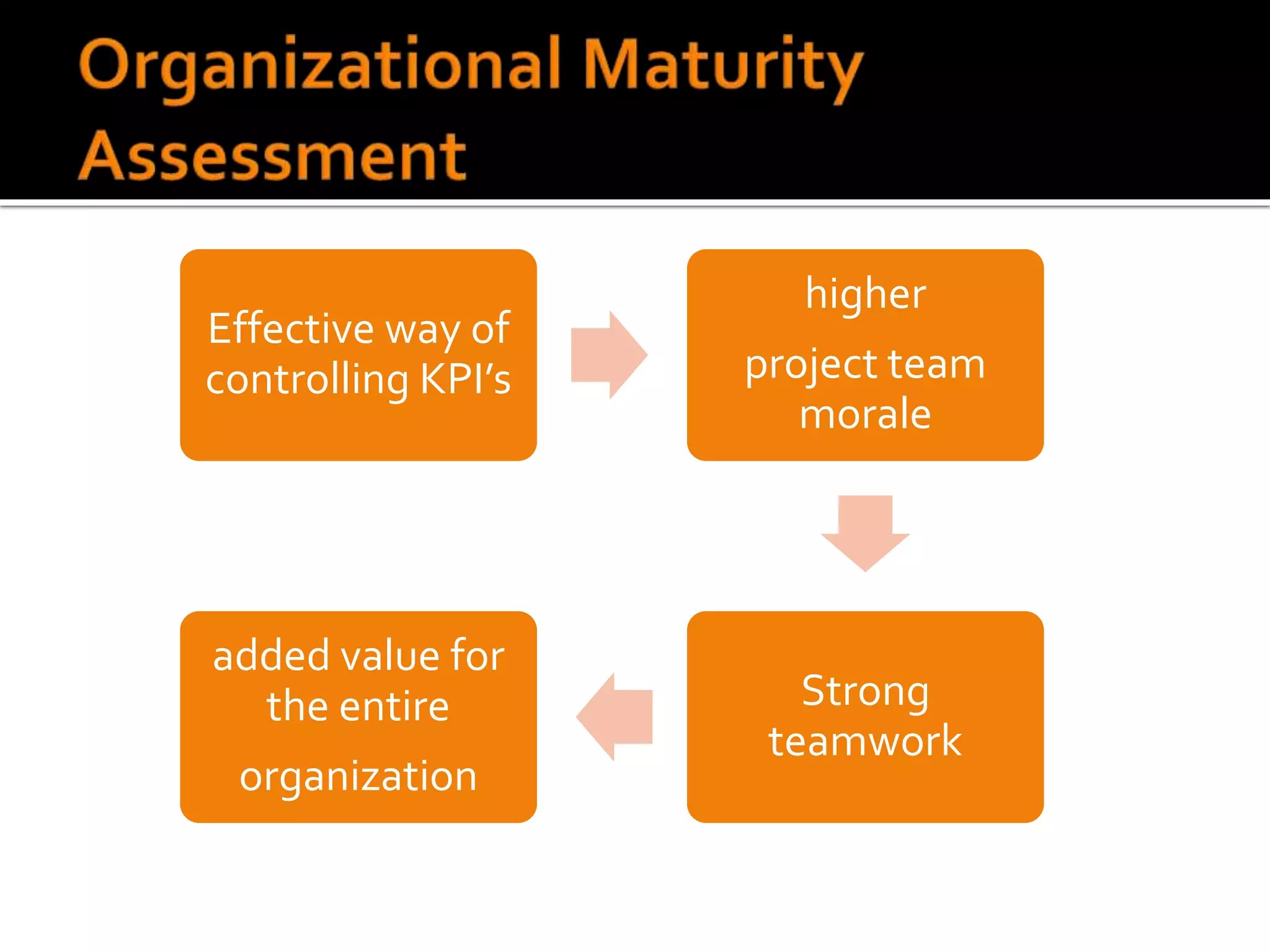
Effective way of
controlling KPI’s
higher
project team
morale
Strong
teamwork
added value for
the entire
organization
Organizations strive to
reach higher project
management maturity
because it is directly
correlated to improved
organizational performance.
The primary purpose of the
assessment is to :
It provides a model for staged
continuous improvement in project
management practices.
Organizational
Maturity
Assessment
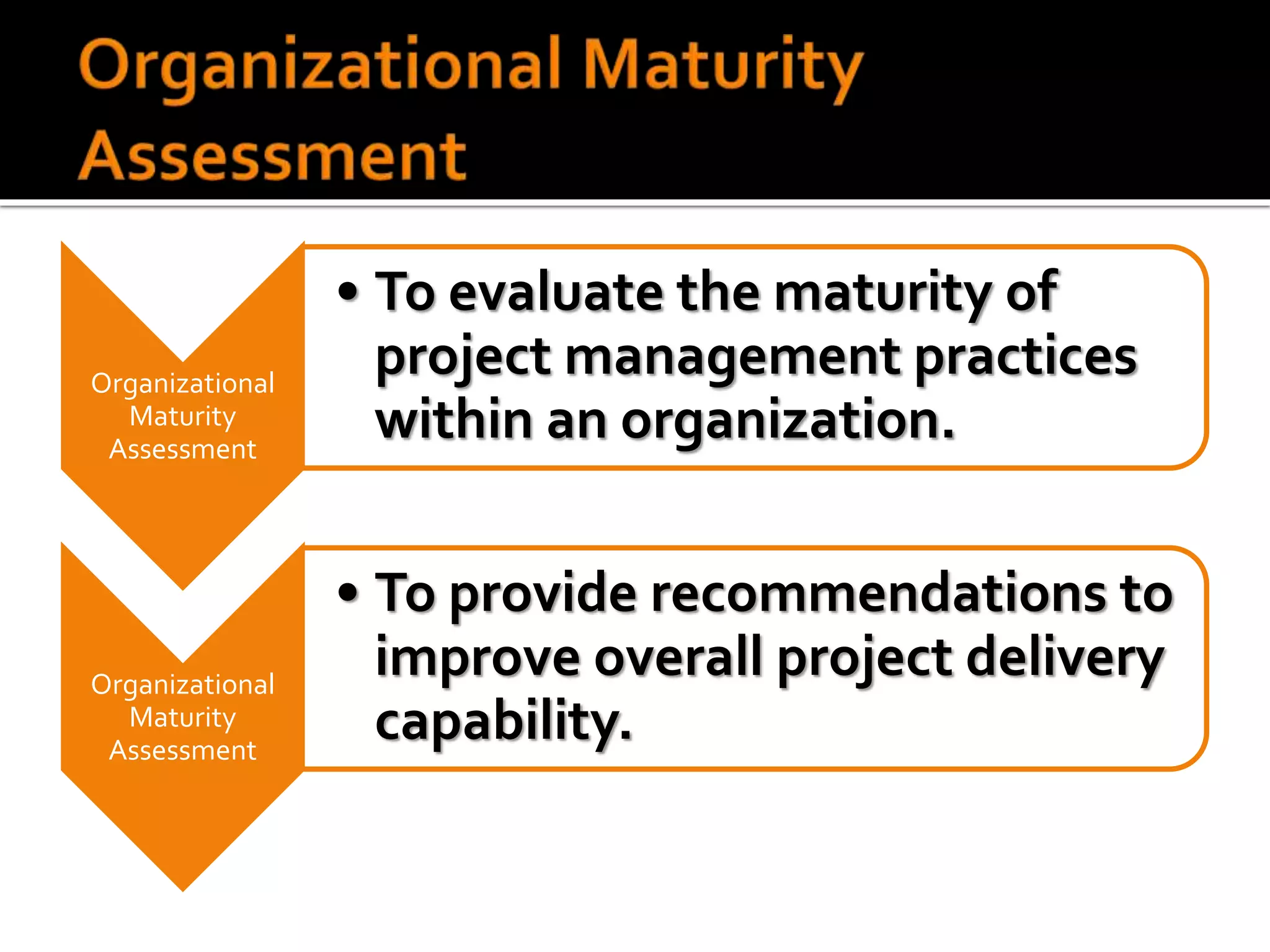
• To evaluate the maturity of
project management practices
within an organization.
Organizational
Maturity
Assessment
• To provide recommendations to
improve overall project delivery
capability.
Organizational
Maturity
Assessment
• A properly performed assessment can also
serve as the fulcrum of positive project
management change in the organization
(Bush and Dunaway, 2005).
Organizational
Maturity
Assessment
• Organizational project management maturity
assessments are designed to accomplish the
following objectives:
Organizational
Maturity
Assessment
• Measure the ability of the organization’s
collective project management staff to
repeatedly deliver projects that meet
specifications, on time and within budget.
Organizational
Maturity
Assessment
• Identify gaps in current project management
capabilities.
Organizational
Maturity
Assessment
• Provide a foundation for improvement and
guidance for advancement in project
management through prioritized, structured,
and sequential improvements.
Organizational
Maturity
Assessment
• Provide an indicator of how effective the
client’s organization is in meeting its goals in
managing projects and meeting business
objectives.
 A staged project management organizational
maturity model and maturity assessment
process is a project management oriented
approach, similar to other well-known
models, such as:
 the Software Engineering Institute Capability
Maturity Model (SEI CMM).
Organizational
Maturity
Assessment
• An effective project management maturity assessment
adheres to the generic concepts for effective change
that have been demonstrated to be successful for over a
decade across industry standard models, but focuses on
improving project management.
Organizational
Maturity
Assessment
• A project management organizational maturity model
describes the key elements of a fully effective project
management environment.
The five-level scale is a common practice for maturity models.
This commonality allows organizational ratings to be
compared across industries or even across models.
These elements are then used for benchmarking and
evaluation.
Level 1 –
Informal
Level 2 –
Documented
Level 3 –
Integrated
Level 4 –
Strategic
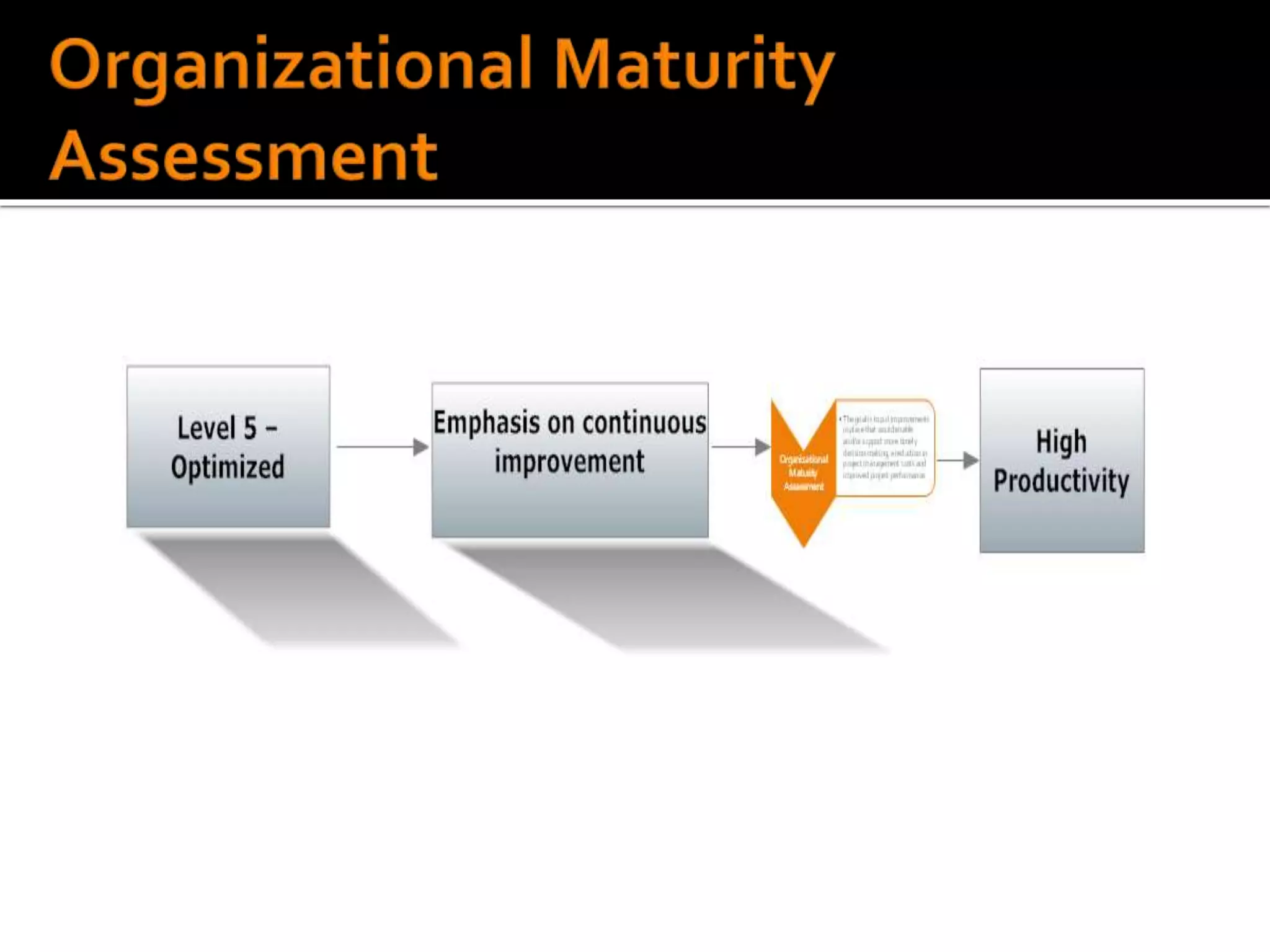
Level 5 –
Optimized
Projects are often successful because of competent staff and
their hard work.
At this level project management is characterized as ad hoc and
informal.
Project management practices are performed
inconsistently at different level.
Level-2 practices include those that bring about basic
management control.
Level 2-By implementing a corporate culture that supports the methods,
practices, and procedures of the project management practices.
Project management practices for organizations at level 2 are
documented and institutionalized across the organization.
Defining the scope of work in a charter or statement of
work (SOW) or other scope definition document and
breaking the scope of work in a graphical work
breakdown structure (WBS)
Integration
Scope,Time, Cost
Procurement
Management
Assigning resources and
estimating the work effort based
on:
Planning and scheduling the work
3-Also by adding , adding time to the base
estimates for them to switch between activities)
1-work interruption factors
2-skill factors, and the part-time effect (accounting
for when team members are working on multiple
activities simultaneously
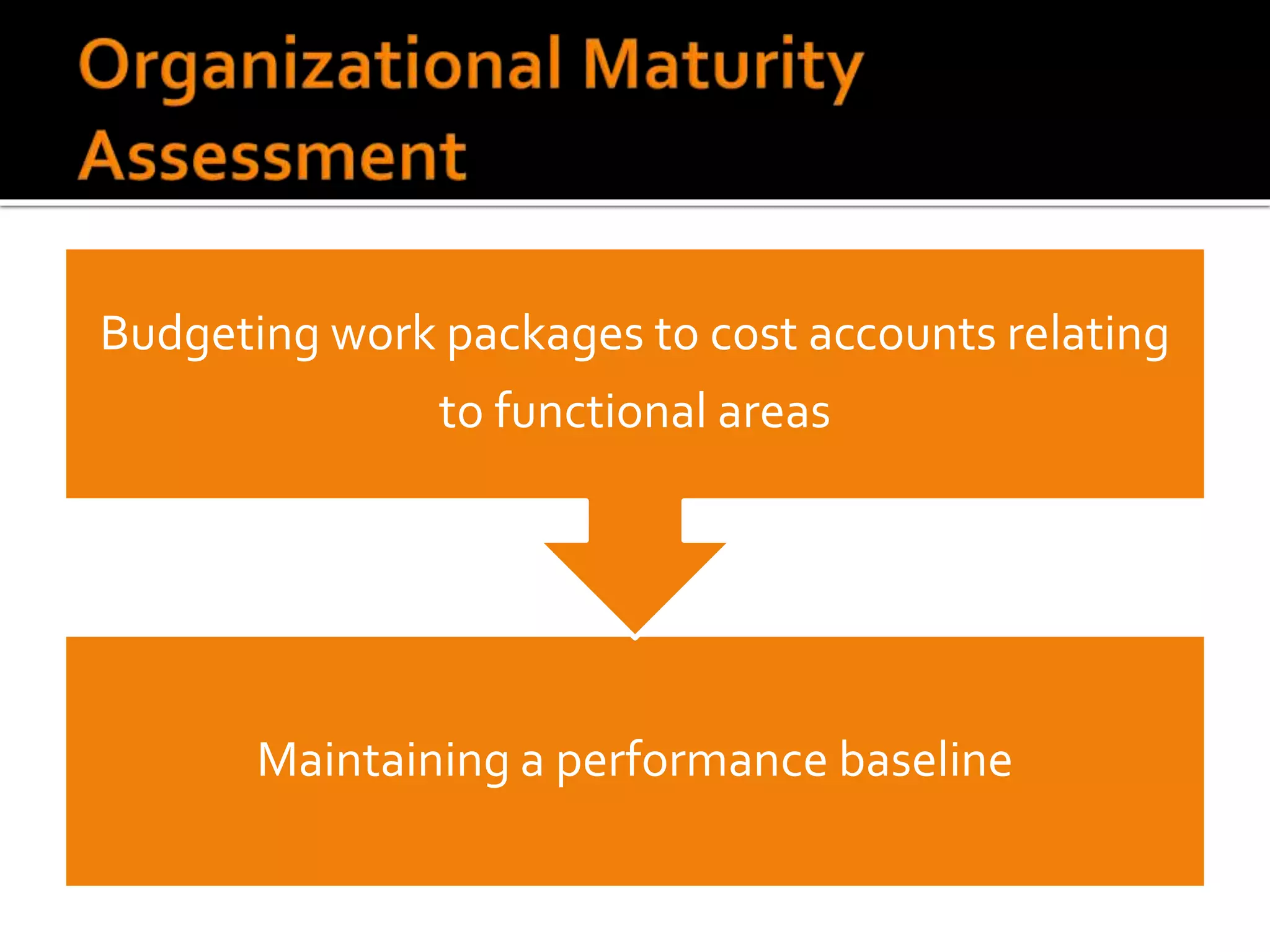
Maintaining a performance baseline
Budgeting work packages to cost accounts relating
to functional areas
Managing changes to the baseline and establishing
a new baseline when increase in scope is approved,
or performance indicates a new baseline is required
Monitoring performance against the baseline and
implementing corrective actions to maintain the
baseline
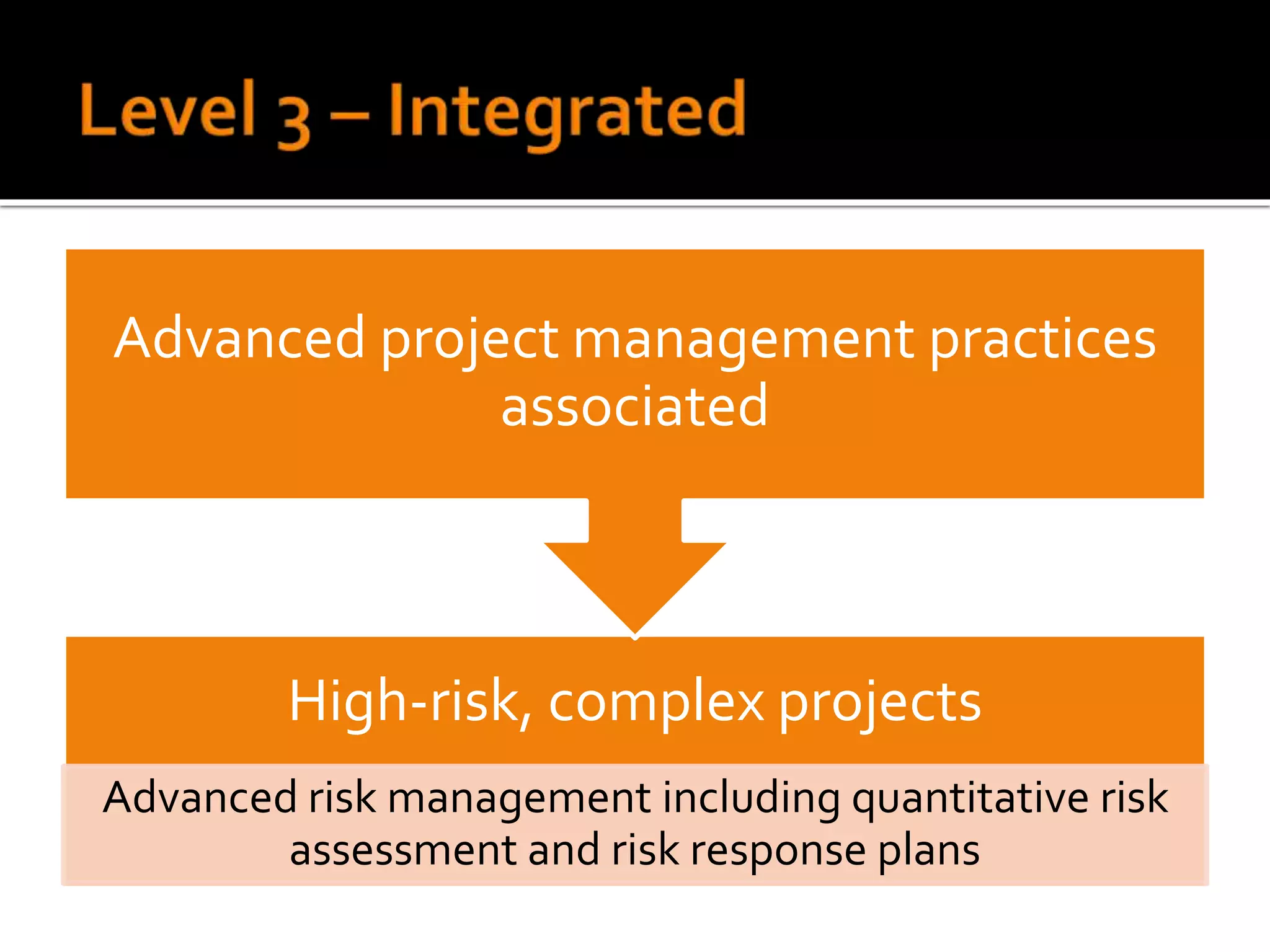
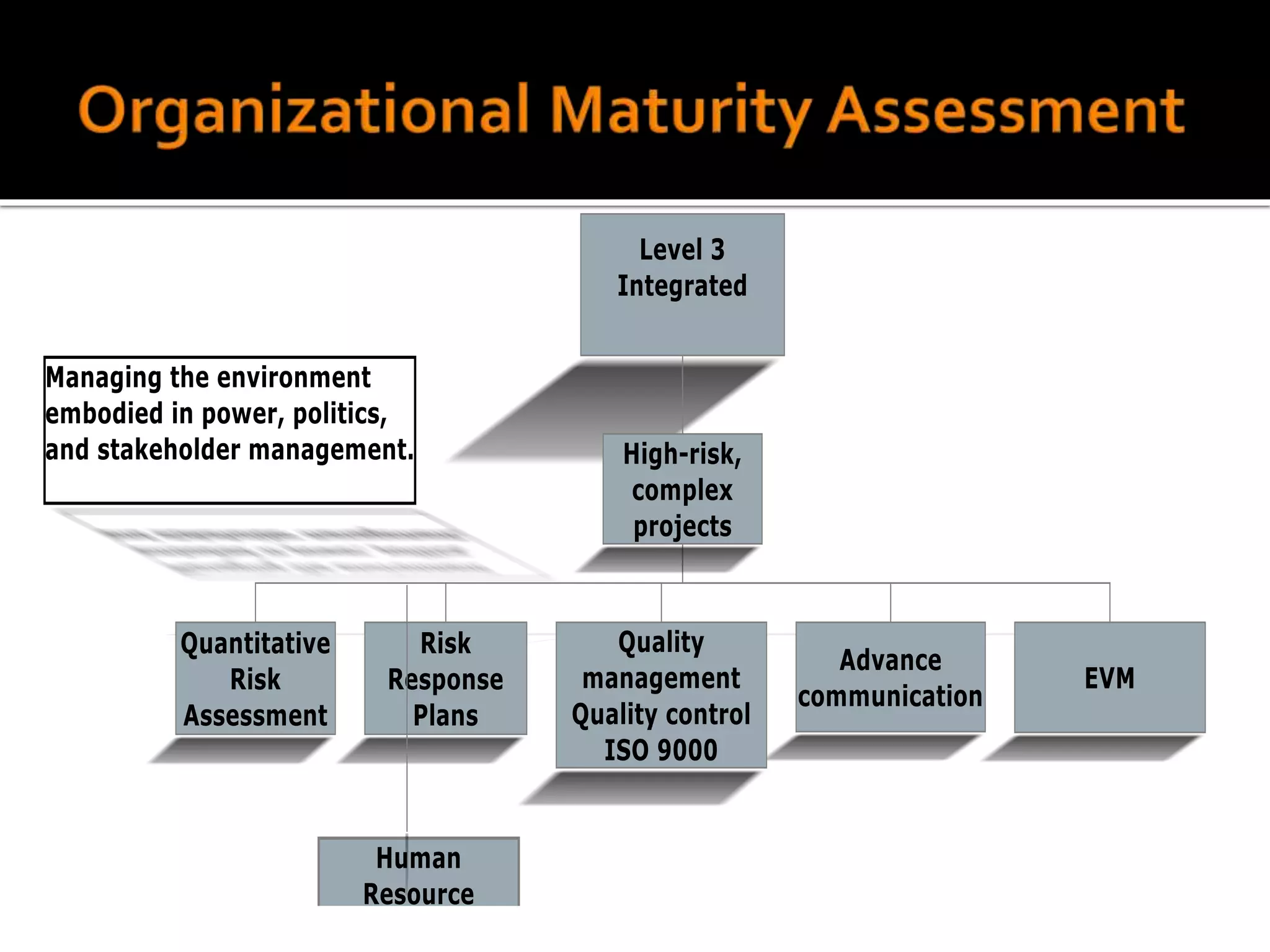
High-risk, complex projects
Advanced risk management including quantitative risk
assessment and risk response plans
Advanced project management practices
associated
Advanced communication techniques
including:
Measuring performance through
earned value management (EVM)
Quality management, including applying effective
quality control and quality assurance practices
Level 4 – Strategic
Managing the environment embodied in power,
politics, and stakeholder management.
Human resource management, involving building
and maintaining high-performing teams.
• An enterprise project management office
(EPMO) and departmental PMOs both of
which support management portfolio
decisions and project team execution.
• Robust strategic plans exist that are
converted to strategic goals and measured
through a corporate scorecard
Organizational
Maturity
Assessment
• Projects report against corporate scorecard
metrics.
Organizational
Maturity
Assessment
• Portfolio and resource management is
practiced including project selection and
prioritization an ongoing review and
management of the portfolio.
 Executive oversight is evidenced by periodic
project sponsor committees and control gate
reviews that are conducted at major project
milestones for reassessment of :
1. the project cost
2. Schedule
3. scope,
4. Quality
5. Risk
6. expected benefits to the organization followed
by go/no-go decisions to continue to invest in
the project
Organizational
Maturity
Assessment
• At this stage the organization demonstrates an
emphasis on continuous improvement to its project
management practices.
Organizational
Maturity
Assessment
• This level requires the organization to measure the
effectiveness of its project management
efforts/system and implement improvements to their
project management processes, tools and
techniques.
Organizational
Maturity
Assessment
• The goal is to put improvements
in place that would enable
and/or support more timely
decision-making, a reduction in
project management costs and
improved project performance.
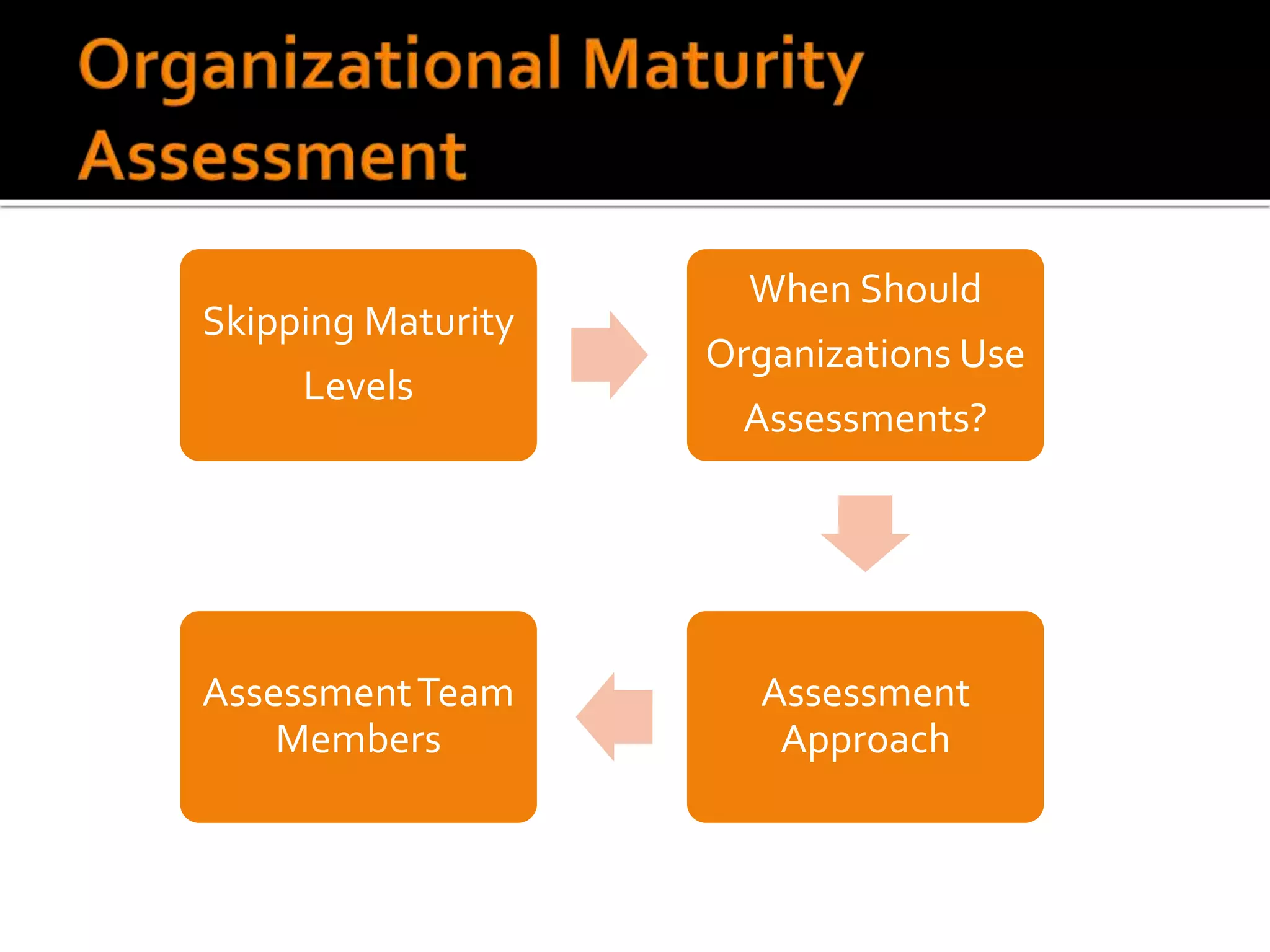
Skipping Maturity
Levels
When Should
Organizations Use
Assessments?
Assessment
Approach
AssessmentTeam
Members
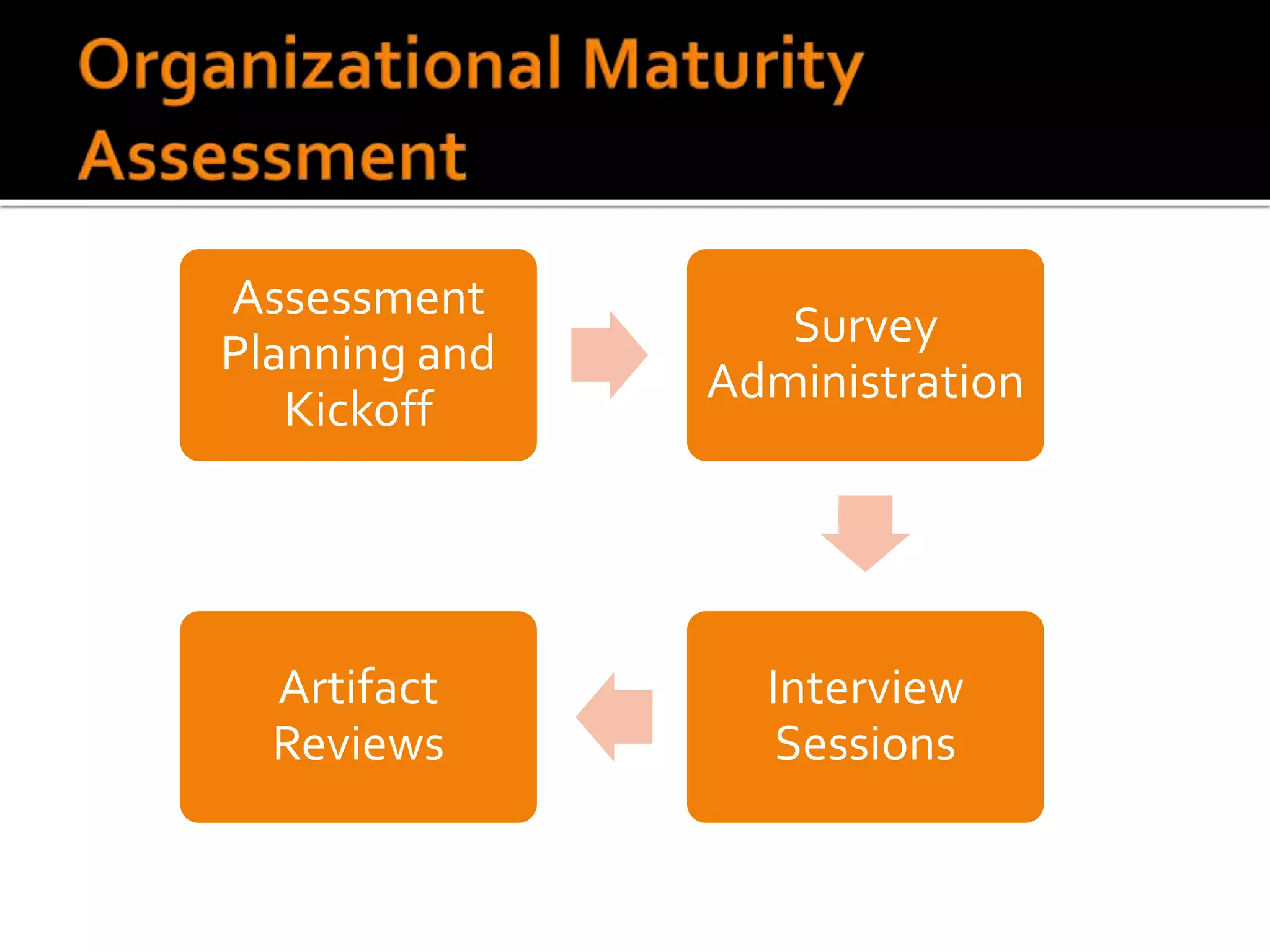
Assessment
Planning and
Kickoff
Survey
Administration
Interview
Sessions
Artifact
Reviews
Assessment
Findings
Final Maturity
Rating
Validation and
Prioritization
Assessment
Findings
Preparation
and Delivery
Keys to Using
Assessment Results
To learn more, visit
www.hp.com
071 Maturity Assessment

071 Maturity Assessment

  • 1.
  • 2.
  • 3.
    Organizational Maturity Assessment • Project managementis about managing change and achieving business objectives. Organizational Maturity Assessment • The rapidly changing work environments for many companies is pushing them to apply the principles and practices of modern project management.
  • 4.
    Organizational Maturity Assessment • It isthrough successful completion of projects that organizations add value to better serve their clients. Organizational Maturity Assessment • It is about how competitive they are in nation and international market.
  • 5.
    There are restrictedsources of funding the company is willing to invest in new/improved products, services, business process, and technology. There are limited resources available to companies.
  • 6.
    Due to theseorganizational and budgetary constraints, management team must not only make the difficult decisions to select only certain projects for execution, but to defer or cancel others as well.
  • 7.
    Strong management team leads to: more effectivebusiness procedures higher quality deliverables lower project costs
  • 8.
    Effective way of controllingKPI’s higher project team morale Strong teamwork added value for the entire organization
  • 9.
    Organizations strive to reachhigher project management maturity because it is directly correlated to improved organizational performance.
  • 10.
    The primary purposeof the assessment is to : It provides a model for staged continuous improvement in project management practices.
  • 11.
    Organizational Maturity Assessment • To evaluatethe maturity of project management practices within an organization. Organizational Maturity Assessment • To provide recommendations to improve overall project delivery capability.
  • 12.
    Organizational Maturity Assessment • A properlyperformed assessment can also serve as the fulcrum of positive project management change in the organization (Bush and Dunaway, 2005). Organizational Maturity Assessment • Organizational project management maturity assessments are designed to accomplish the following objectives:
  • 13.
    Organizational Maturity Assessment • Measure theability of the organization’s collective project management staff to repeatedly deliver projects that meet specifications, on time and within budget. Organizational Maturity Assessment • Identify gaps in current project management capabilities.
  • 14.
    Organizational Maturity Assessment • Provide afoundation for improvement and guidance for advancement in project management through prioritized, structured, and sequential improvements. Organizational Maturity Assessment • Provide an indicator of how effective the client’s organization is in meeting its goals in managing projects and meeting business objectives.
  • 15.
     A stagedproject management organizational maturity model and maturity assessment process is a project management oriented approach, similar to other well-known models, such as:  the Software Engineering Institute Capability Maturity Model (SEI CMM).
  • 16.
    Organizational Maturity Assessment • An effectiveproject management maturity assessment adheres to the generic concepts for effective change that have been demonstrated to be successful for over a decade across industry standard models, but focuses on improving project management. Organizational Maturity Assessment • A project management organizational maturity model describes the key elements of a fully effective project management environment.
  • 17.
    The five-level scaleis a common practice for maturity models. This commonality allows organizational ratings to be compared across industries or even across models. These elements are then used for benchmarking and evaluation.
  • 18.
    Level 1 – Informal Level2 – Documented Level 3 – Integrated Level 4 – Strategic Level 5 – Optimized
  • 19.
    Projects are oftensuccessful because of competent staff and their hard work. At this level project management is characterized as ad hoc and informal. Project management practices are performed inconsistently at different level.
  • 20.
    Level-2 practices includethose that bring about basic management control. Level 2-By implementing a corporate culture that supports the methods, practices, and procedures of the project management practices. Project management practices for organizations at level 2 are documented and institutionalized across the organization.
  • 21.
    Defining the scopeof work in a charter or statement of work (SOW) or other scope definition document and breaking the scope of work in a graphical work breakdown structure (WBS) Integration Scope,Time, Cost Procurement Management
  • 22.
    Assigning resources and estimatingthe work effort based on: Planning and scheduling the work
  • 23.
    3-Also by adding, adding time to the base estimates for them to switch between activities) 1-work interruption factors 2-skill factors, and the part-time effect (accounting for when team members are working on multiple activities simultaneously
  • 24.
    Maintaining a performancebaseline Budgeting work packages to cost accounts relating to functional areas
  • 25.
    Managing changes tothe baseline and establishing a new baseline when increase in scope is approved, or performance indicates a new baseline is required Monitoring performance against the baseline and implementing corrective actions to maintain the baseline
  • 26.
    High-risk, complex projects Advancedrisk management including quantitative risk assessment and risk response plans Advanced project management practices associated
  • 27.
    Advanced communication techniques including: Measuringperformance through earned value management (EVM) Quality management, including applying effective quality control and quality assurance practices
  • 28.
    Level 4 –Strategic Managing the environment embodied in power, politics, and stakeholder management. Human resource management, involving building and maintaining high-performing teams.
  • 29.
    • An enterpriseproject management office (EPMO) and departmental PMOs both of which support management portfolio decisions and project team execution. • Robust strategic plans exist that are converted to strategic goals and measured through a corporate scorecard
  • 30.
    Organizational Maturity Assessment • Projects reportagainst corporate scorecard metrics. Organizational Maturity Assessment • Portfolio and resource management is practiced including project selection and prioritization an ongoing review and management of the portfolio.
  • 31.
     Executive oversightis evidenced by periodic project sponsor committees and control gate reviews that are conducted at major project milestones for reassessment of : 1. the project cost 2. Schedule 3. scope, 4. Quality 5. Risk 6. expected benefits to the organization followed by go/no-go decisions to continue to invest in the project
  • 32.
    Organizational Maturity Assessment • At thisstage the organization demonstrates an emphasis on continuous improvement to its project management practices. Organizational Maturity Assessment • This level requires the organization to measure the effectiveness of its project management efforts/system and implement improvements to their project management processes, tools and techniques.
  • 33.
    Organizational Maturity Assessment • The goalis to put improvements in place that would enable and/or support more timely decision-making, a reduction in project management costs and improved project performance.
  • 34.
    Skipping Maturity Levels When Should OrganizationsUse Assessments? Assessment Approach AssessmentTeam Members
  • 35.
  • 36.
  • 37.
    Keys to Using AssessmentResults To learn more, visit www.hp.com