For Business Analysts Craig Brown www.betterprojects.net
Business Analyst Training My agenda To explain the role of the business analyst,  To discuss the methodology described in the BABOK To discuss practical tips and techniques for doing the job well  To review sample requirements specifications to get an appreciation of what goes into them To provide a list of further resources analysts can call upon for help Your agenda
The Business Analyst  Context > Role > Skills Context Projects and SDLC Why projects go wrong  Project team roles 8.15-9.45 What BA’s do Requirements Management Business Processes Human change management Project Portfolio Planning 10.00-11.00 Practical skills Technical skills Analysis exercise Questions and discussion 11.15-12.15 break break
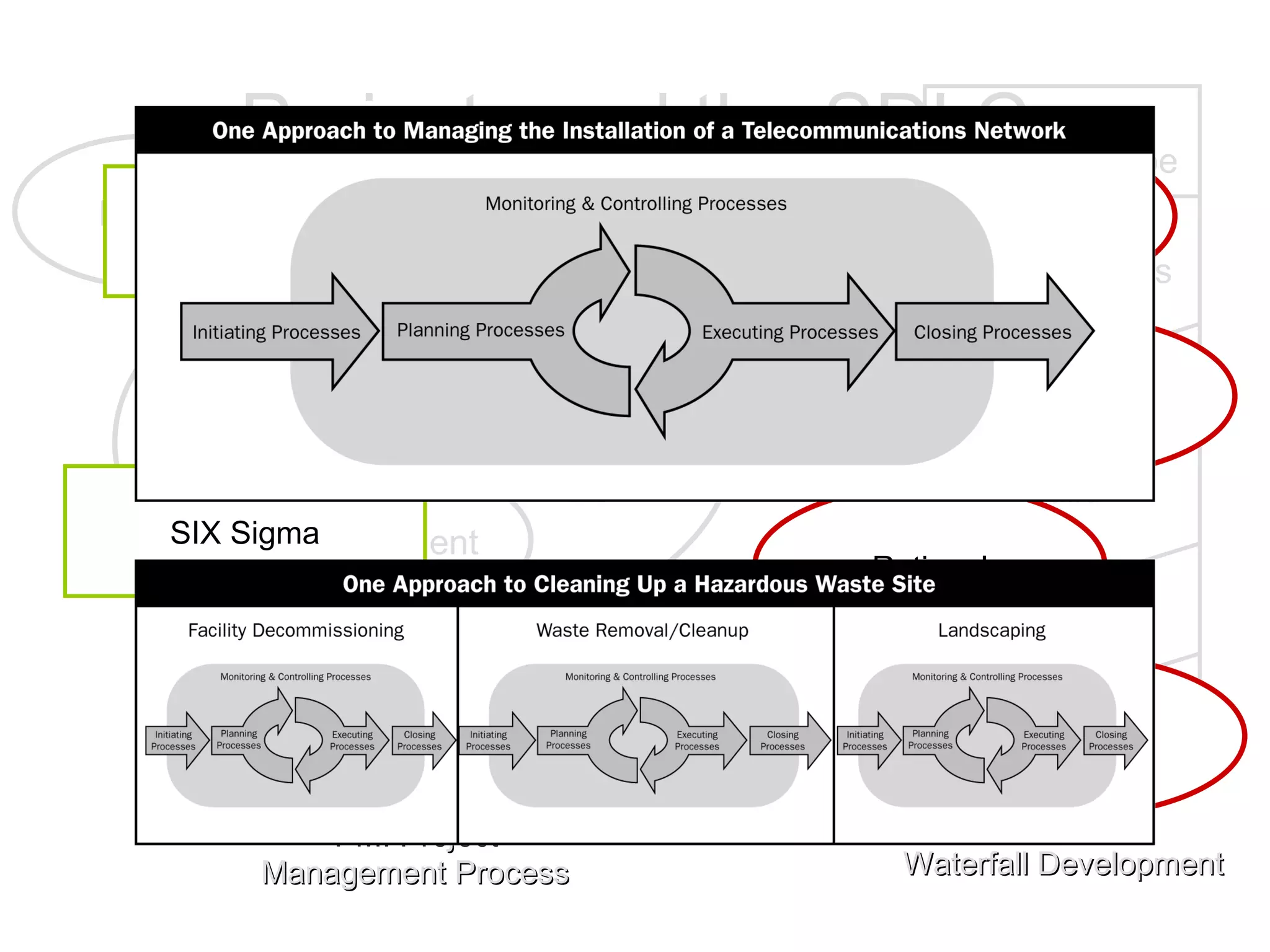
Projects and the SDLC Release Test Close Build Design Requirements Product Scope PMI Project Management Process Waterfall Development Initiate Plan Monitor & Control Implement
Projects and the SDLC Product Scope Release Test Initiate Close Build Design Requirements PMI Project Management Process Waterfall Development SCRUM PRINCE2 SIX Sigma Agile RAD Rational Etc. Etc. Plan Monitor & Control Implement
Projects and the SDLC Release Test Initiate Close Build Design Requirements Product Scope PMI Project Management Process Waterfall Development SCRUM PRINCE2 SIX Sigma Agile RAD Rational Etc. Etc. Plan Do Check Act Plan Monitor & Control Implement
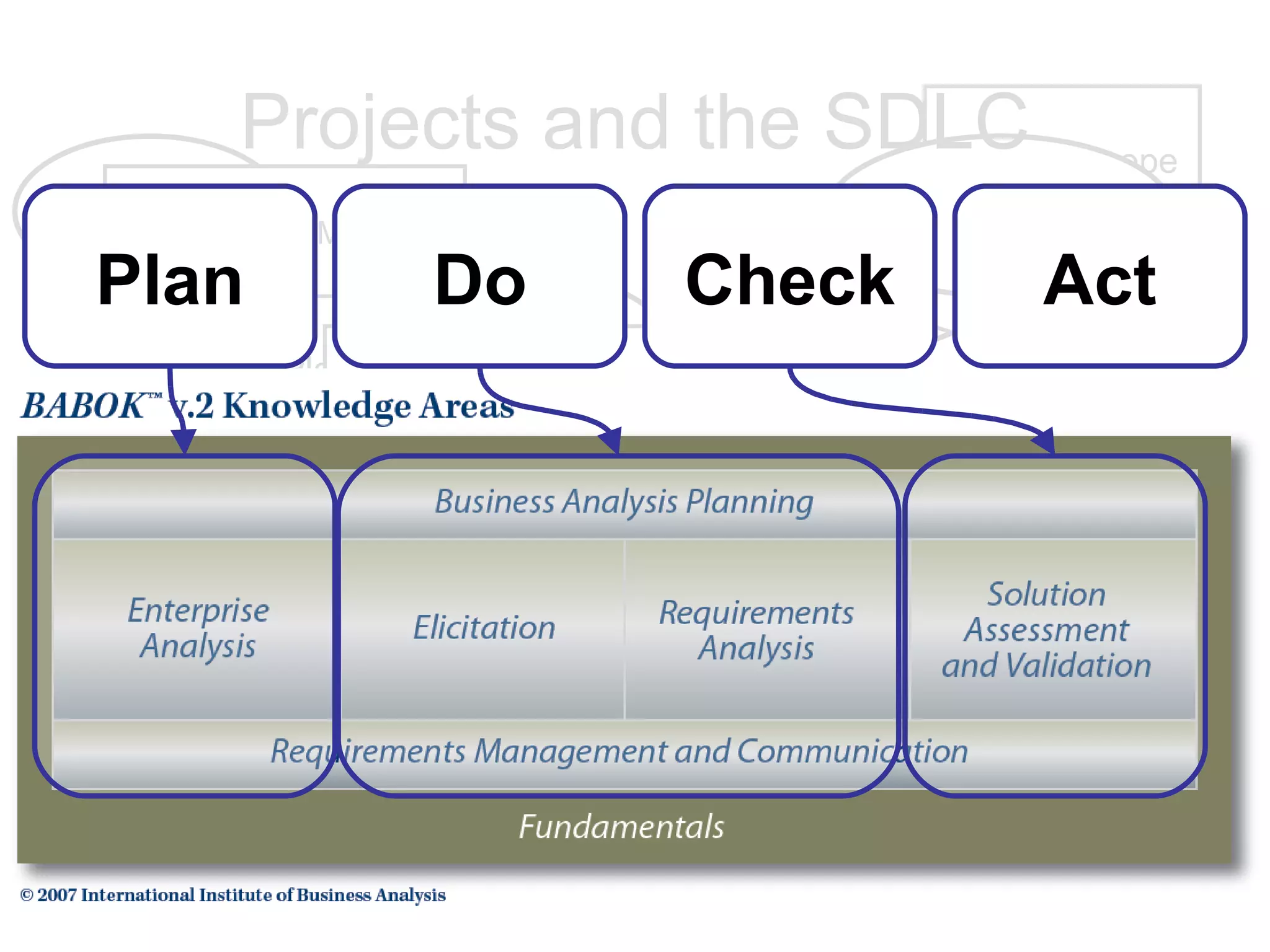
Business Analysis and the BABOK Release Test Initiate Close Build Design Requirements Product Scope PMI Project Management Process Waterfall Development SCRUM PRINCE2 SIX Sigma Agile RAD Rational Etc. Etc. Plan Do Check Act Plan Monitor & Control Implement
Projects and the SDLC Release Test Initiate Close Build Design Requirements Product Scope PMI Project Management Process Waterfall Development SCRUM PRINCE2 SIX Sigma Agile RAD Rational Etc. Etc. Plan Do Check Act Plan Monitor & Control Implement
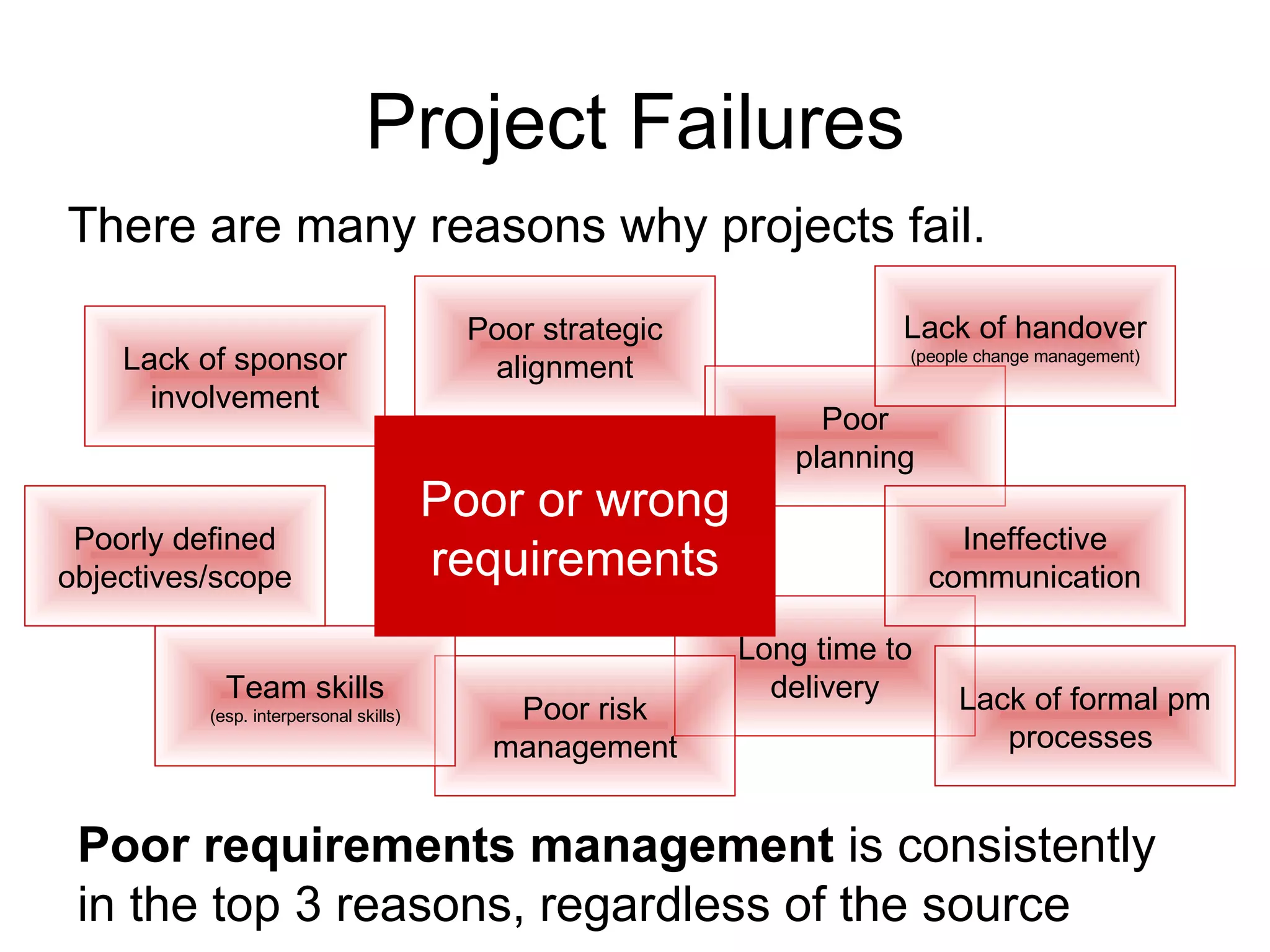
Project Failures There are many reasons why projects fail. Poor strategic alignment Long time to delivery Poor risk management Poor planning Lack of sponsor involvement Ineffective communication Lack of handover (people change management) Team skills (esp. interpersonal skills) Poor requirements management  is consistently in the top 3 reasons, regardless of the source Lack of formal pm processes  Poorly defined objectives/scope Poor or wrong requirements
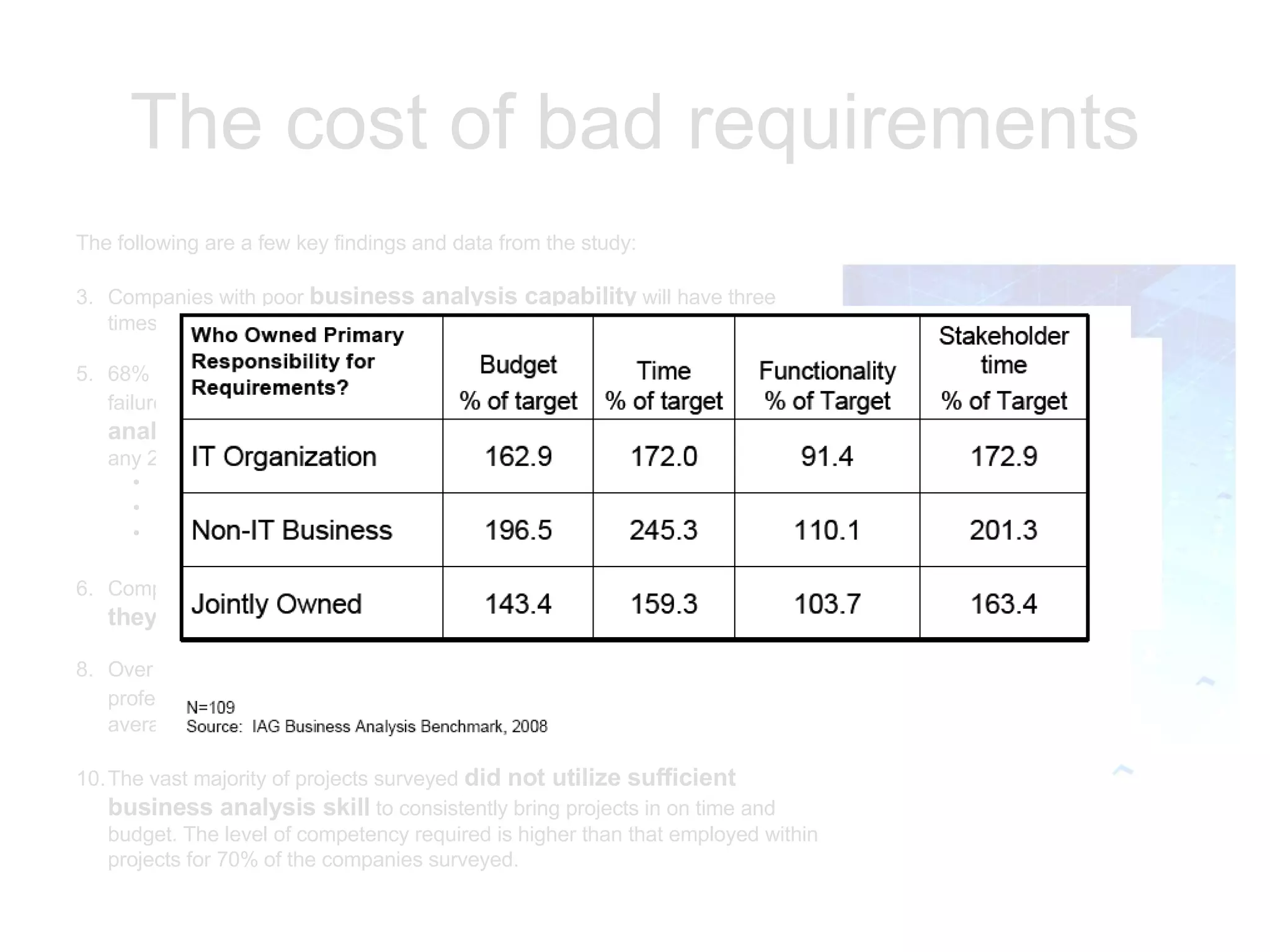
The cost of bad requirements The following are a few key findings and data from the study: Companies with poor  business analysis capability  will have three times as many project failures as successes. 68% of companies are more likely to have a marginal project or outright failure than a success due to  the way they approach business analysis . In fact, 50% of this group’s projects were “runaways” which had any 2 of: Taking over 180% of target time to deliver. Consuming in excess of 160% of estimated budget. Delivering under 70% of the target required functionality. Companies pay a premium of as much as 60% on time and budget  when they use poor requirements  practices on their projects. Over 41% of the IT development budget for software, staff and external professional services will be  consumed by poor requirements  at the average company using average analysts versus the optimal organization. The vast majority of projects surveyed  did not utilize sufficient business analysis skill  to consistently bring projects in on time and budget. The level of competency required is higher than that employed within projects for 70% of the companies surveyed.
The cost of bad requirements The following are a few key findings and data from the study: Companies with poor  business analysis capability  will have three times as many project failures as successes. 68% of companies are more likely to have a marginal project or outright failure than a success due to  the way they approach business analysis . In fact, 50% of this group’s projects were “runaways” which had any 2 of: Taking over 180% of target time to deliver. Consuming in excess of 160% of estimated budget. Delivering under 70% of the target required functionality. Companies pay a premium of as much as 60% on time and budget  when they use poor requirements  practices on their projects. Over 41% of the IT development budget for software, staff and external professional services will be  consumed by poor requirements  at the average company using average analysts versus the optimal organization. The vast majority of projects surveyed  did not utilize sufficient business analysis skill  to consistently bring projects in on time and budget. The level of competency required is higher than that employed within projects for 70% of the companies surveyed. Requirements Professionals ? ? ? ?
Project Failures IAG report can be accesse at iag.biz
Requirements Failures The volume and complexity of  stakeholders Stakeholder expectations & involvement Who is managing the requirements - skills of the requirements team Process  Not deliverables
Requirements Failures Avoid requirements failure by doing these things; Feedback Have developers feed back their interpretation of requirements to the stakeholders and clients. Do it early and often. Use workshops, wireframes, prototypes, or documents, but do it. Bring people together Bring the subject matter experts and requirements owners into the same room as the developers. Get them talking to each other. If you can't be in the same room, arrange regular meetings. Don't rely on written communication. The right Requirements team Make sure your BAs are trained and highly skilled at requirements management (ie not just elicitation, but the whole shebang.)  Practical   tips
Project Team Roles
Project Team Roles Sponsor Project Manager Business Analyst Change Manager Quality Solutions Team Liaison Roles Process Analysts Trainers Testers Solutions Architects SMEs Systems Analysts Technical Writers Users Designers Developers
Sponsor Project Manager Change Manager Quality Liaison Roles Process Analysts Trainers Testers Solutions Architects SMEs Systems Analysts Technical Writers Users Designers Developers Business Analyst
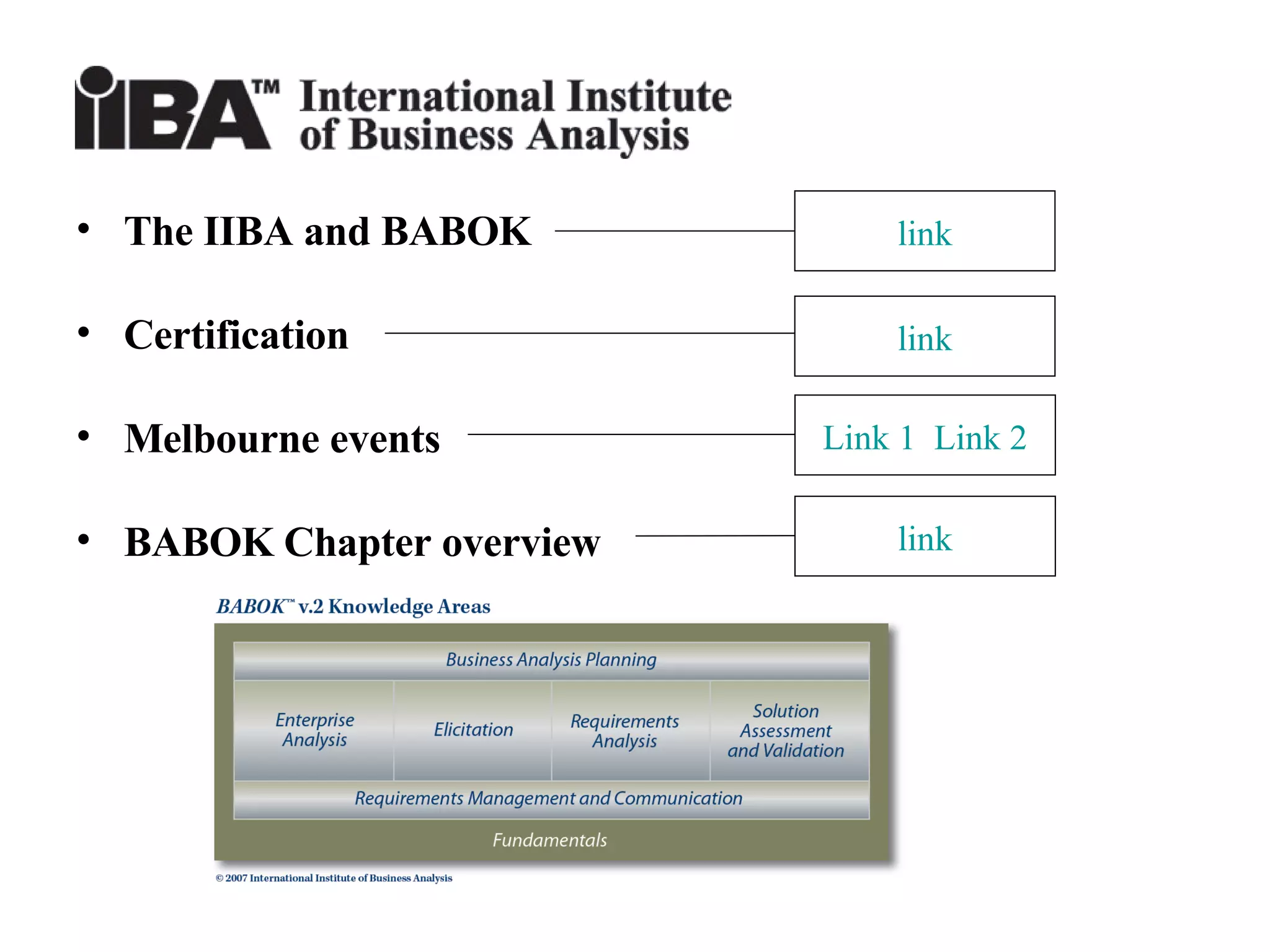
The IIBA and BABOK Certification Melbourne events BABOK Chapter overview   link link link Link 1   Link 2
break
WHAT DOES A BA DO? Requirements Management Business Processes People Change Management Project Portfolio Planning
Requirements Management
MATURITY LEVELS (SEI/IEEE) Chaos  Written requirements Organized Structured Integrated
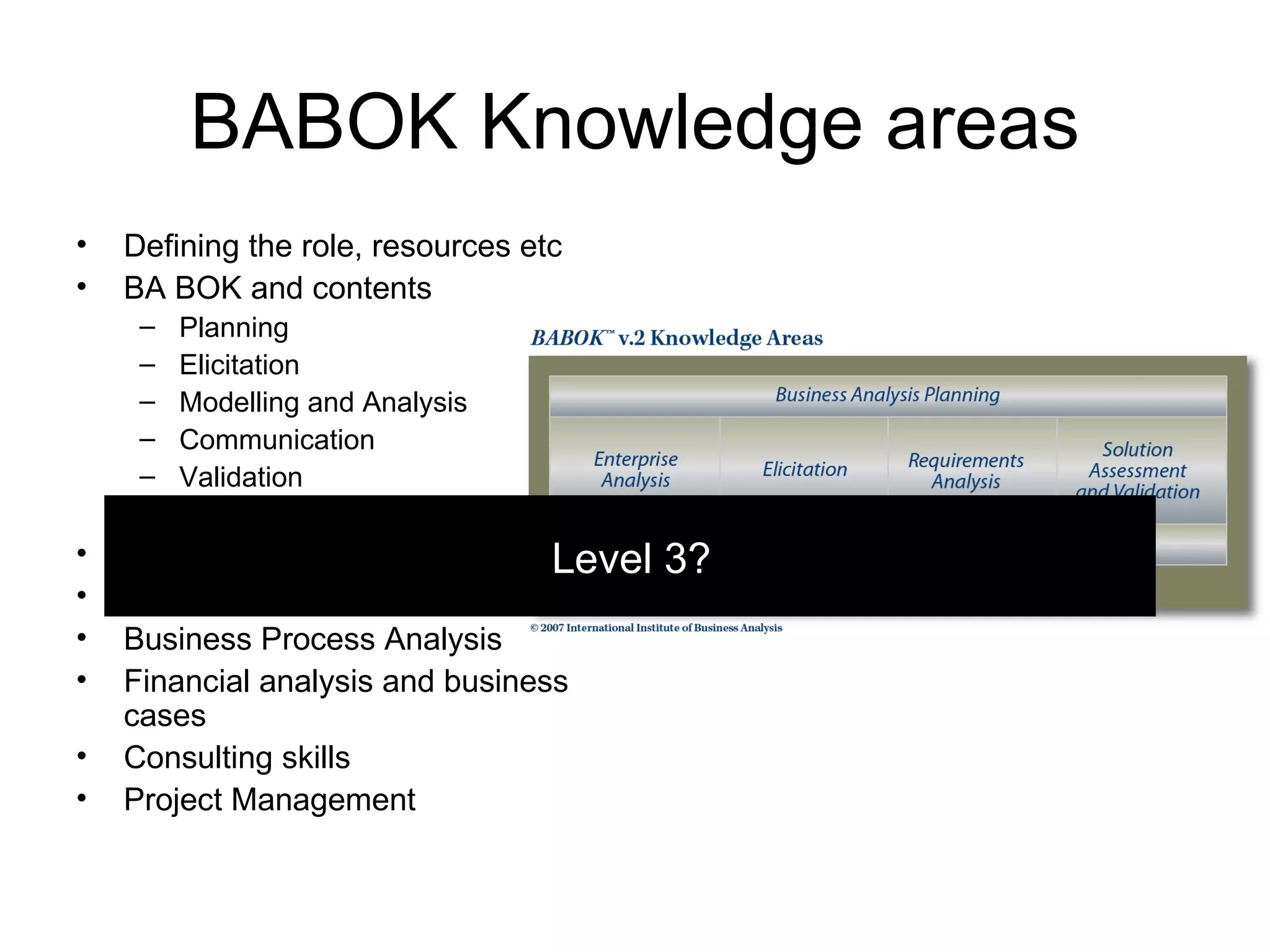
BABOK Knowledge areas Defining the role, resources etc BA BOK and contents Planning Elicitation Modelling and Analysis Communication Validation Verification Enterprise analysis Strategy and Structure  Business Process Analysis  Financial analysis and business cases Consulting skills Project Management Level 3?
BABOK Knowledge areas Defining the role, resources etc BA BOK and contents Planning Elicitation Modelling and Analysis Communication Validation Verification Enterprise analysis Strategy and structure  Business process analysis  Financial analysis and business cases Consulting skills Project management
Basic Skills Requirements Management Planning Elicitation Communication Verification Validation Plan Do Check Act
Requirements integrity Level 4? Guy Beauchamp Modern Analyst
Requirements integrity Guy Beauchamp Modern Analyst
Beautiful Requirements ? ? ? ? ? ? ? ? ? ? ? ? ? ? ? ? ? ? ? ? ? ? ? ? ? ? ? ? ? ? ? ? ? ? ? ? ? ? ? ? ? ? ? ? ? ? ? ? ? ? ? ? ? ? ? ? ? ? ? ? ? ? ? ? ? ? ? ? ? ? ? ? ? ? ? ? ? ? ? ? ? ? ? ? ? ? ? ? ? ? ? ? ? ? ? ? ? ? ? ? ? ? ? ? ? ? ? ? ? ? ? ? ? ? ? ? ? ? ? ? ? ? ? ? ? ? ? ? ? ? ? ? ? ? ? ? ? ? ? ? ? ? ? ? ? ? ? ? ? ? ? ? ? ? ? ? ? ? ? ? ? ? ? ? ? ? ? ? ? ? ? ? ? ? ? ? ? ? ? ? ? ? ? ? ? ? ? ? ? ? ? ? ? ? ? ? ? ? ? ? ? ? ? ? ? ? ? ? ? ? ? ? ? ? ? ? ? ? ? ? ? Level 5?
WHAT DOES A BA DO? Understand the stakeholders Break work down to activity level Who does what, when and why? Get lots of feedback (validation) Manage expectations throughout the process should Requirements management
Basic Skills Requirements Management Planning Elicitation Communication Verification Validation
Requirements Planning Plan before you act Lack of Completeness is the greatest source of requirements problems Incorrect Requirements is also an issue Know the stakeholders, know their business Break your work down to detailed tasks Plans change
Requirements Elicitation Desk research Interviews  Workshops Models Flow charts (Swim Lanes) Use Cases (with stories)  Context Diagrams State Transition Remember Activity Level Method H
Requirements Communication Know who needs to know Have enough time to communicate effectively Communicate through the whole lifecycle No surprises, Bad news early Plan your communication
Requirements Verification Document Reviews 3 day review cycles don’t always work well Tell people in advance Reviews and Inspections are one of the most effective methods of Requirements QA  Walkthrough workshops have strengths and weaknesses S: Group Synergies W: Time and effort Peer Review, Manager Review, Tester Review Look for completeness and accuracy (in   that order)
Requirements Validation Testing V-Model and Agile both highlight test driven development, beginning with requirements.  Waterfall also relies heavily on testing (% of time/effort) UAT BA role in planning, participating, assessing impact of bugs, troubleshooting, workarounds, stakeholders expectations Business Acceptance Contract perspective, Responsibilities of both project and business, Overlapping period Validation is done by people. Take them on the journey.
Designer/Programmer Scope/ High level requirements Workshops and Interviews Identify Constraints Revise Scope/Bus Case Identify Stakeholders Document Business Requirements Approve Business Requirements Solution Design Assess Design Requirements Management Change Management BA activities RTM UAT Ready for Service Change Mgt Plan Comms Plan Training Business person IT BA Bus BA Systems Analyst Business Analyst Stakeholders IT managers, Infrastructure and network SMEs Stakeholders Business Managers and SMEs PM
Business Processes
3 Things Use cases Swim lanes Context diagrams
Use Cases Case user Tyner Blain:  Use Cases
Swim lanes Actor 1 Actor 2 Actor 3 Actor 4 Verb/noun Binary decisions Activity level participants Boundaries Hand-over Begin and end in same lane
Context diagrams Information flow External Internal Drilling down Context Boundary
… and UML Diagram from Wikipedia
… and UML Diagram from Wikipedia UML is for solution design
People Change Management
Changing people Lewin:  Unfreeze > Freeze Maister:  The Fat Smoker Prosci: ADKAR Aware Desire Knowledge Ability Reinforce
Changing people Aware Desire Knowledge Ability Reinforce Stakeholder 1 A D K A R Stakeholder 2 A D K A R Stakeholder 3 A D K A R Stakeholder 4 A D K A R Stakeholder 5 A D K A R
Project Portfolio Planning
Project Portfolio Management Enterprise Analysis Defining the opportunity Solution Strategies Business Cases Benefits management Enterprise Architecture Information Management  Application Planning Business Process
break
workshop Break into groups Review examples Present feedback
workshop What makes good requirements? Quality of documentation Completeness Accuracy Clarity The difference between requirements and design Management through the process Reviewing Requirements
Resources IIBA New, but growing in influence.  BOKS BA BOK PM BOK Others Modern Analyst Articles, Forums, etc Ed Yourdon JESA TynerBlain  – Structured analysis BetterProjects
Modern Analyst Articles Forums Templates Other resources
Ed Yourdon Website Blog Structured Analysis Wiki Free download of his JESA ` book And much more
Tyner Blain Software development Requirements management Product management See Structured analysis  and  Use Cases Scott Sehlhorst, Austin Texas

Business Analyst Training

  • 1.
    For Business AnalystsCraig Brown www.betterprojects.net
  • 2.
    Business Analyst TrainingMy agenda To explain the role of the business analyst, To discuss the methodology described in the BABOK To discuss practical tips and techniques for doing the job well To review sample requirements specifications to get an appreciation of what goes into them To provide a list of further resources analysts can call upon for help Your agenda
  • 3.
    The Business Analyst Context > Role > Skills Context Projects and SDLC Why projects go wrong Project team roles 8.15-9.45 What BA’s do Requirements Management Business Processes Human change management Project Portfolio Planning 10.00-11.00 Practical skills Technical skills Analysis exercise Questions and discussion 11.15-12.15 break break
  • 4.
    Projects and theSDLC Release Test Close Build Design Requirements Product Scope PMI Project Management Process Waterfall Development Initiate Plan Monitor & Control Implement
  • 5.
    Projects and theSDLC Release Test Close Build Design Requirements Product Scope PMI Project Management Process Waterfall Development Initiate Plan Monitor & Control Implement
  • 6.
    Projects and theSDLC Product Scope Release Test Initiate Close Build Design Requirements PMI Project Management Process Waterfall Development SCRUM PRINCE2 SIX Sigma Agile RAD Rational Etc. Etc. Plan Monitor & Control Implement
  • 7.
    Projects and theSDLC Product Scope Release Test Initiate Close Build Design Requirements PMI Project Management Process Waterfall Development SCRUM PRINCE2 SIX Sigma Agile RAD Rational Etc. Etc. Plan Monitor & Control Implement
  • 8.
    Projects and theSDLC Release Test Initiate Close Build Design Requirements Product Scope PMI Project Management Process Waterfall Development SCRUM PRINCE2 SIX Sigma Agile RAD Rational Etc. Etc. Plan Do Check Act Plan Monitor & Control Implement
  • 9.
    Business Analysis andthe BABOK Release Test Initiate Close Build Design Requirements Product Scope PMI Project Management Process Waterfall Development SCRUM PRINCE2 SIX Sigma Agile RAD Rational Etc. Etc. Plan Do Check Act Plan Monitor & Control Implement
  • 10.
    Projects and theSDLC Release Test Initiate Close Build Design Requirements Product Scope PMI Project Management Process Waterfall Development SCRUM PRINCE2 SIX Sigma Agile RAD Rational Etc. Etc. Plan Do Check Act Plan Monitor & Control Implement
  • 11.
    Project Failures Thereare many reasons why projects fail. Poor strategic alignment Long time to delivery Poor risk management Poor planning Lack of sponsor involvement Ineffective communication Lack of handover (people change management) Team skills (esp. interpersonal skills) Poor requirements management is consistently in the top 3 reasons, regardless of the source Lack of formal pm processes Poorly defined objectives/scope Poor or wrong requirements
  • 12.
    The cost ofbad requirements The following are a few key findings and data from the study: Companies with poor business analysis capability will have three times as many project failures as successes. 68% of companies are more likely to have a marginal project or outright failure than a success due to the way they approach business analysis . In fact, 50% of this group’s projects were “runaways” which had any 2 of: Taking over 180% of target time to deliver. Consuming in excess of 160% of estimated budget. Delivering under 70% of the target required functionality. Companies pay a premium of as much as 60% on time and budget when they use poor requirements practices on their projects. Over 41% of the IT development budget for software, staff and external professional services will be consumed by poor requirements at the average company using average analysts versus the optimal organization. The vast majority of projects surveyed did not utilize sufficient business analysis skill to consistently bring projects in on time and budget. The level of competency required is higher than that employed within projects for 70% of the companies surveyed.
  • 13.
    The cost ofbad requirements The following are a few key findings and data from the study: Companies with poor business analysis capability will have three times as many project failures as successes. 68% of companies are more likely to have a marginal project or outright failure than a success due to the way they approach business analysis . In fact, 50% of this group’s projects were “runaways” which had any 2 of: Taking over 180% of target time to deliver. Consuming in excess of 160% of estimated budget. Delivering under 70% of the target required functionality. Companies pay a premium of as much as 60% on time and budget when they use poor requirements practices on their projects. Over 41% of the IT development budget for software, staff and external professional services will be consumed by poor requirements at the average company using average analysts versus the optimal organization. The vast majority of projects surveyed did not utilize sufficient business analysis skill to consistently bring projects in on time and budget. The level of competency required is higher than that employed within projects for 70% of the companies surveyed.
  • 14.
    The cost ofbad requirements The following are a few key findings and data from the study: Companies with poor business analysis capability will have three times as many project failures as successes. 68% of companies are more likely to have a marginal project or outright failure than a success due to the way they approach business analysis . In fact, 50% of this group’s projects were “runaways” which had any 2 of: Taking over 180% of target time to deliver. Consuming in excess of 160% of estimated budget. Delivering under 70% of the target required functionality. Companies pay a premium of as much as 60% on time and budget when they use poor requirements practices on their projects. Over 41% of the IT development budget for software, staff and external professional services will be consumed by poor requirements at the average company using average analysts versus the optimal organization. The vast majority of projects surveyed did not utilize sufficient business analysis skill to consistently bring projects in on time and budget. The level of competency required is higher than that employed within projects for 70% of the companies surveyed. Requirements Professionals ? ? ? ?
  • 15.
    Project Failures IAGreport can be accesse at iag.biz
  • 16.
    Requirements Failures Thevolume and complexity of stakeholders Stakeholder expectations & involvement Who is managing the requirements - skills of the requirements team Process Not deliverables
  • 17.
    Requirements Failures Avoidrequirements failure by doing these things; Feedback Have developers feed back their interpretation of requirements to the stakeholders and clients. Do it early and often. Use workshops, wireframes, prototypes, or documents, but do it. Bring people together Bring the subject matter experts and requirements owners into the same room as the developers. Get them talking to each other. If you can't be in the same room, arrange regular meetings. Don't rely on written communication. The right Requirements team Make sure your BAs are trained and highly skilled at requirements management (ie not just elicitation, but the whole shebang.) Practical tips
  • 18.
  • 19.
    Project Team RolesSponsor Project Manager Business Analyst Change Manager Quality Solutions Team Liaison Roles Process Analysts Trainers Testers Solutions Architects SMEs Systems Analysts Technical Writers Users Designers Developers
  • 20.
    Sponsor Project ManagerChange Manager Quality Liaison Roles Process Analysts Trainers Testers Solutions Architects SMEs Systems Analysts Technical Writers Users Designers Developers Business Analyst
  • 21.
    The IIBA andBABOK Certification Melbourne events BABOK Chapter overview link link link Link 1 Link 2
  • 22.
  • 23.
    WHAT DOES ABA DO? Requirements Management Business Processes People Change Management Project Portfolio Planning
  • 24.
  • 25.
    MATURITY LEVELS (SEI/IEEE)Chaos Written requirements Organized Structured Integrated
  • 26.
    BABOK Knowledge areasDefining the role, resources etc BA BOK and contents Planning Elicitation Modelling and Analysis Communication Validation Verification Enterprise analysis Strategy and Structure Business Process Analysis Financial analysis and business cases Consulting skills Project Management Level 3?
  • 27.
    BABOK Knowledge areasDefining the role, resources etc BA BOK and contents Planning Elicitation Modelling and Analysis Communication Validation Verification Enterprise analysis Strategy and structure Business process analysis Financial analysis and business cases Consulting skills Project management
  • 28.
    Basic Skills RequirementsManagement Planning Elicitation Communication Verification Validation Plan Do Check Act
  • 29.
    Requirements integrity Level4? Guy Beauchamp Modern Analyst
  • 30.
    Requirements integrity GuyBeauchamp Modern Analyst
  • 31.
    Beautiful Requirements ?? ? ? ? ? ? ? ? ? ? ? ? ? ? ? ? ? ? ? ? ? ? ? ? ? ? ? ? ? ? ? ? ? ? ? ? ? ? ? ? ? ? ? ? ? ? ? ? ? ? ? ? ? ? ? ? ? ? ? ? ? ? ? ? ? ? ? ? ? ? ? ? ? ? ? ? ? ? ? ? ? ? ? ? ? ? ? ? ? ? ? ? ? ? ? ? ? ? ? ? ? ? ? ? ? ? ? ? ? ? ? ? ? ? ? ? ? ? ? ? ? ? ? ? ? ? ? ? ? ? ? ? ? ? ? ? ? ? ? ? ? ? ? ? ? ? ? ? ? ? ? ? ? ? ? ? ? ? ? ? ? ? ? ? ? ? ? ? ? ? ? ? ? ? ? ? ? ? ? ? ? ? ? ? ? ? ? ? ? ? ? ? ? ? ? ? ? ? ? ? ? ? ? ? ? ? ? ? ? ? ? ? ? ? ? ? ? ? ? ? Level 5?
  • 32.
    WHAT DOES ABA DO? Understand the stakeholders Break work down to activity level Who does what, when and why? Get lots of feedback (validation) Manage expectations throughout the process should Requirements management
  • 33.
    Basic Skills RequirementsManagement Planning Elicitation Communication Verification Validation
  • 34.
    Requirements Planning Planbefore you act Lack of Completeness is the greatest source of requirements problems Incorrect Requirements is also an issue Know the stakeholders, know their business Break your work down to detailed tasks Plans change
  • 35.
    Requirements Elicitation Deskresearch Interviews Workshops Models Flow charts (Swim Lanes) Use Cases (with stories) Context Diagrams State Transition Remember Activity Level Method H
  • 36.
    Requirements Communication Knowwho needs to know Have enough time to communicate effectively Communicate through the whole lifecycle No surprises, Bad news early Plan your communication
  • 37.
    Requirements Verification DocumentReviews 3 day review cycles don’t always work well Tell people in advance Reviews and Inspections are one of the most effective methods of Requirements QA Walkthrough workshops have strengths and weaknesses S: Group Synergies W: Time and effort Peer Review, Manager Review, Tester Review Look for completeness and accuracy (in that order)
  • 38.
    Requirements Validation TestingV-Model and Agile both highlight test driven development, beginning with requirements. Waterfall also relies heavily on testing (% of time/effort) UAT BA role in planning, participating, assessing impact of bugs, troubleshooting, workarounds, stakeholders expectations Business Acceptance Contract perspective, Responsibilities of both project and business, Overlapping period Validation is done by people. Take them on the journey.
  • 39.
    Designer/Programmer Scope/ Highlevel requirements Workshops and Interviews Identify Constraints Revise Scope/Bus Case Identify Stakeholders Document Business Requirements Approve Business Requirements Solution Design Assess Design Requirements Management Change Management BA activities RTM UAT Ready for Service Change Mgt Plan Comms Plan Training Business person IT BA Bus BA Systems Analyst Business Analyst Stakeholders IT managers, Infrastructure and network SMEs Stakeholders Business Managers and SMEs PM
  • 40.
  • 41.
    3 Things Usecases Swim lanes Context diagrams
  • 42.
    Use Cases Caseuser Tyner Blain: Use Cases
  • 43.
    Swim lanes Actor1 Actor 2 Actor 3 Actor 4 Verb/noun Binary decisions Activity level participants Boundaries Hand-over Begin and end in same lane
  • 44.
    Context diagrams Informationflow External Internal Drilling down Context Boundary
  • 45.
    … and UMLDiagram from Wikipedia
  • 46.
    … and UMLDiagram from Wikipedia UML is for solution design
  • 47.
  • 48.
    Changing people Lewin: Unfreeze > Freeze Maister: The Fat Smoker Prosci: ADKAR Aware Desire Knowledge Ability Reinforce
  • 49.
    Changing people AwareDesire Knowledge Ability Reinforce Stakeholder 1 A D K A R Stakeholder 2 A D K A R Stakeholder 3 A D K A R Stakeholder 4 A D K A R Stakeholder 5 A D K A R
  • 50.
  • 51.
    Project Portfolio ManagementEnterprise Analysis Defining the opportunity Solution Strategies Business Cases Benefits management Enterprise Architecture Information Management Application Planning Business Process
  • 52.
  • 53.
    workshop Break intogroups Review examples Present feedback
  • 54.
    workshop What makesgood requirements? Quality of documentation Completeness Accuracy Clarity The difference between requirements and design Management through the process Reviewing Requirements
  • 55.
    Resources IIBA New,but growing in influence. BOKS BA BOK PM BOK Others Modern Analyst Articles, Forums, etc Ed Yourdon JESA TynerBlain – Structured analysis BetterProjects
  • 56.
    Modern Analyst ArticlesForums Templates Other resources
  • 57.
    Ed Yourdon WebsiteBlog Structured Analysis Wiki Free download of his JESA ` book And much more
  • 58.
    Tyner Blain Softwaredevelopment Requirements management Product management See Structured analysis and Use Cases Scott Sehlhorst, Austin Texas