

Public Service ICT Partnership

Maturity Model
Contents

Maturity Model............................................................................................................1
Contents.....................................................................................................................2
Introduction.................................................................................................................3
Public Service ICT Partnership Maturity Model...........................................................3
   Methodology............................................................................................................3
   Levels of the Model.................................................................................................4
1. Priority setting ........................................................................................................4
2. Standardising .........................................................................................................4
3. Delivering ...............................................................................................................6
4. Performing .............................................................................................................6
5. Transforming ..........................................................................................................7
Recommendations......................................................................................................8
   Apply this maturity model as a method:...................................................................8
   Use the methodology:..............................................................................................8
   Extend this maturity model:.....................................................................................8


                                                                                                                            2
Introduction
It was proposed to map a selection of public service technology partnerships to
understand what lessons can be learned in developing and managing these.

The outcome of this research is the development of a Public Service ICT
Partnership Maturity Model.

This was produced based on a Benchmarking of Best Practices (attached as a
separate document) which provides examples on each of the areas of the model.

Recommendations for next steps are described on how Kent Connects can use this
approach.


Public Service ICT Partnership Maturity Model

Methodology

Maturity models1 are increasingly used in the development & management of IT
organisations. The maturity model enclosed at the end of this document has been
adapted from the Software Engineering Institute’s Maturity Model2.

This can help partnerships improve their processes by measuring how well
they can and do perform on the areas selected below. Using the Benchmarking of
Best Practices, they can also benchmark themselves against other partnerships.

Partnerships can use this maturity model in the following contexts:

     1. Strategic planning

Situations where this may occur include developing a business plan for the
partnership, reviewing its progress over the year or in appraising the professional
development of the partnership team.

     o    Developing high maturity in a particular area: Ensuring that it has
          achieving all of the processes for that particular area (A-H3)
     o    Aiming to reach a higher maturity level as a partnership: Ensuring it has
          achieved all of the processes for that particular level (1-54)

     2. Project planning

Situations where this may occur include reviewing a programme to produce
recommendations for the next phase or in developing project plans for specific
priorities within its strategy (i.e. public service redesign).


1
  http://ivi.nuim.ie/itcmf.shtml
2
  http://www.sei.cmu.edu/cmmi/
3
  See the “Maturity Model” section
4
  See the “Levels of the Model” section


                                                                                 3
o   Coordinating an appraisal of an IT function: Selecting targets to move up
        a maturity level in types of IT function (i.e. infrastructure)
    o   Producing recommendations for improvement: Setting targets to
        consolidate maturity levels in areas and move up levels in others


Levels of the Model

The maturity model is based on five levels of “maturity” described below. What
follows is the description of each level of the model.

1. Priority setting
This is a process that achieves the work needed to define the objectives of the
partnership and the processes that enable the delivery of the activities required to
meet them.


Typical partnership at this level:

   o    A shared strategy is developed to outline the priorities to guide future
        operational decisions and agree to use external standards.

   o    Processes are set out to scope out the development of locally developed
        architectures and infrastructures, creating sub-groups to initiate this process.

   o    Investment is used in an ad-hoc way monitored by generic indicators.


The distinction between priority setting and standardising processes is around the
level of institutionalisation of the processes.

2. Standardising
This is a process that is planned and delivered according to the partnership’s
objectives. This includes institutionalising, resourcing and monitoring its processes,
groups and activities.


Typical partnership at this level:

   o    Issues are mapped to develop shared priorities and inform how investment is
        allocated to projects supported by the partnership.

   o    Standardised processes and infrastructure are implemented to support
        partners to reach an agreed level of maturity in core areas (i.e. procurement).

   o    Funding works on a co-financing basis to ensure commitment by individual
        partners in projects.


                                                                                      4
The distinction between standardising and delivering processes is around the scope
of standards, processes & procedures.


                                                                                 5
3. Delivering
This is a process that is tailored from the partnership’s standard processes to a
particular activity. This includes creating the processes, policies & resources
specific to that field.


Typical partnership at this level:

   o   Rationales for delivery in targeted areas of work are clarified. This informs
       setting of funding and targets for development of specific projects (such as a
       particular service to share, process to re-engineer or system to implement).

   o   Through this level of prioritisation, support is provided by the partnership to
       develop common processes in those areas, particularly where compliance is
       required or where there is a need to transition to new models.

   o   This is often supported by bespoke training or experts and monitored by
       indicators designed specifically for that field.


The distinction between delivering and performing processes is how systematic the
creation and management of processes is to specific activities.

4. Performing
This is a process that establishes quantitative objectives for managing and
monitoring the quality and performance of partnership activities.


Typical partnership at this level:

   o   Information and performance systems are developed and financed to
       systematically analyse needs and opportunities partners need to focus on.

   o   As partnerships progress through this level of maturity, they move to more
       real-time analysis of evidence to iterate responses to emerging demands.

   o   This can be supplemented by providing experts to help partners understand
       how to optimise the use of business intelligence to forecast future trends.

   o   This evidence-based approach drives the development of strategy and
       investment in its delivery, as well as quality assurance of performance of
       systems and auditing to identify opportunities for re-using existing solutions.


The distinction between performing and transforming processes is how much the
partnership applies the analysis of performance to develop improved processes and
activities.


                                                                                    6
5. Transforming
This is a process that is continually improved based on an evidence-based
understanding of its needs & resources. This includes the development of new
processes & activities that support the change required.


Typical partnership at this level:

   o   Information systems enable partners to use the evidence base to move from
       delivery of services to strategic management of the public service ICT
       marketplace of their local area.

   o   Savings and income generation drive investment to manage risk of any future
       budgetary pressures and move towards alternative commercial models.

   o   Shared infrastructure and architecture are developed to streamline processes
       across all priorities of the partnership and aligned to locally agreed
       architectures in relevant areas such as customer services or procurement.

   o   Common principles are developed by partners and applied systematically in
       projects that redesign online services to meet customer needs.

   o   Professional development and performance management are extended to
       include change management to support the transformation needed to deliver
       the strategic vision of the partnership.


It’s important to note that partnerships will not necessarily fit into a particular level
across all its areas of work. Typical partnerships are described to help people
situate where their partnership broadly sits.

There may partnerships which could identify as being firmly on a particular level (i.e.
“Level 1 - Priority setting”) but also demonstrating examples from a much higher level
(i.e. “Level 3 - Delivering”). They would focus on the intermediate level (i.e. “Level 2 -
Standardising”) to then be able to reinforce their processes at the higher level.


                                                                                        7
Recommendations
The following recommendations provide options of how this maturity model could be
applied to meet Kent Connects’ strategic and project planning objectives:

Apply this maturity model as a method:

   o   Of benchmarking Kent Connects to other partnerships on a specific function
       or priorities from its strategy or business plan
   o   Of appraising how future Kent Connects projects perform across the criteria
       to identify and capture good practices in a standardised way

Use the methodology:

   o   To produce maturity models for priority areas from the PS ICT Strategy (i.e.
       information governance, customer service) or future research requirements

Extend this maturity model:

   o   By adding features (i.e. professional development required) that can help
       partnerships move up levels of the maturity model
   o   By exploring the feasibility of benchmarking it to other recognised maturity
       models of specific ICT functions (i.e. SFIA Skills Framework) or of sectors
       Kent Connects works with (i.e. Health Informatics Capability Maturity Model)


                                                                                 8
Type                            Priority Setting                    Standardising                    Delivering                         Performing                           Transforming
   A. How      do  technology Outlining priorities in shared ICT Analysing and attempting to reach   Clarifying rationales for shared Pooling efforts to research            Moving from supporting delivery
      partnerships define their strategy                         consensus on which level -          services and development of new issues, map assets and develop          of services to building the
      priorities?                                                borough/local/regional - current    infrastructure / architecture and systems to monitor performance        capacity of local authorities to sell
                                                                 problems and future challenges      scoping most suitable areas for                                         services and use market analysis
                                                                 can be tackled by different         delivery                                                                to rationalise & joint procure
                                                                 partners

   B. How     is    partnership Funding agreed in strategy in Funding based on priorities &          Funding divided up into areas of   Funding based on multi-criteria      Funding from savings from joint
      funding allocated to advance                            approved by board and managed          work with specific objectives,     analysis (ROI, payback, etc) and     procurement or e-auctions to
      delivering its priorities?                              by partnership office in response      budget lines & metrics for those   CEO commitment to sponsor            implement      transformational
                                                              to calls for proposals                 areas                              projects                             projects


   C. How effective are technology partnerships (TP) at supporting shared or collaborative:


Infrastructure                  Agreement on common use of Implementation            of  nationally Development of infrastructure in    Provision of health check to         Development      of  a   single
                                external architecture (such as PS defined infrastructure (such as selected geographical or service      identify       any       security    infrastructure across the local
                                ICT Information Architecture) to PSN)                               areas (i.e. digital districts)      vulnerabilities associated with      area to facilitate integrated
                                scope opportunities for shared                                                                          devices managed by partners on       provision and shared services
                                infrastructure                                                                                          shared infrastructure                that can produce significant
                                                                                                                                                                             savings

Services                        Development of shared services      Establishment    of     service Development of tools to help        Development of asset and             Development of online portal
                                board to provide forum for          framework contracts for shared partners work        through the     services register so partners can    service & functionality to enable
                                partners to explore opportunities   services   that  can   quantify business case and work through      identify opportunities for reusing   other partnerships to implement
                                for collaboration                   expected savings                different shared services models    existing ICT solutions or sharing    and manage their own online
                                                                                                                                        services

Procurement                     Developed        of       shared Development of management Development          of       shared Development          of     online           Development of joint venture to
                                procurement strategy with agreed information system to manage procurement in specific areas     expenditure analysis dashboard               provide a managed transactional
                                standards                        collaborative contracts                                        to enable managers to have                   service for buying and selling
                                                                                                                                access to statistics & quantify the          services with an integrated
                                                                                                                                performance of their processes               service catalogue

Customer Insight                Development      of    common Development          of   academy Development of project with Implementation of systems to                     Development of online dashboard
                                approach,     with    guidance, providing training in research / government agency to simplify a manage information and data as              to enable residents to access and
                                templates & worked examples     analytical techniques            business process                well as joint strategic needs               visualise information to identify
                                                                                                                                 assessments     or  audits  of              opportunities for improvement
                                                                                                                                 software assets

Self Service / New Channels     Development of shared customer Development of online tools with Implementation of a common,             Integration of metrics into every    Development of self reporting tool
                                services     workflow      and other partners to introduce self scalable self service portal for a      level of their operation to relate   by several partners, accompanied
                                architecture                   service or new channels to specific service                              information to industry wide         by a system to monitor cost
                                                               citizens                                                                 benchmarks & iterate efforts in      savings & better cross agency
                                                                                                                                        responses to user needs              resolution


                                                                                                                                                                                                                9
Type                             Priority Setting                  Standardising                      Delivering                          Performing                           Transforming


   D. To what extent do TPs help their members?


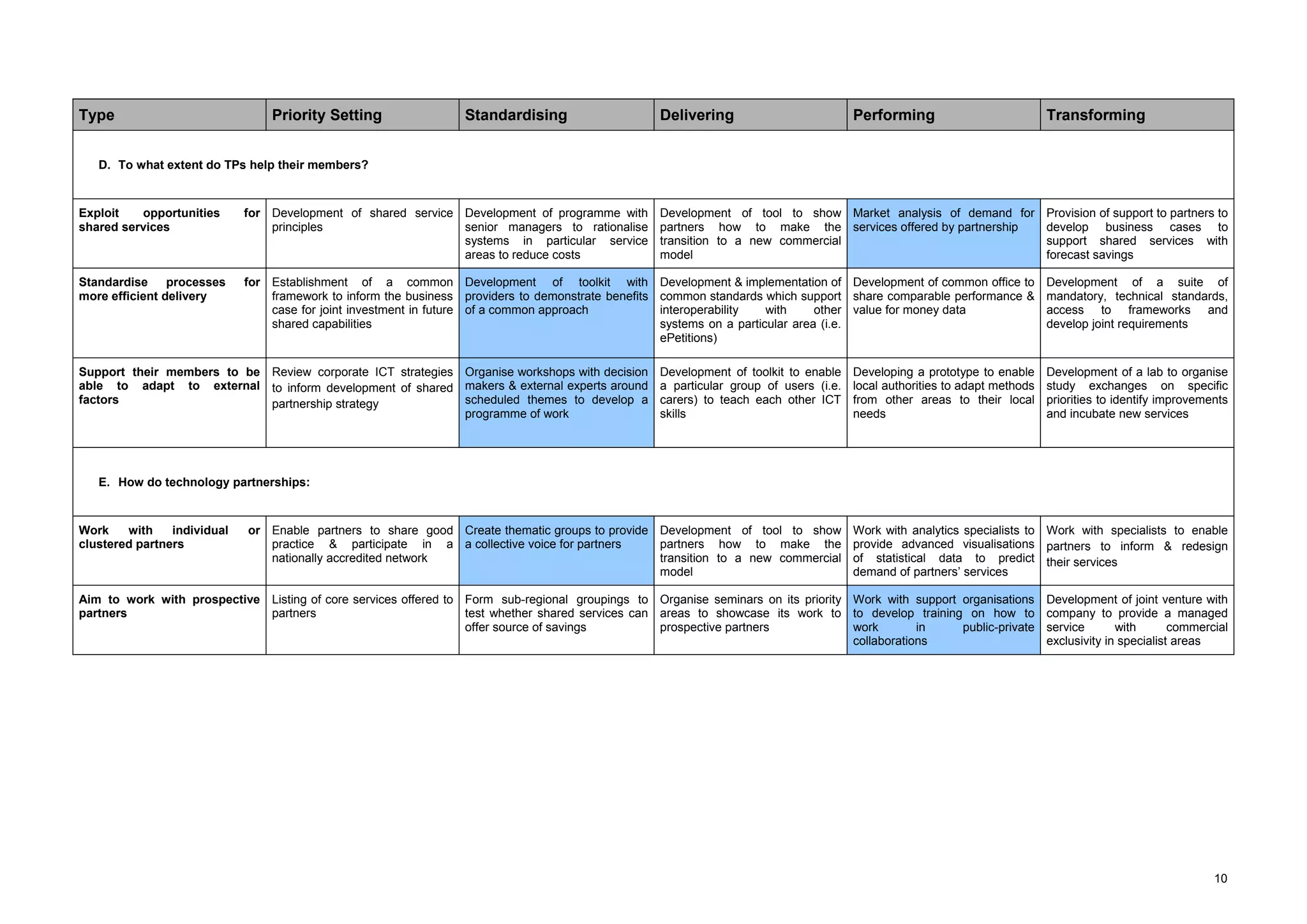
Exploit   opportunities      for Development of shared service Development of programme with          Development of tool to show Market analysis of demand for                Provision of support to partners to
shared services                  principles                    senior managers to rationalise         partners how to make the services offered by partnership                 develop business cases to
                                                               systems in particular service          transition to a new commercial                                           support shared services with
                                                               areas to reduce costs                  model                                                                    forecast savings

Standardise     processes    for Establishment of a common Development of toolkit with                Development & implementation of Development of common office to          Development of a suite of
more efficient delivery          framework to inform the business providers to demonstrate benefits   common standards which support share comparable performance &            mandatory, technical standards,
                                 case for joint investment in future of a common approach             interoperability   with     other value for money data                   access to frameworks and
                                 shared capabilities                                                  systems on a particular area (i.e.                                       develop joint requirements
                                                                                                      ePetitions)

Support their members to be Review corporate ICT strategies Organise workshops with decision          Development of toolkit to enable    Developing a prototype to enable     Development of a lab to organise
able to adapt to external to inform development of shared makers & external experts around            a particular group of users (i.e.   local authorities to adapt methods   study exchanges on specific
factors                     partnership strategy            scheduled themes to develop a             carers) to teach each other ICT     from other areas to their local      priorities to identify improvements
                                                            programme of work                         skills                              needs                                and incubate new services


   E. How do technology partnerships:


Work    with    individual   or Enable partners to share good Create thematic groups to provide Development of tool to show               Work with analytics specialists to Work with specialists to enable
clustered partners              practice & participate in a a collective voice for partners     partners how to make the                  provide advanced visualisations partners to inform & redesign
                                nationally accredited network                                   transition to a new commercial            of statistical data to predict their services
                                                                                                model                                     demand of partners’ services

Aim to work with prospective Listing of core services offered to Form sub-regional groupings to Organise seminars on its priority Work with support organisations              Development of joint venture with
partners                     partners                            test whether shared services can areas to showcase its work to to develop training on how to                  company to provide a managed
                                                                 offer source of savings          prospective partners            work        in    public-private             service       with       commercial
                                                                                                                                  collaborations                               exclusivity in specialist areas


                                                                                                                                                                                                               10
Type                             Priority Setting                  Standardising                          Delivering                           Performing                           Transforming


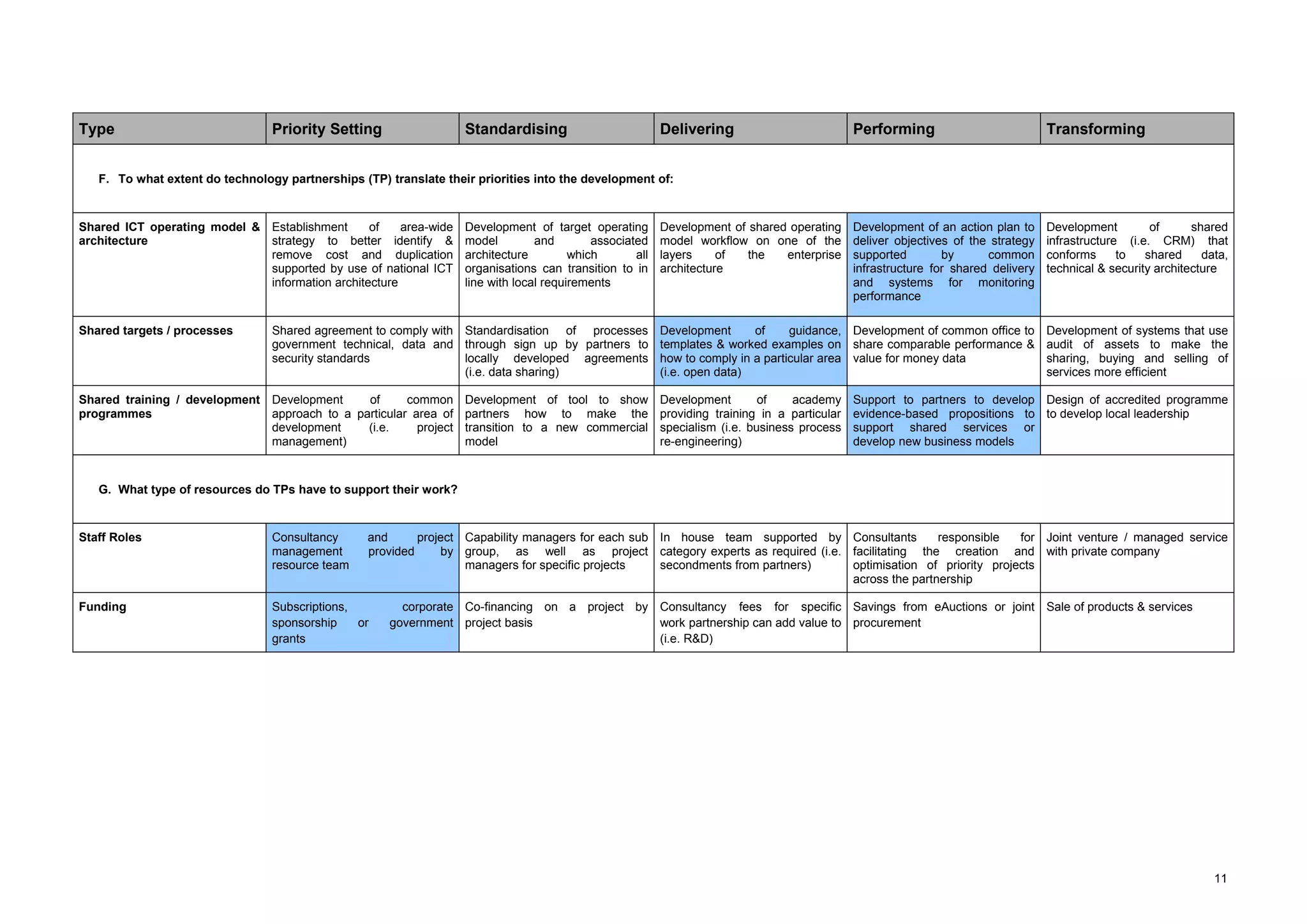
   F. To what extent do technology partnerships (TP) translate their priorities into the development of:


Shared ICT operating model & Establishment      of    area-wide    Development of target operating        Development of shared operating      Development of an action plan to     Development         of      shared
architecture                 strategy to better identify &         model         and        associated    model workflow on one of the         deliver objectives of the strategy   infrastructure (i.e. CRM) that
                             remove cost and duplication           architecture         which       all   layers     of  the   enterprise      supported        by      common      conforms      to   shared     data,
                             supported by use of national ICT      organisations can transition to in     architecture                         infrastructure for shared delivery   technical & security architecture
                             information architecture              line with local requirements                                                and systems for monitoring
                                                                                                                                               performance

Shared targets / processes       Shared agreement to comply with Standardisation of processes             Development      of     guidance, Development of common office to         Development of systems that use
                                 government technical, data and through sign up by partners to            templates & worked examples on share comparable performance &             audit of assets to make the
                                 security standards              locally developed agreements             how to comply in a particular area value for money data                   sharing, buying and selling of
                                                                 (i.e. data sharing)                      (i.e. open data)                                                          services more efficient

Shared training / development Development     of      common Development of tool to show                  Development        of    academy     Support to partners to develop Design of accredited programme
programmes                    approach to a particular area of partners how to make the                   providing training in a particular   evidence-based propositions to to develop local leadership
                              development     (i.e.     project transition to a new commercial            specialism (i.e. business process    support shared services or
                              management)                       model                                     re-engineering)                      develop new business models


   G. What type of resources do TPs have to support their work?


Staff Roles                      Consultancy      and      project Capability managers for each sub In house team supported by Consultants     responsible   for Joint venture / managed service
                                 management       provided     by group, as well as project category experts as required (i.e. facilitating the creation and with private company
                                 resource team                     managers for specific projects   secondments from partners) optimisation of priority projects
                                                                                                                               across the partnership

Funding                          Subscriptions,         corporate Co-financing on a project by Consultancy fees for specific Savings from eAuctions or joint Sale of products & services
                                 sponsorship    or    government project basis                 work partnership can add value to procurement
                                 grants                                                        (i.e. R&D)


                                                                                                                                                                                                                    11
Type                            Priority Setting                Standardising                    Delivering                            Performing                            Transforming


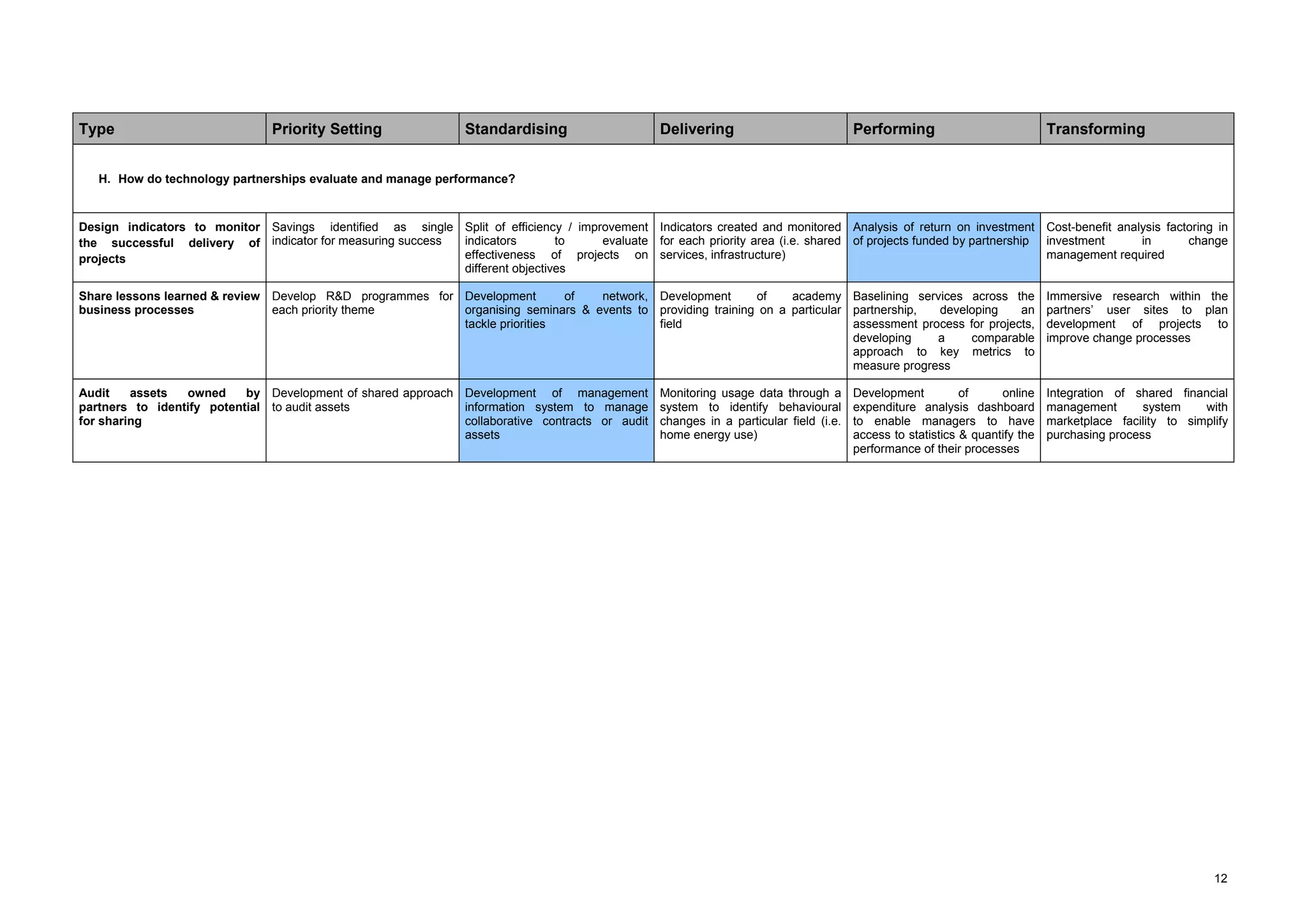
   H. How do technology partnerships evaluate and manage performance?


Design indicators to monitor Savings identified as single Split of efficiency / improvement Indicators created and monitored Analysis of return on investment Cost-benefit analysis factoring in
the successful delivery of indicator for measuring success indicators        to     evaluate for each priority area (i.e. shared of projects funded by partnership investment     in    change
projects                                                   effectiveness of projects on services, infrastructure)                                                  management required
                                                           different objectives

Share lessons learned & review Develop R&D programmes for Development       of   network, Development       of    academy Baselining services across the                     Immersive research within the
business processes             each priority theme        organising seminars & events to providing training on a particular partnership,  developing     an                 partners’ user sites to plan
                                                          tackle priorities               field                              assessment process for projects,                development of projects to
                                                                                                                             developing    a    comparable                   improve change processes
                                                                                                                             approach to key metrics to
                                                                                                                             measure progress

Audit    assets  owned     by Development of shared approach Development of management           Monitoring usage data through a       Development          of     online    Integration of shared financial
partners to identify potential to audit assets               information system to manage        system to identify behavioural        expenditure analysis dashboard        management       system    with
for sharing                                                  collaborative contracts or audit    changes in a particular field (i.e.   to enable managers to have            marketplace facility to simplify
                                                             assets                              home energy use)                      access to statistics & quantify the   purchasing process
                                                                                                                                       performance of their processes


                                                                                                                                                                                                          12
13

Public Service Partnership Maturity Model

  • 1.
    Public Service ICTPartnership Maturity Model
  • 2.
    Contents Maturity Model............................................................................................................1 Contents.....................................................................................................................2 Introduction.................................................................................................................3 Public ServiceICT Partnership Maturity Model...........................................................3 Methodology............................................................................................................3 Levels of the Model.................................................................................................4 1. Priority setting ........................................................................................................4 2. Standardising .........................................................................................................4 3. Delivering ...............................................................................................................6 4. Performing .............................................................................................................6 5. Transforming ..........................................................................................................7 Recommendations......................................................................................................8 Apply this maturity model as a method:...................................................................8 Use the methodology:..............................................................................................8 Extend this maturity model:.....................................................................................8 2
  • 3.
    Introduction It was proposedto map a selection of public service technology partnerships to understand what lessons can be learned in developing and managing these. The outcome of this research is the development of a Public Service ICT Partnership Maturity Model. This was produced based on a Benchmarking of Best Practices (attached as a separate document) which provides examples on each of the areas of the model. Recommendations for next steps are described on how Kent Connects can use this approach. Public Service ICT Partnership Maturity Model Methodology Maturity models1 are increasingly used in the development & management of IT organisations. The maturity model enclosed at the end of this document has been adapted from the Software Engineering Institute’s Maturity Model2. This can help partnerships improve their processes by measuring how well they can and do perform on the areas selected below. Using the Benchmarking of Best Practices, they can also benchmark themselves against other partnerships. Partnerships can use this maturity model in the following contexts: 1. Strategic planning Situations where this may occur include developing a business plan for the partnership, reviewing its progress over the year or in appraising the professional development of the partnership team. o Developing high maturity in a particular area: Ensuring that it has achieving all of the processes for that particular area (A-H3) o Aiming to reach a higher maturity level as a partnership: Ensuring it has achieved all of the processes for that particular level (1-54) 2. Project planning Situations where this may occur include reviewing a programme to produce recommendations for the next phase or in developing project plans for specific priorities within its strategy (i.e. public service redesign). 1 http://ivi.nuim.ie/itcmf.shtml 2 http://www.sei.cmu.edu/cmmi/ 3 See the “Maturity Model” section 4 See the “Levels of the Model” section 3
  • 4.
    o Coordinating an appraisal of an IT function: Selecting targets to move up a maturity level in types of IT function (i.e. infrastructure) o Producing recommendations for improvement: Setting targets to consolidate maturity levels in areas and move up levels in others Levels of the Model The maturity model is based on five levels of “maturity” described below. What follows is the description of each level of the model. 1. Priority setting This is a process that achieves the work needed to define the objectives of the partnership and the processes that enable the delivery of the activities required to meet them. Typical partnership at this level: o A shared strategy is developed to outline the priorities to guide future operational decisions and agree to use external standards. o Processes are set out to scope out the development of locally developed architectures and infrastructures, creating sub-groups to initiate this process. o Investment is used in an ad-hoc way monitored by generic indicators. The distinction between priority setting and standardising processes is around the level of institutionalisation of the processes. 2. Standardising This is a process that is planned and delivered according to the partnership’s objectives. This includes institutionalising, resourcing and monitoring its processes, groups and activities. Typical partnership at this level: o Issues are mapped to develop shared priorities and inform how investment is allocated to projects supported by the partnership. o Standardised processes and infrastructure are implemented to support partners to reach an agreed level of maturity in core areas (i.e. procurement). o Funding works on a co-financing basis to ensure commitment by individual partners in projects. 4
  • 5.
    The distinction betweenstandardising and delivering processes is around the scope of standards, processes & procedures. 5
  • 6.
    3. Delivering This isa process that is tailored from the partnership’s standard processes to a particular activity. This includes creating the processes, policies & resources specific to that field. Typical partnership at this level: o Rationales for delivery in targeted areas of work are clarified. This informs setting of funding and targets for development of specific projects (such as a particular service to share, process to re-engineer or system to implement). o Through this level of prioritisation, support is provided by the partnership to develop common processes in those areas, particularly where compliance is required or where there is a need to transition to new models. o This is often supported by bespoke training or experts and monitored by indicators designed specifically for that field. The distinction between delivering and performing processes is how systematic the creation and management of processes is to specific activities. 4. Performing This is a process that establishes quantitative objectives for managing and monitoring the quality and performance of partnership activities. Typical partnership at this level: o Information and performance systems are developed and financed to systematically analyse needs and opportunities partners need to focus on. o As partnerships progress through this level of maturity, they move to more real-time analysis of evidence to iterate responses to emerging demands. o This can be supplemented by providing experts to help partners understand how to optimise the use of business intelligence to forecast future trends. o This evidence-based approach drives the development of strategy and investment in its delivery, as well as quality assurance of performance of systems and auditing to identify opportunities for re-using existing solutions. The distinction between performing and transforming processes is how much the partnership applies the analysis of performance to develop improved processes and activities. 6
  • 7.
    5. Transforming This isa process that is continually improved based on an evidence-based understanding of its needs & resources. This includes the development of new processes & activities that support the change required. Typical partnership at this level: o Information systems enable partners to use the evidence base to move from delivery of services to strategic management of the public service ICT marketplace of their local area. o Savings and income generation drive investment to manage risk of any future budgetary pressures and move towards alternative commercial models. o Shared infrastructure and architecture are developed to streamline processes across all priorities of the partnership and aligned to locally agreed architectures in relevant areas such as customer services or procurement. o Common principles are developed by partners and applied systematically in projects that redesign online services to meet customer needs. o Professional development and performance management are extended to include change management to support the transformation needed to deliver the strategic vision of the partnership. It’s important to note that partnerships will not necessarily fit into a particular level across all its areas of work. Typical partnerships are described to help people situate where their partnership broadly sits. There may partnerships which could identify as being firmly on a particular level (i.e. “Level 1 - Priority setting”) but also demonstrating examples from a much higher level (i.e. “Level 3 - Delivering”). They would focus on the intermediate level (i.e. “Level 2 - Standardising”) to then be able to reinforce their processes at the higher level. 7
  • 8.
    Recommendations The following recommendationsprovide options of how this maturity model could be applied to meet Kent Connects’ strategic and project planning objectives: Apply this maturity model as a method: o Of benchmarking Kent Connects to other partnerships on a specific function or priorities from its strategy or business plan o Of appraising how future Kent Connects projects perform across the criteria to identify and capture good practices in a standardised way Use the methodology: o To produce maturity models for priority areas from the PS ICT Strategy (i.e. information governance, customer service) or future research requirements Extend this maturity model: o By adding features (i.e. professional development required) that can help partnerships move up levels of the maturity model o By exploring the feasibility of benchmarking it to other recognised maturity models of specific ICT functions (i.e. SFIA Skills Framework) or of sectors Kent Connects works with (i.e. Health Informatics Capability Maturity Model) 8
  • 9.
    Type Priority Setting Standardising Delivering Performing Transforming A. How do technology Outlining priorities in shared ICT Analysing and attempting to reach Clarifying rationales for shared Pooling efforts to research Moving from supporting delivery partnerships define their strategy consensus on which level - services and development of new issues, map assets and develop of services to building the priorities? borough/local/regional - current infrastructure / architecture and systems to monitor performance capacity of local authorities to sell problems and future challenges scoping most suitable areas for services and use market analysis can be tackled by different delivery to rationalise & joint procure partners B. How is partnership Funding agreed in strategy in Funding based on priorities & Funding divided up into areas of Funding based on multi-criteria Funding from savings from joint funding allocated to advance approved by board and managed work with specific objectives, analysis (ROI, payback, etc) and procurement or e-auctions to delivering its priorities? by partnership office in response budget lines & metrics for those CEO commitment to sponsor implement transformational to calls for proposals areas projects projects C. How effective are technology partnerships (TP) at supporting shared or collaborative: Infrastructure Agreement on common use of Implementation of nationally Development of infrastructure in Provision of health check to Development of a single external architecture (such as PS defined infrastructure (such as selected geographical or service identify any security infrastructure across the local ICT Information Architecture) to PSN) areas (i.e. digital districts) vulnerabilities associated with area to facilitate integrated scope opportunities for shared devices managed by partners on provision and shared services infrastructure shared infrastructure that can produce significant savings Services Development of shared services Establishment of service Development of tools to help Development of asset and Development of online portal board to provide forum for framework contracts for shared partners work through the services register so partners can service & functionality to enable partners to explore opportunities services that can quantify business case and work through identify opportunities for reusing other partnerships to implement for collaboration expected savings different shared services models existing ICT solutions or sharing and manage their own online services Procurement Developed of shared Development of management Development of shared Development of online Development of joint venture to procurement strategy with agreed information system to manage procurement in specific areas expenditure analysis dashboard provide a managed transactional standards collaborative contracts to enable managers to have service for buying and selling access to statistics & quantify the services with an integrated performance of their processes service catalogue Customer Insight Development of common Development of academy Development of project with Implementation of systems to Development of online dashboard approach, with guidance, providing training in research / government agency to simplify a manage information and data as to enable residents to access and templates & worked examples analytical techniques business process well as joint strategic needs visualise information to identify assessments or audits of opportunities for improvement software assets Self Service / New Channels Development of shared customer Development of online tools with Implementation of a common, Integration of metrics into every Development of self reporting tool services workflow and other partners to introduce self scalable self service portal for a level of their operation to relate by several partners, accompanied architecture service or new channels to specific service information to industry wide by a system to monitor cost citizens benchmarks & iterate efforts in savings & better cross agency responses to user needs resolution 9
  • 10.
    Type Priority Setting Standardising Delivering Performing Transforming D. To what extent do TPs help their members? Exploit opportunities for Development of shared service Development of programme with Development of tool to show Market analysis of demand for Provision of support to partners to shared services principles senior managers to rationalise partners how to make the services offered by partnership develop business cases to systems in particular service transition to a new commercial support shared services with areas to reduce costs model forecast savings Standardise processes for Establishment of a common Development of toolkit with Development & implementation of Development of common office to Development of a suite of more efficient delivery framework to inform the business providers to demonstrate benefits common standards which support share comparable performance & mandatory, technical standards, case for joint investment in future of a common approach interoperability with other value for money data access to frameworks and shared capabilities systems on a particular area (i.e. develop joint requirements ePetitions) Support their members to be Review corporate ICT strategies Organise workshops with decision Development of toolkit to enable Developing a prototype to enable Development of a lab to organise able to adapt to external to inform development of shared makers & external experts around a particular group of users (i.e. local authorities to adapt methods study exchanges on specific factors partnership strategy scheduled themes to develop a carers) to teach each other ICT from other areas to their local priorities to identify improvements programme of work skills needs and incubate new services E. How do technology partnerships: Work with individual or Enable partners to share good Create thematic groups to provide Development of tool to show Work with analytics specialists to Work with specialists to enable clustered partners practice & participate in a a collective voice for partners partners how to make the provide advanced visualisations partners to inform & redesign nationally accredited network transition to a new commercial of statistical data to predict their services model demand of partners’ services Aim to work with prospective Listing of core services offered to Form sub-regional groupings to Organise seminars on its priority Work with support organisations Development of joint venture with partners partners test whether shared services can areas to showcase its work to to develop training on how to company to provide a managed offer source of savings prospective partners work in public-private service with commercial collaborations exclusivity in specialist areas 10
  • 11.
    Type Priority Setting Standardising Delivering Performing Transforming F. To what extent do technology partnerships (TP) translate their priorities into the development of: Shared ICT operating model & Establishment of area-wide Development of target operating Development of shared operating Development of an action plan to Development of shared architecture strategy to better identify & model and associated model workflow on one of the deliver objectives of the strategy infrastructure (i.e. CRM) that remove cost and duplication architecture which all layers of the enterprise supported by common conforms to shared data, supported by use of national ICT organisations can transition to in architecture infrastructure for shared delivery technical & security architecture information architecture line with local requirements and systems for monitoring performance Shared targets / processes Shared agreement to comply with Standardisation of processes Development of guidance, Development of common office to Development of systems that use government technical, data and through sign up by partners to templates & worked examples on share comparable performance & audit of assets to make the security standards locally developed agreements how to comply in a particular area value for money data sharing, buying and selling of (i.e. data sharing) (i.e. open data) services more efficient Shared training / development Development of common Development of tool to show Development of academy Support to partners to develop Design of accredited programme programmes approach to a particular area of partners how to make the providing training in a particular evidence-based propositions to to develop local leadership development (i.e. project transition to a new commercial specialism (i.e. business process support shared services or management) model re-engineering) develop new business models G. What type of resources do TPs have to support their work? Staff Roles Consultancy and project Capability managers for each sub In house team supported by Consultants responsible for Joint venture / managed service management provided by group, as well as project category experts as required (i.e. facilitating the creation and with private company resource team managers for specific projects secondments from partners) optimisation of priority projects across the partnership Funding Subscriptions, corporate Co-financing on a project by Consultancy fees for specific Savings from eAuctions or joint Sale of products & services sponsorship or government project basis work partnership can add value to procurement grants (i.e. R&D) 11
  • 12.
    Type Priority Setting Standardising Delivering Performing Transforming H. How do technology partnerships evaluate and manage performance? Design indicators to monitor Savings identified as single Split of efficiency / improvement Indicators created and monitored Analysis of return on investment Cost-benefit analysis factoring in the successful delivery of indicator for measuring success indicators to evaluate for each priority area (i.e. shared of projects funded by partnership investment in change projects effectiveness of projects on services, infrastructure) management required different objectives Share lessons learned & review Develop R&D programmes for Development of network, Development of academy Baselining services across the Immersive research within the business processes each priority theme organising seminars & events to providing training on a particular partnership, developing an partners’ user sites to plan tackle priorities field assessment process for projects, development of projects to developing a comparable improve change processes approach to key metrics to measure progress Audit assets owned by Development of shared approach Development of management Monitoring usage data through a Development of online Integration of shared financial partners to identify potential to audit assets information system to manage system to identify behavioural expenditure analysis dashboard management system with for sharing collaborative contracts or audit changes in a particular field (i.e. to enable managers to have marketplace facility to simplify assets home energy use) access to statistics & quantify the purchasing process performance of their processes 12
  • 13.