









Key performance indicators:  How they work and how to use themPresented by: 	Micheal Axelsen	Director	Applied Insight Pty Ltd
AgendaIntroductionKey performance indicators definedAligning KPIs with strategyImplementing KPIsConclusion
INTRODUCTION
About this presentationObjectivesTo identify key performance indicators, their role in management and governance of the organisation, and how to implement key performance indicators for success.
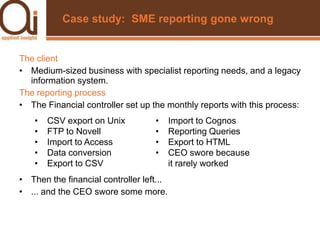
Case study:  SME reporting gone wrongThe clientMedium-sized business with specialist reporting needs, and a legacy information system.The reporting processThe Financial controller set up the monthly reports with this process:
CSV export on Unix
FTP to Novell
Import to Access
Data conversion
Export to CSV
Import to Cognos
Reporting Queries
Export to HTML
CEO swore because it rarely worked
Then the financial controller left...
... and the CEO swore some more.Key performance indicators defined
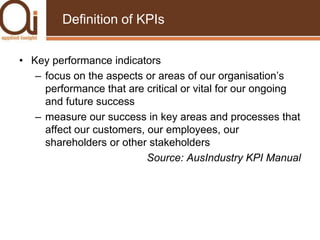
Definition of KPIsKey performance indicatorsfocus on the aspects or areas of our organisation’s performance that are critical or vital for our ongoing and future success   measure our success in key areas and processes that affect our customers, our employees, our shareholders or other stakeholdersSource: AusIndustry KPI Manual
The characteristics of KPIs Non-financial measures Measured frequently (for example, daily, weekly)Acted upon by CEO and the senior management teamAll staff understand the measure and what corrective action is requiredResponsibility can be tied down to the individual or teamSignificant impact – that it is addresses most of the top topeight Critical Success Factors and Balanced Score Card perspectives Has a positive impact – that is, it affects all other performance measures in a positive way
Why do we need ‘key performance indicators’?Businesses are frequently accused of focussing on the ‘bottom line’ and the ‘short term’Kaplan and Norton (1996) promoted the use of the balanced scorecard to look at leading indicators of sustainable, longer-term performanceIt is a more ‘balanced’ view of organisational performance, and is focussed on monitoring these performance indicatorsProvides a more holistic view of the business’s progressKPIs for each business will depend very much on its subjective view of the world
It’s all about perspectiveKPIs are usually drawn from four perspectives:Financial perspective:  Does implementation and execution of strategy contribute to the bottom line?Customer perspective:  What value proposition will the business apply to satisfy customers and thus generate more sales to the most profitable customer groups?  Internal process perspective:  concerned with the processes that create and deliver the customer value proposition – focuses on activities and key processes required in order for the company to excel at providing the value expected by the customers both productively and efficientlyInnovation and learning perspective:  Focuses on the intangible assets of an organisation, mainly on the internal skills and capabilities that are required to support the value-creating internal processes.
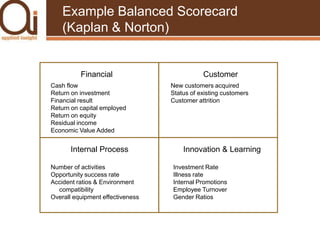
Example Balanced Scorecard (Kaplan & Norton)FinancialCustomerCash flowReturn on investmentFinancial resultReturn on capital employedReturn on equityResidual incomeEconomic Value AddedNew customers acquiredStatus of existing customersCustomer attritionInternal ProcessInnovation & LearningNumber of activitiesOpportunity success rateAccident ratios & Environment      compatibilityOverall equipment effectivenessInvestment RateIllness rateInternal PromotionsEmployee TurnoverGender Ratios
Uses of Balanced Scorecard & KPIsFrequently the balanced scorecard & KPIs approach is used to:Drive strategy executionClarify strategy and make strategy operationalIdentify and align strategic initiativesLink budget with strategyAlign the organisation with strategyConduct periodic strategic performance reviews to learn about and improve strategyThe purpose to which the balanced scorecard and its KPIs is put affects the KPIs to be monitored – leading indicators are preferred, as they show what future performance will be
CriticismsA balanced scorecard is by definition ‘balanced’ – if you wish to achieve quick business growth then perhaps the inherent ‘balance’ is of less value, rather than an unbalanced focus on performance activities that grow the businessSometimes used inappropriately – can you really use Balanced Scorecard to govern internal processes?Subjective and KPIs are not based in actuarial ‘fact’Some criticise any effectiveness in operation as merely a placebo effect – that is, any other management approach might work equally as well
Tips for successA KPI has to be suitable for the specific business, industry and organisation and related to the targets on the long runMake it possible to influence the results of the KPIMake the KPI easy to quantifyMake the KPI linkable to other relevant dataMake the KPI comparable over time. Make sure every KPI has a dedicated, committed ownerThere may be 80 performance indicators, but you should not exceed 10 KPIs (that’s about 2 per quadrant)These will build on each other and provide guidance on the strategies and initiatives pursued by the organisation in reaching its strategic goals
Aligning kpi’s with strategyConclusion
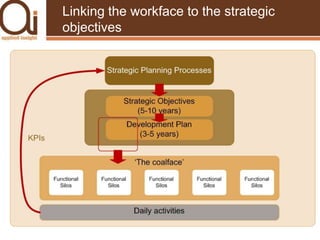
A contribution to strategyA key reason to adopt key performance indicators is to operationalise strategy at the coalfaceIt turns the organisation’s lofty vision, expressed in the strategic plan, into cold hard numbers that can be used to guide everyone’s effortsLike many management measures and approaches, effectiveness will be dependent upon the emphasis placed upon the approach in the organisation – the manner in which it is used
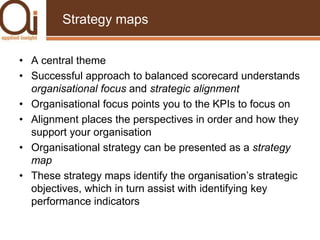
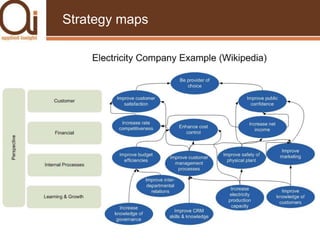
Strategy mapsA central themeSuccessful approach to balanced scorecard understands organisational focus and strategic alignmentOrganisational focus points you to the KPIs to focus onAlignment places the perspectives in order and how they support your organisationOrganisational strategy can be presented as a strategy mapThese strategy maps identify the organisation’s strategic objectives, which in turn assist with identifying key performance indicators
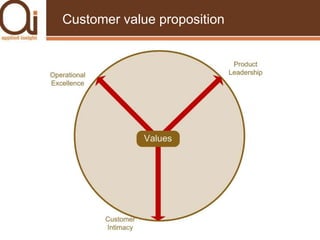
Customer value proposition
Strategy maps
Linking the workface to the strategic objectives
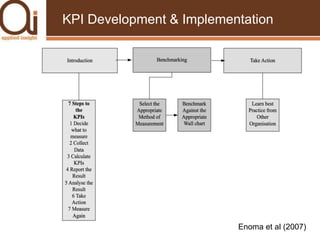
KPI Development & ImplementationEnoma et al (2007)
Implementing kPIS
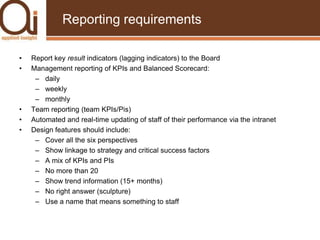
Reporting requirementsReport key result indicators (lagging indicators) to the Board Management reporting of KPIs and Balanced Scorecard:dailyweeklymonthlyTeam reporting (team KPIs/Pis)Automated and real-time updating of staff of their performance via the intranetDesign features should include:Cover all the six perspectivesShow linkage to strategy and critical success factorsA mix of KPIs and PIsNo more than 20Show trend information (15+ months)No right answer (sculpture)Use a name that means something to staff
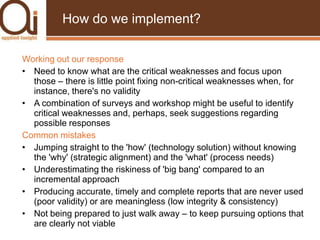
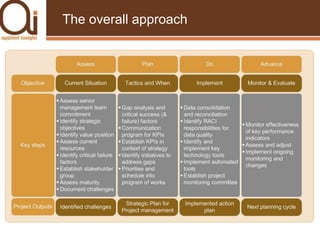
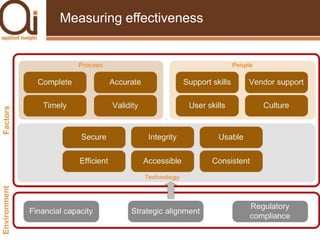
How do we implement?Working out our responseNeed to know what are the critical weaknesses and focus upon those – there is little point fixing non-critical weaknesses when, for instance, there's no validity
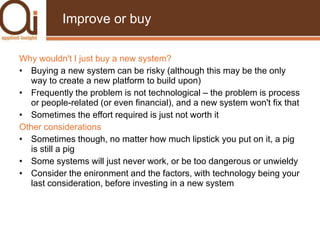
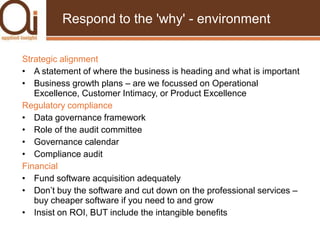
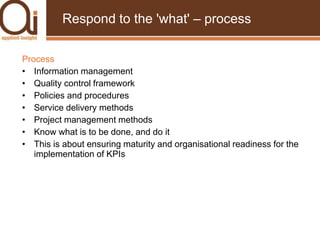
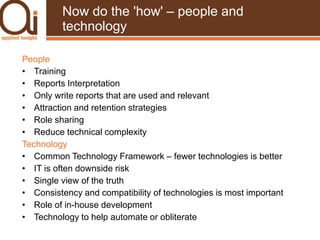
A combination of surveys and workshop might be useful to identify critical weaknesses and, perhaps, seek suggestions regarding possible responsesCommon mistakesJumping straight to the 'how' (technology solution) without knowing the 'why' (strategic alignment) and the 'what' (process needs)
Underestimating the riskiness of 'big bang' compared to an incremental approach
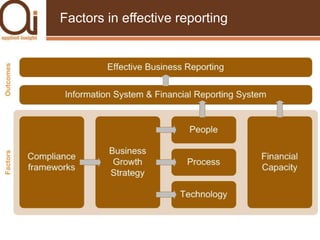
Producing accurate, timely and complete reports that are never used (poor validity) or are meaningless (low integrity & consistency)‏

Overview of Key Performance Indicators

  • 1.
    Key performance indicators: How they work and how to use themPresented by: Micheal Axelsen Director Applied Insight Pty Ltd
  • 2.
    AgendaIntroductionKey performance indicatorsdefinedAligning KPIs with strategyImplementing KPIsConclusion
  • 3.
  • 4.
    About this presentationObjectivesToidentify key performance indicators, their role in management and governance of the organisation, and how to implement key performance indicators for success.
  • 5.
    Case study: SME reporting gone wrongThe clientMedium-sized business with specialist reporting needs, and a legacy information system.The reporting processThe Financial controller set up the monthly reports with this process:
  • 6.
  • 7.
  • 8.
  • 9.
  • 10.
  • 11.
  • 12.
  • 13.
  • 14.
    CEO swore becauseit rarely worked
  • 15.
    Then the financialcontroller left...
  • 16.
    ... and theCEO swore some more.Key performance indicators defined
  • 17.
    Definition of KPIsKeyperformance indicatorsfocus on the aspects or areas of our organisation’s performance that are critical or vital for our ongoing and future success measure our success in key areas and processes that affect our customers, our employees, our shareholders or other stakeholdersSource: AusIndustry KPI Manual
  • 18.
    The characteristics ofKPIs Non-financial measures Measured frequently (for example, daily, weekly)Acted upon by CEO and the senior management teamAll staff understand the measure and what corrective action is requiredResponsibility can be tied down to the individual or teamSignificant impact – that it is addresses most of the top topeight Critical Success Factors and Balanced Score Card perspectives Has a positive impact – that is, it affects all other performance measures in a positive way
  • 19.
    Why do weneed ‘key performance indicators’?Businesses are frequently accused of focussing on the ‘bottom line’ and the ‘short term’Kaplan and Norton (1996) promoted the use of the balanced scorecard to look at leading indicators of sustainable, longer-term performanceIt is a more ‘balanced’ view of organisational performance, and is focussed on monitoring these performance indicatorsProvides a more holistic view of the business’s progressKPIs for each business will depend very much on its subjective view of the world
  • 20.
    It’s all aboutperspectiveKPIs are usually drawn from four perspectives:Financial perspective: Does implementation and execution of strategy contribute to the bottom line?Customer perspective: What value proposition will the business apply to satisfy customers and thus generate more sales to the most profitable customer groups? Internal process perspective: concerned with the processes that create and deliver the customer value proposition – focuses on activities and key processes required in order for the company to excel at providing the value expected by the customers both productively and efficientlyInnovation and learning perspective: Focuses on the intangible assets of an organisation, mainly on the internal skills and capabilities that are required to support the value-creating internal processes.
  • 21.
    Example Balanced Scorecard(Kaplan & Norton)FinancialCustomerCash flowReturn on investmentFinancial resultReturn on capital employedReturn on equityResidual incomeEconomic Value AddedNew customers acquiredStatus of existing customersCustomer attritionInternal ProcessInnovation & LearningNumber of activitiesOpportunity success rateAccident ratios & Environment compatibilityOverall equipment effectivenessInvestment RateIllness rateInternal PromotionsEmployee TurnoverGender Ratios
  • 22.
    Uses of BalancedScorecard & KPIsFrequently the balanced scorecard & KPIs approach is used to:Drive strategy executionClarify strategy and make strategy operationalIdentify and align strategic initiativesLink budget with strategyAlign the organisation with strategyConduct periodic strategic performance reviews to learn about and improve strategyThe purpose to which the balanced scorecard and its KPIs is put affects the KPIs to be monitored – leading indicators are preferred, as they show what future performance will be
  • 23.
    CriticismsA balanced scorecardis by definition ‘balanced’ – if you wish to achieve quick business growth then perhaps the inherent ‘balance’ is of less value, rather than an unbalanced focus on performance activities that grow the businessSometimes used inappropriately – can you really use Balanced Scorecard to govern internal processes?Subjective and KPIs are not based in actuarial ‘fact’Some criticise any effectiveness in operation as merely a placebo effect – that is, any other management approach might work equally as well
  • 24.
    Tips for successAKPI has to be suitable for the specific business, industry and organisation and related to the targets on the long runMake it possible to influence the results of the KPIMake the KPI easy to quantifyMake the KPI linkable to other relevant dataMake the KPI comparable over time. Make sure every KPI has a dedicated, committed ownerThere may be 80 performance indicators, but you should not exceed 10 KPIs (that’s about 2 per quadrant)These will build on each other and provide guidance on the strategies and initiatives pursued by the organisation in reaching its strategic goals
  • 25.
    Aligning kpi’s withstrategyConclusion
  • 26.
    A contribution tostrategyA key reason to adopt key performance indicators is to operationalise strategy at the coalfaceIt turns the organisation’s lofty vision, expressed in the strategic plan, into cold hard numbers that can be used to guide everyone’s effortsLike many management measures and approaches, effectiveness will be dependent upon the emphasis placed upon the approach in the organisation – the manner in which it is used
  • 27.
    Strategy mapsA centralthemeSuccessful approach to balanced scorecard understands organisational focus and strategic alignmentOrganisational focus points you to the KPIs to focus onAlignment places the perspectives in order and how they support your organisationOrganisational strategy can be presented as a strategy mapThese strategy maps identify the organisation’s strategic objectives, which in turn assist with identifying key performance indicators
  • 28.
  • 29.
  • 30.
    Linking the workfaceto the strategic objectives
  • 31.
    KPI Development &ImplementationEnoma et al (2007)
  • 32.
  • 33.
    Reporting requirementsReport keyresult indicators (lagging indicators) to the Board Management reporting of KPIs and Balanced Scorecard:dailyweeklymonthlyTeam reporting (team KPIs/Pis)Automated and real-time updating of staff of their performance via the intranetDesign features should include:Cover all the six perspectivesShow linkage to strategy and critical success factorsA mix of KPIs and PIsNo more than 20Show trend information (15+ months)No right answer (sculpture)Use a name that means something to staff
  • 34.
    How do weimplement?Working out our responseNeed to know what are the critical weaknesses and focus upon those – there is little point fixing non-critical weaknesses when, for instance, there's no validity
  • 35.
    A combination ofsurveys and workshop might be useful to identify critical weaknesses and, perhaps, seek suggestions regarding possible responsesCommon mistakesJumping straight to the 'how' (technology solution) without knowing the 'why' (strategic alignment) and the 'what' (process needs)
  • 36.
    Underestimating the riskinessof 'big bang' compared to an incremental approach
  • 37.
    Producing accurate, timelyand complete reports that are never used (poor validity) or are meaningless (low integrity & consistency)‏