The unreasonable effectiveness of algebra
        (but don’t take it for granted)


              James Davenport

                University of Bath
                (visiting Waterloo)


                11 June 2009
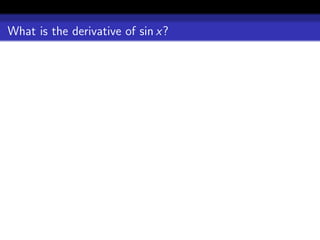
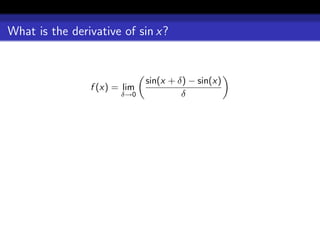
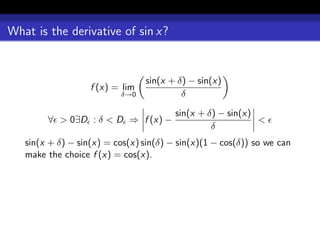
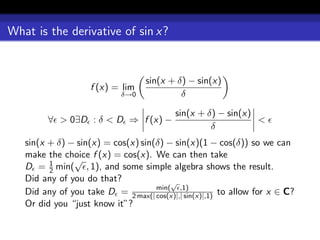
What is the derivative of sin x?


                              sin(x + δ) − sin(x)
                f (x) = lim
                       δ→0             δ
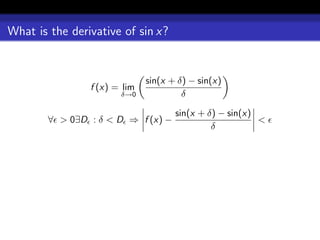
What is the derivative of sin x?


                              sin(x + δ) − sin(x)
                f (x) = lim
                       δ→0             δ

                                     sin(x + δ) − sin(x)
        ∀ > 0∃D : δ < D ⇒ f (x) −                        <
                                              δ
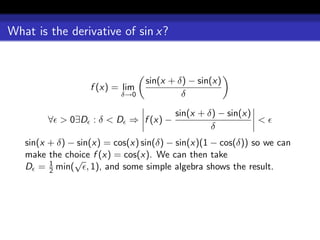
What is the derivative of sin x?


                                 sin(x + δ) − sin(x)
                   f (x) = lim
                          δ→0             δ

                                        sin(x + δ) − sin(x)
        ∀ > 0∃D : δ < D ⇒ f (x) −                           <
                                                 δ
   sin(x + δ) − sin(x) = cos(x) sin(δ) − sin(x)(1 − cos(δ)) so we can
   make the choice f (x) = cos(x).
What is the derivative of sin x?


                                 sin(x + δ) − sin(x)
                   f (x) = lim
                          δ→0             δ

                                        sin(x + δ) − sin(x)
        ∀ > 0∃D : δ < D ⇒ f (x) −                           <
                                                 δ
   sin(x + δ) − sin(x) = cos(x) sin(δ) − sin(x)(1 − cos(δ)) so we can
   make the choice f (x) = cos(x). We can then take
         1     √
   D = 2 min( , 1), and some simple algebra shows the result.
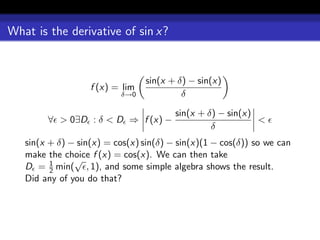
What is the derivative of sin x?


                                 sin(x + δ) − sin(x)
                   f (x) = lim
                          δ→0             δ

                                        sin(x + δ) − sin(x)
        ∀ > 0∃D : δ < D ⇒ f (x) −                           <
                                                 δ
   sin(x + δ) − sin(x) = cos(x) sin(δ) − sin(x)(1 − cos(δ)) so we can
   make the choice f (x) = cos(x). We can then take
         1     √
   D = 2 min( , 1), and some simple algebra shows the result.
   Did any of you do that?
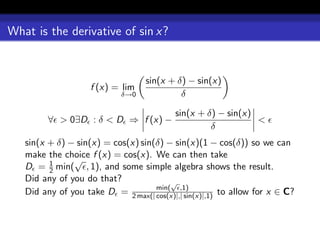
What is the derivative of sin x?


                                   sin(x + δ) − sin(x)
                    f (x) = lim
                             δ→0            δ

                                           sin(x + δ) − sin(x)
         ∀ > 0∃D : δ < D ⇒ f (x) −                             <
                                                    δ
   sin(x + δ) − sin(x) = cos(x) sin(δ) − sin(x)(1 − cos(δ)) so we can
   make the choice f (x) = cos(x). We can then take
         1     √
   D = 2 min( , 1), and some simple algebra shows the result.
   Did any of you do that?              √
   Did any of you take D = 2 max(| min( ,1)
                                    cos(x)|,| sin(x)|,1) to allow for x ∈ C?
What is the derivative of sin x?


                                   sin(x + δ) − sin(x)
                    f (x) = lim
                             δ→0            δ

                                           sin(x + δ) − sin(x)
         ∀ > 0∃D : δ < D ⇒ f (x) −                             <
                                                    δ
   sin(x + δ) − sin(x) = cos(x) sin(δ) − sin(x)(1 − cos(δ)) so we can
   make the choice f (x) = cos(x). We can then take
         1     √
   D = 2 min( , 1), and some simple algebra shows the result.
   Did any of you do that?              √
   Did any of you take D = 2 max(| min( ,1)
                                    cos(x)|,| sin(x)|,1) to allow for x ∈ C?
   Or did you “just know it”?
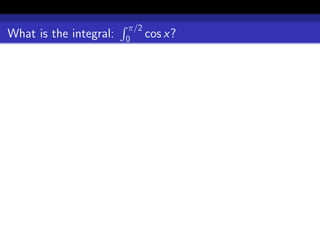
π/2
What is the integral:   0    cos x?
π/2
What is the integral:       0    cos x?


                I = lim S ∆ [cos(x)] = lim S ∆ [cos(x)]
                    |∆|→0                |∆|→0

   (∆ ranges over all dissections of [0, π/2])
π/2
What is the integral:       0    cos x?


                I = lim S ∆ [cos(x)] = lim S ∆ [cos(x)]
                    |∆|→0                |∆|→0

   (∆ ranges over all dissections of [0, π/2])
   Does anyone actually do this?
π/2
What is the integral:       0    cos x?


                I = lim S ∆ [cos(x)] = lim S ∆ [cos(x)]
                    |∆|→0                |∆|→0

   (∆ ranges over all dissections of [0, π/2])
   Does anyone actually do this?
   Can anyone actually do this?
π/2
What is the integral:      0    cos x?


               I = lim S ∆ [cos(x)] = lim S ∆ [cos(x)]
                   |∆|→0               |∆|→0

   (∆ ranges over all dissections of [0, π/2])
   Does anyone actually do this?
   Can anyone actually do this?
   Or do we say “well, we have proved that sin = cos, so   cos = sin,
   and therefore the answer is sin π − sin 0 = 1?
                                   2
π/2
What is the integral:      0    cos x?


               I = lim S ∆ [cos(x)] = lim S ∆ [cos(x)]
                   |∆|→0              |∆|→0

   (∆ ranges over all dissections of [0, π/2])
   Does anyone actually do this?
   Can anyone actually do this?
   Or do we say “well, we have proved that sin = cos, so cos = sin,
   and therefore the answer is sin π − sin 0 = 1?
                                   2
   We might say “therefore, by the Fundamental Theorem of
   Calculus, . . . ”
What is the Fundamental Theorem of Calculus?

   Indeed, what is calculus?
What is the Fundamental Theorem of Calculus?

   Indeed, what is calculus?
        . . . the deism of Liebniz over the dotage of Newton . . .
        [Babbage, chapter 4]
What is the Fundamental Theorem of Calculus?

   Indeed, what is calculus?
        . . . the deism of Liebniz over the dotage of Newton . . .
        [Babbage, chapter 4]

   I claim that calculus is actually the interesting fusion of two,
   different subjects.
What is the Fundamental Theorem of Calculus?

   Indeed, what is calculus?
        . . . the deism of Liebniz over the dotage of Newton . . .
        [Babbage, chapter 4]

   I claim that calculus is actually the interesting fusion of two,
   different subjects.
        What you learned in calculus, which I shall write as D δ : the
        “differentiation of –δ analysis”. Also d d x , and its inverse
                                                δ
         δ .
What is the Fundamental Theorem of Calculus?

   Indeed, what is calculus?
        . . . the deism of Liebniz over the dotage of Newton . . .
        [Babbage, chapter 4]

   I claim that calculus is actually the interesting fusion of two,
   different subjects.
        What you learned in calculus, which I shall write as D δ : the
        “differentiation of –δ analysis”. Also d d x , and its inverse
                                                δ
         δ .
        What is taught in differential algebra, which I shall write as
                                                                  d
        DDA : the “differentiation of differential algebra”. Also dDA x ,
        and its inverse DA .
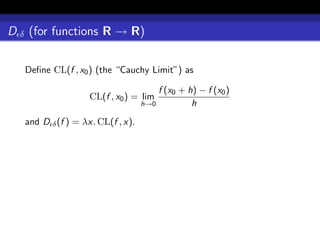
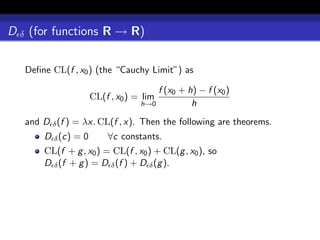
D δ (for functions R → R)

   Define CL(f , x0 ) (the “Cauchy Limit”) as

                                       f (x0 + h) − f (x0 )
                    CL(f , x0 ) = lim
                                   h→0          h
   and D δ (f ) = λx. CL(f , x).
D δ (for functions R → R)

   Define CL(f , x0 ) (the “Cauchy Limit”) as

                                    f (x0 + h) − f (x0 )
                   CL(f , x0 ) = lim
                                h→0          h
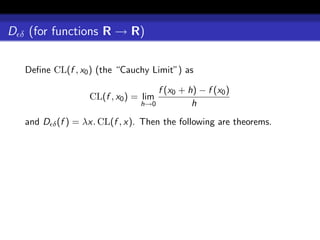
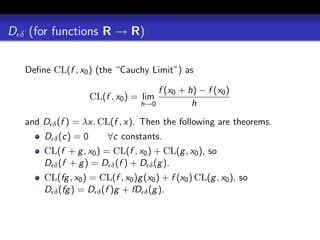
   and D δ (f ) = λx. CL(f , x). Then the following are theorems.
D δ (for functions R → R)

   Define CL(f , x0 ) (the “Cauchy Limit”) as

                                      f (x0 + h) − f (x0 )
                     CL(f , x0 ) = lim
                                  h→0          h
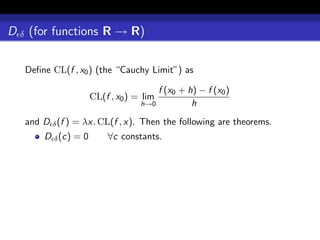
   and D δ (f ) = λx. CL(f , x). Then the following are theorems.
       D δ (c) = 0       ∀c constants.
D δ (for functions R → R)

   Define CL(f , x0 ) (the “Cauchy Limit”) as

                                      f (x0 + h) − f (x0 )
                     CL(f , x0 ) = lim
                                  h→0          h
   and D δ (f ) = λx. CL(f , x). Then the following are theorems.
       D δ (c) = 0       ∀c constants.
       CL(f + g , x0 ) = CL(f , x0 ) + CL(g , x0 ), so
       D δ (f + g ) = D δ (f ) + D δ (g ).
D δ (for functions R → R)

   Define CL(f , x0 ) (the “Cauchy Limit”) as

                                      f (x0 + h) − f (x0 )
                     CL(f , x0 ) = lim
                                  h→0          h
   and D δ (f ) = λx. CL(f , x). Then the following are theorems.
       D δ (c) = 0       ∀c constants.
       CL(f + g , x0 ) = CL(f , x0 ) + CL(g , x0 ), so
       D δ (f + g ) = D δ (f ) + D δ (g ).
       CL(fg , x0 ) = CL(f , x0 )g (x0 ) + f (x0 ) CL(g , x0 ), so
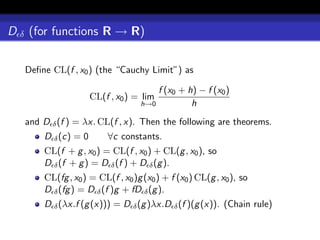
       D δ (fg ) = D δ (f )g + fD δ (g ).
D δ (for functions R → R)

   Define CL(f , x0 ) (the “Cauchy Limit”) as

                                      f (x0 + h) − f (x0 )
                     CL(f , x0 ) = lim
                                  h→0          h
   and D δ (f ) = λx. CL(f , x). Then the following are theorems.
       D δ (c) = 0       ∀c constants.
       CL(f + g , x0 ) = CL(f , x0 ) + CL(g , x0 ), so
       D δ (f + g ) = D δ (f ) + D δ (g ).
       CL(fg , x0 ) = CL(f , x0 )g (x0 ) + f (x0 ) CL(g , x0 ), so
       D δ (fg ) = D δ (f )g + fD δ (g ).
       D δ (λx.f (g (x))) = D δ (g )λx.D δ (f )(g (x)). (Chain rule)
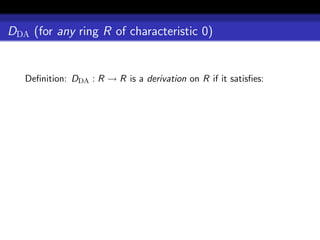
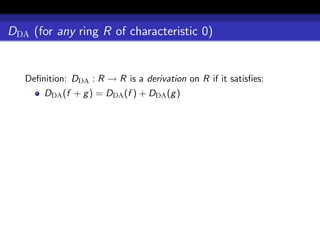
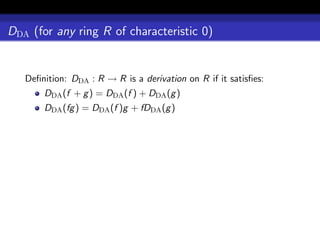
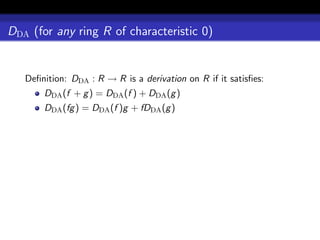
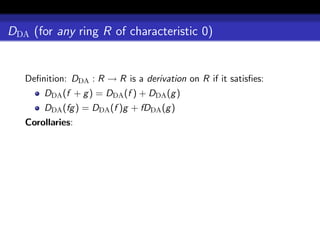
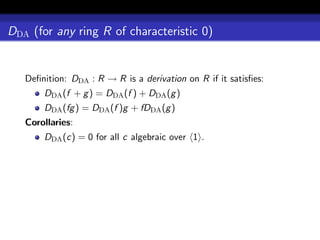
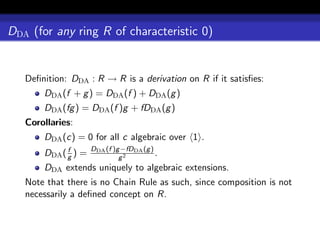
DDA (for any ring R of characteristic 0)


   Definition: DDA : R → R is a derivation on R if it satisfies:
DDA (for any ring R of characteristic 0)


   Definition: DDA : R → R is a derivation on R if it satisfies:
       DDA (f + g ) = DDA (f ) + DDA (g )
DDA (for any ring R of characteristic 0)


   Definition: DDA : R → R is a derivation on R if it satisfies:
       DDA (f + g ) = DDA (f ) + DDA (g )
       DDA (fg ) = DDA (f )g + fDDA (g )
DDA (for any ring R of characteristic 0)


   Definition: DDA : R → R is a derivation on R if it satisfies:
       DDA (f + g ) = DDA (f ) + DDA (g )
       DDA (fg ) = DDA (f )g + fDDA (g )
DDA (for any ring R of characteristic 0)


   Definition: DDA : R → R is a derivation on R if it satisfies:
       DDA (f + g ) = DDA (f ) + DDA (g )
       DDA (fg ) = DDA (f )g + fDDA (g )
   Corollaries:
DDA (for any ring R of characteristic 0)


   Definition: DDA : R → R is a derivation on R if it satisfies:
       DDA (f + g ) = DDA (f ) + DDA (g )
       DDA (fg ) = DDA (f )g + fDDA (g )
   Corollaries:
       DDA (c) = 0 for all c algebraic over 1 .
DDA (for any ring R of characteristic 0)


   Definition: DDA : R → R is a derivation on R if it satisfies:
       DDA (f + g ) = DDA (f ) + DDA (g )
       DDA (fg ) = DDA (f )g + fDDA (g )
   Corollaries:
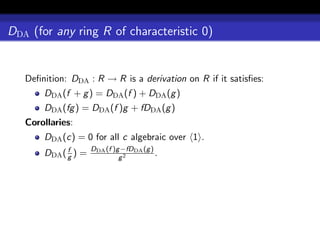
       DDA (c) = 0 for all c algebraic over 1 .
             f       DDA (f )g −fDDA (g )
       DDA ( g ) =            g2
                                          .
DDA (for any ring R of characteristic 0)


   Definition: DDA : R → R is a derivation on R if it satisfies:
       DDA (f + g ) = DDA (f ) + DDA (g )
       DDA (fg ) = DDA (f )g + fDDA (g )
   Corollaries:
       DDA (c) = 0 for all c algebraic over 1 .
             f       DDA (f )g −fDDA (g )
       DDA ( g ) =            g2
                                          .
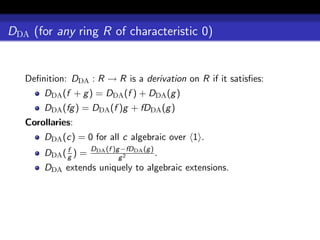
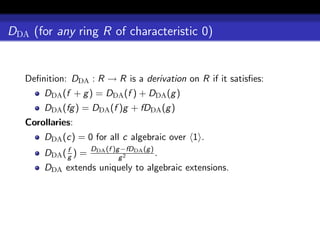
       DDA extends uniquely to algebraic extensions.
DDA (for any ring R of characteristic 0)


   Definition: DDA : R → R is a derivation on R if it satisfies:
       DDA (f + g ) = DDA (f ) + DDA (g )
       DDA (fg ) = DDA (f )g + fDDA (g )
   Corollaries:
       DDA (c) = 0 for all c algebraic over 1 .
             f       DDA (f )g −fDDA (g )
       DDA ( g ) =            g2
                                          .
       DDA extends uniquely to algebraic extensions.
DDA (for any ring R of characteristic 0)


   Definition: DDA : R → R is a derivation on R if it satisfies:
       DDA (f + g ) = DDA (f ) + DDA (g )
       DDA (fg ) = DDA (f )g + fDDA (g )
   Corollaries:
       DDA (c) = 0 for all c algebraic over 1 .
             f       DDA (f )g −fDDA (g )
       DDA ( g ) =            g2
                                          .
       DDA extends uniquely to algebraic extensions.
   Note that there is no Chain Rule as such, since composition is not
   necessarily a defined concept on R.
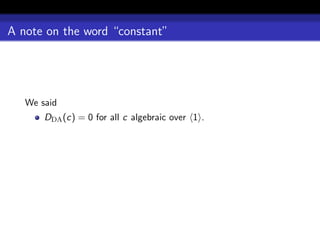
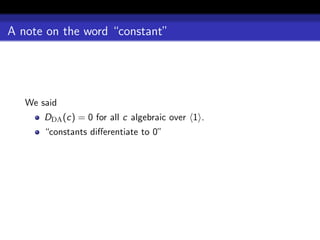
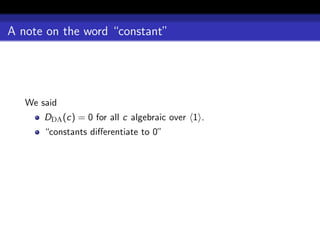
A note on the word “constant”


   We said
       DDA (c) = 0 for all c algebraic over 1 .
A note on the word “constant”


   We said
       DDA (c) = 0 for all c algebraic over 1 .
       “constants differentiate to 0”
A note on the word “constant”


   We said
       DDA (c) = 0 for all c algebraic over 1 .
       “constants differentiate to 0”
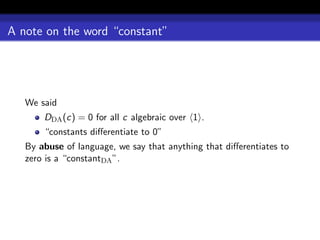
A note on the word “constant”


   We said
       DDA (c) = 0 for all c algebraic over 1 .
       “constants differentiate to 0”
   By abuse of language, we say that anything that differentiates to
   zero is a “constantDA ”.
How are the two subjects related?


   If we define DDA (x) = 1, then DDA is defined on Z[x], and
   extends to Q(x) and indeed Q(x).
How are the two subjects related?


   If we define DDA (x) = 1, then DDA is defined on Z[x], and
   extends to Q(x) and indeed Q(x).
   If we interpret (denoted I) Q(x) as functions R → R, then DDA
   can be interpreted as D δ , i.e.

                       I(DDA (f )) = D δ (I(f ))
How are the two subjects related?


   If we define DDA (x) = 1, then DDA is defined on Z[x], and
   extends to Q(x) and indeed Q(x).
   If we interpret (denoted I) Q(x) as functions R → R, then DDA
   can be interpreted as D δ , i.e.

                         I(DDA (f )) = D δ (I(f ))

   (at least up to removable singularities).
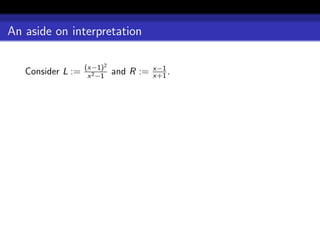
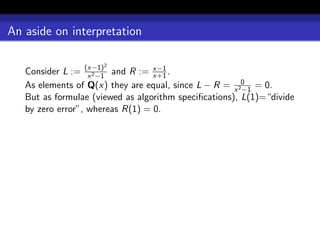
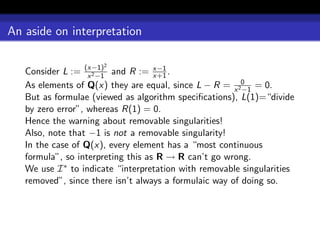
An aside on interpretation

                   (x−1)2               x−1
   Consider L :=    x 2 −1
                             and R :=   x+1 .
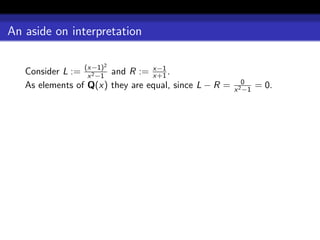
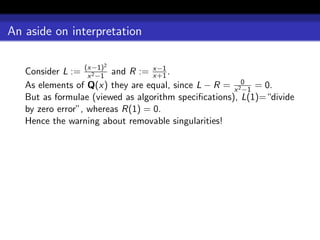
An aside on interpretation

                     2
   Consider L := (x−1) and R := x−1 .
                  x 2 −1         x+1
                                                          0
   As elements of Q(x) they are equal, since L − R =   x 2 −1
                                                                = 0.
An aside on interpretation

                      2
   Consider L := (x−1) and R := x−1 .
                   x 2 −1         x+1
   As elements of Q(x) they are equal, since L − R = x 20 = 0.
                                                        −1
   But as formulae (viewed as algorithm specifications), L(1)=“divide
   by zero error”, whereas R(1) = 0.
An aside on interpretation

                      2
   Consider L := (x−1) and R := x−1 .
                   x 2 −1         x+1
   As elements of Q(x) they are equal, since L − R = x 20 = 0.
                                                        −1
   But as formulae (viewed as algorithm specifications), L(1)=“divide
   by zero error”, whereas R(1) = 0.
   Hence the warning about removable singularities!
An aside on interpretation

                      2
   Consider L := (x−1) and R := x−1 .
                   x 2 −1         x+1
   As elements of Q(x) they are equal, since L − R = x 20 = 0.
                                                        −1
   But as formulae (viewed as algorithm specifications), L(1)=“divide
   by zero error”, whereas R(1) = 0.
   Hence the warning about removable singularities!
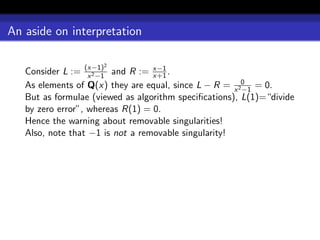
   Also, note that −1 is not a removable singularity!
An aside on interpretation

                      2
   Consider L := (x−1) and R := x−1 .
                   x 2 −1           x+1
   As elements of Q(x) they are equal, since L − R = x 20 = 0.
                                                        −1
   But as formulae (viewed as algorithm specifications), L(1)=“divide
   by zero error”, whereas R(1) = 0.
   Hence the warning about removable singularities!
   Also, note that −1 is not a removable singularity!
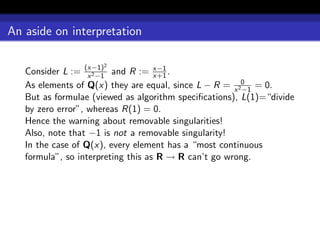
   In the case of Q(x), every element has a “most continuous
   formula”, so interpreting this as R → R can’t go wrong.
An aside on interpretation

                      2
   Consider L := (x−1) and R := x−1 .
                   x 2 −1           x+1
   As elements of Q(x) they are equal, since L − R = x 20 = 0.
                                                         −1
   But as formulae (viewed as algorithm specifications), L(1)=“divide
   by zero error”, whereas R(1) = 0.
   Hence the warning about removable singularities!
   Also, note that −1 is not a removable singularity!
   In the case of Q(x), every element has a “most continuous
   formula”, so interpreting this as R → R can’t go wrong.
   We use I ∗ to indicate “interpretation with removable singularities
   removed”, since there isn’t always a formulaic way of doing so.
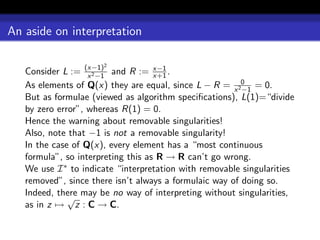
An aside on interpretation

                      2
   Consider L := (x−1) and R := x−1 .
                   x 2 −1           x+1
   As elements of Q(x) they are equal, since L − R = x 20 = 0.
                                                         −1
   But as formulae (viewed as algorithm specifications), L(1)=“divide
   by zero error”, whereas R(1) = 0.
   Hence the warning about removable singularities!
   Also, note that −1 is not a removable singularity!
   In the case of Q(x), every element has a “most continuous
   formula”, so interpreting this as R → R can’t go wrong.
   We use I ∗ to indicate “interpretation with removable singularities
   removed”, since there isn’t always a formulaic way of doing so.
   Indeed, there may be no way of interpreting without singularities,
              √
   as in z → z : C → C.
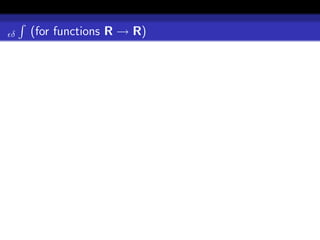
δ   (for functions R → R)
δ    (for functions R → R)


    What is naturally defined is integration over an interval I . We let
    D stand for sub-divisions d1 = a < d2 < · · · < dn = b of I = [a, b],
    and |D| for the largest distance between neighbouring points in D,
    i.e. maxi (di+1 − di ).
δ    (for functions R → R)


    What is naturally defined is integration over an interval I . We let
    D stand for sub-divisions d1 = a < d2 < · · · < dn = b of I = [a, b],
    and |D| for the largest distance between neighbouring points in D,
    i.e. maxi (di+1 − di ). Let
        SD =     i (di+1   − di ) maxdi+1 ≥x≥di f (x);
δ    (for functions R → R)


    What is naturally defined is integration over an interval I . We let
    D stand for sub-divisions d1 = a < d2 < · · · < dn = b of I = [a, b],
    and |D| for the largest distance between neighbouring points in D,
    i.e. maxi (di+1 − di ). Let
        SD =     i (di+1   − di ) maxdi+1 ≥x≥di f (x);
        SD =     i (di+1   − di ) mindi+1 ≥x≥di f (x);
δ     (for functions R → R)


     What is naturally defined is integration over an interval I . We let
     D stand for sub-divisions d1 = a < d2 < · · · < dn = b of I = [a, b],
     and |D| for the largest distance between neighbouring points in D,
     i.e. maxi (di+1 − di ). Let
           SD =    i (di+1   − di ) maxdi+1 ≥x≥di f (x);
           SD =    i (di+1   − di ) mindi+1 ≥x≥di f (x);
    Then    δ I f = lim inf |D|→0 SD = lim sup|D|→0 SD if both exist and
           are equal.
Consequences: Fundamental Theorem of Calculus (FTC δ )

              b         δ [a,b] f       a≤b
   Define   δ a    f =
                        −   δ [b,a] f   a>b
Consequences: Fundamental Theorem of Calculus (FTC δ )

              b         δ [a,b] f   a≤b
   Define   δ a    f =
                       − δ [b,a] f a > b
   (If we’re not careful, we wind up saying “[2,1] is the same set as
   [1,2] except that if you integrate over it you have to add a −
   sign”. What we really have here is the beginnings of contour
   integration.
Consequences: Fundamental Theorem of Calculus (FTC δ )

              b         δ [a,b] f       a≤b
   Define   δ a    f =
                        − δ [b,a] f a > b
   (If we’re not careful, we wind up saying “[2,1] is the same set as
   [1,2] except that if you integrate over it you have to add a −
   sign”. What we really have here is the beginnings of contour
   integration. Apostol theorem 1.20 states that if g (x) ≤ f (x) for
   every x in [a, b], then
                              b                   b
                                  g (x)dx ≤           f (x)dx,
                          a                   a

   and here a < b is implicit.)
Consequences: Fundamental Theorem of Calculus (FTC δ )

              b         δ [a,b] f       a≤b
   Define   δ a    f =
                        − δ [b,a] f a > b
   (If we’re not careful, we wind up saying “[2,1] is the same set as
   [1,2] except that if you integrate over it you have to add a −
   sign”. What we really have here is the beginnings of contour
   integration. Apostol theorem 1.20 states that if g (x) ≤ f (x) for
   every x in [a, b], then
                              b                   b
                                  g (x)dx ≤           f (x)dx,
                          a                   a

   and here a < b is implicit.)
   FTC δ : δ [a,b] D δ f = f (b) − f (a).
Consequences: Fundamental Theorem of Calculus (FTC δ )

              b         δ [a,b] f       a≤b
   Define   δ a    f =
                        − δ [b,a] f a > b
   (If we’re not careful, we wind up saying “[2,1] is the same set as
   [1,2] except that if you integrate over it you have to add a −
   sign”. What we really have here is the beginnings of contour
   integration. Apostol theorem 1.20 states that if g (x) ≤ f (x) for
   every x in [a, b], then
                              b                   b
                                  g (x)dx ≤           f (x)dx,
                          a                   a

   and here a < b is implicit.)
   FTC δ : δ [a,b] D δ f = f (b) − f (a).
                   x
   Or: D δ (λx. δ a f ) = f (if the δ exists).
Consequences: Fundamental Theorem of Calculus (FTC δ )

              b         δ [a,b] f       a≤b
   Define   δ a    f =
                        − δ [b,a] f a > b
   (If we’re not careful, we wind up saying “[2,1] is the same set as
   [1,2] except that if you integrate over it you have to add a −
   sign”. What we really have here is the beginnings of contour
   integration. Apostol theorem 1.20 states that if g (x) ≤ f (x) for
   every x in [a, b], then
                              b                   b
                                  g (x)dx ≤           f (x)dx,
                          a                   a

   and here a < b is implicit.)
   FTC δ : δ [a,b] D δ f = f (b) − f (a).
                   x
   Or: D δ (λx. δ a f ) = f (if the δ exists).
   (Of course, this is normally stated without the λ.)
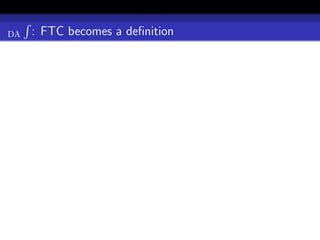
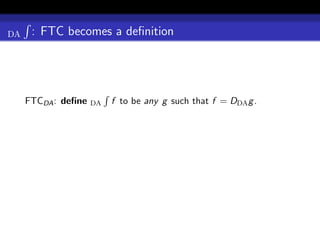
DA   : FTC becomes a definition
DA    : FTC becomes a definition


     FTCDA : define   DA   f to be any g such that f = DDA g .
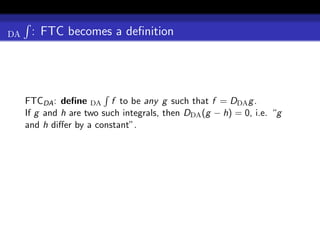
DA    : FTC becomes a definition


     FTCDA : define DA f to be any g such that f = DDA g .
     If g and h are two such integrals, then DDA (g − h) = 0, i.e. “g
     and h differ by a constant”.
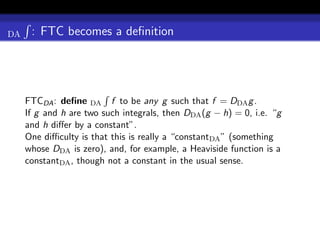
DA    : FTC becomes a definition


     FTCDA : define DA f to be any g such that f = DDA g .
     If g and h are two such integrals, then DDA (g − h) = 0, i.e. “g
     and h differ by a constant”.
     One difficulty is that this is really a “constantDA ” (something
     whose DDA is zero), and, for example, a Heaviside function is a
     constantDA , though not a constant in the usual sense.
Will the real FTC please stand up?

   FTC (as it should be taught).
Will the real FTC please stand up?

   FTC (as it should be taught).
   If g = DA f , and I(g ) is continuous on [a, b], then
                            b
                    δ           I(f ) = I(g )(b) − I(g )(a).
                        a
Will the real FTC please stand up?

   FTC (as it should be taught).
   If g = DA f , and I(g ) is continuous on [a, b], then
                            b
                    δ           I(f ) = I(g )(b) − I(g )(a).
                        a

                                                         1
   Note the caveat on continuity: g : x → arctan         x     is discontinuous
   at x = 0 (limx→0− arctan x = −π whereas
                             1
                                    2
   limx→0+ arctan x = π ),
                   1
                         2
Will the real FTC please stand up?

   FTC (as it should be taught).
   If g = DA f , and I(g ) is continuous on [a, b], then
                            b
                    δ           I(f ) = I(g )(b) − I(g )(a).
                        a

                                                    1
   Note the caveat on continuity: g : x → arctan x is discontinuous
                              1     −π
   at x = 0 (limx→0− arctan x = 2 whereas
   limx→0+ arctan x = π ), which accounts for the invalidity of
                   1
                         2
   deducing that the integral of a negative function is positive —
          1
               −1                          π −π  π
                   = I(g )(1) − I(g )(−1) = −   = > 0.
         −1   x2+1                         4  4  2
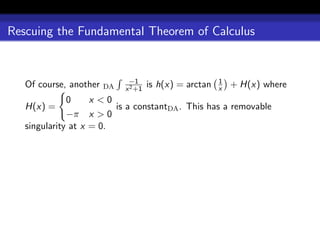
Rescuing the Fundamental Theorem of Calculus


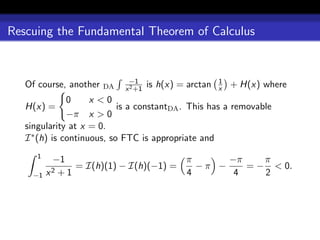
                              −1                         1
   Of course, another   DA   x 2 +1
                                      is h(x) = arctan   x   + H(x) where
              0     x <0
   H(x) =                is a constantDA . This has a removable
              −π x > 0
   singularity at x = 0.
Rescuing the Fundamental Theorem of Calculus


                              −1                         1
   Of course, another   DA   x 2 +1
                                      is h(x) = arctan   x   + H(x) where
               0     x <0
   H(x) =                   is a constantDA . This has a removable
               −π x > 0
   singularity at x = 0.
   I ∗ (h) is continuous, so FTC is appropriate and
      1
           −1                         π      −π    π
               = I(h)(1) − I(h)(−1) =   −π −    = − < 0.
     −1   x2+1                        4       4    2
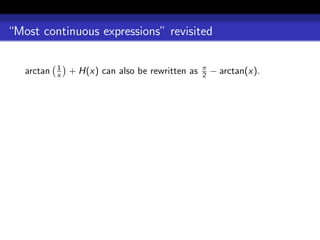
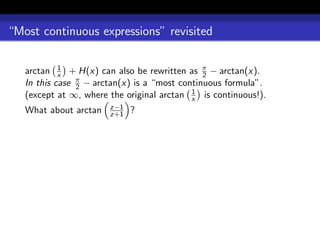
“Most continuous expressions” revisited

            1                                     π
   arctan   x   + H(x) can also be rewritten as   2   − arctan(x).
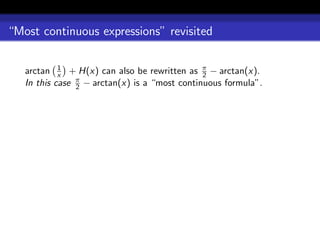
“Most continuous expressions” revisited


   arctan x + H(x) can also be rewritten as π − arctan(x).
            1
                                               2
   In this case π − arctan(x) is a “most continuous formula”.
                2
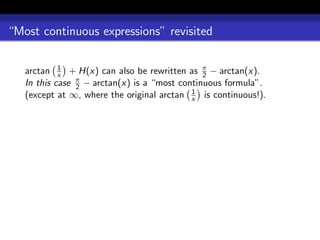
“Most continuous expressions” revisited


   arctan x + H(x) can also be rewritten as π − arctan(x).
            1
                                               2
   In this case π − arctan(x) is a “most continuous formula”.
                2
                                            1
   (except at ∞, where the original arctan x is continuous!).
“Most continuous expressions” revisited


   arctan x + H(x) can also be rewritten as π − arctan(x).
            1
                                               2
   In this case π − arctan(x) is a “most continuous formula”.
                2
                                            1
   (except at ∞, where the original arctan x is continuous!).
                       z−1
   What about arctan   z+1   ?
“Most continuous expressions” revisited


   arctan x + H(x) can also be rewritten as π − arctan(x).
            1
                                               2
   In this case π − arctan(x) is a “most continuous formula”.
                2
                                            1
   (except at ∞, where the original arctan x is continuous!).
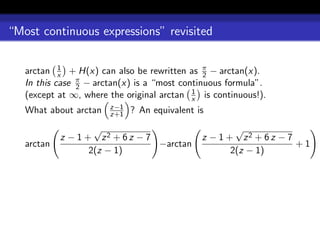
                       z−1
   What about arctan   z+1   ? An equivalent is
                    √                                 √
            z − 1 + z2 + 6 z − 7              z − 1 + z2 + 6 z − 7
   arctan                        −arctan                           +1
                   2(z − 1)                          2(z − 1)
“Most continuous expressions” revisited


   arctan x + H(x) can also be rewritten as π − arctan(x).
            1
                                               2
   In this case π − arctan(x) is a “most continuous formula”.
                2
                                            1
   (except at ∞, where the original arctan x is continuous!).
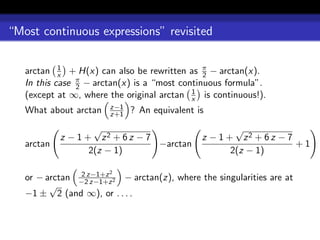
                       z−1
   What about arctan   z+1   ? An equivalent is
                    √                                 √
            z − 1 + z2 + 6 z − 7              z − 1 + z2 + 6 z − 7
   arctan                        −arctan                           +1
                   2(z − 1)                          2(z − 1)

                       2
   or − arctan −2z−1+z 2 − arctan(z), where the singularities are at
                2
                  z−1+z
         √
   −1 ± 2 (and ∞), or . . . .
“Most continuous expressions” revisited


   arctan x + H(x) can also be rewritten as π − arctan(x).
            1
                                               2
   In this case π − arctan(x) is a “most continuous formula”.
                2
                                            1
   (except at ∞, where the original arctan x is continuous!).
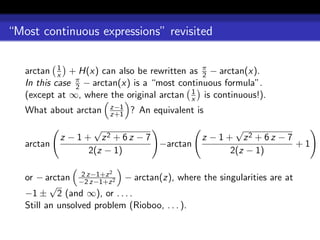
                       z−1
   What about arctan   z+1   ? An equivalent is
                    √                                 √
            z − 1 + z2 + 6 z − 7              z − 1 + z2 + 6 z − 7
   arctan                        −arctan                           +1
                   2(z − 1)                          2(z − 1)

                       2
   or − arctan −2z−1+z 2 − arctan(z), where the singularities are at
                  2
                    z−1+z
          √
   −1 ± 2 (and ∞), or . . . .
   Still an unsolved problem (Rioboo, . . . ).
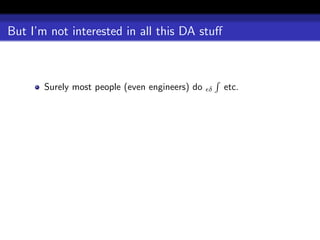
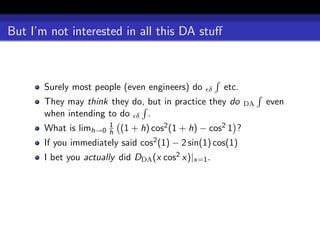
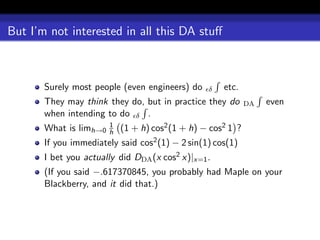
But I’m not interested in all this DA stuff


       Surely most people (even engineers) do   δ   etc.
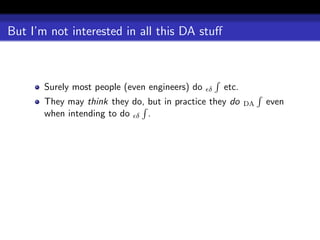
But I’m not interested in all this DA stuff


       Surely most people (even engineers) do   δ   etc.
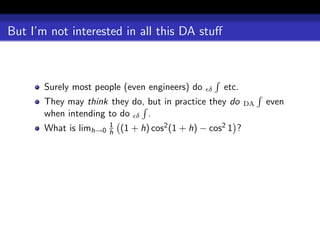
       They may think they do, but in practice they do     DA   even
       when intending to do δ .
But I’m not interested in all this DA stuff


       Surely most people (even engineers) do     δ   etc.
       They may think they do, but in practice they do        DA   even
       when intending to do δ .
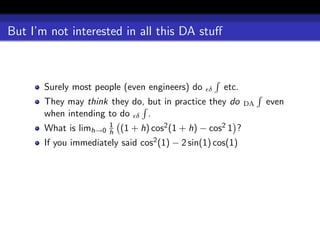
                        1
       What is limh→0   h   (1 + h) cos2 (1 + h) − cos2 1 ?
But I’m not interested in all this DA stuff


       Surely most people (even engineers) do     δ   etc.
       They may think they do, but in practice they do        DA   even
       when intending to do δ .
                        1
       What is limh→0   h   (1 + h) cos2 (1 + h) − cos2 1 ?
       If you immediately said cos2 (1) − 2 sin(1) cos(1)
But I’m not interested in all this DA stuff


       Surely most people (even engineers) do     δ   etc.
       They may think they do, but in practice they do        DA   even
       when intending to do δ .
                        1
       What is limh→0   h   (1 + h) cos2 (1 + h) − cos2 1 ?
       If you immediately said cos2 (1) − 2 sin(1) cos(1)
       I bet you actually did DDA (x cos2 x)|x=1 .
But I’m not interested in all this DA stuff


       Surely most people (even engineers) do     δ   etc.
       They may think they do, but in practice they do        DA   even
       when intending to do δ .
                        1
       What is limh→0   h   (1 + h) cos2 (1 + h) − cos2 1 ?
       If you immediately said cos2 (1) − 2 sin(1) cos(1)
       I bet you actually did DDA (x cos2 x)|x=1 .
       (If you said −.617370845, you probably had Maple on your
       Blackberry, and it did that.)
Conclusions
Conclusions


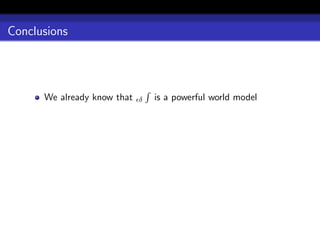
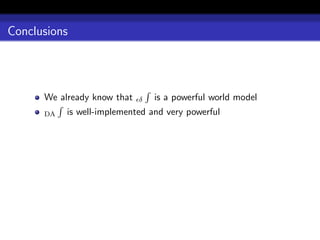
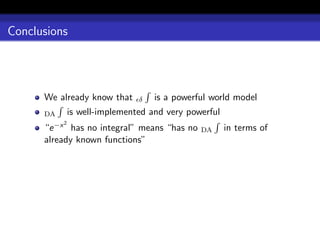
      We already know that   δ   is a powerful world model
Conclusions


      We already know that   δ   is a powerful world model
      DA   is well-implemented and very powerful
Conclusions


      We already know that      δ   is a powerful world model
      DA       is well-implemented and very powerful
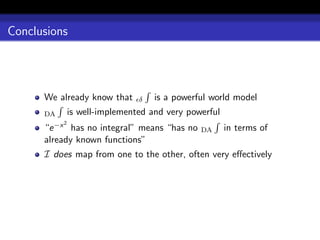
      “e−x 2 has no integral” means “has no            in terms of
                                               DA
      already known functions”
Conclusions


      We already know that      δ   is a powerful world model
      DA       is well-implemented and very powerful
      “e−x 2 has no integral” means “has no            in terms of
                                               DA
      already known functions”
      I does map from one to the other, often very effectively
Conclusions


      We already know that      δ   is a powerful world model
      DA       is well-implemented and very powerful
      “e−x 2 has no integral” means “has no            in terms of
                                               DA
      already known functions”
      I does map from one to the other, often very effectively
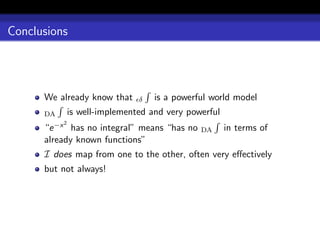
      but not always!
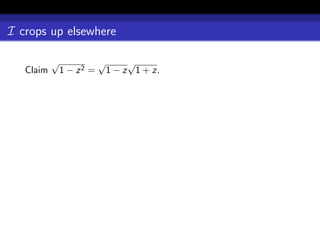
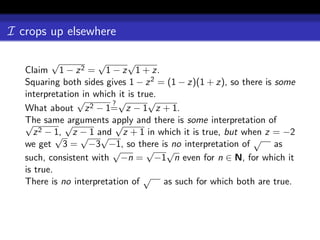
I crops up elsewhere

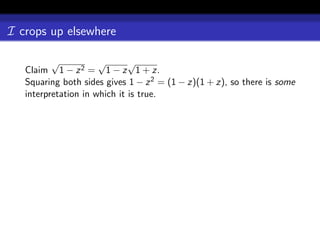
           √              √        √
   Claim       1 − z2 =       1 − z 1 + z.
I crops up elsewhere

          √           √       √
   Claim 1 − z 2 = 1 − z 1 + z.
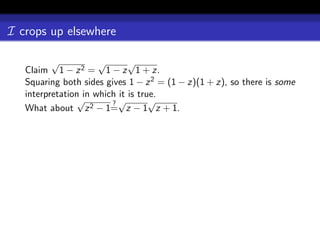
   Squaring both sides gives 1 − z 2 = (1 − z)(1 + z), so there is some
   interpretation in which it is true.
I crops up elsewhere

          √           √       √
   Claim 1 − z 2 = 1 − z 1 + z.
   Squaring both sides gives 1 − z 2 = (1 − z)(1 + z), so there is some
   interpretation in which it is true.
                √        ?√         √
   What about z 2 − 1= z − 1 z + 1.
I crops up elsewhere

          √           √       √
   Claim 1 − z 2 = 1 − z 1 + z.
   Squaring both sides gives 1 − z 2 = (1 − z)(1 + z), so there is some
   interpretation in which it is true.
                 √       ?√         √
   What about z 2 − 1= z − 1 z + 1.
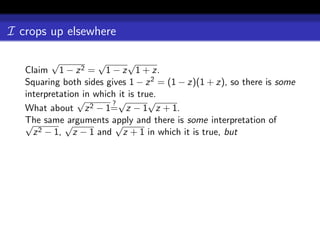
   √ same √
   The        arguments apply and there is some interpretation of
                          √
     z 2 − 1,   z − 1 and z + 1 in which it is true, but
I crops up elsewhere

           √          √       √
   Claim 1 − z 2 = 1 − z 1 + z.
   Squaring both sides gives 1 − z 2 = (1 − z)(1 + z), so there is some
   interpretation in which it is true.
                 √       ?√         √
   What about z 2 − 1= z − 1 z + 1.
   √ same √
   The         arguments apply and there is some interpretation of
                          √
        2 − 1,
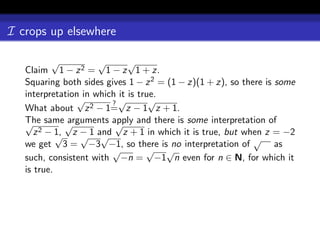
      z     √ z − 1 and z + 1 in which it is true, but when z = −2
                  √ √                                        √
   we get 3 = −3 −1, so there is no interpretation of              as
                         √         √ √
   such, consistent with −n = −1 n even for n ∈ N, for which it
   is true.
I crops up elsewhere

           √          √       √
   Claim 1 − z 2 = 1 − z 1 + z.
   Squaring both sides gives 1 − z 2 = (1 − z)(1 + z), so there is some
   interpretation in which it is true.
                 √       ?√         √
   What about z 2 − 1= z − 1 z + 1.
   √ same √
   The         arguments apply and there is some interpretation of
                          √
        2 − 1,
      z     √ z − 1 and z + 1 in which it is true, but when z = −2
                  √ √                                        √
   we get 3 = −3 −1, so there is no interpretation of              as
                         √         √ √
   such, consistent with −n = −1 n even for n ∈ N, for which it
   is true.
                                   √
   There is no interpretation of       as such for which both are true.
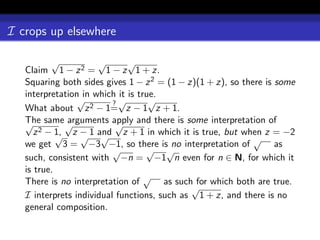
I crops up elsewhere

           √          √       √
   Claim 1 − z 2 = 1 − z 1 + z.
   Squaring both sides gives 1 − z 2 = (1 − z)(1 + z), so there is some
   interpretation in which it is true.
                 √        ?√        √
   What about z 2 − 1= z − 1 z + 1.
   √ same √
   The         arguments apply and there is some interpretation of
                           √
        2 − 1,
      z     √ z − 1 and z + 1 in which it is true, but when z = −2
                  √ √                                        √
   we get 3 = −3 −1, so there is no interpretation of              as
                          √        √ √
   such, consistent with −n = −1 n even for n ∈ N, for which it
   is true.
                                   √
   There is no interpretation of       as such for which both are true.
                                              √
   I interprets individual functions, such as 1 + z, and there is no
   general composition.

Caims 2009

  • 1.
    The unreasonable effectivenessof algebra (but don’t take it for granted) James Davenport University of Bath (visiting Waterloo) 11 June 2009
  • 2.
    What is thederivative of sin x?
  • 3.
    What is thederivative of sin x? sin(x + δ) − sin(x) f (x) = lim δ→0 δ
  • 4.
    What is thederivative of sin x? sin(x + δ) − sin(x) f (x) = lim δ→0 δ sin(x + δ) − sin(x) ∀ > 0∃D : δ < D ⇒ f (x) − < δ
  • 5.
    What is thederivative of sin x? sin(x + δ) − sin(x) f (x) = lim δ→0 δ sin(x + δ) − sin(x) ∀ > 0∃D : δ < D ⇒ f (x) − < δ sin(x + δ) − sin(x) = cos(x) sin(δ) − sin(x)(1 − cos(δ)) so we can make the choice f (x) = cos(x).
  • 6.
    What is thederivative of sin x? sin(x + δ) − sin(x) f (x) = lim δ→0 δ sin(x + δ) − sin(x) ∀ > 0∃D : δ < D ⇒ f (x) − < δ sin(x + δ) − sin(x) = cos(x) sin(δ) − sin(x)(1 − cos(δ)) so we can make the choice f (x) = cos(x). We can then take 1 √ D = 2 min( , 1), and some simple algebra shows the result.
  • 7.
    What is thederivative of sin x? sin(x + δ) − sin(x) f (x) = lim δ→0 δ sin(x + δ) − sin(x) ∀ > 0∃D : δ < D ⇒ f (x) − < δ sin(x + δ) − sin(x) = cos(x) sin(δ) − sin(x)(1 − cos(δ)) so we can make the choice f (x) = cos(x). We can then take 1 √ D = 2 min( , 1), and some simple algebra shows the result. Did any of you do that?
  • 8.
    What is thederivative of sin x? sin(x + δ) − sin(x) f (x) = lim δ→0 δ sin(x + δ) − sin(x) ∀ > 0∃D : δ < D ⇒ f (x) − < δ sin(x + δ) − sin(x) = cos(x) sin(δ) − sin(x)(1 − cos(δ)) so we can make the choice f (x) = cos(x). We can then take 1 √ D = 2 min( , 1), and some simple algebra shows the result. Did any of you do that? √ Did any of you take D = 2 max(| min( ,1) cos(x)|,| sin(x)|,1) to allow for x ∈ C?
  • 9.
    What is thederivative of sin x? sin(x + δ) − sin(x) f (x) = lim δ→0 δ sin(x + δ) − sin(x) ∀ > 0∃D : δ < D ⇒ f (x) − < δ sin(x + δ) − sin(x) = cos(x) sin(δ) − sin(x)(1 − cos(δ)) so we can make the choice f (x) = cos(x). We can then take 1 √ D = 2 min( , 1), and some simple algebra shows the result. Did any of you do that? √ Did any of you take D = 2 max(| min( ,1) cos(x)|,| sin(x)|,1) to allow for x ∈ C? Or did you “just know it”?
  • 10.
    π/2 What is theintegral: 0 cos x?
  • 11.
    π/2 What is theintegral: 0 cos x? I = lim S ∆ [cos(x)] = lim S ∆ [cos(x)] |∆|→0 |∆|→0 (∆ ranges over all dissections of [0, π/2])
  • 12.
    π/2 What is theintegral: 0 cos x? I = lim S ∆ [cos(x)] = lim S ∆ [cos(x)] |∆|→0 |∆|→0 (∆ ranges over all dissections of [0, π/2]) Does anyone actually do this?
  • 13.
    π/2 What is theintegral: 0 cos x? I = lim S ∆ [cos(x)] = lim S ∆ [cos(x)] |∆|→0 |∆|→0 (∆ ranges over all dissections of [0, π/2]) Does anyone actually do this? Can anyone actually do this?
  • 14.
    π/2 What is theintegral: 0 cos x? I = lim S ∆ [cos(x)] = lim S ∆ [cos(x)] |∆|→0 |∆|→0 (∆ ranges over all dissections of [0, π/2]) Does anyone actually do this? Can anyone actually do this? Or do we say “well, we have proved that sin = cos, so cos = sin, and therefore the answer is sin π − sin 0 = 1? 2
  • 15.
    π/2 What is theintegral: 0 cos x? I = lim S ∆ [cos(x)] = lim S ∆ [cos(x)] |∆|→0 |∆|→0 (∆ ranges over all dissections of [0, π/2]) Does anyone actually do this? Can anyone actually do this? Or do we say “well, we have proved that sin = cos, so cos = sin, and therefore the answer is sin π − sin 0 = 1? 2 We might say “therefore, by the Fundamental Theorem of Calculus, . . . ”
  • 16.
    What is theFundamental Theorem of Calculus?
  • 17.
    What is theFundamental Theorem of Calculus? Indeed, what is calculus?
  • 18.
    What is theFundamental Theorem of Calculus? Indeed, what is calculus? . . . the deism of Liebniz over the dotage of Newton . . . [Babbage, chapter 4]
  • 19.
    What is theFundamental Theorem of Calculus? Indeed, what is calculus? . . . the deism of Liebniz over the dotage of Newton . . . [Babbage, chapter 4] I claim that calculus is actually the interesting fusion of two, different subjects.
  • 20.
    What is theFundamental Theorem of Calculus? Indeed, what is calculus? . . . the deism of Liebniz over the dotage of Newton . . . [Babbage, chapter 4] I claim that calculus is actually the interesting fusion of two, different subjects. What you learned in calculus, which I shall write as D δ : the “differentiation of –δ analysis”. Also d d x , and its inverse δ δ .
  • 21.
    What is theFundamental Theorem of Calculus? Indeed, what is calculus? . . . the deism of Liebniz over the dotage of Newton . . . [Babbage, chapter 4] I claim that calculus is actually the interesting fusion of two, different subjects. What you learned in calculus, which I shall write as D δ : the “differentiation of –δ analysis”. Also d d x , and its inverse δ δ . What is taught in differential algebra, which I shall write as d DDA : the “differentiation of differential algebra”. Also dDA x , and its inverse DA .
  • 22.
    D δ (forfunctions R → R)
  • 23.
    D δ (forfunctions R → R) Define CL(f , x0 ) (the “Cauchy Limit”) as f (x0 + h) − f (x0 ) CL(f , x0 ) = lim h→0 h and D δ (f ) = λx. CL(f , x).
  • 24.
    D δ (forfunctions R → R) Define CL(f , x0 ) (the “Cauchy Limit”) as f (x0 + h) − f (x0 ) CL(f , x0 ) = lim h→0 h and D δ (f ) = λx. CL(f , x). Then the following are theorems.
  • 25.
    D δ (forfunctions R → R) Define CL(f , x0 ) (the “Cauchy Limit”) as f (x0 + h) − f (x0 ) CL(f , x0 ) = lim h→0 h and D δ (f ) = λx. CL(f , x). Then the following are theorems. D δ (c) = 0 ∀c constants.
  • 26.
    D δ (forfunctions R → R) Define CL(f , x0 ) (the “Cauchy Limit”) as f (x0 + h) − f (x0 ) CL(f , x0 ) = lim h→0 h and D δ (f ) = λx. CL(f , x). Then the following are theorems. D δ (c) = 0 ∀c constants. CL(f + g , x0 ) = CL(f , x0 ) + CL(g , x0 ), so D δ (f + g ) = D δ (f ) + D δ (g ).
  • 27.
    D δ (forfunctions R → R) Define CL(f , x0 ) (the “Cauchy Limit”) as f (x0 + h) − f (x0 ) CL(f , x0 ) = lim h→0 h and D δ (f ) = λx. CL(f , x). Then the following are theorems. D δ (c) = 0 ∀c constants. CL(f + g , x0 ) = CL(f , x0 ) + CL(g , x0 ), so D δ (f + g ) = D δ (f ) + D δ (g ). CL(fg , x0 ) = CL(f , x0 )g (x0 ) + f (x0 ) CL(g , x0 ), so D δ (fg ) = D δ (f )g + fD δ (g ).
  • 28.
    D δ (forfunctions R → R) Define CL(f , x0 ) (the “Cauchy Limit”) as f (x0 + h) − f (x0 ) CL(f , x0 ) = lim h→0 h and D δ (f ) = λx. CL(f , x). Then the following are theorems. D δ (c) = 0 ∀c constants. CL(f + g , x0 ) = CL(f , x0 ) + CL(g , x0 ), so D δ (f + g ) = D δ (f ) + D δ (g ). CL(fg , x0 ) = CL(f , x0 )g (x0 ) + f (x0 ) CL(g , x0 ), so D δ (fg ) = D δ (f )g + fD δ (g ). D δ (λx.f (g (x))) = D δ (g )λx.D δ (f )(g (x)). (Chain rule)
  • 29.
    DDA (for anyring R of characteristic 0) Definition: DDA : R → R is a derivation on R if it satisfies:
  • 30.
    DDA (for anyring R of characteristic 0) Definition: DDA : R → R is a derivation on R if it satisfies: DDA (f + g ) = DDA (f ) + DDA (g )
  • 31.
    DDA (for anyring R of characteristic 0) Definition: DDA : R → R is a derivation on R if it satisfies: DDA (f + g ) = DDA (f ) + DDA (g ) DDA (fg ) = DDA (f )g + fDDA (g )
  • 32.
    DDA (for anyring R of characteristic 0) Definition: DDA : R → R is a derivation on R if it satisfies: DDA (f + g ) = DDA (f ) + DDA (g ) DDA (fg ) = DDA (f )g + fDDA (g )
  • 33.
    DDA (for anyring R of characteristic 0) Definition: DDA : R → R is a derivation on R if it satisfies: DDA (f + g ) = DDA (f ) + DDA (g ) DDA (fg ) = DDA (f )g + fDDA (g ) Corollaries:
  • 34.
    DDA (for anyring R of characteristic 0) Definition: DDA : R → R is a derivation on R if it satisfies: DDA (f + g ) = DDA (f ) + DDA (g ) DDA (fg ) = DDA (f )g + fDDA (g ) Corollaries: DDA (c) = 0 for all c algebraic over 1 .
  • 35.
    DDA (for anyring R of characteristic 0) Definition: DDA : R → R is a derivation on R if it satisfies: DDA (f + g ) = DDA (f ) + DDA (g ) DDA (fg ) = DDA (f )g + fDDA (g ) Corollaries: DDA (c) = 0 for all c algebraic over 1 . f DDA (f )g −fDDA (g ) DDA ( g ) = g2 .
  • 36.
    DDA (for anyring R of characteristic 0) Definition: DDA : R → R is a derivation on R if it satisfies: DDA (f + g ) = DDA (f ) + DDA (g ) DDA (fg ) = DDA (f )g + fDDA (g ) Corollaries: DDA (c) = 0 for all c algebraic over 1 . f DDA (f )g −fDDA (g ) DDA ( g ) = g2 . DDA extends uniquely to algebraic extensions.
  • 37.
    DDA (for anyring R of characteristic 0) Definition: DDA : R → R is a derivation on R if it satisfies: DDA (f + g ) = DDA (f ) + DDA (g ) DDA (fg ) = DDA (f )g + fDDA (g ) Corollaries: DDA (c) = 0 for all c algebraic over 1 . f DDA (f )g −fDDA (g ) DDA ( g ) = g2 . DDA extends uniquely to algebraic extensions.
  • 38.
    DDA (for anyring R of characteristic 0) Definition: DDA : R → R is a derivation on R if it satisfies: DDA (f + g ) = DDA (f ) + DDA (g ) DDA (fg ) = DDA (f )g + fDDA (g ) Corollaries: DDA (c) = 0 for all c algebraic over 1 . f DDA (f )g −fDDA (g ) DDA ( g ) = g2 . DDA extends uniquely to algebraic extensions. Note that there is no Chain Rule as such, since composition is not necessarily a defined concept on R.
  • 39.
    A note onthe word “constant”
  • 40.
    A note onthe word “constant” We said DDA (c) = 0 for all c algebraic over 1 .
  • 41.
    A note onthe word “constant” We said DDA (c) = 0 for all c algebraic over 1 . “constants differentiate to 0”
  • 42.
    A note onthe word “constant” We said DDA (c) = 0 for all c algebraic over 1 . “constants differentiate to 0”
  • 43.
    A note onthe word “constant” We said DDA (c) = 0 for all c algebraic over 1 . “constants differentiate to 0” By abuse of language, we say that anything that differentiates to zero is a “constantDA ”.
  • 44.
    How are thetwo subjects related? If we define DDA (x) = 1, then DDA is defined on Z[x], and extends to Q(x) and indeed Q(x).
  • 45.
    How are thetwo subjects related? If we define DDA (x) = 1, then DDA is defined on Z[x], and extends to Q(x) and indeed Q(x). If we interpret (denoted I) Q(x) as functions R → R, then DDA can be interpreted as D δ , i.e. I(DDA (f )) = D δ (I(f ))
  • 46.
    How are thetwo subjects related? If we define DDA (x) = 1, then DDA is defined on Z[x], and extends to Q(x) and indeed Q(x). If we interpret (denoted I) Q(x) as functions R → R, then DDA can be interpreted as D δ , i.e. I(DDA (f )) = D δ (I(f )) (at least up to removable singularities).
  • 47.
    An aside oninterpretation (x−1)2 x−1 Consider L := x 2 −1 and R := x+1 .
  • 48.
    An aside oninterpretation 2 Consider L := (x−1) and R := x−1 . x 2 −1 x+1 0 As elements of Q(x) they are equal, since L − R = x 2 −1 = 0.
  • 49.
    An aside oninterpretation 2 Consider L := (x−1) and R := x−1 . x 2 −1 x+1 As elements of Q(x) they are equal, since L − R = x 20 = 0. −1 But as formulae (viewed as algorithm specifications), L(1)=“divide by zero error”, whereas R(1) = 0.
  • 50.
    An aside oninterpretation 2 Consider L := (x−1) and R := x−1 . x 2 −1 x+1 As elements of Q(x) they are equal, since L − R = x 20 = 0. −1 But as formulae (viewed as algorithm specifications), L(1)=“divide by zero error”, whereas R(1) = 0. Hence the warning about removable singularities!
  • 51.
    An aside oninterpretation 2 Consider L := (x−1) and R := x−1 . x 2 −1 x+1 As elements of Q(x) they are equal, since L − R = x 20 = 0. −1 But as formulae (viewed as algorithm specifications), L(1)=“divide by zero error”, whereas R(1) = 0. Hence the warning about removable singularities! Also, note that −1 is not a removable singularity!
  • 52.
    An aside oninterpretation 2 Consider L := (x−1) and R := x−1 . x 2 −1 x+1 As elements of Q(x) they are equal, since L − R = x 20 = 0. −1 But as formulae (viewed as algorithm specifications), L(1)=“divide by zero error”, whereas R(1) = 0. Hence the warning about removable singularities! Also, note that −1 is not a removable singularity! In the case of Q(x), every element has a “most continuous formula”, so interpreting this as R → R can’t go wrong.
  • 53.
    An aside oninterpretation 2 Consider L := (x−1) and R := x−1 . x 2 −1 x+1 As elements of Q(x) they are equal, since L − R = x 20 = 0. −1 But as formulae (viewed as algorithm specifications), L(1)=“divide by zero error”, whereas R(1) = 0. Hence the warning about removable singularities! Also, note that −1 is not a removable singularity! In the case of Q(x), every element has a “most continuous formula”, so interpreting this as R → R can’t go wrong. We use I ∗ to indicate “interpretation with removable singularities removed”, since there isn’t always a formulaic way of doing so.
  • 54.
    An aside oninterpretation 2 Consider L := (x−1) and R := x−1 . x 2 −1 x+1 As elements of Q(x) they are equal, since L − R = x 20 = 0. −1 But as formulae (viewed as algorithm specifications), L(1)=“divide by zero error”, whereas R(1) = 0. Hence the warning about removable singularities! Also, note that −1 is not a removable singularity! In the case of Q(x), every element has a “most continuous formula”, so interpreting this as R → R can’t go wrong. We use I ∗ to indicate “interpretation with removable singularities removed”, since there isn’t always a formulaic way of doing so. Indeed, there may be no way of interpreting without singularities, √ as in z → z : C → C.
  • 55.
    δ (for functions R → R)
  • 56.
    δ (for functions R → R) What is naturally defined is integration over an interval I . We let D stand for sub-divisions d1 = a < d2 < · · · < dn = b of I = [a, b], and |D| for the largest distance between neighbouring points in D, i.e. maxi (di+1 − di ).
  • 57.
    δ (for functions R → R) What is naturally defined is integration over an interval I . We let D stand for sub-divisions d1 = a < d2 < · · · < dn = b of I = [a, b], and |D| for the largest distance between neighbouring points in D, i.e. maxi (di+1 − di ). Let SD = i (di+1 − di ) maxdi+1 ≥x≥di f (x);
  • 58.
    δ (for functions R → R) What is naturally defined is integration over an interval I . We let D stand for sub-divisions d1 = a < d2 < · · · < dn = b of I = [a, b], and |D| for the largest distance between neighbouring points in D, i.e. maxi (di+1 − di ). Let SD = i (di+1 − di ) maxdi+1 ≥x≥di f (x); SD = i (di+1 − di ) mindi+1 ≥x≥di f (x);
  • 59.
    δ (for functions R → R) What is naturally defined is integration over an interval I . We let D stand for sub-divisions d1 = a < d2 < · · · < dn = b of I = [a, b], and |D| for the largest distance between neighbouring points in D, i.e. maxi (di+1 − di ). Let SD = i (di+1 − di ) maxdi+1 ≥x≥di f (x); SD = i (di+1 − di ) mindi+1 ≥x≥di f (x); Then δ I f = lim inf |D|→0 SD = lim sup|D|→0 SD if both exist and are equal.
  • 60.
    Consequences: Fundamental Theoremof Calculus (FTC δ ) b δ [a,b] f a≤b Define δ a f = − δ [b,a] f a>b
  • 61.
    Consequences: Fundamental Theoremof Calculus (FTC δ ) b δ [a,b] f a≤b Define δ a f = − δ [b,a] f a > b (If we’re not careful, we wind up saying “[2,1] is the same set as [1,2] except that if you integrate over it you have to add a − sign”. What we really have here is the beginnings of contour integration.
  • 62.
    Consequences: Fundamental Theoremof Calculus (FTC δ ) b δ [a,b] f a≤b Define δ a f = − δ [b,a] f a > b (If we’re not careful, we wind up saying “[2,1] is the same set as [1,2] except that if you integrate over it you have to add a − sign”. What we really have here is the beginnings of contour integration. Apostol theorem 1.20 states that if g (x) ≤ f (x) for every x in [a, b], then b b g (x)dx ≤ f (x)dx, a a and here a < b is implicit.)
  • 63.
    Consequences: Fundamental Theoremof Calculus (FTC δ ) b δ [a,b] f a≤b Define δ a f = − δ [b,a] f a > b (If we’re not careful, we wind up saying “[2,1] is the same set as [1,2] except that if you integrate over it you have to add a − sign”. What we really have here is the beginnings of contour integration. Apostol theorem 1.20 states that if g (x) ≤ f (x) for every x in [a, b], then b b g (x)dx ≤ f (x)dx, a a and here a < b is implicit.) FTC δ : δ [a,b] D δ f = f (b) − f (a).
  • 64.
    Consequences: Fundamental Theoremof Calculus (FTC δ ) b δ [a,b] f a≤b Define δ a f = − δ [b,a] f a > b (If we’re not careful, we wind up saying “[2,1] is the same set as [1,2] except that if you integrate over it you have to add a − sign”. What we really have here is the beginnings of contour integration. Apostol theorem 1.20 states that if g (x) ≤ f (x) for every x in [a, b], then b b g (x)dx ≤ f (x)dx, a a and here a < b is implicit.) FTC δ : δ [a,b] D δ f = f (b) − f (a). x Or: D δ (λx. δ a f ) = f (if the δ exists).
  • 65.
    Consequences: Fundamental Theoremof Calculus (FTC δ ) b δ [a,b] f a≤b Define δ a f = − δ [b,a] f a > b (If we’re not careful, we wind up saying “[2,1] is the same set as [1,2] except that if you integrate over it you have to add a − sign”. What we really have here is the beginnings of contour integration. Apostol theorem 1.20 states that if g (x) ≤ f (x) for every x in [a, b], then b b g (x)dx ≤ f (x)dx, a a and here a < b is implicit.) FTC δ : δ [a,b] D δ f = f (b) − f (a). x Or: D δ (λx. δ a f ) = f (if the δ exists). (Of course, this is normally stated without the λ.)
  • 66.
    DA : FTC becomes a definition
  • 67.
    DA : FTC becomes a definition FTCDA : define DA f to be any g such that f = DDA g .
  • 68.
    DA : FTC becomes a definition FTCDA : define DA f to be any g such that f = DDA g . If g and h are two such integrals, then DDA (g − h) = 0, i.e. “g and h differ by a constant”.
  • 69.
    DA : FTC becomes a definition FTCDA : define DA f to be any g such that f = DDA g . If g and h are two such integrals, then DDA (g − h) = 0, i.e. “g and h differ by a constant”. One difficulty is that this is really a “constantDA ” (something whose DDA is zero), and, for example, a Heaviside function is a constantDA , though not a constant in the usual sense.
  • 70.
    Will the realFTC please stand up?
  • 71.
    Will the realFTC please stand up? FTC (as it should be taught).
  • 72.
    Will the realFTC please stand up? FTC (as it should be taught). If g = DA f , and I(g ) is continuous on [a, b], then b δ I(f ) = I(g )(b) − I(g )(a). a
  • 73.
    Will the realFTC please stand up? FTC (as it should be taught). If g = DA f , and I(g ) is continuous on [a, b], then b δ I(f ) = I(g )(b) − I(g )(a). a 1 Note the caveat on continuity: g : x → arctan x is discontinuous at x = 0 (limx→0− arctan x = −π whereas 1 2 limx→0+ arctan x = π ), 1 2
  • 74.
    Will the realFTC please stand up? FTC (as it should be taught). If g = DA f , and I(g ) is continuous on [a, b], then b δ I(f ) = I(g )(b) − I(g )(a). a 1 Note the caveat on continuity: g : x → arctan x is discontinuous 1 −π at x = 0 (limx→0− arctan x = 2 whereas limx→0+ arctan x = π ), which accounts for the invalidity of 1 2 deducing that the integral of a negative function is positive — 1 −1 π −π π = I(g )(1) − I(g )(−1) = − = > 0. −1 x2+1 4 4 2
  • 75.
    Rescuing the FundamentalTheorem of Calculus −1 1 Of course, another DA x 2 +1 is h(x) = arctan x + H(x) where 0 x <0 H(x) = is a constantDA . This has a removable −π x > 0 singularity at x = 0.
  • 76.
    Rescuing the FundamentalTheorem of Calculus −1 1 Of course, another DA x 2 +1 is h(x) = arctan x + H(x) where 0 x <0 H(x) = is a constantDA . This has a removable −π x > 0 singularity at x = 0. I ∗ (h) is continuous, so FTC is appropriate and 1 −1 π −π π = I(h)(1) − I(h)(−1) = −π − = − < 0. −1 x2+1 4 4 2
  • 77.
    “Most continuous expressions”revisited 1 π arctan x + H(x) can also be rewritten as 2 − arctan(x).
  • 78.
    “Most continuous expressions”revisited arctan x + H(x) can also be rewritten as π − arctan(x). 1 2 In this case π − arctan(x) is a “most continuous formula”. 2
  • 79.
    “Most continuous expressions”revisited arctan x + H(x) can also be rewritten as π − arctan(x). 1 2 In this case π − arctan(x) is a “most continuous formula”. 2 1 (except at ∞, where the original arctan x is continuous!).
  • 80.
    “Most continuous expressions”revisited arctan x + H(x) can also be rewritten as π − arctan(x). 1 2 In this case π − arctan(x) is a “most continuous formula”. 2 1 (except at ∞, where the original arctan x is continuous!). z−1 What about arctan z+1 ?
  • 81.
    “Most continuous expressions”revisited arctan x + H(x) can also be rewritten as π − arctan(x). 1 2 In this case π − arctan(x) is a “most continuous formula”. 2 1 (except at ∞, where the original arctan x is continuous!). z−1 What about arctan z+1 ? An equivalent is √ √ z − 1 + z2 + 6 z − 7 z − 1 + z2 + 6 z − 7 arctan −arctan +1 2(z − 1) 2(z − 1)
  • 82.
    “Most continuous expressions”revisited arctan x + H(x) can also be rewritten as π − arctan(x). 1 2 In this case π − arctan(x) is a “most continuous formula”. 2 1 (except at ∞, where the original arctan x is continuous!). z−1 What about arctan z+1 ? An equivalent is √ √ z − 1 + z2 + 6 z − 7 z − 1 + z2 + 6 z − 7 arctan −arctan +1 2(z − 1) 2(z − 1) 2 or − arctan −2z−1+z 2 − arctan(z), where the singularities are at 2 z−1+z √ −1 ± 2 (and ∞), or . . . .
  • 83.
    “Most continuous expressions”revisited arctan x + H(x) can also be rewritten as π − arctan(x). 1 2 In this case π − arctan(x) is a “most continuous formula”. 2 1 (except at ∞, where the original arctan x is continuous!). z−1 What about arctan z+1 ? An equivalent is √ √ z − 1 + z2 + 6 z − 7 z − 1 + z2 + 6 z − 7 arctan −arctan +1 2(z − 1) 2(z − 1) 2 or − arctan −2z−1+z 2 − arctan(z), where the singularities are at 2 z−1+z √ −1 ± 2 (and ∞), or . . . . Still an unsolved problem (Rioboo, . . . ).
  • 84.
    But I’m notinterested in all this DA stuff
  • 85.
    But I’m notinterested in all this DA stuff Surely most people (even engineers) do δ etc.
  • 86.
    But I’m notinterested in all this DA stuff Surely most people (even engineers) do δ etc. They may think they do, but in practice they do DA even when intending to do δ .
  • 87.
    But I’m notinterested in all this DA stuff Surely most people (even engineers) do δ etc. They may think they do, but in practice they do DA even when intending to do δ . 1 What is limh→0 h (1 + h) cos2 (1 + h) − cos2 1 ?
  • 88.
    But I’m notinterested in all this DA stuff Surely most people (even engineers) do δ etc. They may think they do, but in practice they do DA even when intending to do δ . 1 What is limh→0 h (1 + h) cos2 (1 + h) − cos2 1 ? If you immediately said cos2 (1) − 2 sin(1) cos(1)
  • 89.
    But I’m notinterested in all this DA stuff Surely most people (even engineers) do δ etc. They may think they do, but in practice they do DA even when intending to do δ . 1 What is limh→0 h (1 + h) cos2 (1 + h) − cos2 1 ? If you immediately said cos2 (1) − 2 sin(1) cos(1) I bet you actually did DDA (x cos2 x)|x=1 .
  • 90.
    But I’m notinterested in all this DA stuff Surely most people (even engineers) do δ etc. They may think they do, but in practice they do DA even when intending to do δ . 1 What is limh→0 h (1 + h) cos2 (1 + h) − cos2 1 ? If you immediately said cos2 (1) − 2 sin(1) cos(1) I bet you actually did DDA (x cos2 x)|x=1 . (If you said −.617370845, you probably had Maple on your Blackberry, and it did that.)
  • 91.
  • 92.
    Conclusions We already know that δ is a powerful world model
  • 93.
    Conclusions We already know that δ is a powerful world model DA is well-implemented and very powerful
  • 94.
    Conclusions We already know that δ is a powerful world model DA is well-implemented and very powerful “e−x 2 has no integral” means “has no in terms of DA already known functions”
  • 95.
    Conclusions We already know that δ is a powerful world model DA is well-implemented and very powerful “e−x 2 has no integral” means “has no in terms of DA already known functions” I does map from one to the other, often very effectively
  • 96.
    Conclusions We already know that δ is a powerful world model DA is well-implemented and very powerful “e−x 2 has no integral” means “has no in terms of DA already known functions” I does map from one to the other, often very effectively but not always!
  • 97.
    I crops upelsewhere
  • 98.
    I crops upelsewhere √ √ √ Claim 1 − z2 = 1 − z 1 + z.
  • 99.
    I crops upelsewhere √ √ √ Claim 1 − z 2 = 1 − z 1 + z. Squaring both sides gives 1 − z 2 = (1 − z)(1 + z), so there is some interpretation in which it is true.
  • 100.
    I crops upelsewhere √ √ √ Claim 1 − z 2 = 1 − z 1 + z. Squaring both sides gives 1 − z 2 = (1 − z)(1 + z), so there is some interpretation in which it is true. √ ?√ √ What about z 2 − 1= z − 1 z + 1.
  • 101.
    I crops upelsewhere √ √ √ Claim 1 − z 2 = 1 − z 1 + z. Squaring both sides gives 1 − z 2 = (1 − z)(1 + z), so there is some interpretation in which it is true. √ ?√ √ What about z 2 − 1= z − 1 z + 1. √ same √ The arguments apply and there is some interpretation of √ z 2 − 1, z − 1 and z + 1 in which it is true, but
  • 102.
    I crops upelsewhere √ √ √ Claim 1 − z 2 = 1 − z 1 + z. Squaring both sides gives 1 − z 2 = (1 − z)(1 + z), so there is some interpretation in which it is true. √ ?√ √ What about z 2 − 1= z − 1 z + 1. √ same √ The arguments apply and there is some interpretation of √ 2 − 1, z √ z − 1 and z + 1 in which it is true, but when z = −2 √ √ √ we get 3 = −3 −1, so there is no interpretation of as √ √ √ such, consistent with −n = −1 n even for n ∈ N, for which it is true.
  • 103.
    I crops upelsewhere √ √ √ Claim 1 − z 2 = 1 − z 1 + z. Squaring both sides gives 1 − z 2 = (1 − z)(1 + z), so there is some interpretation in which it is true. √ ?√ √ What about z 2 − 1= z − 1 z + 1. √ same √ The arguments apply and there is some interpretation of √ 2 − 1, z √ z − 1 and z + 1 in which it is true, but when z = −2 √ √ √ we get 3 = −3 −1, so there is no interpretation of as √ √ √ such, consistent with −n = −1 n even for n ∈ N, for which it is true. √ There is no interpretation of as such for which both are true.
  • 104.
    I crops upelsewhere √ √ √ Claim 1 − z 2 = 1 − z 1 + z. Squaring both sides gives 1 − z 2 = (1 − z)(1 + z), so there is some interpretation in which it is true. √ ?√ √ What about z 2 − 1= z − 1 z + 1. √ same √ The arguments apply and there is some interpretation of √ 2 − 1, z √ z − 1 and z + 1 in which it is true, but when z = −2 √ √ √ we get 3 = −3 −1, so there is no interpretation of as √ √ √ such, consistent with −n = −1 n even for n ∈ N, for which it is true. √ There is no interpretation of as such for which both are true. √ I interprets individual functions, such as 1 + z, and there is no general composition.