12.3 Tangent to a Curve
                        Day Two


Colossians 3:17 “And whatever you do, in word or deed, do
everything in the name of the Lord Jesus, giving thanks
to God the Father through him.”
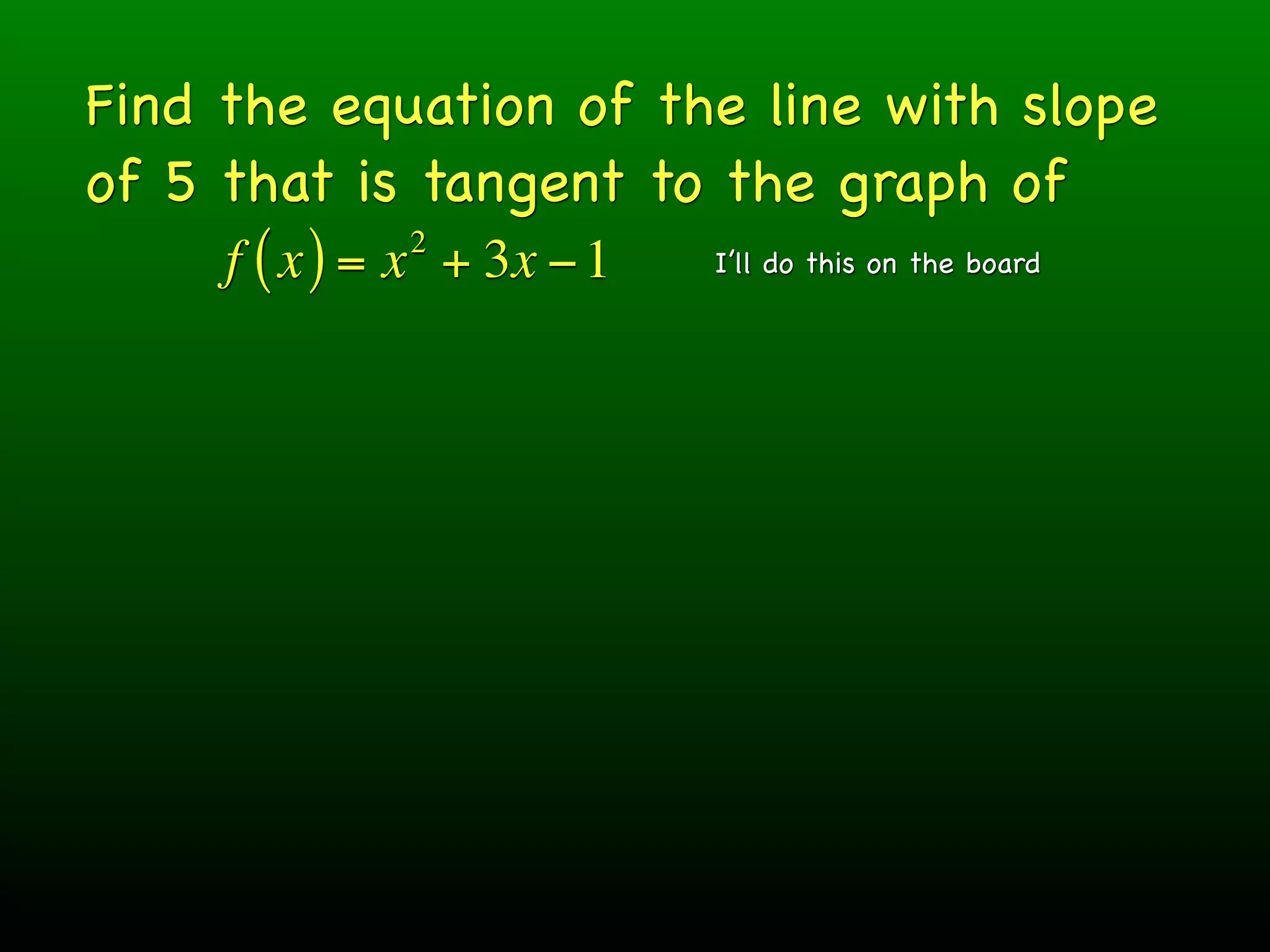
Find the equation of the line with slope
of 5 that is tangent to the graph of
              2
     f ( x ) = x + 3x − 1   I’ll do this on the board
Find the equation of the line with slope
of 5 that is tangent to the graph of
                  2
        f ( x ) = x + 3x − 1       I’ll do this on the board


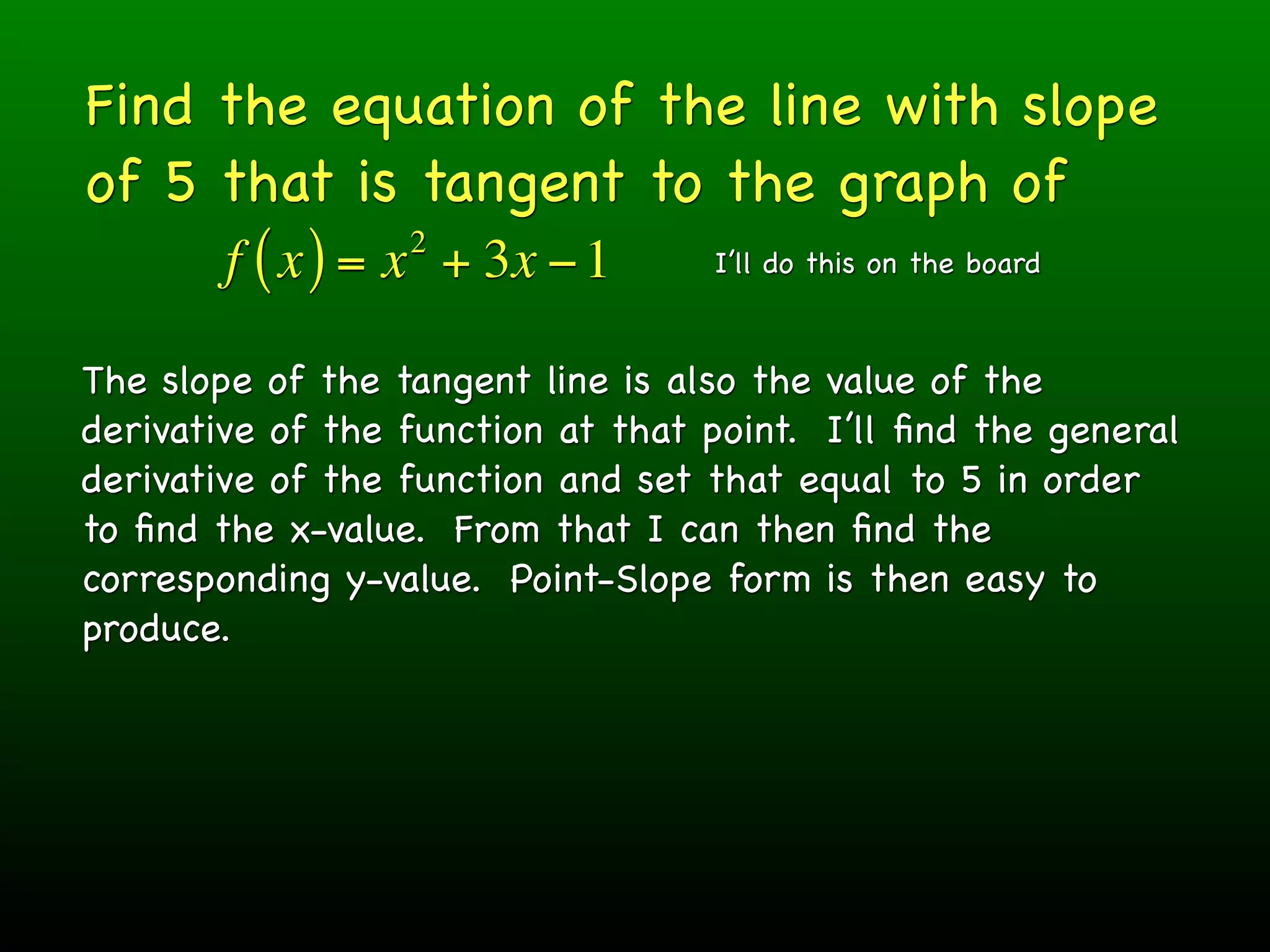
The slope of the tangent line is also the value of the
derivative of the function at that point. I’ll find the general
derivative of the function and set that equal to 5 in order
to find the x-value. From that I can then find the
corresponding y-value. Point-Slope form is then easy to
produce.
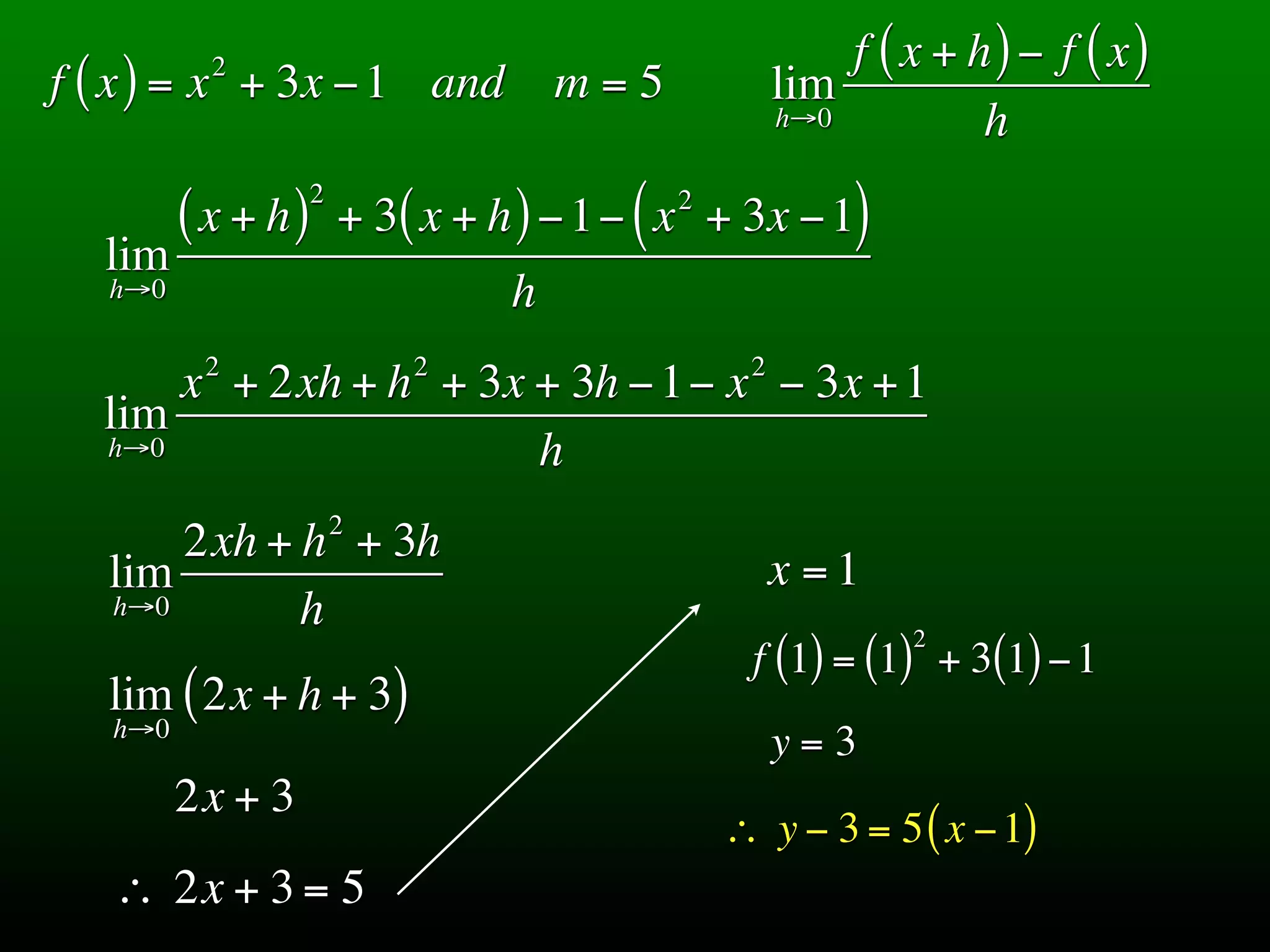
2                                             f ( x + h) − f ( x)
f ( x ) = x + 3x − 1 and              m=5            lim
                                                     h→0          h
                    2
         ( x + h)       + 3( x + h ) − 1− ( x + 3x − 1)
                                            2

  lim
   h→0                            h
          2                 2                    2
      x + 2xh + h + 3x + 3h − 1− x − 3x + 1
  lim
  h→0                  h
                        2
       2xh + h + 3h
   lim                                               x =1
   h→0       h                                               2
                                                 f (1) = (1) + 3(1) − 1
   lim ( 2x + h + 3)
   h→0
                                                     y=3
         2x + 3
                                                ∴ y − 3 = 5 ( x − 1)
   ∴ 2x + 3 = 5
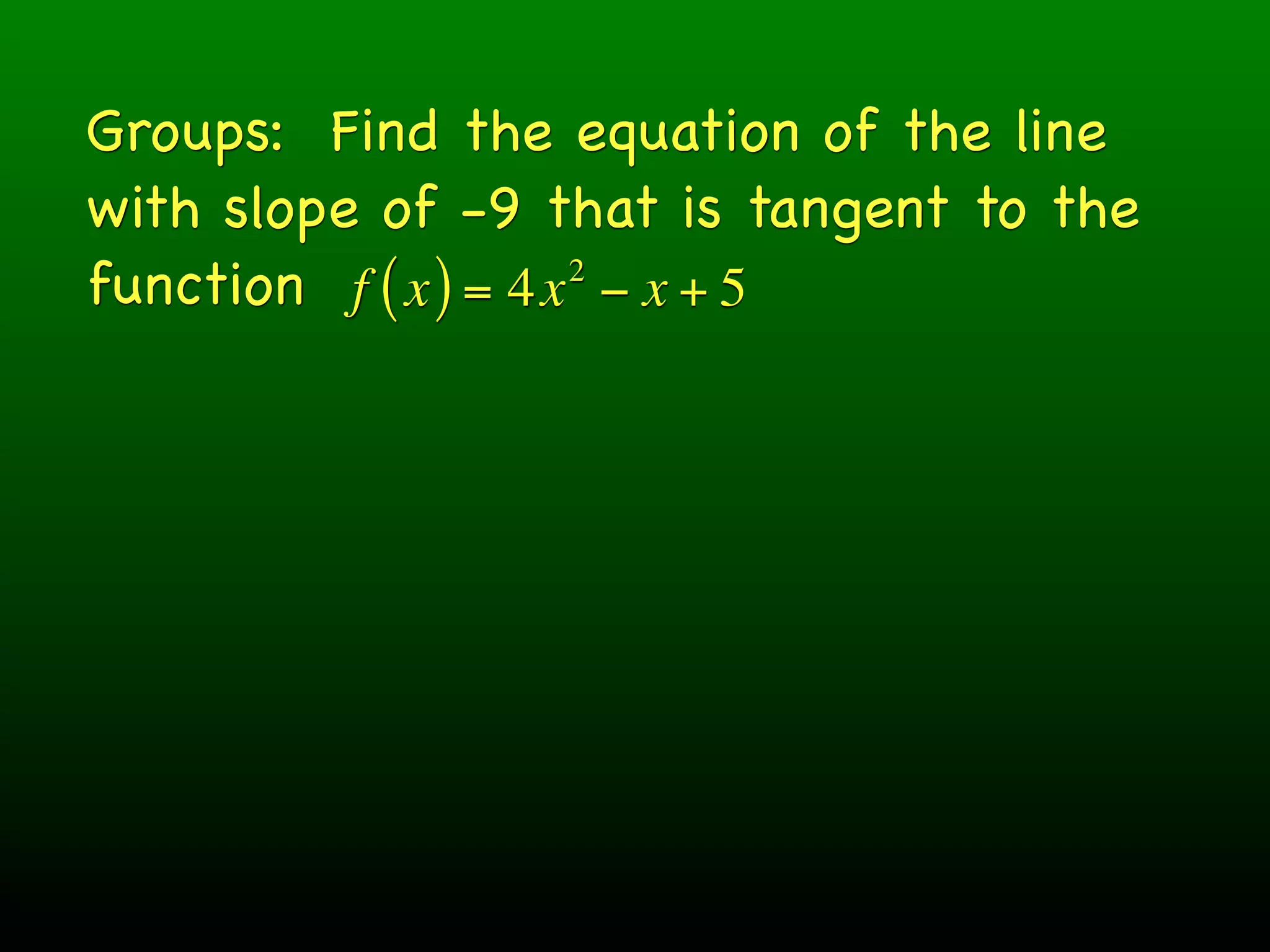
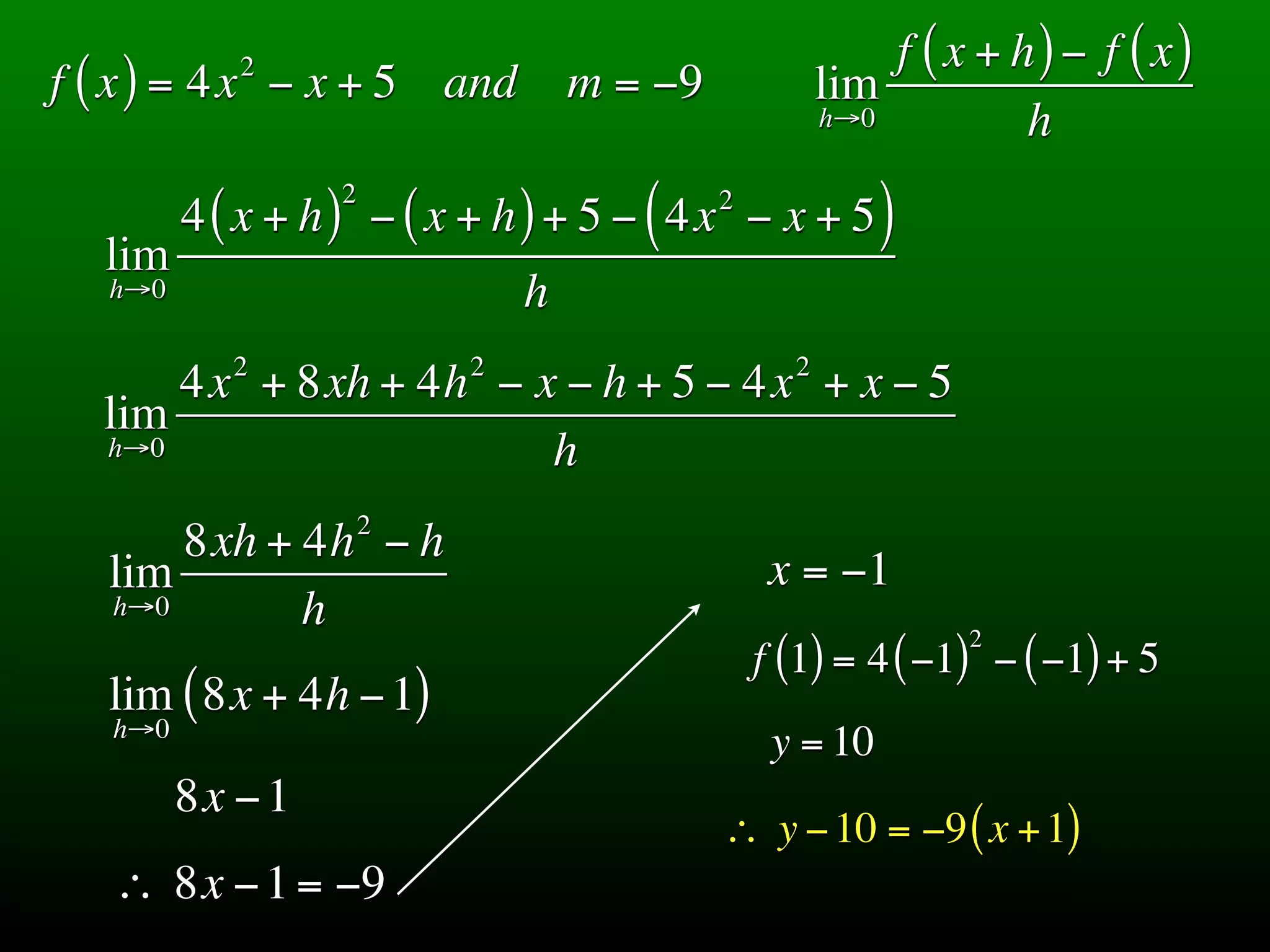
Groups: Find the equation of the line
with slope of -9 that is tangent to the
function f ( x ) = 4x − x + 5
                     2
2                                            f ( x + h) − f ( x)
f ( x ) = 4x − x + 5 and          m = −9             lim
                                                     h→0          h
                  2
         4 ( x + h ) − ( x + h ) + 5 − ( 4x − x + 5 )
                                           2

  lim
   h→0                        h
            2             2                      2
      4x + 8xh + 4h − x − h + 5 − 4x + x − 5
  lim
  h→0                  h
                      2
       8xh + 4h − h
   lim                                          x = −1
   h→0       h                                                2
                                               f (1) = 4 ( −1) − ( −1) + 5
   lim ( 8x + 4h − 1)
   h→0
                                                y = 10
         8x − 1
                                           ∴ y − 10 = −9 ( x + 1)
   ∴ 8x − 1 = −9
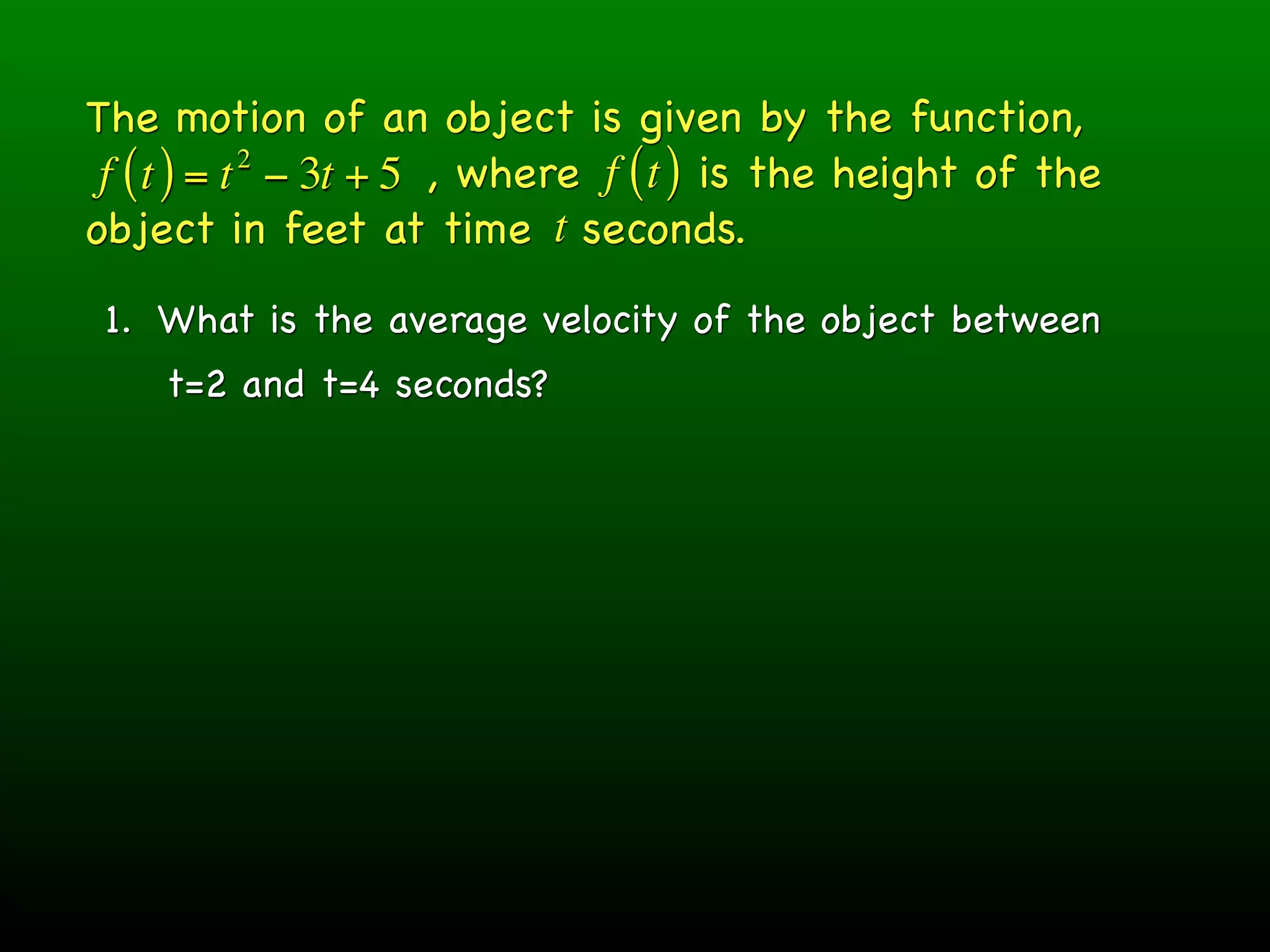
The motion of an object is given by the function,
 f ( t ) = t − 3t + 5 , where f ( t ) is the height of the
            2

object in feet at time t seconds.

 1. What is the average velocity of the object between
    t=2 and t=4 seconds?
The motion of an object is given by the function,
 f ( t ) = t − 3t + 5 , where f ( t ) is the height of the
            2

object in feet at time t seconds.

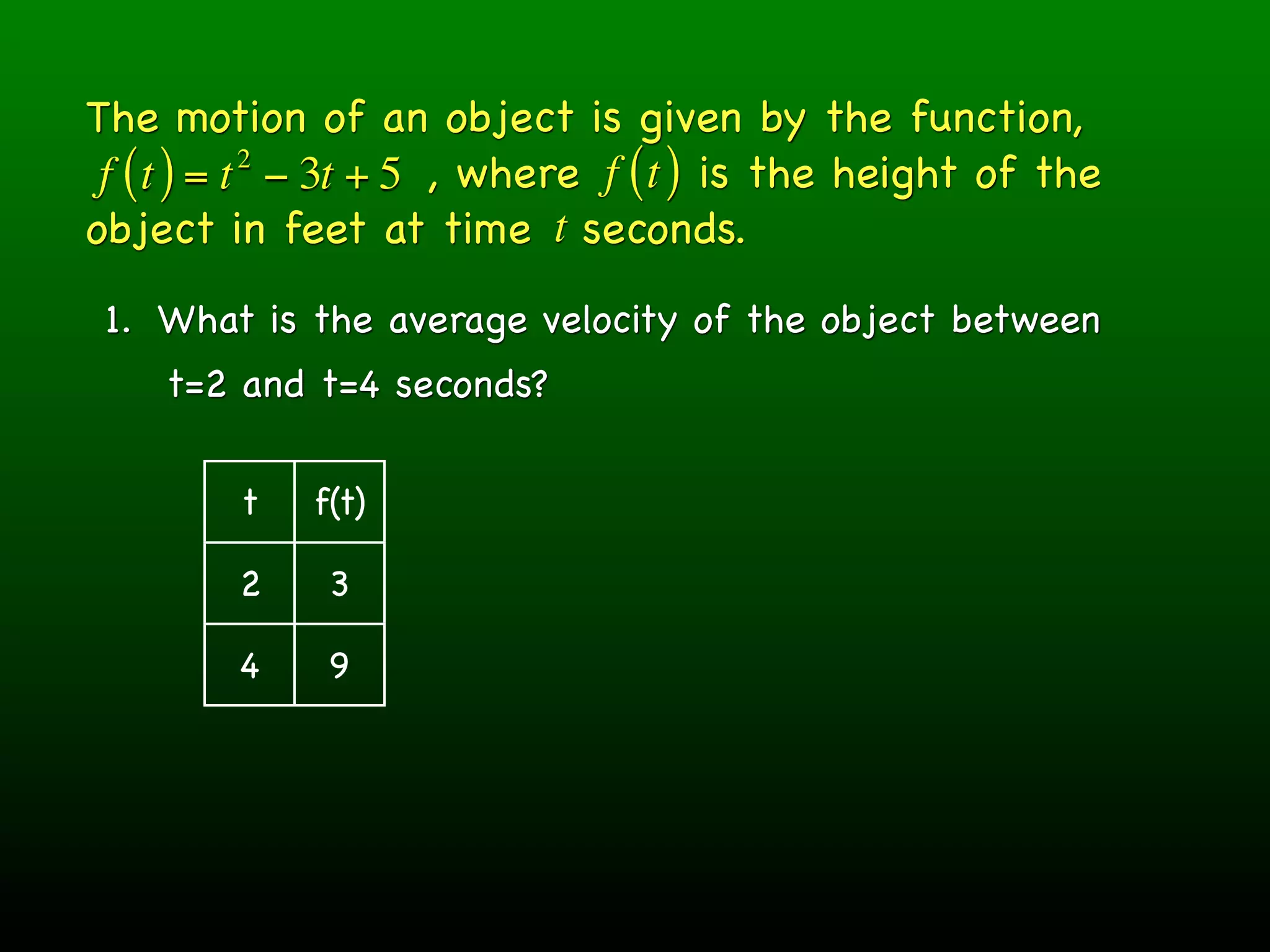
 1. What is the average velocity of the object between
    t=2 and t=4 seconds?

        t    f(t)

        2     3

        4     9
The motion of an object is given by the function,
 f ( t ) = t − 3t + 5 , where f ( t ) is the height of the
            2

object in feet at time t seconds.

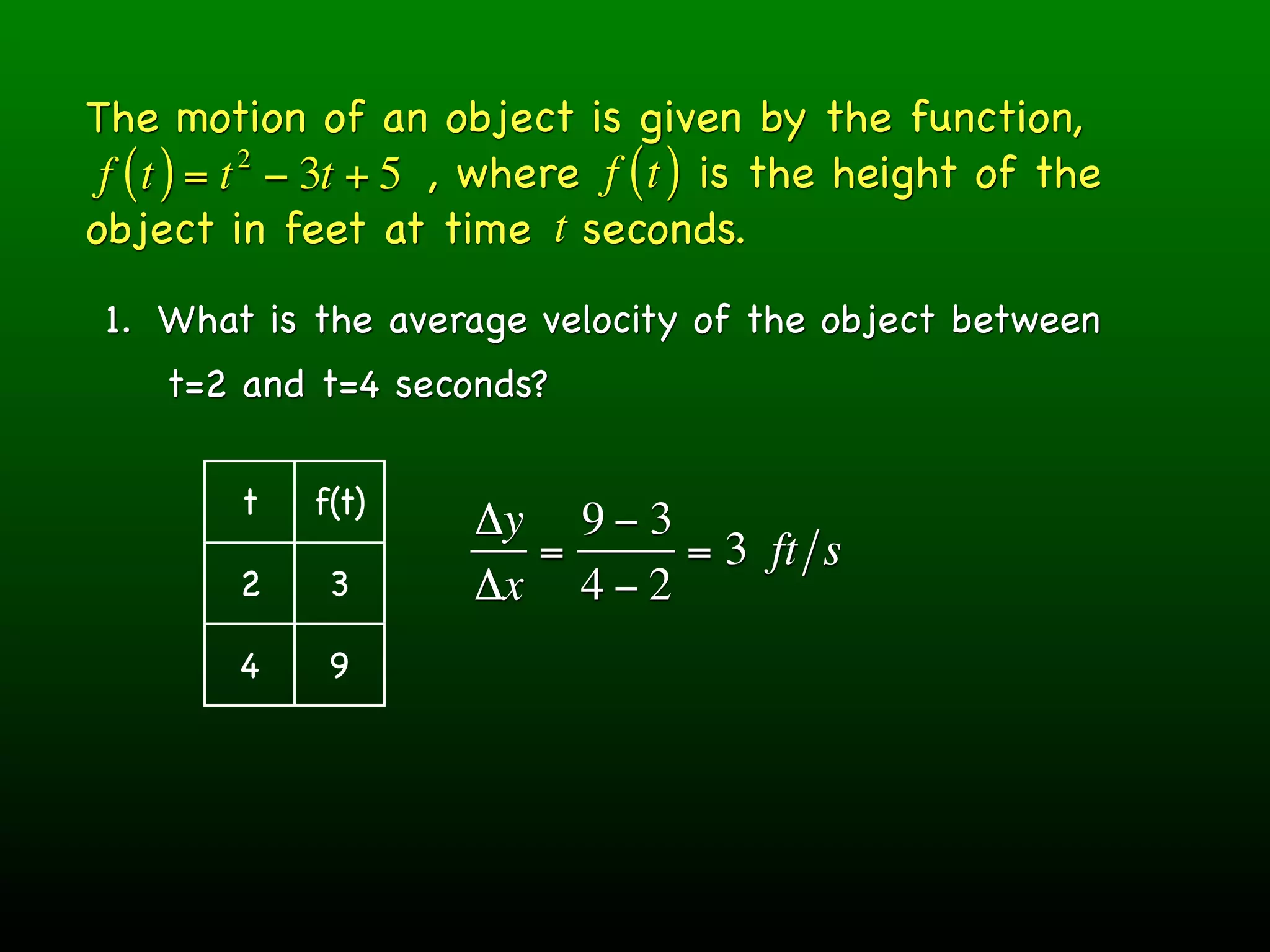
 1. What is the average velocity of the object between
    t=2 and t=4 seconds?

        t    f(t)
                      Δy 9 − 3
                        =      = 3 ft s
        2     3       Δx 4 − 2
        4     9
The motion of an object is given by the function,
 f ( t ) = t − 3t + 5 , where f ( t ) is the height of the
            2

object in feet at time t seconds.
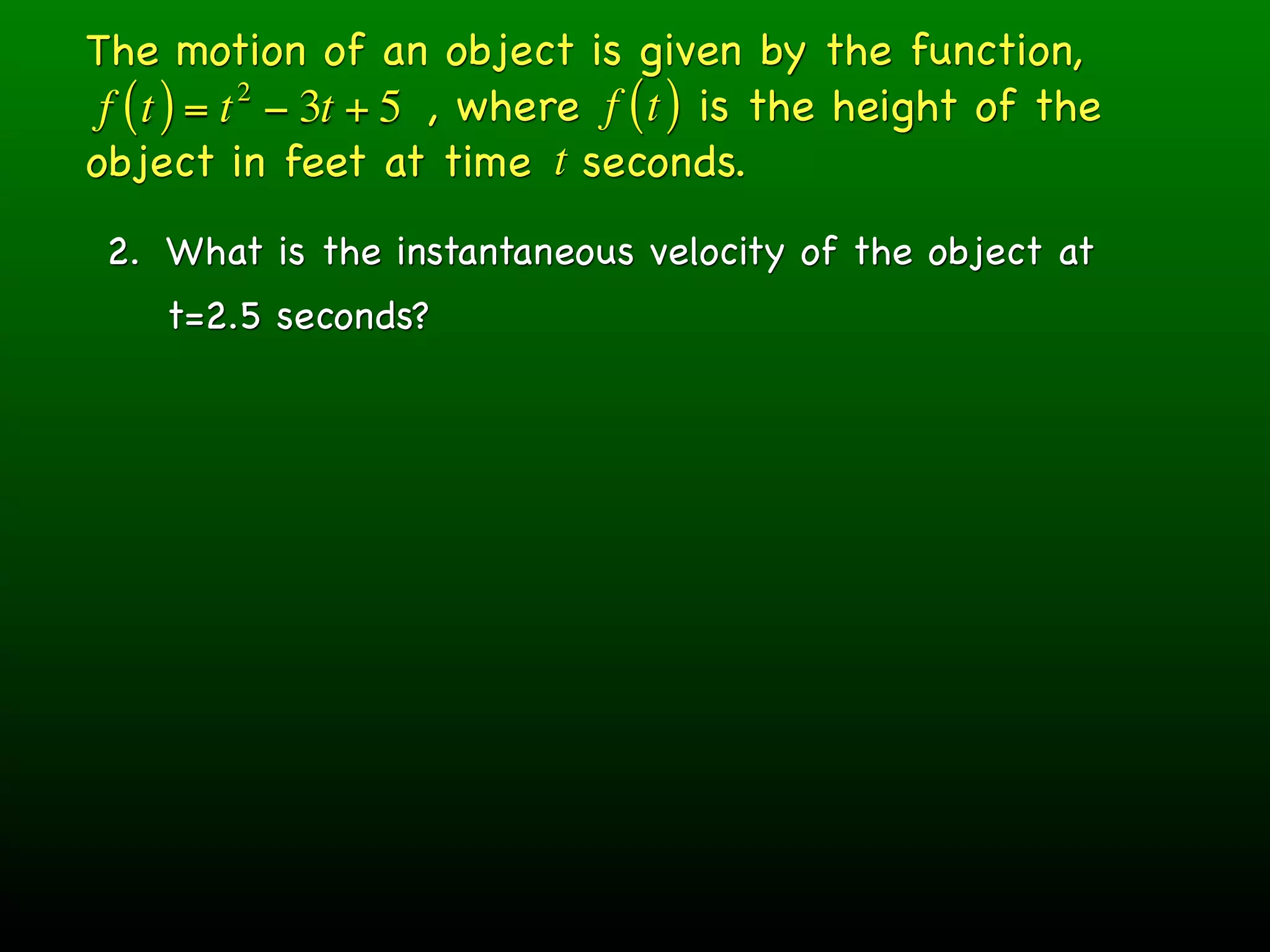
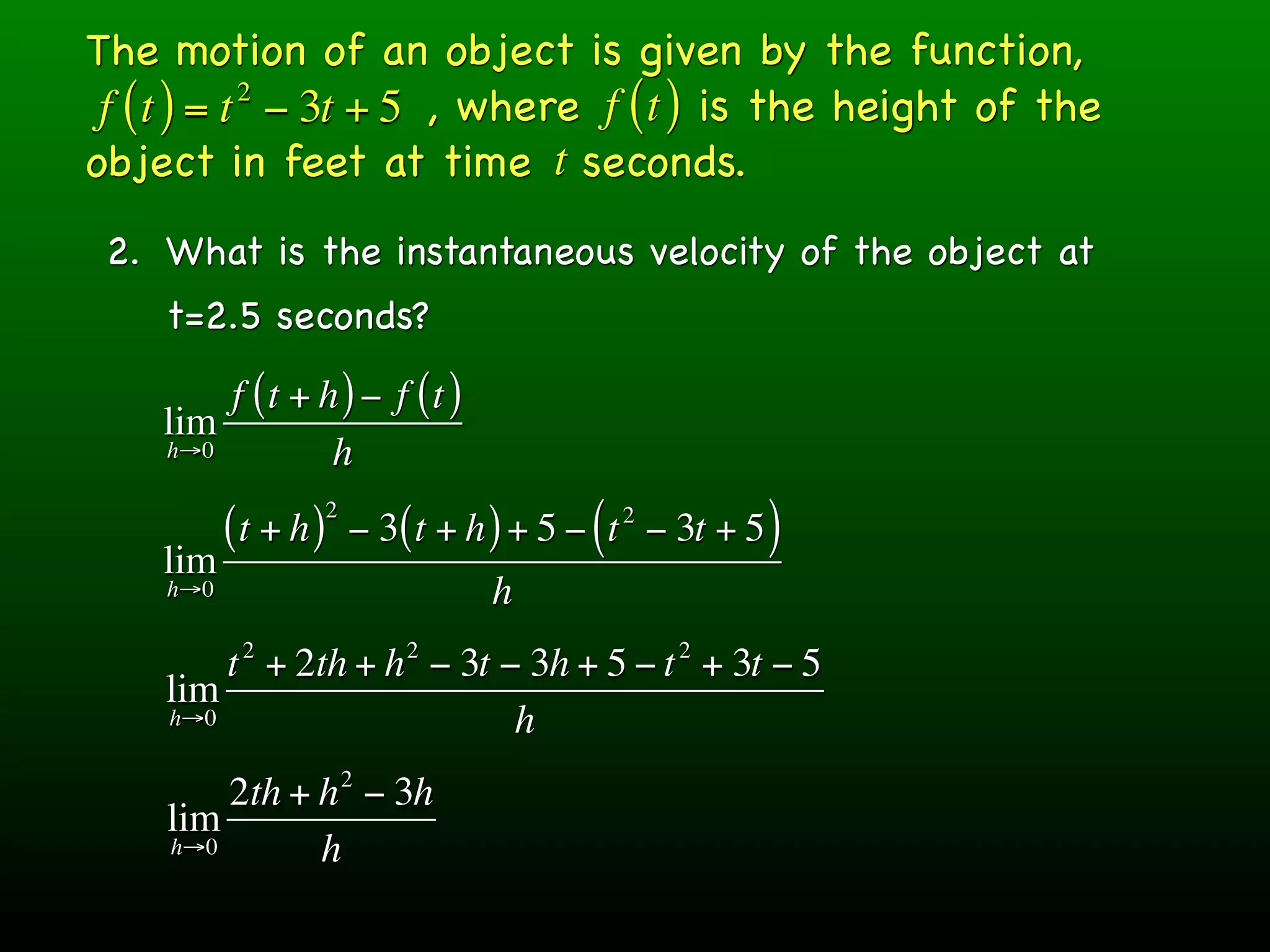
 2. What is the instantaneous velocity of the object at
    t=2.5 seconds?
The motion of an object is given by the function,
 f ( t ) = t − 3t + 5 , where f ( t ) is the height of the
            2

object in feet at time t seconds.
 2. What is the instantaneous velocity of the object at
    t=2.5 seconds?
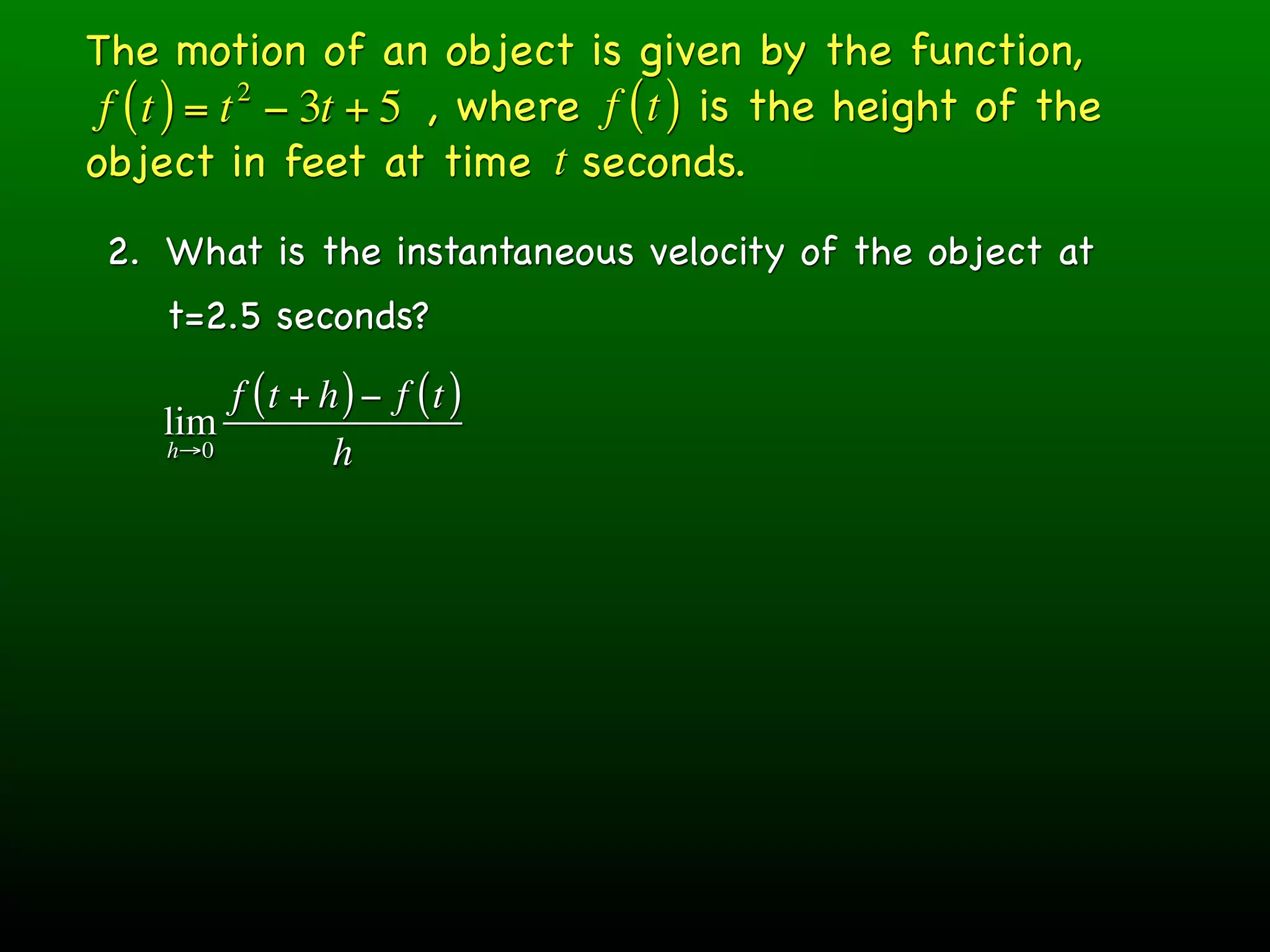
        f (t + h ) − f (t )
    lim
    h→0         h
The motion of an object is given by the function,
 f ( t ) = t − 3t + 5 , where f ( t ) is the height of the
            2

object in feet at time t seconds.
 2. What is the instantaneous velocity of the object at
    t=2.5 seconds?
        f (t + h ) − f (t )
    lim
    h→0         h
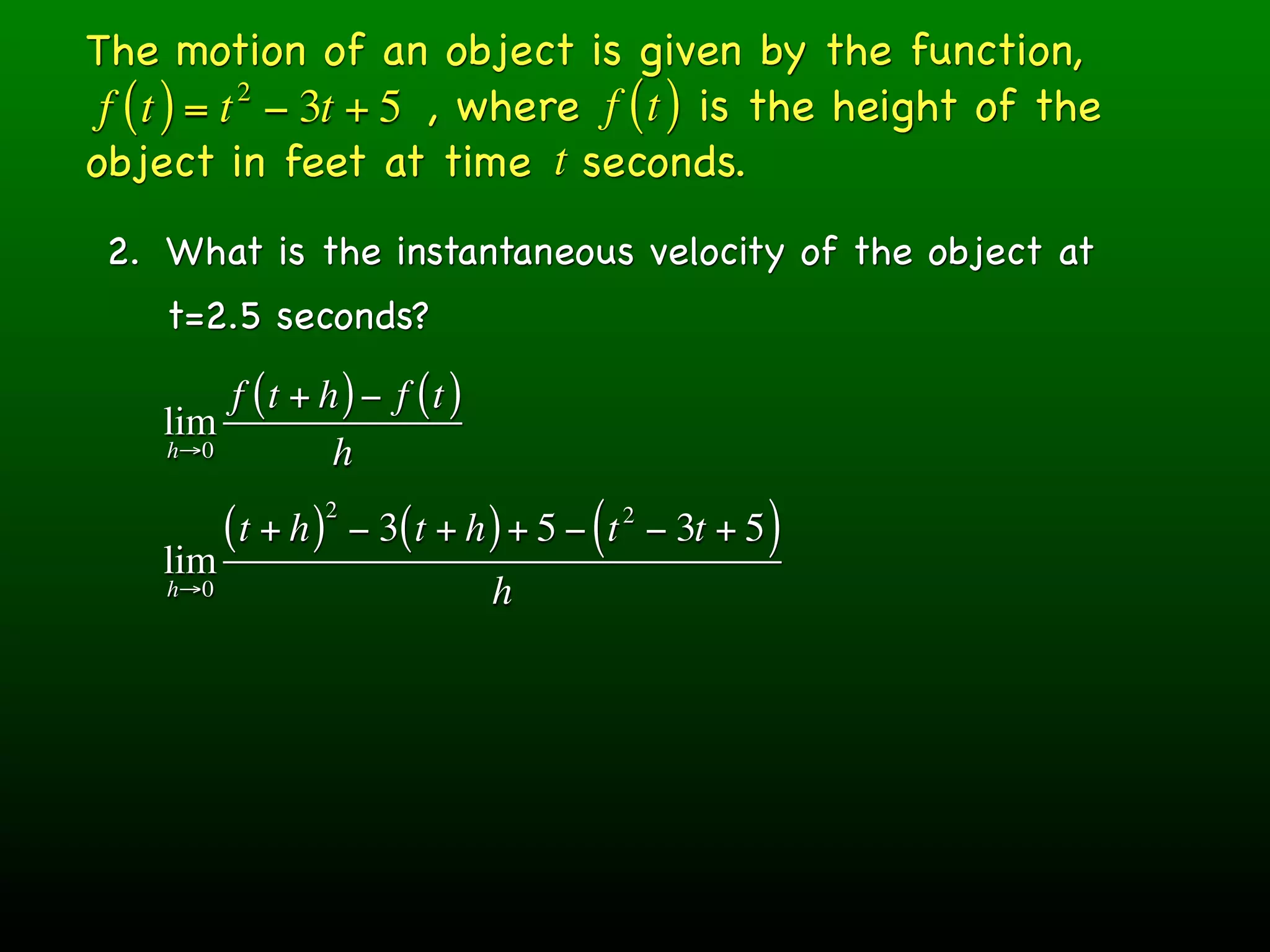
                     2
          (t + h )       − 3( t + h ) + 5 − ( t − 3t + 5 )
                                             2

    lim
    h→0                            h
The motion of an object is given by the function,
 f ( t ) = t − 3t + 5 , where f ( t ) is the height of the
            2

object in feet at time t seconds.
 2. What is the instantaneous velocity of the object at
    t=2.5 seconds?
        f (t + h ) − f (t )
    lim
    h→0         h
                     2
          (t + h )       − 3( t + h ) + 5 − ( t − 3t + 5 )
                                             2

    lim
    h→0                            h
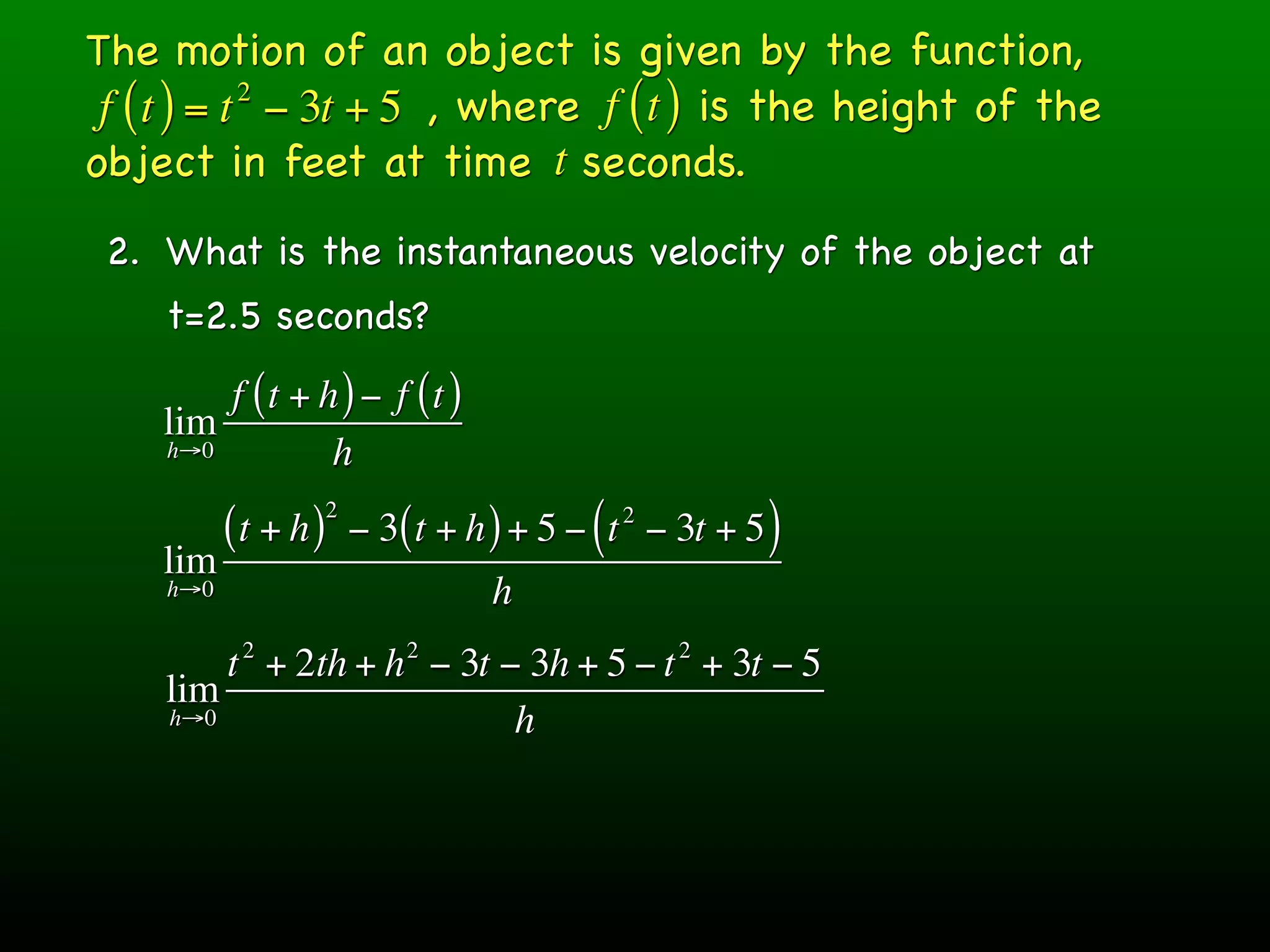
           2                 2                    2
        t + 2th + h − 3t − 3h + 5 − t + 3t − 5
    lim
    h→0                   h
The motion of an object is given by the function,
 f ( t ) = t − 3t + 5 , where f ( t ) is the height of the
            2

object in feet at time t seconds.
 2. What is the instantaneous velocity of the object at
    t=2.5 seconds?
        f (t + h ) − f (t )
    lim
    h→0         h
                     2
          (t + h )       − 3( t + h ) + 5 − ( t − 3t + 5 )
                                             2

    lim
    h→0                            h
           2                 2                    2
        t + 2th + h − 3t − 3h + 5 − t + 3t − 5
    lim
    h→0                   h
                         2
        2th + h − 3h
    lim
    h→0       h
The motion of an object is given by the function,
 f ( t ) = t − 3t + 5 , where f ( t ) is the height of the
            2

object in feet at time t seconds.
 2. What is the instantaneous velocity of the object at
    t=2.5 seconds?
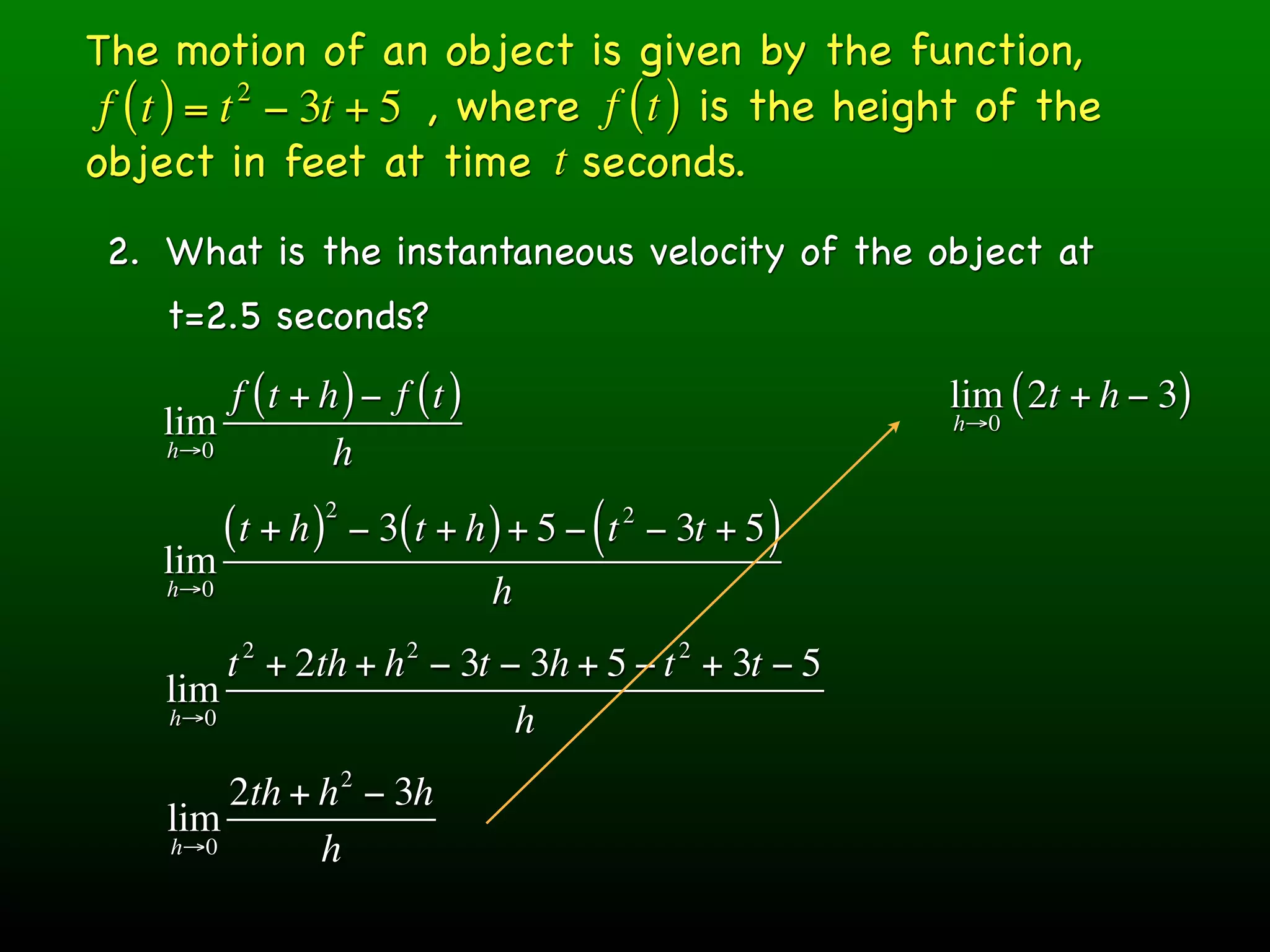
        f (t + h ) − f (t )                                  lim ( 2t + h − 3)
    lim                                                      h→0
    h→0         h
                     2
          (t + h )       − 3( t + h ) + 5 − ( t − 3t + 5 )
                                             2

    lim
    h→0                            h
           2                 2                    2
        t + 2th + h − 3t − 3h + 5 − t + 3t − 5
    lim
    h→0                   h
                         2
        2th + h − 3h
    lim
    h→0       h
The motion of an object is given by the function,
 f ( t ) = t − 3t + 5 , where f ( t ) is the height of the
            2

object in feet at time t seconds.
 2. What is the instantaneous velocity of the object at
    t=2.5 seconds?
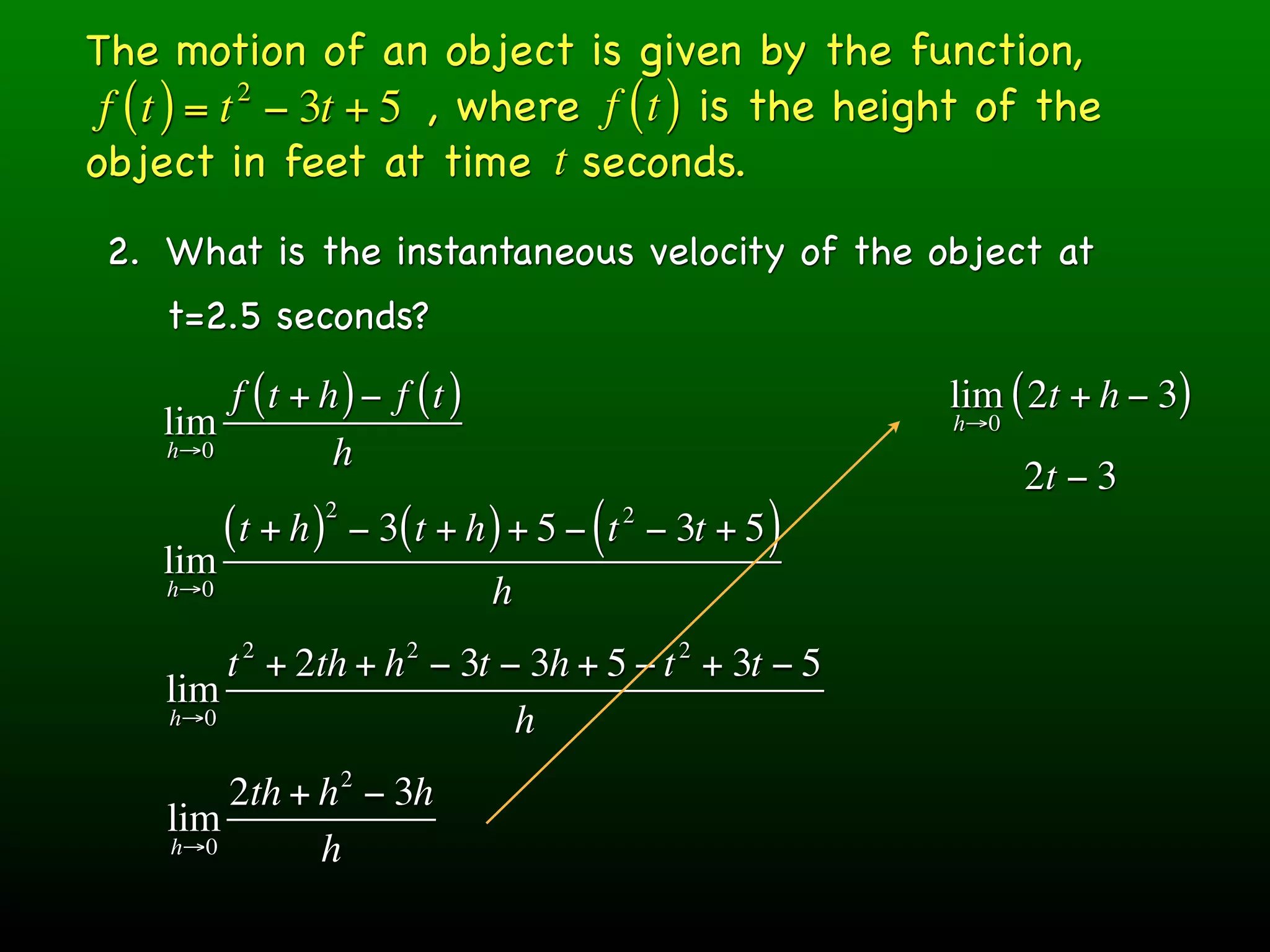
        f (t + h ) − f (t )                                  lim ( 2t + h − 3)
    lim                                                      h→0
    h→0         h
                                                                   2t − 3
                     2
          (t + h )       − 3( t + h ) + 5 − ( t − 3t + 5 )
                                             2

    lim
    h→0                            h
           2                 2                    2
        t + 2th + h − 3t − 3h + 5 − t + 3t − 5
    lim
    h→0                   h
                         2
        2th + h − 3h
    lim
    h→0       h
The motion of an object is given by the function,
 f ( t ) = t − 3t + 5 , where f ( t ) is the height of the
            2

object in feet at time t seconds.
 2. What is the instantaneous velocity of the object at
    t=2.5 seconds?
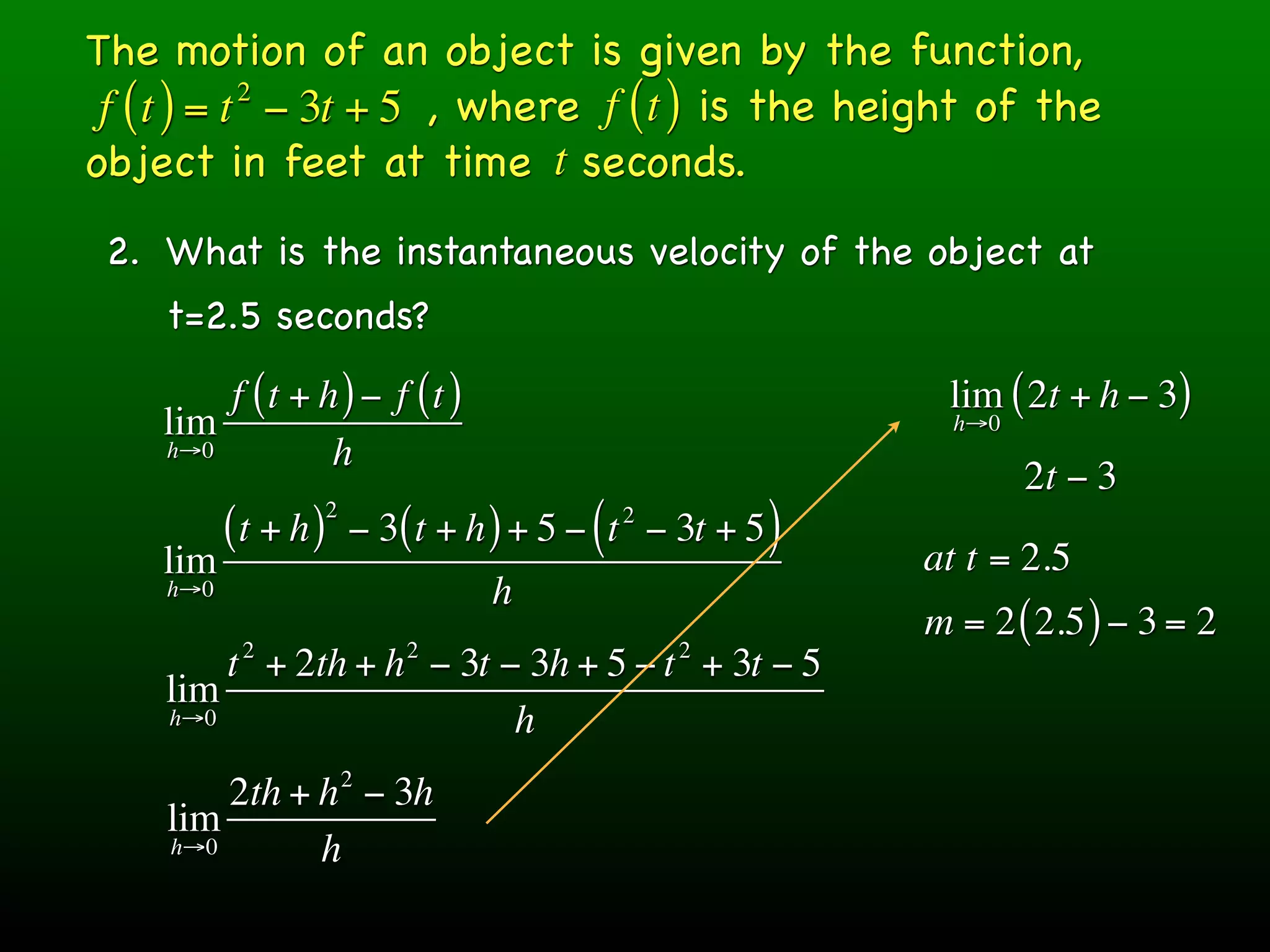
        f (t + h ) − f (t )                                   lim ( 2t + h − 3)
    lim                                                        h→0
    h→0         h
                                                                     2t − 3
                     2
          (t + h )       − 3( t + h ) + 5 − ( t − 3t + 5 )
                                             2

    lim                                                      at t = 2.5
    h→0                            h
                                                             m = 2 ( 2.5 ) − 3 = 2
           2                 2                    2
        t + 2th + h − 3t − 3h + 5 − t + 3t − 5
    lim
    h→0                   h
                         2
        2th + h − 3h
    lim
    h→0       h
The motion of an object is given by the function,
 f ( t ) = t − 3t + 5 , where f ( t ) is the height of the
            2

object in feet at time t seconds.
 2. What is the instantaneous velocity of the object at
    t=2.5 seconds?
        f (t + h ) − f (t )                                   lim ( 2t + h − 3)
    lim                                                        h→0
    h→0         h
                                                                     2t − 3
                     2
          (t + h )       − 3( t + h ) + 5 − ( t − 3t + 5 )
                                             2

    lim                                                      at t = 2.5
    h→0                            h
                                                             m = 2 ( 2.5 ) − 3 = 2
           2                 2                    2
        t + 2th + h − 3t − 3h + 5 − t + 3t − 5
    lim
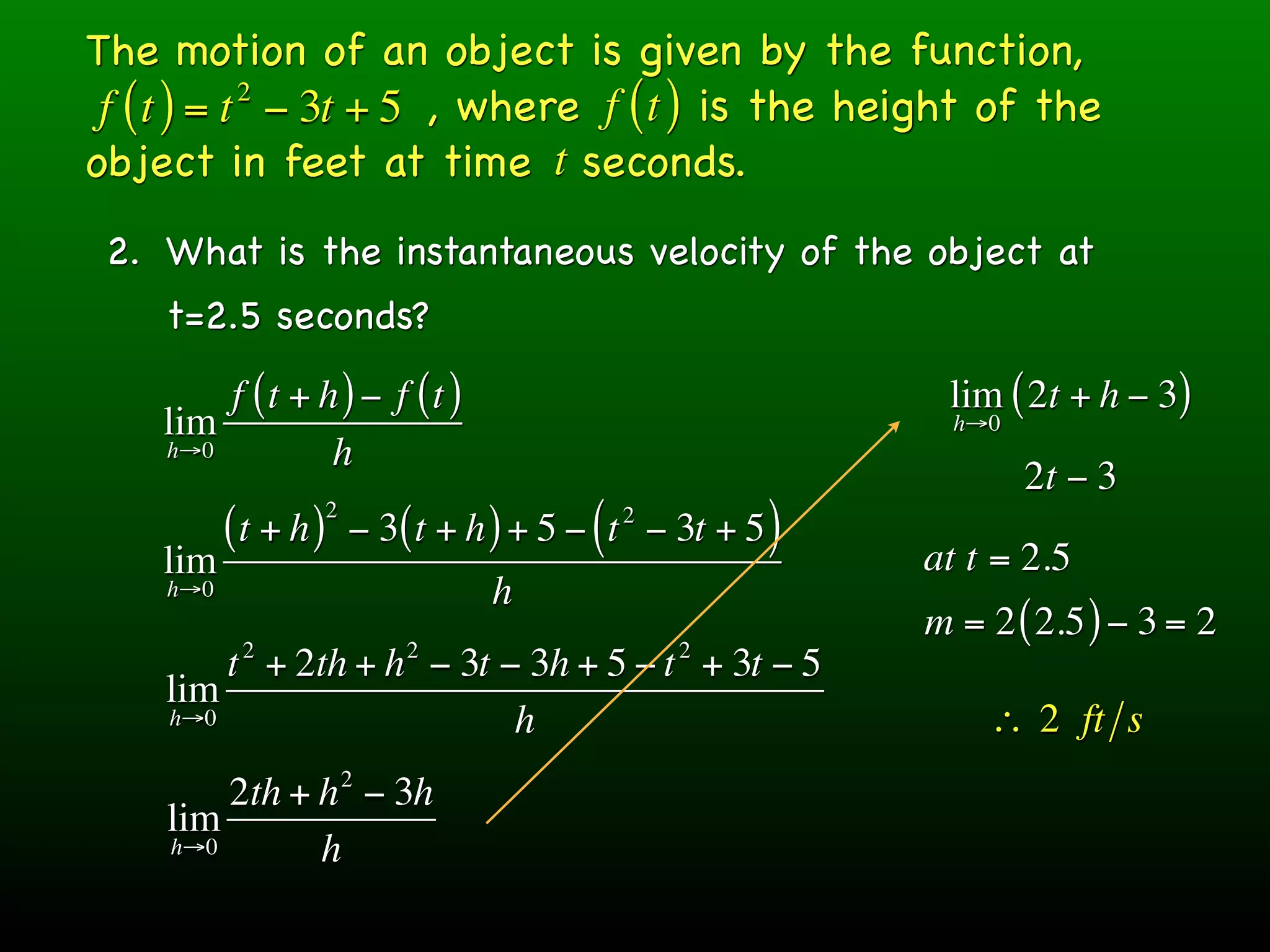
    h→0                   h                                      ∴ 2 ft s
                         2
        2th + h − 3h
    lim
    h→0       h
HW #4

“Whatever you are, be a good one.”
                             Abraham Lincoln

1204 ch 12 day 4

  • 1.
    12.3 Tangent toa Curve Day Two Colossians 3:17 “And whatever you do, in word or deed, do everything in the name of the Lord Jesus, giving thanks to God the Father through him.”
  • 2.
    Find the equationof the line with slope of 5 that is tangent to the graph of 2 f ( x ) = x + 3x − 1 I’ll do this on the board
  • 3.
    Find the equationof the line with slope of 5 that is tangent to the graph of 2 f ( x ) = x + 3x − 1 I’ll do this on the board The slope of the tangent line is also the value of the derivative of the function at that point. I’ll find the general derivative of the function and set that equal to 5 in order to find the x-value. From that I can then find the corresponding y-value. Point-Slope form is then easy to produce.
  • 4.
    2 f ( x + h) − f ( x) f ( x ) = x + 3x − 1 and m=5 lim h→0 h 2 ( x + h) + 3( x + h ) − 1− ( x + 3x − 1) 2 lim h→0 h 2 2 2 x + 2xh + h + 3x + 3h − 1− x − 3x + 1 lim h→0 h 2 2xh + h + 3h lim x =1 h→0 h 2 f (1) = (1) + 3(1) − 1 lim ( 2x + h + 3) h→0 y=3 2x + 3 ∴ y − 3 = 5 ( x − 1) ∴ 2x + 3 = 5
  • 5.
    Groups: Find theequation of the line with slope of -9 that is tangent to the function f ( x ) = 4x − x + 5 2
  • 6.
    2 f ( x + h) − f ( x) f ( x ) = 4x − x + 5 and m = −9 lim h→0 h 2 4 ( x + h ) − ( x + h ) + 5 − ( 4x − x + 5 ) 2 lim h→0 h 2 2 2 4x + 8xh + 4h − x − h + 5 − 4x + x − 5 lim h→0 h 2 8xh + 4h − h lim x = −1 h→0 h 2 f (1) = 4 ( −1) − ( −1) + 5 lim ( 8x + 4h − 1) h→0 y = 10 8x − 1 ∴ y − 10 = −9 ( x + 1) ∴ 8x − 1 = −9
  • 7.
    The motion ofan object is given by the function, f ( t ) = t − 3t + 5 , where f ( t ) is the height of the 2 object in feet at time t seconds. 1. What is the average velocity of the object between t=2 and t=4 seconds?
  • 8.
    The motion ofan object is given by the function, f ( t ) = t − 3t + 5 , where f ( t ) is the height of the 2 object in feet at time t seconds. 1. What is the average velocity of the object between t=2 and t=4 seconds? t f(t) 2 3 4 9
  • 9.
    The motion ofan object is given by the function, f ( t ) = t − 3t + 5 , where f ( t ) is the height of the 2 object in feet at time t seconds. 1. What is the average velocity of the object between t=2 and t=4 seconds? t f(t) Δy 9 − 3 = = 3 ft s 2 3 Δx 4 − 2 4 9
  • 10.
    The motion ofan object is given by the function, f ( t ) = t − 3t + 5 , where f ( t ) is the height of the 2 object in feet at time t seconds. 2. What is the instantaneous velocity of the object at t=2.5 seconds?
  • 11.
    The motion ofan object is given by the function, f ( t ) = t − 3t + 5 , where f ( t ) is the height of the 2 object in feet at time t seconds. 2. What is the instantaneous velocity of the object at t=2.5 seconds? f (t + h ) − f (t ) lim h→0 h
  • 12.
    The motion ofan object is given by the function, f ( t ) = t − 3t + 5 , where f ( t ) is the height of the 2 object in feet at time t seconds. 2. What is the instantaneous velocity of the object at t=2.5 seconds? f (t + h ) − f (t ) lim h→0 h 2 (t + h ) − 3( t + h ) + 5 − ( t − 3t + 5 ) 2 lim h→0 h
  • 13.
    The motion ofan object is given by the function, f ( t ) = t − 3t + 5 , where f ( t ) is the height of the 2 object in feet at time t seconds. 2. What is the instantaneous velocity of the object at t=2.5 seconds? f (t + h ) − f (t ) lim h→0 h 2 (t + h ) − 3( t + h ) + 5 − ( t − 3t + 5 ) 2 lim h→0 h 2 2 2 t + 2th + h − 3t − 3h + 5 − t + 3t − 5 lim h→0 h
  • 14.
    The motion ofan object is given by the function, f ( t ) = t − 3t + 5 , where f ( t ) is the height of the 2 object in feet at time t seconds. 2. What is the instantaneous velocity of the object at t=2.5 seconds? f (t + h ) − f (t ) lim h→0 h 2 (t + h ) − 3( t + h ) + 5 − ( t − 3t + 5 ) 2 lim h→0 h 2 2 2 t + 2th + h − 3t − 3h + 5 − t + 3t − 5 lim h→0 h 2 2th + h − 3h lim h→0 h
  • 15.
    The motion ofan object is given by the function, f ( t ) = t − 3t + 5 , where f ( t ) is the height of the 2 object in feet at time t seconds. 2. What is the instantaneous velocity of the object at t=2.5 seconds? f (t + h ) − f (t ) lim ( 2t + h − 3) lim h→0 h→0 h 2 (t + h ) − 3( t + h ) + 5 − ( t − 3t + 5 ) 2 lim h→0 h 2 2 2 t + 2th + h − 3t − 3h + 5 − t + 3t − 5 lim h→0 h 2 2th + h − 3h lim h→0 h
  • 16.
    The motion ofan object is given by the function, f ( t ) = t − 3t + 5 , where f ( t ) is the height of the 2 object in feet at time t seconds. 2. What is the instantaneous velocity of the object at t=2.5 seconds? f (t + h ) − f (t ) lim ( 2t + h − 3) lim h→0 h→0 h 2t − 3 2 (t + h ) − 3( t + h ) + 5 − ( t − 3t + 5 ) 2 lim h→0 h 2 2 2 t + 2th + h − 3t − 3h + 5 − t + 3t − 5 lim h→0 h 2 2th + h − 3h lim h→0 h
  • 17.
    The motion ofan object is given by the function, f ( t ) = t − 3t + 5 , where f ( t ) is the height of the 2 object in feet at time t seconds. 2. What is the instantaneous velocity of the object at t=2.5 seconds? f (t + h ) − f (t ) lim ( 2t + h − 3) lim h→0 h→0 h 2t − 3 2 (t + h ) − 3( t + h ) + 5 − ( t − 3t + 5 ) 2 lim at t = 2.5 h→0 h m = 2 ( 2.5 ) − 3 = 2 2 2 2 t + 2th + h − 3t − 3h + 5 − t + 3t − 5 lim h→0 h 2 2th + h − 3h lim h→0 h
  • 18.
    The motion ofan object is given by the function, f ( t ) = t − 3t + 5 , where f ( t ) is the height of the 2 object in feet at time t seconds. 2. What is the instantaneous velocity of the object at t=2.5 seconds? f (t + h ) − f (t ) lim ( 2t + h − 3) lim h→0 h→0 h 2t − 3 2 (t + h ) − 3( t + h ) + 5 − ( t − 3t + 5 ) 2 lim at t = 2.5 h→0 h m = 2 ( 2.5 ) − 3 = 2 2 2 2 t + 2th + h − 3t − 3h + 5 − t + 3t − 5 lim h→0 h ∴ 2 ft s 2 2th + h − 3h lim h→0 h
  • 19.
    HW #4 “Whatever youare, be a good one.” Abraham Lincoln