The low-rank basis problem
for a matrix subspace
Tasuku Soma
Univ. Tokyo
Joint work with:
Yuji Nakatsukasa (Univ. Tokyo)
André Uschmajew (Univ. Bonn)
1 / 29
1 The low-rank basis problem
2 Algorithm
3 Convergence Guarantee
4 Experiments
2 / 29
1 The low-rank basis problem
2 Algorithm
3 Convergence Guarantee
4 Experiments
3 / 29
The low-rank basis problem
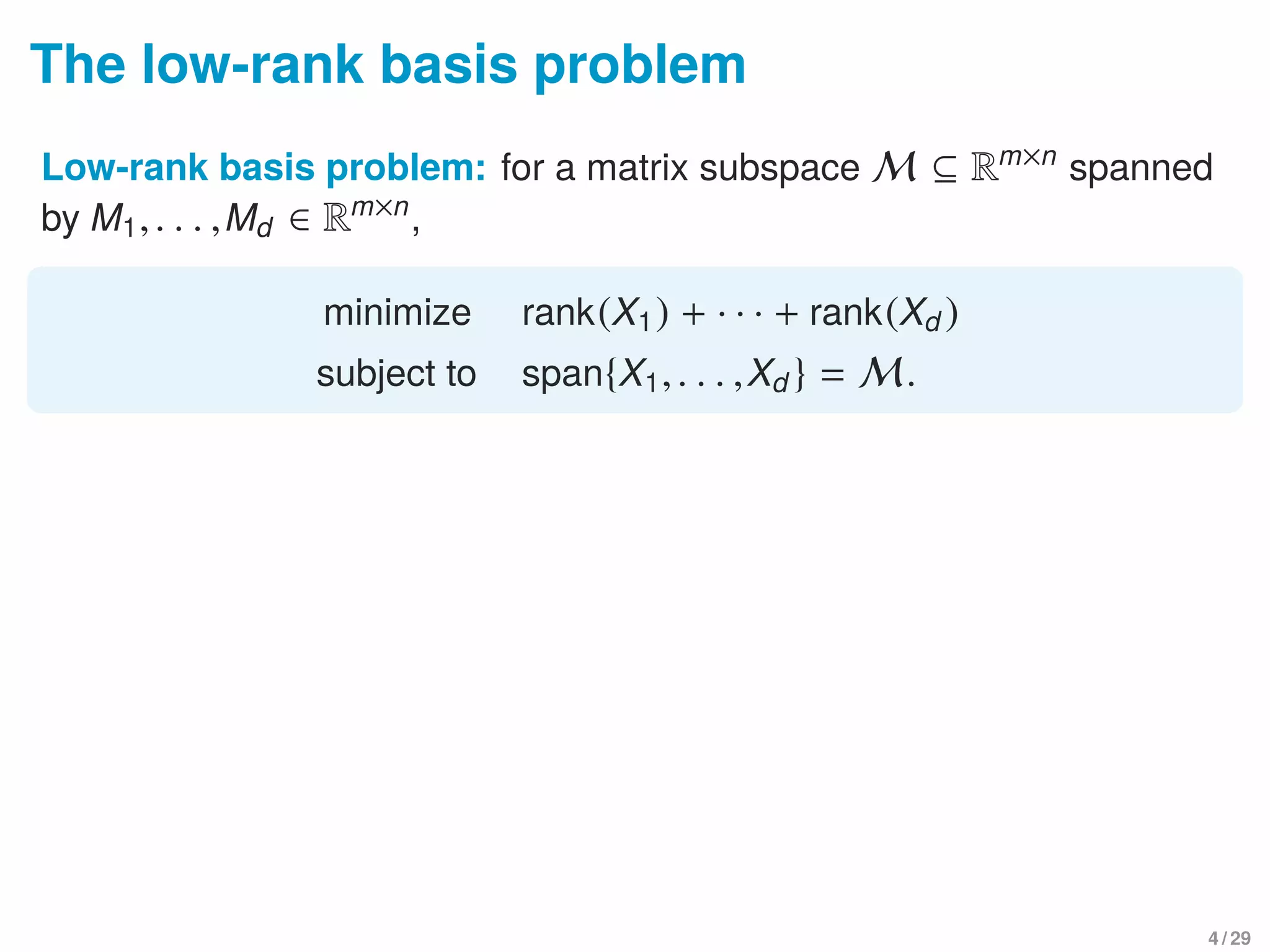
Low-rank basis problem: for a matrix subspace M ⊆ Rm×n
spanned
by M1,. . . ,Md ∈ Rm×n
,
minimize rank(X1) + · · · + rank(Xd )
subject to span{X1,. . . ,Xd } = M.
4 / 29
The low-rank basis problem
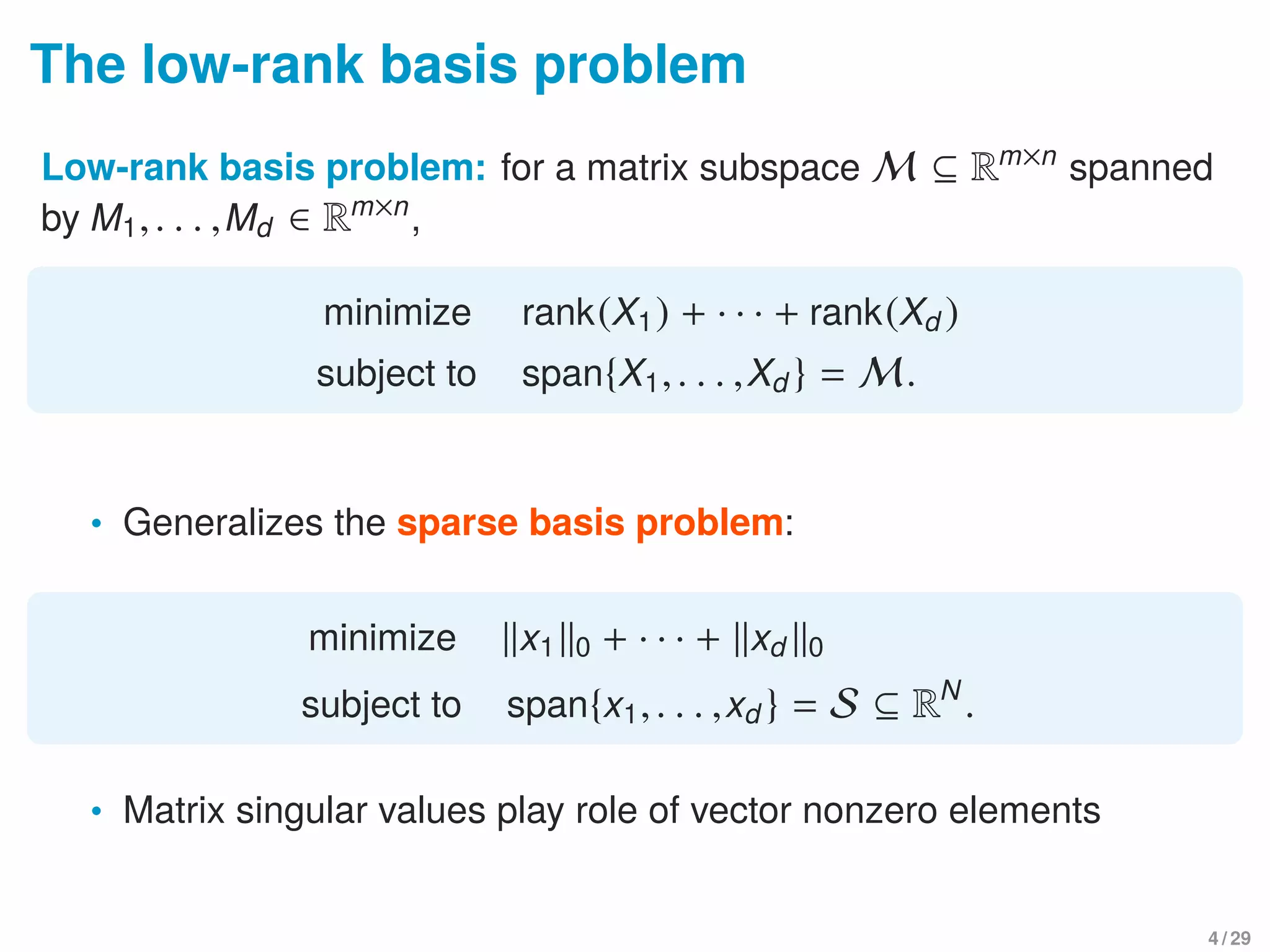
Low-rank basis problem: for a matrix subspace M ⊆ Rm×n
spanned
by M1,. . . ,Md ∈ Rm×n
,
minimize rank(X1) + · · · + rank(Xd )
subject to span{X1,. . . ,Xd } = M.
• Generalizes the sparse basis problem:
minimize x1 0 + · · · + xd 0
subject to span{x1,. . . ,xd } = S ⊆ RN
.
• Matrix singular values play role of vector nonzero elements
4 / 29
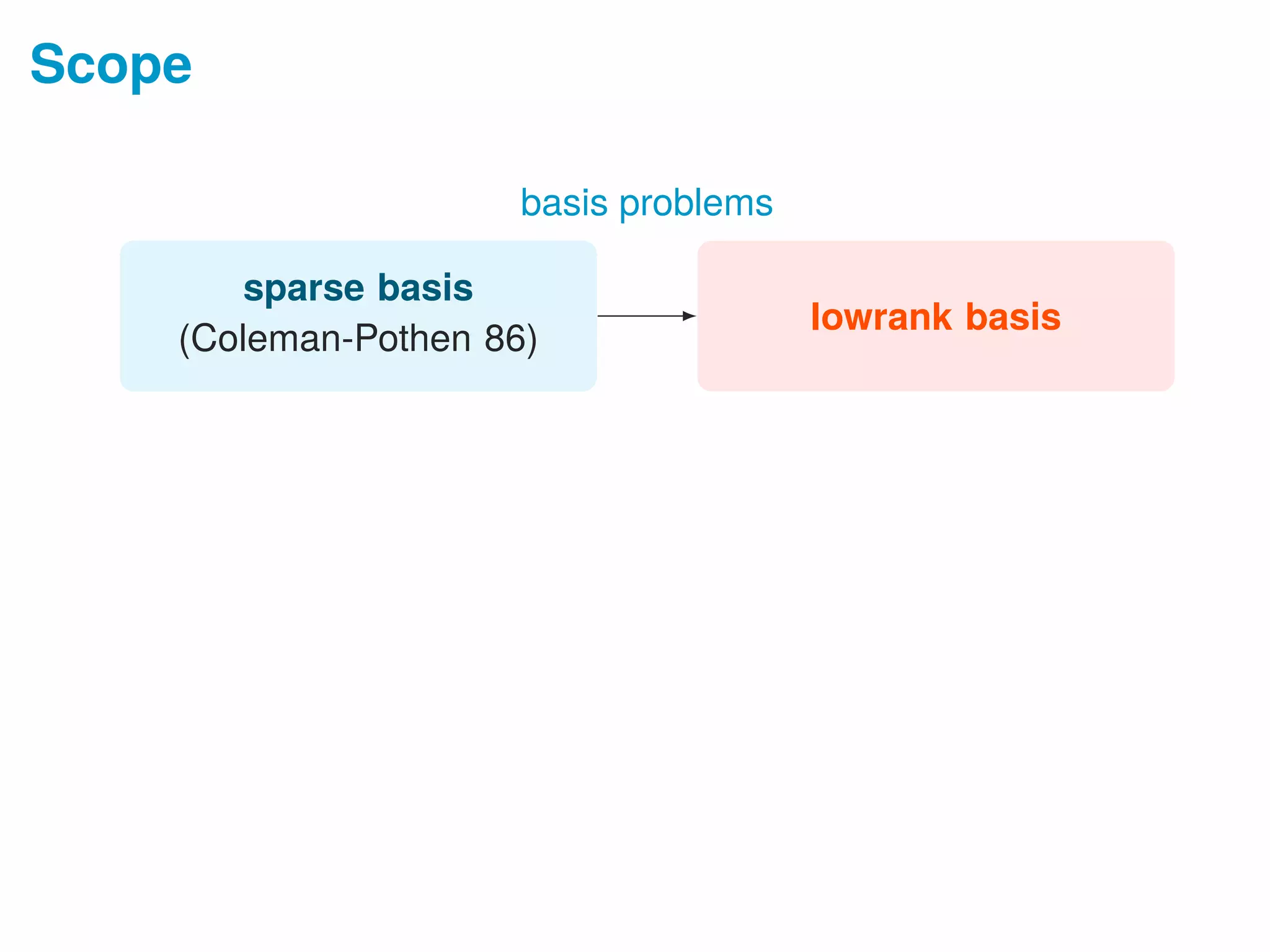
Scope
lowrank basis
sparse basis
(Coleman-Pothen 86)
basis problems
Scope
lowrank basis
sparse basis
(Coleman-Pothen 86)
basis problems
lowrank matrix
sparse vector
(Qu-Sun-Wright 14)
single element problems
• sparse vector problem is NP-hard [Coleman-Pothen 1986]
5 / 29
Scope
lowrank basis
sparse basis
(Coleman-Pothen 86)
basis problems
lowrank matrix
sparse vector
(Qu-Sun-Wright 14)
single element problems
• sparse vector problem is NP-hard [Coleman-Pothen 1986]
• Related studies: dictionary learning [Sun-Qu-Wright 14], sparse PCA
[Spielman-Wang-Wright],[Demanet-Hand 14]
5 / 29
Applications
• memory-efficient representation of matrix subspace
• matrix compression beyond SVD
• dictionary learning
• string theory: rank-deficient matrix in rectangular subspace
• image separation
• accurate eigenvector computation
• maximum-rank completion (discrete mathematics)
• ...
6 / 29
1 The low-rank basis problem
2 Algorithm
3 Convergence Guarantee
4 Experiments
7 / 29
Abstract greedy algorithm
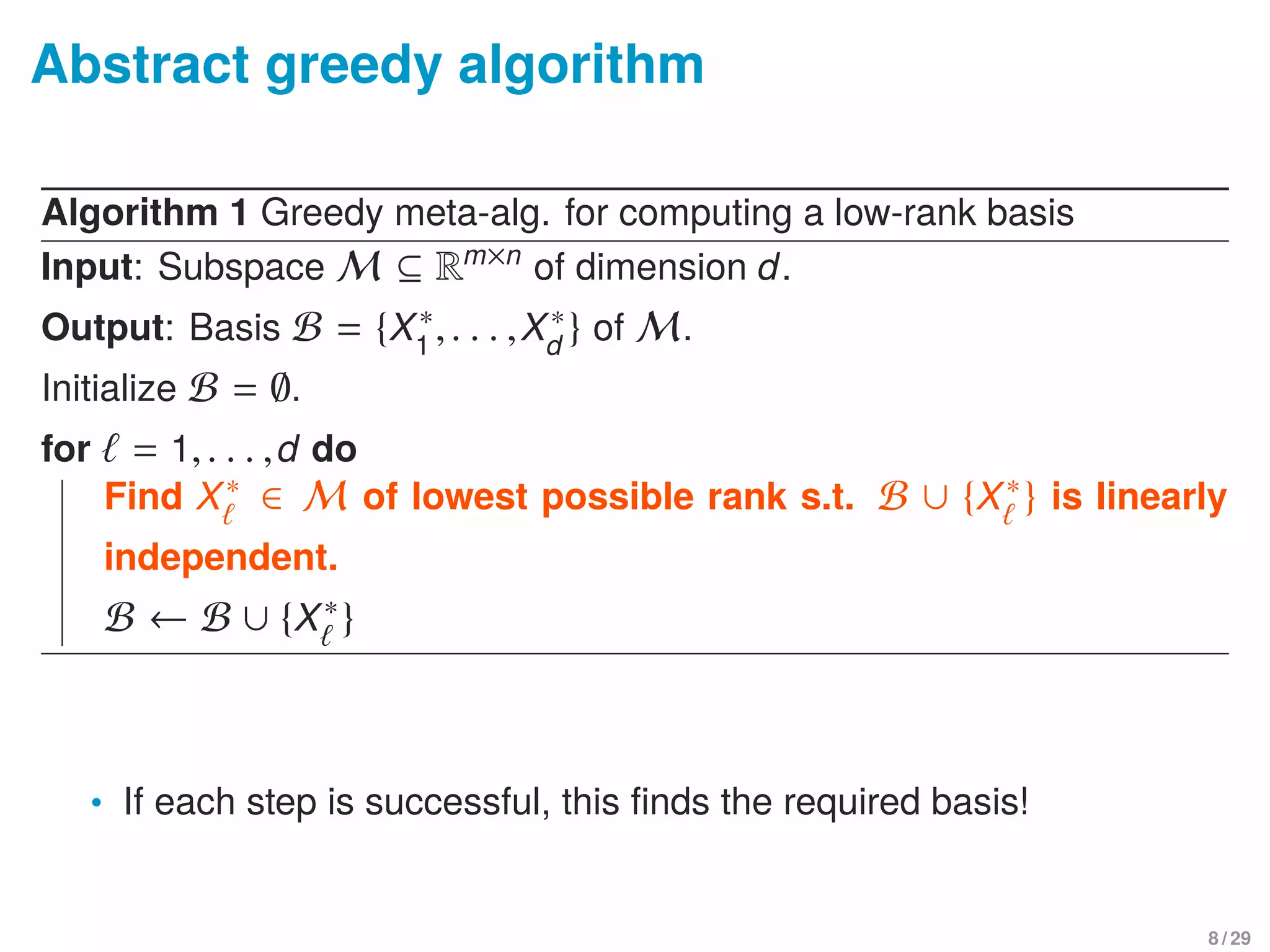
Algorithm 1 Greedy meta-alg. for computing a low-rank basis
Input: Subspace M ⊆ Rm×n
of dimension d.
Output: Basis B = {X∗
1
,. . . ,X∗
d
} of M.
Initialize B = ∅.
for = 1,. . . ,d do
Find X∗ ∈ M of lowest possible rank s.t. B ∪ {X∗} is linearly
independent.
B ← B ∪ {X∗}
• If each step is successful, this finds the required basis!
8 / 29
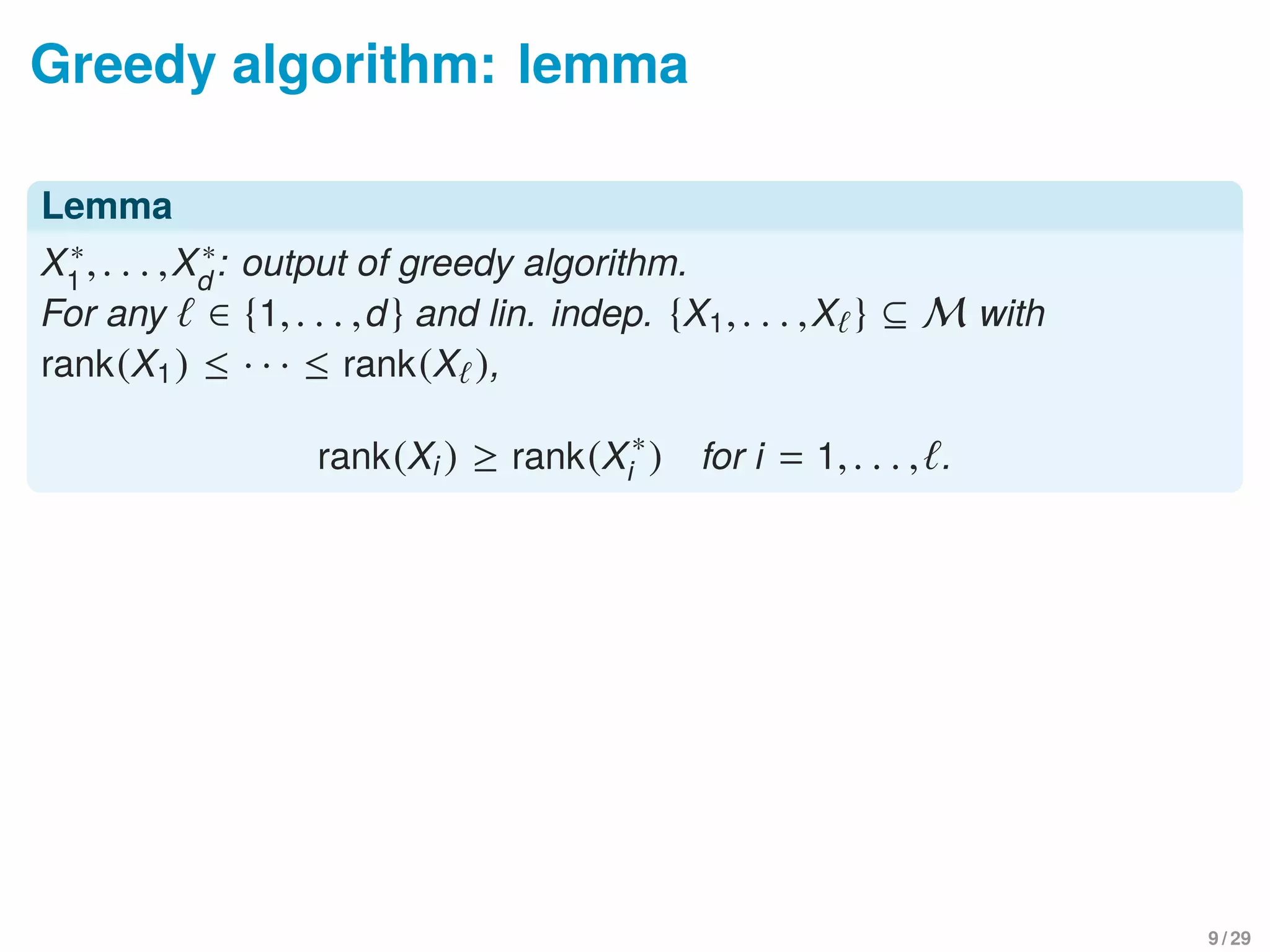
Greedy algorithm: lemma
Lemma
X∗
1
,. . . ,X∗
d
: output of greedy algorithm.
For any ∈ {1,. . . ,d} and lin. indep. {X1,. . . ,X } ⊆ M with
rank(X1) ≤ · · · ≤ rank(X ),
rank(Xi ) ≥ rank(X∗
i ) for i = 1,. . . , .
9 / 29
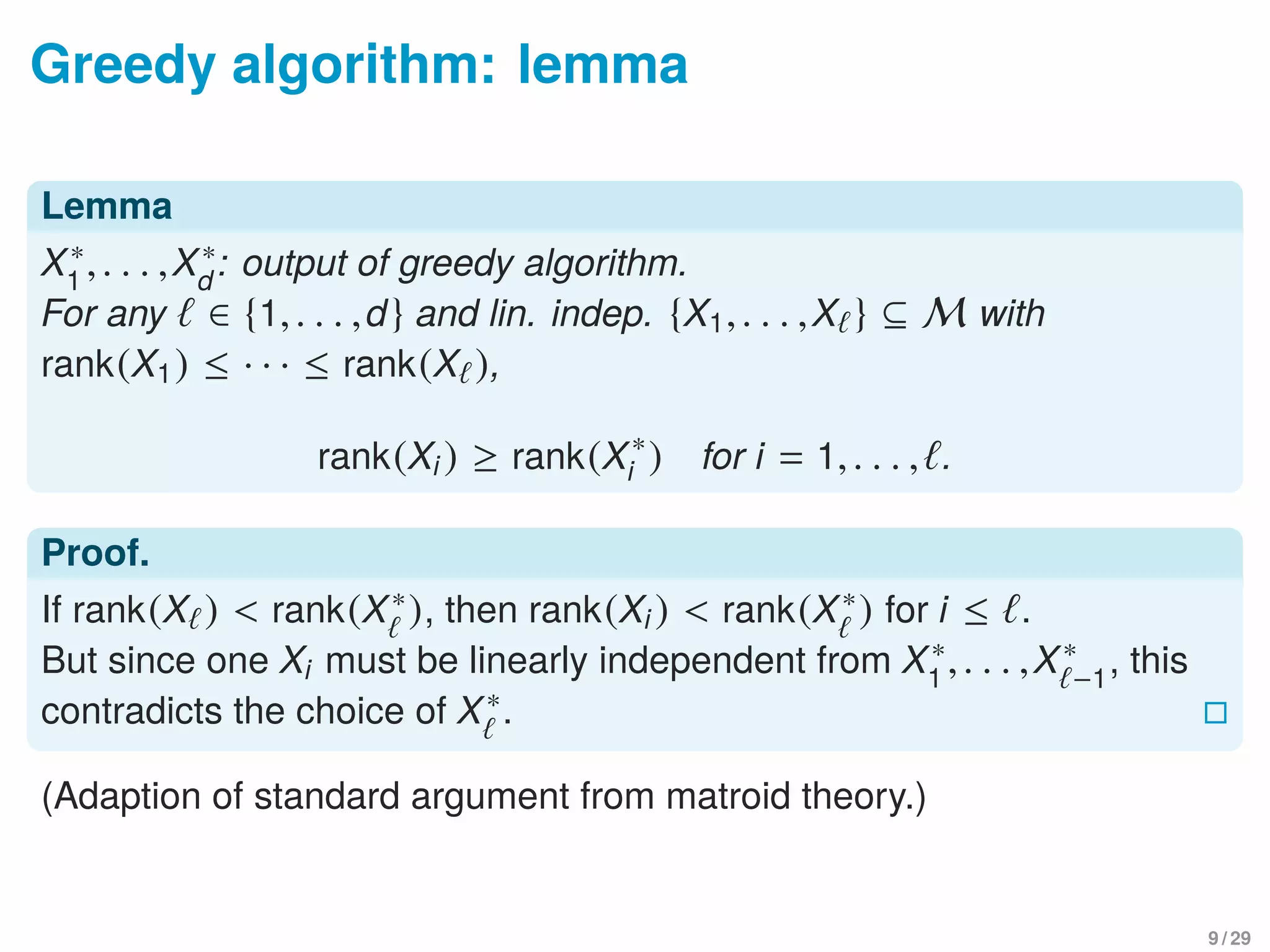
Greedy algorithm: lemma
Lemma
X∗
1
,. . . ,X∗
d
: output of greedy algorithm.
For any ∈ {1,. . . ,d} and lin. indep. {X1,. . . ,X } ⊆ M with
rank(X1) ≤ · · · ≤ rank(X ),
rank(Xi ) ≥ rank(X∗
i ) for i = 1,. . . , .
Proof.
If rank(X ) < rank(X∗), then rank(Xi ) < rank(X∗) for i ≤ .
But since one Xi must be linearly independent from X∗
1
,. . . ,X∗
−1
, this
contradicts the choice of X∗.
(Adaption of standard argument from matroid theory.)
9 / 29
Greedy algorithm: justification
Theorem
X∗
1
,. . . ,X∗
d
: lin. indep. output of greedy algorithm. Then {X1,. . . ,X } is
of minimal rank iff
rank(Xi ) = rank(X∗
i ) for i = 1,. . . , .
In particular, {X∗
1
,. . . ,X∗} is of minimal rank.
• Analogous result for sparse basis problem in [Coleman, Pothen 1986]
10 / 29
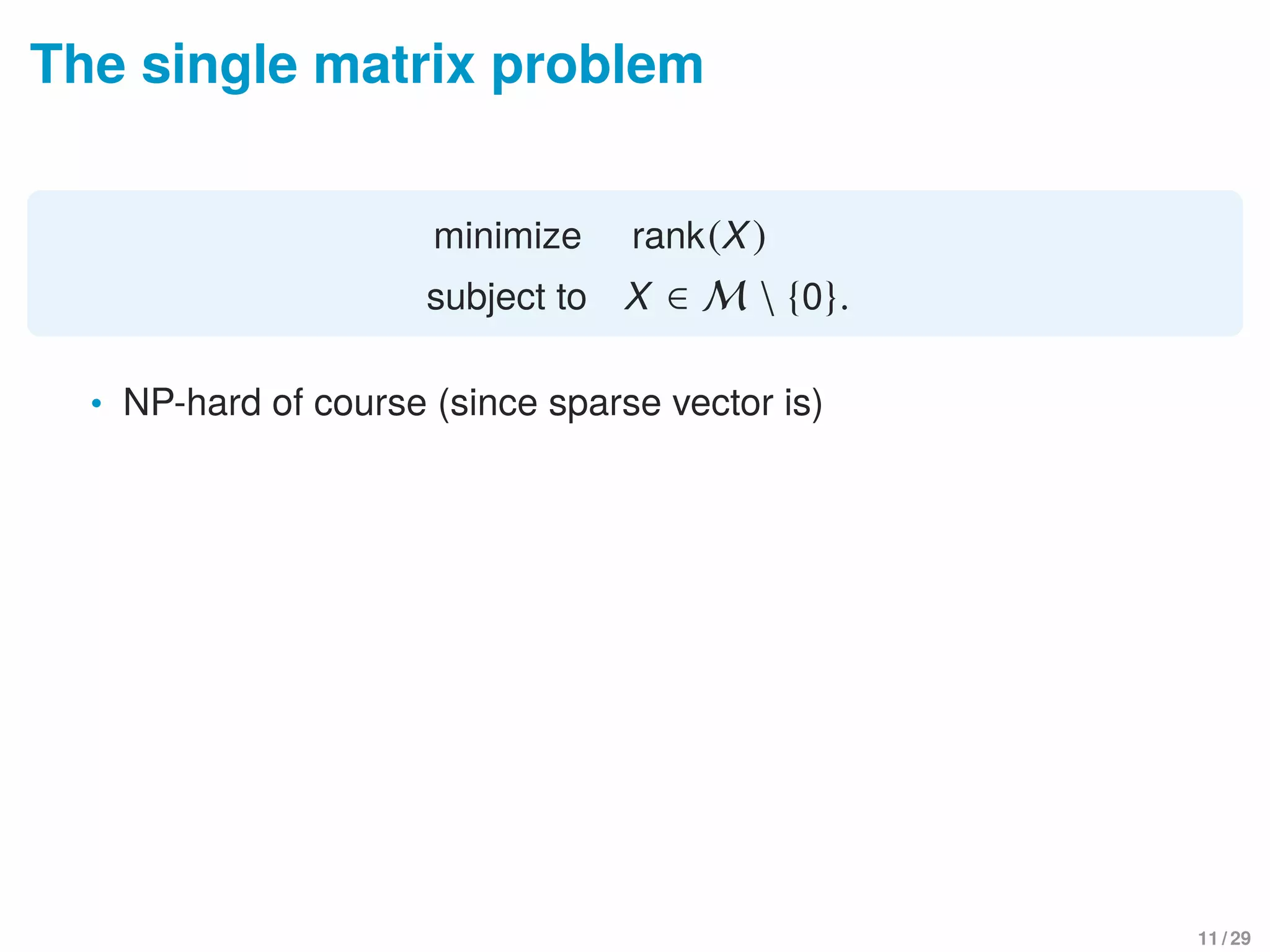
The single matrix problem
minimize rank(X)
subject to X ∈ M  {0}.
• NP-hard of course (since sparse vector is)
11 / 29
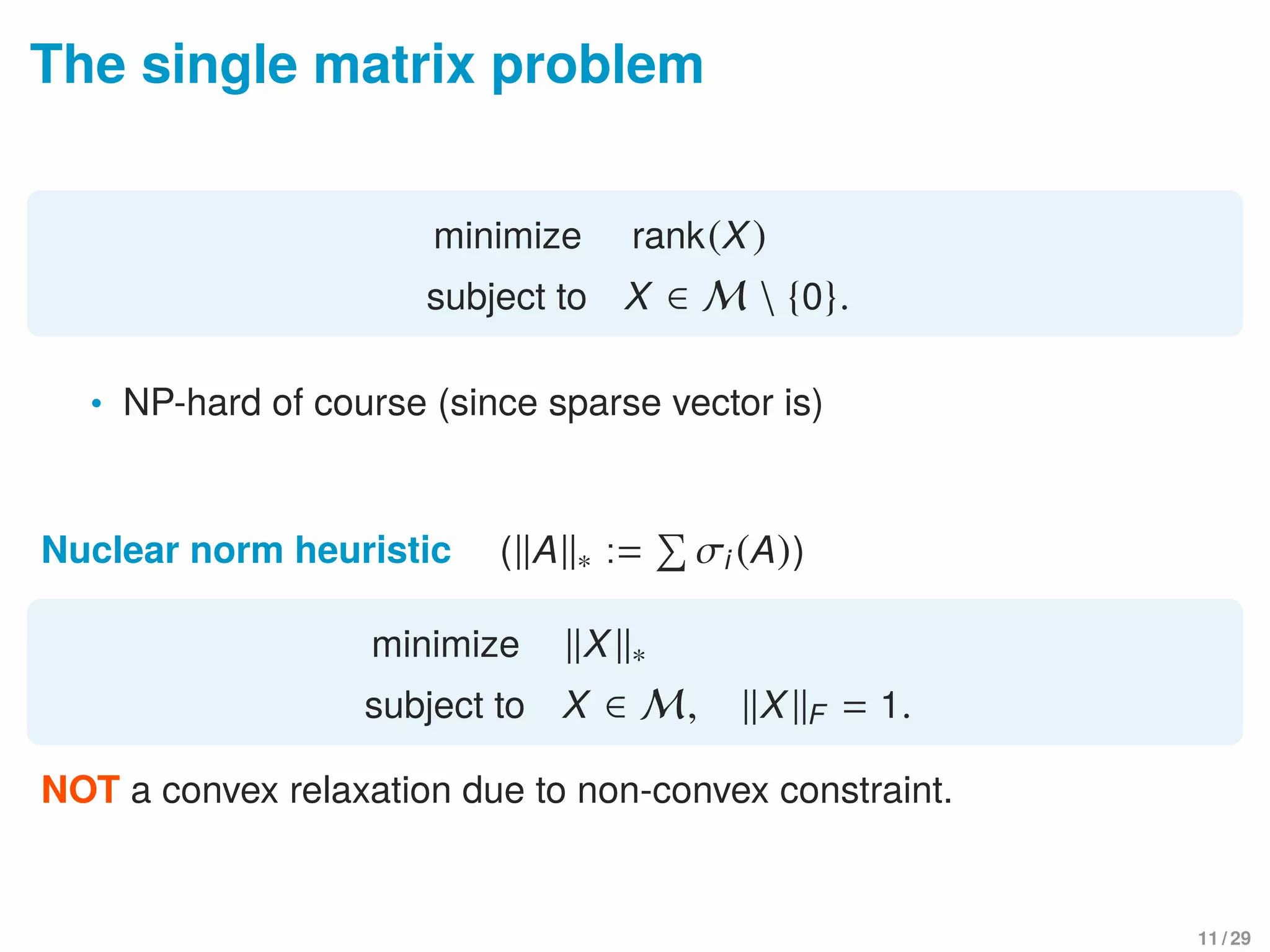
The single matrix problem
minimize rank(X)
subject to X ∈ M  {0}.
• NP-hard of course (since sparse vector is)
Nuclear norm heuristic ( A ∗ := σi (A))
minimize X ∗
subject to X ∈ M, X F = 1.
NOT a convex relaxation due to non-convex constraint.
11 / 29
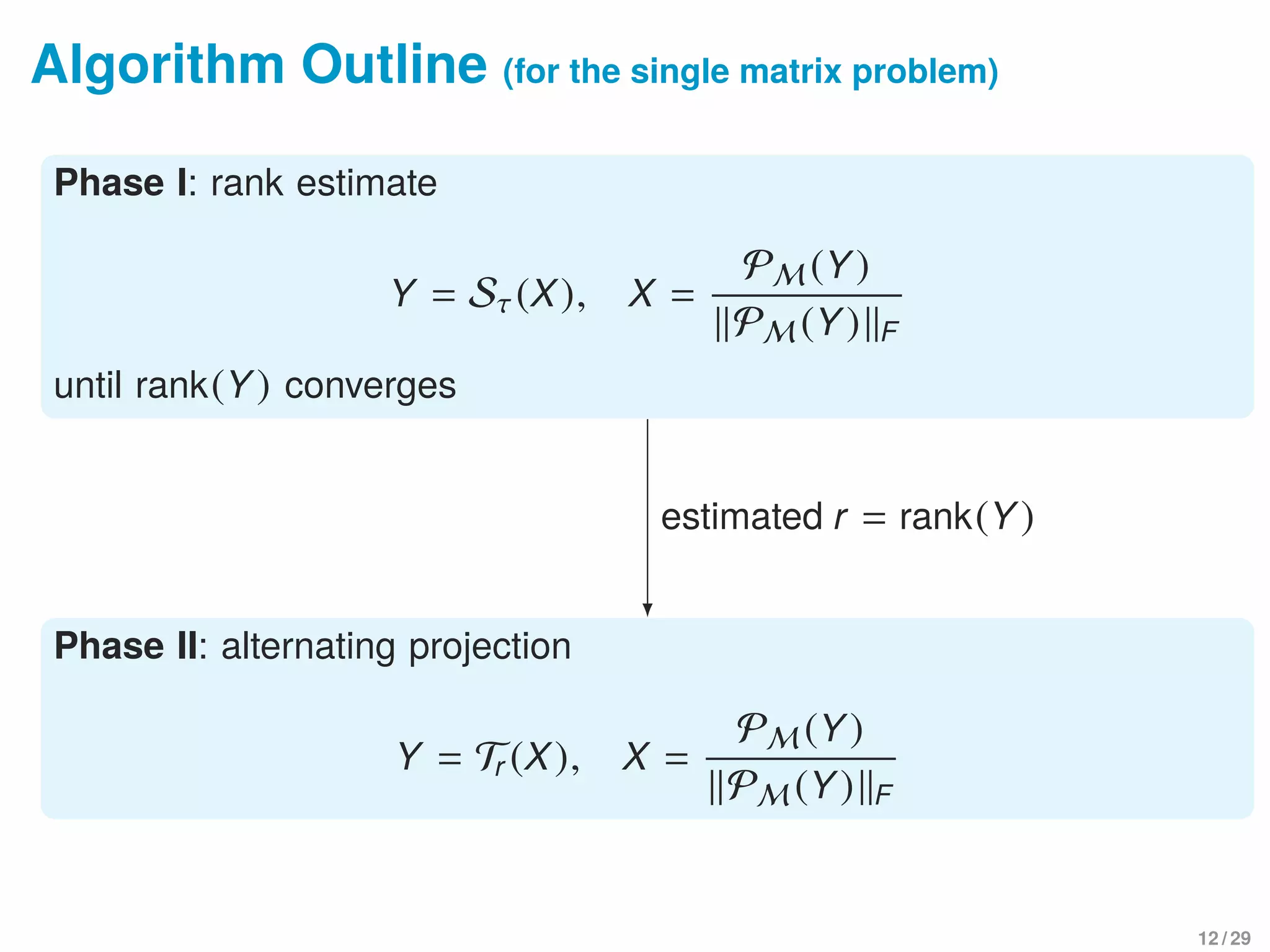
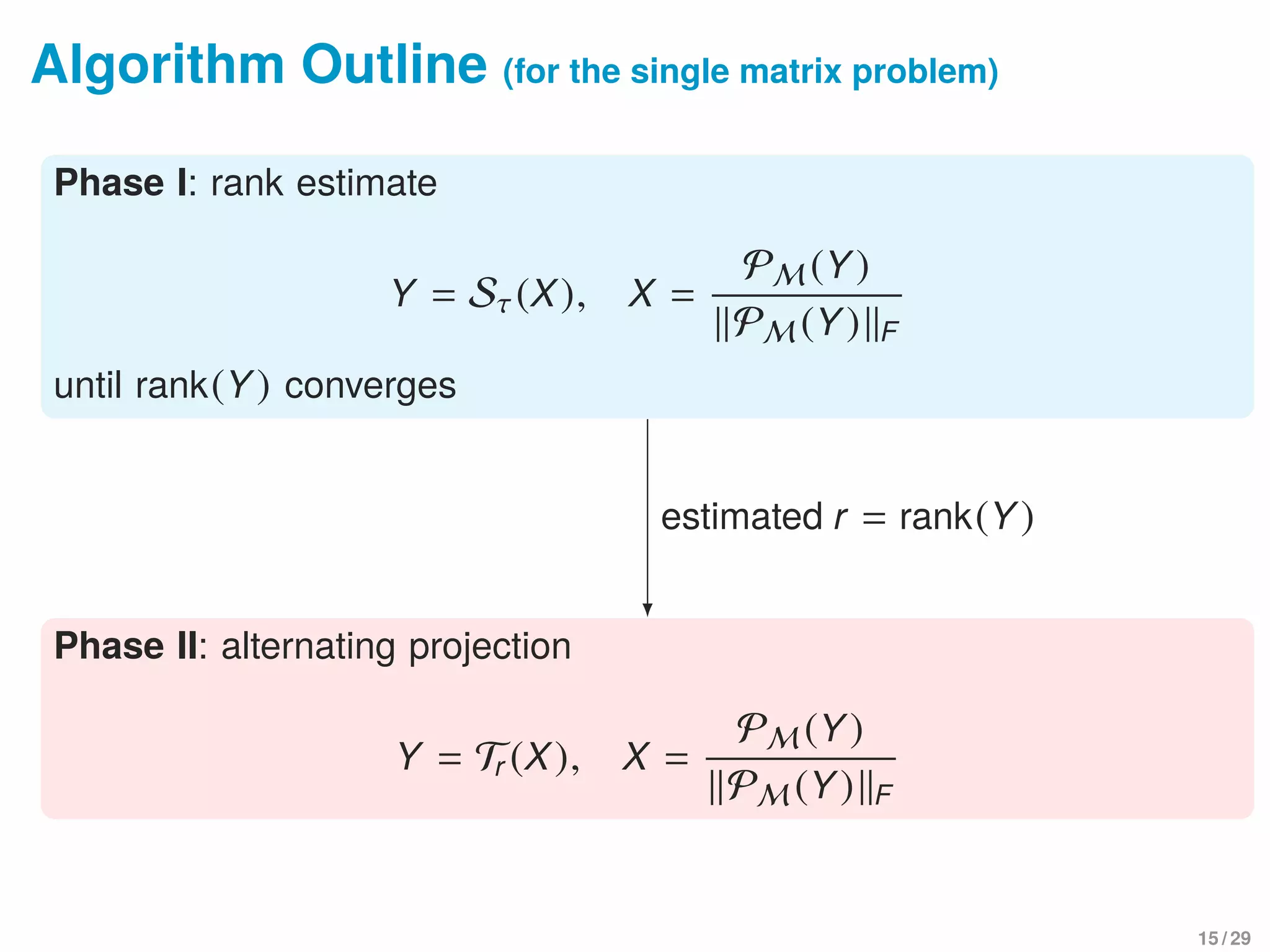
Algorithm Outline (for the single matrix problem)
Phase I: rank estimate
Y = Sτ(X), X =
PM (Y)
PM (Y) F
until rank(Y) converges
Phase II: alternating projection
Y = Tr (X), X =
PM (Y)
PM (Y) F
estimated r = rank(Y)
12 / 29
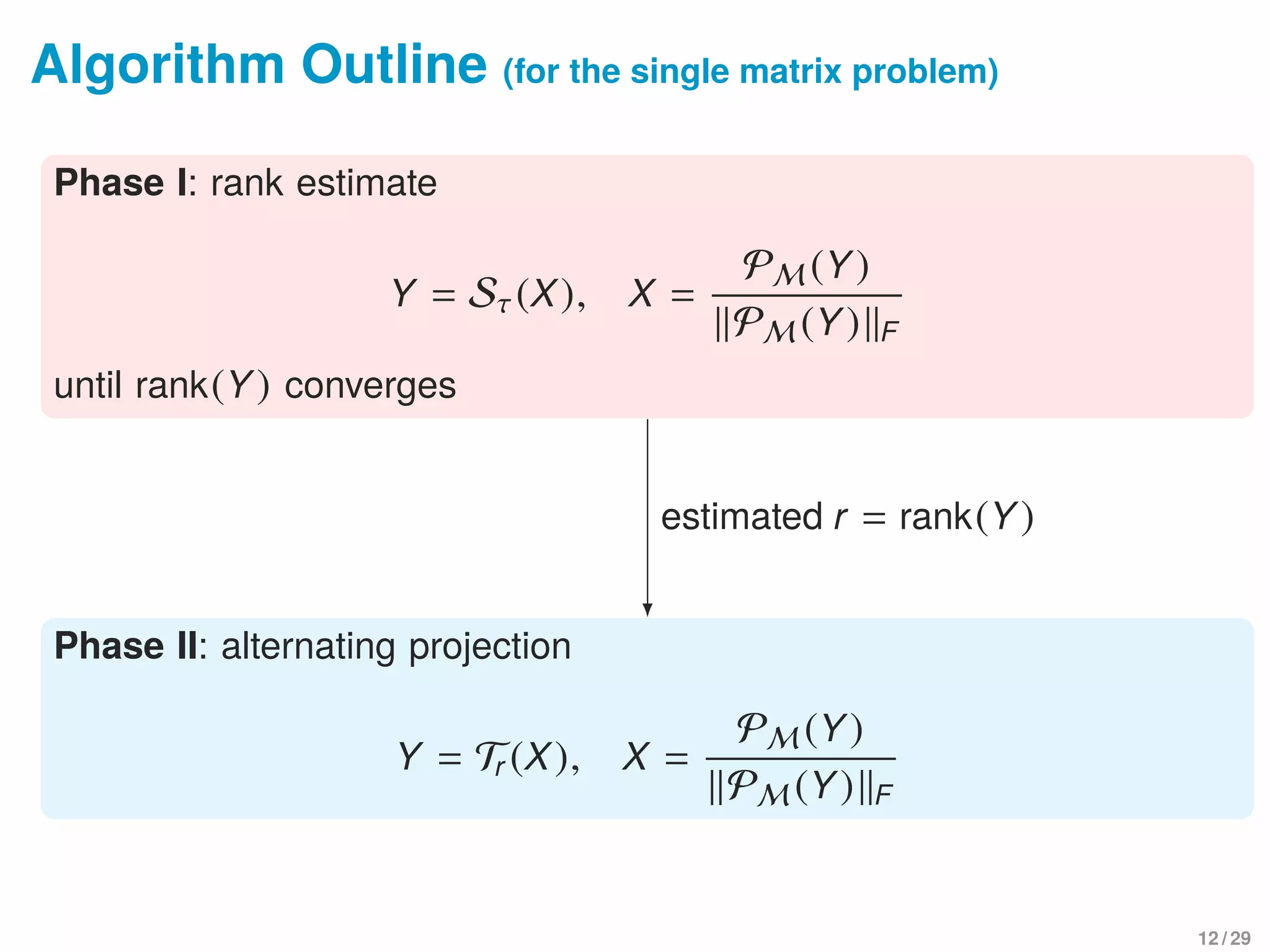
Algorithm Outline (for the single matrix problem)
Phase I: rank estimate
Y = Sτ(X), X =
PM (Y)
PM (Y) F
until rank(Y) converges
Phase II: alternating projection
Y = Tr (X), X =
PM (Y)
PM (Y) F
estimated r = rank(Y)
12 / 29
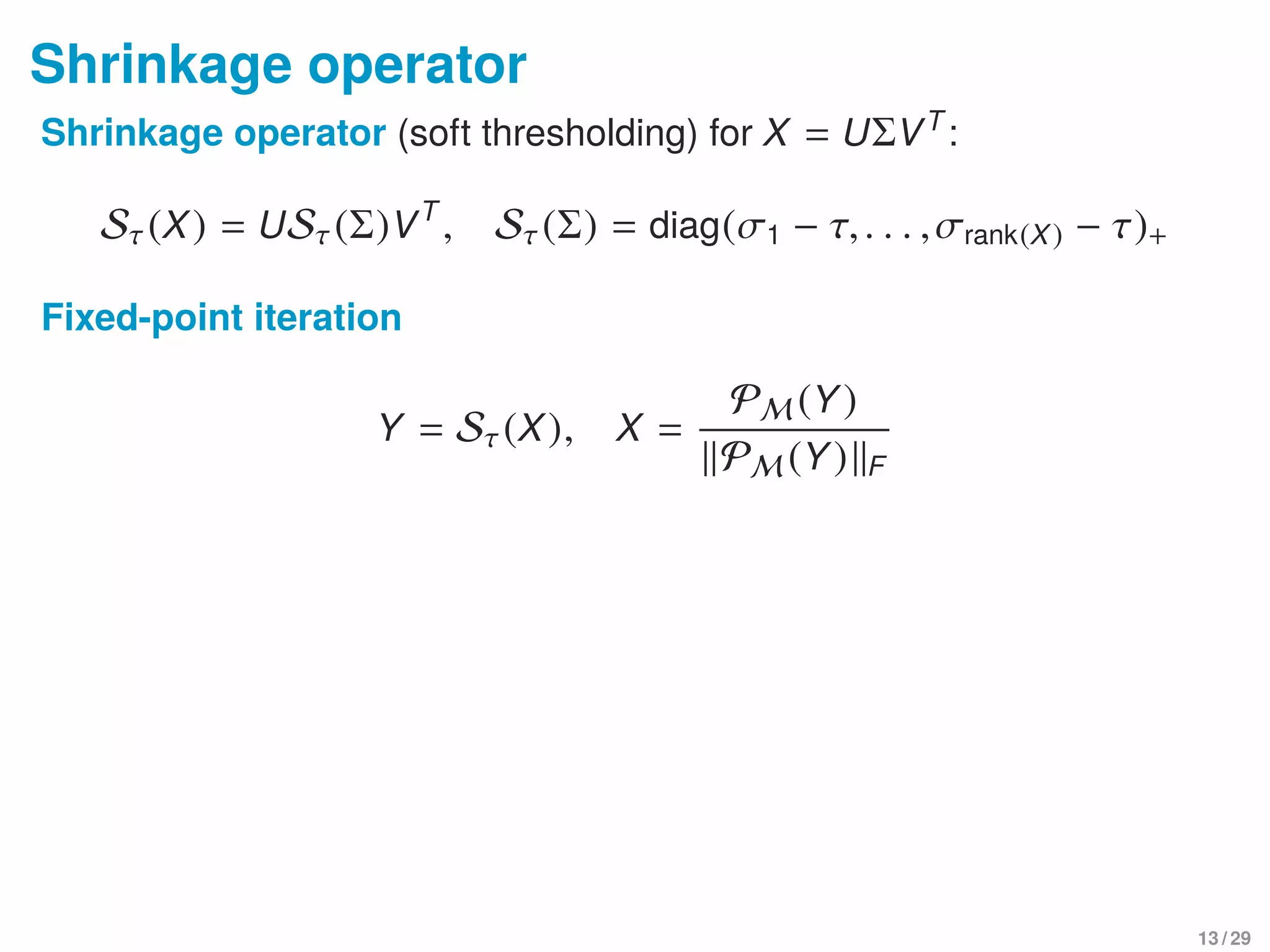
Shrinkage operator
Shrinkage operator (soft thresholding) for X = UΣVT
:
Sτ(X) = USτ(Σ)VT
, Sτ(Σ) = diag(σ1 − τ,. . . ,σrank(X) − τ)+
Fixed-point iteration
Y = Sτ(X), X =
PM (Y)
PM (Y) F
13 / 29
Shrinkage operator
Shrinkage operator (soft thresholding) for X = UΣVT
:
Sτ(X) = USτ(Σ)VT
, Sτ(Σ) = diag(σ1 − τ,. . . ,σrank(X) − τ)+
Fixed-point iteration
Y = Sτ(X), X =
PM (Y)
PM (Y) F
Interpretation: [Cai, Candes, Shen 2010], [Qu, Sun, Wright @NIPS 2014]
block coordinate descent (a.k.a. alternating direction) for
minimize
X,Y
τ Y ∗ +
1
2
Y − X 2
F
subject to X ∈ M, and X F = 1,
[Qu, Sun, Wright @NIPS 2014]: analogous method for sparsest vector.
13 / 29
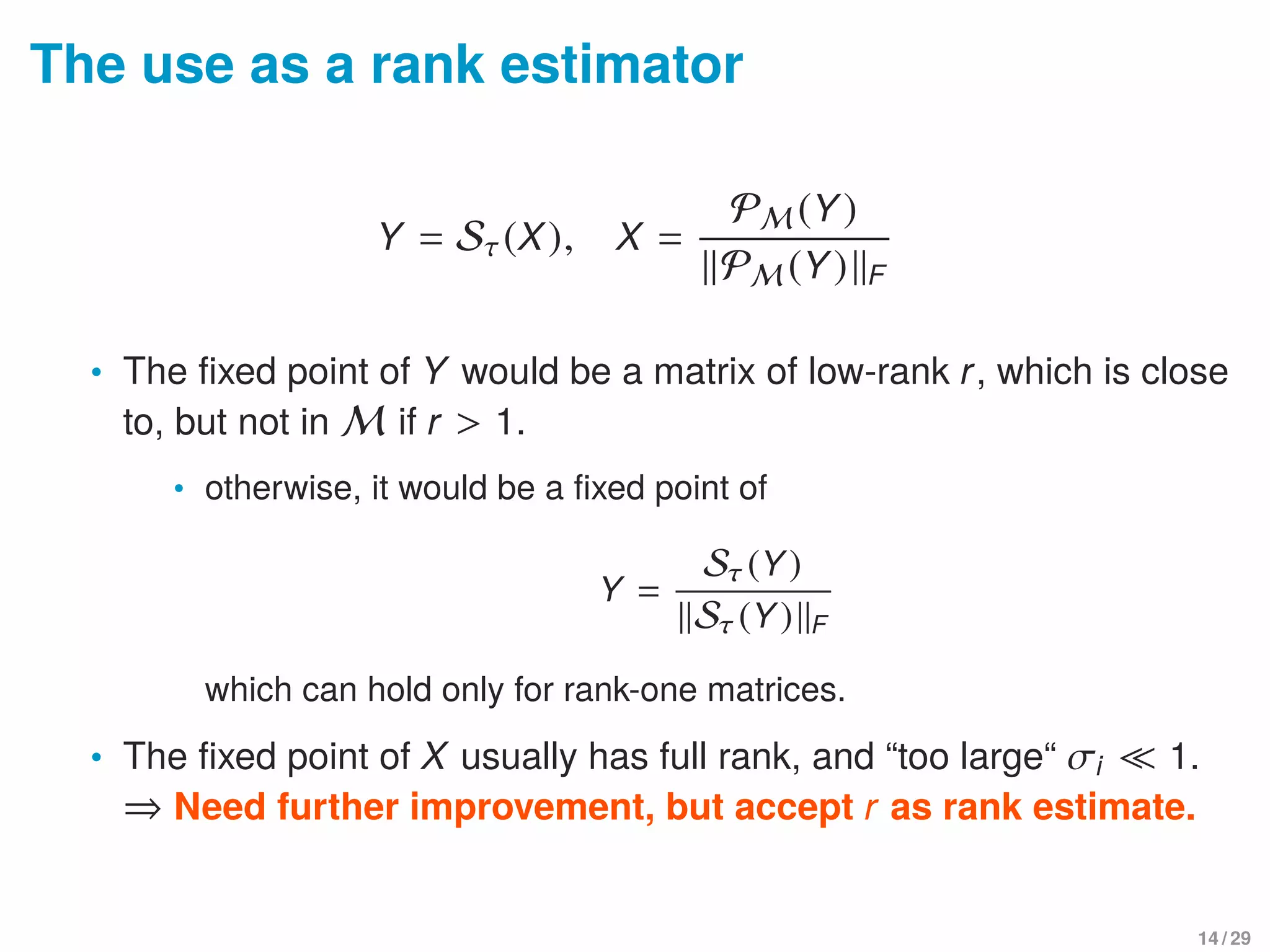
The use as a rank estimator
Y = Sτ(X), X =
PM (Y)
PM (Y) F
• The fixed point of Y would be a matrix of low-rank r, which is close
to, but not in M if r > 1.
• otherwise, it would be a fixed point of
Y =
Sτ (Y)
Sτ (Y) F
which can hold only for rank-one matrices.
• The fixed point of X usually has full rank, and “too large“ σi 1.
⇒ Need further improvement, but accept r as rank estimate.
14 / 29
Algorithm Outline (for the single matrix problem)
Phase I: rank estimate
Y = Sτ(X), X =
PM (Y)
PM (Y) F
until rank(Y) converges
Phase II: alternating projection
Y = Tr (X), X =
PM (Y)
PM (Y) F
estimated r = rank(Y)
15 / 29
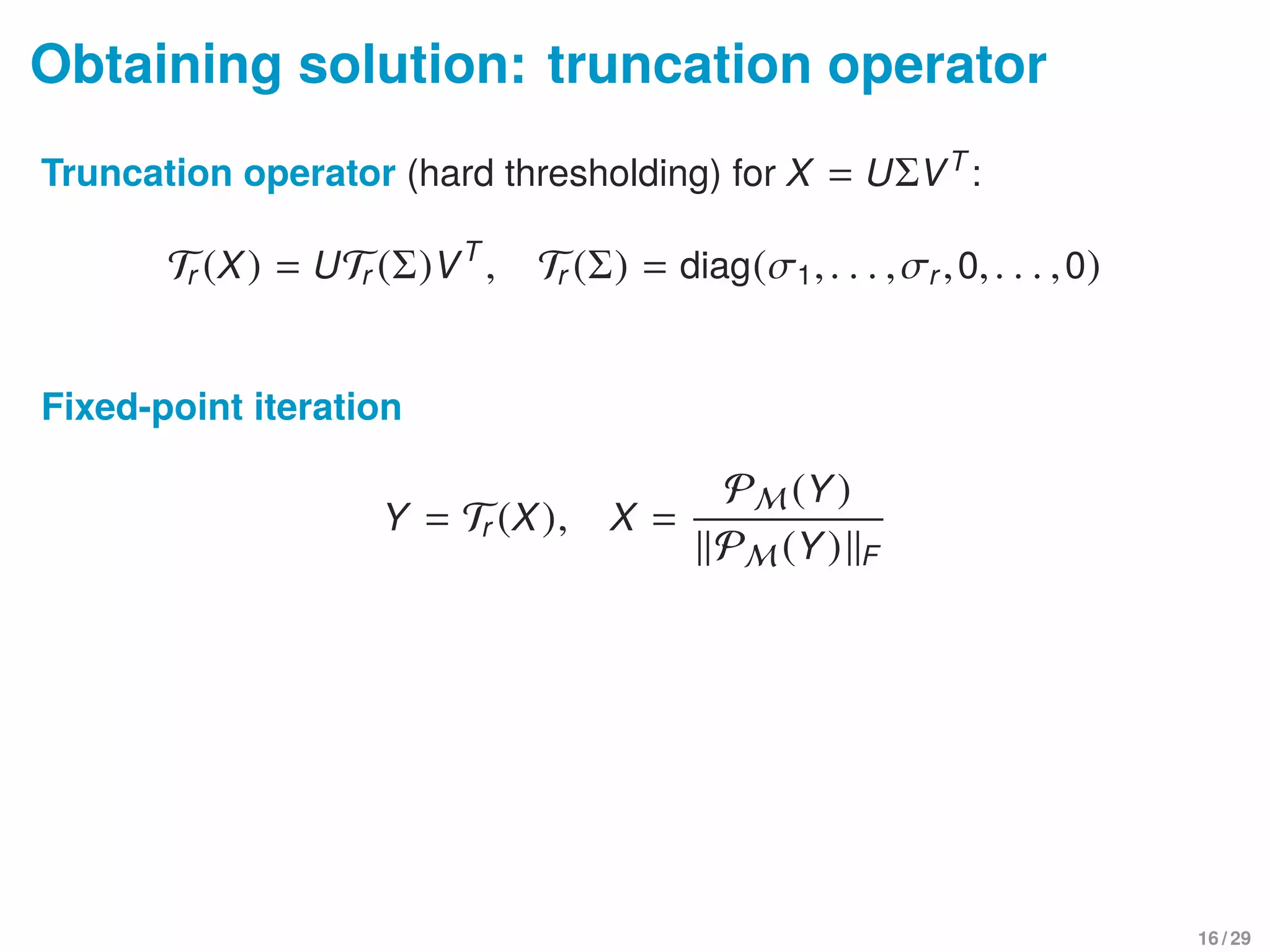
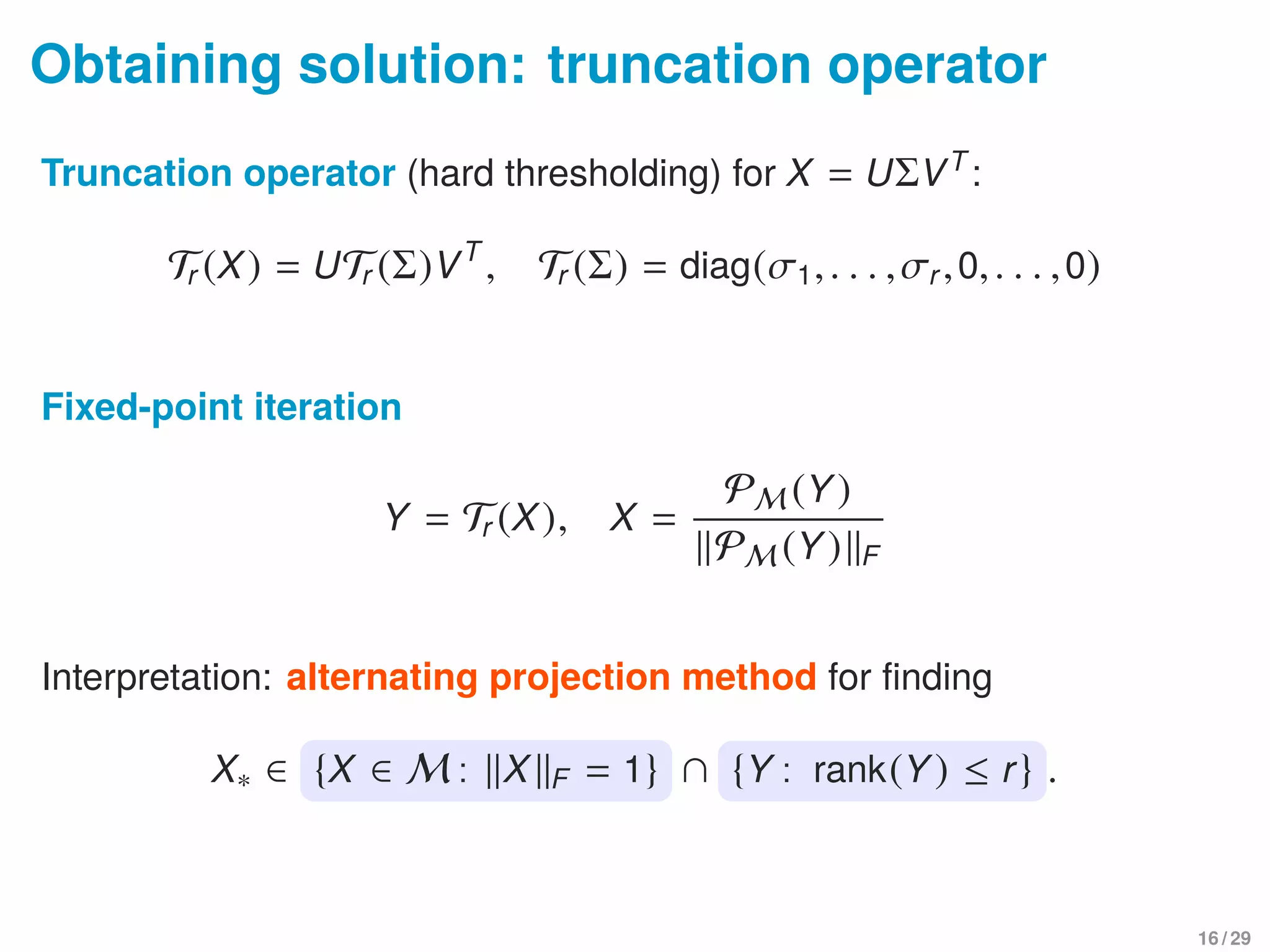
Obtaining solution: truncation operator
Truncation operator (hard thresholding) for X = UΣVT
:
Tr (X) = UTr (Σ)VT
, Tr (Σ) = diag(σ1,. . . ,σr,0,. . . ,0)
Fixed-point iteration
Y = Tr (X), X =
PM (Y)
PM (Y) F
16 / 29
Obtaining solution: truncation operator
Truncation operator (hard thresholding) for X = UΣVT
:
Tr (X) = UTr (Σ)VT
, Tr (Σ) = diag(σ1,. . . ,σr,0,. . . ,0)
Fixed-point iteration
Y = Tr (X), X =
PM (Y)
PM (Y) F
Interpretation: alternating projection method for finding
X∗ ∈ {X ∈ M : X F = 1} ∩ {Y : rank(Y) ≤ r} .
16 / 29
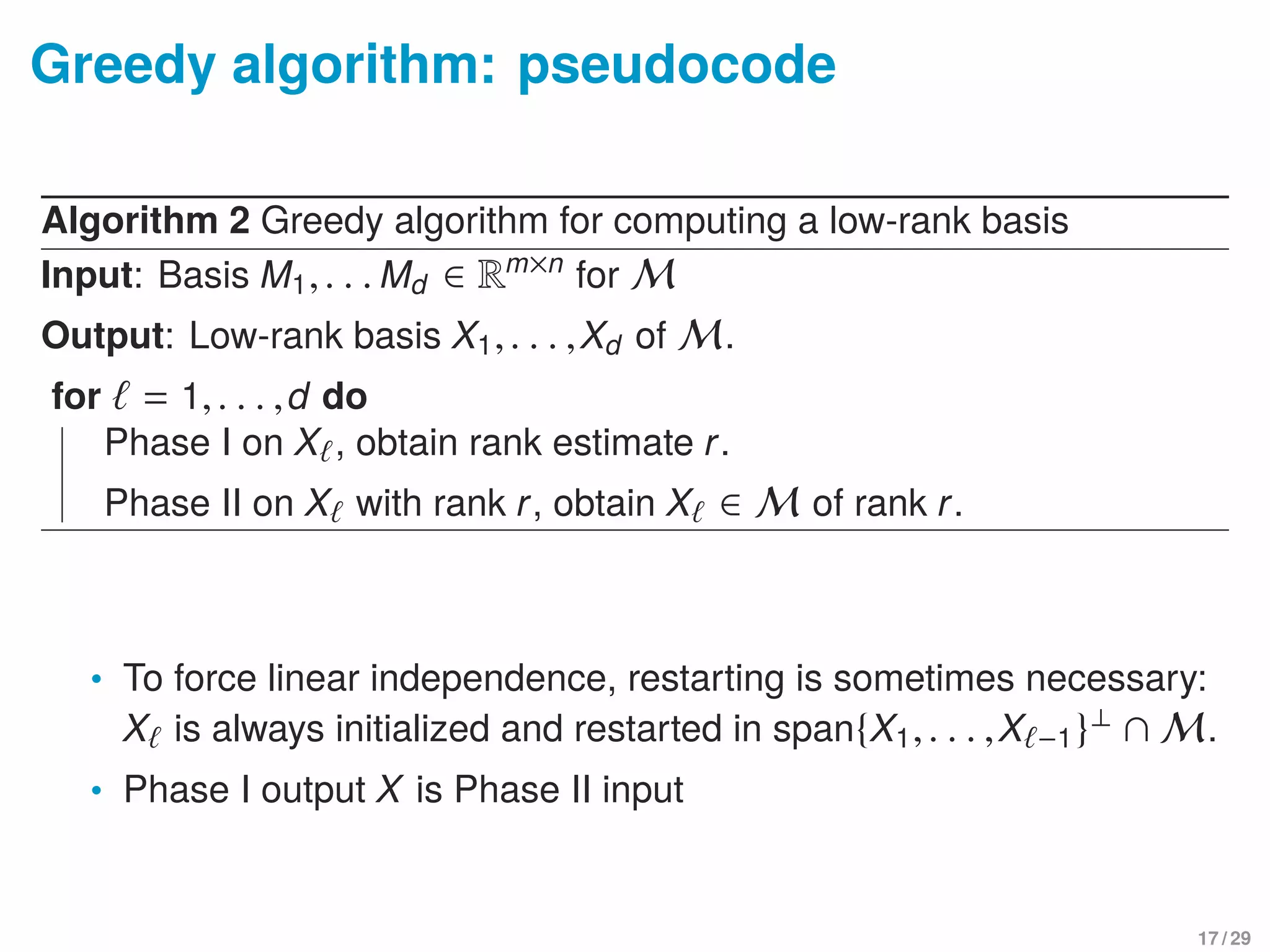
Greedy algorithm: pseudocode
Algorithm 2 Greedy algorithm for computing a low-rank basis
Input: Basis M1,. . . Md ∈ Rm×n
for M
Output: Low-rank basis X1,. . . ,Xd of M.
for = 1,. . . ,d do
Phase I on X , obtain rank estimate r.
Phase II on X with rank r, obtain X ∈ M of rank r.
• To force linear independence, restarting is sometimes necessary:
X is always initialized and restarted in span{X1,. . . ,X −1}⊥ ∩ M.
• Phase I output X is Phase II input
17 / 29
1 The low-rank basis problem
2 Algorithm
3 Convergence Guarantee
4 Experiments
18 / 29
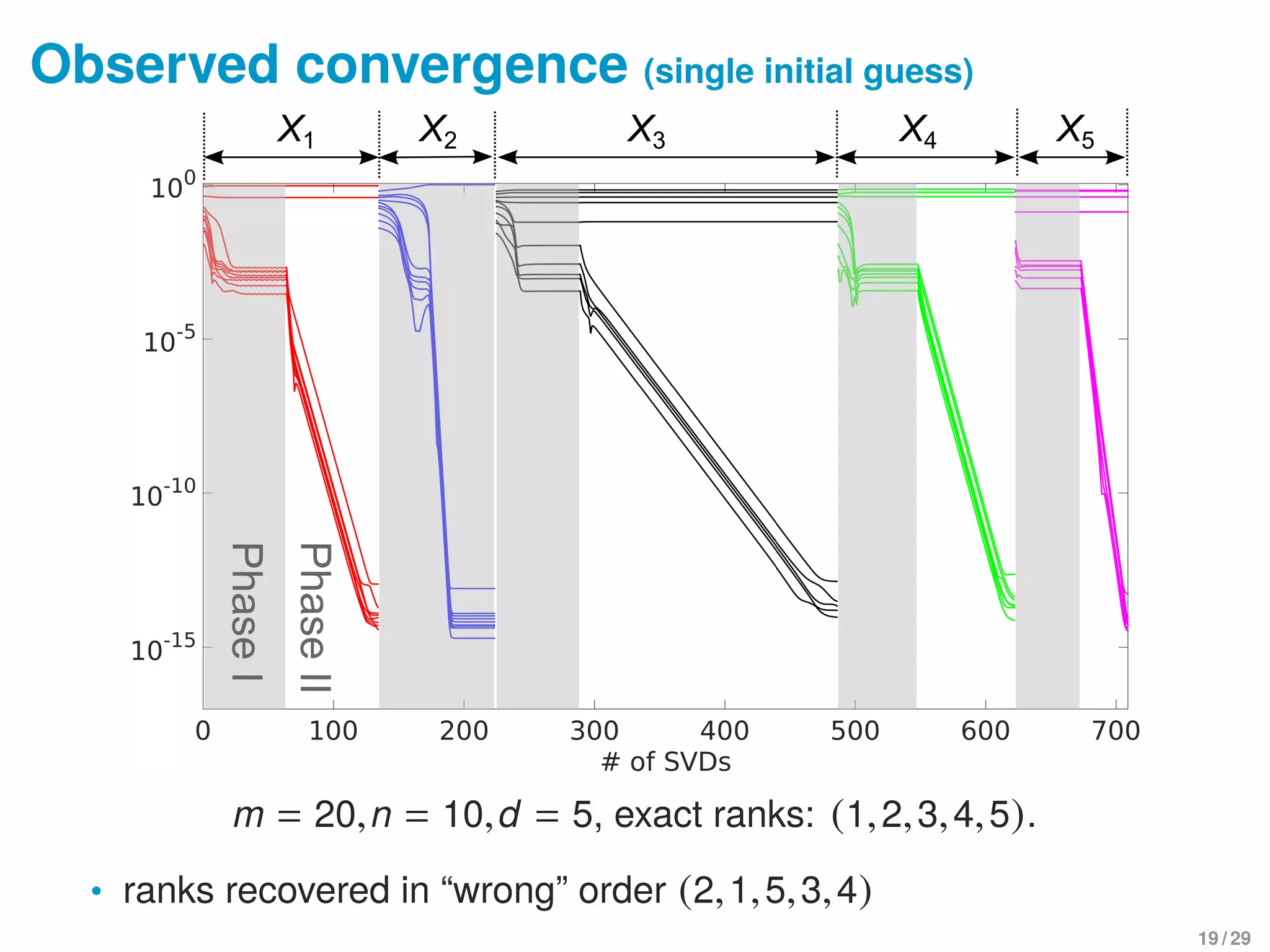
Observed convergence (single initial guess)
m = 20,n = 10,d = 5, exact ranks: (1,2,3,4,5).
• ranks recovered in “wrong” order (2,1,5,3,4)
19 / 29
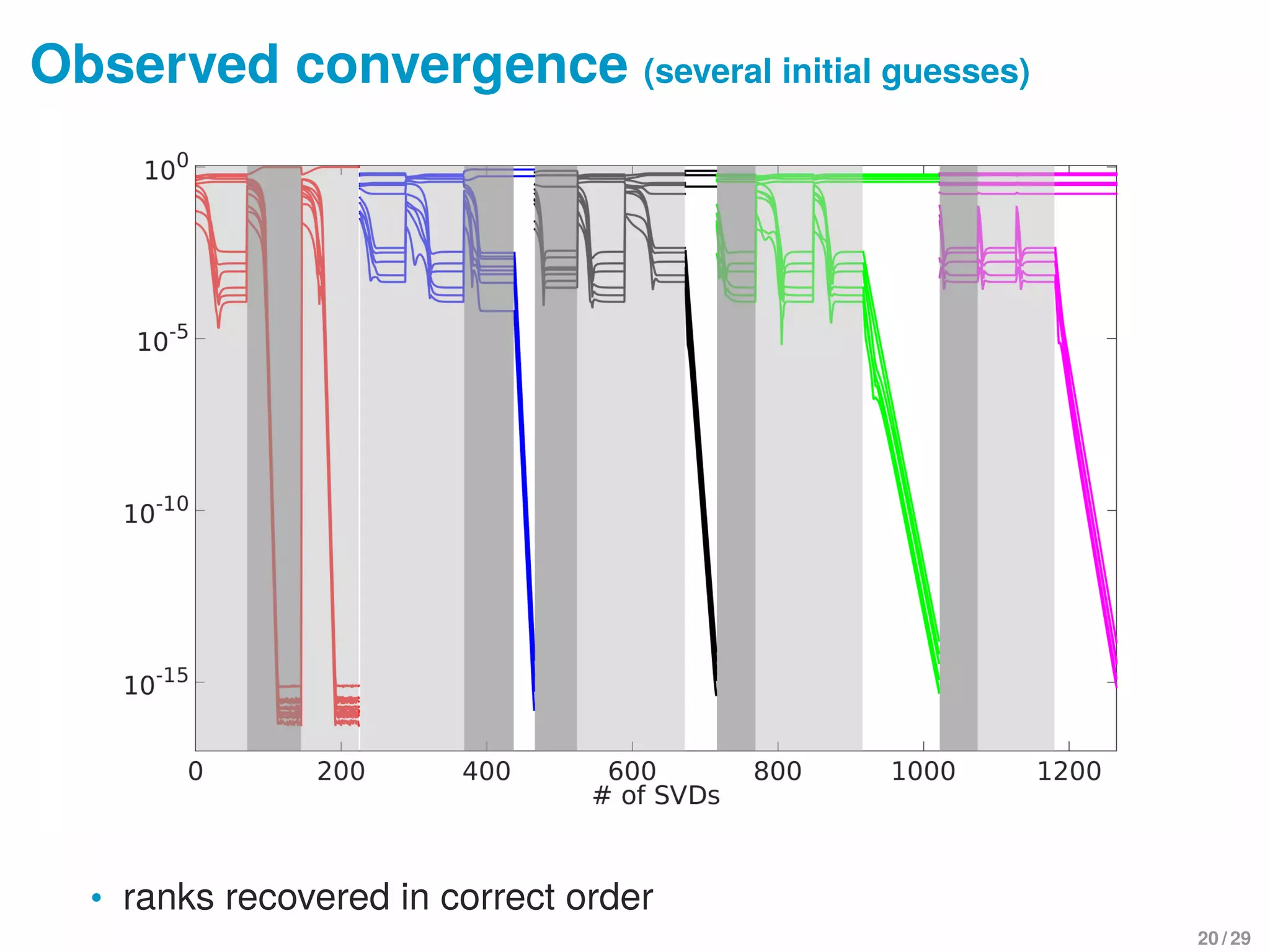
Observed convergence (several initial guesses)
• ranks recovered in correct order
20 / 29
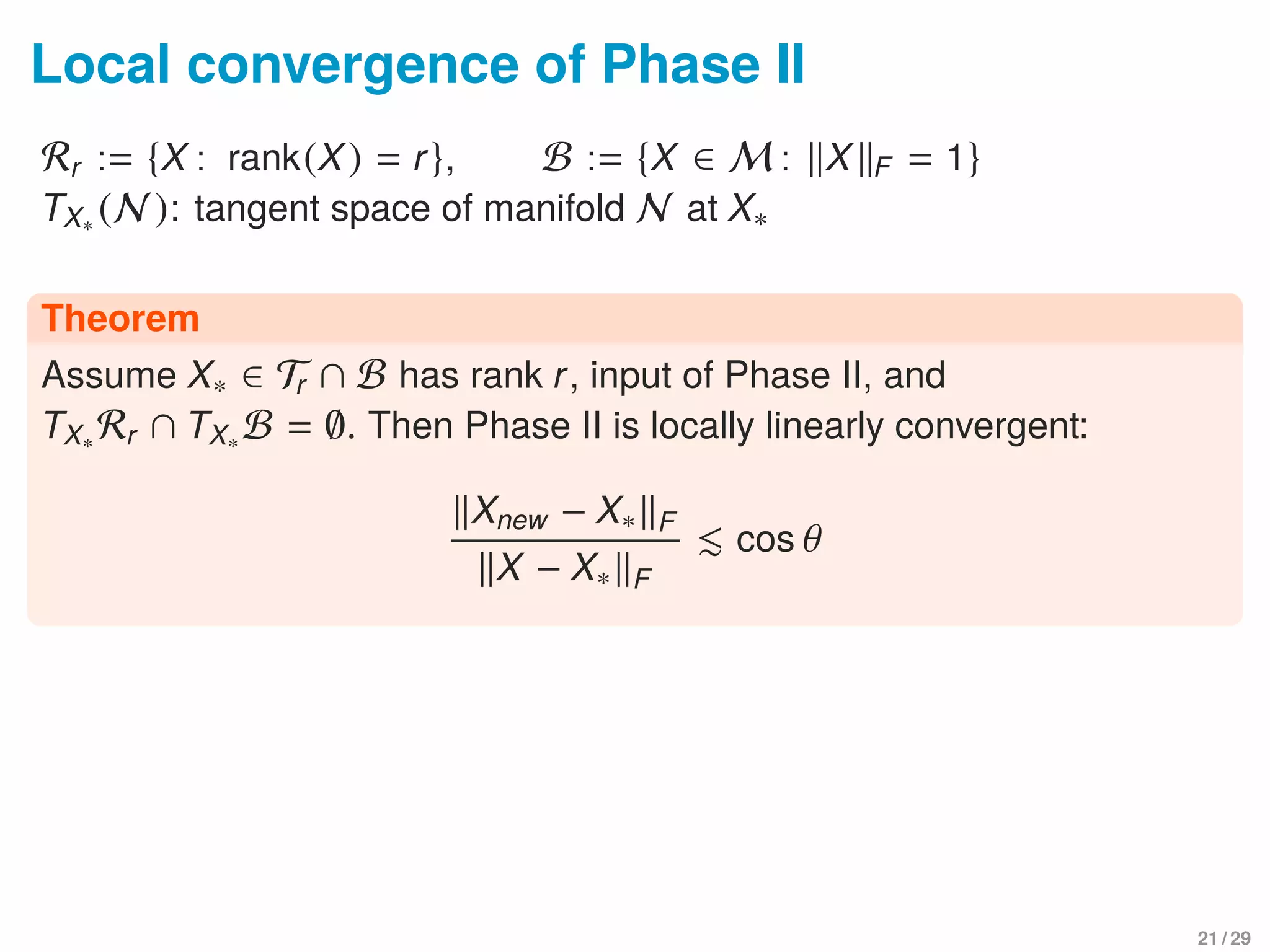
Local convergence of Phase II
Rr := {X : rank(X) = r}, B := {X ∈ M : X F = 1}
TX∗ (N ): tangent space of manifold N at X∗
Theorem
Assume X∗ ∈ Tr ∩ B has rank r, input of Phase II, and
TX∗ Rr ∩ TX∗ B = ∅. Then Phase II is locally linearly convergent:
Xnew − X∗ F
X − X∗ F
cos θ
21 / 29
Local convergence of Phase II
Rr := {X : rank(X) = r}, B := {X ∈ M : X F = 1}
TX∗ (N ): tangent space of manifold N at X∗
Theorem
Assume X∗ ∈ Tr ∩ B has rank r, input of Phase II, and
TX∗ Rr ∩ TX∗ B = ∅. Then Phase II is locally linearly convergent:
Xnew − X∗ F
X − X∗ F
cos θ
• Follows from a meta-theorem on alternating projections in
nonlinear optimization [Lewis, Luke, Malick 2009]
• We provide “direct” linear algebra proof
• Assumption holds if X∗ is isolated rank-r matrix in M
21 / 29
Local convergence: intuition
X∗
TX∗ B
TX∗ Rr
cos θ ≈ 1√
2
X∗
TX∗ B
TX∗ Rr
cos θ ≈ 0.9
Xnew − X∗ F
X − X∗ F
≤ cos θ + O( X − X∗
2
F )
θ ∈ (0, π
2
]: subspace angle between TX∗ B and TX∗ Rr
cos θ = max
X∈TX∗ B
Y∈TX∗ Rr
| X,Y F |
X F Y F
.
22 / 29
1 The low-rank basis problem
2 Algorithm
3 Convergence Guarantee
4 Experiments
23 / 29
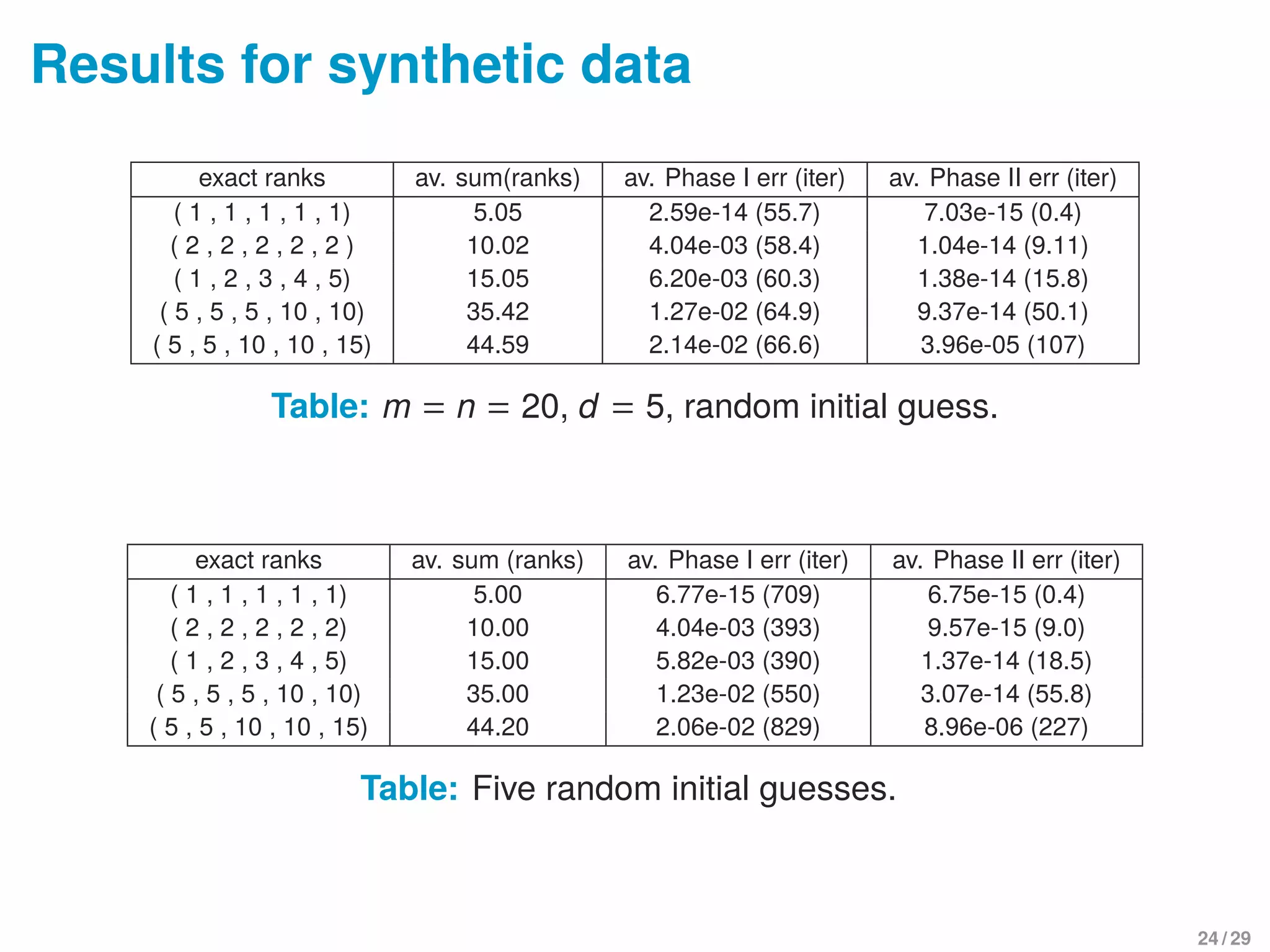
Results for synthetic data
exact ranks av. sum(ranks) av. Phase I err (iter) av. Phase II err (iter)
( 1 , 1 , 1 , 1 , 1) 5.05 2.59e-14 (55.7) 7.03e-15 (0.4)
( 2 , 2 , 2 , 2 , 2 ) 10.02 4.04e-03 (58.4) 1.04e-14 (9.11)
( 1 , 2 , 3 , 4 , 5) 15.05 6.20e-03 (60.3) 1.38e-14 (15.8)
( 5 , 5 , 5 , 10 , 10) 35.42 1.27e-02 (64.9) 9.37e-14 (50.1)
( 5 , 5 , 10 , 10 , 15) 44.59 2.14e-02 (66.6) 3.96e-05 (107)
Table: m = n = 20, d = 5, random initial guess.
exact ranks av. sum (ranks) av. Phase I err (iter) av. Phase II err (iter)
( 1 , 1 , 1 , 1 , 1) 5.00 6.77e-15 (709) 6.75e-15 (0.4)
( 2 , 2 , 2 , 2 , 2) 10.00 4.04e-03 (393) 9.57e-15 (9.0)
( 1 , 2 , 3 , 4 , 5) 15.00 5.82e-03 (390) 1.37e-14 (18.5)
( 5 , 5 , 5 , 10 , 10) 35.00 1.23e-02 (550) 3.07e-14 (55.8)
( 5 , 5 , 10 , 10 , 15) 44.20 2.06e-02 (829) 8.96e-06 (227)
Table: Five random initial guesses.
24 / 29
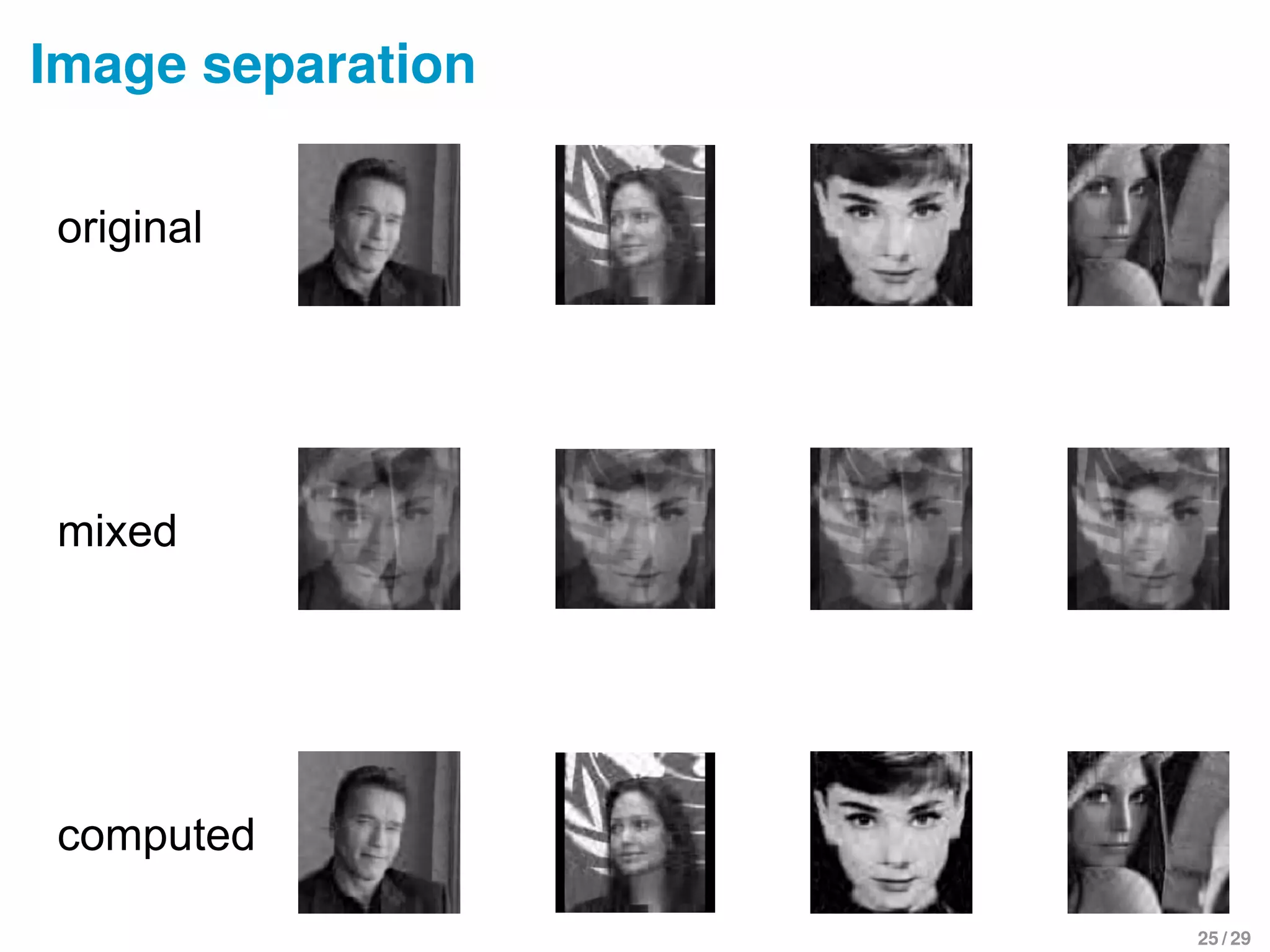
Image separation
original
mixed
computed
25 / 29
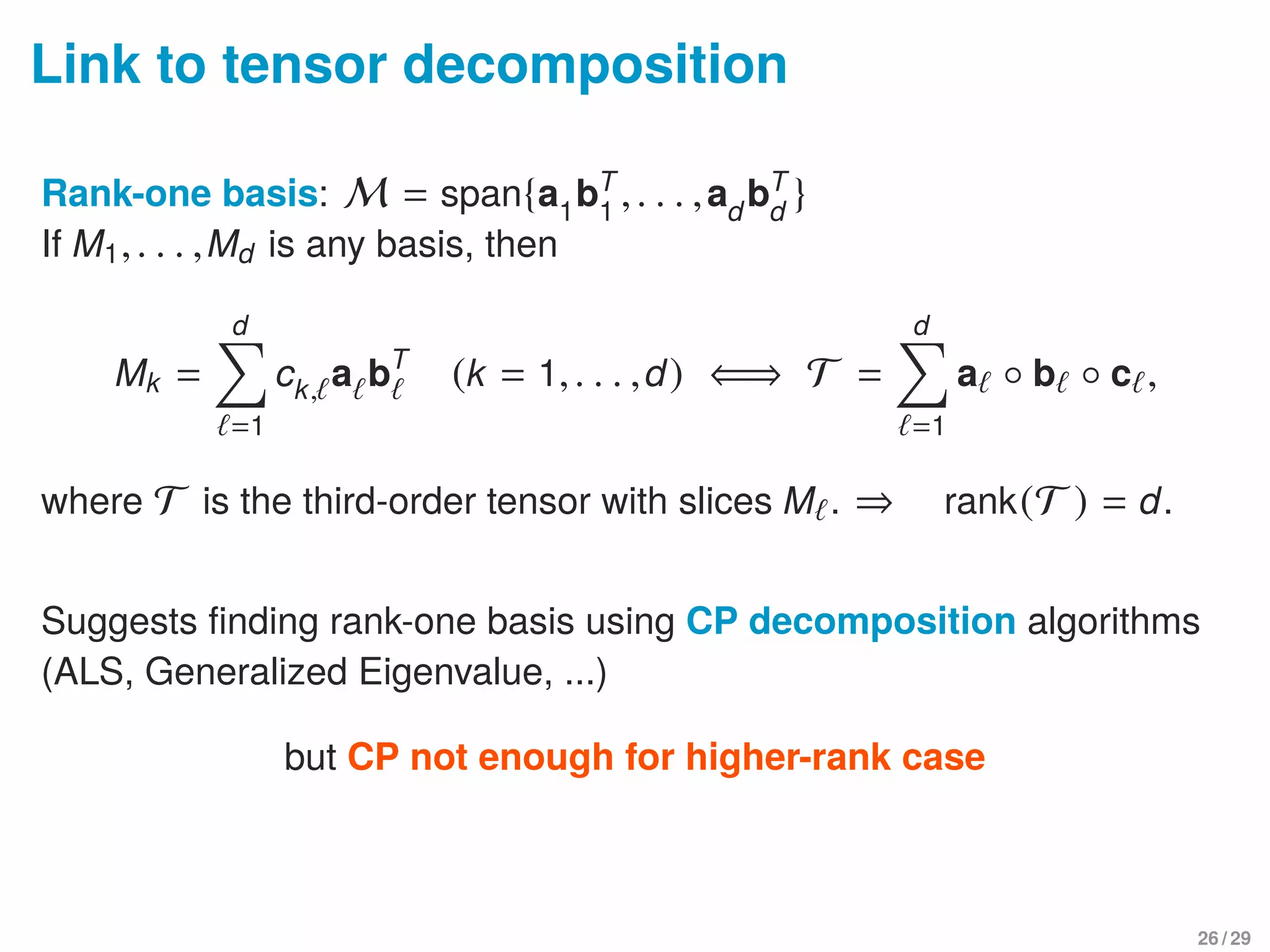
Link to tensor decomposition
Rank-one basis: M = span{a1
bT
1
,. . . ,ad
bT
d
}
If M1,. . . ,Md is any basis, then
Mk =
d
=1
ck, a bT
(k = 1,. . . ,d) ⇐⇒ T =
d
=1
a ◦ b ◦ c ,
where T is the third-order tensor with slices M . ⇒ rank(T ) = d.
Suggests finding rank-one basis using CP decomposition algorithms
(ALS, Generalized Eigenvalue, ...)
but CP not enough for higher-rank case
26 / 29
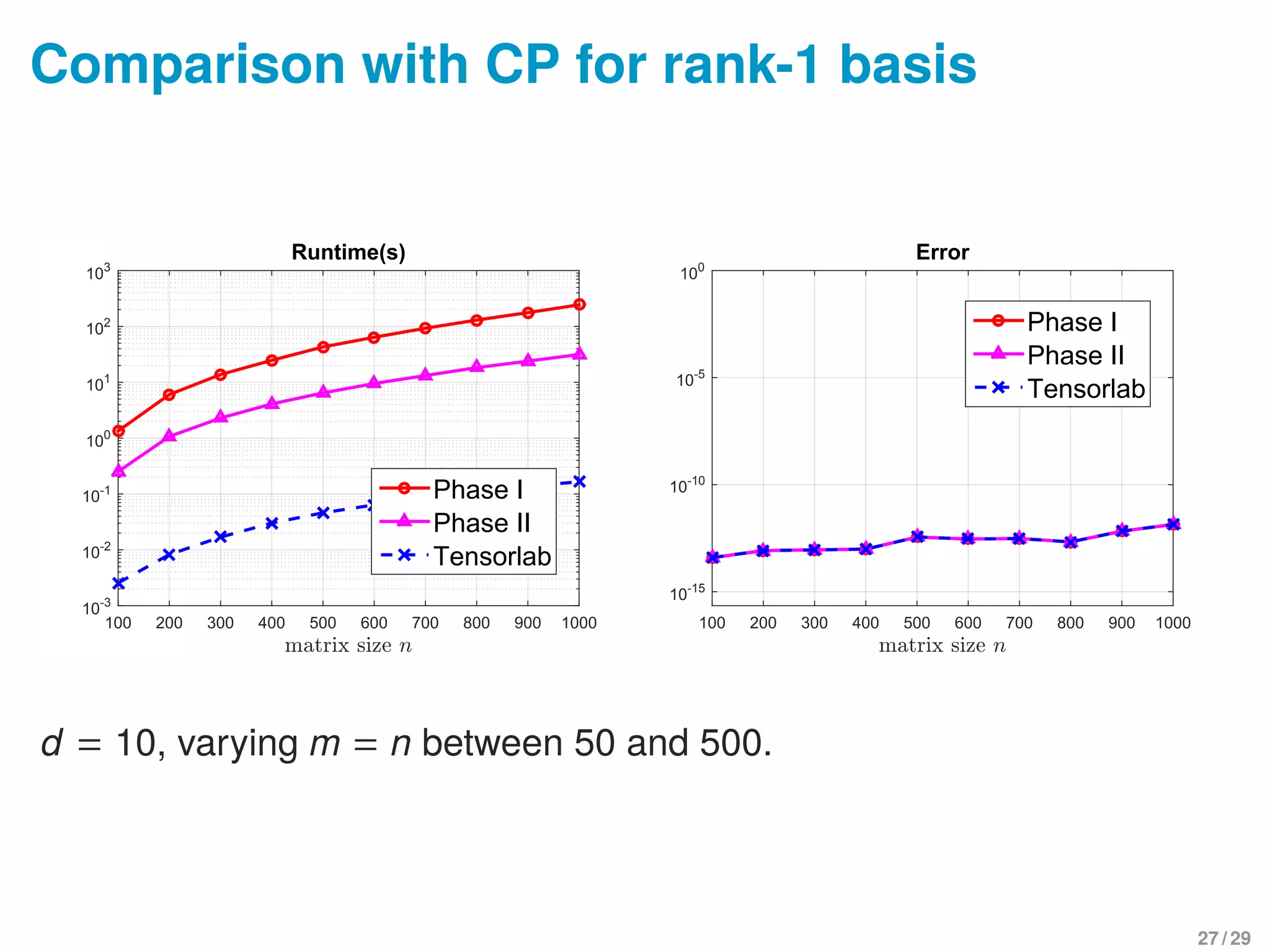
Comparison with CP for rank-1 basis
matrix size n
100 200 300 400 500 600 700 800 900 1000
10-3
10-2
10-1
100
101
102
103
Runtime(s)
Phase I
Phase II
Tensorlab
matrix size n
100 200 300 400 500 600 700 800 900 1000
10-15
10-10
10-5
100
Error
Phase I
Phase II
Tensorlab
d = 10, varying m = n between 50 and 500.
27 / 29
Comparison with CP for rank-1 basis
dimension d
2 4 6 8 10 12 14 16 18 20
10-4
10-3
10-2
10-1
100
Runtime(s)
Phase I
Phase II
Tensorlab
dimension d
2 4 6 8 10 12 14 16 18 20
10-15
10-10
10-5
100
Error
Phase I
Phase II
Tensorlab
m = n = 10, varying d between 2 and 20.
28 / 29
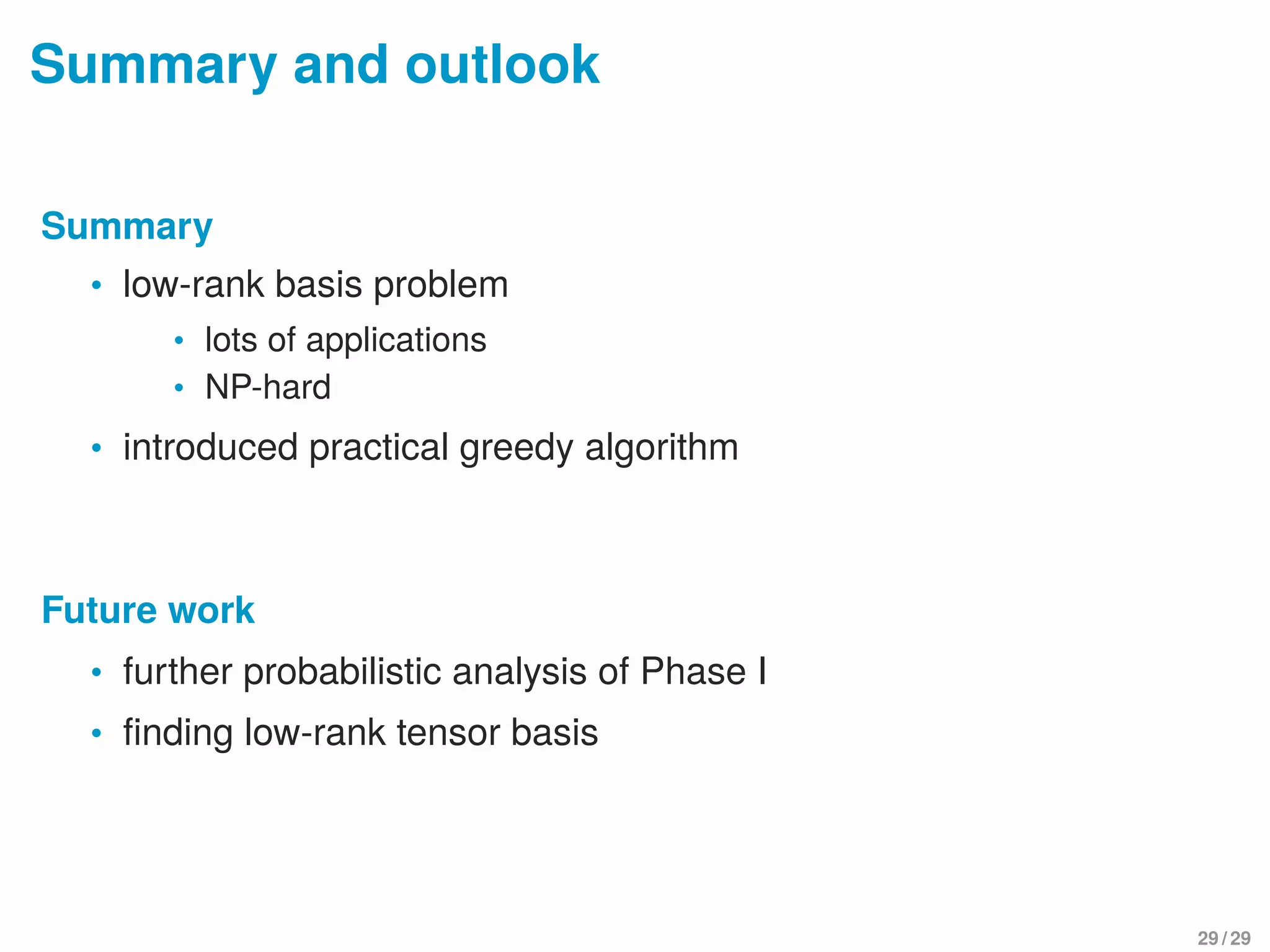
Summary and outlook
Summary
• low-rank basis problem
• lots of applications
• NP-hard
• introduced practical greedy algorithm
Future work
• further probabilistic analysis of Phase I
• finding low-rank tensor basis
29 / 29
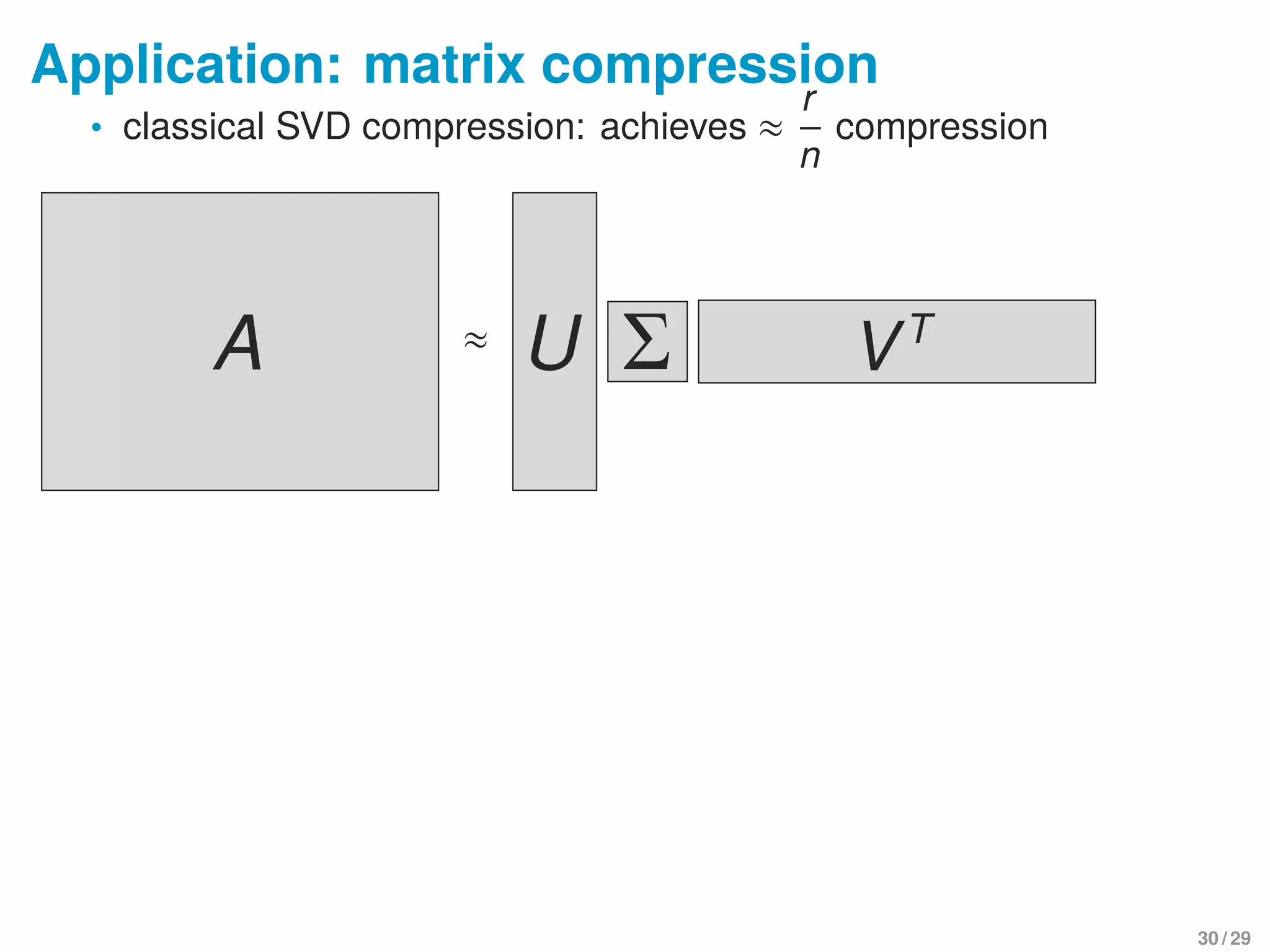
Application: matrix compression
• classical SVD compression: achieves ≈
r
n
compression
A ≈ U Σ VT
30 / 29
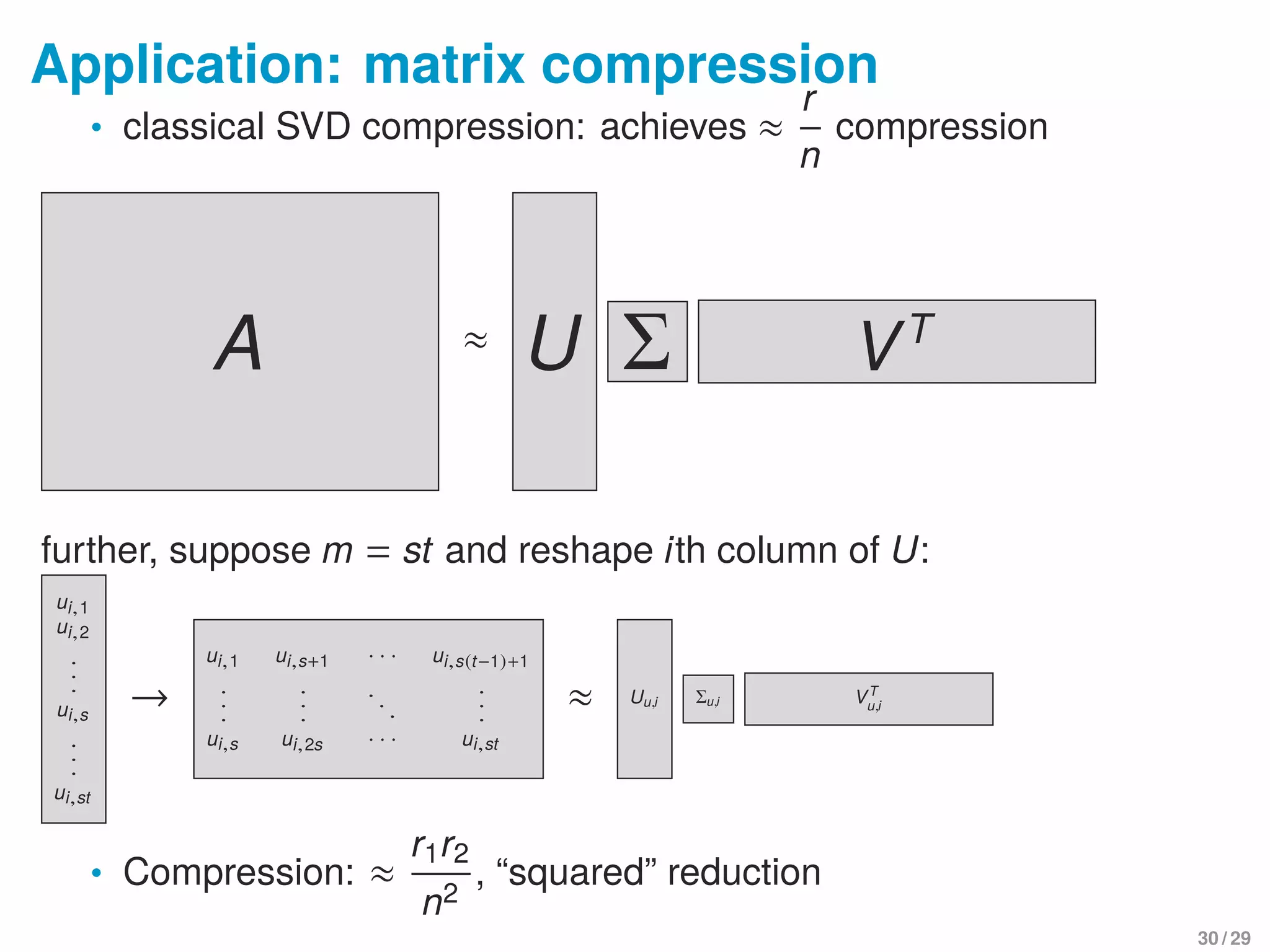
Application: matrix compression
• classical SVD compression: achieves ≈
r
n
compression
A ≈ U Σ VT
further, suppose m = st and reshape ith column of U:
ui,1
ui,2
.
.
.
ui,s
.
.
.
ui,st
→
ui,1 ui,s+1 · · · ui,s(t−1)+1
.
.
.
.
.
.
. . .
.
.
.
ui,s ui,2s · · · ui,st
≈ Uu,i Σu,i VT
u,i
• Compression: ≈
r1r2
n2
, “squared” reduction
30 / 29
Finding right “basis” for storage reduction
U = [U1,. . . ,Ur], ideally, each column Ui = [ui,1,ui,2,. . . ,ui,st]T
has
low-rank structure when matricized
ui,1
ui,2
.
.
.
ui,s
.
.
.
ui,st
→
ui,1 ui,s+1 · · · ui,s(t−1)+1
.
.
.
.
.
.
. . .
.
.
.
ui,s ui,2s · · · ui,st
≈ Uu,i VT
u,i for i = 1,. . . ,r
• More realistically: ∃ Q ∈ Rr×r
s.t. UQ has such property
⇒ finding low-rank basis for matrix subspace spanned by
mat(U1),mat(U2),. . . ,mat(Ur )
31 / 29
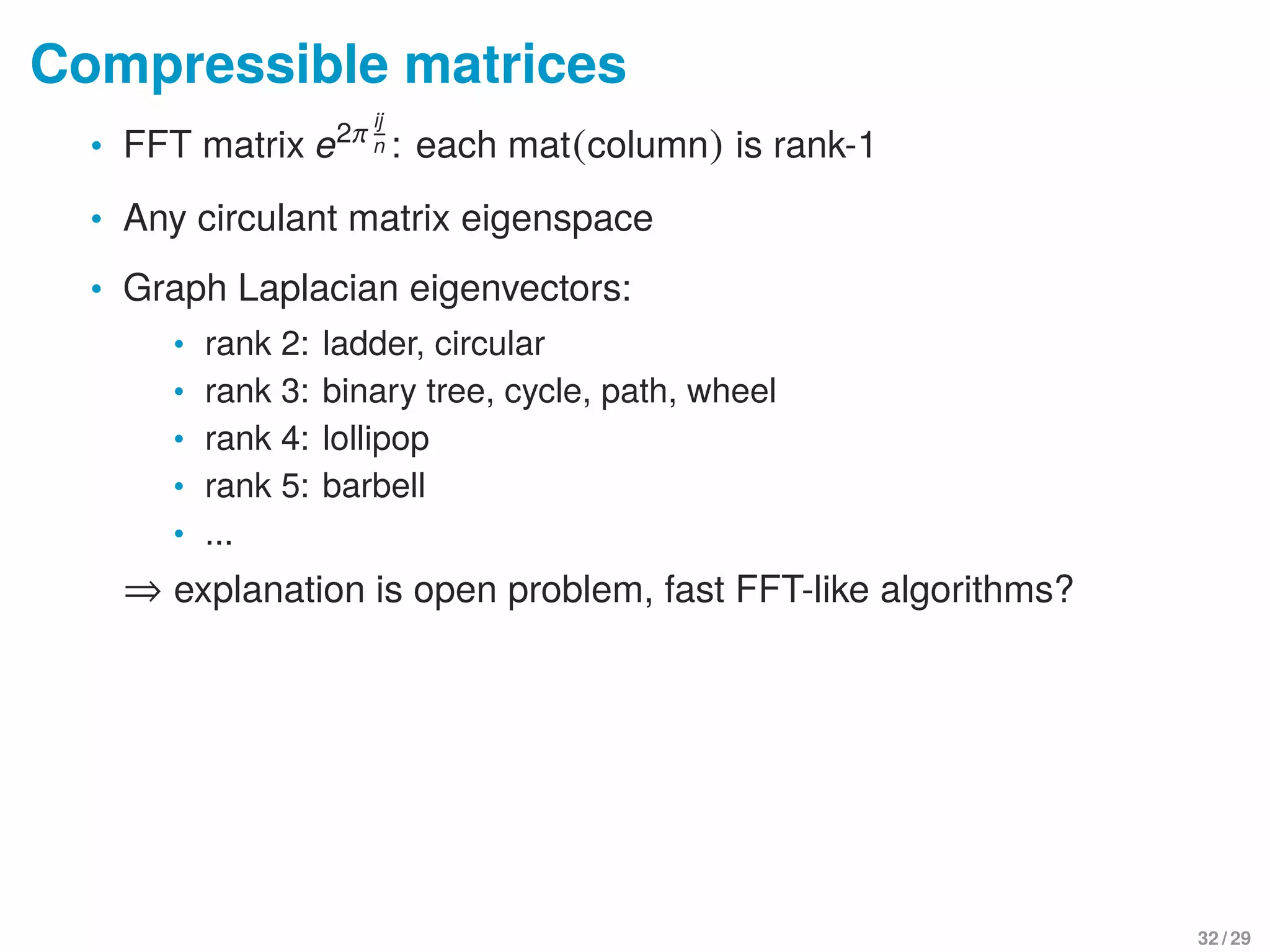
Compressible matrices
• FFT matrix e2π ij
n : each mat(column) is rank-1
• Any circulant matrix eigenspace
• Graph Laplacian eigenvectors:
• rank 2: ladder, circular
• rank 3: binary tree, cycle, path, wheel
• rank 4: lollipop
• rank 5: barbell
• ...
⇒ explanation is open problem, fast FFT-like algorithms?
32 / 29
Eigenvectors of multiple eigenvalues
A[x1,x2,. . . ,xk] = λ[x1,x2,. . . ,xk]
• eigenvector x for Ax = λx is not determined uniquely +
non-differentiable
• numerical practice: content with computing span(x1,x2)
extreme example: I, any vector is eigenvector!
• but perhaps




1
,

1

, . . .
1




is a “good” set of eigenvectors
• why? low-rank, low-memory!
33 / 29
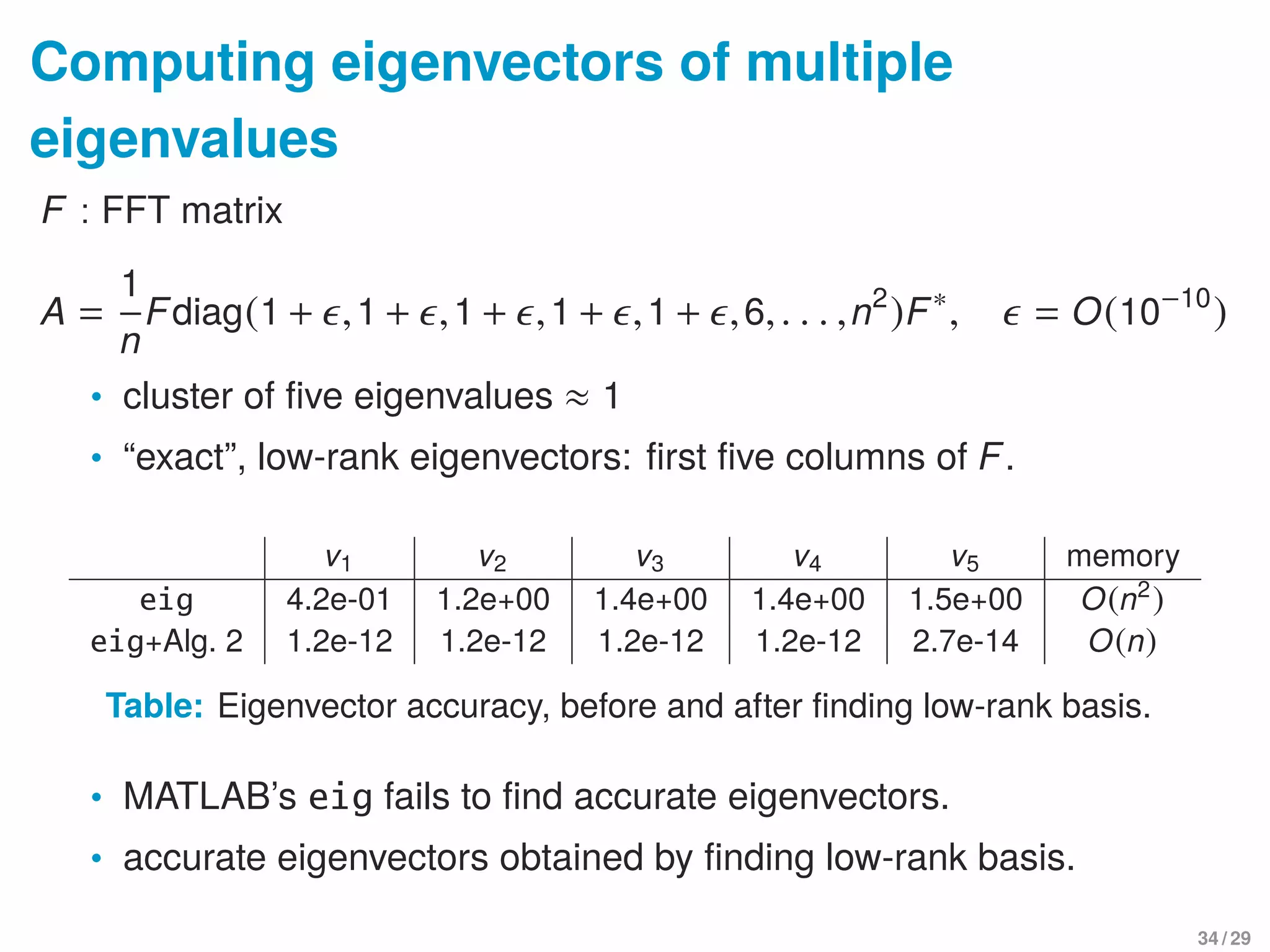
Computing eigenvectors of multiple
eigenvalues
F : FFT matrix
A =
1
n
Fdiag(1 + ,1 + ,1 + ,1 + ,1 + ,6,. . . ,n2
)F∗
, = O(10−10
)
• cluster of five eigenvalues ≈ 1
• “exact”, low-rank eigenvectors: first five columns of F.
v1 v2 v3 v4 v5 memory
eig 4.2e-01 1.2e+00 1.4e+00 1.4e+00 1.5e+00 O(n2
)
eig+Alg. 2 1.2e-12 1.2e-12 1.2e-12 1.2e-12 2.7e-14 O(n)
Table: Eigenvector accuracy, before and after finding low-rank basis.
• MATLAB’s eig fails to find accurate eigenvectors.
• accurate eigenvectors obtained by finding low-rank basis.
34 / 29
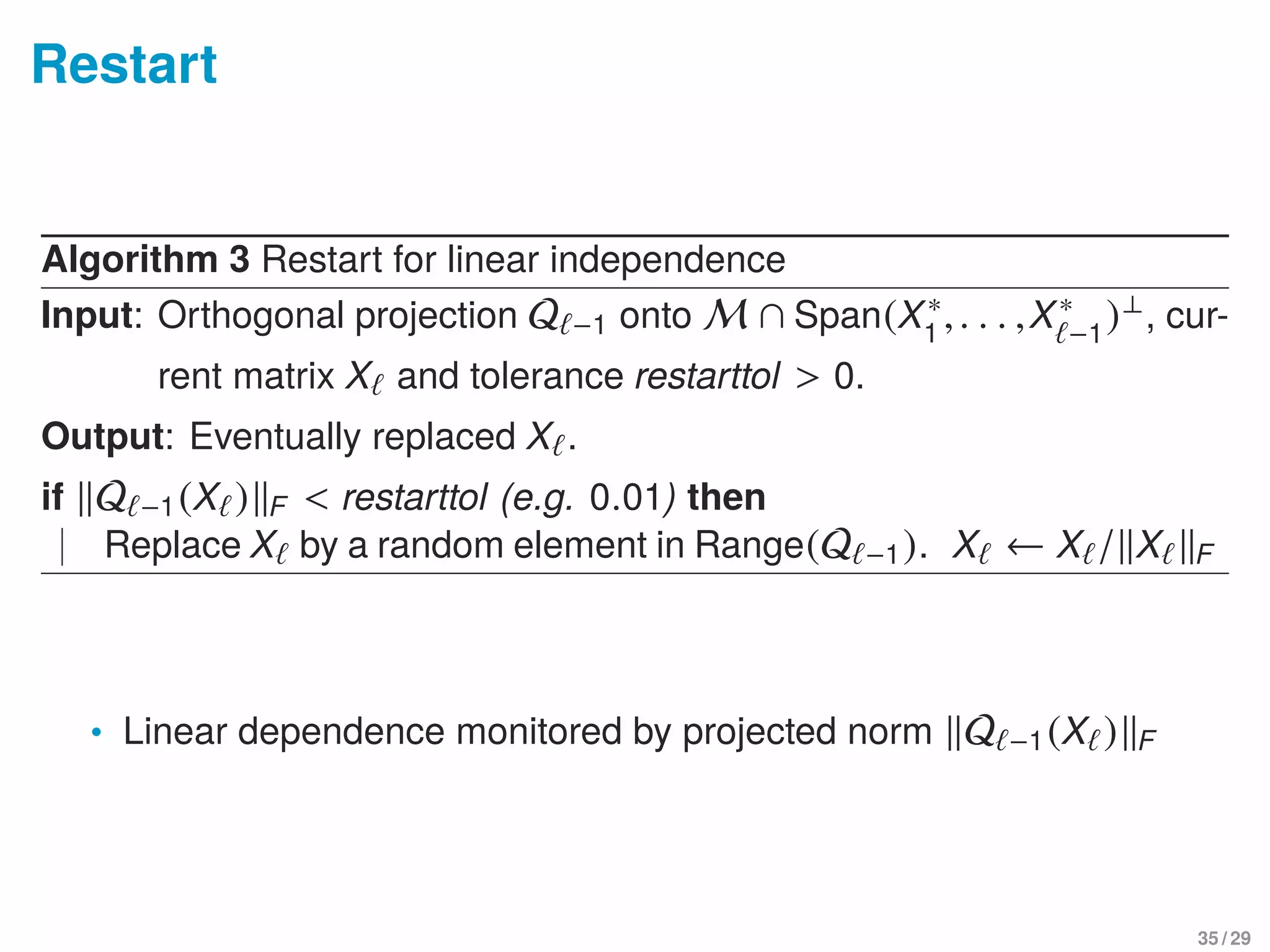
Restart
Algorithm 3 Restart for linear independence
Input: Orthogonal projection Q −1 onto M ∩ Span(X∗
1
,. . . ,X∗
−1
)⊥, cur-
rent matrix X and tolerance restarttol > 0.
Output: Eventually replaced X .
if Q −1(X ) F < restarttol (e.g. 0.01) then
Replace X by a random element in Range(Q −1). X ← X / X F
• Linear dependence monitored by projected norm Q −1(X ) F
35 / 29
Linear algebra convergence proof
TX∗ Rr = [U∗ U⊥
∗ ]
A B
C 0
[V∗ V⊥
∗ ]T
. (1)
X − X∗ = E + O( X − X∗
2
F )
with E ∈ TX∗ B. Write E = [U∗ U⊥
∗ ][ A B
C D ][V∗ V⊥
∗ ]T
. By (1)
D 2
F
≥ sin2
θ · E 2
F
. ∃F,G orthogonal s.t.
X = FT Σ∗ + A 0
0 D
GT
+ O( E 2
F ).
Tr (X) − X∗ F =
A + Σ∗ 0
0 0
−
Σ∗ −B
−C CΣ−1
∗ B F
+ O( E 2
F )
=
A B
C 0 F
+ O( E 2
F ).
So
Tr (X) − X∗ F
X − X∗ F
=
E 2
F
− D 2
F
+ O( X − X∗
2
F
)
E F + O( X − X∗
2
F
)
≤ 1 − sin2
θ + O( X − X∗
2
F ) = cos θ + O( X − X∗
2
F )
36 / 29
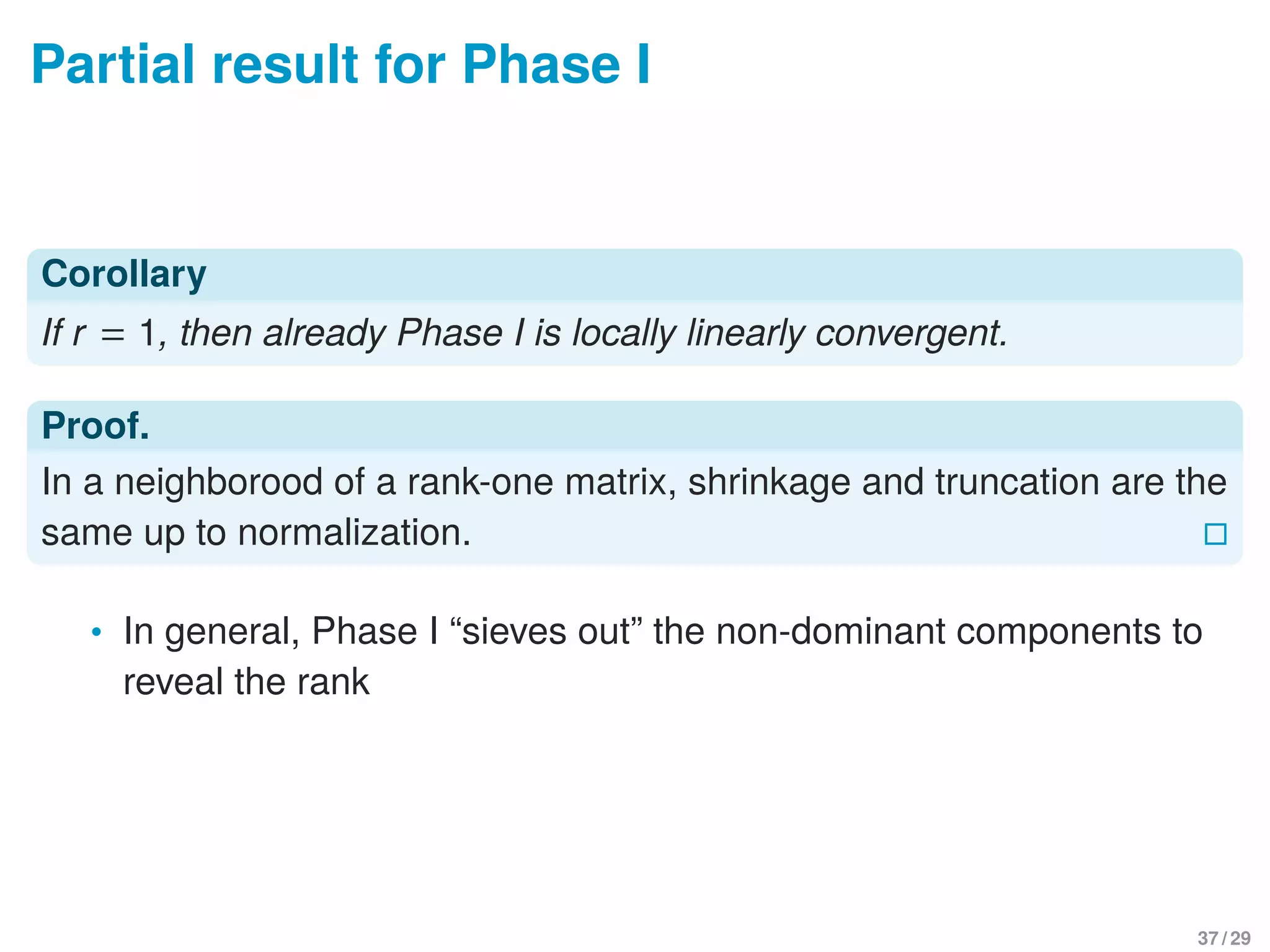
Partial result for Phase I
Corollary
If r = 1, then already Phase I is locally linearly convergent.
Proof.
In a neighborood of a rank-one matrix, shrinkage and truncation are the
same up to normalization.
• In general, Phase I “sieves out” the non-dominant components to
reveal the rank
37 / 29
String theory problem
Given A1,. . . ,Ak ∈ Rm×n
, find ci ∈ R s.t.
rank(c1A1 + c2A2 + · · · + ckAk ) < n
A1 A2 . . . Ak Q = 0, Q = [q1,. . . ,qnk−m]
• finding null vector that is rank-one when matricized
• ⇒ Lowest-rank problem from mat(q1),. . . ,mat(qnk−m) ∈ Rn×k
when rank= 1
• slow (or non-)convergence in practice
• NP-hard? probably.. but unsure (since special case)
38 / 29

The low-rank basis problem for a matrix subspace

  • 1.
    The low-rank basisproblem for a matrix subspace Tasuku Soma Univ. Tokyo Joint work with: Yuji Nakatsukasa (Univ. Tokyo) André Uschmajew (Univ. Bonn) 1 / 29
  • 2.
    1 The low-rankbasis problem 2 Algorithm 3 Convergence Guarantee 4 Experiments 2 / 29
  • 3.
    1 The low-rankbasis problem 2 Algorithm 3 Convergence Guarantee 4 Experiments 3 / 29
  • 4.
    The low-rank basisproblem Low-rank basis problem: for a matrix subspace M ⊆ Rm×n spanned by M1,. . . ,Md ∈ Rm×n , minimize rank(X1) + · · · + rank(Xd ) subject to span{X1,. . . ,Xd } = M. 4 / 29
  • 5.
    The low-rank basisproblem Low-rank basis problem: for a matrix subspace M ⊆ Rm×n spanned by M1,. . . ,Md ∈ Rm×n , minimize rank(X1) + · · · + rank(Xd ) subject to span{X1,. . . ,Xd } = M. • Generalizes the sparse basis problem: minimize x1 0 + · · · + xd 0 subject to span{x1,. . . ,xd } = S ⊆ RN . • Matrix singular values play role of vector nonzero elements 4 / 29
  • 6.
  • 7.
    Scope lowrank basis sparse basis (Coleman-Pothen86) basis problems lowrank matrix sparse vector (Qu-Sun-Wright 14) single element problems • sparse vector problem is NP-hard [Coleman-Pothen 1986] 5 / 29
  • 8.
    Scope lowrank basis sparse basis (Coleman-Pothen86) basis problems lowrank matrix sparse vector (Qu-Sun-Wright 14) single element problems • sparse vector problem is NP-hard [Coleman-Pothen 1986] • Related studies: dictionary learning [Sun-Qu-Wright 14], sparse PCA [Spielman-Wang-Wright],[Demanet-Hand 14] 5 / 29
  • 9.
    Applications • memory-efficient representationof matrix subspace • matrix compression beyond SVD • dictionary learning • string theory: rank-deficient matrix in rectangular subspace • image separation • accurate eigenvector computation • maximum-rank completion (discrete mathematics) • ... 6 / 29
  • 10.
    1 The low-rankbasis problem 2 Algorithm 3 Convergence Guarantee 4 Experiments 7 / 29
  • 11.
    Abstract greedy algorithm Algorithm1 Greedy meta-alg. for computing a low-rank basis Input: Subspace M ⊆ Rm×n of dimension d. Output: Basis B = {X∗ 1 ,. . . ,X∗ d } of M. Initialize B = ∅. for = 1,. . . ,d do Find X∗ ∈ M of lowest possible rank s.t. B ∪ {X∗} is linearly independent. B ← B ∪ {X∗} • If each step is successful, this finds the required basis! 8 / 29
  • 12.
    Greedy algorithm: lemma Lemma X∗ 1 ,.. . ,X∗ d : output of greedy algorithm. For any ∈ {1,. . . ,d} and lin. indep. {X1,. . . ,X } ⊆ M with rank(X1) ≤ · · · ≤ rank(X ), rank(Xi ) ≥ rank(X∗ i ) for i = 1,. . . , . 9 / 29
  • 13.
    Greedy algorithm: lemma Lemma X∗ 1 ,.. . ,X∗ d : output of greedy algorithm. For any ∈ {1,. . . ,d} and lin. indep. {X1,. . . ,X } ⊆ M with rank(X1) ≤ · · · ≤ rank(X ), rank(Xi ) ≥ rank(X∗ i ) for i = 1,. . . , . Proof. If rank(X ) < rank(X∗), then rank(Xi ) < rank(X∗) for i ≤ . But since one Xi must be linearly independent from X∗ 1 ,. . . ,X∗ −1 , this contradicts the choice of X∗. (Adaption of standard argument from matroid theory.) 9 / 29
  • 14.
    Greedy algorithm: justification Theorem X∗ 1 ,.. . ,X∗ d : lin. indep. output of greedy algorithm. Then {X1,. . . ,X } is of minimal rank iff rank(Xi ) = rank(X∗ i ) for i = 1,. . . , . In particular, {X∗ 1 ,. . . ,X∗} is of minimal rank. • Analogous result for sparse basis problem in [Coleman, Pothen 1986] 10 / 29
  • 15.
    The single matrixproblem minimize rank(X) subject to X ∈ M {0}. • NP-hard of course (since sparse vector is) 11 / 29
  • 16.
    The single matrixproblem minimize rank(X) subject to X ∈ M {0}. • NP-hard of course (since sparse vector is) Nuclear norm heuristic ( A ∗ := σi (A)) minimize X ∗ subject to X ∈ M, X F = 1. NOT a convex relaxation due to non-convex constraint. 11 / 29
  • 17.
    Algorithm Outline (forthe single matrix problem) Phase I: rank estimate Y = Sτ(X), X = PM (Y) PM (Y) F until rank(Y) converges Phase II: alternating projection Y = Tr (X), X = PM (Y) PM (Y) F estimated r = rank(Y) 12 / 29
  • 18.
    Algorithm Outline (forthe single matrix problem) Phase I: rank estimate Y = Sτ(X), X = PM (Y) PM (Y) F until rank(Y) converges Phase II: alternating projection Y = Tr (X), X = PM (Y) PM (Y) F estimated r = rank(Y) 12 / 29
  • 19.
    Shrinkage operator Shrinkage operator(soft thresholding) for X = UΣVT : Sτ(X) = USτ(Σ)VT , Sτ(Σ) = diag(σ1 − τ,. . . ,σrank(X) − τ)+ Fixed-point iteration Y = Sτ(X), X = PM (Y) PM (Y) F 13 / 29
  • 20.
    Shrinkage operator Shrinkage operator(soft thresholding) for X = UΣVT : Sτ(X) = USτ(Σ)VT , Sτ(Σ) = diag(σ1 − τ,. . . ,σrank(X) − τ)+ Fixed-point iteration Y = Sτ(X), X = PM (Y) PM (Y) F Interpretation: [Cai, Candes, Shen 2010], [Qu, Sun, Wright @NIPS 2014] block coordinate descent (a.k.a. alternating direction) for minimize X,Y τ Y ∗ + 1 2 Y − X 2 F subject to X ∈ M, and X F = 1, [Qu, Sun, Wright @NIPS 2014]: analogous method for sparsest vector. 13 / 29
  • 21.
    The use asa rank estimator Y = Sτ(X), X = PM (Y) PM (Y) F • The fixed point of Y would be a matrix of low-rank r, which is close to, but not in M if r > 1. • otherwise, it would be a fixed point of Y = Sτ (Y) Sτ (Y) F which can hold only for rank-one matrices. • The fixed point of X usually has full rank, and “too large“ σi 1. ⇒ Need further improvement, but accept r as rank estimate. 14 / 29
  • 22.
    Algorithm Outline (forthe single matrix problem) Phase I: rank estimate Y = Sτ(X), X = PM (Y) PM (Y) F until rank(Y) converges Phase II: alternating projection Y = Tr (X), X = PM (Y) PM (Y) F estimated r = rank(Y) 15 / 29
  • 23.
    Obtaining solution: truncationoperator Truncation operator (hard thresholding) for X = UΣVT : Tr (X) = UTr (Σ)VT , Tr (Σ) = diag(σ1,. . . ,σr,0,. . . ,0) Fixed-point iteration Y = Tr (X), X = PM (Y) PM (Y) F 16 / 29
  • 24.
    Obtaining solution: truncationoperator Truncation operator (hard thresholding) for X = UΣVT : Tr (X) = UTr (Σ)VT , Tr (Σ) = diag(σ1,. . . ,σr,0,. . . ,0) Fixed-point iteration Y = Tr (X), X = PM (Y) PM (Y) F Interpretation: alternating projection method for finding X∗ ∈ {X ∈ M : X F = 1} ∩ {Y : rank(Y) ≤ r} . 16 / 29
  • 25.
    Greedy algorithm: pseudocode Algorithm2 Greedy algorithm for computing a low-rank basis Input: Basis M1,. . . Md ∈ Rm×n for M Output: Low-rank basis X1,. . . ,Xd of M. for = 1,. . . ,d do Phase I on X , obtain rank estimate r. Phase II on X with rank r, obtain X ∈ M of rank r. • To force linear independence, restarting is sometimes necessary: X is always initialized and restarted in span{X1,. . . ,X −1}⊥ ∩ M. • Phase I output X is Phase II input 17 / 29
  • 26.
    1 The low-rankbasis problem 2 Algorithm 3 Convergence Guarantee 4 Experiments 18 / 29
  • 27.
    Observed convergence (singleinitial guess) m = 20,n = 10,d = 5, exact ranks: (1,2,3,4,5). • ranks recovered in “wrong” order (2,1,5,3,4) 19 / 29
  • 28.
    Observed convergence (severalinitial guesses) • ranks recovered in correct order 20 / 29
  • 29.
    Local convergence ofPhase II Rr := {X : rank(X) = r}, B := {X ∈ M : X F = 1} TX∗ (N ): tangent space of manifold N at X∗ Theorem Assume X∗ ∈ Tr ∩ B has rank r, input of Phase II, and TX∗ Rr ∩ TX∗ B = ∅. Then Phase II is locally linearly convergent: Xnew − X∗ F X − X∗ F cos θ 21 / 29
  • 30.
    Local convergence ofPhase II Rr := {X : rank(X) = r}, B := {X ∈ M : X F = 1} TX∗ (N ): tangent space of manifold N at X∗ Theorem Assume X∗ ∈ Tr ∩ B has rank r, input of Phase II, and TX∗ Rr ∩ TX∗ B = ∅. Then Phase II is locally linearly convergent: Xnew − X∗ F X − X∗ F cos θ • Follows from a meta-theorem on alternating projections in nonlinear optimization [Lewis, Luke, Malick 2009] • We provide “direct” linear algebra proof • Assumption holds if X∗ is isolated rank-r matrix in M 21 / 29
  • 31.
    Local convergence: intuition X∗ TX∗B TX∗ Rr cos θ ≈ 1√ 2 X∗ TX∗ B TX∗ Rr cos θ ≈ 0.9 Xnew − X∗ F X − X∗ F ≤ cos θ + O( X − X∗ 2 F ) θ ∈ (0, π 2 ]: subspace angle between TX∗ B and TX∗ Rr cos θ = max X∈TX∗ B Y∈TX∗ Rr | X,Y F | X F Y F . 22 / 29
  • 32.
    1 The low-rankbasis problem 2 Algorithm 3 Convergence Guarantee 4 Experiments 23 / 29
  • 33.
    Results for syntheticdata exact ranks av. sum(ranks) av. Phase I err (iter) av. Phase II err (iter) ( 1 , 1 , 1 , 1 , 1) 5.05 2.59e-14 (55.7) 7.03e-15 (0.4) ( 2 , 2 , 2 , 2 , 2 ) 10.02 4.04e-03 (58.4) 1.04e-14 (9.11) ( 1 , 2 , 3 , 4 , 5) 15.05 6.20e-03 (60.3) 1.38e-14 (15.8) ( 5 , 5 , 5 , 10 , 10) 35.42 1.27e-02 (64.9) 9.37e-14 (50.1) ( 5 , 5 , 10 , 10 , 15) 44.59 2.14e-02 (66.6) 3.96e-05 (107) Table: m = n = 20, d = 5, random initial guess. exact ranks av. sum (ranks) av. Phase I err (iter) av. Phase II err (iter) ( 1 , 1 , 1 , 1 , 1) 5.00 6.77e-15 (709) 6.75e-15 (0.4) ( 2 , 2 , 2 , 2 , 2) 10.00 4.04e-03 (393) 9.57e-15 (9.0) ( 1 , 2 , 3 , 4 , 5) 15.00 5.82e-03 (390) 1.37e-14 (18.5) ( 5 , 5 , 5 , 10 , 10) 35.00 1.23e-02 (550) 3.07e-14 (55.8) ( 5 , 5 , 10 , 10 , 15) 44.20 2.06e-02 (829) 8.96e-06 (227) Table: Five random initial guesses. 24 / 29
  • 34.
  • 35.
    Link to tensordecomposition Rank-one basis: M = span{a1 bT 1 ,. . . ,ad bT d } If M1,. . . ,Md is any basis, then Mk = d =1 ck, a bT (k = 1,. . . ,d) ⇐⇒ T = d =1 a ◦ b ◦ c , where T is the third-order tensor with slices M . ⇒ rank(T ) = d. Suggests finding rank-one basis using CP decomposition algorithms (ALS, Generalized Eigenvalue, ...) but CP not enough for higher-rank case 26 / 29
  • 36.
    Comparison with CPfor rank-1 basis matrix size n 100 200 300 400 500 600 700 800 900 1000 10-3 10-2 10-1 100 101 102 103 Runtime(s) Phase I Phase II Tensorlab matrix size n 100 200 300 400 500 600 700 800 900 1000 10-15 10-10 10-5 100 Error Phase I Phase II Tensorlab d = 10, varying m = n between 50 and 500. 27 / 29
  • 37.
    Comparison with CPfor rank-1 basis dimension d 2 4 6 8 10 12 14 16 18 20 10-4 10-3 10-2 10-1 100 Runtime(s) Phase I Phase II Tensorlab dimension d 2 4 6 8 10 12 14 16 18 20 10-15 10-10 10-5 100 Error Phase I Phase II Tensorlab m = n = 10, varying d between 2 and 20. 28 / 29
  • 38.
    Summary and outlook Summary •low-rank basis problem • lots of applications • NP-hard • introduced practical greedy algorithm Future work • further probabilistic analysis of Phase I • finding low-rank tensor basis 29 / 29
  • 39.
    Application: matrix compression •classical SVD compression: achieves ≈ r n compression A ≈ U Σ VT 30 / 29
  • 40.
    Application: matrix compression •classical SVD compression: achieves ≈ r n compression A ≈ U Σ VT further, suppose m = st and reshape ith column of U: ui,1 ui,2 . . . ui,s . . . ui,st → ui,1 ui,s+1 · · · ui,s(t−1)+1 . . . . . . . . . . . . ui,s ui,2s · · · ui,st ≈ Uu,i Σu,i VT u,i • Compression: ≈ r1r2 n2 , “squared” reduction 30 / 29
  • 41.
    Finding right “basis”for storage reduction U = [U1,. . . ,Ur], ideally, each column Ui = [ui,1,ui,2,. . . ,ui,st]T has low-rank structure when matricized ui,1 ui,2 . . . ui,s . . . ui,st → ui,1 ui,s+1 · · · ui,s(t−1)+1 . . . . . . . . . . . . ui,s ui,2s · · · ui,st ≈ Uu,i VT u,i for i = 1,. . . ,r • More realistically: ∃ Q ∈ Rr×r s.t. UQ has such property ⇒ finding low-rank basis for matrix subspace spanned by mat(U1),mat(U2),. . . ,mat(Ur ) 31 / 29
  • 42.
    Compressible matrices • FFTmatrix e2π ij n : each mat(column) is rank-1 • Any circulant matrix eigenspace • Graph Laplacian eigenvectors: • rank 2: ladder, circular • rank 3: binary tree, cycle, path, wheel • rank 4: lollipop • rank 5: barbell • ... ⇒ explanation is open problem, fast FFT-like algorithms? 32 / 29
  • 43.
    Eigenvectors of multipleeigenvalues A[x1,x2,. . . ,xk] = λ[x1,x2,. . . ,xk] • eigenvector x for Ax = λx is not determined uniquely + non-differentiable • numerical practice: content with computing span(x1,x2) extreme example: I, any vector is eigenvector! • but perhaps     1 ,  1  , . . . 1     is a “good” set of eigenvectors • why? low-rank, low-memory! 33 / 29
  • 44.
    Computing eigenvectors ofmultiple eigenvalues F : FFT matrix A = 1 n Fdiag(1 + ,1 + ,1 + ,1 + ,1 + ,6,. . . ,n2 )F∗ , = O(10−10 ) • cluster of five eigenvalues ≈ 1 • “exact”, low-rank eigenvectors: first five columns of F. v1 v2 v3 v4 v5 memory eig 4.2e-01 1.2e+00 1.4e+00 1.4e+00 1.5e+00 O(n2 ) eig+Alg. 2 1.2e-12 1.2e-12 1.2e-12 1.2e-12 2.7e-14 O(n) Table: Eigenvector accuracy, before and after finding low-rank basis. • MATLAB’s eig fails to find accurate eigenvectors. • accurate eigenvectors obtained by finding low-rank basis. 34 / 29
  • 45.
    Restart Algorithm 3 Restartfor linear independence Input: Orthogonal projection Q −1 onto M ∩ Span(X∗ 1 ,. . . ,X∗ −1 )⊥, cur- rent matrix X and tolerance restarttol > 0. Output: Eventually replaced X . if Q −1(X ) F < restarttol (e.g. 0.01) then Replace X by a random element in Range(Q −1). X ← X / X F • Linear dependence monitored by projected norm Q −1(X ) F 35 / 29
  • 46.
    Linear algebra convergenceproof TX∗ Rr = [U∗ U⊥ ∗ ] A B C 0 [V∗ V⊥ ∗ ]T . (1) X − X∗ = E + O( X − X∗ 2 F ) with E ∈ TX∗ B. Write E = [U∗ U⊥ ∗ ][ A B C D ][V∗ V⊥ ∗ ]T . By (1) D 2 F ≥ sin2 θ · E 2 F . ∃F,G orthogonal s.t. X = FT Σ∗ + A 0 0 D GT + O( E 2 F ). Tr (X) − X∗ F = A + Σ∗ 0 0 0 − Σ∗ −B −C CΣ−1 ∗ B F + O( E 2 F ) = A B C 0 F + O( E 2 F ). So Tr (X) − X∗ F X − X∗ F = E 2 F − D 2 F + O( X − X∗ 2 F ) E F + O( X − X∗ 2 F ) ≤ 1 − sin2 θ + O( X − X∗ 2 F ) = cos θ + O( X − X∗ 2 F ) 36 / 29
  • 47.
    Partial result forPhase I Corollary If r = 1, then already Phase I is locally linearly convergent. Proof. In a neighborood of a rank-one matrix, shrinkage and truncation are the same up to normalization. • In general, Phase I “sieves out” the non-dominant components to reveal the rank 37 / 29
  • 48.
    String theory problem GivenA1,. . . ,Ak ∈ Rm×n , find ci ∈ R s.t. rank(c1A1 + c2A2 + · · · + ckAk ) < n A1 A2 . . . Ak Q = 0, Q = [q1,. . . ,qnk−m] • finding null vector that is rank-one when matricized • ⇒ Lowest-rank problem from mat(q1),. . . ,mat(qnk−m) ∈ Rn×k when rank= 1 • slow (or non-)convergence in practice • NP-hard? probably.. but unsure (since special case) 38 / 29